A sales proposal platform and a tender-response platform may both promise faster writing, but they solve different problems. Sales tools are often strongest at branding, pricing, signatures and buyer engagement. A public-sector tender platform must also help your team find relevant opportunities, reuse verified evidence and answer scored requirements without losing compliance detail.
That distinction matters in the UK. Find a Tender became the central digital platform under the Procurement Act 2023 on 24 February 2025, with structured notices designed to be searched, reused and managed digitally through the government's central digital platform guidance. Teams still need to work across other portals, including Contracts Finder, Public Contracts Scotland and Sell2Wales, so discovery remains part of the bid workflow rather than a separate administrative task.
The comparison below looks at the work each tool helps a team complete, not a generic feature count. The benchmark is Bidwell's three-part workflow: tender monitoring, a reusable knowledge base and AI response generation. Each tool has a credible use case, but not every product is designed to carry a UK public-sector bid from opportunity discovery to cited final answer.
For a useful explanation of how AI-assisted drafting fits into the wider process, see these proposal generation features explained. The practical questions are simple: does the tool fit your workflow, can your reviewers verify its outputs, is pricing clear, and will implementation create more work than it removes?
1. Bidwell
Bidwell is built around the part of public-sector bidding that generic proposal software often misses. It combines UK tender monitoring, an evidence-led knowledge base and AI response generation, so teams can move from finding an opportunity to preparing a custom answer in one workflow.
The monitoring layer covers major UK sources, including Find a Tender, Contracts Finder, Public Contracts Scotland and Sell2Wales. That matters because UK tender monitoring is split across official portals. Find a Tender publishes above-threshold and below-threshold notices for new UK procurements, with below-threshold exceptions in Scotland, while Contracts Finder continues to cover relevant opportunities in England and other territories as the official Find a Tender search explains.
The knowledge base stores past responses, policies, case studies, accreditations and other company material in a searchable structure. AI drafting then uses that evidence to create complete tender answers in the company's voice. Citations attached to the source material give reviewers a practical way to check whether a statement is supported before it reaches the final submission.
Where Bidwell fits
Bidwell is strongest for UK SMEs and bid teams that repeatedly answer public-sector tenders. A searchable evidence base prevents writers from starting with a blank document, while matched opportunity alerts reduce the manual effort involved in checking several procurement sources.
The platform is also designed for learning between bids. Approved material can feed back into the knowledge base, giving later responses a stronger starting point. That doesn't remove human review. A bid manager still needs to check the tender question, scoring logic, delivery promise and supporting evidence.
Practical rule: Use AI to assemble and organise evidence, but keep a named reviewer responsible for every final answer.
The main limitation is its UK focus. Teams that need global tender discovery or a broad sales-proposal workflow may need another platform alongside it. Discovery and response generation are also separate parts of the product, so check which capabilities your team needs before choosing a plan.
Pros
- Public-sector discovery: Monitors major UK tender portals and helps teams identify relevant opportunities.
- Reusable evidence: Builds a searchable knowledge base from past bids, policies, credentials and case studies.
- Cited drafting: Produces customized responses with source references for reviewer verification.
- SME fit: Focuses on the practical needs of small bid teams rather than enterprise administration.
For a closer look at the platform's tender workflow, visit Bidwell's bid writing software. The product is available from Bidwell.
2. Responsive
Responsive, formerly RFPIO, is designed for organisations handling a high volume of RFPs, RFIs, DDQs, security questionnaires and formal proposals. Its centre of gravity is governed response management, not UK opportunity discovery.
The platform helps teams import questions, analyse requirements, assign work, draft answers and run quality checks. Its content library gives approved contributors a controlled source of reusable material, while permissions and workflows help managers decide who can edit, approve or publish an answer.
Responsive also has a broad integration footprint. It connects with systems such as Salesforce, Microsoft Dynamics, SharePoint, OneDrive, Teams, Slack, Box, Seismic, Highspot, Jira and Confluence through its response management platform. That makes it a serious option for larger organisations where bid content sits across several business systems.
Best use and trade-off
Responsive suits complex public-sector, enterprise and regulated bids where governance is more important than a lightweight drafting experience. Its AI capabilities can support intake, requirement analysis, drafting, quality checks and translation, but the value depends on a well-maintained content library and agreed approval process.
It doesn't provide the same UK-first tender monitoring focus as Bidwell. A team may still need a separate discovery process for Find a Tender, Contracts Finder and devolved portals. That creates an important distinction: Responsive can manage the response operation after an opportunity is identified, while Bidwell connects discovery and response preparation.
Pricing is quote-based, and implementation usually involves permissions, content migration and process design. Smaller teams may find that disproportionate to their bid volume. Larger teams may consider that effort necessary for auditability and control.
Responsive is a strong choice when several departments contribute to every answer and nobody can rely on informal document sharing.
Its optional Trust Center also supports buyer-facing access to completed questionnaires, policies and related information. That expands its role beyond internal bid writing, although it also makes the platform more dependent on good governance.
3. Loopio
Loopio is built for teams that answer the same questions repeatedly. Its strength is reusable answers and coordinated questionnaire work, rather than finding new tender opportunities or shaping every submission from a blank page.
The platform supports RFPs, RFIs, DDQs and security questionnaires. Project tools assign questions, manage reviews, send reminders and track status, giving bid managers a clear view of unanswered items and late contributors. AI-assisted drafting works from a curated content library, so contributors start with approved material instead of an empty prompt.
That approach suits recurring information-security, service-delivery and governance questions. Over time, teams can improve consistency while keeping content owners and reviewers involved. Microsoft 365 and SharePoint connectivity also helps teams reuse evidence stored in familiar internal systems through Loopio's response platform.

The workflow trade-off
Loopio fits a response operation that already has opportunities in hand. It does not replace Bidwell's tender monitoring, matching and alerting, so UK bid teams still need a process for finding and qualifying opportunities across the relevant procurement portals. Bidwell's tender monitoring, knowledge base and AI response generation cover more of the public-sector journey, while Loopio concentrates on controlled answer production.
The distinction matters for bespoke, narrative-heavy tenders. A detailed methodology or social value response may need a distinct delivery story for each buyer, whereas Loopio is strongest when questions, evidence and approvals can be reused. Its contributor controls can still help, but the team may need more editorial work to turn approved answers into a persuasive submission.
Loopio also suits organisations where content governance is the main operational problem. Owners can control reuse, and teams can connect material from Microsoft systems. That value depends on maintaining the library, permissions and review process.
Pricing is quote-based and generally aimed at mid-market or enterprise buyers. Ask how migration, permissions and integrations affect the total cost before committing. Choose Loopio for repeatable questionnaires and governed collaboration, not as a complete UK public-sector bid pipeline.
4. QorusDocs
QorusDocs is built for organisations that want to create proposals inside the Microsoft environment they already use. It works with Word, PowerPoint, Outlook, Dynamics 365, Teams and SharePoint, putting content discovery and proposal assembly close to the documents and conversations where teams already work.
That approach reduces change management. A sales or bid contributor can continue authoring in familiar Microsoft applications rather than learning a separate document editor. AI-assisted search and drafting help assemble content, while engagement analytics provide information about how recipients interact with a proposal.
The Microsoft trade-off
QorusDocs is most compelling for a business that has standardised on Microsoft 365 and Dynamics 365. Its “work where you work” model can be more important than having a standalone authoring environment, particularly when the team needs to pull approved content from SharePoint or coordinate activity through Teams.
It still isn't a dedicated UK tender discovery system. Bidwell's monitoring, matching and alerting are more directly aligned with the first stage of a public-sector bid. QorusDocs becomes more relevant after the opportunity is known, especially when the response needs to be assembled inside Word or PowerPoint.
Pricing isn't published as a simple public schedule, so a serious evaluation requires a demonstration and a discussion about licensing. Smaller teams should test whether the integration benefit justifies the procurement effort.
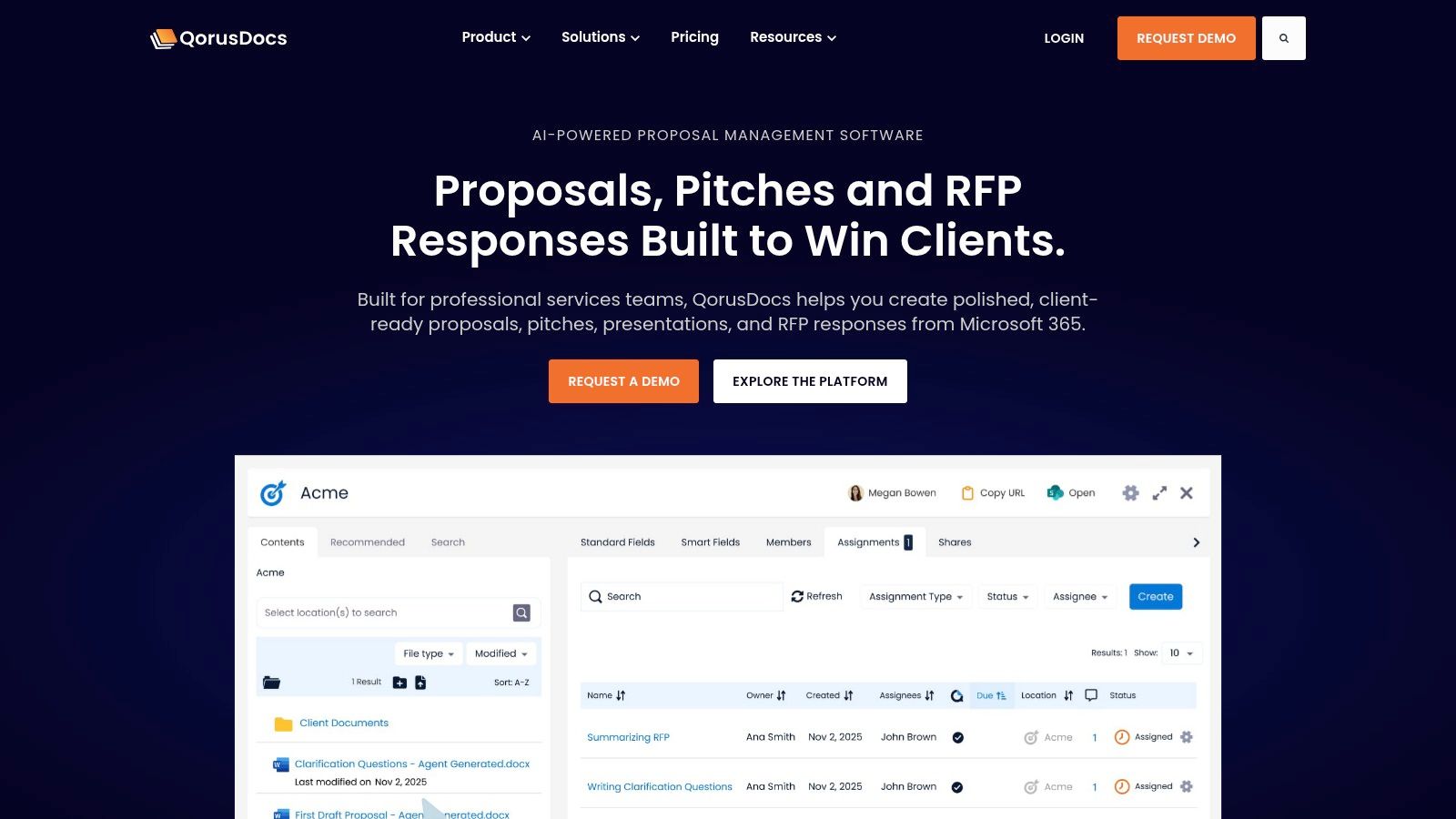
QorusDocs works well for Microsoft-led proposal operations. It works less well as a single answer to tender monitoring, evidence management and AI-generated UK tender responses. If those three tasks need to live together, Bidwell is the more focused option.
5. XaitPorter
XaitPorter suits large, structured documents that require many contributors to work in parallel. Its core role is co-authoring complex proposals and technical submissions without losing control of layout, permissions or document status.
The platform is built for long tenders with multiple sections, reviewers and approval points. Real-time editing reduces file merging, while role-based permissions control who can change specific content. Reusable material and status tracking give bid managers a consistent production process.
The main trade-off is focus. XaitPorter helps organise and produce the submission after the work is defined, but it does not replace opportunity discovery or a source-based evidence system. It is not a UK tender monitoring product, and it does not provide the same tender-specific starting point as Bidwell's monitoring, knowledge base and AI response generation.
XaitCPQ can support pricing workflows alongside the document process. That connection is useful when technical responses and commercial details must stay aligned. Teams should still check how the pricing workflow fits their existing systems and approval controls.
XaitPorter makes a practical choice when document structure, permissions and version control consume bid-team time. It is less suitable when the main delay is finding relevant UK opportunities or producing a cited first draft quickly.
The product targets mid-sized and larger teams. Pricing is custom, and implementation deserves careful review. AI assistance may support content and library work, although the platform remains centred on collaborative document production.
For a public-sector bid, the division of work is clear: XaitPorter coordinates the multi-author submission, Bidwell finds UK opportunities, organises evidence and drafts tender answers, while a sales proposal tool presents a commercial offer to a buyer. XaitPorter is therefore a weaker fit for interactive pricing, online acceptance or payment collection.
6. RocketDocs
RocketDocs is aimed at financial services, insurance and other regulated environments where response content must be controlled, reviewed and defensible. Its focus is private AI and governed answers for RFPs, DDQs, vendor-risk requests and security questionnaires.
The platform combines a managed answer library with its private AI assistant, Astro. That model is relevant when teams have strict requirements around how sensitive information is handled and who can approve generated content. Reporting and workflow controls support the audit trail that regulated organisations often need.
RocketDocs also provides material for planning enterprise AI deployments and buyer-facing guidance through its regulated response platform. Those resources are useful for teams deciding how AI should operate inside an established compliance process.
Regulated response work
RocketDocs makes more sense for a regulated response office than for a small business beginning to bid into UK public procurement. It can help manage DDQs, vendor risk and security questionnaires after an opportunity enters the pipeline, but it isn't positioned as a UK tender monitoring product.
That leaves a clear difference from Bidwell. Bidwell's knowledge base and AI response generation are closely tied to UK tender documents and public-sector evidence. RocketDocs prioritises private AI, governance and regulated response operations.
Pricing is custom and likely to suit enterprise buyers. Implementation also requires more than uploading a few documents. The organisation needs content ownership, approval rules and a policy for reviewing AI outputs.
Fluent AI text isn't proof of capability. In regulated bids, the source, approval history and accuracy of each answer matter just as much as the writing.
RocketDocs is a good fit where auditability and private processing dominate the buying decision. It is probably too narrow and heavy for an SME looking for simple UK opportunity discovery and fast tender drafting.
7. PandaDoc
PandaDoc sits on the sales and document workflow side of this comparison. It helps teams create branded proposals, quotes and contracts, then manage approvals, signatures, payments and engagement from one platform.
Its drag-and-drop editor, content library, pricing tables and quote features suit commercial proposals. Deal Rooms, bulk send, web forms and CRM integrations extend the workflow beyond document creation. Compliance support includes SOC 2, GDPR and eIDAS, with optional EU data residency described in PandaDoc's document workflow offering.
Sales proposal strength
PandaDoc is practical for a UK SME that sends branded sales proposals and needs a fast route from quote to signature. Published plans make initial evaluation easier than with quote-only enterprise tools, although advanced CPQ and governance can require higher tiers.
It isn't designed to monitor Find a Tender or Contracts Finder, build a tender evidence base or draft answers against scored public-sector questions. Teams can use it after a tender response has been approved, but it won't replace Bidwell's discovery and response workflow.
The product also favours document-based proposals rather than the most interactive web-page experiences. That can be useful where buyers expect a formal PDF or signed document, but it isn't the same experience as a buyer engagement platform built around web pages.
PandaDoc belongs on this list because proposal writing software doesn't always mean tender software. If your work is mostly quotes, statements of work, contracts and signatures, it may be a better fit than a specialist bid platform. If public procurement is the priority, compare its document workflow with Bidwell's document management system, then test both against a real tender.
8. Better Proposals
Better Proposals suits UK SMEs that need polished commercial proposals without a lengthy implementation project. It brings templates, interactive pricing tables, product catalogues, reusable content, CRM connections and electronic signatures into a workflow built for sending an offer and getting a decision.
Its strongest use case is a known buyer. A services firm can assemble a project proposal, show different options or discounts, and send it for acceptance without setting up a wider bid operation. Google Fonts and Word import give teams control over presentation, while higher tiers include simultaneous editing and approval features through Better Proposals.
The buyer is already known. Better Proposals supports a sales conversation after the opportunity has been identified. It does not monitor Find a Tender or Contracts Finder, maintain a tender evidence base, or generate cited answers against scored public-sector questions.
Presentation matters. The software works well for consultancy offers, project quotes and branded commercial documents. A clear pricing structure and acceptance route may matter more here than formal question assignment or a detailed audit trail.
The team is small. Contributors can start authoring quickly, which keeps the setup burden low. That simplicity is useful for sales teams, but it does not solve the evidence-control problems that arise when several bid contributors must work from approved, current material.
That difference separates Better Proposals from tools designed for the full public-sector bid process. Responsive and Loopio address larger RFP and DDQ governance requirements, while Bidwell combines UK tender monitoring, a knowledge base and AI response generation. Better Proposals covers the document and acceptance stage rather than discovery through submission.
Advanced permissions and approval features sit in the Enterprise tier, so check the current plan structure before committing. The platform may be easy to adopt, but ease of authoring does not replace evidence management.
For sales proposals, it can be a sensible choice when the buyer is known, the team needs speed, and tender governance is limited. For public-sector tendering, compare it with Bidwell against a real response. If discovery, reusable evidence and scored answers all matter, Better Proposals is unlikely to cover the complete workflow.
9. Qwilr
Qwilr turns proposals into secure web pages with interactive pricing, ROI calculators, embedded media, acceptance and e-signature. It is designed for a buyer-facing sales experience, not primarily for internal tender compliance.
The platform connects with Salesforce, HubSpot, Dynamics, Pipedrive and Zoho, and includes API options and AI features such as Smart Proposal Engine and AI Prefill. Engagement analytics show how recipients interact with the proposal, which can help sales teams decide when to follow up through Qwilr's proposal platform.

Where the format works
Qwilr is attractive when the proposal is part of a sales conversation. Interactive pricing, calculators and embedded content can help a buyer understand an offer without downloading a static document.
Public-sector tenders can be different. A contracting authority may require a particular response format, portal submission or PDF export. Qwilr supports exports, but a web-page-first workflow may create extra work when the buyer's instructions are document-led.
The per-document credit model also needs attention if the team sends a high volume of proposals. Ask how usage is calculated and whether the commercial model matches your proposal volume.
Qwilr doesn't replace Bidwell's tender monitoring or evidence-led drafting. It may sit later in the process, when a sales team is presenting an approved commercial offer. For a public-sector bid, the main question is not whether the page looks polished. It is whether the response answers every requirement with verified evidence and appropriate governance.
10. Proposify
Proposify is a mature platform for teams that need a central process for creating, approving and tracking commercial proposals. Its strengths are templates, permissions, approval workflows and engagement analytics.
Managers can control who edits a proposal, require approval before sending and review metrics such as opens, time on page and section engagement. Integrations with common sales tools, payments and file storage help connect proposal production with the wider sales process through Proposify's proposal software.
The final comparison
Proposify is well suited to agencies, services firms and SMEs that send proposals to known prospects. It provides more control than an informal Word-based process, especially when several people need to review branding, scope and pricing before release.
It isn't a replacement for strategic response management in a complex RFP environment. It also doesn't provide Bidwell's combination of UK tender monitoring, a reusable public-sector evidence base and AI-generated tender answers.
Pricing can change across plans, so verify current tiers, permissions and included integrations before buying. Teams should also test whether the engagement analytics are useful for their sales motion. A metric is only valuable if someone knows what action to take after seeing it.
For a broader document-production comparison, review Bidwell's document creation software package. Proposify is a credible sales workflow tool, but it belongs on the commercial proposal side of the dividing line.
Top 10 Proposal Writing Software Comparison
| Product | Core features ✨ | Target audience 👥 | Quality ★ | Pricing & value 💰 | USP / Notes 🏆 |
|---|---|---|---|---|---|
| Bidwell 🏆 | AI tender discovery + full draft generation; reusable, searchable KB; auto-cited answers; monitors major UK portals | 👥 UK SMEs & small bid teams | ★★★★★ Fast drafts; auditable outputs | 💰 KB free; Drafting £20/mo; £30/mo w/ discovery (first 3 free) | 🏆 Best for UK public sector tenders, fast, SMB-friendly, source-cited answers |
| Responsive (formerly RFPIO) | Enterprise SRM: AI intake, requirements analysis, drafting, quality checks, deep integrations | 👥 Large/regulatory bid teams & enterprises | ★★★★☆ Enterprise-grade controls | 💰 Quote-based (enterprise) | Strong governance, broad integrations for complex RFx |
| Loopio | Curated answer library, AI-assisted drafts, project workflows, MS/SharePoint connectivity | 👥 Mid-market teams handling recurring questionnaires | ★★★★☆ Easy to use; strong support | 💰 Quote-based (mid-market/enterprise) | Excellent repeatable Q&A governance and reviewer workflows |
| QorusDocs | Native MS365 authoring (Word/PowerPoint/Outlook), AI content assembly, analytics | 👥 Organisations standardized on Microsoft 365/Dynamics | ★★★★☆ Familiar in-app experience | 💰 License/demo-based; per-user options | Works where you work, low change management for MS shops |
| XaitPorter (Xait) | Real-time multi-author co-editing, workflow, content reuse, automated layout | 👥 Large teams producing long, structured proposals | ★★★★☆ Strong for complex, multi-section docs | 💰 Custom enterprise pricing | Removes formatting/version friction on big bids |
| RocketDocs | Private generative AI, governed answer library, regulated workflows & reporting | 👥 Financial services, insurance, highly regulated teams | ★★★★☆ Audit-focused & privacy-first | 💰 Custom/enterprise | Emphasis on private AI and strict compliance controls |
| PandaDoc | Drag-and-drop editor, CPQ/price tables, eSign, payments, compliance (SOC2/GDPR/eIDAS) | 👥 SMEs seeking end-to-end proposals + payments | ★★★★☆ Fast time-to-value | 💰 Transparent plans; SMB-friendly | Covers proposal → eSign → payment in one stack |
| Better Proposals | Branded proposals, interactive pricing tables, templates, content library | 👥 UK SMEs, agencies, service firms | ★★★★☆ Simple, quick authoring | 💰 Published affordable tiers | UK-friendly, minimal formatting hassle for SMBs |
| Qwilr | Web-page proposals, interactive quotes/ROI, engagement analytics, CRM integrations | 👥 Sales teams wanting polished buyer-facing proposals | ★★★★☆ Polished buyer experience | 💰 Subscription + per-document credits possible | Interactive web proposals with detailed engagement analytics |
| Proposify | Template library, approvals, roles/permissions, tracking analytics & integrations | 👥 Agencies, service firms, growing SMEs | ★★★★☆ Mature approval workflows | 💰 Published tiers; verify current plans | Strong for centralized proposal approvals and analytics |
Choose the Workflow You Actually Need
The best proposal writing software depends on where your work starts. If your team begins with a known prospect and ends with a branded document, signature or payment, PandaDoc, Better Proposals, Qwilr and Proposify deserve attention. Their strengths are presentation, commercial structure, approvals, buyer engagement and sales follow-up.
Public-sector tendering begins earlier. You need to find relevant notices, decide whether the opportunity fits, interpret requirements, assemble evidence and answer questions against a scoring framework. Find a Tender is free to use and works alongside Contracts Finder, Public Contracts Scotland, Sell2Wales and eTendersNI, so a single manual search routine can quickly become fragmented across the UK procurement guidance.
Choose Bidwell when the priority is finding UK public-sector opportunities, building a reusable evidence base and generating cited tender answers. Its three-part workflow is the closest match for an SME that wants tender monitoring, a knowledge base and AI response generation in the same operating process.
Responsive and Loopio make more sense for established response teams that need governed content libraries, assignments, approvals and questionnaire management at scale. QorusDocs is the natural candidate for organisations committed to Microsoft 365, Dynamics 365 and SharePoint workflows. XaitPorter is better suited to long, technically complex documents with many contributors and difficult version control. RocketDocs belongs on the shortlist for heavily regulated responses where private AI and auditability are central.
That split also explains why generic feature comparisons are often misleading. A product may have AI drafting, but not source citations. It may have templates, but not tender discovery. It may offer signatures and engagement analytics, but no useful way to answer a scored requirement.
Before signing a contract, test a representative piece of work rather than a polished demonstration. Upload a real tender or proposal, ask the tool to identify requirements, check how it uses source material and review the final output against the original questions.
Use this evaluation sequence:
- Test evidence handling: Can reviewers see where each important claim came from?
- Test workflow ownership: Can a bid manager assign, review, approve and lock responses?
- Test discovery: Does the product monitor the UK portals your team uses?
- Test implementation: Can your team import existing bids and organise them without creating a second content-admin job?
- Test commercial fit: Confirm current pricing, permissions, user limits, integrations and data-residency options.
- Test human review: Make sure the workflow keeps a named person responsible for the final submission.
AI can produce fluent text, but fluent text isn't proof that a supplier can deliver. UK procurement coverage has warned that increased AI-generated bid volume may also bring more clarification questions and require greater evaluator due diligence in this analysis of AI bid writing in UK government procurement. Your software should therefore help people verify claims, not just make answers sound finished.
The right choice may also be a combination of tools. Bidwell can handle UK opportunity discovery, evidence reuse and tender drafting, while a sales platform can manage a later commercial proposal or signature workflow. Responsive, Loopio, QorusDocs, XaitPorter and RocketDocs can provide deeper governance where the organisation has the volume and implementation capacity to support them.
A good final test is whether the team can explain why it selected the product. If the answer is only “the AI writes quickly”, keep evaluating. If the answer is that the platform finds the right work, reuses verified evidence, assigns responsibility and makes review safer, you're choosing software for the bid process rather than for the blank page.
Pricing and features of workflow software should be assessed in the same practical way. Compare the complete workflow, not just the licence price or the number of AI buttons.
Bidwell combines UK tender monitoring, a searchable knowledge base and cited AI response generation for teams bidding into public-sector contracts. Test it against a representative tender and see whether your writers can move from opportunity to verified first draft with less manual work. Visit Bidwell to explore the platform.