
AI bid writing software reads the tender notice, pulls evidence from your company records and drafts a response. Your team reviews that draft before anything goes out the door. Responsibility for the final bid stays exactly where it should: with you.
What AI Bid Writing Software Actually Does
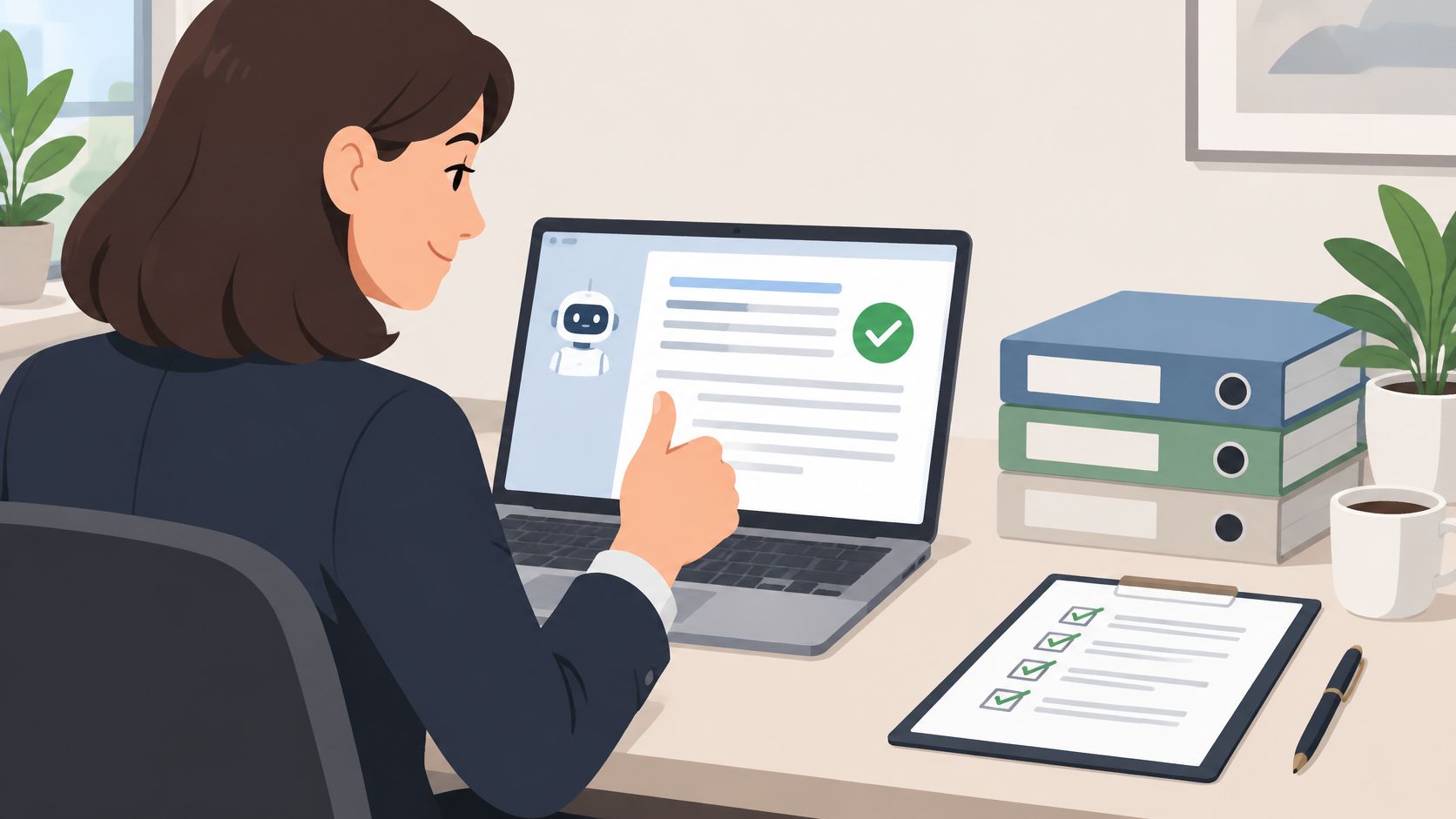
The easiest way to picture it: a junior bid writer who's memorised every submission you've ever made. They're quick at pulling a first pass together. They still need a senior pair of eyes on every line before it goes near the buyer.
Bidwell writes each new bid against the actual tender notice, not a generic template, and the first draft comes back in minutes. That's a starting point for review. It isn't permission to submit unchecked.
The human owns the submission. Software drafts; your team checks, approves and signs.
Under the bonnet, the software connects three jobs that normally live across browser tabs, shared folders and half-finished documents:
- Tender monitoring watches the portals and surfaces opportunities your team can assess.
- Knowledge base holds your company evidence: case studies, methodologies, team biographies.
- AI response generation draws on that evidence to prepare answers to the tender in front of you.
Together, they hand the reviewer something concrete to improve. That beats a blank page every time.
Keep Evidence and Judgement Together
Say a buyer asks how you'll manage service interruptions. Your knowledge base might hold a previous support contract, an escalation procedure and biographies for the proposed delivery team.
The draft pulls those bits together. Your job is checking they still hold true. Is the procedure current? Are the named people actually available? Can you hit the response times you're promising?
- Check the evidence against current company records.
- Check the answer against the question being scored.
- Approve commitments only when your team can deliver them.
For a parallel outside bidding, look at AI-assisted legal document drafting, where the same rule applies: the machine drafts, a human verifies the sources.
The quickest way to see the split is to walk a bid stage by stage. Some work sits with the software. The rest sits with your business, and no tool can take it off your hands.
What the Software Handles and What Your Team Still Owns
| Bid Stage | Handled By | What Good Looks Like |
|---|---|---|
| Portal searching | Software | Relevant opportunities surfaced |
| Evidence retrieval | Software | Company records inform answers |
| First drafting | Software | Notice-specific response prepared |
| Factual accuracy checks | Your team | Every claim verified |
| Pricing decisions | Your team | Deliverable commercial commitments |
| Compliance checks | Your team | Requirements checked individually |
| Final sign-off | Your team | Authorised human approval |
Notice the pattern. The software does the searching, fetching and first-pass writing. Anything that commits your business — facts, price, compliance, approval — stays in human hands.
Want to see it for yourself? Pick one tender question from a live bid and compare the draft against your evidence. That ten-minute exercise tells you more than any feature list.

Start with the numbers. UK public-sector procurement reached £395 billion in 2024/25, and SMEs made up 72% of suppliers on CCS commercial agreements: 37% microbusinesses, 23% small businesses and 12% medium-sized businesses. Read the full research on UK public-sector procurement and SME suppliers.
So access isn't the real barrier for smaller firms. The constraint sits inside the business.
The Hidden Cost of Every Opportunity
A tender costs money before you draft a sentence. Someone reads the notice, maps evidence to the scored questions, writes method statements, shapes the commercial response and checks compliance line by line.
For a 12-person IT services firm, that cost lands hard. If the bid manager also runs operations, every hour on a tender is an hour taken from client delivery. Three days on one bid can mean three days of project work slipping.
Costly preparation changes behaviour. Teams bid less, and they pick the safest bids.
The Go/No-Go Squeeze
That's the squeeze. Firms with pricey preparation tend to stick to a small set of familiar tenders each year. They pass on contracts they could deliver because the effort can't be justified before the deadline.
The loss rarely shows up anywhere. The opportunity is never weighed against capability. It's weighed against spare hours.
This isn't a case for chasing everything. It's a case for making more suitable bids reachable. If you could credibly win six contracts a year and only attempt two, your own process is doing the rationing.
Where the Three Features Come In
Used well, AI bid writing software cuts that preparation cost. Bidwell's three core features go straight at the work that makes bidding expensive:
- Tender monitoring surfaces more relevant notices, rather than leaving you dependent on whatever reaches the inbox.
- The knowledge base ends the blank-page search. Case studies and methodologies sit organised and ready to reuse.
- AI response generation creates a first pass in minutes, shifting your time from assembly to judgement.
For the 12-person firm, the change is practical. The operations lead stops acting like a typist and starts acting like a reviewer. They're checking evidence, risk and pricing rather than rebuilding documents.
That rewrites the go/no-go maths. A bid that needs two hours of review instead of twenty hours of writing makes smaller contracts worth another look.
If that squeeze sounds familiar, read our guide on how Bidwell supports SME owners. Next, we'll look at how the three features work as one workflow.
The real value sits in how the parts connect. AI bid writing software works best when the opportunity, your supporting evidence and the draft response stay linked from start to finish.
How Tender Monitoring, Knowledge Bases and AI Drafting Fit Together
Bidwell begins with tender monitoring across Find a Tender, Contracts Finder, Public Contracts Scotland and Sell2Wales. Daily alerts include AI-generated summaries, so you can assess what matters without starting the week by checking four separate portals.
When a suitable opportunity appears, the process moves into your knowledge base. Think of it as a shared drive with proper structure. The AI can find and use the material, rather than relying on folders that only make sense to your longest-serving colleague.
A useful knowledge base usually contains:
- Case studies and methodologies showing what you've delivered and how you work.
- Team biographies and accreditations supporting claims about your people and credentials.
- Past answers that provide reusable explanations, checked against the current requirement.
Add this material once, then draw on it across multiple bids. That's far better than hunting for the same attachments every time another deadline appears.
Connect Stored Evidence to Scored Questions
Good organisation makes that reuse possible. Give files clear names, remove outdated versions and separate proven delivery experience from proposed approaches before you ask the AI to draft.
For practical guidance on organising company information so people can find and maintain it, read this guide to building a user-focused knowledge base. The goal is usable evidence, rather than simply a larger document library.
The tender notice sets the test. Your knowledge base holds the proof. AI response generation brings the two together.
Bidwell drafts against the actual tender notice, mapping stored evidence to the evaluation questions and creating a first version specific to that opportunity. It does more than retrieve an old answer and swap in a new buyer name.
The diagram below shows the three connected stages, along with the feedback loop that returns successful bid content to the evidence library.
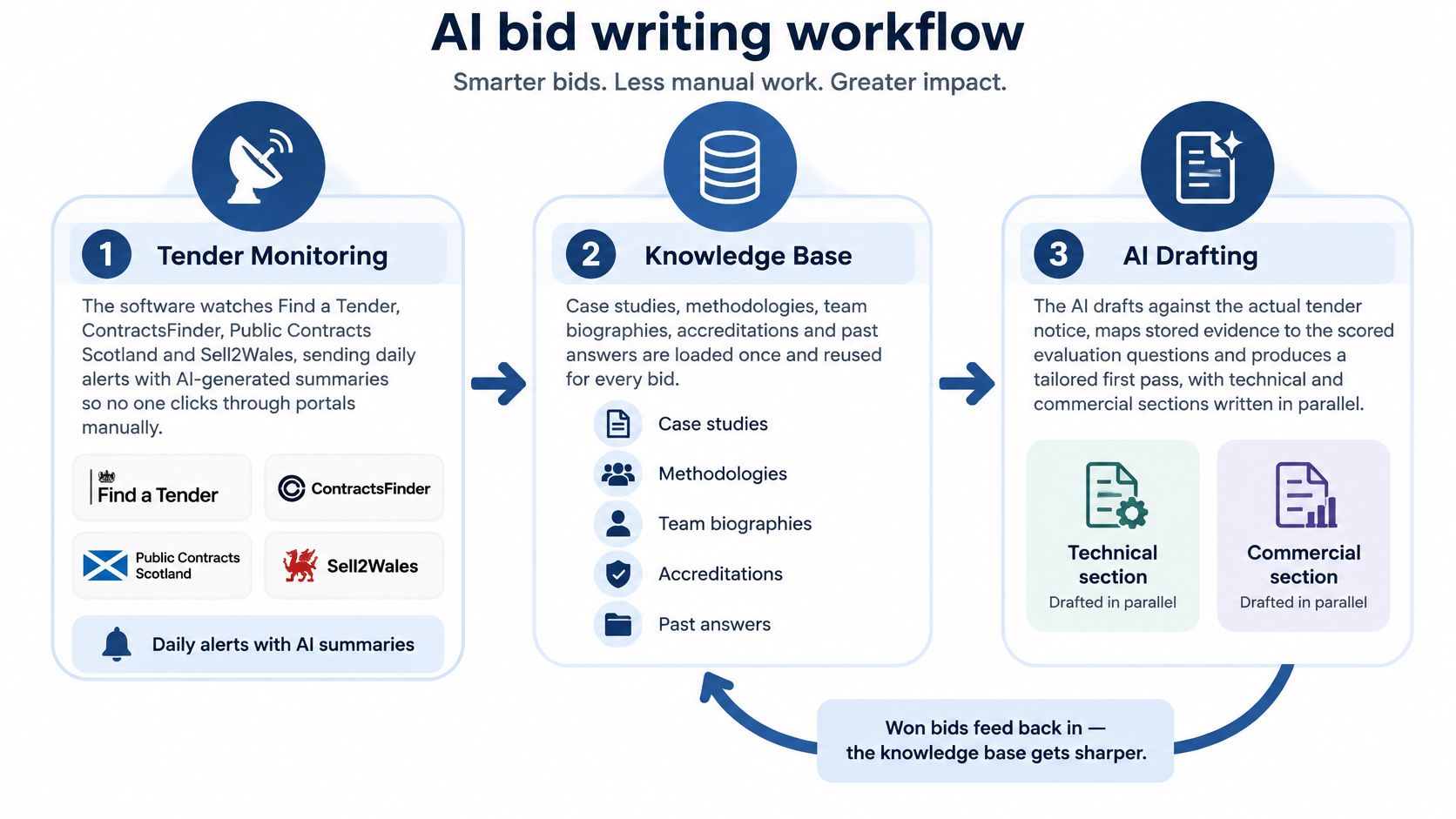
The important point is continuity. Monitoring finds the opportunity, stored evidence supports the response and approved winning content becomes material for future bids.
Follow an IT Services Bid Through the Workflow
Imagine an IT services SME assessing an RM6178 Network Services 3 requirement. Its knowledge base already holds a network migration case study, a service management methodology and biographies for the proposed engineers.
Once you've assessed the notice, you can use that evidence to generate the response. Bidwell drafts the technical and commercial sections in parallel, though each needs a different register.
- Technical response explains the delivery approach, using the migration methodology to cover sequencing, testing and service continuity.
- Commercial response explains the delivery assumptions behind the offer, drawing on the same evidence without inventing prices or commitments.
A staged migration, for example, might support both the technical implementation plan and the commercial explanation of phased delivery. You then check that both sections describe the same service.
Most Bidwell IT services customers are bid managers. As won bids are added back in, the knowledge base improves through more relevant, reviewed examples. That doesn't automatically prove every older answer is still current.
Pick one relevant notice and trace a scored question back to your evidence before you generate the first draft.
A slick demo proves very little. The only way to evaluate AI bid writing software properly is to run your own tender documents through it. Make the supplier show you how it reached its answers, not just the polished output.
What to Look for When Evaluating AI Bid Writing Tools
Treat the demo like an audition. You're answering one simple question: can this software work with your evidence, follow the buyer's instructions, and hand your team a draft they can confidently sign off?
Take these five questions into every supplier conversation. Run the same documents through each tool so the comparison stays fair.
- Does it follow the actual notice? Pick a scored question and ask which requirement the answer addresses. Then ask for the supporting evidence.
- How does it ingest company knowledge? Upload a real case study and a real methodology. If the draft keeps your facts intact, that's a good sign. If it pads answers with plausible-sounding filler, walk away.
- Who reviews and approves it? A named person should check, edit and approve every word. If ownership looks fuzzy in the demo, it'll be fuzzy in production.
- Does it cover the whole process? You want tender monitoring and evidence management alongside drafting. A text generator alone won't fix your pipeline.
- What time does it actually save? Ask for hours. Preparation, checking and rewriting all count. "Faster" isn't a number.
Evaluation Criteria for AI Bid Writing Software
Keep this table open during the demonstration. Treat every answer as something to verify during a trial.
| Criterion | Question to Ask | Warning Sign | What to Test |
|---|---|---|---|
| Notice alignment | Which requirement informs this answer? | Generic template | Trace one scored question |
| Knowledge base | Which document supports this claim? | Invented detail | Upload your methodology |
| Review | Who approves the wording? | Unclear ownership | Complete a named review |
| Coverage | Are monitoring and evidence included? | Drafting alone | Follow one opportunity |
| Time | How many hours remain? | Adjectives without measurements | Record total effort |
With Bidwell, keep tender monitoring, the knowledge base and AI response generation in the same assessment. A useful trial tests how those pieces connect. Judging the drafting on its own misses the point.
Measure the work left for your team, not simply how quickly words appear.
Run a Trial Your Team Can Judge
Smaller firms often need more convincing, and the numbers back that up. Government research put AI adoption at 15% of small companies, 34% of medium-sized companies and 68% of large companies. Read the government's AI adoption findings.
That gap doesn't prove smaller businesses have nothing to gain. It's a sign that confidence and implementation deserve real attention.
- Bring one real notice with its scoring criteria.
- Use one real knowledge base containing approved evidence.
- Complete one honest review, recording corrections and hours.
Before your next demo, shortlist your options with Bidwell's alternatives comparison, then ask each supplier to run the same trial with your reviewer in the room.
AI bid writing software can help you prepare, but responsibility for the offer stays with you. The useful question is where its work stops and yours begins.
Common Concerns And Honest Limitations
Will evaluators notice AI drafting? A properly reviewed answer should sound like your business, read with your evidence, and carry your delivery detail. Add project specifics, named people and practical points such as who handles an escalation and what happens if they're away.
Does it guarantee wins? No. Stronger writing can't fix a weak delivery model, missing accreditations or pricing that won't compete. Bidwell's tender monitoring can surface opportunities, but your team still has to judge whether the contract is genuinely within reach.
Treat the draft as a working document, with approval still owned by people who can deliver the work.
What about commercially sensitive material? Before pricing, client records or proprietary methods go into the knowledge base, ask about data isolation, access controls and retention. These are practical checks, and they deserve direct answers rather than assumptions from a demo.
- Ask who can access uploaded documents and generated responses.
- Confirm how long information stays stored and how deletion works.
- Request written answers before sharing commercially sensitive evidence.
Make Expert Review Part Of The Workflow
Can it cope with framework complexity? Bidwell can draft technical and commercial responses in parallel for RM6178 Network Services 3 bids, but subject-matter experts still need to check accuracy. Check that delivery assumptions agree across both sections, because an answer that reads well on its own can still clash with the rest of the submission.
What if a draft is wrong? Fix it before approval, then check whether the underlying evidence also needs updating. A mistaken staffing claim needs checking against current availability, since a smoother sentence can still carry the same error.
For a practical review, give each commitment an owner:
- Technical lead checks methods, dependencies and delivery promises.
- Commercial lead checks prices, assumptions and exclusions.
- Bid manager checks the response against the buyer's requirements.
That split keeps responsibility visible when several colleagues are contributing under pressure. It also gives reviewers a clear reason to challenge confident wording that lacks evidence behind it.
The approval boundary is explicit: Bidwell drafts the bid, the customer reviews and approves every word, and a human always signs before submission. Read about Bidwell's approach to tender responses.
Think drafting capacity, with bid expertise supplied by your team. Bid managers, SME owners, bid writers and BD directors use Bidwell's tender monitoring, knowledge base and AI response generation. Bring one difficult question to your next review and assign its expert owner.
Start your first AI bid writing software trial on a manageable opportunity. Leave the big renewal alone. This week, complete one cycle and find out where your evidence is thin.
Getting Started with Your First AI-Assisted Bid
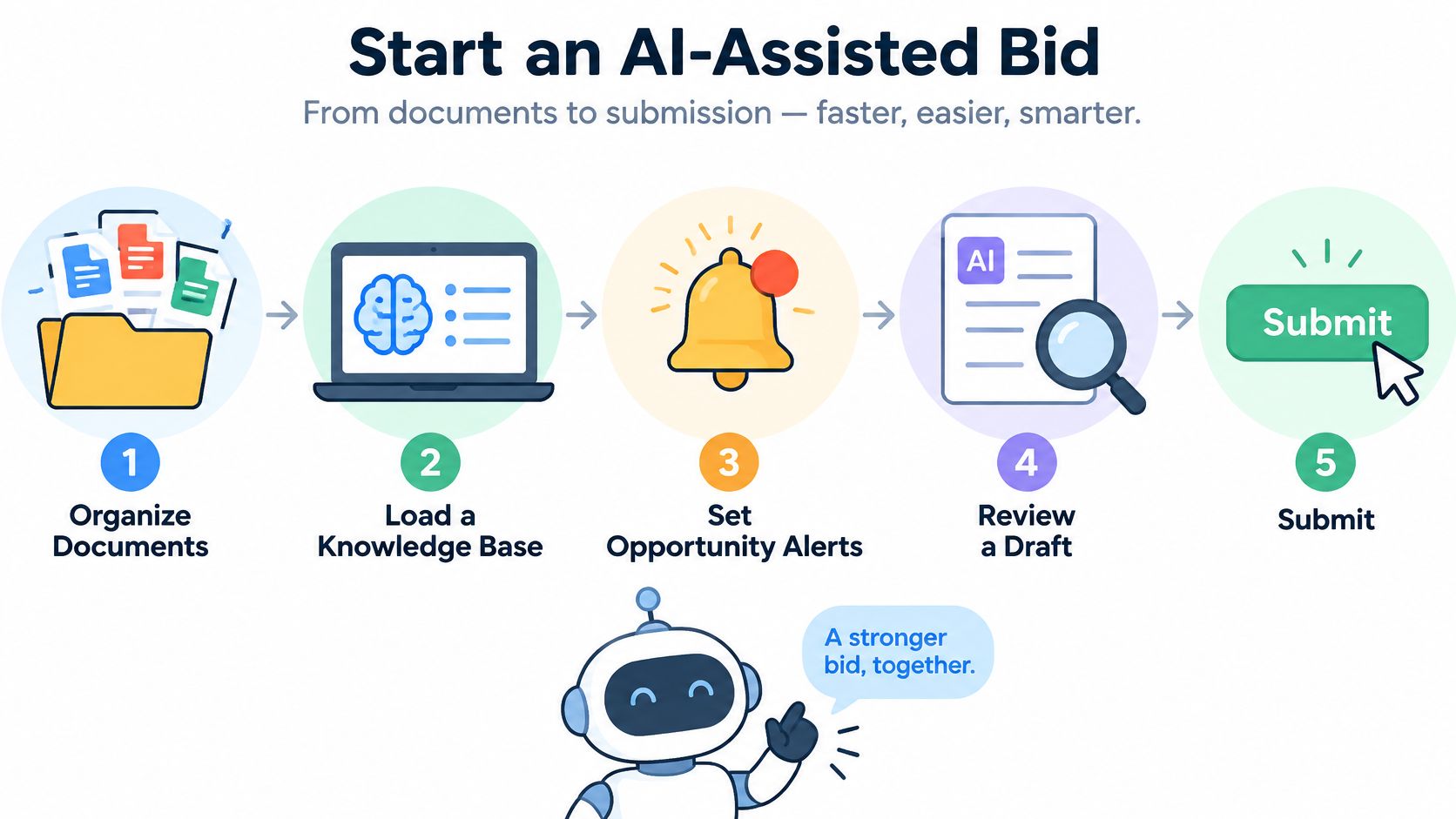
Before you commit, run Bidwell's three free diagnostics: the Tender readiness checker, Framework eligibility tool and Cost-to-respond estimator. Use them as a reality check on readiness, qualification and effort. They should help you decide whether to bid, not push you into one.
- Gather your strongest evidence. Pull together case studies, methodology documents, team biographies and answers that have scored well before. Pick examples that show delivery, not descriptions of services.
- Load your knowledge base. Bidwell's set-up takes about 15 minutes. Before drafting, check the uploaded material still matches your current people, processes and credentials.
- Tighten tender monitoring filters. Set alerts around contracts you can actually deliver. A regional IT support firm, for instance, should watch relevant services and locations instead of every technology notice.
Treat this like packing a toolbox. If evidence is missing, the drafter starts without the materials needed to explain your approach convincingly.
Complete the Cycle and Measure the Work
- Run one low-stakes bid. Choose a suitable notice, use AI response generation, then review, refine and submit after approval. Give this first attempt extra review time.
- Record the actual effort. Compare the hours with your normal process. Mark answers that needed heavy rewriting, then fix the knowledge base entries behind them before the next bid.
Bidwell's stated comparison is 20–40 hours of conventional writing and coordination versus roughly 2–4 hours of review and refinement, with drafts returned in minutes and complete responses developed in hours rather than weeks. Treat those figures as benchmarks, not guarantees. For wider procurement context, read the government’s SME action plan.
Judge the trial by total human effort, not drafting speed alone.
- Record time spent checking evidence.
- Separate factual corrections from stylistic edits.
- Note missing delivery examples.
By the third or fourth bid, the work should feel noticeably quicker as your evidence improves. Pick your pilot notice today, assign its reviewer, and follow Bidwell’s tender response workflow from monitoring through approval.
Practical questions matter when you're choosing software for your team.
Frequently Asked Questions About AI Bid Writing Software
Does It Work for Specialist Sectors Like Construction or Healthcare?
That comes down to your evidence. Give AI response generation sector-specific material to work with — case studies, methodologies, your construction site inspection process or healthcare mobilisation plan — and it's got something real to build on.
Thin evidence produces thin answers, regardless of the sector.
How Do I Compare the Cost Against Hiring a Bid Writer?
Work out the hours saved per bid at your internal hourly rate, review time included, and set that against the subscription. Then look honestly at how many extra suitable opportunities tender monitoring could surface that you'd genuinely pursue. More bids doesn't automatically mean more wins, so keep that assumption out of the maths.
- Saving ten hours at £40 per hour frees up £400 of internal capacity — useful, but not the same as cash in the bank.
- A bid writer brings strategic input that software won't, so compare what each actually does rather than price alone.
Do I Need Technical Skills?
Not for day-to-day use, and no coding is involved. Bidwell is built for bid managers and SME owners, with 15-minute set-up, so ask to see uploading evidence and configuring alerts demonstrated live before you commit.
What Happens to My Knowledge Base if I Leave?
Sort this out before you upload a single document. Your knowledge base is a business asset, so confirm the export formats are usable, whether there are charges for getting your data out, and when retained copies get deleted.
Bring one notice and your strongest evidence to Bidwell. Run tender monitoring, the knowledge base and AI response generation together, and record how much review effort the output needs before deciding.

