
Tender is the correct British spelling; tendor is a misspelling, not a recognised UK procurement term. Could a spelling mistake stop your team finding a contract before anyone gets the chance to write a good bid?
It can create that risk when you use it in saved searches, folder names or reusable answers. The problem isn't just how a document looks. It's whether your team finds the right notice, files the right evidence and submits wording that answers the buyer's question.
Tender or Tendor at a Glance
Tender is correct. Tendor isn't a UK procurement term.
Tender, tendor and the phrases buyers use
| Form | Status | Where it appears | What to do |
|---|---|---|---|
| tender | Correct British English | Find a Tender, bid documents, contract notices | Use this spelling in searches and responses |
| tendor | Misspelling, not a procurement term | Typos and unrelated brand names | Don't use it in official searches or bids |
| invitation to tender (ITT) | Formal document name | Notice types and buyer packs | Search and cite this phrase |
| competitive tendering | Name of the bidding process | Procedures and evaluation rules | Use it when describing the process |
The official terminology is easy to check. The Find a Tender notice types use tender and related language for invitations and requests to participate in competitive procedures.
A tender can be the supplier's formal offer of goods, works or services. It's also a verb describing the act of submitting that offer. Neither use takes an “o” at the end.
An invitation to tender, usually shortened to ITT, is the buyer's invitation and associated pack. You'll normally use it to locate the questions, timetable, submission instructions and scoring information. Competitive tendering describes the process, rather than your individual response.
Use the buyer's vocabulary
Searching for tendor Buckinghamshire Council won't reliably surface a live notice. Searching for tender Buckinghamshire Council uses the spelling a buyer is likely to publish, although you should also search by service, buyer name and contract reference.
Don't assume a search engine's spelling correction will rescue every search. A portal search, an exact-match filter and your team's document search may handle the same typo differently.
Practical rule: Copy the buyer's terminology into your working notes before creating searches or response headings.
Start with the places where an error gets reused:
- Saved searches: Replace the misspelling and check that the results include relevant procurement notices.
- File names: Use tender alongside the buyer name, service and contract reference.
- Approved wording: Keep the correct phrases in the knowledge base, rather than copying whichever old draft is easiest to find.
Correct the first line of a draft before anyone worries about scores. That gives later writers and reviewers a clean starting point, and prevents AI response generation from reproducing a mistake embedded in past material.
Other Meanings That Are Not a Bid
A search result can use the correct spelling and still have nothing to do with procurement. Tender has several ordinary meanings, so the surrounding words matter.
Legal tender concerns payment and the settlement of debts, including the relevant rules for Bank of England notes. It doesn't mean every shop must accept every banknote, and it has nothing to do with submitting an offer for a council contract.
Tender can also describe a gentle tone or food that's soft enough to cut easily. In other settings, a tender is a small boat serving a larger vessel, or a railway vehicle carrying fuel and water.
Try the formal-offer test
Replace the word tender with formal offer to supply. If the sentence still makes sense, you're probably reading the procurement meaning.
“The council will assess our formal offer to supply” works. “The chef cooked a formal offer to supply steak” doesn't. You don't need a long dictionary entry to tell those uses apart.
If the sentence only makes sense with cash, texture or a vehicle, it isn't describing your procurement response.
There's a useful distinction within procurement too. A buyer asking for tender documents may mean the response forms, while a colleague discussing the tender pack may mean all the documents issued by the authority. Check the document label rather than assuming both people mean the same file.
Answer the requirement, not the dictionary
Don't put a list of meanings into a bid to look thorough. An evaluator assessing mobilisation needs to understand your dates, staffing and handover arrangements.
Consider a hypothetical cleaning contract:
| Opening | What the evaluator gets |
|---|---|
| Weak: A tender is a formal offer to provide services. | A definition, but no delivery information |
| Strong: Our response covers the office-cleaning lot. Our contract manager will lead mobilisation, and we'll track site readiness against the agreed start date. | Scope, ownership and a measure of progress |
The stronger opening gives the buyer something relevant to assess. You can then explain staff allocation, equipment checks and the opening-week schedule.
For tender monitoring, pair the word with a procurement phrase, service description or buyer name so alerts don't fill with dictionary noise. Keep a short vocabulary note in the knowledge base, including approved document names and abbreviations.
When a phrase feels unfamiliar, return to the notice's own heading and instructions. Those tell you what the buyer expects in that competition, which is more useful than collecting every possible meaning of the word.
What Tender Means on a UK Contract
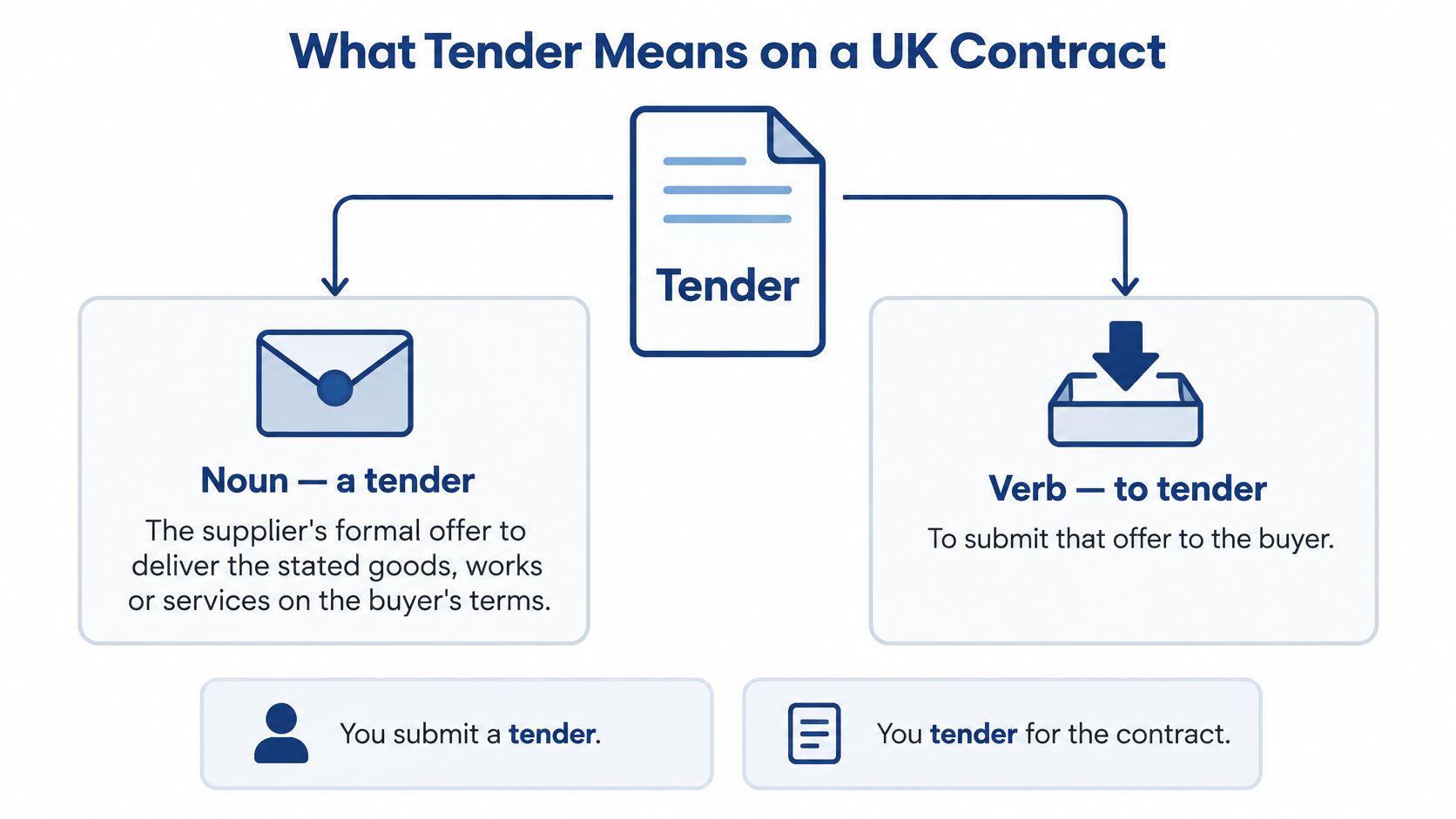
What does “tender” mean in a UK contract? It's your formal offer to deliver the stated goods, works or services on the buyer's terms. It explains what you'll provide, how you'll provide it and the commercial basis of your offer.
You submit a tender or tender for a cleaning contract. The word works as both a noun and a verb.
Build the offer around the scoring rules
Your response needs to answer the buyer's published criteria. Under section 23 of the Procurement Act 2023, award criteria must relate to the contract, be clear, measurable and specific, comply with technical-specification rules, and be proportionate to the contract's nature, complexity and cost.
The authority must publish its assessment methodology, including whether failing a criterion could disqualify a tender. If several criteria apply, their relative importance must be shown through percentage weightings, ranking or another permitted method.
So the most advantageous tender isn't necessarily the cheapest. The buyer assesses how well each offer meets the requirements against the published criteria and methodology.
Read the question and its scoring descriptors together. If it asks how you'll maintain service continuity, company history helps only when it shows you can keep that particular service running.
Make each promise traceable
For a hypothetical cleaning procurement, a small compliance map could look like this:
| Response element | Working note |
|---|---|
| Criterion | Maintain service continuity during staff absence |
| Evidence | Approved case study describing cover arrangements on a comparable contract |
| Proposed action | Maintain a trained relief team and an escalation rota |
| Measurable result | Record uncovered shifts and report performance against the buyer's required target |
| Pass/fail check | Confirm whether the pack makes a minimum staffing commitment mandatory |
Don't invent a performance figure to make an answer sound stronger. Use a verified result from your evidence, or make a delivery commitment your operations team has approved.
The same principle applies when preparing questions for specialist suppliers. You can compare teleoperation data suppliers, while keeping the tender response focused on the authority's own requirements.
For the response workflow, Bidwell's guide to working on tenders offers a relevant starting point. Keep the live requirement separate from reusable evidence, then connect them explicitly in your answer.
Clear headings and cited evidence help evaluators find the proposed action, check the supporting experience and understand what you're committing to deliver.
Which Portal Publishes the Tender
Which portal should you check for a UK tender? Start with the buyer's location and the live notice. A search limited to one portal can miss opportunities, just as searching for “tendor” instead of “tender” can hide a notice from your results.
Where a UK tender notice is published
| Channel | What it covers | Value clue | Rule to remember |
|---|---|---|---|
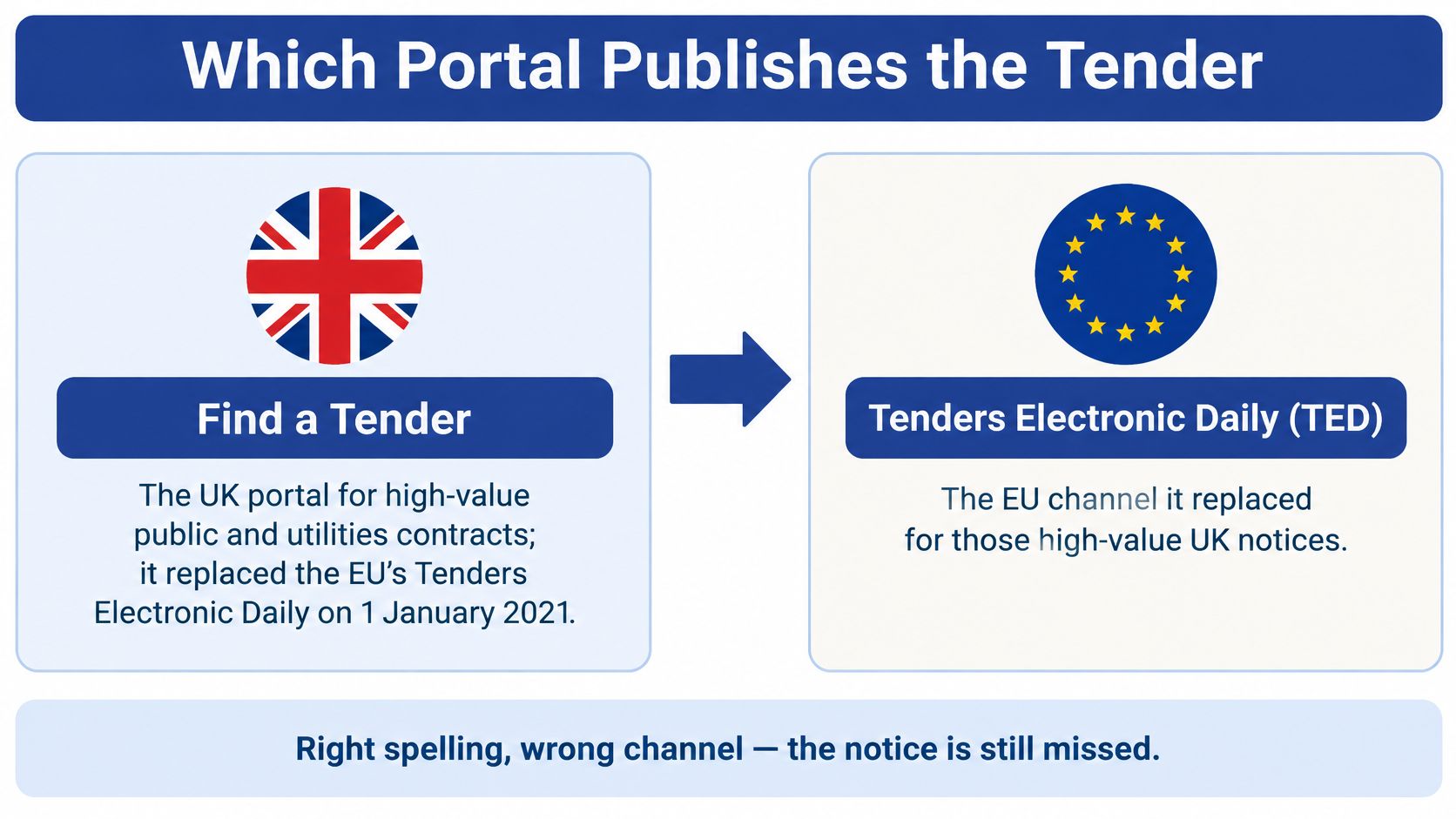
| Find a Tender | High-value UK public and utilities contracts, notices and awards | Older guidance generally used above £139,688 including VAT; check the applicable current threshold | Replaced TED on 1 January 2021; notices generally go here only for procurements commenced from 24 February 2025 |
| Contracts Finder | Lower-value opportunities in England and wider procurement information | Below-threshold value limits applied under previous rules | Not required for Procurement Act 2023 procurements commenced from 24 February 2025 |
| Public Contracts Scotland | Scottish public-sector opportunities | Scotland's own threshold and publication rules apply; the live notice confirms the route | Separate national portal, not covered by an England-only search |
| Sell2Wales | Welsh public-sector opportunities | Wales's own threshold and publication rules apply; the live notice confirms the route | Separate national portal, not covered by an England-only search |
The historical transition and threshold context in government procurement guidance identify 1 January 2021 as the replacement of the EU's Tenders Electronic Daily by Find a Tender for high-value UK notices. Older guidance gives £139,688 including VAT as a general threshold. That figure isn't a safe current cut-off: thresholds change and differ by category.
The government's Contracts Finder transparency guidance explains that, for procurements commenced from 24 February 2025, notices generally only need publication on Find a Tender. The Procurement Act doesn't require publication on Contracts Finder.
Understand the change before narrowing your search
Under the previous rules, most above-threshold opportunities needed publication on both Find a Tender and Contracts Finder, with Find a Tender first. Relevant below-threshold opportunities also needed Contracts Finder publication, subject to applicable value limits, as set out in the government's Contracts Finder transparency guidance.
That history explains why older guidance and current notices can appear to give different answers. Check when the procurement commenced, not merely when you found a document.
Choose the channel, then inspect the notice
Before setting alerts, identify the buyer's location and the nation's arrangements. Then search the relevant service using terms such as “tender,” “invitation to tender,” the buyer's name and the service description.
A broad monitoring routine should include Find a Tender, Contracts Finder, Public Contracts Scotland and Sell2Wales. For Northern Ireland, include eTendersNI too. Bidwell's Buckinghamshire Council e-tendering guide offers a buyer-specific starting point. Follow the live notice for the submission route, registration requirements and attachments.
A search term is only the first filter. Confirm the route and requirements in the notice itself, and keep portal guidance dated so an old publication assumption doesn't shape a new search.
Phrases You Will See on the Notice
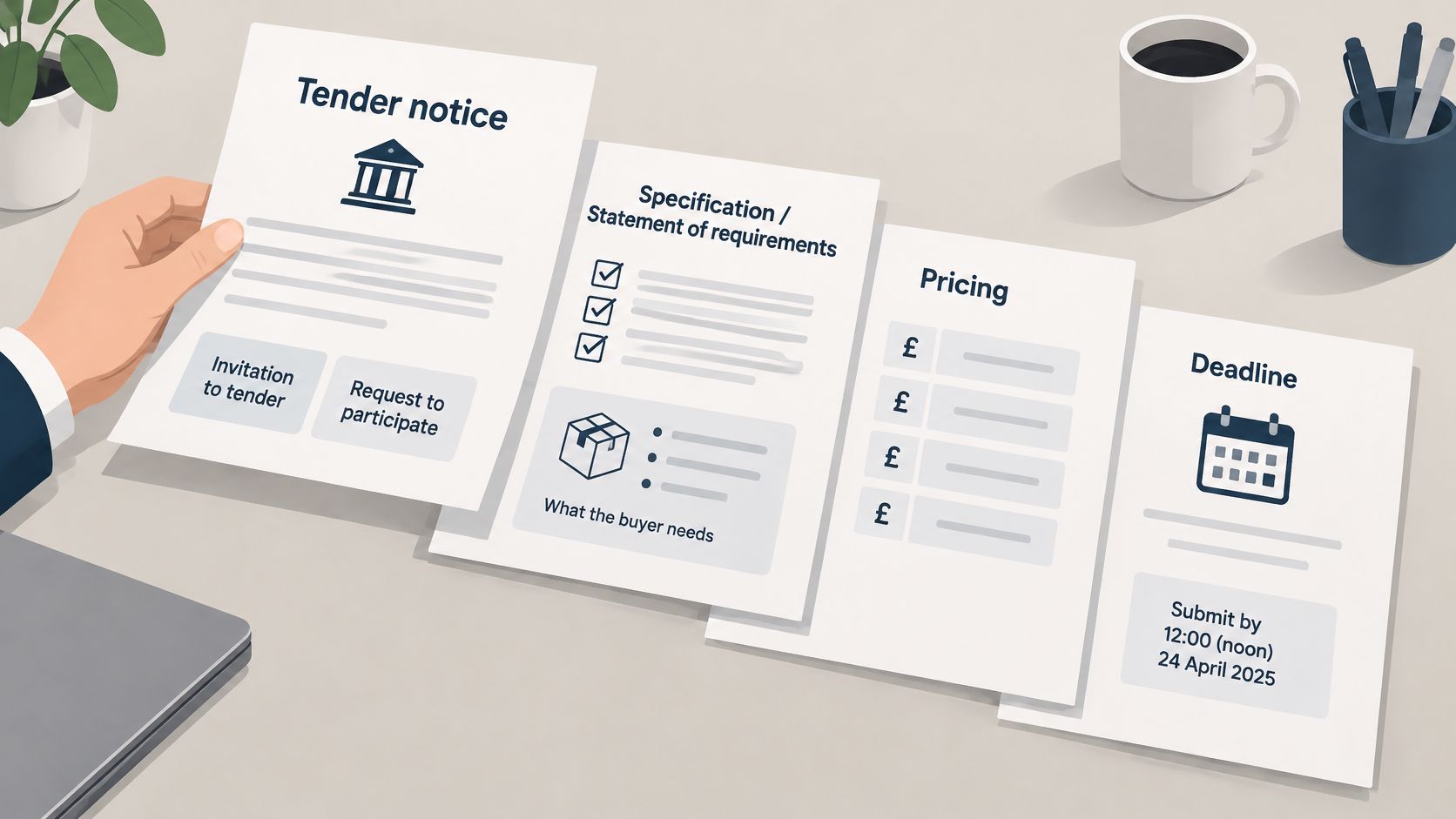
Say you've opened an office-cleaning opportunity. The notice might be labelled tender notice, invitation to tender or request to participate.
Those labels aren't interchangeable instructions. A request to participate may ask you to establish eligibility before you're invited to submit the full offer, so read the required action before opening a response template.
Follow the pack's document labels
The specification or statement of requirements describes what must be delivered. The evaluation criteria and scoring methodology explain how the buyer will assess your response.
The terms and conditions sit apart from the questions, but still need review. A persuasive answer doesn't resolve a contract term your business can't accept or a mobilisation obligation it can't meet.
Check the pricing schedule too. Make sure its scope agrees with the lots and services described in your written response, rather than treating it as a separate administrative attachment.
For a hypothetical contract, the spelling difference looks like this:
| Correct model line | Misspelt version to remove |
|---|---|
| We tender for the three-year contract on the terms in the ITT. | We tendor for the three-year contract on the terms in the ITT. |
| Our tender covers lots 1 and 2 only. | Our tendor covers lots 1 and 2 only. |
| This tender maps each answer to the published weighting. | This tendor maps each answer to the published weighting. |
These are drafting examples, not commitments to paste unchanged. Replace their duration, lot references and contractual wording with the actual details in the live pack.
Extract the information that controls your response
Create a working note before drafting:
- Deadline: Record the submission time, clarification cut-off and any separate document deadlines.
- Lots: Identify exactly which parts you're bidding for.
- Pass/fail rules: Flag mandatory conditions and the evidence needed to satisfy them.
- Weightings: Record how the buyer allocates importance across criteria.
- Word limits: Note whether tables, captions and attachments count towards the allowance.
Search the whole pack, not just the notice summary. A misspelling can sit in a copied heading, appendix or pricing tab long after you've corrected the main response.
Store useful phrases from previous bids in the knowledge base alongside their source documents. During AI-assisted drafting, retain those references so a reviewer can compare the answer with the live requirement.
Mirror the buyer's heading when it identifies the required document. If the pack says invitation to tender, use that phrase rather than inventing a synonym that makes the response harder to follow.
Fix the Typo Before the Deadline
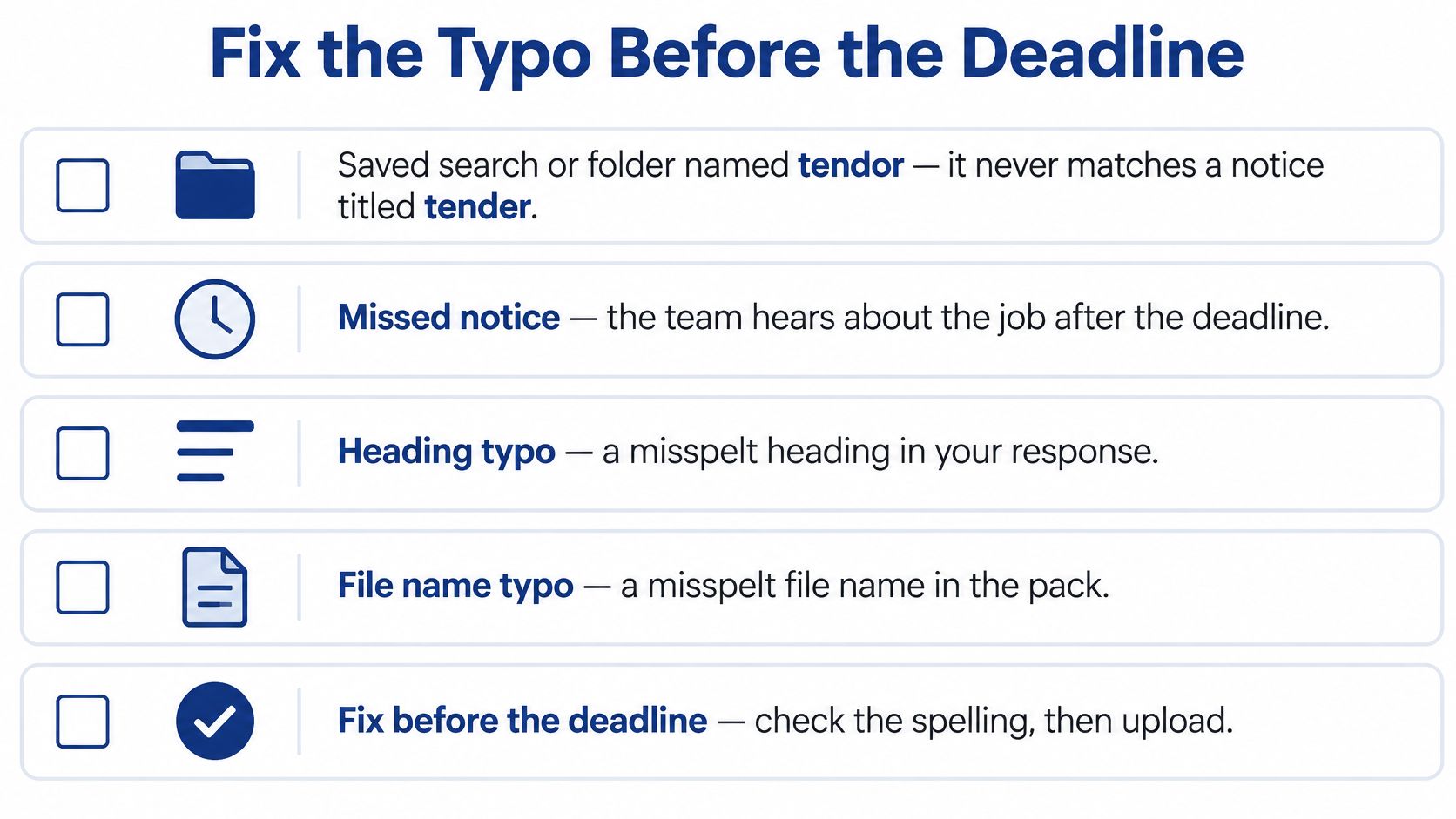
An exact-match saved search for tendor can miss a notice titled tender. If nobody checks the search results, your team may only hear about the contract after submissions close.
A folder name doesn't control a portal's results, but it can make internal retrieval harder when colleagues search for the correct spelling. A misspelt response heading or uploaded file name can also signal that the final pack wasn't checked.
That doesn't mean a typo automatically loses marks. The greater risk is letting the same unchecked working habits affect scope, evidence or compliance.
Correct the workflow in order
Repair discovery and filing. Set tender-monitoring searches and folder names to tender, invitation to tender and competitive tendering where appropriate. Check actual results rather than assuming a saved alert works because it's switched on.
Read each question three times. Read for the requested action, then the evidence required, then the scoring conditions. Answer the question in your opening sentence before adding context.
Run a complete find check. Search for tendor in the draft, pricing schedule, appendices and file names. Review each result in context, rather than blindly replacing text inside an unrelated proper name.
Have a person verify AI-generated answers. Check every delivery promise against approved evidence and the live notice. Remove unsupported claims, outdated credentials and wording that sounds confident but doesn't answer the question.
The government's guidance on AI transparency in procurement says authorities may ask suppliers whether AI helped create their responses and may use clarification questions, site visits or presentations to check delivery capability. It also recommends proportionate controls to prevent confidential authority information, or material outside the public domain, being used as AI training data.
Keep verified credentials, case studies and past responses in the knowledge base. Before adding buyer material to any AI workflow, check the confidentiality terms and how the system handles that material.
A polished paragraph isn't proof of capability. Your reviewer should be able to identify the source and the person responsible for delivering the promise.
Use drafting time for checking
Bidwell's tender discovery monitors Find a Tender, Contracts Finder, PCS, Sell2Wales and eTendersNI. Matching uses sector, CPV code, region and contract value, so the spelling check belongs alongside those filters.
Our AI response generation drafts the first 80% of a tender response in around 30 minutes. With Bidwell, the 20-to-40-hour tender writing task becomes a 2-to-4-hour task, with customers reviewing, polishing and submitting the response themselves.
The Bidwell bid-writing software workflow supports that division of work. Use the time available for evidence checks, operational approval and a final review, not just cosmetic edits.
For a same-day reset, confirm the spelling and match searches to the relevant portals using sector, CPV code, region and value. Read the invitation and weightings before drafting, then build answers from approved knowledge-base material with a citation for each supported point.
Finally, review the response yourself and verify the upload confirmation. Treat tender or tendor as a workflow check, not merely a spelling quiz. Correct terminology helps you find the opportunity; accountable review helps you submit an offer you can deliver.
Bidwell combines tender monitoring, a knowledge base and AI response generation so you can move from the right notice to an evidence-backed draft. Visit Bidwell to organise your source material, find relevant opportunities and prepare responses for your team to review before submission.

