The UK public sector procurement market was estimated at £407 billion in 2023/24, covering central government, local authorities, the NHS and other public bodies, according to House of Commons analysis cited by Cardiff University. Yet an SME owner can still spend hours searching and miss the right opportunity because the market is split across portals, notice types and inconsistent data.
That's the central problem with procurement software UK buyers often overlook. Enterprise procurement platforms help public bodies buy and manage suppliers. Smaller suppliers need something different: tender monitoring that finds relevant work, a knowledge base that stores approved evidence, and AI response generation that helps produce accurate bids without inventing claims.
Where UK Public Sector Spending Reaches SMEs
Public bodies recorded £227.7 billion in reported third-party procurement spend during 2024, although that figure covers only part of the wider market described in the British Chambers of Commerce analysis. Market size matters less to an SME than identifying buyers that already award work to businesses with similar capacity.
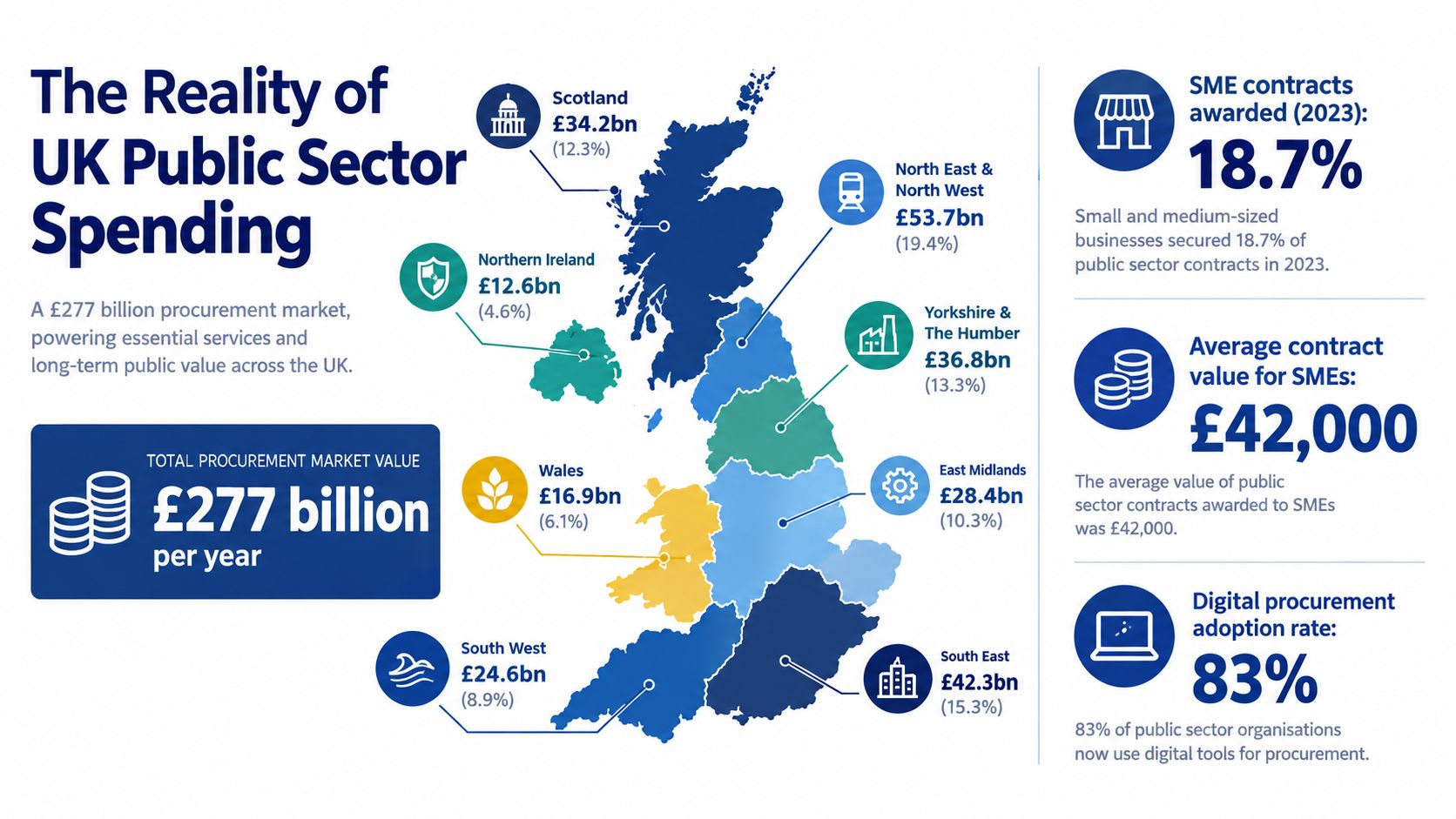
Local government offers the clearest starting point
Local government awarded £28.1 billion directly to SMEs in 2024, equal to 35% of its procurement spend, per the same BCC analysis. Councils therefore give smaller firms a practical route into public sector work, with demand spread across many buyers, regions and service categories.
The NHS awarded £7.9 billion directly to SMEs, or 19% of its procurement spend, while central government awarded £6.9 billion, or 11%. Those figures do not make central government irrelevant. They indicate that an SME should assess each channel separately rather than assume every public buyer offers the same route to market.
A cleaning company, specialist consultancy or regional technology provider may find a stronger pipeline through councils, NHS organisations or devolved bodies than through large central-government competitions. Compare buyer history, geography, category fit, qualification requirements and delivery capacity before committing bid time.
Start with buyers whose previous awards match your delivery capacity, then expand cautiously with monitoring rather than subscribing to every alert feed.
Monitoring matters because the market is fragmented
Public procurement does not arrive in one consistent list. Notices appear across national and devolved systems, and suppliers must separate live opportunities from pipelines, awards, frameworks and expired notices. Inconsistent notice fields and naming conventions can also make a suitable contract difficult to find through broad keyword searches.
Bidwell's tender monitoring can bring relevant opportunities into one working queue. Filters for location, category, value and procurement stage help a small team decide which notices deserve a bid or no-bid discussion. The practical gain is not a larger alert count. It is less time spent screening irrelevant notices and more time assessing work that fits the company's capability, evidence and capacity.
What Procurement Software Actually Does for Suppliers
Search for procurement software and you'll often find tools built for the buyer's side of the transaction. These systems handle purchase requests, approvals, supplier onboarding, sourcing events, contract management and spend reporting. They're useful for a council or corporate procurement team managing internal demand.
They don't necessarily solve the supplier's first problem, which is finding a winnable opportunity before the deadline. An SME bidding for public work usually needs a supplier-side workflow, not a purchase-to-pay system.
Buyer-side and supplier-side tools solve different problems
| Buyer-side procurement software | Supplier-side bid software |
|---|---|
| Routes purchase requests for approval | Finds relevant tender notices |
| Manages supplier records and compliance | Filters opportunities by fit |
| Runs sourcing and quotation events | Extracts questions and requirements |
| Tracks contracts and spend | Reuses approved evidence |
| Reports on purchasing activity | Produces reviewable draft responses |
The distinction sounds obvious, but it changes how you evaluate products. A platform may have excellent supplier management and still be poor at identifying new tenders. Another may store contracts neatly but offer no practical help with writing answers.
For suppliers, tender monitoring should identify the source notice, deadline, buyer, geography, category, value and procurement stage. The system should preserve the original record, not just send a vague email based on a keyword match.
The second requirement is a knowledge base. Your approved case studies, policies, accreditations, staff profiles, insurance details and previous answers should be searchable and organised by sector or requirement. Without that foundation, AI response generation has little reliable material to work from.
Choose software around the bid decision
A useful supplier-side platform helps answer three questions quickly:
- Is this opportunity relevant to our service, geography and capacity?
- Can we meet the mandatory requirements and timetable?
- Can we produce a specific, evidenced response before submission?
Bid writing software should support those decisions rather than just create documents. Bidwell's bid writing software connects tender information with stored business evidence, so a bid manager can review a draft against the actual requirement instead of starting with a blank page.
What doesn't work is treating AI as a substitute for judgement. A generic model can produce fluent prose, but fluency doesn't prove experience, compliance or delivery capability. The supplier still needs to decide whether the opportunity is worth pursuing and whether every answer is supported by evidence.
Navigating the Fragmented UK Tender Portals
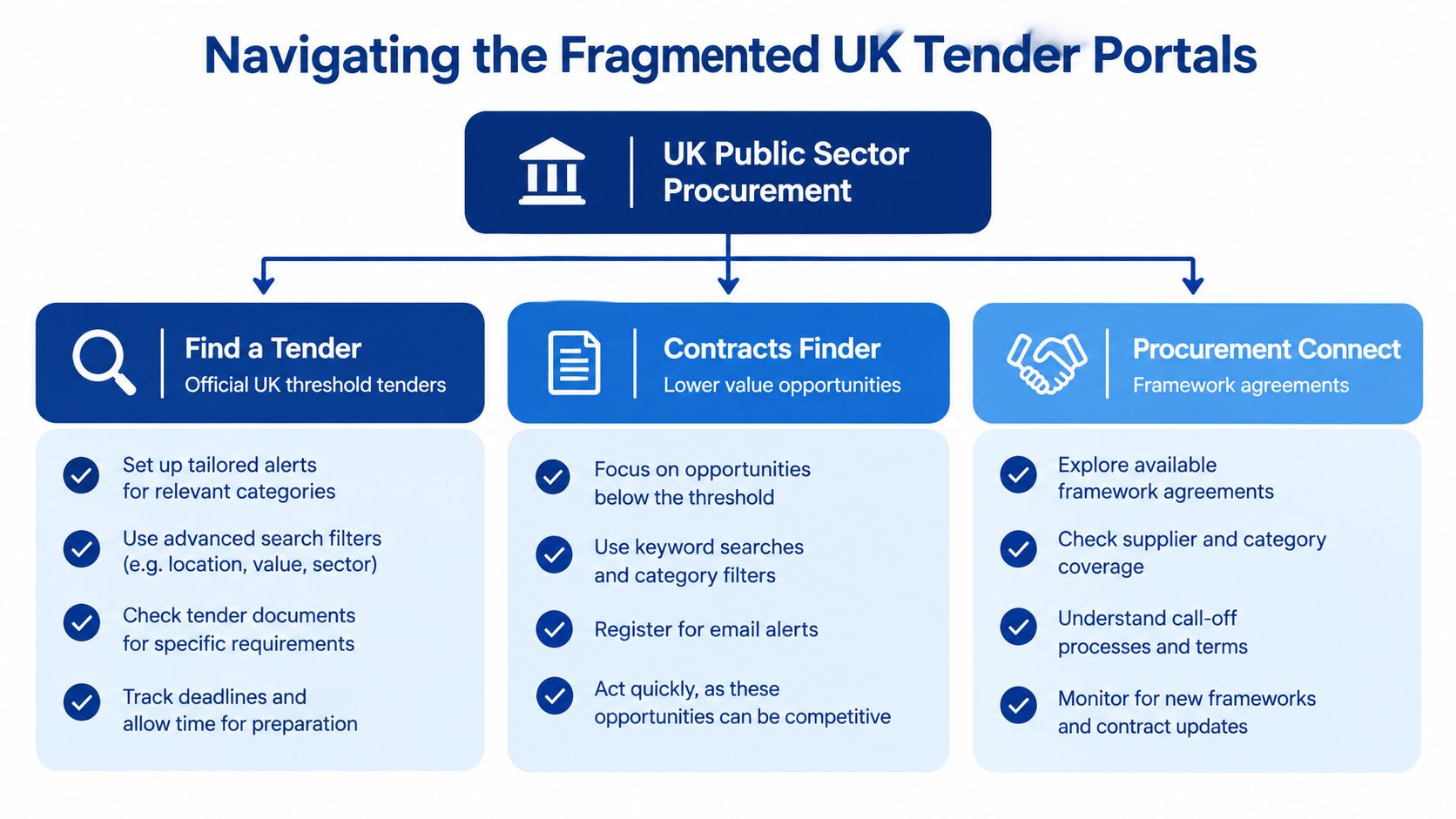
There isn't one complete UK tender inbox. Your monitoring setup needs to reflect the geography and publication service behind each opportunity.
Find a Tender is the central platform for higher-value notices and, from 24 February 2025, publishes new UK procurements under the Procurement Act 2023 outside Scotland. It also carries the lifecycle of above-threshold contracts outside Scotland, from pipeline through to termination.
Contracts Finder covers England and other non-devolved territories. Public Contracts Scotland covers Scottish opportunities, while Sell2Wales covers Welsh procurement. Below-threshold Scottish notices aren't included in Find a Tender, which is one reason a single-feed strategy is unsafe.
Use thresholds as routing clues
Contracts Finder covers government contracts worth more than £12,000 including VAT, while high-value UK opportunities above £139,688 are published through Find a Tender, as shown in Find a Tender's search service.
Those figures aren't a complete monitoring strategy, but they help you understand why different feeds matter. A supplier that only checks high-value notices may miss smaller council work. A supplier that searches only Contracts Finder may miss opportunities published through devolved services or higher-value notices on Find a Tender.
Set monitoring rules around:
- Geography: Include the regions where you can deliver.
- Category: Use CPV codes and sector terms, but test both because buyers classify notices differently.
- Value: Set sensible lower and upper limits for your team's capacity.
- Stage: Separate pipelines, active tenders, awards and frameworks.
- Notice type: Include lots, subcontracting routes and framework call-offs where relevant.
A tool such as Bidwell's tender monitoring use case is useful when it combines these feeds and turns them into alerts with enough context to make a decision. The alert should tell you why the opportunity matches, not just repeat the title.
Don't confuse coverage with usefulness
A directory can help you discover adjacent tools and suppliers, including Wispra's business directory. But a list of portals or providers won't remove the daily work of checking duplicates, reading attachments and deciding whether a notice is live.
Good monitoring keeps the source link and provenance attached to the alert. It also makes it easy to move from a relevant opportunity into the knowledge base and response workflow. That connection is what turns portal coverage into a practical pipeline.
Dealing with Messy Procurement Data
Published data looks authoritative because it comes from official sources. It still contains gaps, contradictions and fields that require interpretation.
A UK Parliament analysis of Contracts Finder records from 2018 to 2022 found that 6% of large contracts lacked basic information about the procurement procedure used, according to the Public Procurement Review Service progress report. A system that assumes every field is complete will make confident but unsafe exclusions.
Missing information should trigger review
A missing procedure isn't proof that an opportunity is unsuitable. It's a reason to inspect the notice and attachments.
The same applies to an absent estimated value, unclear deadline, inconsistent dates or incomplete award details. Software should represent these fields as nullable and show a completeness or confidence warning. It should distinguish a confirmed value from an inferred one.
For a bid manager, the practical workflow is simple:
- Keep the record: Don't discard a notice just because one field is blank.
- Flag the risk: Mark missing or contradictory information for human review.
- Use reliable signals: Prioritise buyer, category, geography, deadline and contract duration.
- Preserve provenance: Keep the original notice beside any normalised fields.
- Record the decision: Note why the team rejected, watched or pursued the opportunity.
This approach prevents false negatives. It also makes the pipeline easier to audit when a colleague asks why an alert was ignored.
Data quality is part of bid discipline
Data quality affects more than search results. Duplicate notices can make a market look larger than it is. An award record can be mistaken for a live competition. A pipeline notice can be treated as an immediate bid, leading to wasted preparation.
A useful platform should normalise buyer and supplier identifiers, notice types, procurement stages, CPV classifications, values, dates and outcomes. It should then expose the underlying data through an export or integration rather than trapping the team in a browser-only view.
Teams looking beyond procurement feeds can also review guidance on how to reduce the cost of poor data quality. For Bidwell's tender monitoring, the important principle is that automation should prioritise human attention, not pretend that uncertain records are certain.
Building a Reusable Knowledge Base for Faster Bids
Finding a relevant tender is only half the job. The response still needs evidence, structure and careful tailoring.
The government's Contracts Finder collection records 34,968 total contracts in the 2025/26 financial year, which means SMEs operate in a market with tens of thousands of published records, as shown in the Contracts Finder collection on data.gov.uk. A team that rebuilds its company history and credentials for every bid will spend too much time searching for material it has already approved.
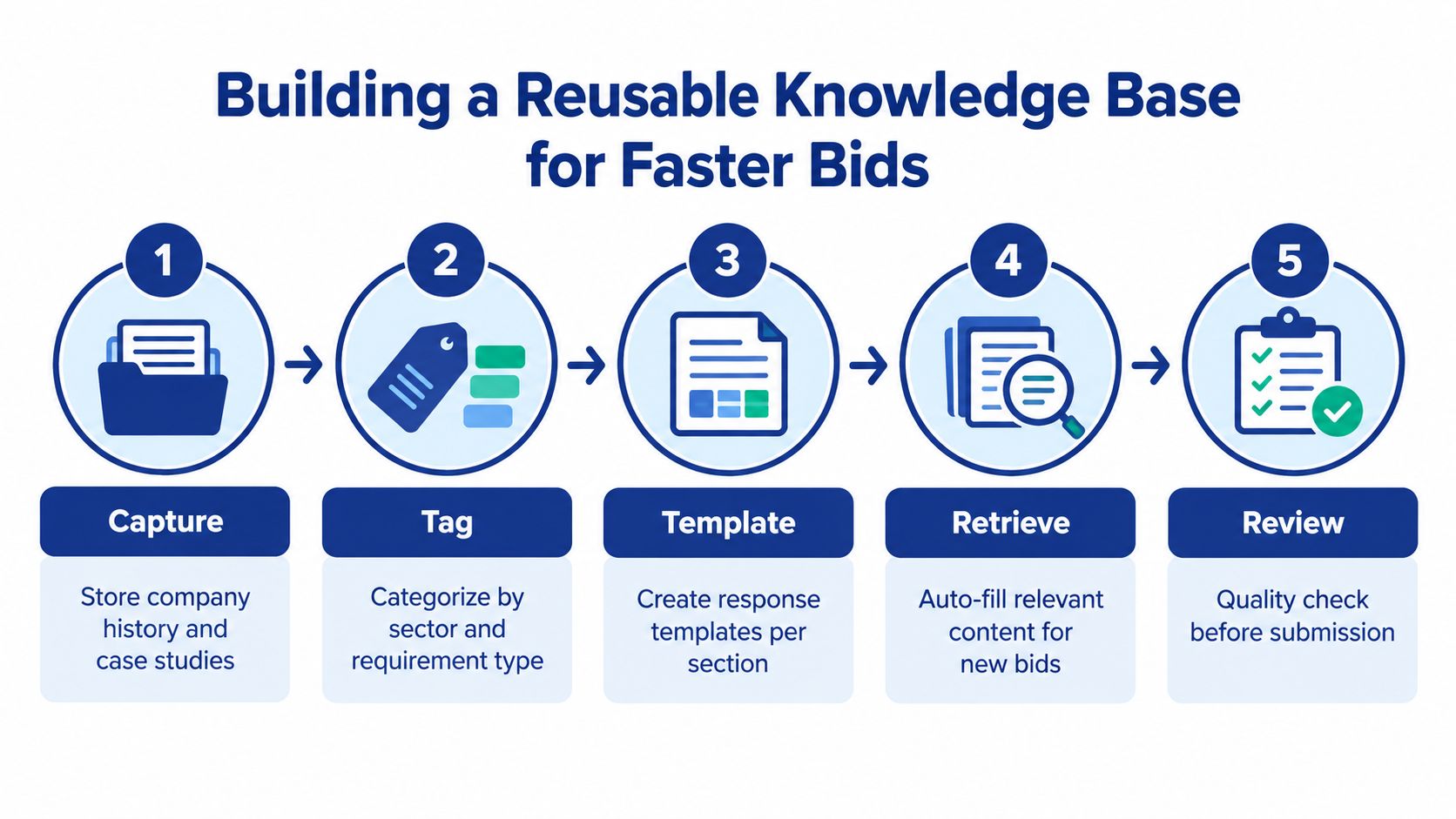
Store evidence before you need it
A useful knowledge base isn't a dumping ground for old Word files. It's a controlled collection of material that someone has checked and can reuse.
Start with the evidence that appears repeatedly in tenders:
- Company profile: Services, locations, ownership and operating model.
- Credentials: Accreditations, policies, insurance and relevant registrations.
- Case studies: Client context, scope, delivery method and outcomes that can be evidenced.
- People: CVs, roles, qualifications and availability.
- Previous answers: Strong responses mapped to common requirement types.
- Delivery controls: Quality assurance, safeguarding, information security and risk processes.
Tag each item by sector, service, buyer type and requirement. Add an owner and review status where appropriate. That helps a bid manager see whether a piece of evidence is current, approved and relevant to the tender in front of them.
Let AI retrieve, not invent
Bidwell's knowledge base gives AI response generation a controlled source of company information. The system can match tender questions to previous answers, credentials and case studies, then produce a draft for review.
That changes the writer's role. Instead of spending the first part of a bid hunting through folders, the writer can test whether the draft answers the question, reflects the scoring criteria and uses the right example. The work still needs judgement, editing and approval, but the starting point is more useful than a blank document.
A sensible review loop looks like this:
- Extract the question and mandatory requirements.
- Retrieve approved evidence that matches the requirement.
- Draft an answer in the buyer's requested format.
- Flag unsupported or weak claims.
- Check names, dates, commitments and attachments.
- Approve the final response through the bid team.
The knowledge base should make approved evidence easier to find, not make unverified claims sound more convincing.
Evaluating Software for UK Compliance and AI Rules
A procurement software demonstration can look impressive while hiding the details that matter to a UK bid team. Test the underlying data model, export options, provenance and review controls before you judge the interface.
The government's transparency model is designed to cover notices from procurement planning through contract expiry, use common identifiers and publish machine-readable information aligned with the Open Contracting Data Standard. A suitable platform should therefore normalise notice types, buyer and supplier identifiers, procurement stages, CPV classifications, values, dates and award outcomes across the relevant portals.
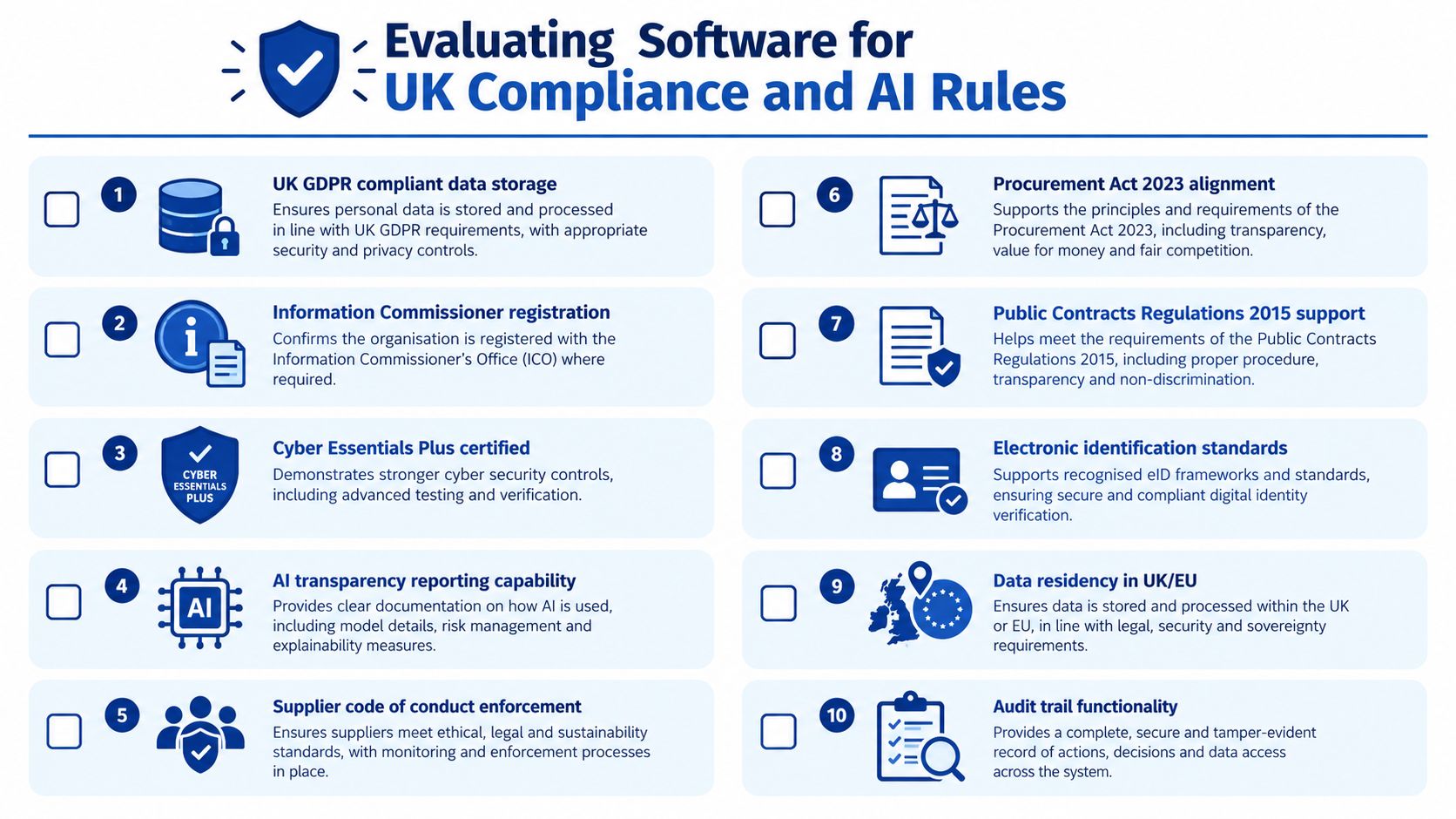
Ask the technical questions
Use the demonstration to test real records, not prepared examples.
- Coverage: Does the platform monitor Find a Tender, Contracts Finder, Public Contracts Scotland and Sell2Wales?
- Normalisation: Can it distinguish live tenders, pipelines, awards and frameworks?
- Deduplication: Does it identify the same opportunity across different notices?
- Export: Can you retrieve data through CSV, XML, an API or an equivalent structured feed?
- Provenance: Can every alert be traced to the original notice?
- Filtering: Can you filter by buyer, geography, value, stage and category?
- Auditability: Can the team see what the system inferred and what the source confirmed?
These controls matter because your tender monitoring should remain useful outside the platform. Exportable records support internal reporting, bid reviews and audit trails. They also reduce the risk of building your entire pipeline around an interface you can't interrogate.
Set rules for AI response generation
UK government guidance states that buyers may ask suppliers to disclose whether AI helped create tender responses and may require confirmation that AI-supported responses were checked for accuracy, according to PPN 017 on improving transparency of AI use in procurement.
That makes review controls a procurement requirement, not an optional extra. Your AI tool should draw from approved knowledge-base content, flag unsupported claims and leave a clear record of human checking. Confidential contracting-authority information must not be treated casually or used as training data.
When comparing a procurement software package for UK teams, ask to see how the product handles rejected evidence, conflicting documents and final approval. If the answer is merely “the model writes the response”, the control environment isn't mature enough.
Winning More Contracts with a Unified Workflow
The strongest setup connects three activities that SMEs often keep apart: finding work, preparing evidence and writing the response.
The process starts when tender monitoring identifies an opportunity. A bid manager checks the buyer, location, category, deadline, procedure and mandatory requirements. If the tender fits, the team opens a bid record and links the relevant items from its knowledge base.
The next decision is not “Can AI write this?” It's “Can we answer this credibly with the people, evidence and time available?” That distinction prevents teams from chasing every alert just because the software has made it easy to open one.
A practical operating rhythm
At alert stage, remove duplicates and reject opportunities outside your geography or service scope. Keep a watch status for early pipeline notices that may become relevant later.
At qualification stage, check mandatory requirements, lot structure, framework position, contract duration, submission route and the buyer's evaluation method. Review missing fields rather than assuming they mean no.
At drafting stage, use the knowledge base to retrieve approved case studies, policies and previous answers. Ask AI response generation to produce a structured draft, then have a bid writer adapt it to the question and scoring guidance.
At quality stage, verify every factual statement, commitment, named resource and reference. Confirm that the final answer meets word limits, file requirements and portal instructions.
At review stage, record why the team bid or declined. That decision history improves future tender monitoring because it shows which alerts were genuinely relevant and which filters created noise.
The same discipline applies when you're managing Microsoft partners effectively. Clear ownership, documented evidence and defined review points matter whether you're responding alone or coordinating several delivery partners.
A unified workflow won't make every tender winnable. It does give an SME a better way to protect scarce bid time. The practical target is a smaller, better-qualified pipeline, supported by evidence the team trusts and drafts a human can verify.
Bidwell brings together tender monitoring across major UK public-sector portals, a searchable knowledge base for your credentials and case studies, and AI response generation for customized draft answers. Visit Bidwell to see how your team can replace scattered searches and documents with a controlled workflow for finding and responding to public-sector opportunities.