
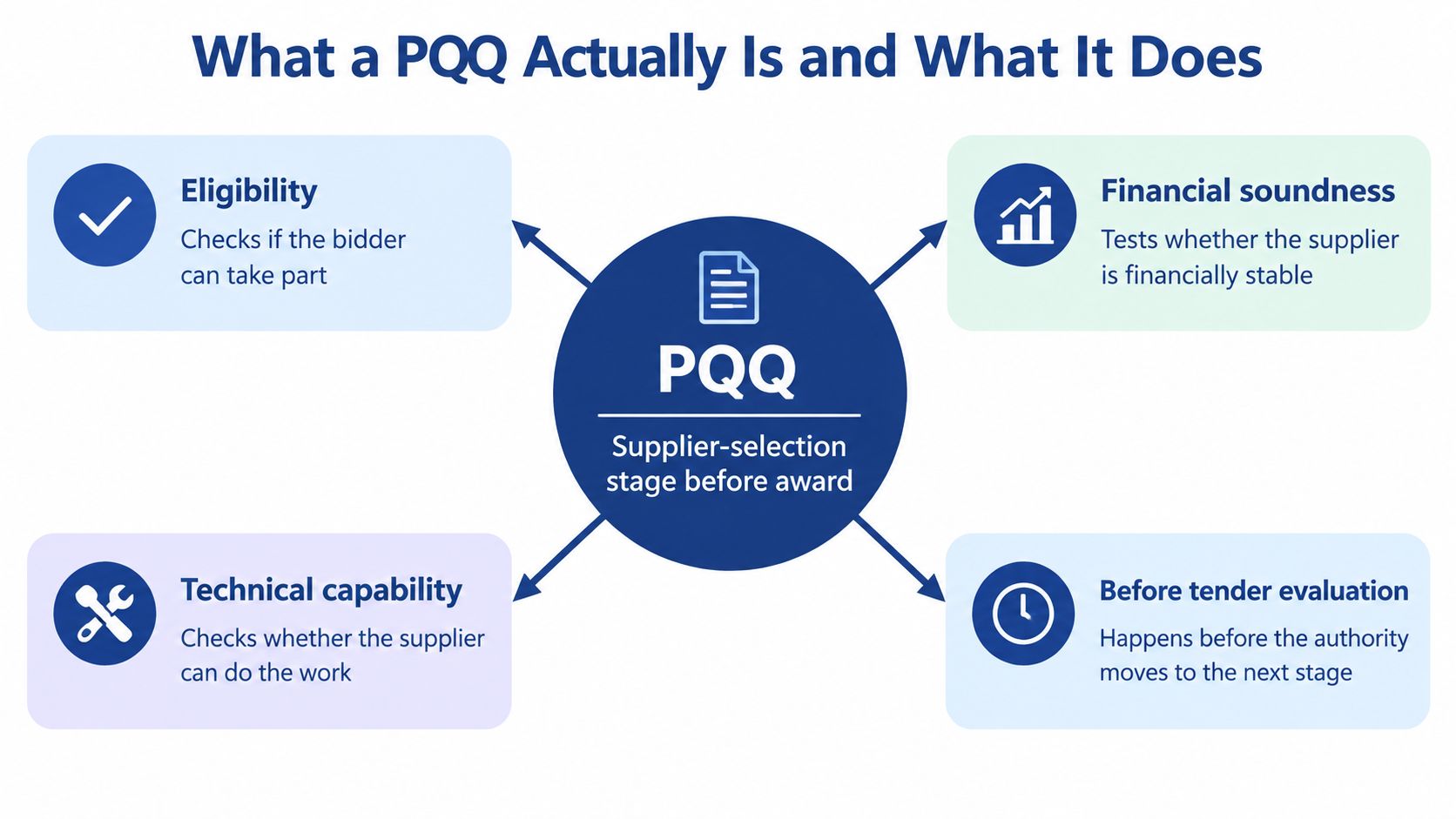
A pre-qualification questionnaire (PQQ) is the supplier-selection stage used to check whether a bidder is eligible, financially sound and technically capable before being invited to tender; in the UK, it has largely been replaced by the Standard Selection Questionnaire.
The advice to sell your business in every answer misses the point. A persuasive capability statement won't rescue an incorrect declaration or evidence that doesn't meet the buyer's requirement. Start with compliance, then make the answer easy to assess.
Why Most PQQ Failures Have Nothing to Do with Capability
Treat that heading as a warning, not a measured failure rate. There's no basis for claiming that most rejected suppliers lack nothing but better paperwork. The practical risk is narrower and more useful: a capable supplier can still be excluded because its submission is incomplete, inaccurate or inconsistent.
A pre-qualification questionnaire tests what you can demonstrate, not what your delivery team privately knows it can achieve. If the authority asks for evidence against a specified requirement, a confident description of your business isn't an adequate substitute.
Capability needs a paper trail
The commercial consequence is straightforward. You can spend time identifying an attractive contract and still lose the opportunity before the buyer evaluates your proposed service. For an SME, that makes selection preparation a bid/no-bid issue, not just an administrative task.
The Standard Selection Questionnaire policy and template provide the framework for this selection-compliance exercise. Build your response around the exact question rather than pasting a general company introduction into every box.
Practical rule: Don't ask whether an answer sounds impressive. Ask whether an evaluator can verify that it meets the requirement.
A useful working record connects:
- The requirement: What the buyer actually needs you to demonstrate.
- The evidence: The document, declaration or reference supporting your answer.
- The owner: The colleague authorised to confirm that information.
- The response: The precise wording you're submitting.
Tender monitoring should help you spot the requirement early. A knowledge base should hold the supporting material. AI response generation should help turn that material into an answer, without creating facts to fill gaps.
Those are separate jobs. Mixing them together is how an attractive draft gets mistaken for an approved submission.
What a PQQ Actually Is and What It Does
Think of a PQQ as the check at the entrance, not the judging of the competition. Historically, it was used mainly in restricted procedures to establish which suppliers were suitable to receive an invitation to tender.
The government introduced mandatory core questions for relevant central government bodies through Procurement Policy Note 01/12, published on 10 February 2012. The intention was to reduce inconsistent and unnecessarily demanding requirements, as explained in the government's PQQ standardisation policy.
Read the procurement framework, not just the label
The standard PQQ was replaced by the Standard Selection Questionnaire in 2016, following the Public Contracts Regulations 2015. The SQ retained the selection purpose while using a structured self-declaration approach.
Under the Procurement Act 2023, the comparable assessment is generally framed around conditions of participation. These must be proportionate checks of legal and financial capacity or technical ability, taking account of the contract's nature, complexity and cost, according to the government's conditions of participation guidance.
The terminology therefore needs careful handling:
- PQQ: The historic supplier-selection term, which you may still encounter in documents.
- SQ: The standard questionnaire associated with the earlier regulatory framework.
- Conditions of participation: The capacity and ability requirements used under the Procurement Act framework.
Don't assume every UK opportunity uses an identical document or procedure. Check the notice, applicable regime and buyer's instructions.
When someone asks “what is PQQ in procurement?”, the useful answer goes beyond expanding the abbreviation. It means understanding which supplier checks apply to this competition, when they're assessed and what evidence the authority expects. Store reusable evidence by subject, rather than organising everything around an old form title.
The Questions You Will Actually Face
A PQQ or SQ isn't just an expression of interest. It asks you to make statements about the business, its resources and its integrity. Some answers belong with the bid writer, but others need finance, compliance or director approval.
Prepare the evidence before drafting. That makes it easier to distinguish a genuine gap from information that already exists elsewhere in the business.
PQQ and SQ question blocks and the evidence that satisfies them
| Question block | What it tests | Evidence to prepare |
|---|---|---|
| Corporate identity and legal status | Which entity is bidding and how it's structured | Registration details, ownership information and group structure |
| Economic and financial standing | Capacity to support delivery financially | Requested accounts and permitted supporting financial information |
| Technical and professional capability | Ability and resources to perform the work | Relevant qualifications, personnel records and capacity evidence |
| Relevant experience | Whether previous work demonstrates the required capability | Contract references and clearly scoped case studies |
| Quality and health and safety | Whether your management arrangements match the requirement | Applicable policies, procedures and requested certificates |
| Insurance | Whether the specified cover requirement is met | Policy schedules and any permitted commitment to obtain cover |
| Exclusion grounds | Whether integrity or other exclusion issues arise | Approved declarations and relevant explanations or remedial evidence |
The evidence column is a preparation list, not a promise that every buyer will accept every document. The authority's stated requirements control what satisfies the question.
Take exclusion declarations seriously
The government's SQ exclusion questions cover convictions involving corruption, bribery, terrorist offences, money laundering, terrorist financing, trafficking and participation in a criminal organisation. They also address insolvency, grave professional misconduct, distortion of competition and conflicts of interest.
Many answers are self-declarations. An adverse answer may require an explanation and evidence of self-cleaning measures, rather than omission or an unsupported negative answer.
Don't interpret that as permission to decide the issue yourself. Refer uncertain declarations to the appropriate legal or compliance owner and follow the questionnaire's instructions.
Financial answers should explain resilience against the requirement. Experience answers should establish relevance to the proposed work. Neither benefits from padding with unrelated company history.
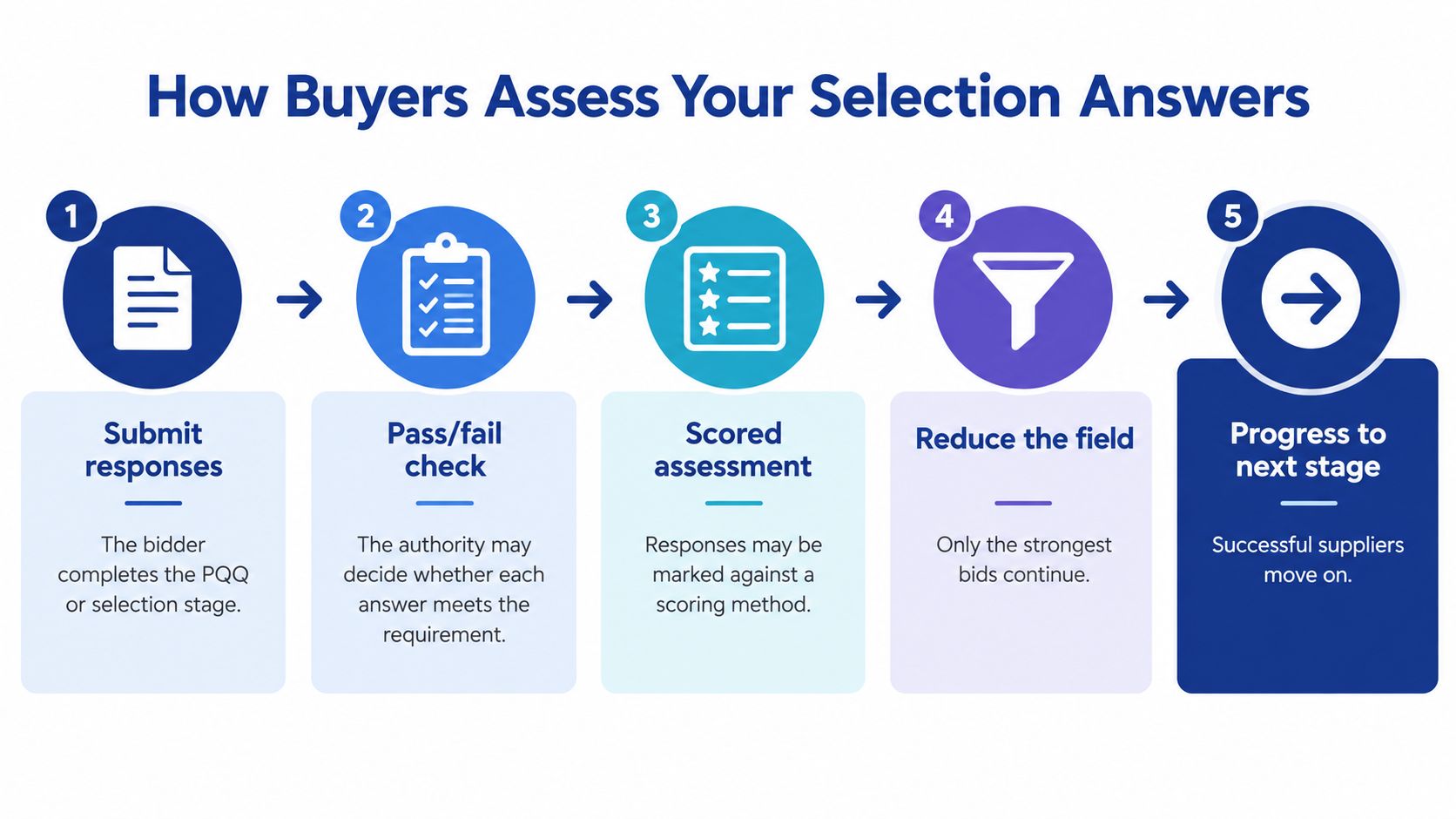
How Buyers Assess Your Selection Answers
Read the assessment rules before writing. You need to know whether an answer must clear a minimum requirement, achieve a mark or support a shortlist decision.
For defence procurement, the government's supplier-selection guidance expressly allows pass/fail assessment or scored responses. It requires the PQQ to identify scored and weighted questions, explain the method, and state pass/fail requirements and the consequences of failure.
Separate qualification from tender quality
A supplier can fail by falling below a minimum mark on an individual question or an overall threshold under those defence selection rules. Don't assume a strong answer elsewhere compensates for a failed mandatory requirement.
Under the Procurement Act framework, participation conditions and award criteria have different jobs. The guidance on assessing competitive tenders says participation responses must be assessed separately, even when reviewed alongside tenders in an open procedure.
Once the supplier meets those conditions, the authority assesses its tender against the award criteria without carrying the earlier participation assessment into that judgement.
Passing the supplier check doesn't give your delivery proposal extra credit. Write each answer for the assessment it actually faces.
For each selection question, record:
- Assessment type: Pass/fail, scored or another stated check.
- Required standard: The threshold or evidence the buyer specifies.
- Consequence: Whether failure prevents progression.
- Reviewer: Who will check the response before submission.
If safety capability needs work, Opus Safety's guide to choosing safety support for UK employers is a useful resource when considering external support. It isn't a substitute for the buyer's assessment requirements.
For teams considering support for bid managers, the useful distinction is operational: monitor assessment rules early, organise compliance evidence separately, then use AI drafting against the correct question.
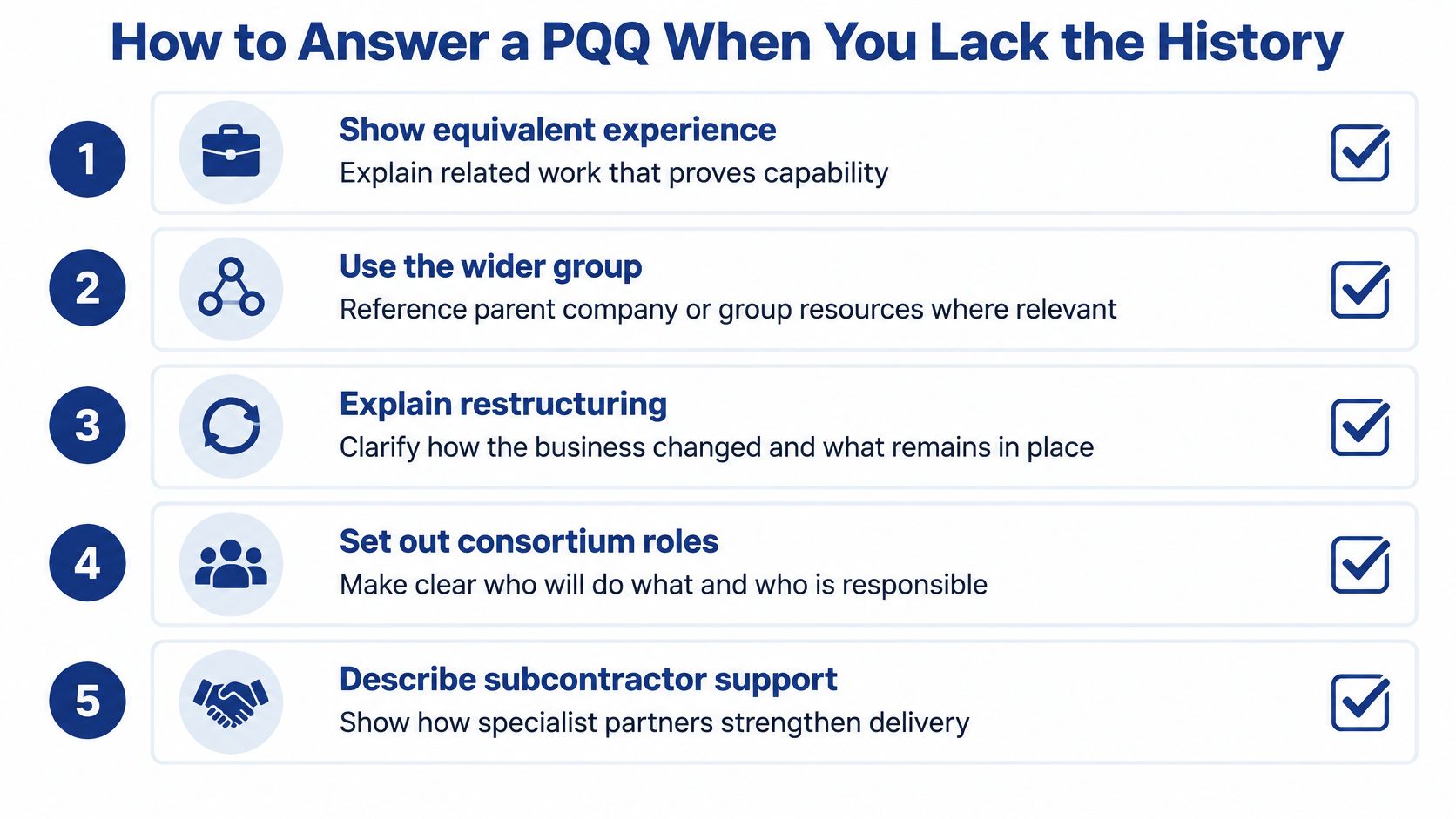
How to Answer a PQQ When You Lack the History
A new company shouldn't pretend it has the trading record of its founders. A restructured business shouldn't submit another entity's accounts as though nothing changed.
The better approach is to explain the limitation and ask whether the authority will accept relevant alternative evidence. An alternative needs acceptance, not just persuasive wording.
Make the limitation assessable
Use this sequence for each affected question:
- State what's missing: Identify the requested history, reference or financial evidence you can't provide.
- Explain why: Describe the new incorporation, restructuring or delivery arrangement plainly.
- Offer verifiable material: Propose the closest relevant evidence, without presenting it as automatically equivalent.
- Identify the responsible entity: Say whose resources or experience you're relying on and who will perform the work.
- Seek clarification: Ask whether the proposed evidence or third-party reliance is acceptable before submission.
Potential alternatives include parent-company support, predecessor accounts, committed key personnel, relevant private-sector references and a delivery partner's capacity. Their usefulness depends on the question and the authority's acceptance, not on how confidently you describe them.
An issued UK supplier questionnaire illustrates why format matters: incomplete answers or failure to follow the requested format can lead to disqualification. Don't leave a mandatory field blank because you've explained the issue somewhere else.
Keep ownership visible
For a consortium, show which member supplies each capability and how responsibilities fit together. For a subcontractor, distinguish specialist support from the bidding entity's own resources.
For a restructured business, explain what changed and what remains available to deliver the contract. Avoid treating previous work by an individual as a contract performed by the new company.
Store these distinctions in your knowledge base alongside supporting documents. Otherwise, AI response generation may produce fluent wording that blurs company experience, employee experience and partner capability. Review those boundaries carefully before approval.
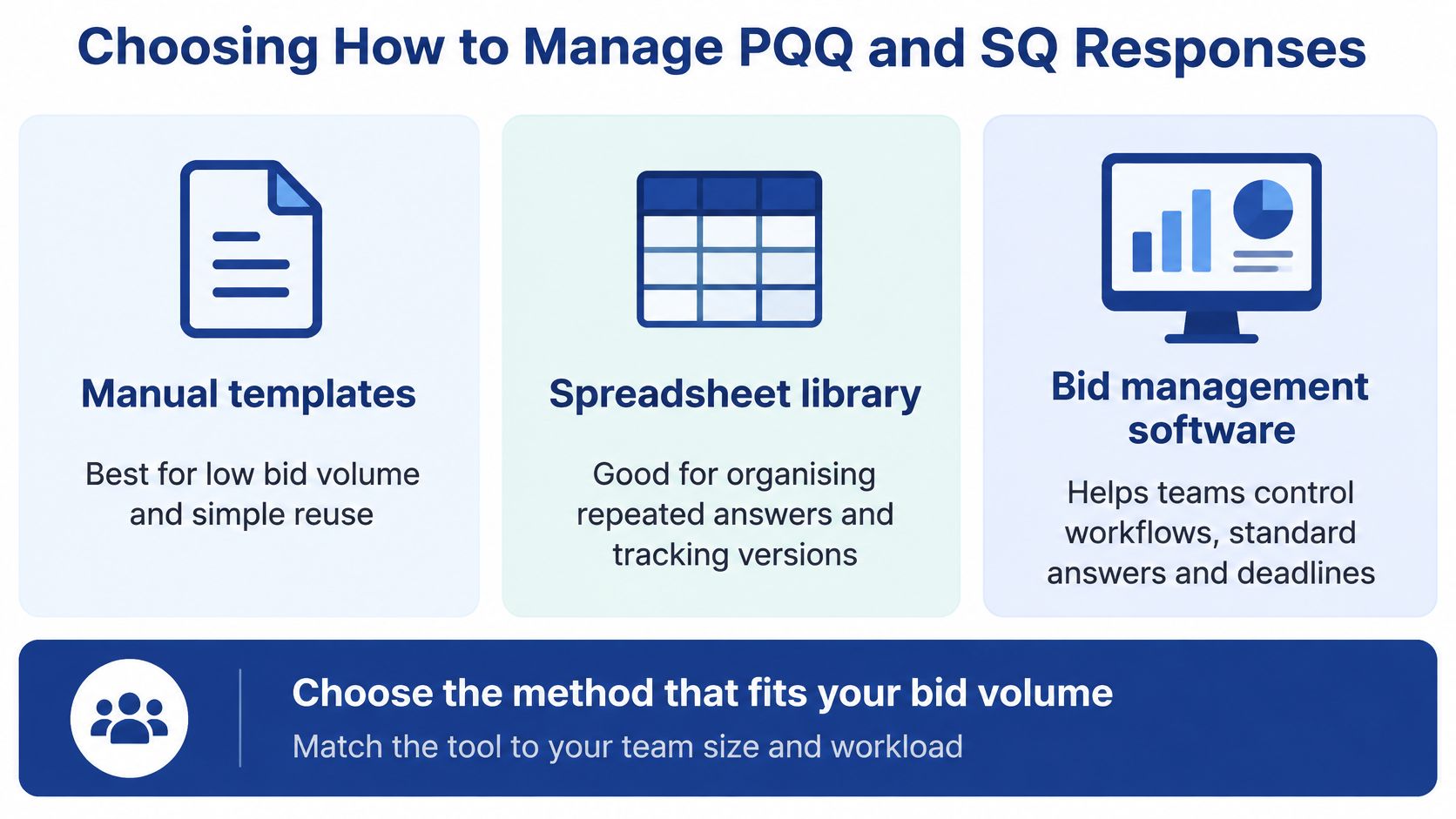
Choosing How to Manage PQQ and SQ Responses
Choose a working method that matches your workload. A shared drive can be perfectly adequate when bids are occasional and someone actively maintains it. Buying software won't fix evidence that nobody owns.
The main trade-off is between low setup effort and repeatable control. Decide how you'll maintain source documents, approve answers and identify outdated material before choosing the tool.
Compare the work, not just the licence
| Approach | Setup and cost considerations | Evidence control and consistency | Suitable working pattern |
|---|---|---|---|
| Manual templates and shared drive | Limited system setup, but repeated staff effort | Depends heavily on folder discipline and ownership | Occasional bids with a stable reviewer |
| Spreadsheet answer library | Requires indexing and ongoing maintenance | Can track owners, versions and document references | Repeated questions across a manageable workload |
| Bid writer or consultant | External fees or dedicated staff cost | Still needs access to approved company evidence | Complex submissions or limited internal writing capacity |
| AI-assisted bid platform | Requires knowledge-base preparation and subscription evaluation | Supports reuse, but outputs still need checking | Regular bidding with recurring evidence requirements |
A consultant can improve the explanation, but can't approve your financial declaration for you. A spreadsheet can organise answers, but won't keep its own entries accurate. AI can draft text, but shouldn't decide whether an exclusion declaration is true.
Bidwell is one option for connecting the work: tender monitoring identifies opportunities, its knowledge base holds credentials, past responses and case studies, and AI response generation drafts customised answers from that information. Its bid-writing software should be assessed against those practical jobs, not treated as a substitute for sign-off.
Test against a real questionnaire
Use a previous submission to assess any proposed system. Check whether a reviewer can trace an answer back to its evidence and identify who approved it.
Then change a source document and consider how you'd prevent reuse of the old answer. That exercise tells you more about suitability than a polished demonstration alone.
Keep the process proportionate. The right system is the one your team can maintain consistently.
Common PQQ Mistakes and When to Push Back
The dangerous answer isn't always obviously wrong. It can be correct for the parent company but not the bidder, accurate when first written but now outdated, or supported by a certificate that covers a different activity.
Don't review only for grammar. Check that the declaration, supporting document and named bidding entity agree.
Run a controlled final check
- Entity and dates: Confirm names, reporting periods and document validity.
- Declarations: Obtain approval from finance, legal, compliance and directors as appropriate.
- Claims: Check that policies, certifications, references and insurance statements are auditable.
- Format: Answer the requested field rather than substituting an unsolicited capability statement.
- Submission record: Preserve the exact submitted answers and attachments.
Use a knowledge base to hold approved evidence, not every historical draft. Keep AI-generated answers visibly separate from authorised declarations until a responsible person has reviewed them.
Before you submit: A polished sentence isn't evidence. Find the document or authorised confirmation behind it.
Question disproportionate requirements properly
The cited historical Cabinet Office guidance prohibited a formal pre-qualification stage for below-threshold goods and services procurements, listing £111,676 for central government and £172,514 for other authorities in that framework. Those are historical figures in the SME procurement reform guidance, not current thresholds to apply automatically.
That distinction matters. A standalone screening stage isn't the same as proportionate supplier questions or evidence requested within a tender. Check the applicable regime and current threshold before challenging the process.
Ask the authority to explain the legal basis, relevance and proportionality of an excessive requirement. Also ask whether the answer is scored, checked against a minimum or requested for information.
Government policy specifically targeted barriers such as excessive insurance requirements, disproportionate turnover demands and routine requests for audited trading histories. The government's procurement reform policy explains that wider SME-access context.
Don't ignore a question you believe is inappropriate. Raise a precise clarification through the stated channel, retain the answer and make your participation decision on that basis.
Your Next Step on the Next PQQ You See
Start with the notice and assessment documents, not an empty answer template. Establish what applies, what could prevent progression and which colleagues need to contribute.
Your first working document should be an evidence map. Put each requirement beside the supporting material, its owner and any unresolved issue. That makes the bid decision more useful than a general conversation about whether the contract looks attractive.
Build a submission you can defend
Before drafting, confirm:
- The framework: Identify the applicable procurement regime and requirements.
- The assessment: Mark the mandatory checks and any selection scoring.
- The evidence: Locate approved material and flag gaps.
- The alternatives: Obtain clarification where you need another entity's capacity or substitute evidence.
- The approvals: Schedule the right people to review declarations.
- The record: Decide where the submitted version and buyer clarifications will be retained.
Don't wait until the final review to discover that a director needs to confirm an answer or a proposed reference belongs to a different entity. Give those issues an owner while there's still time to resolve them.
Reuse the evidence, reconsider the answer
After submission, retain useful material with enough context to reuse it safely. Record what the evidence proves, which entity it covers and any limits on its use. Don't promote a contract-specific answer into an approved standard response without checking it.
For regular bidders, a connected tender discovery and response process is more useful than another isolated template. Bring opportunities in early, keep evidence organised and use drafting assistance only after the facts are clear.
The next questionnaire shouldn't trigger a fresh search through old inboxes. It should trigger a controlled check against information your business already maintains.
Bidwell brings tender monitoring, a reusable knowledge base and AI response generation into the same workflow. Visit Bidwell to see how you can organise your selection evidence and prepare PQQ or SQ drafts for proper review.


