
It's Monday morning. You've found a tender that looks made for your business, the deadline is uncomfortable, and someone has already suggested reusing the last submission. Before lunch, your operations director is gathering certificates and your best salesperson is writing an introduction nobody asked for.
Stop before you commit the team. If you want to bid for a contract profitably, your first job isn't writing. It's deciding whether this opportunity deserves your time, then building a response the buyer can score.
What Bidding for a Contract Really Means in 2026
A bid manager opens the tender pack and finds a specification, pricing workbook, declarations, contract terms and a portal questionnaire. The service looks familiar. The commitments buried in those documents might not be.
You're not submitting a sales brochure. You're proposing a delivery method, accepting commercial obligations and providing evidence against a particular assessment method.
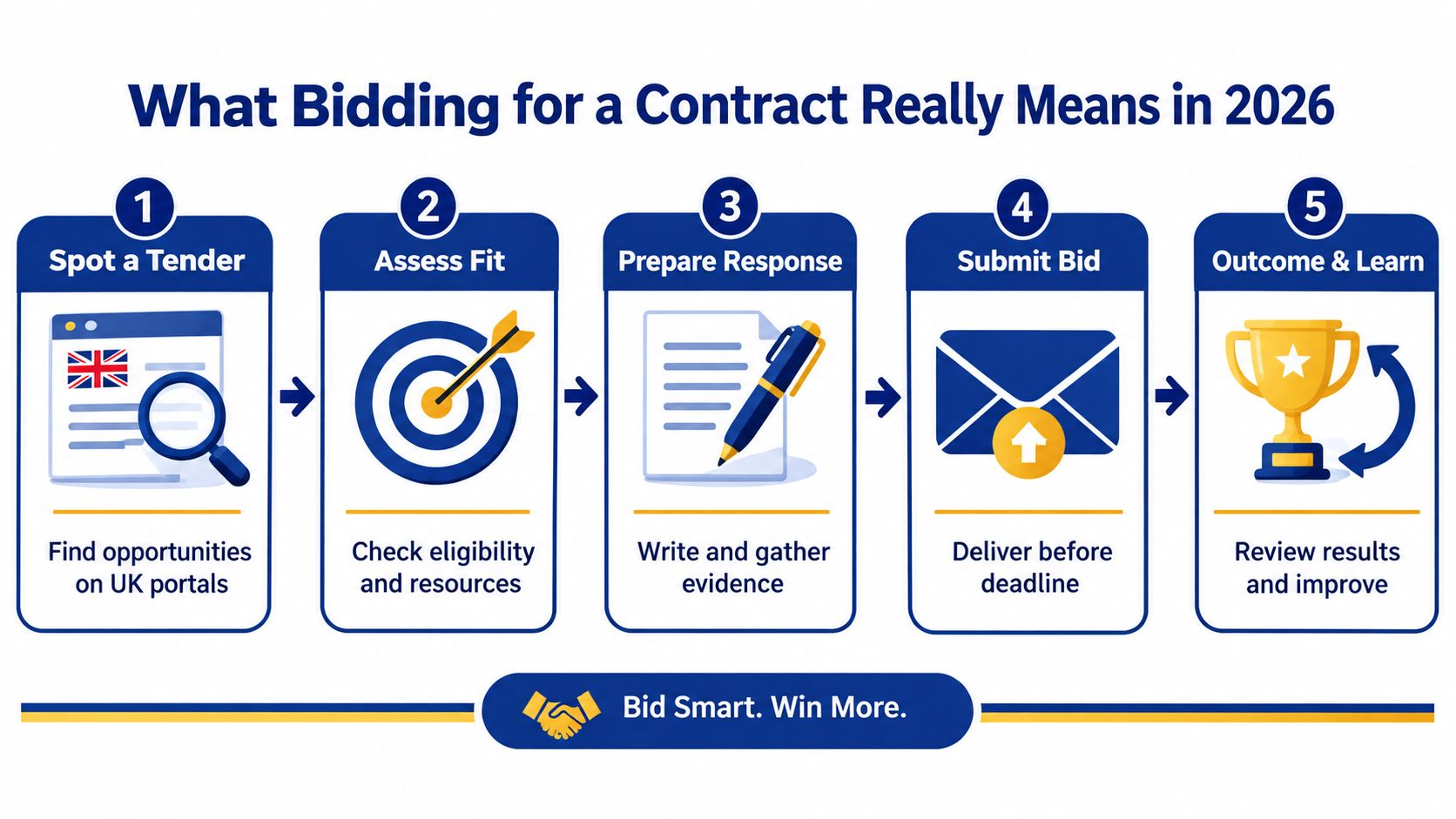
Registration isn't competitive readiness
The government's supplier guidance on the Procurement Act 2023 explains the Central Digital Platform's role in maintaining reusable supplier information. That reduces administrative repetition. It doesn't replace the work of proving that your business can deliver this contract.
Separate the material you maintain continuously from the commitments you make for a particular buyer:
- Maintain centrally. Keep company information, financial records, credentials and approved policies current.
- Check for each opportunity. Review eligibility, exclusions, contractual obligations and available delivery capacity.
- Tailor deliberately. Build the proposed service, mobilisation approach and evidence around the actual requirement.
A registration record can tell a buyer who you are. It can't explain how you'll handle their difficult transition, cover an absent supervisor or report service failures.
Put AI in the right place
Use tender monitoring to identify possibilities, a knowledge base to retrieve approved evidence, and AI response generation to assemble a draft. Keep commercial judgement and final approval with named people.
Practical rule: Automate the assembly of an answer, not the decision to stand behind it.
Don't set an arbitrary speed target before you understand the tender. A well-maintained evidence library can make drafting less labour-intensive, but missing proof still needs to be obtained and risky commitments still need approval.
Before committing, name the bid owner, delivery reviewer and pricing approver. Agree what work will be displaced. That is the starting point: an explicit investment decision, not a burst of enthusiasm followed by unpaid evening work.
Deciding Which Opportunities Are Worth Pursuing
Say no earlier. An attractive contract value doesn't make an opportunity commercially sensible, and recognising the service description isn't enough to justify a bid.
There is genuine SME access to this market. In 2023/24, CCS reported £3.52 billion of central-government spend directly with 1,525 SMEs, according to its public-sector procurement report. That establishes opportunity, not your probability of winning.

Make the decision on a page
Read enough of the invitation to tender, or ITT, to complete a qualification record. Don't authorise drafting while fundamental questions remain unanswered.
| Decision area | Evidence needed | Reason to stop |
|---|---|---|
| Scope | Clear match to services you can deliver | Essential work sits outside your capability |
| Eligibility | Mandatory conditions and acceptable evidence | A requirement cannot be met |
| Capacity | Available people, equipment and management | Delivery depends on unapproved recruitment |
| Evidence | Relevant, verifiable experience | The strongest criteria expose weak experience |
| Commercial fit | Credible costs, terms and cash-flow assessment | Delivery creates unacceptable exposure |
| Bid effort | Named contributors and approved budget | The pursuit displaces more valuable work |
For qualification-heavy opportunities, use a consistent PQQ preparation workflow. Surface missing evidence before the writing team becomes attached to the opportunity.
Budget the pursuit, not just the contract
Estimate staff hours by role and apply your internal cost rates. Add external legal or technical review, clarification work and any pre-award preparation you'll fund.
Set a maximum bid budget and record the assumptions behind your likelihood-of-success judgement. Treat that judgement as an estimate, not a precise probability.
The CMA's reflections on public procurement warn that fixed participation costs disadvantage smaller suppliers. Short deadlines, burdensome conditions and uncertain prospects deserve commercial scrutiny, not heroic effort.
Competition is still worth preparing for: in 2023/24, 53% of new MOD contracts awarded to SMEs followed competition, representing 70% of SME contract value, up from 61%, according to MOD contract statistics.
Use monitoring to find candidates and the knowledge base to test evidence fit. Start AI response generation only after approval.
Finding the Right Tenders Across UK Portals
Monday morning, 9am. Your alerts inbox holds 40 new notices. Three are worth reading, one is worth bidding, and the rest will eat an hour you never get back unless your filters do the rejecting for you.
That ratio is normal. The fix is a monitoring setup that kills weak alerts before a human spends time on them, because the fastest way to lose money on tenders is to investigate everything.
From 24 February 2025, Find a Tender became the publication service for above- and below-threshold notices for new UK procurements, except below-threshold procurements in Scotland, as explained by the Find a Tender publication service. Useful consolidation, but you still need the rest of the map: Contracts Finder, Public Contracts Scotland, Sell2Wales for Welsh work and eTendersNI for Northern Ireland. No single feed covers your patch, so build the geography first and the keyword logic second.
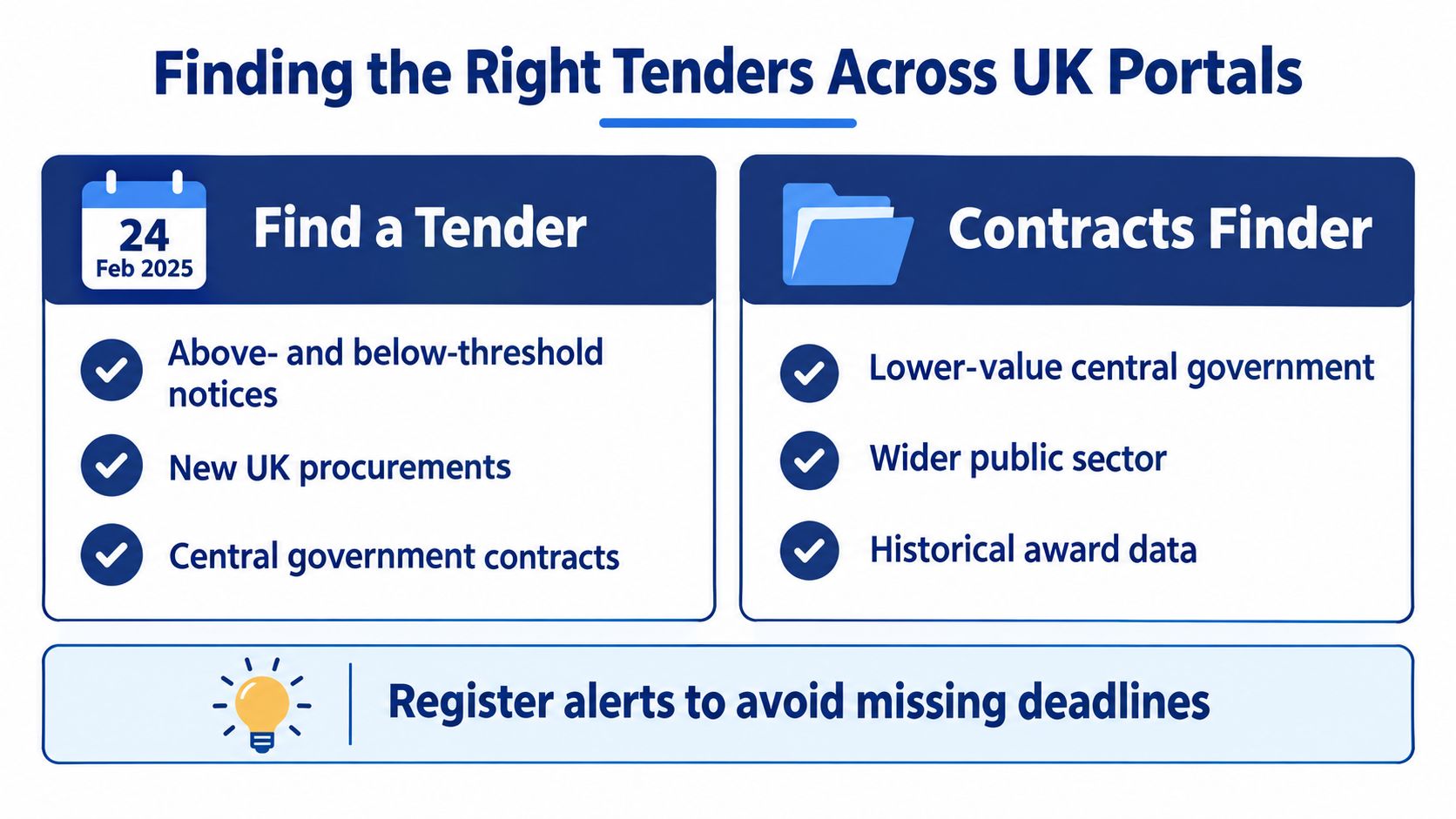
Two mistakes keep costing SMEs here. First, filtering only on CPV codes when buyers describe the same service in half a dozen vocabularies; pair the codes with the phrases buyers use, and weight them by contract value and region so borderline results get inspected rather than auto-binned. Second, treating the alert portal as the submission portal. The notice that finds you is often not the system where clarifications and uploads happen, and discovering that at 4pm on deadline day is how competent bids die.
Watch your rejection pile, not just your shortlist. If winnable work keeps surfacing under terminology you never search for, your filters are the problem, not the portal. Buyer behaviour matters too: follow the authorities whose requirements match your delivery model, and split early engagement, live tenders and award notices into separate queues, because each demands a different action.
When an alert survives triage, give it ten minutes, not ten hours. An AI summary should surface the service, location, deadline, procurement route and obvious qualification conditions, which is enough for a reject-or-investigate call. A buyer-specific resource such as this Buckinghamshire Council e-tendering guide can fill in the mechanics of an unfamiliar portal, but verify everything against the live documents before anyone writes a word.
One person owns this inbox daily, and every alert ends with a recorded outcome: investigate, reject or qualify. Ambiguity is where bid budgets leak. Most SMEs don't lose tenders because they write badly. They lose because they say yes to notices that were never winnable, then turn a thirty-hour writing effort into an expensive lesson instead of a three-hour review of a bid worth making.
Reading the ITT and Building a Compliance Matrix
The ITT is your working specification for the bid. Read it as a set of obligations, not background material to skim before writing.
Separate administrative compliance, economic and financial standing, and technical quality and price. A persuasive method statement won't repair a missing mandatory declaration, and an eligible supplier can still submit a weak technical response.
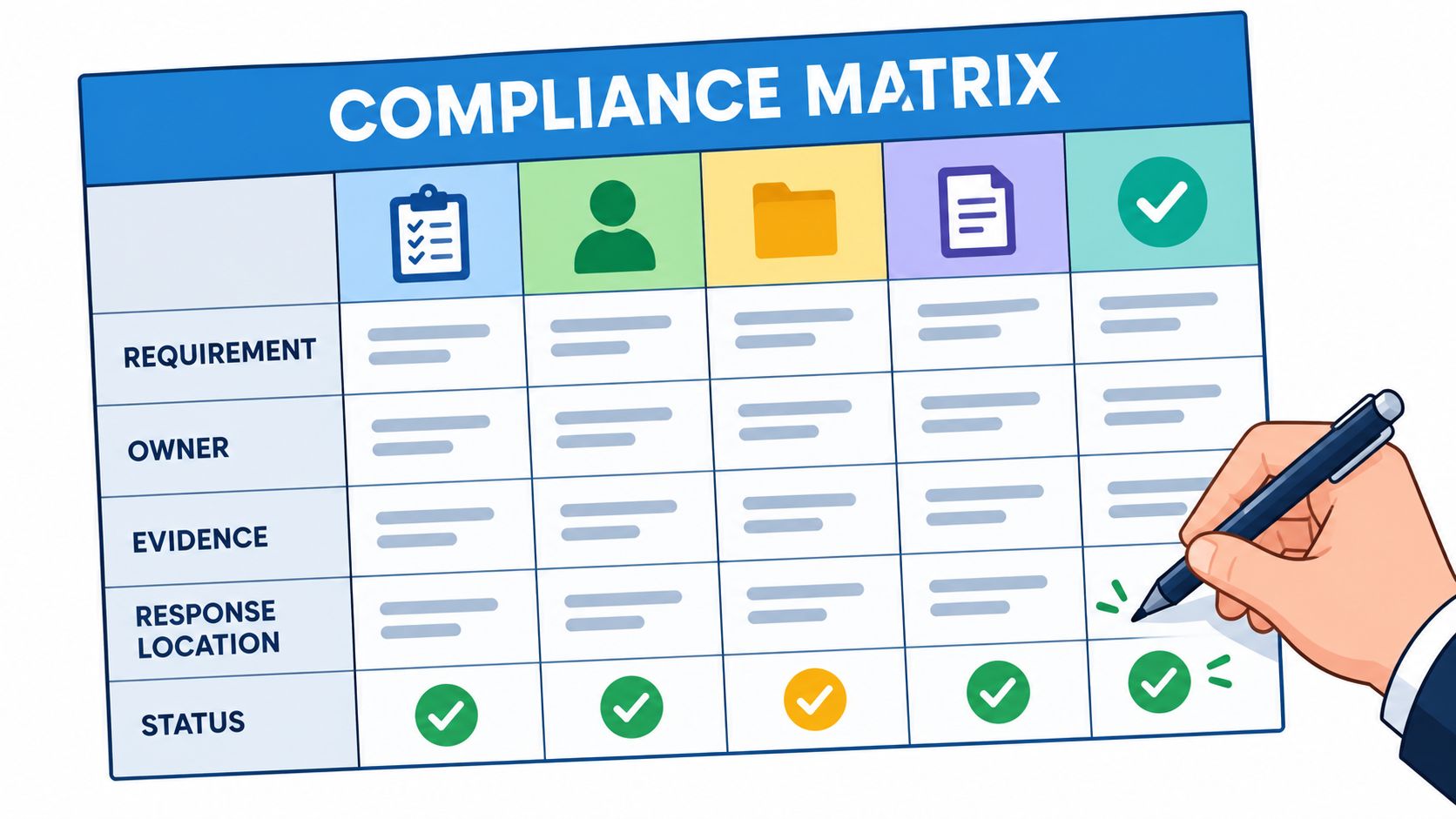
Give every requirement an owner
Create a compliance matrix before allocating prose. Break compound questions into their separate requirements so nobody mistakes a partially answered question for a completed response.
| Requirement | Owner | Evidence source | Response location | Status |
|---|---|---|---|---|
| Supplier declaration | Bid lead | Approved company records | Portal declaration | Awaiting check |
| Financial evidence | Finance lead | Current financial documents | Requested attachment | In preparation |
| Mobilisation method | Operations lead | Delivery plan and relevant experience | Technical response | Drafting |
| Pricing schedule | Commercial lead | Approved cost model | Buyer workbook | Awaiting approval |
Add the exact document reference, applicable word limit and clarification dependency where relevant. Keep the matrix short enough to use during a review meeting.
The government's procurement guidance for FCDO suppliers explains that evaluation criteria and their relative importance must be published. Use that information to allocate effort, rather than letting the most vocal contributor choose the priorities.
Separate compliance from editorial polish
Mark each item as mandatory, scored or informational according to the documents. Don't guess when wording is ambiguous. Raise a clarification through the prescribed channel.
For editorial discipline alongside procurement checks, Humantext.pro's content quality assurance framework is a useful resource to consider. Keep your actual acceptance tests tied to the buyer's requirements, not a general writing checklist.
- Traceability. Every requested element has a response location.
- Accountability. Every unresolved item has an owner.
- Consistency. Staffing, dates and commitments agree across documents.
Store approved evidence in the knowledge base and attach it to the relevant matrix entry. Give AI response generation the question, assessment wording and permitted evidence, not an undifferentiated folder. Monitoring has already done its job; document control now matters more than finding another opportunity.
Pricing Your Bid so It Stands Up to Evaluation
I've watched SMEs shave margin to claw back a quality deficit, win the contract, then spend two years paying for the privilege of delivering it. Price follows the score. Get the score right first.
Under UK guidance on assessing competitive tenders, award criteria must be relevant, clear, measurable, specific and proportionate, and they can cover quality, social, economic and environmental considerations alongside price. Read the actual evaluation model before assuming cheapest wins. Plenty of tenders weight quality heavily enough that a mid-priced bid with strong evidence beats the lowest compliant offer.
Run the scoring maths before you touch the price
Map each quality response to the buyer's scoring scale, then apply the published weighting and normalisation exactly as the documents describe. That tells you where the marks sit.
If the maths shows you're losing on a scored question, ask what would close the gap. Say a tender weights quality at 60% and price at 40%: improving a heavily weighted answer moves the result further than a modest price cut, and it doesn't come out of your margin. Sharper evidence or a more credible delivery method is often the cheaper fix.
Cutting price to offset a weak answer buys you a contract you priced to lose.
Cost the bid you actually wrote
Build the model from the delivery plan, with finance and operations in the room. The costs that sink SMEs are the ones nobody listed:
| Category | What gets forgotten |
|---|---|
| People | Supervision and management overhead on top of delivery labour |
| Starting and finishing | Mobilisation, implementation, transition and exit work |
| External inputs | Subcontractors, insurance, technology, travel |
| Ongoing obligations | Compliance, reporting, inflation exposure, contractual service commitments |
Cross-check the result against the technical response. Every commitment in your answers needs a line in the commercial assumptions. If a writer added a monthly review meeting or extra site presence to sound responsive, that has a cost. Put it in the model or take it out of the answer.
Stress-test the downside before you submit
Hand the pricing to someone who didn't build it. Have them attack staffing assumptions, supplier quotes, mobilisation dependencies and payment timing. Ask what happens if mobilisation runs long or delivery costs climb.
The same guidance requires prices to cover all costs, without unauthorised assumptions or caveats. Excluding a hard requirement and hoping nobody notices is a clarification question waiting to happen.
Record the approved assumptions in your knowledge base. When AI drafts a response, it should describe the service you priced. Anything it adds beyond that is an unapproved cost written into a contract.
Judge pricing performance through your own funnel: qualified opportunities, compliant submissions, shortlist outcomes, awards, quality scores and price position, segmented by buyer and contract type. No universal win rate is worth chasing. If a category keeps demanding a delivery model you cannot price sustainably, that's a qualification signal. Filter it out and spend the hours on tenders you can win and fund.
Writing Answers That Actually Score
A cleaning contractor gets asked how it will mobilise a school contract in six weeks. The first paragraph describes twenty years of family ownership. The evaluator moves on, and the score lands at the bottom of the scale.
Answer the question in the first line. If the buyer asks how you will mobilise, explain who owns readiness, how site information gets checked and what must happen before service starts. Company history waits unless the question requires it.
The government's SME bidding guidance recommends evidence-led responses aligned to the assessment method and warns against generic content, unsupported claims and missed word limits. Treat those as writing controls set before drafting, not finishing touches.
Write for the person holding the scoresheet
Evaluators mark against criteria, not impressions. Every paragraph needs a job: state the method, show who delivers it and in what sequence, commit to measurable outputs, name the risks and your controls, attach evidence, and add social value where the question calls for it.
Compare two openings to "Describe your approach to contract management":
We pride ourselves on proactive partnership and best-in-class service delivery.
A named contract manager chairs a monthly performance review against the KPI schedule, with corrective actions logged, assigned and closed within agreed timescales.
The first claims. The second commits. Evaluators can only score the second.
Make AI draft, then make reviewers attack it
Organise the knowledge base by evidence type and service relevance: credentials, approved policies, case studies, staff experience and past responses, each with an owner and review status. For each case study, keep the client context, scope, work performed and verified outcome, with measured results held separately from client feedback.
Give the AI tool the exact question, the relevant assessment wording, the word limit and the selected evidence. Instruct it to flag gaps rather than fill them with plausible claims.
The reviewer's job is to test accuracy and delivery credibility. Are the named people available? Does the evidence match the proposed work? Does the answer promise anything operations has not approved? Trim introductory prose before cutting proof.
Take a thirty-hour response. Drafted from a maintained knowledge base, the same answer becomes a three-hour review pass, and the senior time shifts from writing to verifying. AI supplies the draft. Permission to submit comes only after review.
Why Copy and Paste Answers Keep Costing You Marks
Reusing evidence is sensible. Reusing an entire answer because the question looks familiar is careless.
A previous response was written for a different specification, operating environment and assessment method. Even when the service is similar, the new buyer may care about different risks, reporting arrangements or mobilisation dependencies.
Keep the facts and rebuild the argument
Under section 23 of the Procurement Act 2023, award criteria must relate to the contract, be sufficiently clear, measurable and specific, and be proportionate to its nature, complexity and cost, as set out in the legislation on award criteria. Broad claims about excellent service don't demonstrate how your proposal satisfies those criteria.
Audit your recent responses by asking what each paragraph proves. Highlight company description separately from proposed actions and supporting evidence.
| Keep under control | Rewrite for the opportunity | Delete unless requested |
|---|---|---|
| Current certifications | Mobilisation arrangements | Generic opening statements |
| Approved policy facts | Buyer-specific reporting | Unsupported superiority claims |
| Verified case evidence | Service methods and responsibilities | Repeated company history |
| Accurate staff credentials | Contract-specific social value | Irrelevant client examples |
Don't discard a strong case study because you've used it before. Explain its relevance to the new requirement, including any important differences. Relevance is the work; copying is merely the shortcut.
Reuse boundary: Keep an approved fact. Reconsider every promise.
A bid-writing software workflow should help separate evidence retrieval from answer construction. That's the distinction between maintaining a useful library and maintaining a collection of stale submissions.
Review the submission as a complete package
Reserve the closing period for controlled review, not a frantic attempt to invent missing evidence. Freeze the main draft early enough for reviewers to inspect the actual package.
Run separate compliance and quality passes. Combining them encourages reviewers to correct punctuation while overlooking a missing attachment or an unsupported delivery commitment.
- Compliance pass. Check declaration accuracy, required signatures, attachments, file formats, word limits and portal instructions.
- Quality pass. Assess each answer against the buyer's scoring language, with evidence visible beside the claim it supports.
- Commercial reconciliation. Confirm that staffing, service levels and proposed activities match the approved price.
- Submission check. Confirm upload completion, inspect the submitted files where possible and retain the receipt or confirmation.
Word limits need particular care. As noted in the SME bidding guidance earlier, excess content may be disregarded. Don't place essential evidence beyond the permitted response.
Ask a reviewer who wasn't the principal writer to explain what the buyer is being promised. If they can't identify the method, responsibility and evidence without interpretation, the answer needs work.
Make the debrief change the next decision
After an award decision, compare assessment information with your forecast. Distinguish a weak proposal from weak explanation, an evidence gap from a compliance failure, and an uncompetitive price from a misjudged opportunity.
For contracts below £5 million, the award notice needn't identify every unsuccessful supplier, but must include specified tender participation counts, including assessed SME and qualifying non-governmental organisation tenders, under the government's contract award notice guidance. Use that context alongside your assessment information, not instead of it.
Record the buyer's feedback against the exact question and evidence used. Assign an action: obtain stronger proof, revise the delivery approach, correct the pricing assumption or tighten qualification.
Feed those decisions into the knowledge base so future AI-generated drafts use corrected material. Adjust tender monitoring when the result exposes a poor market fit.
That's how you improve the next bid for a contract. Not by writing a longer capability statement, but by making a better decision and presenting a more defensible proposal.
Bidwell offers tender monitoring, a knowledge base for approved evidence, and AI response generation for customised tender drafts. Visit Bidwell to organise your next qualified opportunity, gather the supporting material and move your team's effort from blank-page writing to review and refinement.

