
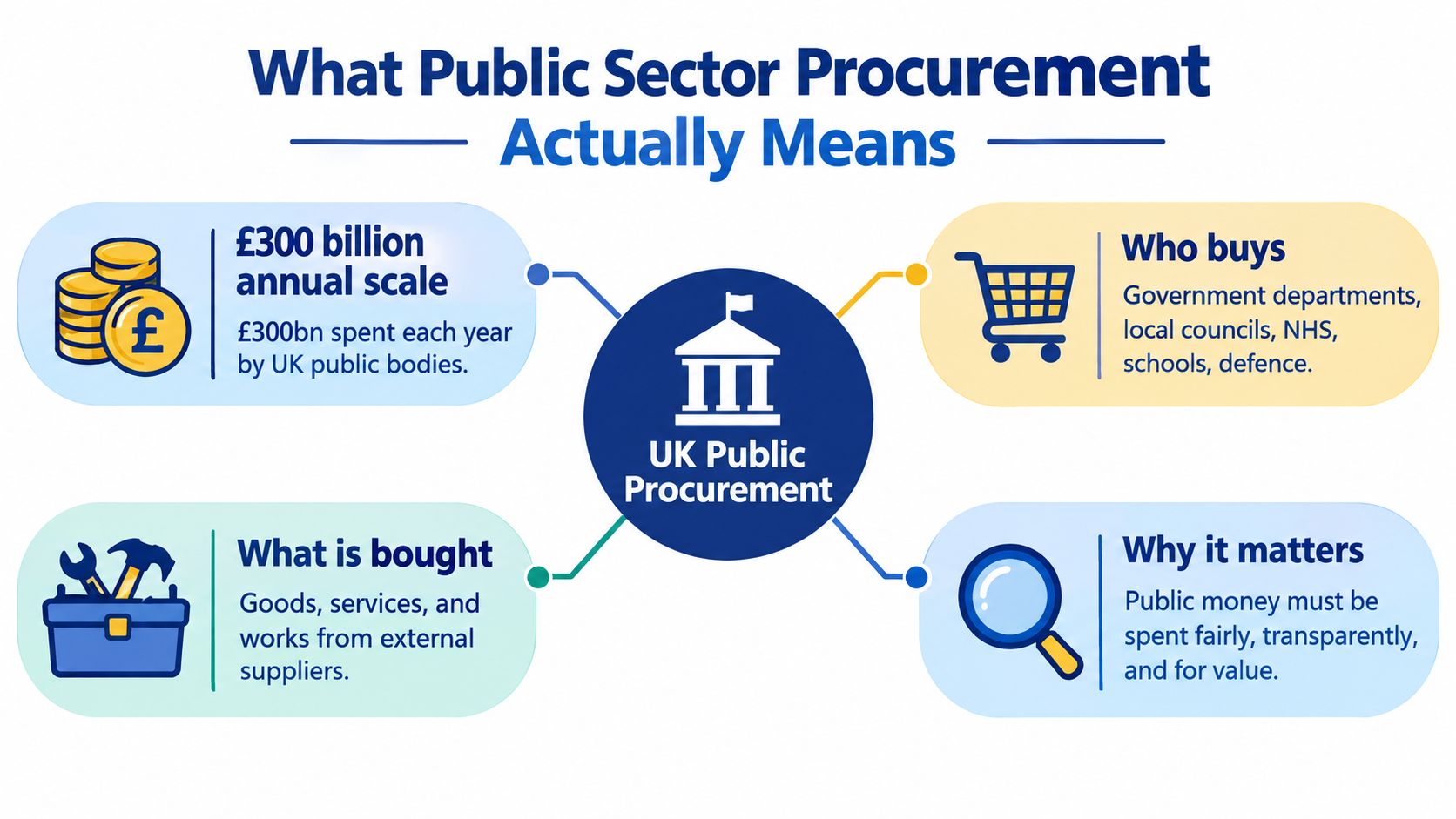
The UK public sector spends approximately £300 billion a year on procurement, around one-third of all public expenditure. That makes procurement in the public sector far more than a government back-office function. For suppliers, it's a substantial commercial market, but winning work means understanding who buys, where opportunities appear and how buyers assess bids.
A good bid doesn't just describe what your business can do. It answers the buyer's stated requirements, follows the rules in the tender documents and gives evaluators clear evidence that you can deliver.
What Public Sector Procurement Actually Means
Public bodies buy goods, services and works from external suppliers. Goods might include computers or healthcare supplies. Services can range from facilities management to professional advice, while works include construction and maintenance.
The buyers are varied. They include central government departments, local councils, NHS organisations, universities, schools and devolved administrations. Each buyer has its own needs, but public money must be spent through processes designed to support fair competition and value.
The basic language of a tender
A contracting authority is the public body running the procurement. It sets out what it needs, invites suppliers to respond and evaluates bids against published requirements.
The document that describes the requirement is often called a specification. It might set out what a supplier must provide, the service levels to meet, how delivery will work and what evidence the buyer expects. An Invitation to Tender, or ITT, is the formal invitation to submit a bid, usually with the specification, questions, deadlines and evaluation criteria.
For example, a council might need a supplier to maintain its buildings. The specification could describe the work and service standards, while the ITT explains how to submit a response and how the council will score it.
Public procurement isn't a list of tenders waiting to be answered. Buyers plan what they need, define the requirement and then run a process to select a supplier. Understanding purchasing best practices can help businesses improve the way they organise purchasing information and decisions, even when preparing to sell to a public body.
How UK Procurement Rules Got Where They Are
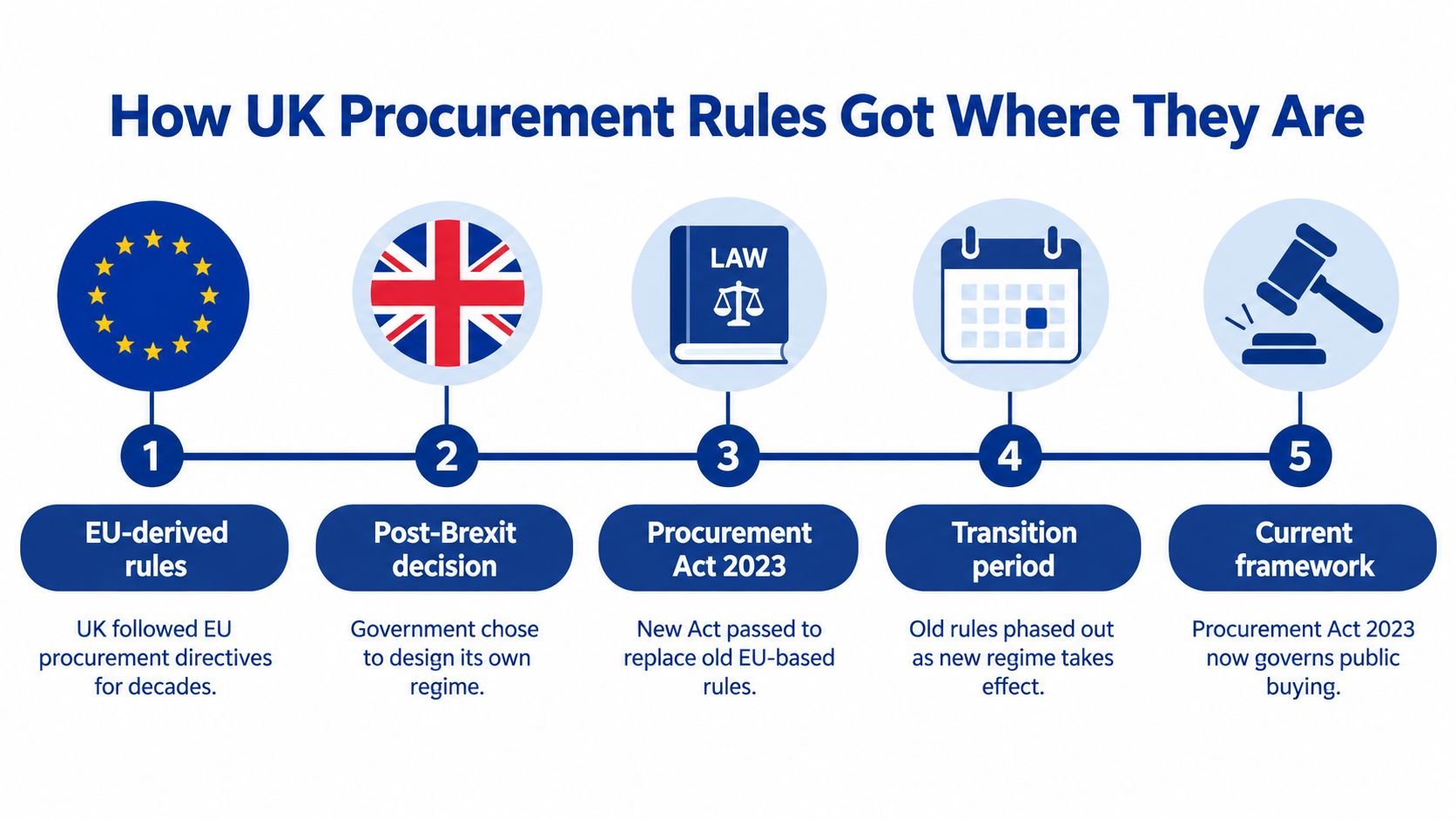
The current UK procurement framework followed a period in which rules were largely shaped by European Union directives. Different types of public purchasing were governed through separate regulations, including the Public Contracts Regulations 2015, the Utilities Contracts Regulations 2016, the Concession Contracts Regulations 2016 and the Defence and Security Public Contracts Regulations 2011.
That history matters when you read a tender. The rules applying to a contract can depend on when the procurement began, so don't assume that every opportunity you find follows the same regime.
The move to a consolidated framework
The Procurement Act 2023 received Royal Assent on 26 October 2023. It replaced much of the previous framework with a consolidated UK-wide regime intended to simplify public purchasing and improve transparency. After an implementation delay from the originally planned October 2024 date, the new regime came into force on 24 February 2025. These dates and the Act's purpose are set out in the explanatory notes to the Procurement Act 2023.
For suppliers, the practical point is straightforward: check the procurement documents and applicable dates rather than relying on an old bid template or an explanation written for the previous rules. The legal framework determines how the authority publishes notices, manages competition and awards the contract.
The change is also a useful prompt to review internal bid processes. A response library built under the old regime can still contain valuable credentials and evidence, but your team should check that templates and compliance checks match the current tender's instructions.
Where UK Tender Opportunities Are Published
Find a Tender is the central source for new UK procurements under the Procurement Act 2023. It publishes above-threshold and below-threshold notices, although Scotland is excluded from the below-threshold publication requirement.
Smaller opportunities may appear elsewhere. Below-threshold opportunities worth more than £12,000 including VAT are generally published on Contracts Finder in England and other non-devolved territories, Public Contracts Scotland in Scotland, and Sell2Wales in Wales. The portal rules and publication arrangements are set out in the relevant regulations.
Match the portal to the opportunity
| Portal | Coverage | Typical threshold |
|---|---|---|
| Find a Tender | New procurements under the Procurement Act 2023, including above-threshold and below-threshold notices | Central source; includes below-threshold notices where the requirement applies |
| Contracts Finder | England and other non-devolved territories | Below-threshold opportunities above £12,000 including VAT are generally published |
| Public Contracts Scotland | Scottish public-sector opportunities | Below-threshold opportunities above £12,000 including VAT are generally published |
| Sell2Wales | Welsh public-sector opportunities | Below-threshold opportunities above £12,000 including VAT are generally published |
The threshold in the table is a practical guide to where certain below-threshold notices are generally published. It isn't a promise that every contract appears on the same portal, so check the authority's own procurement information where needed.
Monitoring just one portal can leave gaps. A supplier that tracks Find a Tender but never checks regional sources may miss relevant local work. Build a routine around the buyers and locations you serve, then make sure alerts cover the portals that apply.
Who Is Involved on Each Side of a Procurement
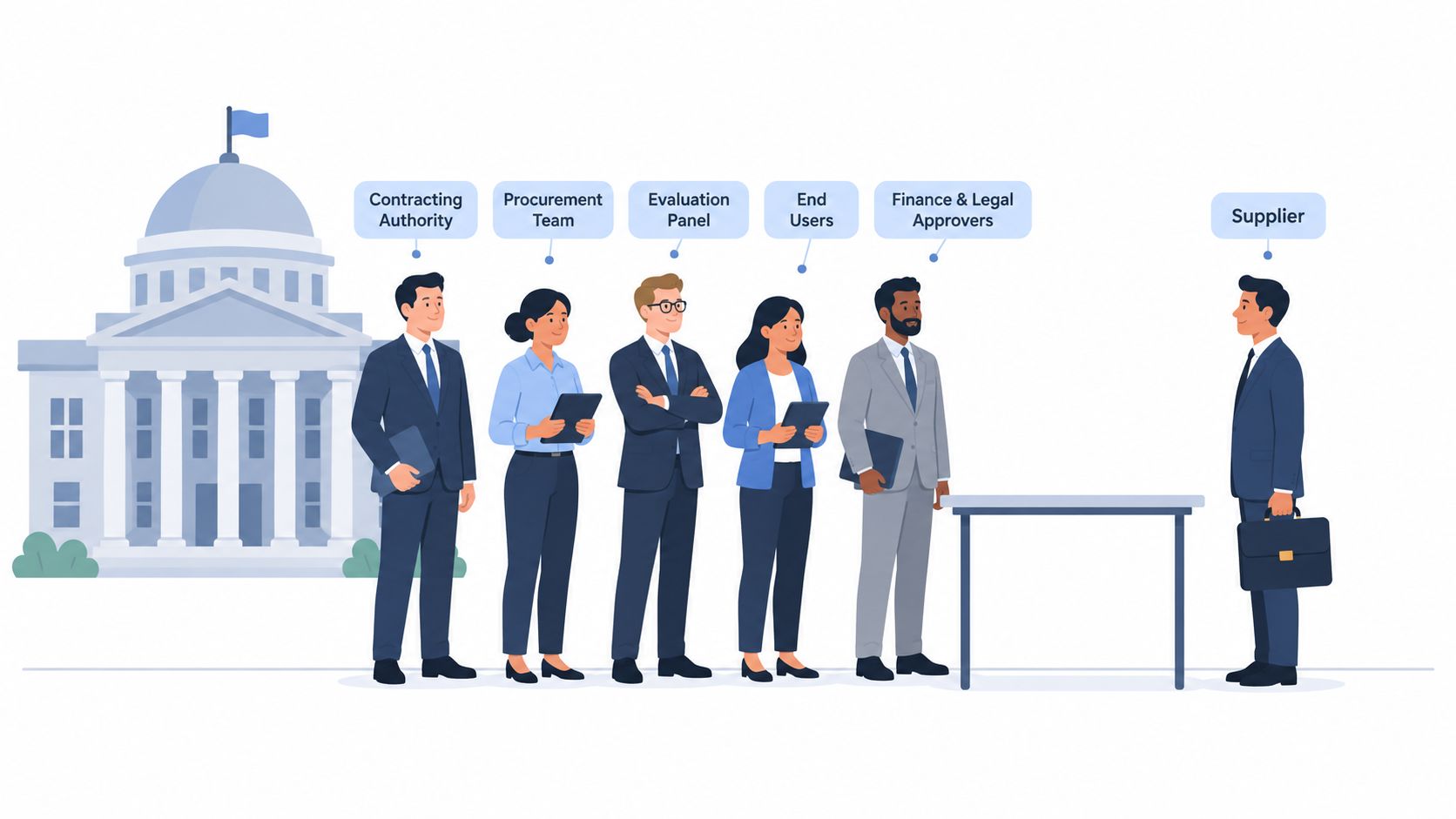
A tender can involve several people inside the buying organisation. The contracting authority owns the procurement, but procurement and commercial staff often manage the process. Evaluators may include technical specialists who understand the service, end users who will work with the supplier, and finance or legal approvers who review cost and contractual risk.
On the supplier side, the response may need input from a bid manager, bid writer, technical subject-matter experts, commercial leads and senior approvers. Each person contributes a different part of the case: delivery knowledge, pricing, evidence, compliance or final sign-off.
Different roles, different questions
The buyer's team needs to show that the process is fair and that its decision is supported by the published requirements. They'll look for evidence that the supplier can meet the specification, manage delivery risks and provide value. The supplier's team, meanwhile, has to make that evidence easy to assess.
This difference affects how you write. A technical specialist may want to know how the service will work in practice. A finance reviewer may focus on pricing assumptions, while procurement staff check whether the bid follows the submission instructions.
Practical rule: Write for the people who'll evaluate the response, not just the person who first reads it.
A response that makes a broad claim such as “we provide excellent service” leaves work for the evaluator. A stronger answer explains the relevant approach, identifies who will deliver it and points to supporting evidence. Keep claims tied to the contract, and make it easy to find the answer to each question.
How a Typical Procurement Procedure Runs
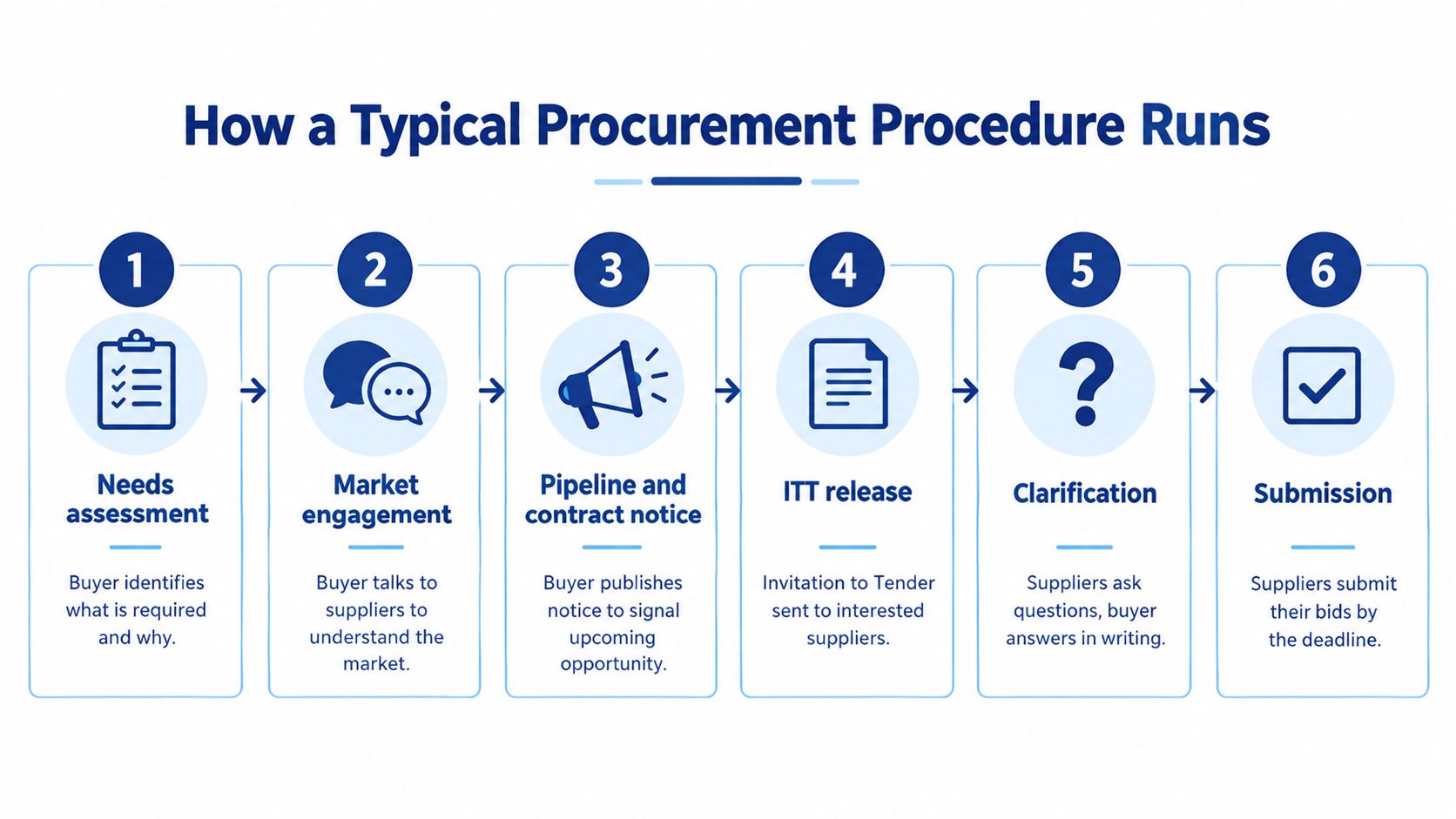
A procurement starts before the ITT arrives. The buyer identifies a need, works out what it should cover and may engage with the market to understand available solutions. Suppliers may see advance information or a pipeline notice before the formal competition begins.
From early signal to submitted bid
Once the authority is ready to compete the requirement, it publishes the relevant notice and issues tender documents. Suppliers review the specification, assess whether they can meet the requirements and decide whether to bid. If a requirement is unclear, the ITT will normally explain how to submit clarification questions and when the authority will respond.
The response then moves through preparation, internal review and submission. After the deadline, the authority evaluates bids against the stated criteria, makes an award and publishes the required information.
There are two useful notice points for below-threshold procurements. The authority must publish a below-threshold tender notice before advertising a notifiable below-threshold contract, then publish a contract details notice as soon as reasonably practicable after award. The obligation appears in Part 6 of the Procurement Act 2023.
That means your monitoring shouldn't stop when a tender closes. An award notice can show that a procurement has concluded and help your team review the result. For a clearer picture of how to prepare and manage a formal proposal, this guide to RFP best practices for vendors offers useful process context.
Keep the tender pack under control
Treat the pack as a set of linked instructions, not one long document to skim. Record the deadline, submission route, mandatory requirements, clarification process and evaluation criteria in a bid plan. Assign each answer to a named owner and leave time for an independent check.
A missed requirement can undermine an otherwise strong response. Your final review should confirm that every question has an answer, requested attachments are present and the submitted files match the buyer's instructions.
Compliance Points That Actually Affect Your Bid
Start with the contract's estimated value, the buyer type and the contract classification. Thresholds help determine whether the full statutory procurement regime applies, and the relevant figures can change over time. For 2026–2027, the thresholds including VAT are £135,018 for goods and services bought by central government authorities, £207,720 for equivalent purchases by sub-central authorities, and £5,193,000 for works. These figures come from the Procurement Act 2023 threshold schedules.
Don't treat those as interchangeable cut-offs. A local authority and a central government department may fall under different thresholds for goods and services. Mixed requirements can also need careful classification, so check the tender documents and the effective date before deciding how the rules apply.
Read the scoring rules before writing
Evaluation criteria must relate to the contract's subject matter, be clear, specific, measurable and proportionate. The authority must publish the criteria and their relative weightings in advance, as described in the SME and VCSE public procurement bid pack.
Use the published criteria as your response plan. If a question carries a clear weighting, make sure the answer addresses its full scope and provides relevant evidence. Don't spend most of your bid describing general company strengths while leaving a scored requirement thin.
Some contracts also ask suppliers to provide a standard set of eligibility and capability information through pre-qualification questions. Keeping approved answers and supporting evidence organised in a PQQ response workspace can help your team avoid inconsistencies between tenders.
Payment performance deserves attention too. Government consultation material says undisputed invoices to small businesses should be paid within five days, all payments to small businesses within 30 days and all businesses within 60 days. For major central-government contracts, suppliers must demonstrate supply-chain payment performance, including 95% of invoices paid within 60 days and an average payment time of 45 days, according to the government consultation on public procurement reforms.
Where SME Access Is Genuinely Strong
“Public sector” isn't one uniform market for small suppliers. A 2026 analysis by the British Chambers of Commerce and Tussell found a sharp difference between local and central government in direct SME spending during 2025.
Local government spent £29.1 billion directly with SMEs, representing 34% of its procurement. Central government spent £6.4 billion directly with SMEs, or 10%. The figures are reported in the 2026 BCC and Tussell SME Procurement Tracker.
Choose buyers deliberately
That contrast should shape your route-to-market plan. If your service suits local authorities, council tenders may offer a different pattern of direct access than central government procurement. But buyer type is only one factor: the contract's scope, delivery geography, required capacity and route to market still matter.
Direct-spend figures don't capture the full role SMEs play. A small business may deliver through a prime contractor or a framework arrangement rather than hold a direct contract with the public body. So the figures are a useful view of direct awards, not a complete measure of SME participation.
For a smaller supplier, the practical response is to identify the buyers whose requirements match your strengths, then track both direct competitions and relevant supply-chain routes. Build a pipeline around realistic opportunities, not every public contract that appears.
A more useful question: Which buyers are most likely to need what you deliver, and can you meet their requirements directly or through a partner?
SME-focused guidance can help teams judge readiness and target opportunities. Start with a clear account of your delivery capacity, relevant evidence and the type of contracts you can support, then use resources for SME owners bidding for public-sector work to inform your planning.
A Practical Bidding Routine for Public Sector Work
Use pipeline notices to plan ahead: organisations with annual procurement spend above £100 million must publish a notice within the first 56 days of the financial year, covering planned procurements worth £2 million or more and an 18-month forward look (government guidance on transparency). Then monitor the relevant portals, validate value and buyer thresholds, and triage alerts against your capability.
Keep approved credentials, policies, case studies and past answers in a knowledge base. Bidwell combines tender monitoring across UK portals with a knowledge base and AI response generation, producing first drafts for human review. Its bid-writing software supports a repeatable workflow, so your team can spend less time starting from scratch and more time checking fit, evidence and compliance.
Bidwell brings UK tender monitoring, reusable bid evidence and AI-generated first drafts into one response workflow. Visit Bidwell to see how it can help your team find relevant opportunities and prepare clearer, more consistent bids.

