
Only 20% of reported UK public procurement spending went directly to SMEs in 2023, despite a market worth £194.8 billion. Smaller suppliers received £39.7 billion, according to the SME Procurement Tracker. That's a substantial opportunity, but it isn't an invitation to bid indiscriminately.
Bidding on contracts starts with choosing work you can win and deliver profitably. The writing matters, but a polished answer won't rescue poor commercial fit, missing evidence or a delivery model that doesn't stand up.
What Bidding on Contracts in the UK Actually Involves
A public-sector bid is a sequence of decisions, not a company brochure with a price attached. You need to identify suitable work, decide whether it deserves your resources, plan around the evaluation criteria, submit a convincing response and learn from the result.
Buyer selection matters. The procurement tracker cited above shows that local government directed £24.1 billion, or 34% of its spending, to SMEs, while some central-government departments allocated only around 2% to smaller businesses. Treat those differences as a targeting consideration, not a prediction of your own success.
Understand the route to work
The Procurement Act 2023 changed the statutory framework and introduced measures intended to reduce obstacles to SME participation. Yet access to a purchasing arrangement isn't the same as winning revenue: British Chambers of Commerce reporting on procurement reform records that SMEs represented 72% of suppliers on CCS commercial agreements, while CCS recorded £3.52 billion, or 16.7% of central-government spend, directly with 1,525 SMEs for the year reported in July 2024.
Before committing, establish what the buyer is offering. Is it a specific delivery contract, admission to an agreement, or an opportunity that requires further competition?
For a different purchasing context, Pacific Mobile Structures, Inc.’s resource on cooperative purchasing discusses benefits for healthcare and government. It's useful background when thinking about purchasing routes, but it shouldn't replace the rules in a UK tender.
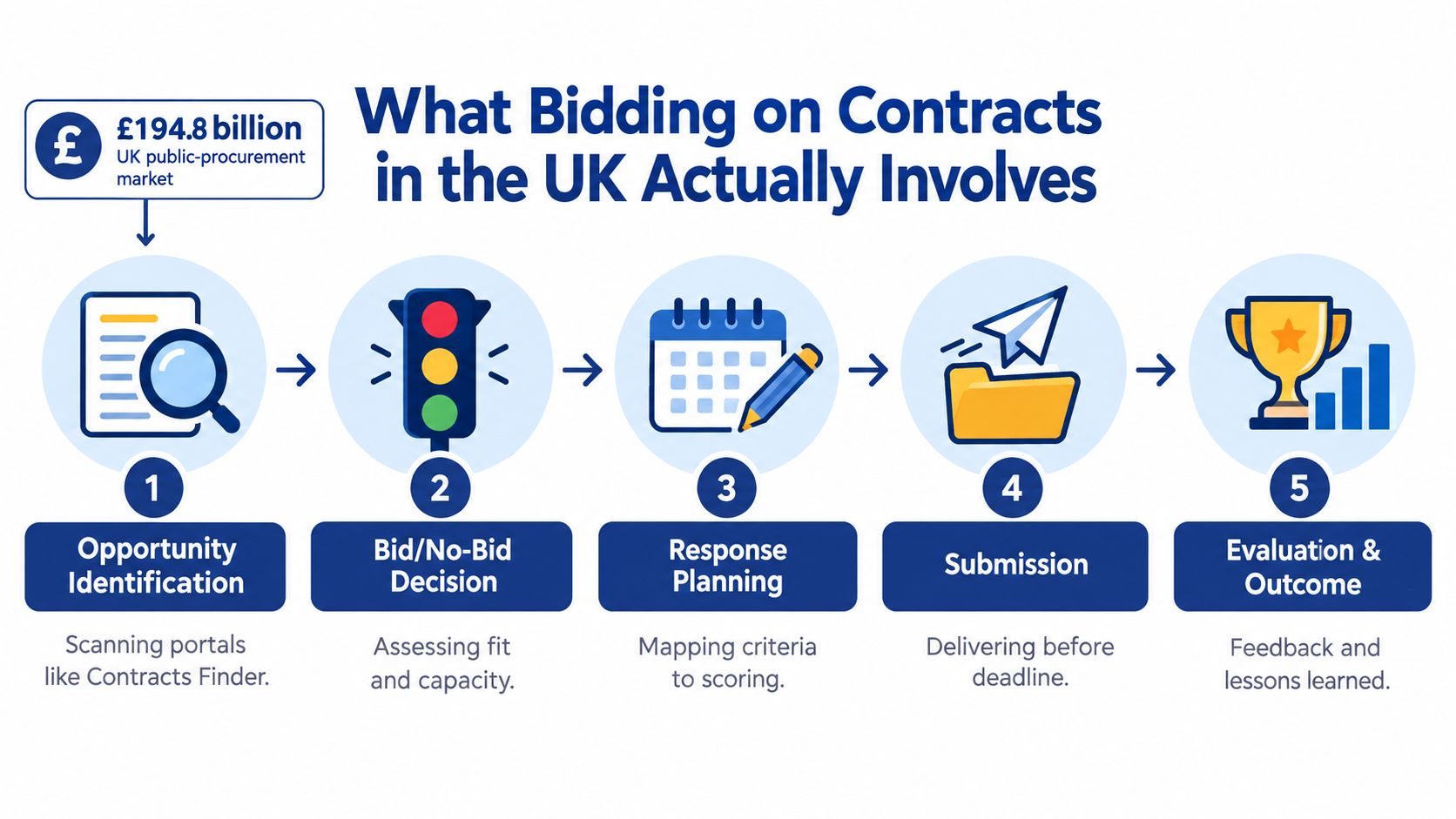
Give each stage a decision owner
- Opportunity identification: Someone checks scope, location, value and buyer requirements, rather than forwarding every notice to the writer.
- Bid/no-bid: Commercial and operational colleagues approve the pursuit before drafting starts.
- Response planning: The bid lead assigns questions, evidence and review responsibilities.
- Submission: An accountable person checks the complete package and confirms receipt.
- Evaluation and outcome: The team records what scored well and what needs changing.
Tender monitoring supports the first decision. A knowledge base supports evidence selection, while AI response generation supports drafting. None replaces the person who must decide whether the promised service is commercially and operationally credible.
Where to Find the Right Tenders
Start with Find a Tender, but don't assume every relevant opportunity follows the same publication rules. The notice date, authority and procurement type all affect where you should look.
From 24 February 2025, Find a Tender became the main service for new Procurement Act procurements, covering above- and below-threshold notices except below-threshold procurements in Scotland. For competitions started earlier, it generally contains only above-threshold notices.
UK tender portals at a glance
| Portal | Coverage | Minimum publication value |
|---|---|---|
| Find a Tender | New Procurement Act notices, with the Scottish below-threshold exception; generally above-threshold legacy notices | Depends on the notice, buyer and procurement regime |
| Contracts Finder | England and other non-devolved territories | Central government: £12,000 including VAT; sub-central authorities and NHS trusts: £30,000 including VAT, under the Contracts Finder transparency guidance |
| Public Contracts Scotland | Scottish opportunities, including below-threshold work | Check the applicable Scottish publication requirements |
| Sell2Wales | Welsh opportunities | Check the applicable Welsh publication requirements |
Don't confuse a portal's publication floor with the threshold that determines the procurement regime. For procurements commencing from 1 January 2026, the government's procurement threshold guidance sets £135,018 including VAT for central-government goods and services, £207,720 for sub-central goods and services, and £5,193,000 for general works contracts.
Contract classification matters. A construction supplier shouldn't apply a goods-and-services threshold because the buyer is a central-government authority.
Configure alerts around delivery fit
Bidwell is one option alongside direct portal searches. Its tender monitoring covers Find a Tender, Contracts Finder, Public Contracts Scotland and Sell2Wales, providing daily alerts with AI-generated summaries.
Set filters around sector, CPV code, geography and contract value. Then ask the recipient to check the original documents, particularly whether the notice concerns a new competition, a legacy procurement or a purchasing arrangement.
- Assign an alert owner: Route relevant notices to someone who can make an initial fit assessment.
- Separate buying routes: Keep direct contracts distinct from agreement applications. The frameworks resource provides a starting point for that distinction.
- Record buyer context: Store authority-specific requirements in the knowledge base so repeat opportunities don't require fresh detective work.
AI response generation belongs later. Finding a notice quickly is useful only if you leave enough time to inspect it before committing to a response.
Deciding Whether to Bid in the First Place
Eligibility is a minimum condition, not a business case. You can meet every participation requirement and still be looking at a contract that consumes working capital, exposes you to unacceptable risk or prevents you serving existing customers.
Research referenced in the government's SME action plan found that 41% of UK construction SMEs succeeded in public-sector bidding only 10% of the time or less, while 55% reported declining success over the preceding five years. The same source records Home Office direct SME spending of £267.8 million in 2025/26, or 4%, against an indicative 8% target.
Those figures don't establish your odds. They do make a strong case for questioning the assumption that more submissions automatically mean more worthwhile work.
Bid/no-bid scorecard
| Factor | Question to answer | Red flag |
|---|---|---|
| Capability and evidence | Can we prove we can deliver the required scope? | Critical experience is missing |
| Expected value | Does a realistic chance of winning justify the investment? | Confidence rests on enthusiasm rather than evidence |
| Total bid cost | What will writing, pricing, legal review and partner coordination consume? | Existing delivery staff must absorb unplanned bid work |
| Cash flow | When do costs arise, and when can we invoice and collect payment? | Mobilisation depends on cash we don't have |
| Margin | What remains after all delivery obligations? | Pricing excludes management, reporting or cover |
| Insurance and liability | Can we accept and fund the contractual exposure? | Unaffordable insurance or unacceptable liability |
| Subcontracting | Are partner capacity, pricing and responsibilities confirmed? | Essential commitments remain informal |
| Timescale and scope | Can we prepare and mobilise properly? | An unusually short deadline or unrealistic budget |
Make the commercial decision explicit
A useful internal calculation is expected contribution from winning multiplied by an evidence-based probability of success, less total bid cost. Use a cautious judgement informed by comparable pursuits, not a guessed industry win rate.
For digital-service suppliers using delivery partners, WebinOne's discussion of web design reseller margins is relevant background. Apply the underlying commercial question to your own proposal: what remains after the subcontractor, account management, revisions and support are paid?
Commercial rule: A technically winnable contract can still be the wrong contract to win.
Decline when the economics or exposure can't be made acceptable. Seek a consortium partner when a defined capability gap can be covered with clear accountability, and use clarification questions when a requirement appears unrealistic.
Keep qualification evidence organised through a PQQ preparation workflow. Tender monitoring identifies candidates, the knowledge base tests readiness, and AI response generation should begin only after approval.
Planning Your Response Around the Buyer's Scoring
Don't start by dividing the document into equal writing tasks. Start by asking where the buyer will award marks and where your proposed response is weakest.
Government guidance on assessing competitive tenders requires award criteria to relate to the contract subject matter and be clear, measurable, specific and proportionate. Where multiple criteria apply, the buyer must disclose their relative importance through weightings, ranking or another stated method.
Build a weighted response plan
Use the published scoring scale to set a defensible target for each criterion. Multiply that target by its published weighting, then identify the weighted gaps between your current evidence and the score you're aiming for.
If mobilisation carries substantial weight and your transition plan is vague, improve that plan before polishing an already convincing technical answer. If the buyer uses a different evaluation method, follow that method rather than imposing your own arithmetic.
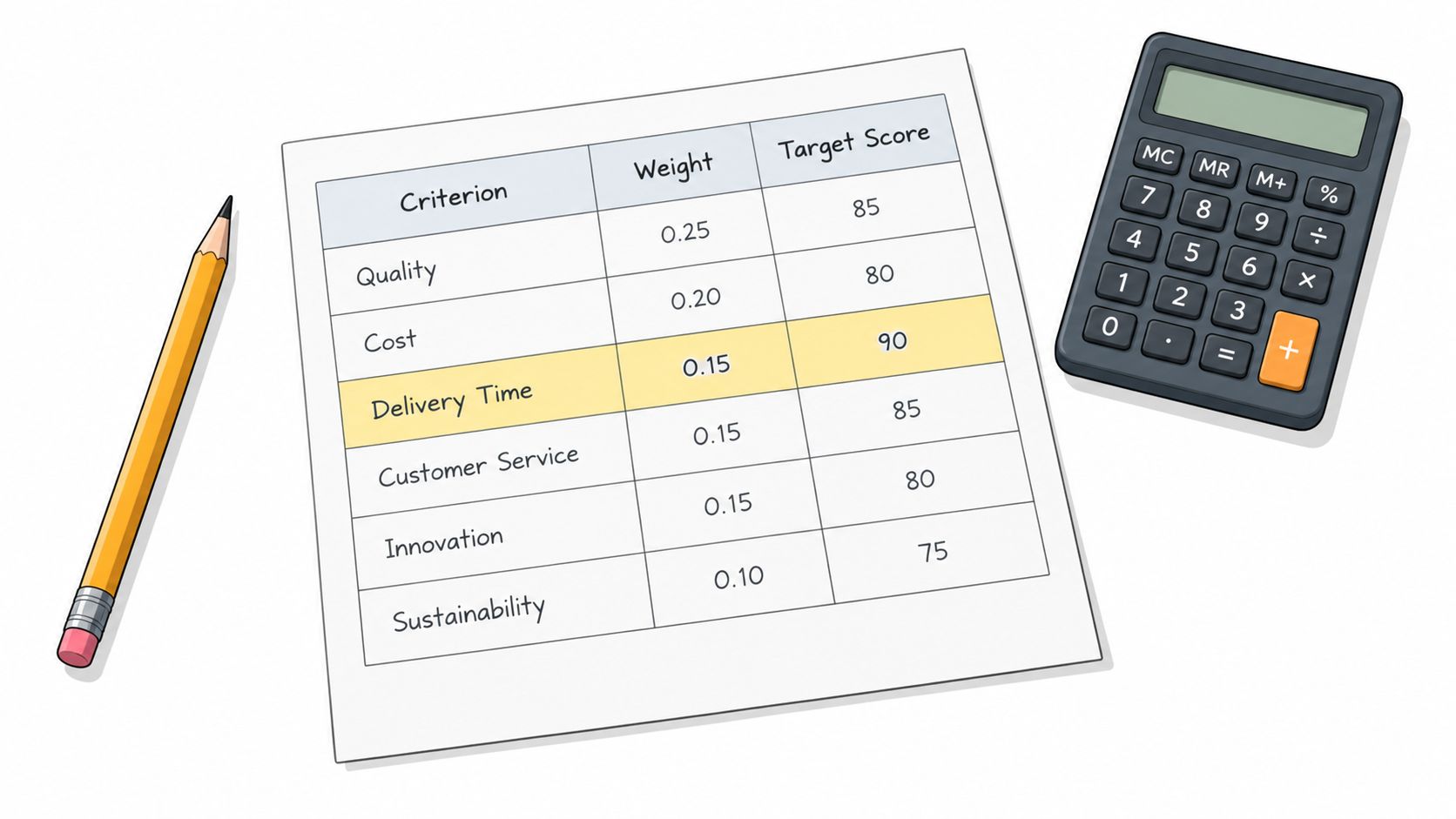
Build the compliance matrix alongside the scoring plan. They serve different purposes: the matrix protects completeness, while the scoring plan directs effort.
- Requirements: Capture every question, sub-question, attachment and mandatory declaration.
- Constraints: Record word or page limits, submission deadlines and required formats.
- Accountability: Assign an owner, evidence provider and reviewer to each response.
- Evaluation: Attach the relevant criterion, weighting and scoring descriptors.
Keep price connected to delivery
The evaluation guidance also warns that an abnormally low tender may require an explanation of whether the price is correct and deliverable. Don't cut the price without checking what that reduction does to staffing, service levels and risk cover.
Spend drafting effort where better evidence can change the weighted result, not where the team finds writing easiest.
Use the knowledge base to identify proof for the highest-priority gaps. Give AI response generation the actual question, scoring descriptors and approved delivery approach, rather than asking for a generic persuasive answer.
Retain the original notice and its amendments with the response plan. Tender monitoring helps detect the opportunity, but the tender documents remain the authority for what you must submit.
Writing Answers That Actually Score
A scoring answer makes the evaluator's job straightforward. It explains what you'll do, who'll do it, how you'll control delivery and what evidence supports the proposal.
Company history isn't a substitute for an answer. Include background only when it demonstrates something the buyer has asked you to prove.
Replace adjectives with a delivery method
Consider a hypothetical quality-management question. A weak draft might read:
We're committed to excellent quality and have an experienced team that always puts customers first.
That gives the evaluator little to assess. A more useful draft, subject to confirming the proposed arrangements, would read:
The contract manager will maintain an issue register, assign corrective actions to named owners and review closure evidence at the agreed governance meeting. Service reports will compare performance with the contractual measures and record corrective action where requirements aren't met.
The improved wording describes a method, responsibility and control. It still needs supporting evidence, such as a relevant reporting template or a verified case study explaining how that approach worked on comparable delivery.
Make the connection explicit. Explain which aspects of the previous contract match this buyer's scope, risks or operating environment.
Remove the mistakes that cost marks
The government's SME/VCSE Bid Pack warns against unsupported claims, generic copy-and-paste answers, ignored word limits and other avoidable failures. Check drafts for these practical weaknesses:
- Not answering the question: Respond to every requested component.
- Hiding behind company history: Put the proposed contract method first.
- Ignoring scoring descriptors: Address the evidence needed for the intended score.
- Reusing generic copy: Adapt the approach to the buyer's circumstances.
- Making unsupported claims: Replace superiority language with verifiable proof.
- Ignoring limits: Edit to the stated allowance without removing essential evidence.
- Leaving assumptions unresolved: Confirm operational commitments before submission.
A maintained knowledge base makes drafting more useful because credentials, previous responses and case studies are available together. The bid-writing software workflow uses that material to support AI response generation rather than starting from a blank page.
Treat generated wording as a draft requiring approval. Check dates, scope, accreditations, named roles and whether historic evidence supports the proposed contract.
Don't allow the tool to convert an aspiration into a promise. The writer owns the wording, but the delivery team must own the commitments, and the evidence must withstand scrutiny.
Winning on Social Value Without Overpromising
A long list of good intentions isn't a social-value delivery plan. Smaller suppliers should compete through credible commitments tied to the contract, not by copying a corporate programme they can't fund.
The British Chambers of Commerce's Great British Supply Chain Report reports that social-value scoring has been found to disadvantage smaller businesses. It also records £45.2 billion in direct public-sector spending with SMEs in 2025, equivalent to 21% of direct procurement spending.
Make the commitment measurable
For a hypothetical local-government service contract, a credible employment proposal might explain which roles could be recruited locally, how vacancies would be advertised and how outcomes would be recorded. Don't promise recruitment that the staffing model doesn't require.
For an NHS opportunity, consider commitments compatible with the service and its operating constraints. Community activity shouldn't depend on taking essential staff away from delivery without funded cover.
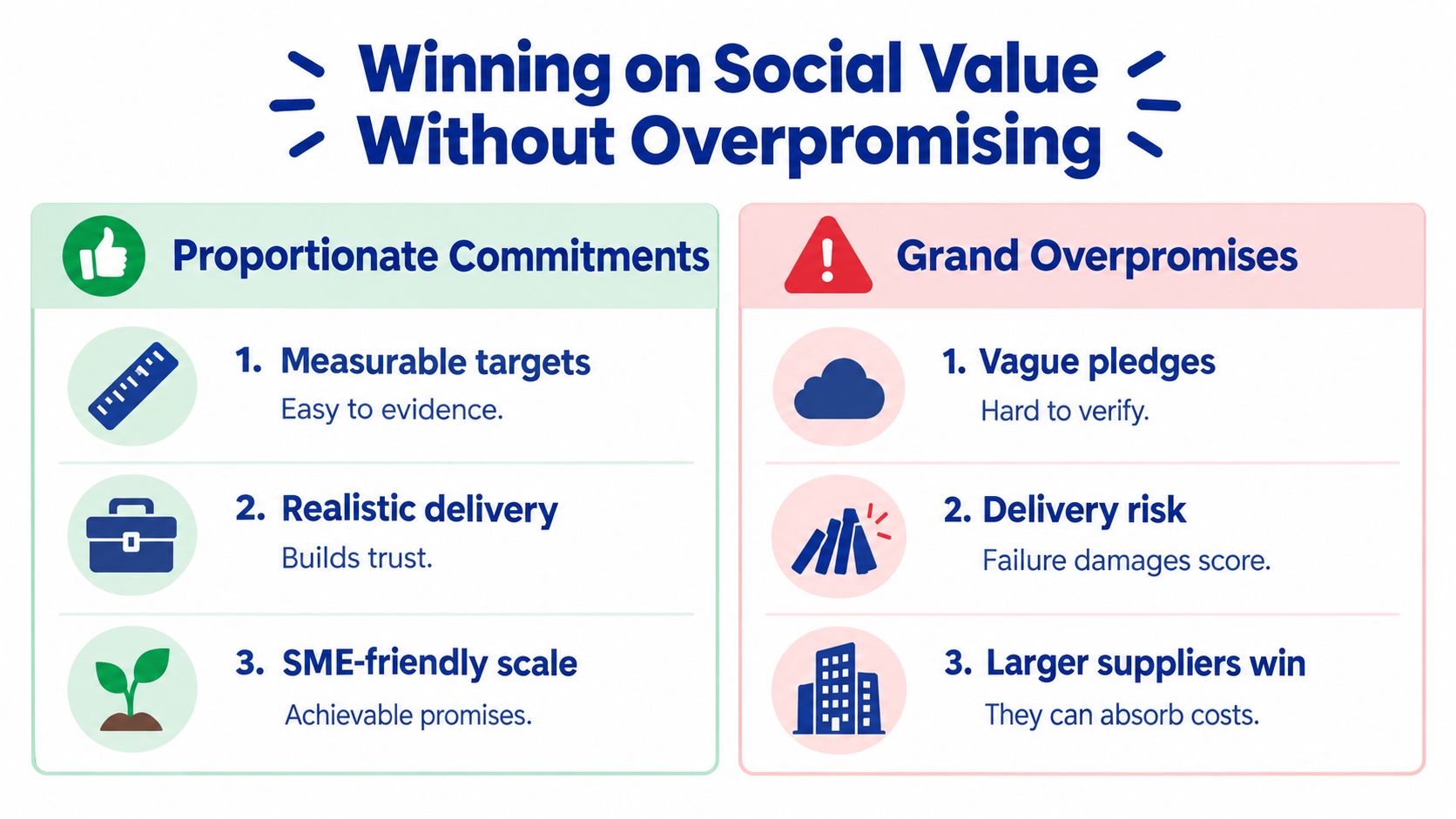
- Local employment: Specify the proposed activity, eligible roles and evidence of outcomes.
- Carbon reporting: Establish a realistic baseline and explain the measurement boundary.
- Community partnerships: Confirm the partner's involvement before making a commitment.
- Responsible subcontracting: Describe how payment and delivery responsibilities will be monitored.
- Governance: Name the accountable role and reporting process.
Challenge disproportionate requirements carefully
If a lot is too large for a credible SME delivery model, ask whether the buyer will consider a different structure. If the social-value question is ambiguous, request clearer outcome measures through the formal clarification process.
Keep the question specific. Explain the delivery issue and ask what evidence or interpretation the buyer expects, rather than making a general complaint about fairness.
Delivery test: If operations can't explain how a promise will be fulfilled and reported, don't put it in the bid.
A consortium may make a commitment achievable, but assign ownership rather than leaving every partner jointly responsible in vague terms. Record who delivers, who measures and who reports.
Store approved commitments and supporting evidence in the knowledge base. AI response generation can help adapt the wording, while tender monitoring helps you identify buyers and scopes suited to your capabilities.
Submission, Review and What to Do After the Result
Submission is a controlled handover, not the moment to discover a missing attachment. The SME/VCSE Bid Pack cited earlier recommends at least two independent review rounds, including for smaller tenders.
Build those reviews into the timetable before drafting. A review squeezed into the final upload window can identify a problem without leaving time to fix it.
Review in the right order
The first independent review should test strict compliance. The next should assess evaluator readability and evidence quality, then check commercial consistency across the full submission.
| Review focus | What the reviewer should test |
|---|---|
| Compliance | Questions, attachments, declarations, limits and required formats |
| Evaluator perspective | Clear answers, relevant evidence and alignment with scoring descriptors |
| Commercial consistency | Pricing, assumptions, staffing, social value and mobilisation agree |
Resolve unclear requirements through the buyer's clarification channel before its deadline. After submitting, keep someone responsible for checking messages and coordinating any requested response.

Turn the result into usable evidence
Save the final submitted files and confirmation of receipt. After the decision, request available feedback on criterion-level scores, weaknesses and where the response failed to demonstrate the expected evidence.
A win deserves scrutiny too. Identify the commitments operations must now deliver, and distinguish persuasive evidence from wording that merely sounded confident internally.
Update the knowledge base with approved answers, evaluator feedback and corrections. Use outcomes to refine tender monitoring and improve the inputs supplied to AI response generation, rather than retaining unsuccessful copy unchanged.
Finally, understand the specific below-threshold rule. Under Part 6 of the Procurement Act 2023, an authority inviting tenders for a regulated below-threshold contract may not restrict submission by assessing supplier suitability, and it cannot advertise a notifiable below-threshold contract before publishing the required notice.
That doesn't remove your responsibility to assess delivery fit. It reinforces the distinction between access to a competition and producing a response that deserves the award.
Bidwell offers tender monitoring, a knowledge base for your credentials and evidence, and AI response generation for custom drafts. Visit Bidwell to organise your opportunity search and prepare your next response around the buyer's published criteria, with your team retaining responsibility for commercial decisions and final review.

