UK public procurement accounts for approximately £300 billion a year, around one-third of total public expenditure, and the rules changed materially when the Procurement Act 2023 came into force on 24 February 2025 and replaced more than 350 EU-derived regulations (legislation.gov.uk explanatory notes). That matters because public sector work in the UK isn't one market, it's a set of linked markets, with different buyers, different portals, and different signals to watch.
If you're bidding into this space, the job isn't just finding tenders. It's knowing which notices matter, which authority types buy, where the evaluation pressure sits, and how to keep your evidence ready when the window opens. A useful starting point for the buyer side is the Crown Commercial Service overview, because it sits inside the wider government buying environment that now runs on a single principal regime.
A second practical point cuts through a lot of outdated advice. The old EU-derived patchwork no longer drives new procurements in the same way, and the day-to-day reality for suppliers now centres on transparency duties, pipeline notices, award notices, and tighter tracking of who published what, where, and when. If your team still treats public procurement in the UK as one tidy calendar of advertised tenders, you'll miss work.
For organisations buying into the public sector, cyber risk is part of that picture too. Public bodies don't just want a compliant bidder, they want suppliers who can protect data, users, and operational continuity, which is why resources such as council WiFi threat defense are relevant to the wider delivery conversation. The practical takeaway is simple, procurement is now a structured commercial process, not a side channel.
What Public Procurement in the UK Looks Like in 2026
The first thing to understand is scale. UK public procurement sits at the centre of how the state buys everything from services to works and supplies, and the statutory framework now covers most central departments, arm's-length bodies, local authorities, health authorities, and schools when they award non-exempt contracts above the relevant thresholds (legislation.gov.uk explanatory notes). For suppliers, that means dealing with a broad mix of buyers, each with different buying patterns, internal approvals, and commercial pressures.
What changed with the new regime
Before February 2025, procurement was spread across several EU-derived regulations. The main ones were the Public Contracts Regulations 2015, Utilities Contracts Regulations 2016, Concession Contracts Regulations 2016, and Defence and Security Public Contracts Regulations 2011. The Procurement Act 2023 brought those into a single principal regime, and the Cabinet Office guidance hub reflects how that change now shapes notices, transparency, and market monitoring. Practical details sit on the Cabinet Office Procurement Act 2023 guidance hub, which is useful for seeing how the regime is being handled in day-to-day buying activity.
For bidders, the operational change is straightforward. Procurement now rewards earlier visibility into the market. You are not just waiting for a tender to land in your inbox. You are tracking pipeline notices, tender notices, award notices, and contract notices as part of one commercial system.
Practical rule: if you only track live tenders, you are already late for a lot of competitions.
That affects bid planning, resource allocation, and relationship building. It also explains why a good monitoring setup and a reusable knowledge base now sit inside the core bid workflow, because teams need a way to spot fit quickly, reuse evidence cleanly, and respond before time is wasted on the wrong opportunity.
Why suppliers should care
For a bidder, the change is not legal theory. It is that the framework treats procurement as a managed lifecycle, from planning through award and beyond. That creates earlier signals for opportunity qualification, but it also raises the bar for keeping evidence current, especially when you are competing against incumbents that already know the buyer's route to market.
Cyber risk sits in that picture too. Public bodies want compliant bidders, but they also want suppliers that can protect data, users, and operational continuity, which is why resources such as council WiFi threat defense matter to the wider delivery conversation.
The practical question is no longer whether public procurement exists. It is which buyer, which notice type, and which route are worth your time. That is where monitoring and response preparation matter more than generic public sector sales talk.
Where UK Tenders Actually Get Published
The UK's publication framework is fragmented by design, so single-portal monitoring is a bad habit. The main places to watch are Find a Tender, Contracts Finder, Public Contracts Scotland, Sell2Wales, and eSourcing NI/eTendersNI. If you don't cover all the relevant portals for the home nations you sell into, you'll miss work.
The portal mix that matters
Find a Tender is now the key national notice service for many procurements under the Procurement Act 2023. For new procurements in England, Wales and Northern Ireland that start on or after 24 February 2025, it carries both above- and below-threshold notices, while Scottish below-threshold opportunities remain outside the service (Find a Tender notice types). That means it's central, but it isn't the whole market.
Contracts Finder still matters for below-threshold work in England and other non-devolved territories. Public Contracts Scotland remains essential if you sell north of the border. Sell2Wales is the relevant publication channel for Welsh opportunities, and eSourcing NI/eTendersNI matters for Northern Ireland. If a team only watches FTS, it will miss a lot of lower-value and locally important work.
| Portal | Covers | Typical thresholds |
|---|---|---|
| Find a Tender | England, Wales and Northern Ireland under the Procurement Act 2023 | Above-threshold and, for new procurements from 24 February 2025, below-threshold notices too |
| Contracts Finder | England and other non-devolved territories | Below-threshold opportunities and related notices |
| Public Contracts Scotland | Scotland | Above-threshold notices and Scottish below-threshold work |
| Sell2Wales | Wales | Wales-based public-sector opportunities |
| eSourcing NI/eTendersNI | Northern Ireland | Northern Ireland opportunities |
How to use the landscape
Start with buyer geography, then overlay contract value. If the authority sits in Scotland, don't rely on an England-focused monitor. If the opportunity looks sub-threshold, check the local portal as well as the national one. If it's a cross-border framework or a multi-authority route, expect publication in more than one place, or at least enough metadata that you'll need to cross-check.
A workable setup is simple. Track the main portals daily, use consistent filters for sector, CPV, buyer type, region, and value, and store the notices somewhere your team can review them quickly. That's where tender monitoring stops being a list of links and becomes a proper sales system.
How a UK Procurement Procedure Runs From Start to Finish
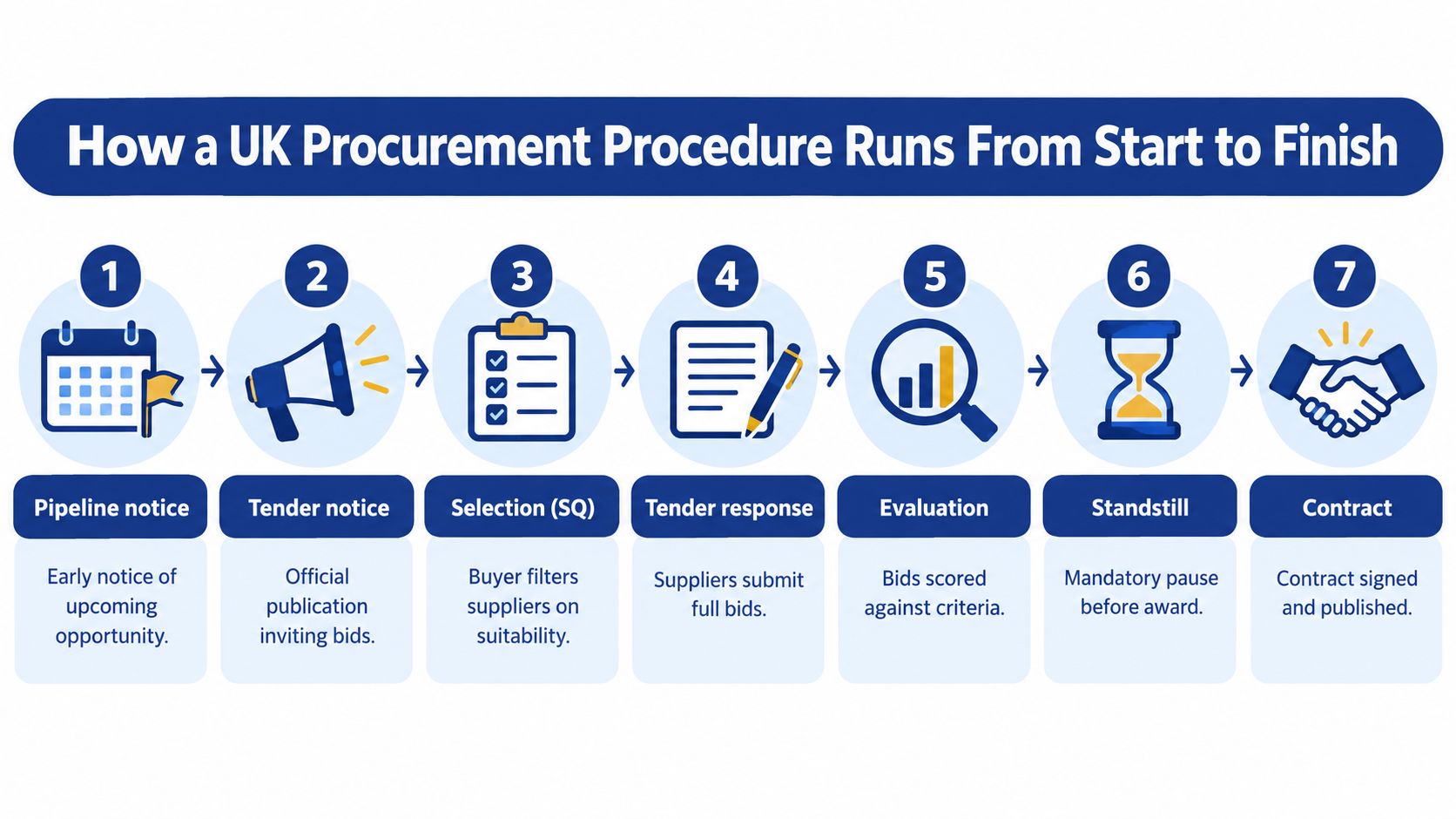
The Procurement Act regime is easier to manage if you think in stages rather than isolated notices. A typical competition now moves from pipeline notice to tender notice, then selection, tender response, evaluation, standstill, and finally contract award. The supplier that understands each stage early has a better chance of shaping the bid, rather than just reacting to it.
What each stage means in practice
A UK1 pipeline notice tells you an authority intends to buy, usually for requirements above £2 million (government SME action plan). It's not a promise of a contract, but it is a useful lead indicator. That's the point where you can line up partners, collect evidence, and decide whether the market is worth the effort.
The tender notice is the formal invitation to bid. After that comes selection, where the buyer filters suppliers on suitability, and then the full tender response, where your team has to show delivery fit, pricing logic, and confidence on mobilisation. The buyer then scores responses through evaluation, and only after that comes the award phase.
A pipeline notice is a signal to prepare, not proof that the contract will exist in the same shape later.
The biggest timing change for many teams is the standstill period. For procurements covered by the Procurement Act 2023, it is at least eight working days from the day the contract award notice is published, and the authority generally cannot enter the contract during that period (standstill guidance). If you lose, that short window is the time to review the assessment record and decide whether a challenge is realistic.
How a bid team should use the timeline
Good teams don't wait until tender day to start writing. They map pipeline notices against capacity, pre-build evidence in a knowledge base, and use AI drafting only after they've qualified the opportunity properly. That's where a tool like the Facility Management Insights bidding guide is useful context for teams that need a process view, because the competition itself is only one part of the work.
The day-to-day lesson is blunt. Earlier visibility changes bid quality, but only if the team has a disciplined process for deciding what to pursue.
Choosing the Right Procedure for the Job
Not every competition is built the same way, and the buyer's chosen route tells you a lot about how the work will be awarded. The main procedures you're likely to see are the open procedure, the competitive flexible procedure, the restricted procedure, and, in some cases, a single supplier negotiation route. Each one signals a different balance between accessibility, control, and buyer discretion.
What the route says about the opportunity
The open procedure is the clearest signal that a buyer wants broad market participation. If you're a smaller supplier with a well-matched offer, that's usually the friendliest route because you're not forced through a long pre-qualification stage before the submission. It still takes time to write properly, but it's a cleaner route for new entrants.
The competitive flexible procedure is more variable. It gives contracting authorities room to design the process around the requirement, which sounds attractive on paper and often is for technical or service-heavy contracts. In practice, that flexibility can mean more stages, more clarification, more presentation rounds, and more room for incumbency to matter.
The restricted procedure filters suppliers first, then invites only the short-listed bidders to tender. That can work well for buyers who need control, but it can be harder for smaller firms if the selection criteria are shaped around deep corporate references or broad balance-sheet comfort.
If a notice points to a process with lots of buyer discretion, assume the evaluation will reward evidence of delivery confidence, not just a neat sales narrative.
How to decide whether to bid
Use the procedure as a quality check on your time. If you see an open route, assess whether your evidence already matches the buyer's likely scoring model. If you see a flexible route, read the notice and the documents carefully, because the buyer may have built in presentations, workshops, or staged submissions that add real bid cost.
A single supplier negotiation route is the strongest signal of a controlled, narrow competition. That doesn't automatically mean you shouldn't bid, but it does mean you should ask whether the contract is accessible or whether the buyer already has a preferred shape of solution in mind.
The safest habit is simple. Read the route, read the scope, and then decide whether the bid cost matches the probability of winning.
How Evaluation and Award Decisions Are Made
Evaluation under the new regime still comes down to comparing bids against the buyer's stated criteria. The Most Advantageous Tender test means price rarely stands alone. Buyers are weighing the mix of quality, delivery confidence, risk handling, and commercial fit that best matches the requirement.

What evaluators mark
Threshold guidance sets the point where the full regime applies. For the threshold period running to 31 December 2027, the threshold including VAT for a central government goods or services contract is £135,018, the sub-central threshold is £207,720, and the works threshold is £5,193,000 (threshold guidance). That does not tell you how the score is split, but it does tell you when the formal rules bite.
Evaluators usually mark what they can evidence. If the question asks for mobilisation, they want a mobilisation plan. If it asks for risk, they want a risk response. If it asks for social value, they want commitments that fit the contract, not generic good intentions.
Clarifications and interviews work on the same basis. They test whether the written bid is believable, consistent, and scoped properly. A weak response often loses because the delivery model, references, and pricing story do not line up.
How to write to the rubric
Build your response around the marks, not around your favourite company story. Use the question wording as the structure. Answer first, evidence second, explanation third.
A useful internal check is simple:
- Score the question, not the contract: Write to the specific marking criteria, not a broad company brochure.
- Use proof that fits the size of the contract: Do not paste in case studies from different sectors or delivery scales.
- Keep claims tied to deliverables: If you promise resilience, show who delivers it, how, and when.
- Prepare clarification questions early: A strong clarification can remove a false assumption before evaluation hardens it.
That is where a well-built knowledge base helps, because the best evidence is reusable only if it is organised.
Where SMEs Win Public Sector Spend
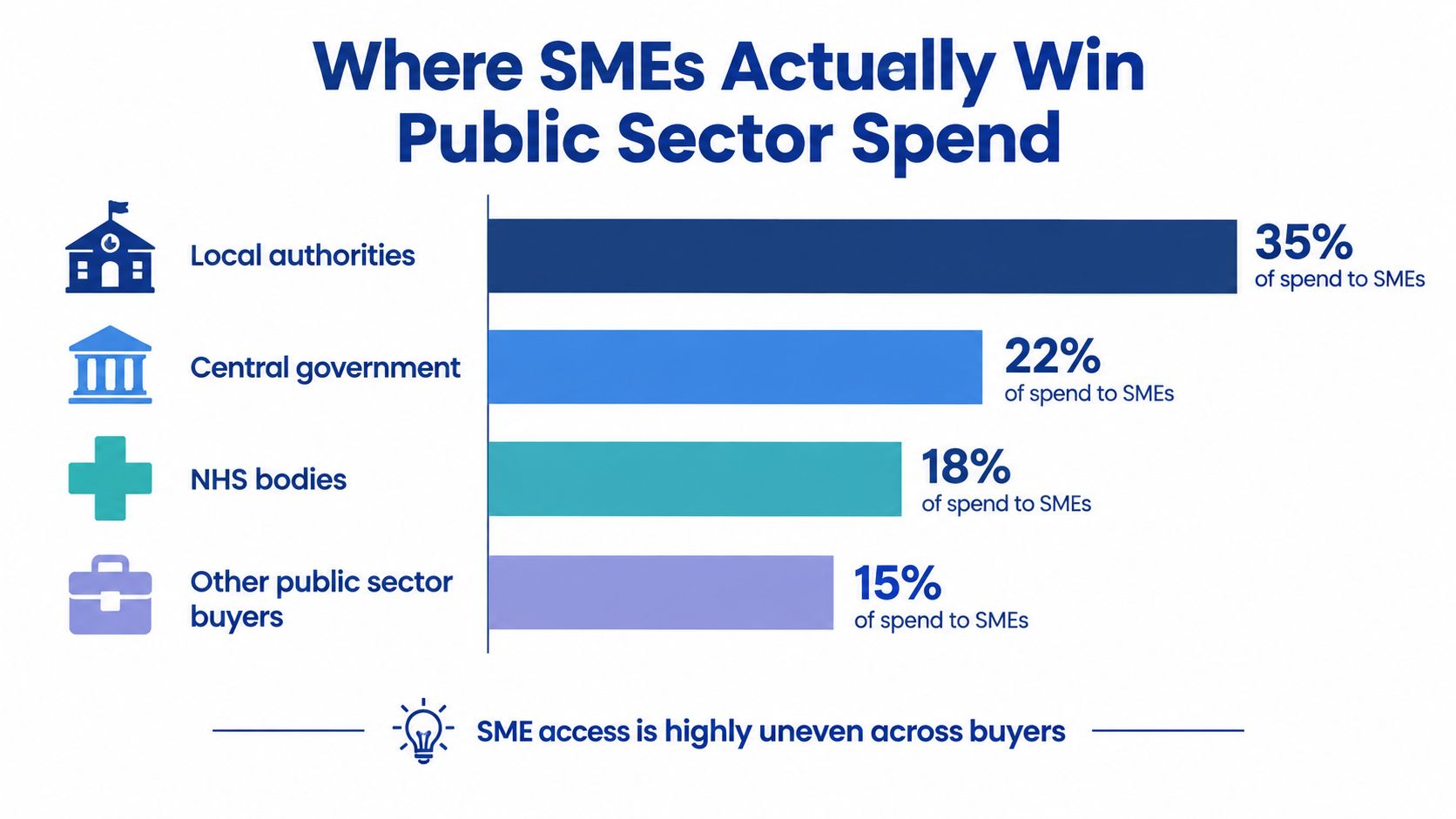
SMEs sit near the centre of the policy debate, but the central question is where they win work. The latest headline figure is £45.2 billion of public-sector spend with SMEs in 2025, equal to 21% of direct procurement spend and a six-year high (British Chambers of Commerce). That is a material market, though most direct spend still goes elsewhere.
Buyer type matters more than general optimism
SME access is uneven. Local government accounted for £29.1 billion and had an SME share of 34% in 2025, in the same BCC analysis. That makes local authorities one of the more practical places for smaller suppliers to focus effort.
Central government can look very different. The Department of Health and Social Care example shows why buyer-by-buyer analysis matters. In 2024/25, DHSC reported total procurement spend of approximately £6.05 billion and direct SME spend of approximately £778.1 million, or 12.86% (government review service progress report). That is a different opportunity shape from a local authority market.
A high number of awards can still be a weak target if the spend is small, fragmented, or locked into incumbents. The test is whether a buyer consistently gives SMEs meaningful share and whether the contract sizes fit your delivery capacity.
A better way to prioritise prospects
Use a simple three-part filter. Rank buyers by demonstrated SME share. Check whether the contract value fits your team's scale. Look for repeatable routes into the buyer, such as lots, frameworks, or recurring service lines.
The guide to professional public artistry is a reminder that public work often rewards niche positioning, not generic presence. For your own pipeline, the practical equivalent is to focus on the authorities and categories that already buy in a way SMEs can win.
If you manage frameworks, the Bidwell frameworks page is a useful internal reference point, because framework access often determines whether SME spend is reachable at all. The task is to separate attractive rhetoric from buyer behaviour.
Putting It All Together as an Operating Model
A small bid team can run this market on a weekly rhythm if the process is disciplined. Start with tender monitoring across Find a Tender, Contracts Finder, Public Contracts Scotland, and Sell2Wales, because portal coverage is still the front door to the market. Then qualify anything material against the pipeline notice, the route, the buyer type, and the threshold context.
A practical workflow
First, capture the notice and tag it properly. Record the buyer, category, region, deadline, route, and likely contract type in your tracker. That avoids the familiar mess where people forward opportunities in email threads and nobody knows which version is current.
Second, feed the opportunity into a knowledge base. Put accreditations, insurance details, policies, case studies, team CVs, and standard method statements there. When the evidence sits in one place, you can answer questions faster and with fewer inconsistencies.
Third, use AI response generation only after the team has qualified the bid and selected the right evidence. The system should never decide what you say. Its job is to turn a repetitive writing job into a faster review cycle. Bidwell's bid writing software is built around that workflow, with monitoring, a searchable knowledge base, and AI drafting that supports the first pass of a response.
Keep the human review close to the scoring matrix. That is where weak assumptions get caught before they become expensive mistakes.
What good looks like on a busy week
A decent operating model lets you move from discovery to draft without starting from zero each time. Monitoring surfaces the notice. Qualification decides whether the team should bid. The knowledge base supplies the evidence. AI prepares a draft. A bid manager edits against the marking criteria, then submits with enough margin to cope with last-minute clarifications.
That setup does not remove bid discipline. It makes the discipline repeatable. In a market where timing, evidence and portal coverage all matter, repeatability is what stops good opportunities from slipping past.
Frequently Asked Questions on UK Public Procurement
Which thresholds apply to my contract in 2026? As covered above, the main thresholds including VAT for 1 January 2026 to 31 December 2027 are £135,018 for central government goods or services, £207,720 for sub-central government, and £5,193,000 for works. Check the contract type first, then the authority type, because those two points determine which threshold applies.
What does the eight-working-day standstill let me do? It gives you a short review window after the award notice is published, before the authority generally enters the contract, as explained in the standstill section above. Use that time to read the assessment information, compare the scoring with your bid, and decide whether any challenge is commercially sensible.
How do payment terms affect prime and subcontract cash flow? Central government reporting for 2024/25 showed 92% of invoices paid within five days and 100% within 30 days, but newer guidance also requires some bidders for central-government contracts above £5 million a year to show they pay all invoices within an average of 45 days (prompt payment data). That helps, but it does not remove subcontractor risk, so payment terms still need checking in the bid and in the supply chain.
Where should a new SME start? Start with buyers that already show meaningful SME spend, especially local government, then build around categories you can deliver profitably. Use monitoring to spot the right notices, use a knowledge base to avoid rewriting the same evidence, and use AI drafting to shorten the first-pass response time.
If you want to turn this into a practical bid process rather than a reading exercise, Bidwell can help you monitor opportunities, organise your evidence, and draft responses around the way UK procurements run. It is built for teams that need to spot the right notices early, stay organised across the portals, and spend more time reviewing strong answers instead of writing from scratch.