
The most popular advice about writing a tender bid is to make your response persuasive. That's the wrong place to start. A polished answer can't rescue a bid for a contract you're not eligible to deliver, or one that would strain your cash flow and team from day one.
Treat bid quality as the result of good selection, clear compliance and credible evidence. The writing matters, but it comes after the decision to bid and the work of understanding what the buyer will score.
Start With the Bid Decision
A bid manager opens several attractive notices, starts drafting, then finds a mandatory requirement the business can't meet. Or the mobilisation plan assumes staff and equipment the company won't have in time. Both problems should be caught before anyone writes a response.
The cost of getting that decision wrong is real. Research cited in the Journal of Public Procurement found that assembling a routine UK bid cost firms approximately £5,800 on average, while two surveys reported average annual win rates of 23.47% and 25.52% (Journal of Public Procurement research on UK tendering costs and outcomes). Those figures make bid/no-bid discipline part of the commercial job, not a box-ticking exercise.
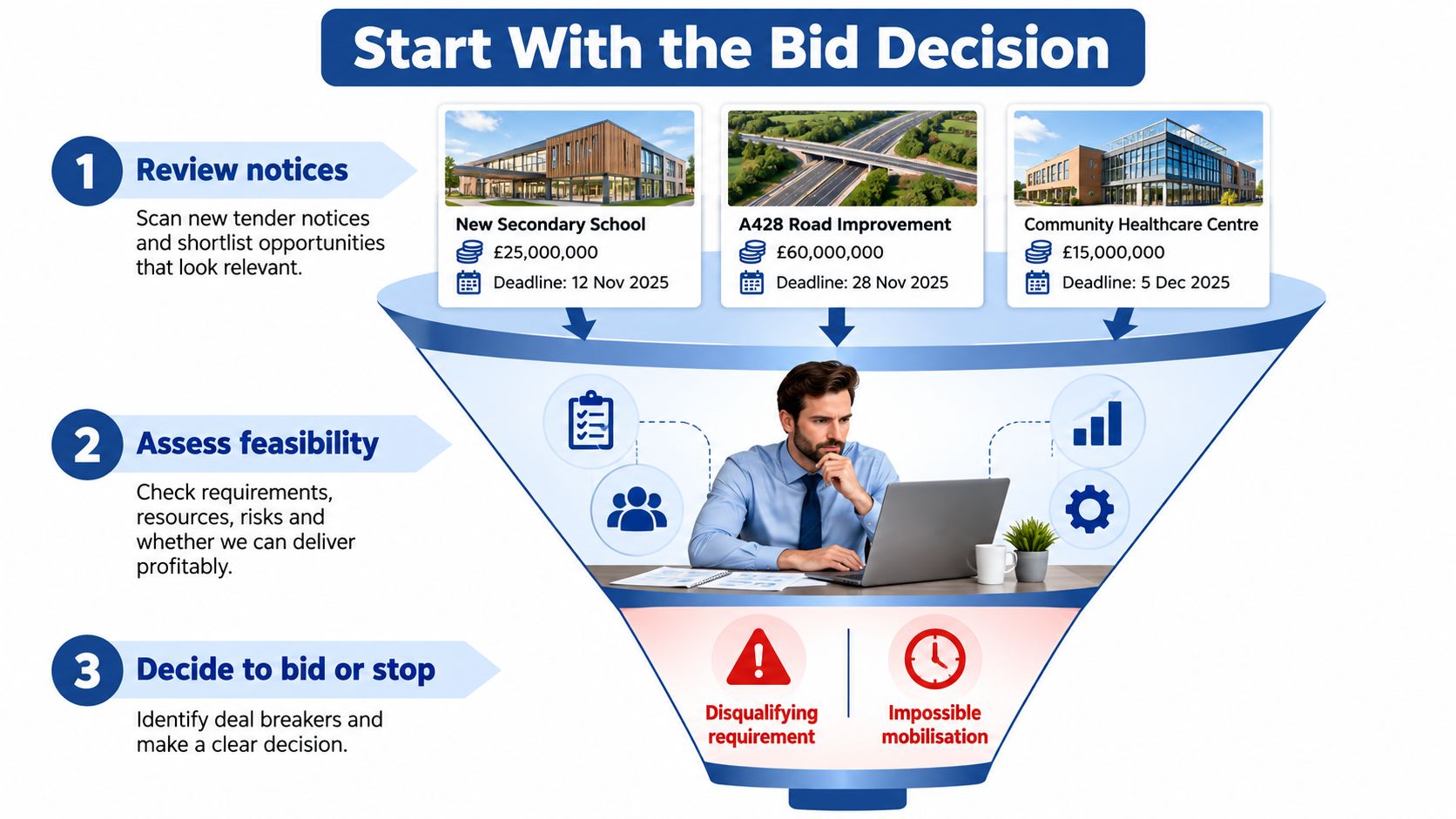
Test the opportunity before the prose
Start with the buyer's requirements. Can your business meet every mandatory condition, including exclusion, insurance, financial and technical requirements? Does the contract fit the work you do, and is the lot structure a realistic route in? A smaller lot may suit your capability; a wider framework may demand evidence and capacity you can't credibly show.
Then test delivery. Can you mobilise on the buyer's timetable? Can you staff the work without damaging existing contracts? Does the payment profile leave you carrying costs for longer than your working capital allows? These are bid questions, even if they don't appear in the response form.
Your evidence matters just as much. If the buyer asks for comparable delivery experience, a general company profile isn't a substitute for a relevant case study, reference or operating record. Be honest about gaps before the team spends hours writing around them.
Set a clear decision rule
Proceed only when the opportunity fits, the evidence exists and the likely return justifies the effort. If you can't meet a mandatory requirement, stop. If the delivery plan depends on resources you can't secure, stop or escalate the issue before committing. If a requirement is unclear, ask the buyer for clarification rather than guessing.
Tender monitoring helps you find opportunities early enough to make that assessment properly. Bidwell monitors UK tender portals and provides summaries of relevant notices, giving teams a starting point for review rather than a reason to bid automatically. The decision still belongs to people who understand the business's capacity, commercial position and appetite for risk.
Choose the Right Tender
Finding a notice is not the same as finding a good opportunity. The Scottish Government's 2020 Public Procurement Survey found that 61% of SMEs reported difficulty identifying available contracts sometimes or always/often, compared with 42% of large businesses (Scottish Government Public Procurement Survey). If your team relies on occasional portal searches, it may miss suitable work or waste time on notices that were never a fit.
Use a repeatable review. First, capture the notice and deadline. Next, check eligibility and exclusion requirements, then compare the specification with your actual capability. Read the lot structure, assess mobilisation and payment exposure, and estimate the effort needed to produce a compliant response. Finish by listing the evidence you can use and the gaps you'd need to close.
| Check | Evidence to review | Proceed when | Stop or escalate when |
|---|---|---|---|
| Eligibility | Conditions, declarations and exclusion requirements | Every mandatory condition can be met | A mandatory condition cannot be met |
| Contract fit | Specification, scope and lot structure | The work matches your services and experience | The requirement sits outside your capability |
| Delivery | Mobilisation dates, staffing and dependencies | Resources can be committed credibly | Delivery relies on unconfirmed capacity |
| Commercial exposure | Pricing approach and payment profile | The work is commercially sustainable | Cash flow or price assumptions are unsafe |
| Evidence and effort | Case studies, credentials and expected bid work | Relevant proof exists and effort is proportionate | Claims can't be evidenced or the bid would displace stronger work |
Write down the decision and its reasons. That record helps the team plan capacity and makes it harder for enthusiasm about a large contract to drown out practical concerns. A suitable service opportunity may be worth pursuing, while a framework requiring capabilities you can't demonstrate should be declined, even if the headline value looks attractive.
Bidwell monitors Find a Tender, ContractsFinder, Public Contracts Scotland and Sell2Wales, with AI-generated summaries to help teams decide which notices deserve a full review. Use monitoring to improve visibility, not to outsource judgement. For a structured way to handle pre-qualification requirements, see the guidance on PQQs and supplier questionnaires.
Build a Compliance Matrix
Once you've decided to bid, make the buyer's documents your plan. Read the invitation to tender, specification, contract terms, schedules, attachments and evaluation guidance. Don't rely on a quick scan of the question set. A requirement may sit in an appendix, a declaration or a set of instructions rather than the main response form.
Create one compliance matrix and record each question, requirement, word limit, attachment, deadline, evaluation weight and accountable owner. Add a status column so the team can see what's not started, in progress or ready for review. Assign owners by subject matter: operations can explain delivery, finance can test pricing and payment assumptions, and the bid lead can control the response and submission process.
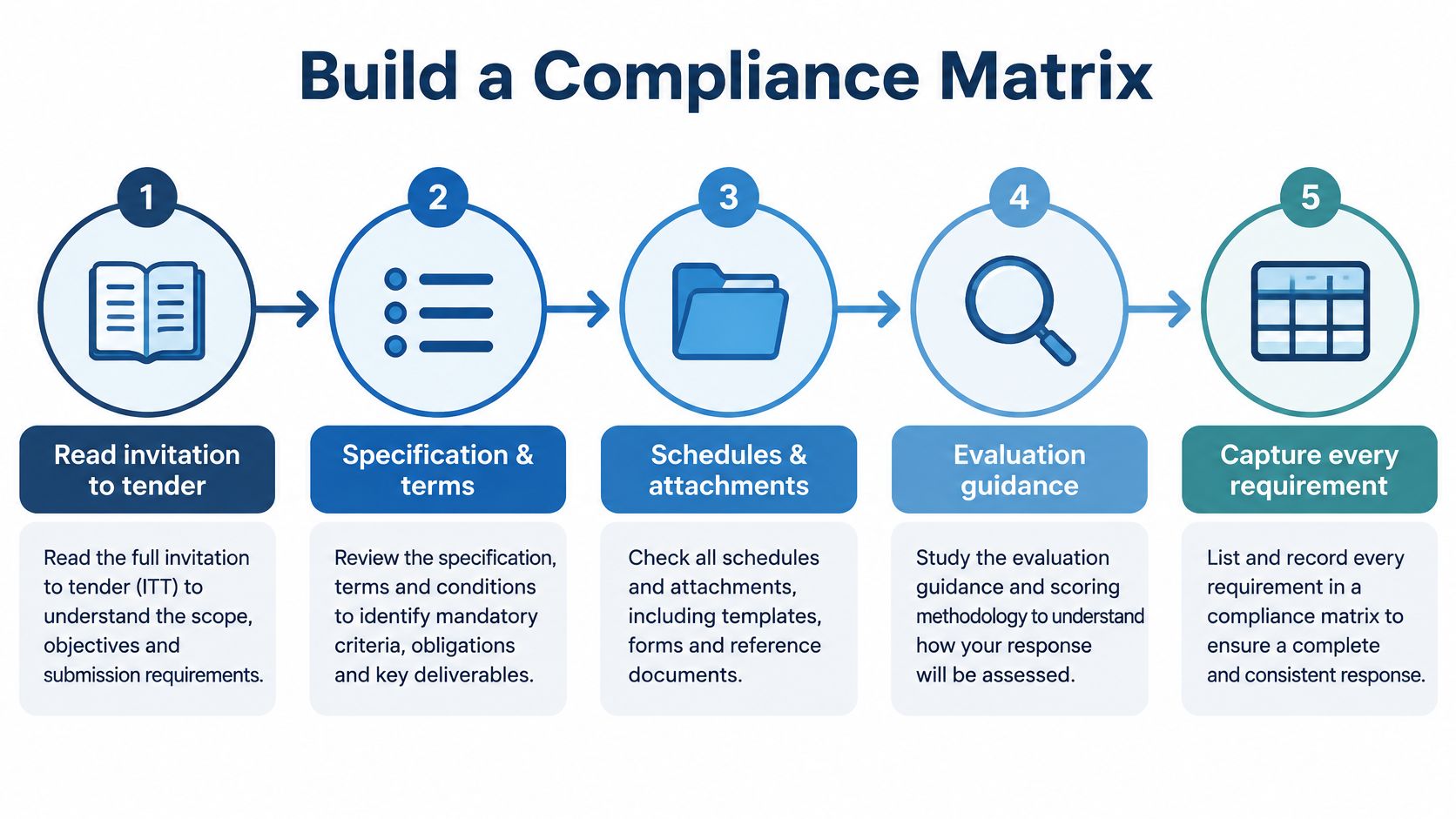
Make gaps visible early
Take a risk-management question as a working example. If the buyer sets a word limit and asks for supporting evidence, the matrix should name the response owner, record that limit, identify the evidence needed and set an internal review date. If the evidence hasn't been found, the gap is visible while there's still time to deal with it.
That matters because a blank cell is a risk, not an admin detail. Without named owners, commercial, operational and technical teams can each assume someone else has covered a requirement. Record clarification questions as well, and track the buyer's answers against the relevant row.
UK government guidance recommends checking that every question is answered, the specification and evaluation criteria are addressed, the response explains how the work will be delivered and the evidence is relevant (government guidance on bidding for contracts as an SME). Organise the response around those tests, not around whatever material happens to be easiest to find.
Control the source material and the word count
Tender alerts give you a chance to begin mapping requirements early. A well-maintained knowledge base can hold approved credentials, policies, case studies and past responses, so the team isn't searching through old folders while the deadline approaches. Keep source material current and make clear who can approve changes.
Draft in a controlled document and record word counts as you edit. Text beyond a stated limit may be ignored or removed, so don't assume a good answer will be read in full if it exceeds the buyer's instructions. Bidwell's approach to security questionnaires reflects the same principle: organise responses around the buyer's questions and the evidence needed to answer them.
Draft Answers That Match the Criteria
A scored answer should make the evaluator's job easy. Use the buyer's wording, answer the question directly and put the most relevant evidence where it can be found. A long company history followed by claims of “excellent service” doesn't show how you'll deliver the contract.
Build each answer in a consistent order:
- State the outcome. Explain what the buyer will receive.
- Describe the method. Set out the delivery activities in sequence.
- Name responsibility. Identify the role accountable for the work.
- Define the measure. Say how performance or acceptance will be checked.
- Address risk. Explain what could go wrong and what control you'll use.
- Prove capability. Add a relevant case study, credential, reference or operating record.

Follow the published scoring method
UK government guidance states that evaluation criteria must be linked to the contract, clear, specific, measurable, proportionate and published in advance with their relative weightings (SME and VCSE public procurement bid pack). Your response should mirror that structure. If quality carries 60% of the score and price carries 40%, give the higher-weighted quality questions more drafting and review attention, while still submitting a complete, compliant commercial offer.
For example, a buyer asks how you'll manage service risks. Don't open with a broad account of your company's history. Set out how your team will identify and record risks, who reviews them, what triggers escalation, and how the buyer will see progress. Then support the method with a comparable example, making clear which work your business delivered and what evidence supports the claim.
Bidwell's knowledge base can supply approved source material, while its AI response generation can organise that material against the tender questions. Treat the draft as a starting point. A person who knows the work must check every detail, tailor the answer to the buyer and remove anything the organisation can't deliver. The platform doesn't make the bid decision or take responsibility for the final submission.
A useful comparison is the discipline involved in preparing a persuasive legal argument. This resource on writing a legal brief that persuades judges offers a related lesson: structure and supporting evidence matter more than polished language alone. In a tender, the evaluator needs to find the response to the published question and see why the evidence supports it.
Prove Claims and Social Value
Every major claim should be auditable. A reviewer should be able to identify who owns the commitment, what the baseline is, what target has been set, how performance will be measured and what happens if delivery slips. If any part is missing, the claim may read well but won't give the buyer a dependable delivery promise.
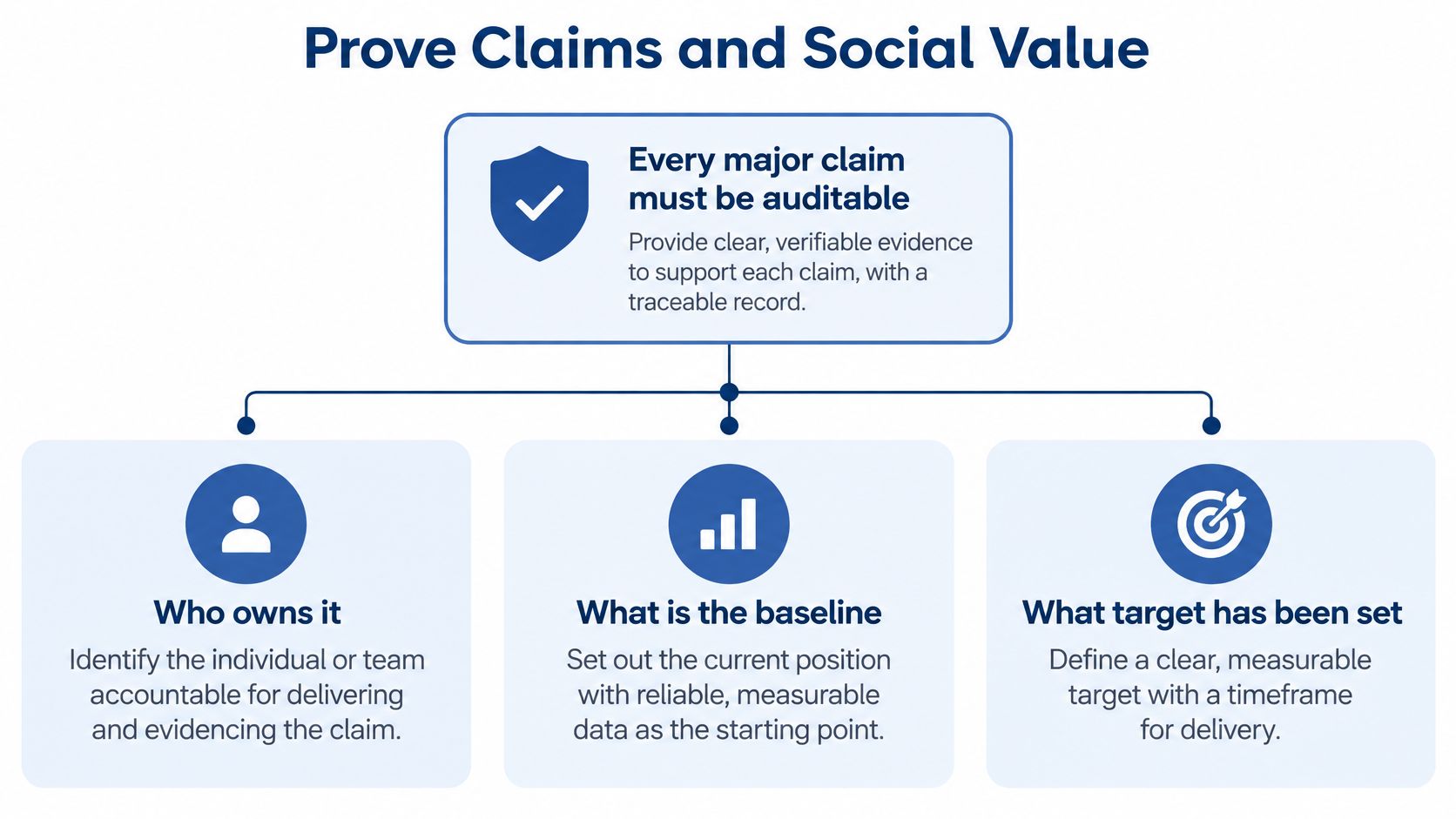
Replace adjectives with proof
“High-quality service” tells the evaluator little. Replace it with a named result from relevant work, the activity that produced it and the acceptance measure used. If a case study describes a service delivered by a subcontractor, say so. Don't present another organisation's credentials or results as if your business delivered them.
Apply the same test to social value. A commitment to local jobs, apprenticeships, environmental outcomes or community benefits needs an owner and a delivery plan. If a subcontractor will provide part of the outcome, agree how it will report evidence and who in your organisation will check it. A promise without supply-chain agreement isn't a secure commitment.
Make the commitment deliverable
Ministry of Justice guidance reports that social value commonly contributes 10–20% of the overall tender score, although the weighting varies by procurement (SME and VCSE quick-start guide). Read the authority's stated outcomes and scoring model before choosing what to promise. A smaller, well-supported commitment that fits the contract is stronger than an ambitious pledge with no credible owner, resources or measurement plan.
Your response should describe the activity, the measure and how the team will review progress. Include a corrective action if delivery falls behind. That doesn't mean dressing up an aspiration as a guarantee. It means making a commitment the organisation can resource and explain.
AI-assisted drafting can help organise evidence, but a human reviewer must verify the source, accuracy and relevance of each claim. They must also confirm that social-value commitments are deliverable by the bidder and any named partners. Don't promise more just to sound impressive.
Review and Submit With Control
The person who drafted the response shouldn't be the only person deciding it's ready. Use an independent review that checks the bid against the matrix, not just for spelling and grammar. A response can read cleanly and still contain a disqualifying gap or a commercial contradiction.
Run the checks in this order:
- Compliance: Confirm every question, declaration, attachment and mandatory requirement is addressed.
- Evidence: Check that claims match the source material and that credentials belong to the bidder or are clearly attributed to a partner.
- Delivery and price: Compare the method, mobilisation plan, staffing and pricing. A low price that can't support the proposed service is not a competitive advantage.
- Consistency: Make sure the response, financial information, social-value commitments and contract assumptions agree.
- Document control: Recheck word counts after edits, file names, signatures, declarations and required formats.
Then validate the submission on the portal. Check that each file opens, the right version is attached and every required field is complete. Leave time to resolve portal problems rather than trying to upload the final package at the last moment.
Unreviewed AI output can be inaccurate, generic or misaligned with what the organisation can deliver. The final reviewer must fact-check it and confirm that every promise has an accountable owner. Submission should happen only after a responsible person has checked the complete package, including attachments and declarations. Once it's submitted, you may not be able to replace a missed file or correct a late error.
Build a Repeatable Tender Process
A good tender routine joins four activities: monitoring relevant notices, making a disciplined bid decision, maintaining approved evidence and drafting answers for human review. Keep each activity distinct. Better drafting can't fix a poor opportunity choice, and monitoring alone won't make an unsupported claim credible.
For the next live tender, work through this final check:
- Opportunity: Is the contract a fit, and can you meet every mandatory requirement?
- Evidence: Is each important claim supported by material your team can verify?
- Delivery: Are responsibilities, measures, risks and mobilisation realistic?
- Commercials: Does the price support the proposed delivery and payment profile?
- Social value: Do commitments match the buyer's outcomes and your capacity?
- Submission: Have people checked word counts, attachments, declarations and portal validation?
The strongest tender bid isn't the longest. It's the clearest, most credible response to the buyer's published question.
Bidwell users can reduce a tender-writing task that typically takes 20–40 hours to 2–4 hours of review and refinement after AI-generated first drafts are produced. Use that saved drafting time for selection, tailoring and assurance, not for submitting more weak-fit bids. The Bidwell bid-writing software brings tender monitoring, a knowledge base and AI response generation into the same working routine, while people remain responsible for the decisions and final checks.
Choose one action before your next deadline: record a bid/no-bid decision, tidy an evidence file or assign owners in a compliance matrix. A repeatable process is built by using it on the next opportunity, then improving it before the one after that.
Visit Bidwell to monitor UK tender opportunities, organise approved bid evidence and generate first drafts for your team to review. Put the next live tender through a clear selection and evidence process before anyone starts writing.


