
Only one in five UK SMEs had bid for a public-sector contract in the previous three years, and 49% of newer bidders who submitted between one and nine bids hadn't won a single contract. If you're going to bid on a contract, qualify it commercially before you spend hours writing a response. Parliamentary evidence on SME bidding makes clear that submitting a tender isn't a quick route to a win.
You may be looking at an ITT that seems like a perfect fit, with a deadline already looming and your team asking who can write the answers. Resist the urge to start drafting. First decide whether the contract is worth pursuing, then find the right opportunities, read the buyer's requirements as an evaluator would, and submit a response that meets every mandatory condition.
What Bidding on a UK Contract Actually Involves
Bidding on a contract isn't a sales email with a price attached. It's a structured compliance and scoring exercise: the buyer sets requirements, publishes how responses will be assessed, and awards based on the evidence suppliers submit. The low participation and non-win figures above are a warning against treating every tender as a promising lead.
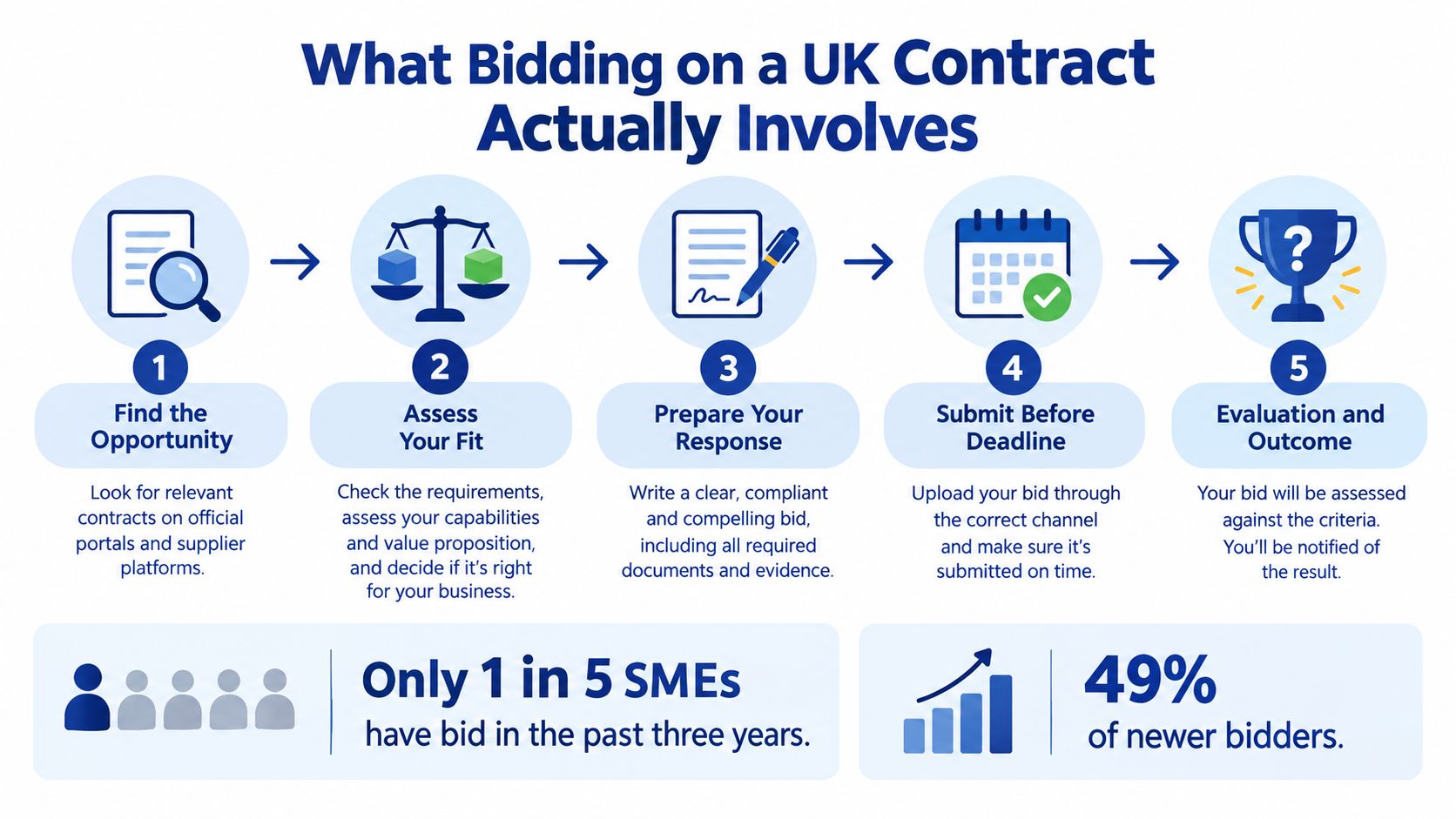
Four stages that determine where your time goes
Qualify the opportunity before you open the response forms. Check whether the work fits your capability, whether the contract can make commercial sense, and whether you can meet its conditions. This step helps you avoid spending time on an opportunity you can technically bid for but shouldn't deliver.
Find opportunities early enough to assess them properly. A live tender discovered close to its deadline leaves less room to clarify unclear requirements, bring colleagues into the response, and review evidence. Use tender opportunities for businesses as one place to understand how monitoring can support a repeatable search process.
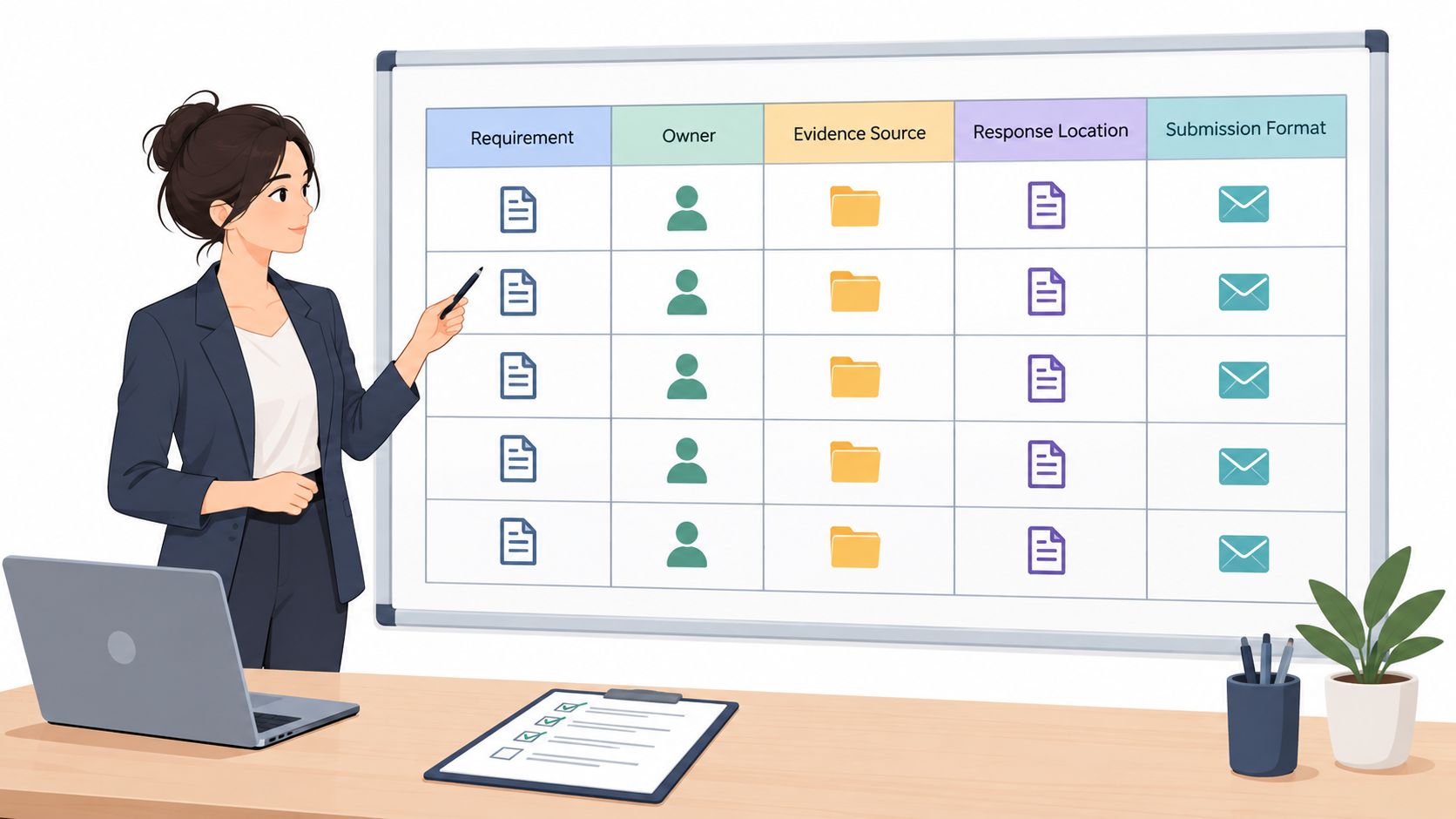
Prepare by mapping each requirement to evidence and an answer owner. Then write to the marking criteria, not to a general idea of what makes your business impressive. Buyers can only assess what your submitted response demonstrates.
Submit a complete, correctly formatted response before the deadline. Then review the result and use feedback to improve your evidence and future answers. Treat each bid as part of a working process, not as a one-off document that disappears when the portal closes.
Practical rule: If you can't explain why the contract fits your business, how you'll deliver it, and where your evidence comes from, you're not ready to write.
Deciding Whether a Contract Is Worth Your Time
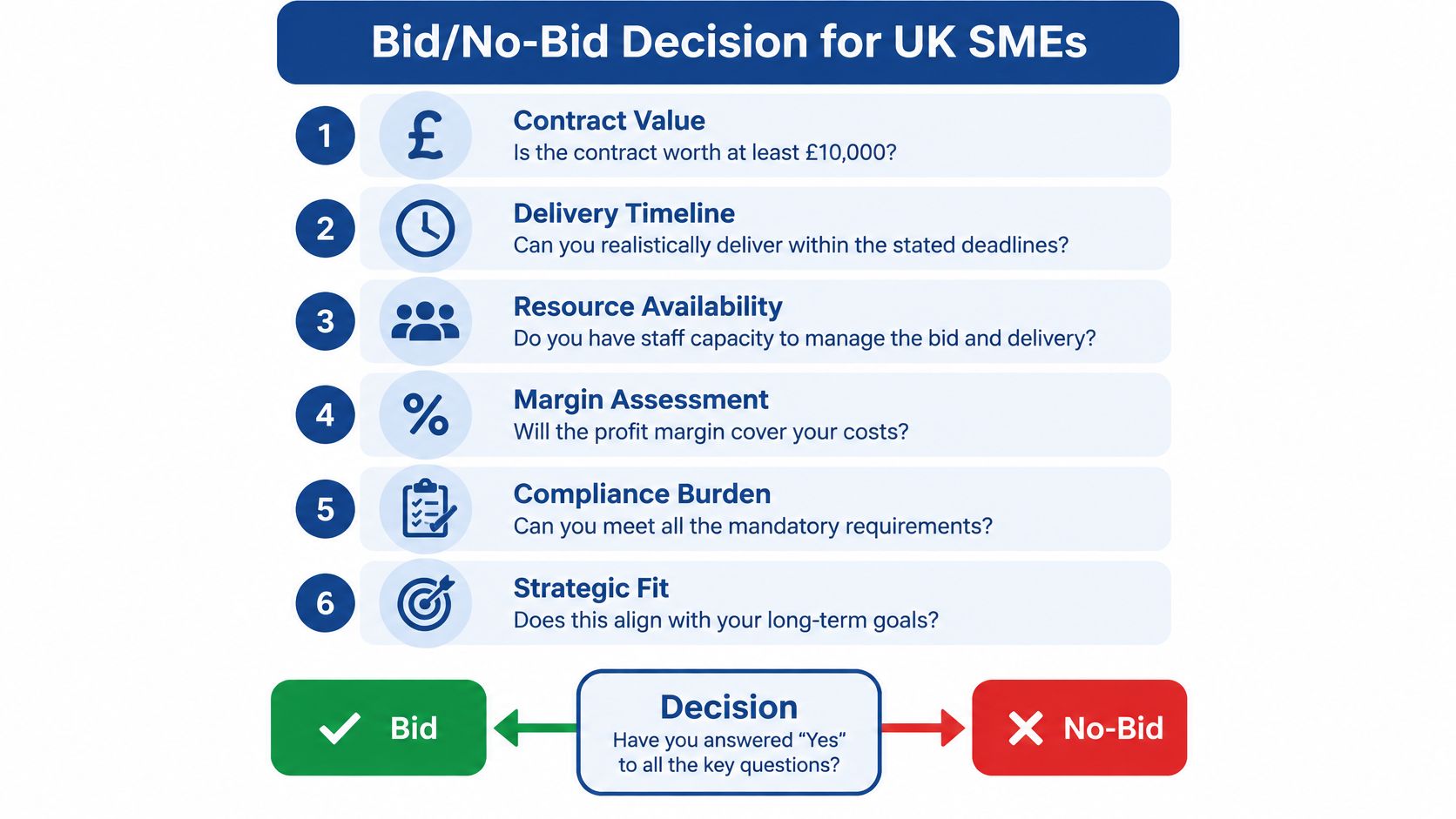
Most tenders aren't worth bidding on. An opportunity can be open to SMEs and still carry poor margins, awkward payment timing, heavy insurance conditions, or a delivery burden your team can't sustain. “We could probably win it” isn't a bid strategy.
Score the opportunity against the commercial realities before opening the ITT. Don't rely on one enthusiastic salesperson's view of the buyer or the contract.
Use a commercial screen, not a guess
- Visibility and fit: Is the requirement clear, and does the work match what your team already delivers? Check whether the buyer has shared pipeline or market-engagement information, and whether the contract geography works for your operation.
- Margin after bid cost: Estimate the delivery cost and the genuine effort needed to respond. A contract that looks profitable before pricing, compliance work, mobilisation, and ongoing management may not be profitable in practice.
- Cash flow: Check the payment profile and when you'll incur staffing, materials, or subcontractor costs. The Procurement Act includes mandatory 30-day payment terms, but that doesn't remove the need to plan working capital against the contract's actual payment and delivery arrangements.
- Risk, insurance, and incumbent position: Read the liability and insurance requirements, then assess whether the buyer's existing supplier has a practical advantage. Don't assume that a formally open competition is commercially balanced.
- Mobilisation and compliance: Can you start on the required timetable? Can you provide every policy, credential, declaration, and piece of evidence without pulling key staff away from delivery?
The Procurement Act 2023 requires authorities to consider SME barriers before inviting tenders for regulated below-threshold contracts. Below-threshold notice thresholds are £12,000 for central government and £30,000 for other authorities. That duty doesn't make every opportunity viable, but it gives you a reason to ask why a requirement is necessary if it appears disproportionate. Put the issue to the buyer through a clarification question before the stated deadline.
For example, a cleaning SME should compare the contract's locations, staffing assumptions, insurance conditions, mobilisation demands, and payment profile against its actual operation. A commercial cleaning contracts guide can help frame the questions to ask about the work itself, but the buyer's specification and terms remain the decisive documents.
Apply the screen to the next five opportunities in your pipeline. Rate each as strong, uncertain, or unsuitable against margin, cash flow, risk, capacity, and evidence. Pursue the strong fits, clarify the uncertain ones, and reject the rest.
Finding the Right Contract Opportunities
Once an opportunity passes your commercial screen, look in the places where the buyer is likely to publish it. There isn't one feed that captures every public-sector opportunity across the UK, so serious monitoring needs to cover the relevant national and devolved services.
| Portal | Typical threshold | Best for |
|---|---|---|
| Find a Tender | Regulated notices above £12,000 including VAT | Central publication of regulated procurement notices and advance pipeline information |
| Contracts Finder | Varies by opportunity | UK government opportunities, including contracts and notices that may suit smaller suppliers |
| Public Contracts Scotland | Varies by opportunity | Public-sector procurement in Scotland |
| Sell2Wales | Varies by opportunity | Welsh public-sector opportunities |
Find a Tender is the central publication route for regulated UK notices above £12,000 inclusive of VAT, while pipeline notices cover anticipated procurements worth £2 million or more, according to government procurement guidance. A pipeline notice isn't a live tender, but it can give you time to understand the buyer's plans and prepare relevant evidence before the competition opens.
Contracts Finder, Public Contracts Scotland, and Sell2Wales each belong in a monitoring routine if their buyers and geography match your services. Check the notice itself for the value, procedure, buyer, and closing date rather than assuming a portal's general threshold tells you whether your business is eligible. Some tenders may use frameworks or other arrangements, so learn how to find invitation-only government contracts when open notices aren't the only route into a market.
Build a rhythm for reviewing alerts
Set up alerts around your service areas, regions, contract values, and relevant procurement categories. Review new notices regularly, then decide quickly whether each one deserves a closer look. A monitoring tool such as Bidwell can track major UK portals and send daily alerts with AI-generated summaries, helping your team see key details before committing time to the tender pack.
Don't confuse alert volume with pipeline quality. Keep a shortlist of opportunities that match your capability, and remove notices that fail your commercial screen. The useful output of monitoring is not a long list of tenders. It's a manageable set of opportunities your business can assess and pursue.
Reading the Procurement Notice Like an Evaluator
The first careful read often decides whether the next hours of work are productive or wasted. Start with the notice and the full tender pack, including the specification, annexes, response instructions, terms, and marking scheme. Don't draft until you understand the route to award and the evidence the buyer expects.
Identify the procedure and the deadline
Check whether the buyer is using an open procedure, a competitive flexible procedure, or a below-threshold process. For an open or competitive flexible procedure above the relevant threshold, the normal minimum tendering period is 25 days when electronic submission is allowed and all associated documents are supplied with the tender notice, according to Find a Tender's notice guidance. Treat that as a timetable to manage, not spare time to leave unused.
Under the Procurement Act 2023, notice types provide signals at different stages. A UK1 notice gives a forward look at planned procurements over £2 million; UK2 covers preliminary market engagement; UK3 identifies a planned procurement; UK4 advertises the tender; and UK6 records the contract award. Watching earlier notices can help you understand a buyer's priorities before the formal competition begins.
Extract the evaluation rules
Build a short summary of the closing date, procedure, scoring weightings, and evaluator priorities. Then find the selection questionnaire, pass/fail conditions, word or page limits, mandatory attachments, and any required pricing schedules. A high technical score won't save an answer that fails a mandatory condition.
Buyers assess the response in front of them, not the proposal you meant to write.
Use a PQQ response process to keep selection questions and supporting evidence organised. For each scored question, record the exact criterion and the proof needed to satisfy it. If the wording, pricing basis, or contractual obligation is unclear, send a clarification question before the buyer's deadline.
Save the closing date, procedure, criteria, and buyer priorities in your knowledge base. Those details can inform future bids to the same organisation, especially when its evaluation approach or standard requirements recur.
Preparing a Compliant and Competitive Response
A strong response is controlled, evidence-led work. Start with a compliance matrix that maps every requirement to an owner, evidence source, response location, and submission format. Include pass/fail conditions and attachments, not just the scored questions.
Write in the order evaluators need
For each scored answer, make the evidence easy to follow:
- Requirement: State what the buyer needs you to achieve.
- Method: Explain your proposed approach and the steps you'll take.
- Accountability: Identify the responsible roles and relevant controls.
- Delivery evidence: Set out measurable outputs, risks, and comparable experience.
Keep each answer tied to the published criterion. Don't make the evaluator search through a company history or a general list of services to find the proof that matters. Public evaluators are expected to assess only the evidence in the submitted response, and Crown Commercial Service guidance treats a missing mandatory item as capable of invalidating otherwise strong technical content.
Your knowledge base should contain approved policies, accreditations, case studies, and relevant past answers. For example, a fire and security supplier can refer to this overview of accreditations for fire and security systems when deciding which credentials to evidence in a tender. Keep source material current and check that each document supports the claim you're making.
Bidwell is one option for storing that material and using AI response generation to draft customised answers from a company's own evidence. Its bid writing software can support the first-draft stage, but the bid team still needs to check accuracy, relevance, and compliance. AI can organise approved material; it can't take responsibility for a promise your business can't deliver.
Before submission, have a second reviewer mark each answer against the published rubric. Then run a binary check for signatures, declarations, file types, portal limits, pricing schedules, insurance, policies, and the deadline. Treat every item as a pass or fail. One missing mandatory attachment is enough to put the whole response at risk.
Submitting, Learning and Bidding Again
Submission is a process, not a button. Upload the correct files, use clear file names, allow time to resolve portal issues, and save the submission confirmation. Don't leave the final upload until the deadline is close. A complete response that arrives late may not be considered.
A small team might finish a response by dividing ownership clearly: operations supplies delivery details, finance checks the price, and a bid lead brings evidence into the buyer's requested format. AI-assisted drafting can help assemble a first version from approved material, but the team must still review every claim and attachment. Don't treat a fast draft as a finished bid.
Turn the outcome into better evidence
After the buyer publishes the award notice, request a debrief if you haven't already received useful feedback. Record what evaluators said about strengths, weaknesses, and compliance, then update your knowledge base. Fix the source material or response approach before the next tender, rather than filing the feedback away and repeating the same mistake.
The market is substantial, but SMEs don't receive the same share everywhere. In 2023, the UK public sector spent £194.8 billion on third-party goods and services, including £39.7 billion directly with SMEs. SMEs received about 20% of direct procurement spending, while local government directed £24.1 billion, or 34% of its procurement spend, to SMEs; some central departments allocated as little as 2% to smaller suppliers, according to ICAEW's analysis of SME procurement spending.
Use those differences to shape your pipeline, not to justify bidding indiscriminately. Test a focused rhythm your team can sustain, and pursue only opportunities that pass the commercial screen and match your evidence. When an opportunity fails that test, say no and reserve your time for a better fit.
Bidwell monitors major UK tender portals and provides daily alerts with AI-generated summaries, while its knowledge base stores credentials, past responses, and case studies for AI-assisted drafting. If you're tired of rebuilding every tender response from scratch, visit Bidwell and see whether its workflow fits the way your team bids.


