Most advice on tender vs bid starts with a neat definition: the buyer issues the tender, and the supplier submits the bid. That's tidy, but it won't help much when a notice appears in your pipeline and someone asks whether it deserves a full response.
The useful questions are more operational. Which portal published it? Which procedure is being used? Has the value crossed a relevant threshold? Is this an SQ, an ITT, a framework call-off or a direct award? What exactly will evaluators score?
Those answers determine the work. They affect who owns the opportunity, how much evidence you need, which forms must be completed and whether your response belongs in a central platform or a buyer-specific e-sourcing portal. Under the current UK system, the distinction between tender and bid is really a distinction between the buyer's process and your controlled response to it.
Why the Tender vs Bid Question Is More Than Vocabulary
The shorthand is half right and half useless.
A tender is connected to the buyer's invitation and procurement process. A bid is connected to the supplier's offer. But if you stop there, you miss the decisions that cause most avoidable bid failures. A notice on Find a Tender doesn't necessarily demand the same response as a notice on Contracts Finder, Public Contracts Scotland or a buyer's own sourcing portal.
The Procurement Act 2023 came into force on 24 February 2025, and the enhanced Find a Tender service launched on the same date as the UK's central digital platform. The platform publishes information about what public bodies plan to buy, how suppliers can bid, who won and what happens during contract management, as explained in the government factsheet on the Central Digital Platform.
That makes the vocabulary practical. A bid manager who calls every incoming document a “tender” can miss the difference between a selection questionnaire and a final offer. A director who calls every notice a “bid opportunity” may assume the team should start writing before checking the procedure, eligibility requirements or deadline.
The portal changes the response
Find a Tender is the central platform for regulated public procurement, but it sits alongside or links through other UK routes, including Contracts Finder, Public Contracts Scotland, Sell2Wales and eTendersNI. The UK government procurement guidance makes clear that public bodies still use multiple publishing and bidding routes.
The practical consequence is straightforward. Tender monitoring is not just searching for the word “tender”. It means identifying the notice source, the contracting authority, the procedure and the submission route before anyone decides how to respond.
A tender is the buyer's controlled environment. A bid is your attempt to satisfy it. Confusing the two leads to mistimed SQ and ITT work, incomplete declarations and effort spent on a route where your organisation cannot compete.
What Tender and Bid Actually Mean in UK Procurement
In UK public procurement, tender usually describes the buyer's competitive process. It can refer to the notice, the procedure, the document pack or the wider exercise that runs from publication through evaluation and award.
The contracting authority sets the specification, conditions, evaluation criteria and timetable. It may use an open procedure, a restricted route, a competitive flexible process, a framework competition or another permitted route. The exact label matters because it tells suppliers how access works and what they must submit.
A bid is the supplier's response. That might be an SQ response, an ITT response, a tender response or an offer for a framework call-off. One tender can receive many bids. Each bid is a supplier's attempt to show that it can meet the requirement and should be selected.
Why the distinction matters in a live file
The tender defines the rules of the competition. The bid carries your commercial and delivery commitments.
That normally means the bid team must bring together:
- Methodology, explaining how the service will be delivered.
- Evidence, showing relevant capability, experience and resources.
- Pricing, completed in the buyer's prescribed schedule.
- Declarations, including required supplier information and confirmations.
- Social value commitments, where they form part of the evaluation.
- Portal submissions, uploaded in the required formats and before the stated deadline.
A bid is not just a persuasive document. Under the enhanced Find a Tender workflow, suppliers may need to complete the required supplier-information section, generate a share code or download a file, then submit it exactly as directed in the notice or tender documents. The Find a Tender factsheet for suppliers sets out that structured process.
The word bid is also used loosely inside teams. “We're bidding” might mean researching the notice, pricing the work, drafting quality answers or uploading the final package. That's fine in conversation, provided the underlying artefacts remain distinct.
If you're comparing systems for managing that work, a practical compare bid tracking software resource can help separate opportunity tracking from response production. Those are related activities, but they shouldn't be treated as the same workflow.
The Key Differences Side by Side
The easiest way to see the distinction is to follow the direction of movement.
The tender flows from a contracting authority to the market. The bid flows from a supplier back to the authority. One establishes the competition. The other tries to succeed within it.
A ministry, council, NHS trust, university or other public body issues the tender. The supplier receives the documents, decides whether to proceed and prepares the bid. The authority's procurement documents carry the procedural weight, while the supplier's response creates risk through its pricing, method statements, delivery promises and signed declarations.
| Dimension | Tender | Bid |
|---|---|---|
| Issued by | Contracting authority or buyer | Supplier or bidding organisation |
| Direction | Buyer to the supplier market | Supplier to the buyer |
| Purpose | Opens and governs a procurement | Offers a solution, price and delivery commitment |
| Typical contents | Notice, specification, conditions, criteria and timetable | Quality answers, pricing, evidence, forms and declarations |
| Legal and procedural weight | Sets the rules of the competition and the basis for award | Must comply with those rules and may create commercial commitments |
| Format | Structured notices and document packs on a portal | Completed forms and uploaded response files |
| Timing | Runs from publication through evaluation and award | Runs from discovery and qualification to submission |
| Scoring role | Defines criteria, weightings and requirements | Provides evidence against each scoring point |
| Owner | Procurement and the contracting authority's subject experts | Bid manager, contributors, commercial leads and approvers |
Where teams usually blur the line
A buyer might say it is “going out to tender”. A supplier might say it is “putting in a tender”. In everyday UK business language, both can be understood, but the second phrase can hide what is being submitted.
Is the team completing a selection questionnaire? Is it responding to an ITT? Is it pricing a call-off under a framework? Is it answering a clarification? Each is a different supplier artefact, with different approval and compliance risks.
Scottish public-sector guidance describes evaluation as a multi-criteria exercise involving cost, service, quality and most economically advantageous tender considerations. The Clackmannanshire Council procurement guidance also emphasises the need to follow the specification, answer every question, use the required format and meet the closing deadline.
Practical rule: call the buyer's process the tender, and call your completed offer the bid. Then name the exact stage, such as SQ, ITT or framework call-off.
How a UK Tender Process Actually Runs
The live process starts before a supplier writes anything.
A contracting authority plans its requirement, considers the market and chooses a route. It then publishes the relevant notice through the appropriate platform. Find a Tender is central for regulated procurement, while other notices and submission activity may sit on Contracts Finder, a devolved portal or a buyer's own e-sourcing system.
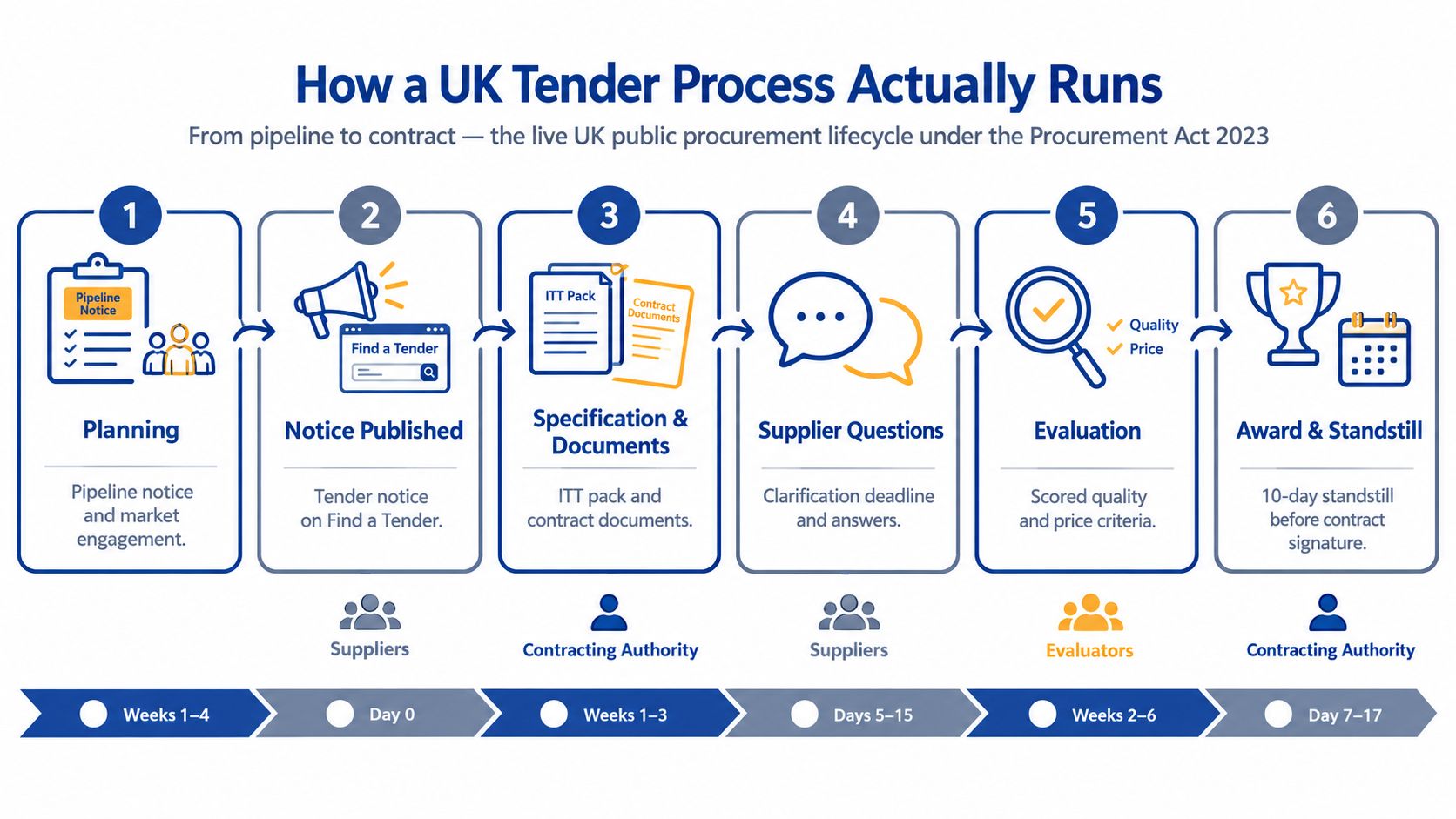
From notice to response
The first supplier task is qualification. Read the notice, selection criteria, exclusion grounds and instructions before opening a response template. In a multi-stage route, the SQ or equivalent selection response may determine whether you reach the ITT stage.
The ITT pack then sets out the specification, contract terms, pricing schedule, quality questions and evaluation method. The clarification period is not a courtesy exercise. It's the controlled route for resolving ambiguity, challenging an impractical requirement or confirming how the authority expects a response to be formatted.
The bid action sits at submission. The supplier completes the required forms, checks the files, validates pricing and submits through the stated portal. A buyer-specific sourcing system may handle the tender documents and the final upload, while Find a Tender provides the central notice or share-code mechanism for regulated opportunities. The Ministry of Justice procurement information illustrates how suppliers may register interest, access documents, submit electronically and communicate through a sourcing portal.
Evaluation and award
Evaluators score the bid against the published award criteria. They may assess quality, cost, delivery approach, experience, social value and whole-life considerations. A framework call-off or DPS competition can compress the process because suppliers have already passed an earlier access stage, but the call-off still has its own requirements and deadline.
The authority then issues the outcome, including the standstill communication where applicable, before completing the award and contract signature. The exact timetable depends on the route and documents. A bid manager should never rely on a generic calendar. The notice and procurement documents control the dates that matter.
Thresholds also shape the route. For 2026, the verified UK thresholds include £135,018 for central government goods and services, £215,720 for sub-central authorities such as councils, NHS trusts and universities, and £5,193,000 for works contracts regardless of authority, as summarised in the UK Find a Tender threshold reference. Those figures help determine when a regulated tender process is required, which in turn affects the notice and response environment.
For teams handling several opportunities, the Bidwell tender use case shows the practical connection between notice monitoring and the later bid workflow. The key is not merely seeing more notices. It's knowing which ones have entered a process your team can realistically complete.
What a Real Bid Looks Like for an SME
Take a hypothetical 25-person cyber consultancy considering a £450,000 Department for Education cyber-resilience lot through a CCS framework. The numbers describe the scenario, not a reported case study. The team still has to make the same hard decisions as any SME.
The bid lead starts with the specification and evaluation weightings. The technical director checks whether the consultants are available during mobilisation. Finance tests the margin and pricing assumptions. The commercial lead checks whether the framework terms, insurance requirements and liability position are acceptable.
The go or no-go decision
A credible go or no-go review asks four blunt questions:
- Can we deliver it? Capacity and named expertise must exist, not just appear in a CV library.
- Can we evidence it? Relevant references, policies and outcomes need to match the authority's requirement.
- Can we price it safely? A low figure that ignores delivery effort creates a contract problem later.
- Can we complete it properly? The response window must allow time for review, approvals and portal submission.
If the answer is yes, the response team maps the requirements. The quality response may need method statements, social value commitments, Cyber Essentials Plus evidence, a pricing schedule and declarations. Each answer should follow the buyer's question and make the evidence easy to find.
The submission is more than the narrative
The team submits clarification questions through the prescribed route, tracks answers and updates the response accordingly. It checks PDF formatting, file-size limits, page limits, naming conventions and spreadsheet formulas. Then an authorised person completes the portal declaration and submits before the deadline.
For an open tender, the team may need to build the full response without a prior relationship or shortlist. A framework mini-competition can narrow the field but still demand a custom solution. A multi-stage process may reduce the number of suppliers progressing to the final offer, while increasing the importance of getting the selection response exactly right.
That route choice changes the bid burden. A small team shouldn't treat every notice as a full-scale proposal exercise. It should match bid hours, contributors and approval effort to the procedure, contract fit and realistic chance of success. A response platform such as Bidwell's bid writing software can support that work by generating draft answers from an approved knowledge base, but the subject experts still need to verify the commitments.
After submission, the team may receive clarification requests, then an outcome and debrief. A good bid file preserves the submitted version, pricing approval, evidence sources and final correspondence. That record improves the next decision, whether the result is a win, a loss or a decision not to pursue similar work.
Where Using the Wrong Term Bites You
Loose terminology becomes expensive when it changes what people think they're approving.
Consider the first situation. A supplier refers to a published contract notice as a “bid opportunity” in correspondence with the authority. Later, the team receives an award communication but treats it as another invitation to bid. It misses the applicable standstill window because nobody recognised that the procurement had moved from supplier response to award notification.
The problem isn't the phrase alone. The phrase signals that the team has misunderstood the procedural moment. A notice means the authority is inviting responses. An award communication means the authority has completed evaluation and is explaining the result.
A selection response isn't the final offer
The second situation happens inside the boardroom. A bid manager labels an SQ response as the “tender” in a board paper, and leadership approves pricing as though the organisation is submitting its final commercial offer.
That approval may be premature. A selection questionnaire can establish whether a supplier passes the initial stage, while the later ITT may require a detailed methodology, final pricing, implementation plan and additional declarations. Calling both documents “the tender” hides the difference in risk and decision rights.
The same issue appears when a team treats a framework position as though it were a contract award. Being eligible to compete for call-offs isn't the same as winning a specific requirement. The later bid still needs to meet the call-off rules, answer the buyer's questions and land within the stated deadline.
The label should tell the next person what has happened, what remains to do and who must approve it.
Use precise names in pipeline meetings and board packs. Record the portal, procedure, stage, deadline and submission owner. That language makes legal timelines easier to manage and stops commercial decisions being taken against the wrong document.
Reading a Tender Notice Before You Bid
Treat the notice as a screening document, not as a prompt to start drafting.
The first pass should tell you who is buying, what route is being used and whether the opportunity fits your organisation. The second pass should test the hidden workload. Only then should contributors begin writing answers.
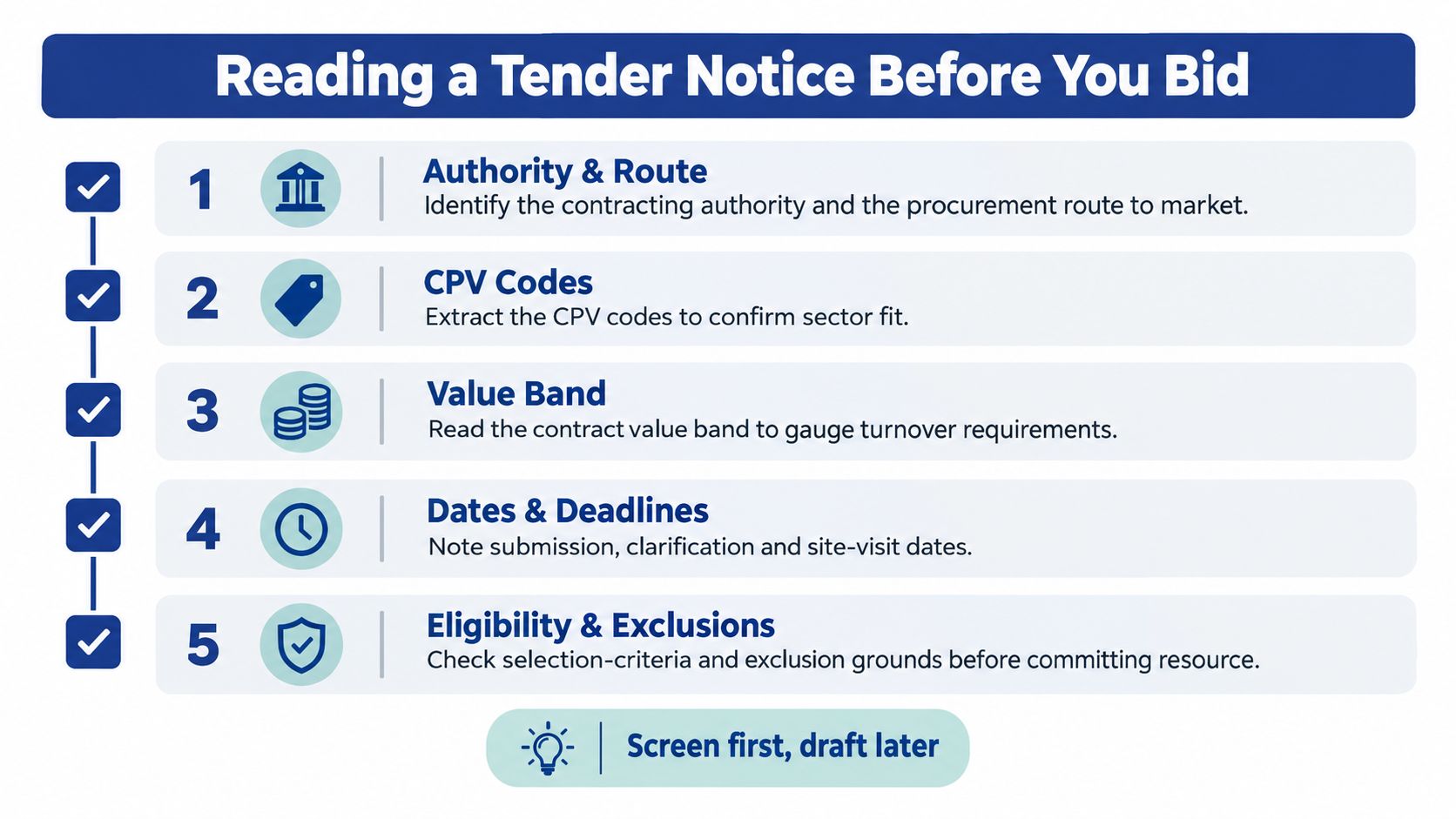
Five checks before opening the response template
Authority and route. Identify the contracting authority, portal and procedure. An open tender, restricted route, competitive flexible process and framework competition create different access and response demands.
CPV codes. Check the classification codes against your actual service fit. A familiar title can conceal a requirement outside your delivery model.
Value band. Use the stated value to assess scale, financial exposure and likely resource demand. Compare it with the applicable threshold rather than assuming every notice follows the same regulated route.
Dates and deadlines. Record the clarification deadline, submission time, site visit and any selection-stage dates. A response that is technically strong but late may not be considered.
Eligibility and exclusions. Read selection criteria, exclusion grounds, insurance requirements, parent company guarantees, certifications and declarations before committing resource.
The details that quietly disqualify suppliers
Lots deserve careful attention. You may fit one lot but not another, or the authority may require a separate submission for each. Social value can also carry meaningful evaluation weight, so treat it as a scored requirement rather than a paragraph added at the end.
Set a go or no-go score against estimated bid hours, delivery capacity, evidence strength and realistic win probability. Ask whether your knowledge base contains credible material for the quality questions, and whether the response team can review every answer before submission.
A structured monitoring system can surface fields such as authority, portal, value, procedure, deadline and sector fit, so the bid manager compares opportunities without reopening every PDF. That's where tender monitoring, a knowledge base and AI-assisted response generation fit together. The system finds and organises the notice, the library supplies approved evidence, and the drafting tool helps shape answers that still require human review.
Tying the Workflow Back to Your Bid Team
The tender versus bid distinction earns its place when it changes the working week.
Someone needs to own the portals and alert feeds. Someone else must triage each notice against fit, threshold, route and deadline. A bid lead then makes the go or no-go recommendation, while an accountable director approves the commercial position and declarations.
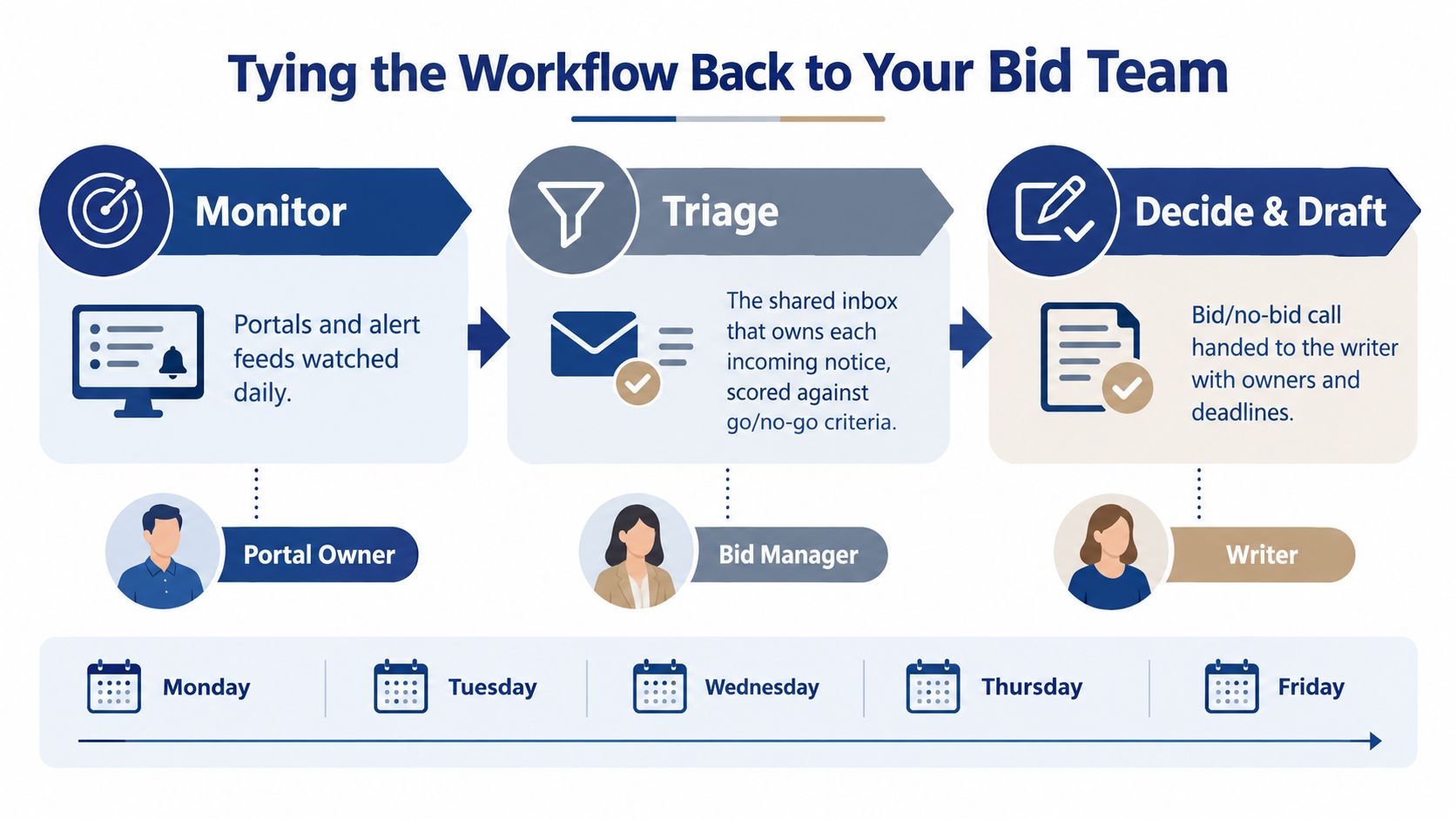
A workable operating rhythm
The portal owner monitors Find a Tender, Contracts Finder and relevant devolved portals. The bid manager checks new notices against structured fields rather than relying on a free-text search for “tender”. That reduces the chance of confusing an early pipeline notice with an active competition.
The capture or commercial lead then tests the opportunity. They check authority, procedure, threshold, lots, mandatory requirements, submission route and response effort. The decision should be recorded with a reason, not left in an inbox where the deadline can disappear.
If the opportunity passes, the writer works from an approved knowledge base. Past responses, policies, case studies, CVs and credentials should be mapped to common quality themes, but none should be copied blindly. The reviewer checks every answer against the evaluation criteria and asks whether the evidence actually supports the promise.
Ownership prevents deadline risk
The final review needs named owners. One person checks compliance, another checks pricing and a senior approver signs the declarations. The portal owner confirms that the uploaded files are the final versions and that the submission receipt has been retained.
That operating model keeps the artefacts separate. The monitoring team owns the tender notice. The bid team owns the supplier response. The knowledge base supports evidence reuse, and AI response generation can reduce first-draft effort without removing accountability for accuracy.
For bid managers who want to formalise that division of work, Bidwell for bid managers is one example of a platform built around monitoring, reusable source material and response drafting. The important principle is broader than any one product: the right person should handle the right artefact at the right stage.
When teams use that discipline, “tender versus bid” stops being a vocabulary debate. It becomes a practical control over portal ownership, qualification, drafting, review and submission.
Bidwell brings UK tender monitoring, a reusable knowledge base and AI-assisted response generation into one workflow, so your team can screen notices before committing bid effort and draft from approved evidence when it decides to proceed. Visit Bidwell to see how it can support the move from published tender to compliant, review-ready bid.