The most popular advice on the best bid software is usually wrong. Most comparison articles rank platforms as if tender discovery, bid writing and bid management were the same job. They aren't.
A small UK supplier that can't see suitable opportunities has a discovery problem. A team that keeps rewriting its accreditations has a content problem. A bid manager drowning in approvals and deadlines has a workflow problem. Buying an expensive all-in-one suite won't fix the wrong bottleneck.
The useful question is simpler: which part of your bid process is costing you the most time or causing you to miss good work? Once you've answered that, the right software layer becomes much easier to identify.
The Three Layers of Bid Software
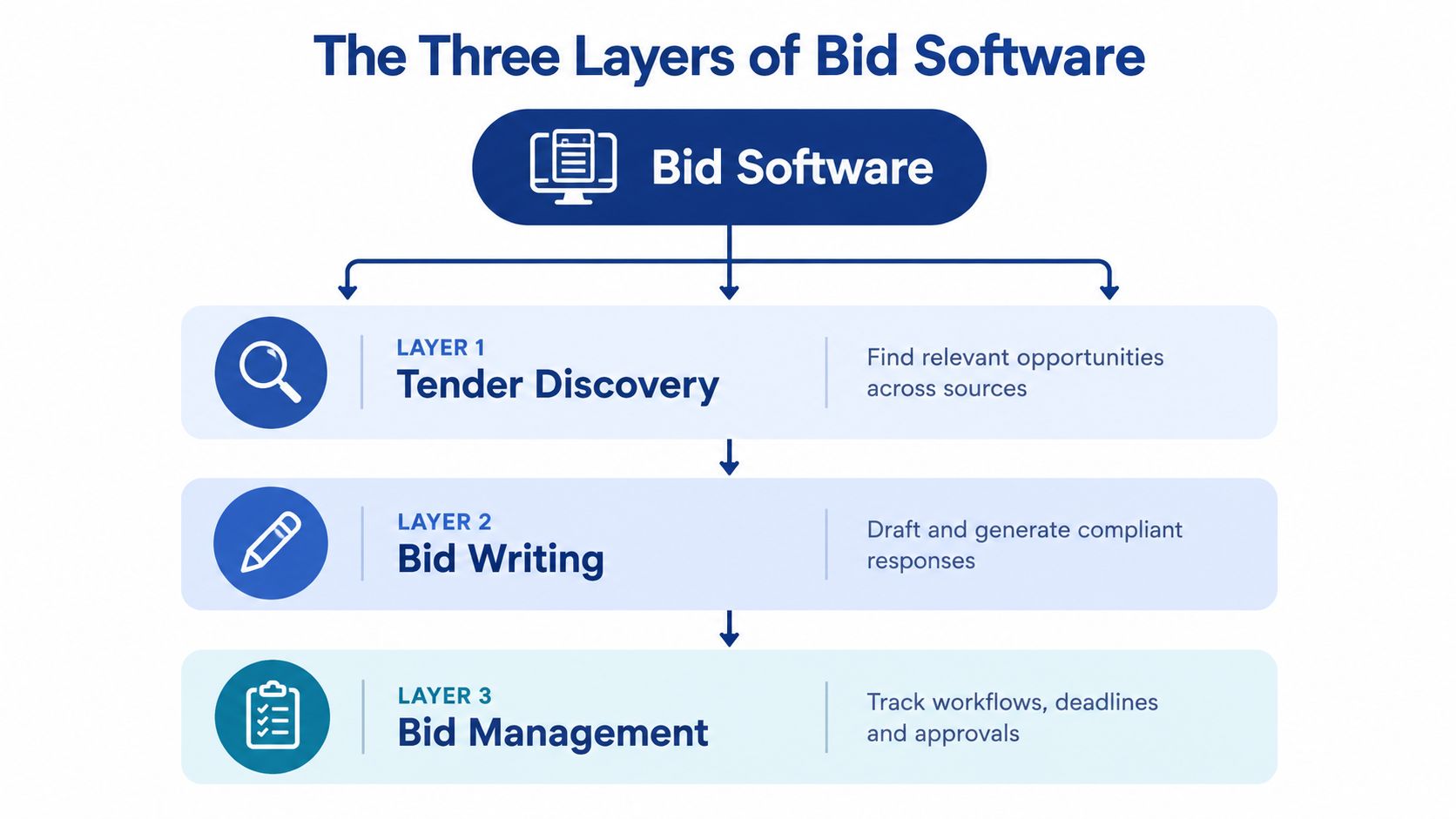
One tool rarely does every bid-related job equally well. A tender database may help you find opportunities but offer no useful content library. An AI writing tool may produce fluent paragraphs while knowing nothing about your actual policies, accreditations or delivery evidence.
That distinction matters for SMEs. You can overbuy an enterprise workflow suite when your main problem is portal monitoring. You can also buy an attractive AI writer and discover that your evidence still lives across email threads, shared drives and files called Final_v2.
Discovery tools
Tender discovery software watches procurement portals and brings relevant notices into one working view. In the UK, that means handling sources such as Find a Tender, Contracts Finder, Public Contracts Scotland and Sell2Wales, rather than expecting a bid manager to search each site manually.
The important features aren't just keyword search. Look for buyer, location, sector, contract value, deadline and notice-type filters. Good monitoring also removes obvious mismatches and gives you enough context to decide whether an opportunity deserves qualification.
Content libraries
A knowledge base stores the evidence needed to answer tender questions. That includes policies, case studies, CVs, service descriptions, accreditations, insurance details, previous answers and delivery methods.
A folder structure is not automatically a knowledge base. The useful distinction is retrieval. Your team should be able to find the approved evidence for a social value question or mobilisation plan without opening every document in a shared drive.
AI drafting and bid management
AI response generation turns relevant evidence into a draft aligned with the question and evaluation criteria. It should help with structure, coverage and first drafts, but it shouldn't invent delivery experience or make unsupported promises.
Bid management is the operational layer around the writing. It covers owners, deadlines, reviews, clarification questions, version control and final submission checks. Some platforms specialise here, while others combine monitoring, a knowledge base and drafting in one workspace.
| Software Type | Primary Focus | Best Suited For |
|---|---|---|
| Tender discovery | Finding and filtering opportunities | Suppliers missing relevant notices |
| Knowledge base | Storing and retrieving evidence | Teams rewriting the same material |
| AI drafting | Producing tailored first drafts | Writers facing repetitive responses |
| Bid management | Coordinating people and deadlines | Larger teams with complex approvals |
Practical rule: Buy the layer that fixes your current constraint first. Add the others when the process, not the software catalogue, justifies them.
Navigating the Fragmented UK Tender Portals
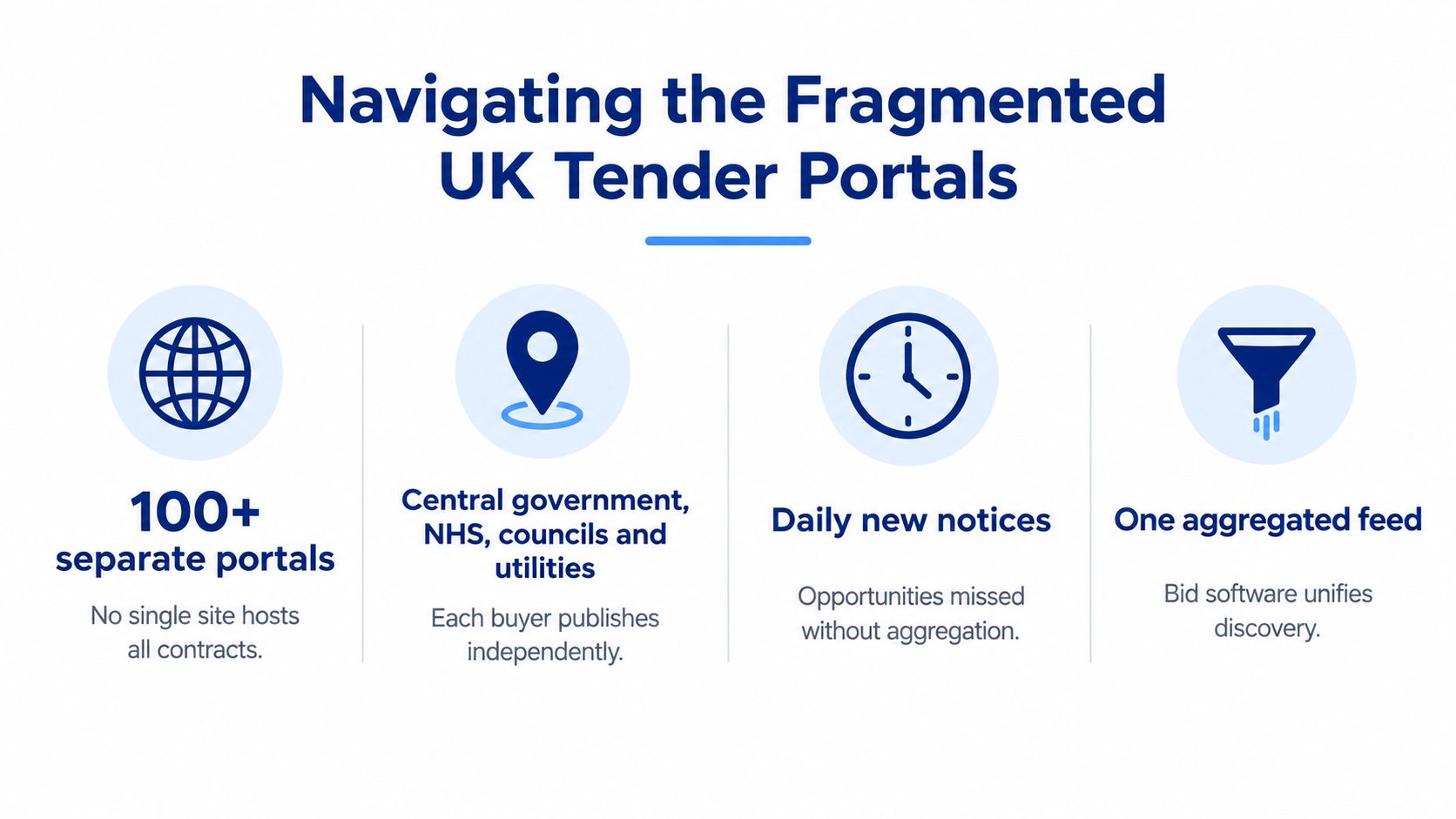
You cannot bid for a contract your team never sees. UK suppliers have to work across several procurement notice systems, each with different search behaviour, alert settings and notice formats.
One industry summary reports more than 610,000 notices across Find a Tender, Contracts Finder, Public Contracts Scotland and Sell2Wales. It also records more than 51,000 distinct procurements in 2025, with around £185 billion in advertised value across those registers. Those figures show why opportunity discovery is a systems problem, not something to leave to an occasional inbox alert. (UK procurement data systems guide)
The same summary records 8,639 procurements on Find a Tender, 41,219 on Contracts Finder, 1,469 on Public Contracts Scotland and 281 on Sell2Wales in 2025. The uneven spread matters. A supplier that searches only one portal may be looking in the wrong place for its target buyers.
What the UK platforms cover
Contracts Finder lets suppliers search government contracts over £12,000 including VAT, as well as future opportunities and previous tender information. GOV.UK directs suppliers towards Find a Tender for higher-value work. (Contracts Finder search guidance)
Find a Tender is the central digital platform for UK public procurement. The enhanced service launched on 24 February 2025, and official guidance says it supports supplier registration, a unique identifier, reusable supplier information and free opportunity alerts. (Central Digital Platform factsheet)
The thresholds and publication rules still need careful handling. Find a Tender is generally used for high-value contracts above £139,688 including VAT, while Contracts Finder covers the lower threshold described above. New below-threshold and above-threshold notices moved into the enhanced Find a Tender service from the launch date, except below-threshold notices in Scotland. (Find a Tender service guidance)
What aggregation should do
A monitoring platform should normalise notices from several sources, not just display a list of links. It should help your team compare deadlines, identify the contracting authority, classify the requirement and decide whether the opportunity fits your capability.
The practical test is simple. A daily, filtered feed should let bid managers qualify opportunities against service area, geography, buyer type, framework position and evidence availability. Bidwell's tender monitoring workflow is built around that discovery and qualification job.
The government platform itself points towards structured, searchable procurement information that can be reused. The Open Contracting Data publication describes Find a Tender as a source of structured notices, which makes reliable extraction and normalisation more useful than a generic list of procurement websites.
Comparing the Leading Bid Platforms
There isn't one universal winner. A project-management platform can be excellent at assigning actions and controlling approvals while doing little to improve tender discovery. A writing assistant can produce a polished paragraph without knowing whether your organisation has the evidence to support it.
The comparison below separates the main buying choices. It also shows why UK SMEs should be cautious about paying for enterprise workflow features before fixing opportunity fit and evidence retrieval.
| Software Type | Primary Focus | Best Suited For |
|---|---|---|
| Portal search and alert tools | Notice discovery | Teams that already have strong writing and document control |
| Enterprise bid management suites | Work allocation, approvals and audit trails | Larger bid departments with formal governance |
| Standalone AI writing tools | Drafting and editing | Experienced writers with an organised evidence store |
| Knowledge-base platforms | Reusable company content | Teams losing time to repeated research and rewriting |
| UK-focused tender platforms | Monitoring, evidence and response preparation | SMEs bidding across public-sector portals |
| General project-management tools | Tasks, dates and ownership | Teams needing coordination rather than tender intelligence |
The trade-offs in practice
Discovery-only software is a sensible first purchase if your pipeline is weak. It won't solve the writing burden, though. Your team will still need to assess every notice, gather evidence and draft answers elsewhere.
Enterprise suites can work well where several contributors, reviewers and commercial stakeholders need controlled handoffs. Their weakness is often cost and implementation effort. A small team may spend more time maintaining the system than using the functions that justified the purchase.
Standalone AI tools are faster to adopt, but they depend heavily on the material supplied to them. If the source content is incomplete, out of date or generic, the output will be generic too. A fluent response still fails if it ignores a scoring criterion or claims experience you can't prove.
A unified platform such as Bidwell combines tender monitoring, a searchable knowledge base and AI response generation for UK public-sector bids. That makes it relevant where one person or a small team owns the process from finding the notice through to final review. The alternative is to connect separate tools and maintain the handoffs yourself.
For a broader view of how different products fit together, compare Bidwell alternatives for tender response work. The right choice depends less on the longest feature list and more on whether the platform matches your current process.
Building a Reusable Knowledge Base
Your response can only be as strong as the evidence behind it. Evaluators want specific answers about delivery, governance, quality, risk, people and outcomes. Generic claims about being reliable or customer-focused rarely carry much weight without supporting detail.
Many SMEs keep that evidence in a shared drive. One folder contains policies, another contains old bids, and a third contains case studies with unclear dates or ownership. Files named Approved, Approved_new and Final_latest create a version-control problem before anyone starts writing.
Start with evidence, not documents
Build the library around the questions your team must answer. Useful categories include:
- Company credentials: Legal details, accreditations, insurance, policies and relevant certifications.
- Delivery evidence: Case studies, mobilisation plans, service methods and quality controls.
- People and expertise: Team CVs, roles, qualifications and named responsibilities.
- Past responses: Strong answers, evaluator feedback and reusable explanations.
- Commercial and operational material: Reporting, risk management, social value and continuity arrangements.
Each item needs an owner and a review date. It should also have enough context for another writer to use it correctly. A case study without the client type, service delivered, responsibilities and evidence of results is little more useful than a marketing paragraph.
Make retrieval dependable
Use tags that reflect how bid managers search. Service line, buyer sector, geography, framework, question theme and evidence type are more useful than a vague folder called “General”.
A good knowledge base should return the approved source material when a writer searches for mobilisation, safeguarding or contract management. It should also make outdated content visible, rather than allowing an old policy to surface as if it were current.
Teams building AI workflows may also benefit from guidance on best enrichment tools for AI agents, particularly when they need to improve the quality and structure of information before automation uses it.
A content library earns its place when a writer trusts the retrieved evidence enough to use it, and can see who approved it.
How AI Response Generation Actually Works
Bid writers are right to distrust generic AI drafting. A chatbot can produce a smooth answer that misses the question, ignores the scoring criteria or invents a capability. The problem isn't solved by asking for a longer prompt.
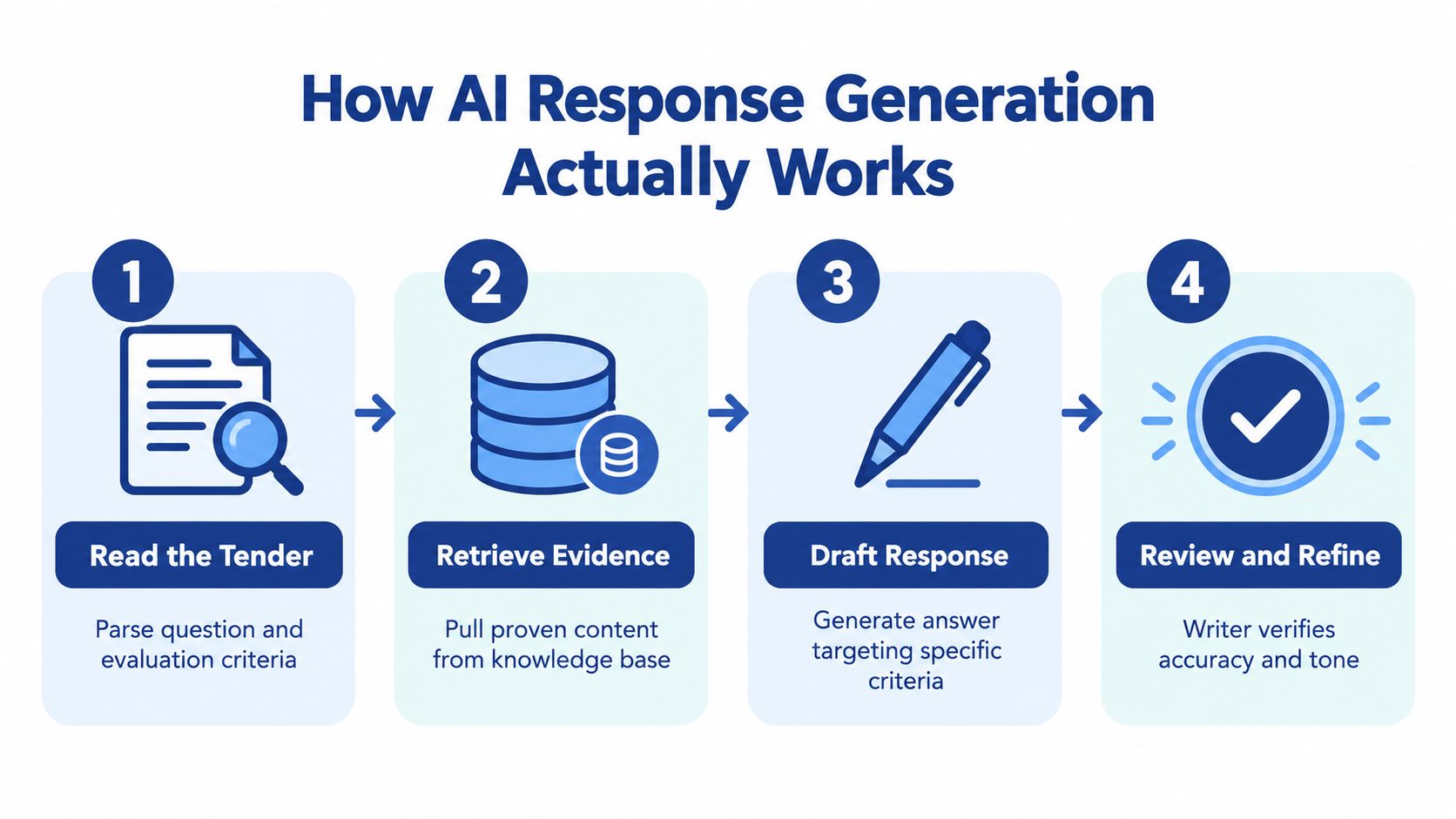
Useful AI response generation starts with controlled source material. The system reads the tender question, identifies the requested themes and retrieves relevant evidence from the organisation's knowledge base. It then drafts around the actual requirement instead of filling a page with broad statements.
A defensible drafting process
The workflow should be visible to the writer:
- Read the tender: Parse the question, instructions, word limit and evaluation criteria.
- Retrieve evidence: Find approved policies, case studies, credentials and delivery details.
- Draft the response: Structure an answer around the buyer's requirements and your evidence.
- Review and refine: Check accuracy, tone, compliance, detail and scoring coverage.
The writer remains responsible for the final answer. AI can produce a useful first draft, but it can't approve a mobilisation date, verify a staffing commitment or decide whether a case study matches the buyer's requirement.
Why the source material matters
A knowledge base filled with vague brochures will produce vague responses. A structured library containing precise delivery methods, named roles, policies and relevant past answers gives the drafting engine something dependable to work with.
This is also where the time saving becomes practical. The stated Bidwell workflow is intended to turn a 20 to 40-hour writing task into 2 to 4 hours of review and refinement, rather than asking a writer to accept an unverified machine-written submission. That claim describes a workflow target, not permission to skip human judgement.
The Federation of Small Businesses procurement report illustrates why drafting support matters. Nearly half of respondents thought writing a successful public-sector bid would take longer than a day, while 13% thought it would take less than two hours. The gap reflects how differently teams experience the same task depending on their evidence, process and support.
AI should remove repetitive drafting work. It shouldn't remove the person who understands the contract.
Choosing the Right Tool for Your Team
The right purchase depends on where the process breaks. A solo bid manager who misses notices needs something different from a team that finds suitable work but can't control versions or retrieve evidence.
Use the following decision points rather than choosing the platform with the longest feature list.
If opportunities are the problem
Start with tender monitoring when your team searches portals manually, relies on inconsistent alerts or discovers opportunities after the deadline is close. You need cross-portal coverage, sensible filters and a qualification view.
Contracts Finder and Find a Tender should form part of the search process, with relevant devolved portals included where your market requires them. A discovery layer may be enough if your existing content and writing process already work well.
If repeated writing is the problem
Choose a knowledge base when writers repeatedly ask the same subject-matter experts for policies, credentials and service descriptions. AI drafting becomes useful after the evidence has been organised and approved.
A central library is usually more valuable than a clever text editor when several people write bids in different styles. It gives the team a common source of truth and makes review more consistent.
If coordination is the problem
Choose bid management features when deadlines, approvals and ownership are causing failures. You need clear actions, controlled versions, reviewer visibility and a final compliance check.
Large teams may justify a dedicated workflow suite. Smaller teams should test whether they need that complexity or whether a unified monitoring, knowledge and drafting workflow would reduce handoffs. Bid writing software for tender teams is one option for organisations that need the response process connected to the evidence behind it.
A practical buying test
Before committing, run a real tender question through the proposed workflow. Ask the platform to find the relevant evidence, identify gaps and produce a draft that follows the buyer's instructions.
Then inspect what the writer must correct. If the system finds irrelevant documents, hides its sources or produces unsupported claims, the problem will become expensive at scale. If it exposes evidence clearly and leaves the writer with a focused review, it may fit your team.
Implementing Your New Bid Workflow
Buying software is the easy part. The first month determines whether it becomes part of the bid process or another unused subscription.
Start by choosing a small, representative set of previous bids. Include a strong submission, a weak submission and a response that required substantial subject-matter input. Extract the reusable evidence, remove obsolete wording and assign an owner to each important item.
A practical first month
During the opening phase, configure monitoring around your actual services and target buyers. Don't begin with every possible keyword. Start with terms that produce a manageable number of relevant notices, then adjust the filters when your team understands the results.
Next, load the knowledge base in priority order:
- Core credentials: Policies, accreditations, insurance and company information.
- Proof of delivery: Case studies, references and service examples.
- Response material: Strong past answers, methods and governance content.
- People information: Current CVs, roles and relevant qualifications.
Use one live opportunity to test the full route from alert to final review. Record where the team still leaves the platform, what evidence is missing and which generated sections need the most correction.
AI adoption works better when writers understand that the tool handles repetitive drafting, not accountability. They still need to interpret the question, challenge weak evidence and make sure the proposed service can be delivered.
For teams coordinating several connected workflows, an overview of workflow orchestration software can help clarify where automation should sit and where human approval remains necessary.
By the end of the first month, you should know which notices are worth pursuing, which evidence is reusable and where the review process still slows down. That knowledge is more valuable than a feature checklist.
Bidwell brings tender monitoring, a reusable knowledge base and AI response generation into one workflow for UK public-sector SMEs. Visit Bidwell to see how it can help your team find relevant opportunities, reuse verified evidence and spend its time refining stronger responses rather than starting every bid from a blank page.