You've just found a tender that looks perfect on paper. The buyer needs exactly what your team delivers, the contract value is attractive, and the deadline is uncomfortably close. Then three more opportunities arrive, each demanding specialist input, pricing work and senior review. The problem isn't finding tenders. It's deciding which ones deserve your team's attention.
Bid no bid analysis is the discipline that makes that decision defensible. In UK public procurement, the strongest qualification process looks beyond turnover, margin and basic eligibility. It asks whether the notice, procurement route, buyer engagement and competitive conditions give your organisation a realistic path to winning.
Why Bid No Bid Analysis Matters in UK Public Sector Procurement
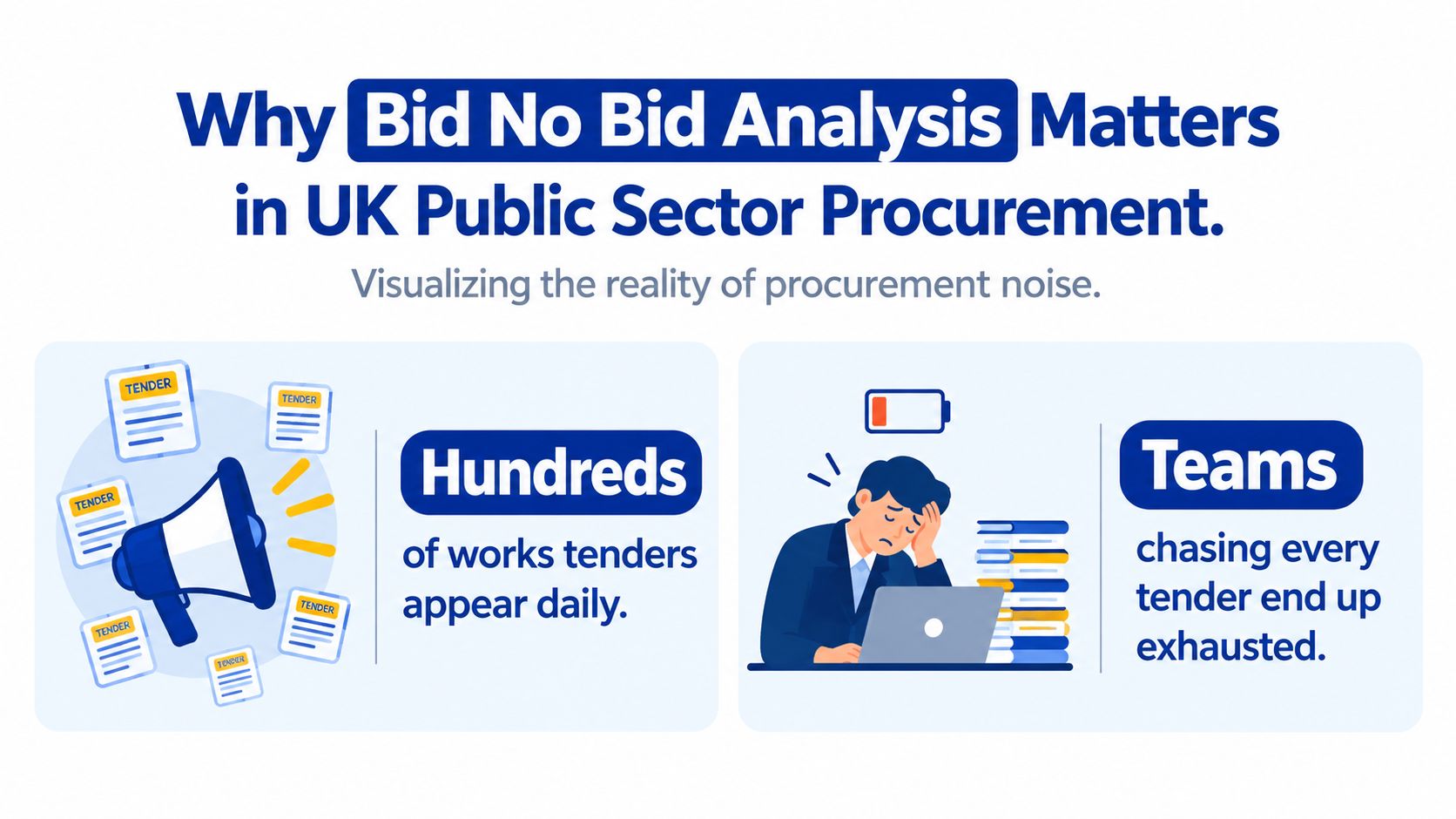
A bid manager's week can disappear before anyone has written a good answer. One colleague is checking a works notice, another is chasing a case study, and a director is asking whether the opportunity is winnable. Meanwhile, the deadline keeps moving closer.
The volume explains the pressure. More than 800 new works tenders can appear in a single day across UK procurement portals, while nearly 56,000 public sector contracts worth £386 billion are due to expire in the next 12 months, according to industry analysis of UK tender information volumes. A straightforward tender response can take 40 to 80 hours of professional time, so an attractive contract can still be a poor use of capacity if the route to award is weak.
Treat qualification as capacity protection
The common mistake is to treat a no-bid decision as lost revenue. In practice, it protects the people who create your competitive advantage. A technical lead who spends days supporting a low-probability response isn't available for a better opportunity, a live delivery issue or a relationship with a priority buyer.
Start with a short screen before opening the response template. Check whether you're eligible, whether your evidence is comparable, whether you understand your competitive position and whether the work fits your strategic direction. If one of those checks produces a serious concern, pause the pursuit and record what would need to change.
That doesn't mean rejecting every difficult tender. It means separating a genuine stretch opportunity from one where the team is relying on optimism. Your tender monitoring workflow should surface opportunities early enough for that decision to happen before writing begins.
Learn from the bids you didn't win
Selectivity becomes useful when it improves over time. Review the last 5 to 10 submissions with the available debrief feedback and look for recurring gaps in quality, price or social value. If your scores repeatedly fall short on delivery assurance, another attractive contract won't fix that weakness by itself.
A bid/no-bid meeting should therefore leave a trail. Record why the team pursued the work, what evidence supported the decision and which assumptions proved wrong. After several cycles, you'll have a clearer view of the opportunities where your capability converts into evaluation points, rather than a list of tenders that merely looked relevant.
The Four-Lens Qualification Screen
Run the first qualification screen before anyone starts drafting. UK bid guidance recommends checking financial eligibility, evidence comparability, competitive position and strategic fit before proposal writing begins, as set out in this practical guidance on improving bid success.
The screen should be quick enough to use consistently and serious enough to stop an emotionally driven pursuit.
Lens one checks financial eligibility
Confirm that your organisation can meet the buyer's requirements, including financial standing, insurance, accreditations and any mandatory supplier conditions. Don't leave this to the compliance check at the end. A missing condition can make hours of persuasive writing irrelevant.
Also check whether the commercial structure is deliverable. A contract may fit your service line but expose you to payment, liability or resourcing terms that the business can't sensibly accept. Flag those issues for commercial review rather than assuming they'll be resolved later.
Lens two tests evidence comparability
A relevant-sounding case study isn't necessarily relevant evidence. Compare the customer environment, scope, complexity, outcomes and delivery responsibilities with the tender requirements. If the buyer wants experience in a regulated setting and your example comes from a very different environment, score the evidence conservatively.
Create a simple evidence map. For each key requirement, identify the named reference, proof point and accountable subject matter expert. A competitive analysis frameworks guide can help structure the external comparison, but the useful question remains practical: where can your evidence beat the likely alternatives?
Lens three tests your competitive position
Ask who is likely to bid, whether an incumbent has an advantage and whether the buyer's requirements appear shaped around a particular operating model. You won't know every competitor, but you can still identify warning signs.
A weak position isn't an automatic no. It becomes a no when the team can't explain how it will overcome the weakness. For example, a partner arrangement, a distinct implementation method or stronger local delivery evidence may change the assessment. Record that reasoning instead of awarding a generous score for “good relationships”.
Lens four tests strategic fit
The opportunity should support where the organisation can win and deliver well. Strategic fit includes sector relevance, reference value, service alignment and the effect on existing commitments.
Review the recent submission history alongside the screen. If your debriefs show repeated losses on price and this tender is heavily price-sensitive, treat that as evidence, not background noise. Any serious red flag should pause the bid until an owner provides a credible mitigation.
Building a Weighted Scoring Matrix for UK Tenders
A scoring matrix is useful when it clarifies judgement, not when it disguises uncertainty behind precise-looking totals. Build it around the buyer's evaluation model and make every score traceable to evidence.
UK public sector awards are based on the most economically advantageous tender, so quality and social value sit alongside price. A matrix that gives commercial fit nearly all the attention can therefore send the team towards opportunities where it cannot earn enough evaluation points.
Match the matrix to the evaluation
Start with the published criteria. Typical headings might include technical approach, relevant experience, delivery confidence, price, social value and commercial risk. Add a separate field for route-to-market strength, because a compliant tender with weak access to the buyer's process may deserve a lower pursuit score.
Use a consistent rating scale and define what each rating means. A high score should require evidence, such as a closely comparable reference, a clear pricing position or meaningful pre-market engagement. “The team feels confident” isn't evidence.
A practical matrix might look like this:
| Criterion | What to test | Evidence required |
|---|---|---|
| Technical approach | Can the solution answer the scored requirements? | Solution outline and subject matter review |
| Experience | Are the references genuinely comparable? | Case studies, credentials and outcomes |
| Price | Can the bid remain competitive without unacceptable risk? | Cost model and assumptions |
| Social value | Can the team provide specific, credible commitments? | Knowledge base evidence and delivery plan |
| Competitive position | What advantage can the buyer recognise? | Market and incumbent assessment |
| Route to market | Does the notice and procedure favour early influence or open competition? | Notice type, engagement record and procurement route |
Give social value its proper weight
Social value shouldn't be treated as a final paragraph added by the bid writer. Under PPN 026 and the Social Value Model, contracts valued at £1 million and above but below £5 million must give social value at least 10% weighting, while contracts valued at £5 million or above must give it at least 20% weighting.
That changes the qualification question. If your organisation can't support credible commitments on jobs, skills, waste reduction or net zero, the issue belongs in the go/no-go decision. Your knowledge base should hold reusable evidence, but each response still needs a buyer-specific commitment with an accountable delivery owner.
Calibrate rather than admire the score
A score is only as useful as the assumptions behind it. Ask a commercial lead, delivery lead and bid lead to score independently when an opportunity is borderline, then discuss the largest differences. Optimistic scoring often appears in competitive position and win likelihood, while cautious scoring often appears in social value because the evidence hasn't been organised.
Set a decision threshold that reflects capacity and risk. Don't let a strong strategic fit cancel out an unresolved mandatory condition, and don't let a large contract value compensate for evidence you don't possess.
What Win-Rate Data Tells Us About Bid Discipline
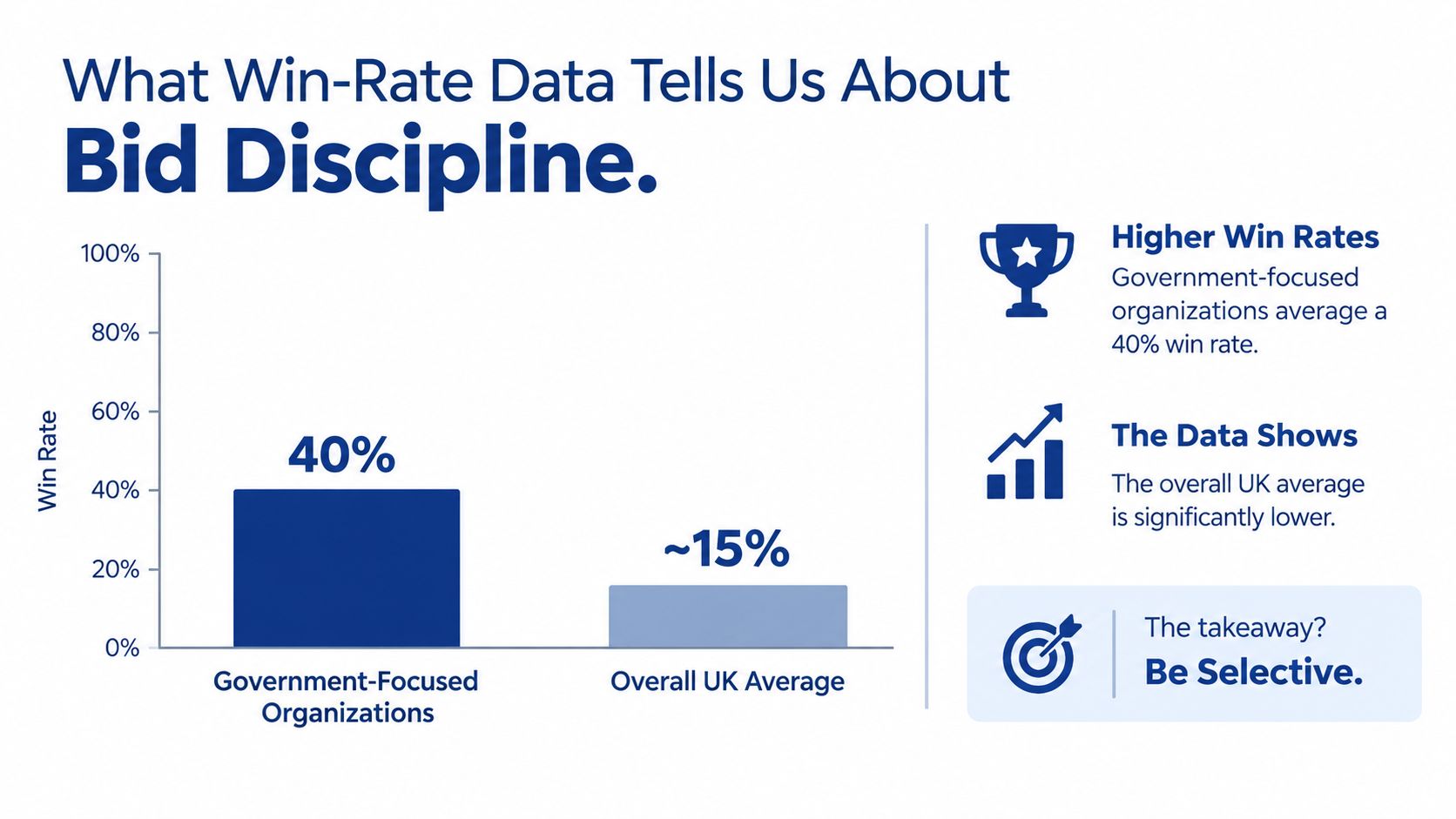
Win rate improves through better qualification, not just through a larger pipeline. Organisations focused primarily on government contracts average a win rate of around 40%, compared with 47% across UK organisations overall, according to the UK bid win-rate benchmark.
For public sector teams, that gap should prompt a closer look at the opportunities entering the pipeline. A strong service fit and acceptable margin do not make a tender winnable. Notice type, the quality of pre-market engagement and the route to market can shift the odds before the specification is published. A direct competition, a framework call-off or a negotiated route each creates different access to the buyer, different competitive pressure and different evidence requirements.
Process quality matters more than activity
The same benchmark reports stronger results among teams using dedicated proposal tools and structured processes than among teams without a formal win/loss review process. The figures do not show that software alone causes the difference. They show the value of a repeatable operating rhythm, where teams qualify early, record assumptions and learn from outcomes.
That discipline should begin before bid writing. Check whether the notice reflects genuine market access, whether engagement revealed a buyer priority you can address, and whether the route to market favours your relevant experience. Treat eligibility as a starting condition, not proof of competitiveness. A positive conversation with a buyer is also evidence to test, not confirmation of preference.
Practical rule: If you cannot explain why this opportunity is more winnable than the last similar loss, lower the score or pause the bid.
Use debriefs to improve the decision
A debrief should change future qualification, not only improve the next response. A price gap may alter the commercial screen. A social value gap may expose missing evidence. A weak quality score may show that the route to market or delivery model does not suit the organisation.
Record those findings against the notice type, engagement history and procurement route. Over time, the team can identify which upstream signals precede credible opportunities and which create expensive false positives. That gives directors an evidence-based reason for declining an attractive contract, rather than a general feeling that the bid looked difficult.
Running a Stakeholder Sign-Off Meeting
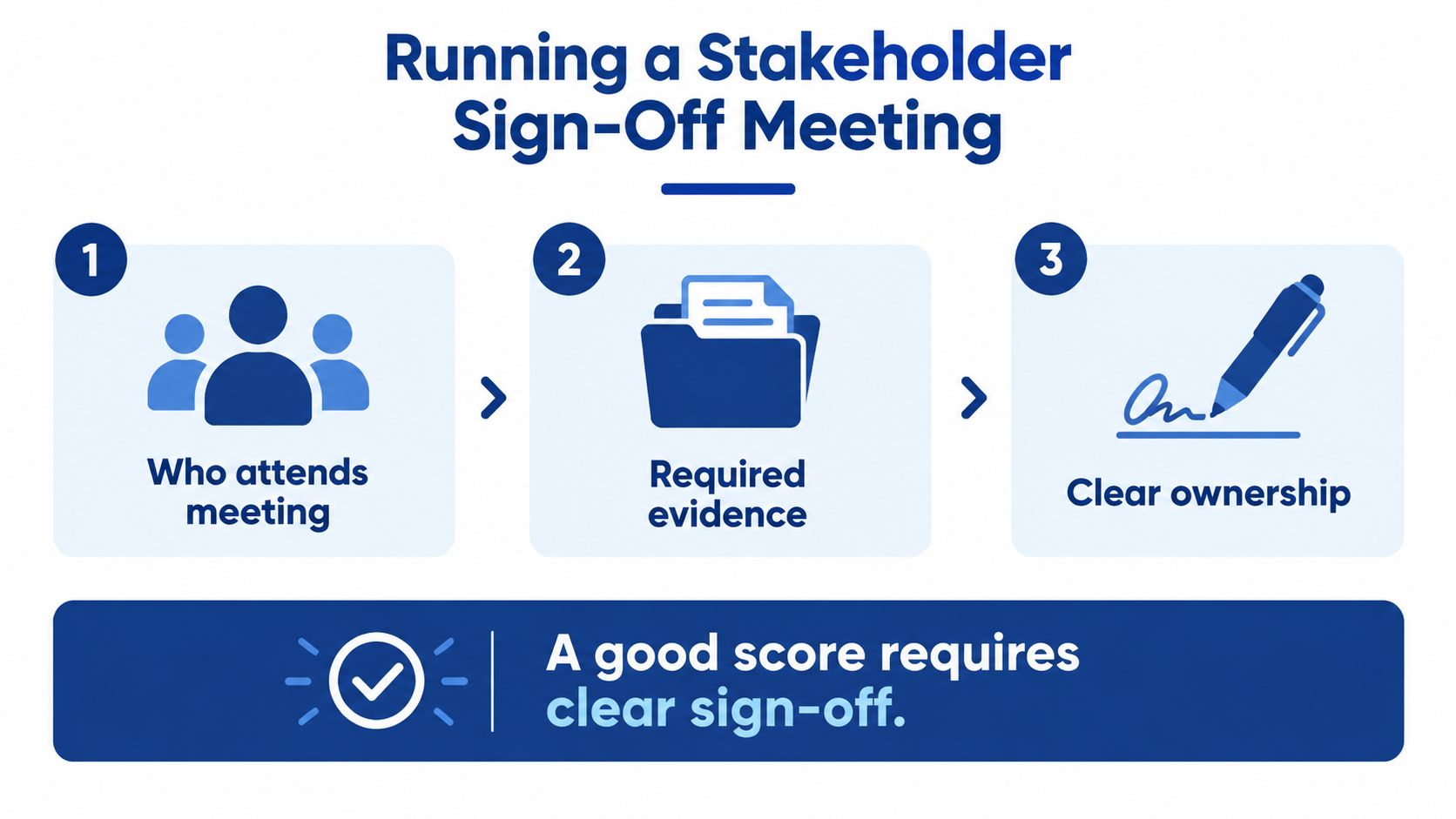
A sign-off meeting should settle ownership and risk, not become a second brainstorming session. Keep the attendee list small enough for a decision, with the bid manager presenting the evidence and each functional lead answering for a defined area.
The right group usually includes the bid lead, commercial owner, delivery lead and a senior decision-maker. Bring in a technical specialist or social value owner when their evidence could change the outcome. Everyone should see the scorecard before the meeting, including the assumptions behind any high rating.
Require evidence for the decision
Use a fixed checklist so the meeting doesn't drift into broad opinions:
- Financial risk: Can the business accept the contract terms, insurance requirements and likely cash demands?
- Delivery capacity: Can the organisation staff the work while protecting existing commitments?
- Compliance gaps: Are mandatory conditions, accreditations and declarations covered?
- Evidence strength: Does each scored requirement have a credible, comparable example?
- Pricing confidence: Are the numbers complete, defensible and free from hidden assumptions?
- Route-to-market logic: Does the notice, procedure and buyer engagement create a credible path to award?
If someone disagrees with the recommendation, record the dissent and the evidence behind it. A disagreement is useful when it exposes an assumption. It's wasteful when the final decision merely reflects the most senior voice in the room.
Record the outcome in operational terms
For a go decision, name the bid lead, solution owner, pricing owner, reviewers and approval points. For a no-go decision, record the reason and any trigger that would justify reconsideration, such as a partner confirming missing capability or a clarification changing the scope.
Bid managers who want a clearer role structure can use the Bidwell bid manager workflow as a reference point. The important principle is simple: a score without an owner is only a document.
How Bidwell Supports Opportunity Qualification and Response Capture
The process works better when information arrives early, evidence is organised and drafting starts from approved material. The three useful capabilities are tender monitoring, a knowledge base and AI response generation. Each supports a different decision point, rather than replacing commercial judgement.
Tender monitoring gives the team a consistent view of the pipeline. UK opportunities may appear through Find a Tender, Contracts Finder, Public Contracts Scotland and Sell2Wales, so relying on manual portal checks can leave gaps. The team needs alerts and summaries early enough to assess the notice type, timing, procurement route and signs of buyer engagement.
Use monitoring for upstream signals
The publication route affects when you can learn about an opportunity. From 24 February 2025, Find a Tender publishes above-threshold and below-threshold notices for new UK procurements, except below-threshold notices in Scotland. Earlier procurements generally had above-threshold coverage there, while Contracts Finder carries relevant below-threshold contracts, including those over £12,000 including VAT, or £30,000 outside central government, as described in the Find a Tender search service.
The 2026 thresholds also matter for triage. PPN 023 lists £135,018 for central government goods and services, £207,720 for sub-central goods and services, and £5,193,000 for works contracts in the relevant categories, as set out in the official threshold amounts. Monitoring should therefore help the team understand not just what is available, but how and where the opportunity entered the pipeline.
Reuse evidence without making responses generic
A knowledge base should hold credentials, past responses, case studies, social value commitments and delivery evidence. It gives the qualification team a fast answer to “can we prove this?” before the bid is approved.
That evidence also needs governance. Mark outdated examples, assign owners to social value commitments and separate approved claims from draft material. PPN 026 makes reusable evidence particularly valuable because larger contracts carry defined social value weighting, but copying a generic paragraph into every tender won't meet the buyer's specific requirement.
Generate a first response for expert review
Once the team decides to bid, AI bid writing software can generate a response built from the tender requirements and approved organisational evidence. The bid manager still checks accuracy, compliance, tone, pricing assumptions and delivery credibility.
That division of labour matters. AI can reduce the time spent assembling a first draft, but it shouldn't decide whether a weak opportunity is worth pursuing or invent proof that the organisation doesn't hold. The decision remains a commercial one, supported by better information capture.
Turning Bid No Bid Analysis into a Repeatable Habit
A repeatable habit starts with a fixed order. Monitor the market, run the four-lens screen, score the opportunities that pass, then hold a short sign-off with named owners. Don't begin with a response template. Begin with the question of whether the team has a credible route to a competitive submission.
Keep a record of every decision, including no-bids. Track the reason in practical language: missing evidence, unacceptable commercial exposure, weak route to market, insufficient capacity or poor strategic fit. When the outcome arrives, compare the original assumptions with the buyer's feedback and update the relevant screen or matrix field.
Protect the process under pressure
The process usually slips when a sales target is urgent or a senior contact wants to pursue the work. That's when the team is most likely to skip evidence checks, inflate competitive scores or ignore delivery capacity. A rushed approval can create more pressure than a timely no-bid.
Use a short decision record that fits into the normal working day. Keep the mandatory conditions visible, make dissent easy to record and require a named owner for every unresolved risk. The framework should help a small team make a clear decision, not create another administrative burden.
Make upstream signals part of the habit
Notice type, pre-market engagement and route to market deserve a place beside fit and margin. An opportunity may be technically suitable but poorly positioned because the team missed early engagement, entered through a route that favours an incumbent or discovered the notice after competitors had shaped the requirement.
Review those signals in each pipeline meeting. Ask what the team knew before publication, what it learned from the notice and whether the procurement route supports a realistic pursuit. That is how bid no bid analysis develops from a static scorecard into a decision system that learns from the market.
Bidwell brings tender monitoring, an organised knowledge base and AI response generation into the same workflow, helping UK teams qualify opportunities before they commit scarce bid capacity. Visit Bidwell to see how you can turn upstream tender signals and approved evidence into clearer go/no-go decisions and focused responses.