
Approximately £385 billion is spent through UK public procurement every year, according to the Home Office SME action plan. That's a substantial opportunity, but a tender submission isn't an ordinary sales proposal. You're making a formal offer against published requirements, with evidence the buyer can assess.
Treat it as a bid-or-walk decision followed by two compliance gates. Confirm you can qualify and deliver before committing the writing time. Then separate administrative completeness from the technical and commercial case, using evidence you've prepared before the notice arrives.
How Long You Have to Submit
The standard electronic tendering minimum is 25 days where the notice and associated documents are issued together, under section 54 of the Procurement Act 2023. The statutory periods below run from the day after the authority invites tenders to the submission deadline.
Minimum UK tendering periods under the Procurement Act 2023
| How you submit | Documents issued | Minimum period |
|---|---|---|
| Electronic | Notice and all associated documents together | 25 days |
| Electronic | Documents not all supplied together | 30 days |
| Not electronic | Complete documents together | 30 days |
| Not electronic | Documents not all supplied together | 35 days |
These are statutory minimums for the circumstances shown, not a promise that every procurement gives you the same response window. Check the applicable procedure, any permitted exceptions and the actual deadline in the notice. Don't apply this table automatically to Scottish procurement or a competition continuing under an earlier regime.
The Procurement Act's new regime took effect on 24 February 2025, as explained in the government's short guide for suppliers. Establish which rules govern the opportunity before building the timetable.
Put the dates somewhere everyone can see
On the day the notice appears, record the publication date, clarification deadline and submission deadline. Include the time, not just the date. Assign someone to check portal messages while the rest of the team works.
Use Find a Tender for above-threshold notices and Contracts Finder for many lower-value opportunities. Include Public Contracts Scotland, Sell2Wales and eTendersNI in your search where relevant. The notice should tell you which portal accepts the response.
Build your working schedule backwards:
- Submission buffer: Leave room to replace a corrupted file or resolve a login problem.
- Approval point: Give the authorised signatory time to read the commercial commitments.
- Content freeze: I'd freeze the pack 48 hours before the planned upload, allowing controlled changes only.
- Clarification cut-off: Ask questions early enough to use the answer, rather than merely recording the uncertainty.
A reminder system helps, provided someone owns the action. The Pretty Progress deadline reminders for students offer a useful comparison for organising deadline prompts, although the tender portal remains your authority for procurement dates.
Don't mistake a countdown for preparation time
Missing pricing sheets or unclear schedules need an immediate clarification. Treat your internal timetable as provisional while essential information is unresolved, but keep working towards the published deadline unless the authority formally changes it.
Practical rule: Use the response window to tailor existing evidence, not to discover whether your company has any.
Tender monitoring gets the opportunity onto the calendar. A maintained knowledge base supplies the proof. AI response generation belongs after those tasks, when it can work against the buyer's actual questions.
Decide Whether This Tender Is Worth Bidding
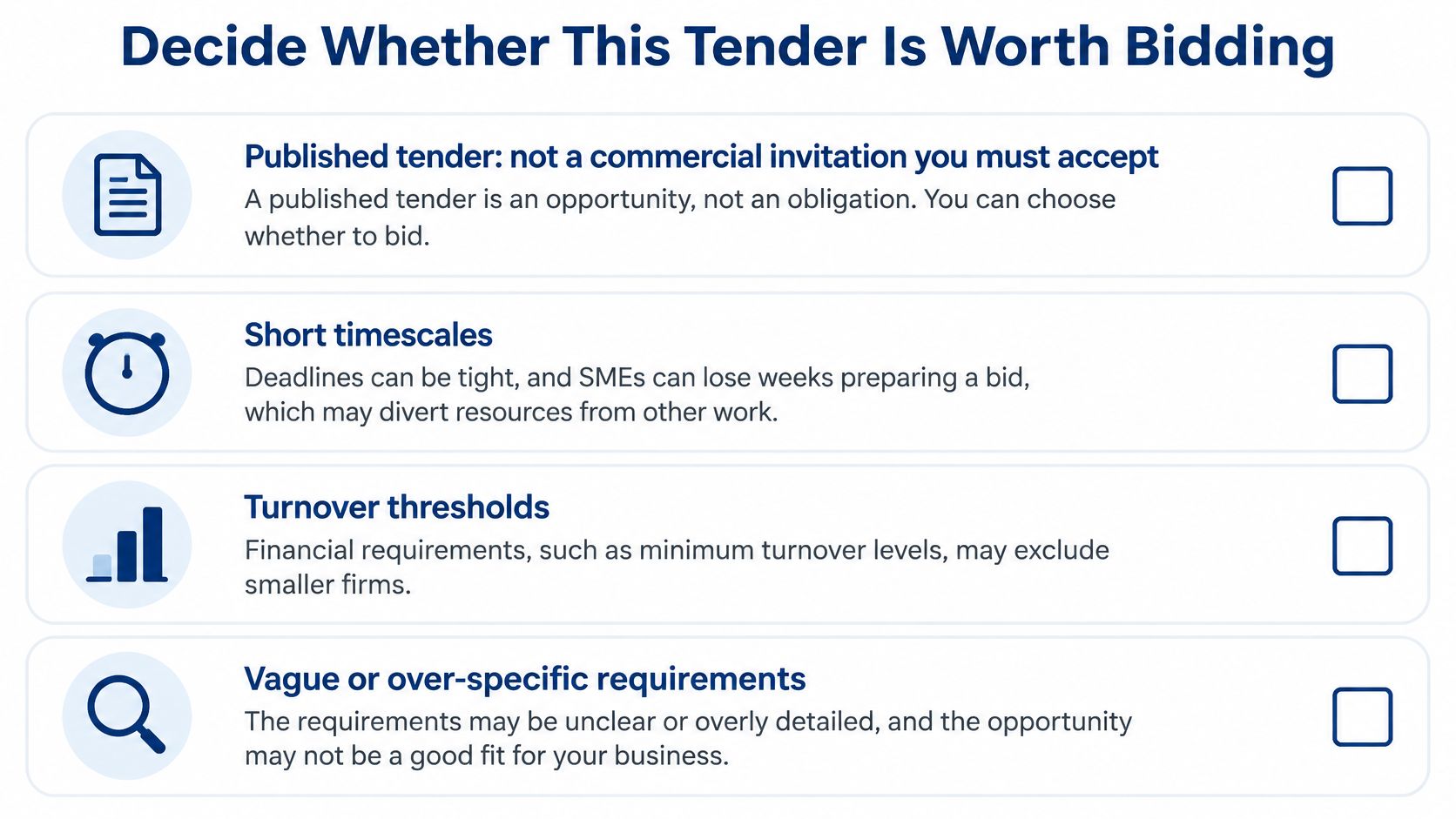
A published tender is not a commercial invitation you must accept. You can submit a compliant response and still make a poor investment if the work is uneconomic, the delivery risk is unacceptable or your evidence doesn't support the highest-weighted questions.
The Department for Business and Trade's SME action plan identifies short timescales, financial requirements, unclear specifications and contract-risk allocation among the barriers smaller suppliers face. Procurement reform doesn't remove the need for a commercial decision.
Test the pack against the business you have
Ask finance, operations and the proposed delivery lead to challenge the opportunity before drafting starts. Enthusiasm isn't evidence of capacity. Nor does a familiar contract title mean the scope matches your service.
Bid or no-bid signals from the notice and pack
| Signal | Where to look | Bid if | Walk away or reshape if |
|---|---|---|---|
| Turnover threshold | Qualification or conditions of participation | Last accounts clear it with margin | You can only clear it using group companies you cannot evidence |
| Insurance | Contract conditions | Current certificates meet the limit and expiry covers the term | You'd be buying required submission-stage cover after submission |
| Mobilisation | Specification and KPIs | Named people are free in that window | The start date assumes staff you don't have |
| Incumbent knowledge | Market brief, TUPE, site data | Scope is specified well enough to price blind | Scoring depends on undocumented site history |
| Weighting | Award criteria | You can evidence the highest-weighted criteria | Price dominates and your cost is structurally higher |
| Lot size | Lots schedule | One lot matches delivery capacity | The only winnable lot needs a consortium you haven't agreed |
| Clarifications | Portal Q&A | Answers remove ambiguity before you draft | Answers stay vague and the deadline won't move |
| Evidence on hand | Your knowledge base | Case studies, policies and references map to the questions | You'd be writing claims with no proof |
Check when each condition must be met. A buyer may require insurance at submission, award or contract commencement. Don't reject an otherwise suitable opportunity because you've assumed the wrong timing, but don't promise cover without checking availability and cost.
For financial standing, distinguish your bidding entity from the wider group. If you're relying on another organisation, confirm that the procurement permits the arrangement and identify the supporting commitments required. Preparing PQQ responses should expose those dependencies before they become drafting problems.
Make the commercial call explicit
Say a hypothetical tender gives quality a 70% weighting. That helps only if you can demonstrate the required delivery approach with relevant proof. A quality-heavy competition isn't automatically favourable to a smaller specialist.
Read the liability provisions, payment terms and service-credit arrangements alongside the specification. A contract can fit your technical skills while placing more financial risk on the business than the margin justifies.
A rational no-bid is a result. It preserves capacity for work you can qualify for, deliver and price responsibly.
Partnering can close a genuine capability gap. Subcontracting may offer a safer route into an unfamiliar authority. Waiting for a smaller lot can also be sensible, particularly when the alternative is an unagreed consortium or unsupported promises.
Record the decision and its conditions. Only after a defensible yes should the writing plan open.
How to Prepare the Tender Submission
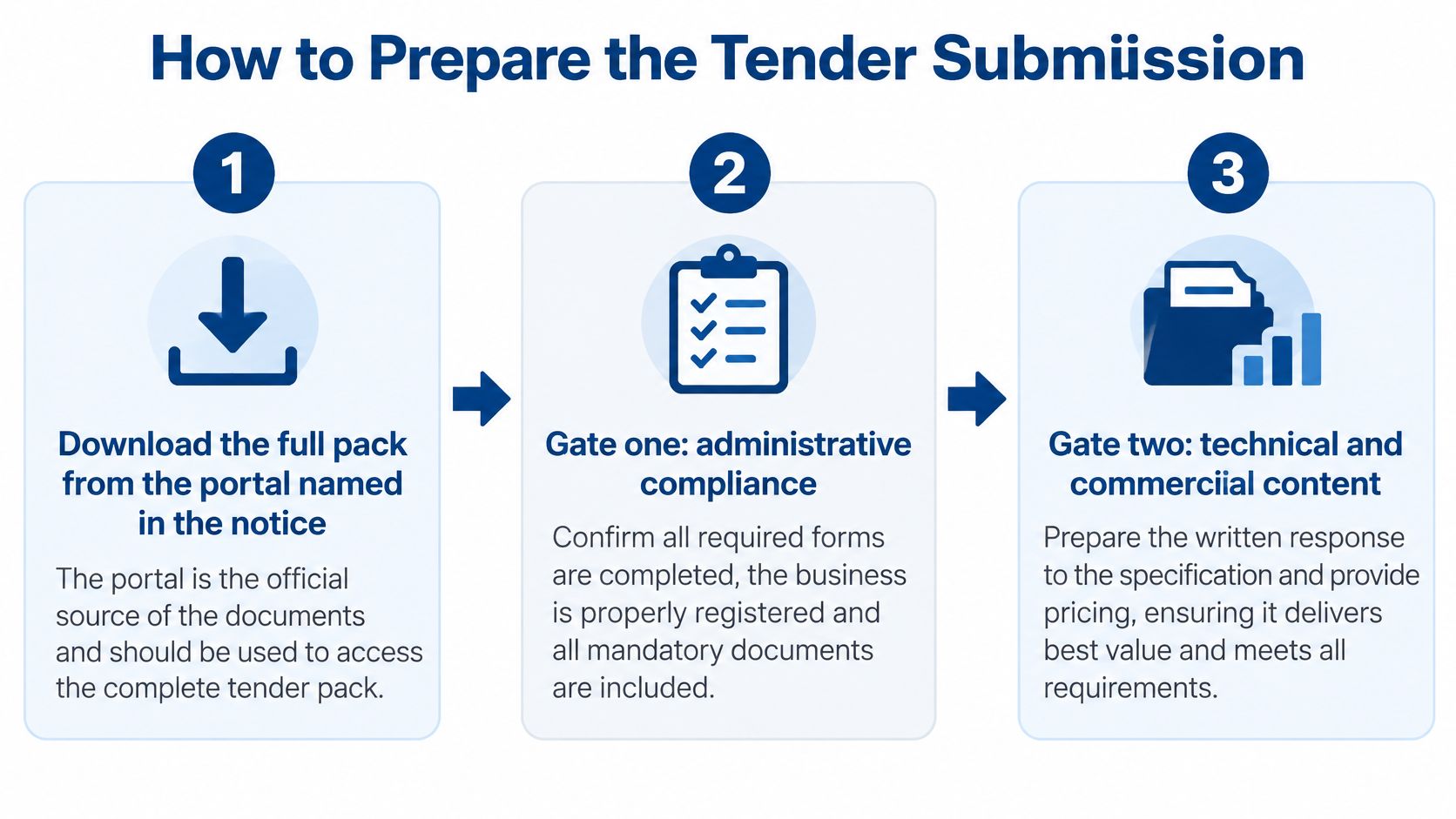
Run two gates, not one writing sprint. Gate one checks whether the submission is administratively complete. Gate two checks whether the technical response and price form a credible offer.
The government's public-procurement quick-start guide recommends clear responsibilities and at least two review rounds, even for smaller procurements. It also warns that material above a word or character limit may be disregarded.
Work through the gates in order
Download the full pack. Use the portal named in the notice and record each document's version date. This prevents someone pricing an attachment forwarded before the latest amendment.
Build the compliance matrix. List every question, pass-or-fail requirement, word or character cap, attachment and owner. Include portal-only fields, which are easy to miss when writers work from downloaded files.
Confirm eligibility before drafting. Check exclusions, financial standing, insurance and conditions of participation. Resolve missing signatures and certificates now, rather than discovering an administrative blocker after the narrative is finished.
Map the scored questions. Connect each question to the specification, criterion, weighting and assessment method. This prevents a polished answer addressing the general topic while missing the actual scoring requirement.
Storyboard the response. Set out the key message, delivery method, measurable outcome, risk, evidence and win theme. A win theme should explain a relevant advantage, not repeat a slogan.
Draft from current documents. Use approved case studies, credentials and policies, with an internal reference to the supporting document. AI can produce a first pass, but a person must check that every claim is accurate and applicable.
Run the completeness review. Compare the response with every question and instruction. Ask whether all requested components are present, including those buried in appendices.
Run the evidence and clarity review. Challenge unsupported claims, unclear ownership and inconsistent commitments. Use someone who didn't write the answer where practical.
Check the counts. Use the word processor or portal counter, then inspect the answer manually for text boxes, tables and headings. Follow the buyer's counting rules rather than assuming every tool counts identically.
Export and upload methodically. Use the required formats and filenames. Match each file to the checklist so an attractive PDF doesn't replace a mandatory workbook.
Keep the supporting documents visible
Document checklist for both gates
| Document | Gate | What good looks like | Common failure |
|---|---|---|---|
| Eligibility and exclusion declarations | Gate 1 | Signed by someone authorised to bind the company | Unsigned or outdated template |
| Financial standing evidence | Gate 1 | Accounts covering the requested period | Older accounts or missing group data |
| Insurance certificates | Gate 1 | Current cover at required limits, with renewal arrangements checked | Expiry during the term left unexplained |
| Mandatory certificates | Gate 1 | Numbers and expiry dates checked against the notice | Certificate lapses before award |
| Central Digital Platform profile | Gate 1 | Supplier information matches bid forms | Company name or number mismatch |
| Compliance matrix | Gate 1 | Every question, limit, attachment and owner listed | Missing attachment or word cap |
| Storyboard per scored answer | Gate 2 | Message, method, KPI, risk, evidence and win theme | Capability statement without proof |
| Pricing schedule and method statement | Gate 2 | Matching headcount and assumptions | Price funds fewer people than the method describes |
The same evidence discipline applies to DDQ preparation. Give reusable material an owner and approval status, so the next questionnaire starts with checked information rather than a search through old inboxes.
Write Answers the Evaluator Can Score
A capable supplier can write an unscoreable answer. Saying your team is experienced doesn't tell the evaluator who will deliver the work, how they'll control it or what evidence supports the promise.
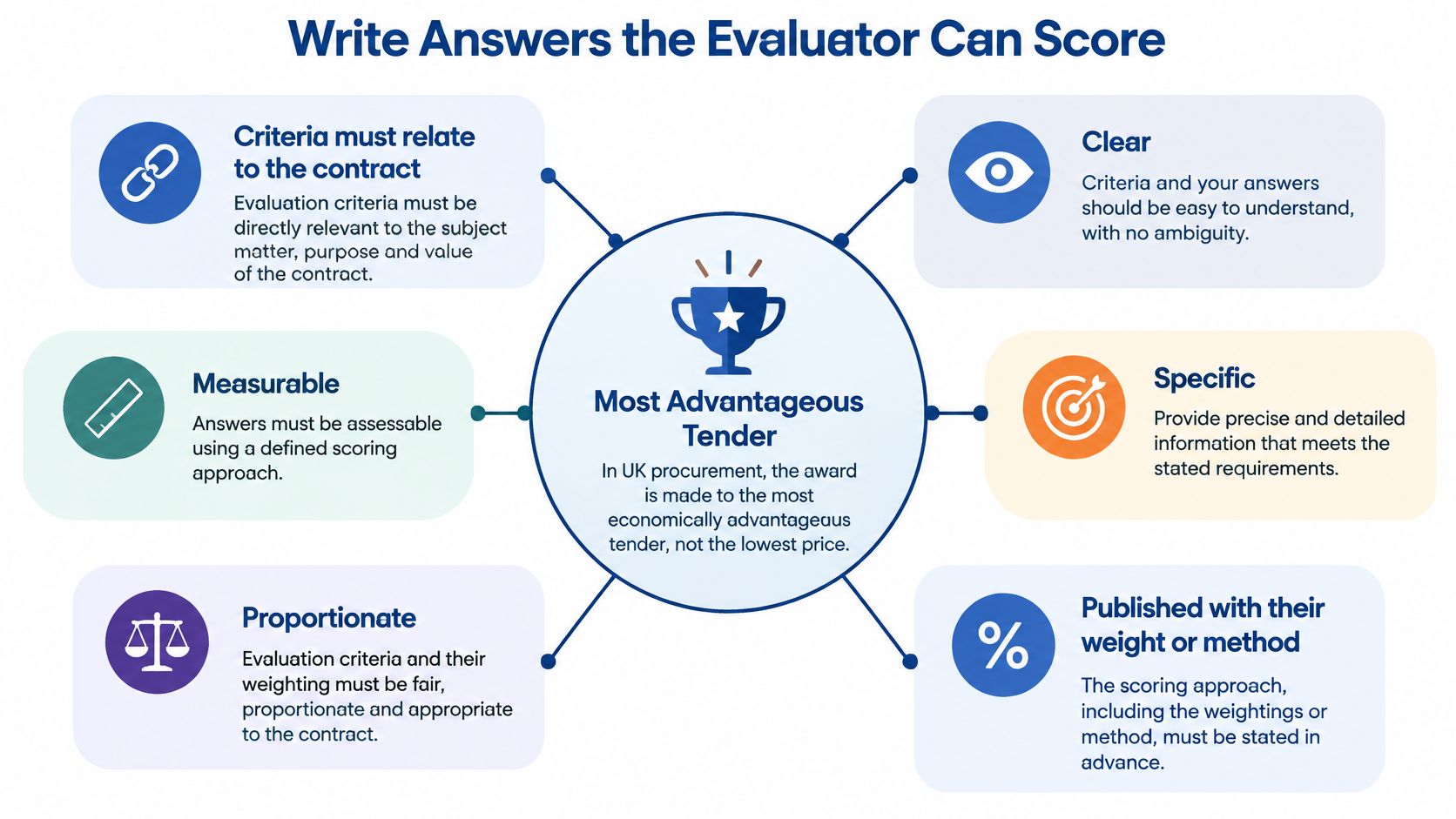
The award model is Most Advantageous Tender, not lowest price. The government's guidance on assessing competitive tenders explains that award criteria must relate to the contract, including relevant social, economic and environmental criteria.
Turn the criterion into a delivery commitment
Suppose the question asks how you'll maintain service continuity during mobilisation. Don't open with company history. Start with the transition action and explain the controls.
A worked evidence line might contain:
- Action: Validate the asset register and agree the handover checklist before taking operational responsibility.
- Accountable role: The mobilisation manager owns completion; the service director approves readiness.
- Timing: Complete validation during the opening mobilisation week, before the agreed handover milestone.
- Measure: Track verified assets against the buyer's complete asset list, with unresolved items recorded separately.
- Risk control: Escalate missing access permissions and retain a documented fallback arrangement.
- Proof: Cite a relevant transition case study and an available customer reference.
That's an illustrative structure, not a commitment to copy unchanged. Replace it with a method your delivery team has approved and a measurable target appropriate to the contract.
Then explain why the evidence is comparable. A case study from a different sector may still demonstrate the same mobilisation risk, but the evaluator shouldn't have to infer the connection.
For social value, describe activity linked to the purchased service. If you propose local recruitment, explain the roles, delivery responsibility and reporting method. A generic page about corporate values doesn't establish what this contract will receive.
Price the method you've actually written
The government's Sourcing Playbook cautions against careless use of relative price scoring and identifies potential central scrutiny for complex outsourcing bids priced 10% below either the bid average or the Should Cost Model estimate. That isn't a universal disqualification threshold or a suggested discount.
Build the price from the work. Include mobilisation effort, supervision, reporting, leave cover, subcontractor costs and the risks the contract places on you. If the figure is uncompetitive, change the delivery design deliberately or reconsider the bid.
Commercial check: A lower price is only credible when you can explain what changed in the cost model.
Read the narrative, pricing schedule, mobilisation plan and social-value commitments together. Check job titles, staffing assumptions, service hours and reporting effort. An evaluator shouldn't find a dedicated manager in the method statement and no funded management time in the workbook.
A bid-writing workflow should make supporting evidence easier to inspect, not hide it behind fluent prose. Keep the source document attached to the claim during review, and remove any statement your team can't substantiate.
Portal Pitfalls and the Final Checks
A file uploaded to the wrong lot may leave the intended lot unanswered. A response drafted against a superseded specification may describe work the buyer no longer wants. Neither problem is fixed by strong writing elsewhere.
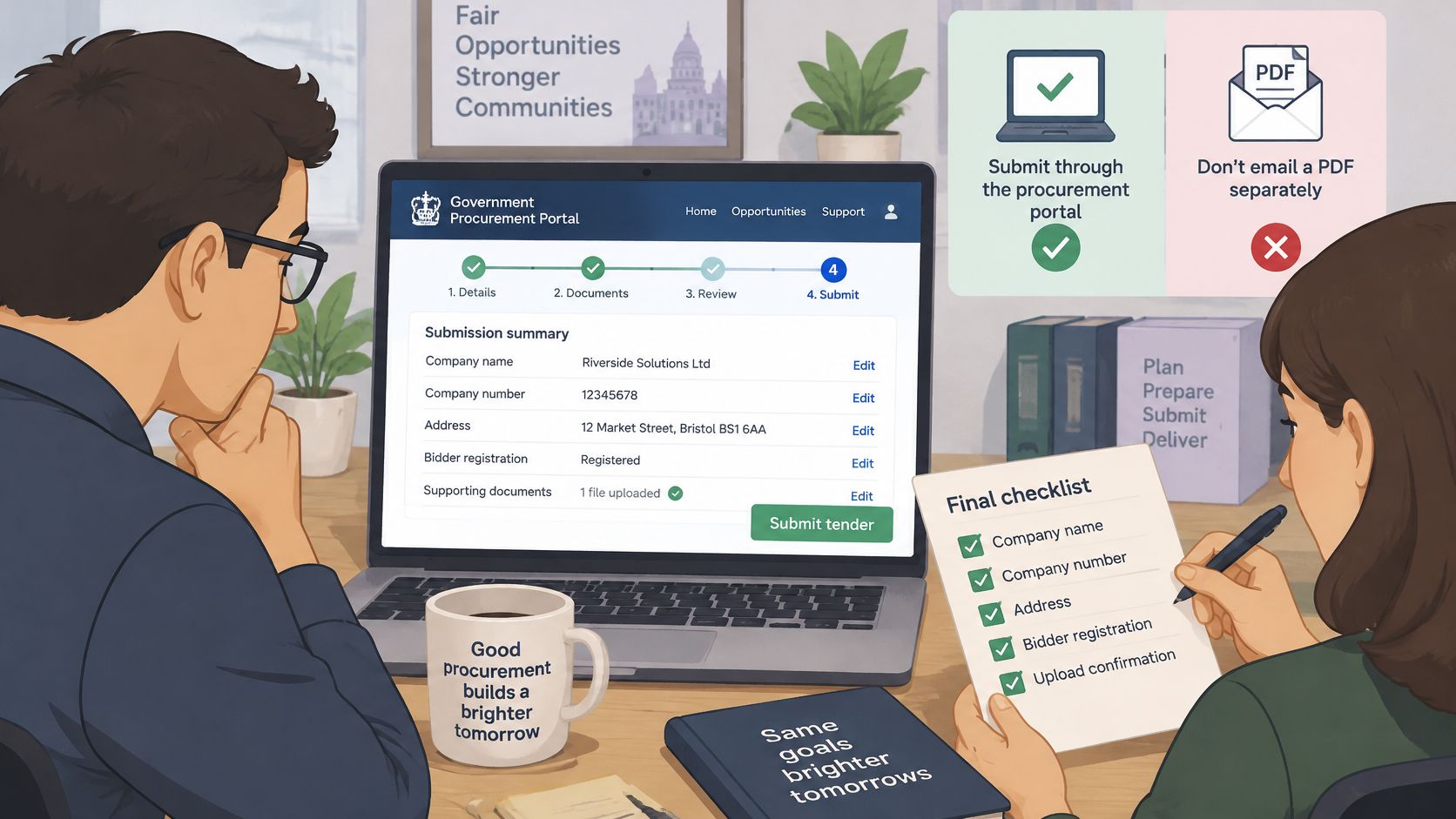
Treat the portal as the submission system, not a postbox for a PDF you can also email. Register the bidding entity early, check access permissions and confirm which user can perform the final submission action.
Resolve document problems through the portal
The government's competitive tendering procedures guidance says the tendering period cannot begin under section 54 until suppliers have the information needed to prepare their tenders. Missing specifications, schedules or pricing documents are therefore more than inconvenient omissions.
Raise the issue formally and request confirmation of the complete document set and deadline. Don't decide for yourself that the published deadline no longer applies. Keep the clarification and the authority's response in your submission record.
When an amended workbook arrives, compare it with the previous version. Check tabs, formulas, quantities and instructions, not just the filename. Assign the affected changes to the pricing or technical owner and obtain approval again where commitments have changed.
Monitoring needs a named owner throughout the live competition. A portal notification sitting unread in a shared inbox doesn't help the writer using yesterday's specification.
Run the deadline-morning check
Have someone check the portal against the approved file set. The person checking should be able to stop submission if a mandatory item is missing.
- Bidding entity: Company name, number and address match the supplier record and forms.
- Registration: Central Digital Platform information is current where required, alongside registration on the submission portal.
- Correct destination: Each response and attachment sits under the lot you intend to bid.
- Mandatory fields: Required answers are complete, including declarations outside the uploaded documents.
- Authority to sign: The appropriate person has signed every required declaration.
- Certificates: Dates, limits and certificate identifiers match the requirements.
- Text limits: Answers fit the portal's own character or word counter.
- Commercial consistency: Prices and social-value commitments match across all submitted locations.
- Clarifications: Relevant answers and amendments have been incorporated.
- Submission status: The portal confirms submission, rather than merely showing uploaded or saved files.
- Receipt: Confirmation and its timestamp are saved.
Use the requested file structure. A ZIP archive isn't a substitute for separate schedules when the portal requires individual uploads. Open the final exported files too, particularly spreadsheets with formulas or documents converted to PDF.
Avoid shared-login confusion by naming the person responsible for submission and a backup with authorised access. Leave time for slow uploads, session expiry and files rejected by the portal.
If the receipt is missing, don't assume you've submitted. Check the status, attempt the required completion action and contact portal support or the authority through the stated route. Save the correspondence, but don't assume a support request substitutes for a valid submission.
File the Receipt and Reuse the Bid
Save the receipt, exact uploaded files and clarification log in a folder named with the contract reference. Do it on submission day while the approved versions are still identifiable. Your working drafts aren't an adequate record of the offer you made.
Keep the submitted pack read-only. If someone later corrects a calculation or edits an answer, save that separately with a clear explanation. You need to distinguish what you submitted from what you subsequently learned.
Separate immediate lessons from evaluation feedback
Hold a short internal review while the work is fresh. Identify avoidable delays, missing evidence and approvals that arrived too late. You can improve those processes before the buyer announces an outcome.
- Reusable material: Mark clear explanations and useful structures, but don't label an answer successful before receiving feedback.
- Evidence gaps: Assign an owner to obtain the missing reference, outcome measure or policy approval.
- Commercial lessons: Record assumptions that required difficult clarification or created pricing uncertainty.
- Process fixes: Update the checklist where a missed task nearly reached submission.
When the award decision arrives, request the evaluation breakdown available for the procurement. Store each comment beside the relevant question and answer. An email saying the bid needed more detail is less useful than a record showing which delivery control the evaluator couldn't assess.
A winning response still needs checking before reuse. The accepted offer belongs to that buyer, scope and delivery period. Preserve the strong explanation without carrying forward obsolete staffing commitments, prices or customer-specific details.
Make the next bid easier to start
Bidwell connects tender monitoring, a knowledge base and AI response generation in that cycle. Our Discover stage watches every UK tender portal, matches opportunities by CPV code, keyword, region and value, and emails only those that fit. When you're ready, you drop in the blank tender or PQQ, its questions are extracted and matched to your evidence, and answers are drafted in your voice with citations for review.
When a tender is won, the response goes back into your knowledge base. Keep the underlying evidence current too, so a sound answer doesn't become attached to an expired certificate or an outdated delivery claim.
You still review, polish and submit the drafted tender yourself. The bid lead sharpens the win themes, the delivery team confirms the commitments and the commercial owner approves the price. Reuse should remove unnecessary reconstruction, not remove judgement.
The next opportunity should begin with a qualification decision and an evidence check. It shouldn't begin with a frantic search for the last person who answered a similar question.
Bidwell helps you find relevant tenders, organise reusable evidence and draft answers against the actual questionnaire. Visit Bidwell to prepare your next tender submission with source-backed drafts that your team can review, refine and submit.


