
Most bid advice tells you to start writing quickly. I wouldn't. If you open the specification and start drafting answers on day one, you've already made the most expensive mistake in the process.
A tender pack isn't a writing brief. It's a controlled requirements baseline. It tells you whether you're eligible, what risk you're being asked to carry, how you'll be scored, and whether the contract is worth your time at all.
Read it in that order. Audit first, build your scoring plan second, and only then write. The teams who do that walk away from bad packs early and put real effort into the ones they can win.
That discipline also shapes how you use tools. Tender monitoring gets you the pack early, a knowledge base gives you checked evidence to draw on, and AI response generation helps you draft against the questions. None of those helps if you skip the audit and draft against a pack you haven't understood.
The Documents That Make Up a Tender Pack
A tender pack is the set of tender documents a buyer issues so suppliers can bid. It has two parts. The tender notice announces the opportunity, and the associated documents carry the working detail you need to respond.
Don't treat the notice as the opportunity itself. The notice is your entry point. The pack behind it holds the specification, the contract terms, the pricing format and the scoring method that will decide the result.
The legal footing matters here. The UK government guidance on the Procurement Act 2023 confirms the Act took effect on 24 February 2025 for new procurements, and under section 21 a contracting authority must publish a tender notice for an open procedure or a competitive flexible procedure and provide associated tender documents in accordance with that notice. Those documents can include the technical specification, award criteria, assessment methodology, contract terms and instructions for submitting a bid.
The same guidance sets a quality bar. An authority can't invite tenders unless the notice or associated documents contain enough information for suppliers to prepare their submissions, including clear details of the goods, services or works required. Documents will generally be supplied electronically and free of charge.
What Each Document Does
| Document | What it covers | Why it matters |
|---|---|---|
| Invitation to Tender (ITT) | Process, deadlines, submission rules and response format | Read first for dates and format |
| Pre-qualification questionnaire (PQQ) or selection stage | Supplier eligibility: finances, insurance, experience and exclusion grounds | Missed answers can disqualify you before scoring |
| Specification or statement of requirements | What must be delivered, service levels and standards | Source for every compliance requirement |
| Terms and conditions | Contract clauses on liability, insurance and payment | Risk here is often unpriced |
| Pricing schedule | Required price format, rates and assumptions | Mirror the format exactly |
| Award criteria and scoring method | Weighting, sub-criteria and how marks are given | Shows where your effort earns marks |
One label causes confusion. You'll still see PQQ in older packs and in everyday bid talk, and it's useful to understand how PQQs work in practice when you're sorting selection documents. Under the Act, pre-qualification in a competitive flexible procedure runs through participation requests, so the name on the file may differ while the job stays the same. It screens whether you're allowed to compete at all.
Where to Look First
Open the ITT first. You're looking for three things before anything else: the submission deadline, the clarification deadline, and the exact response format. If you get those wrong, good content won't save you.
Then go to the schedules and appendices, not just the main text. Mandatory conditions hide there. A required certificate, a word limit, a signing requirement or a pass/fail declaration often sits in an appendix that people skim on the final day.
If a requirement is buried in a schedule, it still counts. Evaluators won't excuse you for reading the main document properly and the appendix badly.
I would also check the terms early, even though they're dull. Liability, insurance and payment clauses tell you what winning would commit you to. That check belongs at the start, not after you've spent two weeks writing.
How Procurement Rules Set the Pack and Your Deadline
Your deadline isn't set by the buyer's preference. It's set by law, and it's tied directly to when you receive the full pack. That's why treating the notice date as day one is a planning error.
Under the framework in Part 3 of the Procurement Act 2023 on legislation.gov.uk, the minimum tendering period is 25 days when tenders are submitted electronically and the tender notice and all associated documents are provided at the same time, increasing to 30 days when submission is electronic but the complete set isn't issued alongside the notice. Where electronic submission isn't available, the minimum is 30 days if all documents are supplied together and 35 days if they are not.
Minimum Tendering Periods by Submission Route
| Submission route | Documents issued with notice | Minimum period |
|---|---|---|
| Electronic | All together | 25 days |
| Electronic | Not all together | 30 days |
| Non-electronic | All together | 30 days |
| Non-electronic | Not all together | 35 days |
Read that table as a supplier protection, not as trivia. Withholding or staggering tender materials can add at least 5 calendar days to the minimum competition period. Document completeness has a measurable effect on your timetable.
These are statutory minimums, not targets. Authorities must also consider the nature and complexity of the contract when setting the deadline. A buyer who gives you the minimum on a complex services contract is telling you something about how the procurement will be run.
The framework also stops an authority starting the tendering period unless the notice or associated documents contain sufficient information for suppliers to prepare a tender. If the pricing schedule is missing, or the specification is too thin to price against, that isn't a minor gap. It's a problem with the basis of the competition.
Your Day One Checkpoint
Download every document on the day you find the notice. Log the date the full set arrived, list every file and version, and work out your internal deadline from that date. Don't plan backwards from a submission date until you've confirmed you've got everything.
Good tender monitoring earns its keep here. The earlier you see the notice, the earlier the checkpoint starts, and the more of that minimum period you get to use. The same discipline applies on the buyer side after award, which is why teams managing suppliers often keep vendor management tips from Matil close when they think about how document control and clear expectations carry into contract management.
Audit the Pack Before You Commit Bid Time
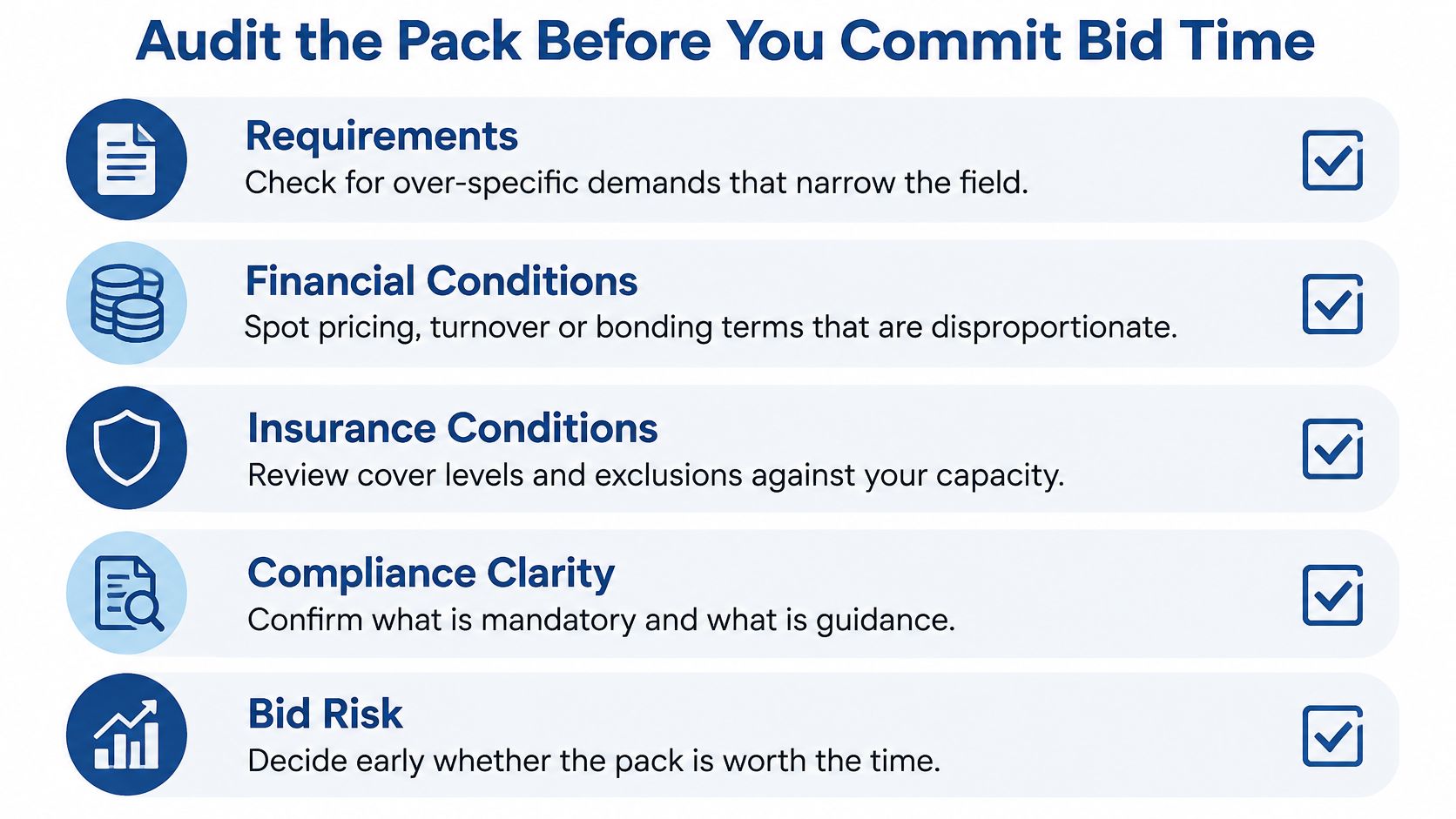
A tender pack can make a bid unviable before anyone writes a response. Audit the documents as one requirements baseline, then decide whether the conditions, costs and delivery commitments are acceptable.
The Department for Business and Trade SME action plan 2025 to 2028 identifies procurement requirements that can be excessively prescriptive, poorly defined or financially disproportionate. It also points to excessive risk allocation and unrealistic bid timescales. These issues can shape whether a supplier can bid and deliver on workable terms.
The Audit in Six Steps
- Separate mandatory requirements from scored criteria. Record pass/fail conditions separately from scored questions. If the documents do not make the distinction clear, flag it for clarification.
- Check financial and experience thresholds. Compare turnover, insurance and experience requirements with your actual position and the contract's demands. A threshold you cannot meet is a no-bid signal.
- Identify risks you cannot price. Review liability caps, indemnities, performance deductions and liquidated damages. For each risk, establish its potential cost or the control you would need. If neither is clear, your price is not ready.
- Record changes needed before delivery. New accreditation, staff or systems create cost and lead-time commitments. Include both in the decision, rather than assuming they can be arranged later.
- Submit clarification questions early. Keep a dated list of ambiguities and send questions before the buyer's deadline. Once the clarification window closes, unresolved points may affect your response and price.
- Write down the bid or no-bid decision. Record the reasons before drafting starts. That gives the team a clear basis for stopping if the requirements, risks or costs do not stack up.
The same pass/fail discipline applies to due diligence questionnaires and other selection documents. A missing policy or expired certificate can prevent a buyer from assessing your wider capability.
Tools That Support the Decision
Bidwell offers three free tools to help assess readiness before drafting: a Tender readiness checker, a Framework eligibility tool and a Cost-to-respond estimator. Use them alongside the tender documents, not instead of checking the terms yourself.
Tender discovery can help find packs worth auditing. It is an add-on costing £10 a month that watches every UK portal and surfaces tenders matching your sectors, frameworks and CPV codes. Matching also considers region and contract value, helping you focus review time on opportunities that fit.
Practical rule: If you cannot meet a pass/fail condition, stop. Drafting cannot change an eligibility answer.
A no-bid decision is a useful outcome when the pack points to a requirement you cannot meet, a risk you cannot price or a commitment you cannot deliver.
Turn Award Criteria Into a Scoring Plan
Evaluators can only award marks for evidence they can find. That sounds obvious, but it's where most responses lose ground. Teams write about their general capability, while the buyer scores against a published structure that the response never quite mirrors.
The rules behind that structure are clear. The official Procurement Act 2023 e-learning on assessment and award states that award criteria must relate to the contract subject matter and be clear, measurable, specific and proportionate, and that authorities must publish the assessment methodology, including whether failure against a criterion can disqualify a tender and how criteria are weighted or ranked.
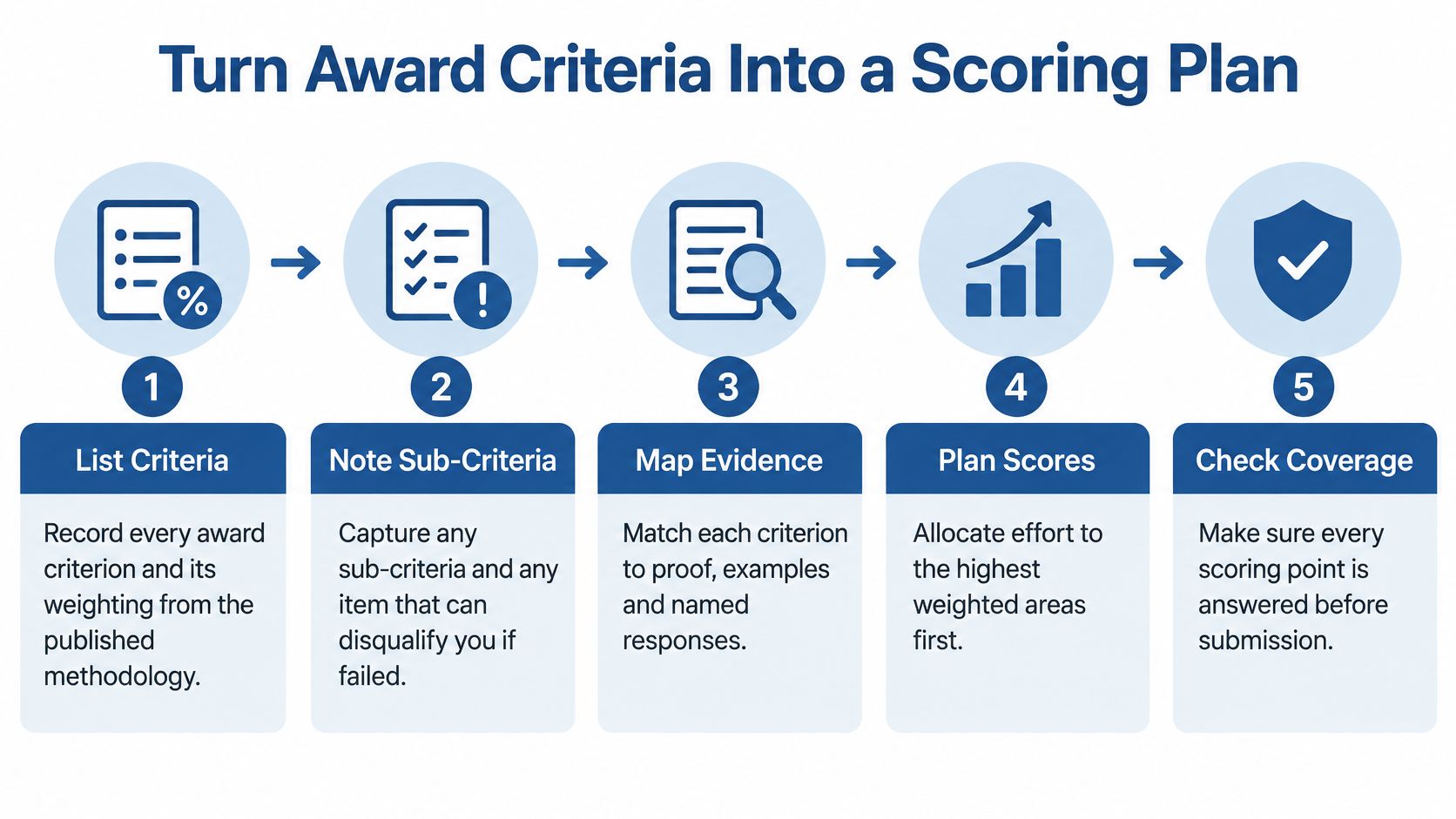
That published methodology is your outline. Convert it into a scoring model before anyone writes a paragraph.
Building the Scoring Model
- List every criterion and its weighting. Take them straight from the published methodology, including sub-criteria. Flag any criterion where failure can disqualify you, because that one gets compliance treatment, not creative treatment.
- Write the required outcome in the buyer's terms. For each criterion, state what the buyer wants to see happen, using their words. If you paraphrase it into your own sales language now, you'll drift from what's scored.
- Add the working detail. Against each outcome, record the performance measure, the evidence source, your delivery method, the risk control, and one quantified benefit. This row becomes the skeleton of your answer, and gaps show up before you've wasted drafting time.
- Tie wider commitments to the contract. If social, economic or environmental criteria appear, link each commitment to work delivered under this contract. A general corporate promise detached from delivery won't score well, because criteria must stay connected to the subject matter.
- Use the buyer's structure. Mirror their headings, units and terminology. An evaluator working through several bids shouldn't have to translate your language into their scoring sheet.
- Score it cold. Give the draft to a reviewer who hasn't written it and ask them to score it using only the published method. They get no verbal explanations from you, because evaluators won't get any either.
What a Defect Looks Like
The cold review gives you a simple test. Any point that takes more than a minute to locate is an evidence or structure defect. The content might be in there somewhere, but buried evidence scores like missing evidence.
Watch for two common faults in that review. The first is generic capability language, long paragraphs about being experienced and committed that could sit in any bid for any buyer. The second is evidence in the wrong place, a strong case study attached to a criterion it does not answer.
Separate mandatory compliance from value-adding detail as you fix these. Compliance points need to be explicit and complete. Value points need to be specific and measurable. Mixing them into one flowing narrative makes both harder to score.
Done properly, the scoring plan becomes your response outline. Writing starts from where the marks sit rather than from a blank page, and your AI response generation has a structure to draft against instead of a vague instruction to write something persuasive.
Build a Knowledge Base for Repeat Tender Questions
Stale answers are the quiet risk in repeat bidding. You reuse a strong response, nobody checks the figures, and you submit a headcount, a client name or an insurance limit that stopped being true a year ago.
The fix is treating your knowledge base as a library of evidence, not a folder of old bids. An old bid is an answer to someone else's question, written for a different buyer. A library entry is a checked fact, case study or method you can build a new answer from.
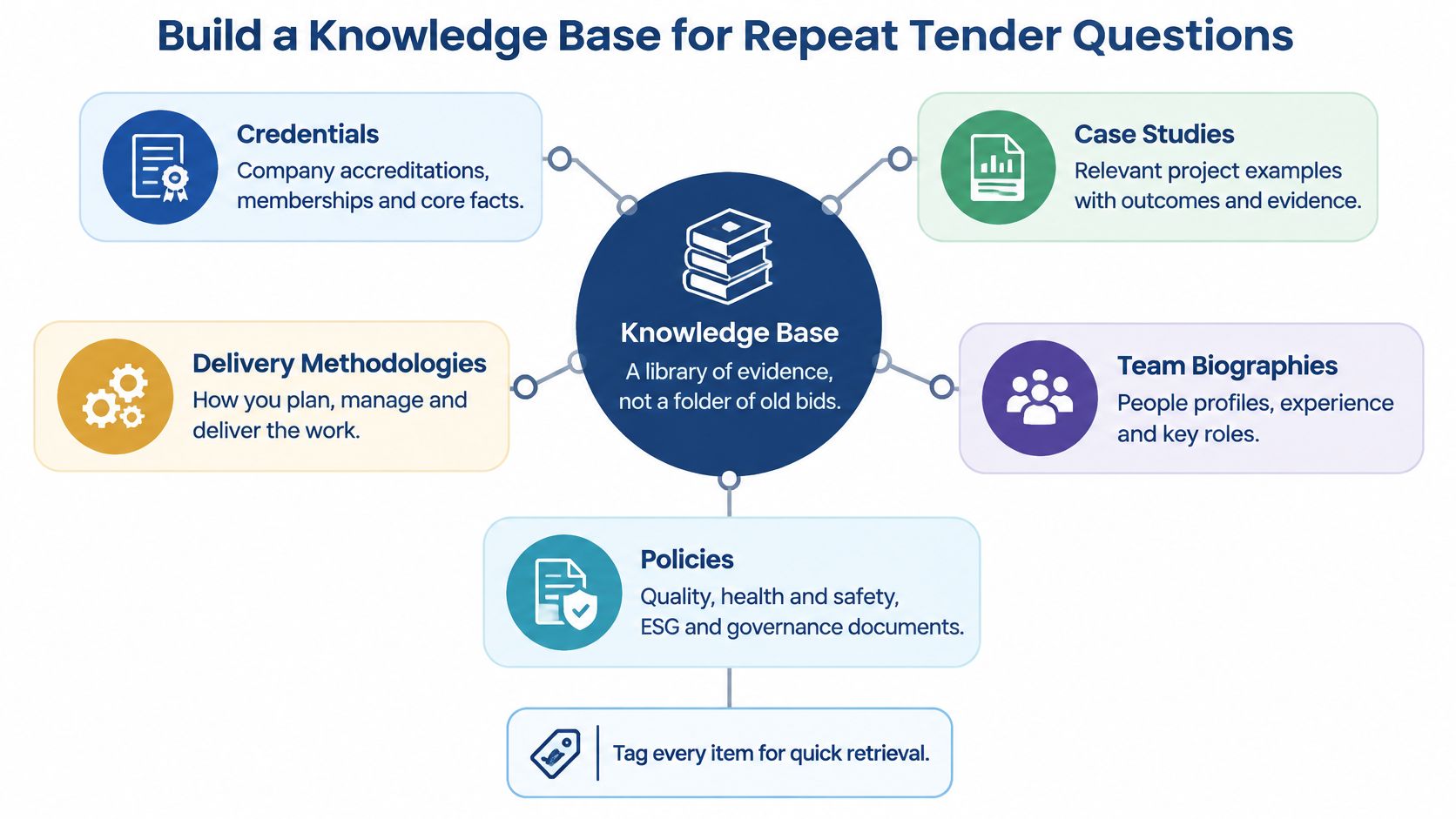
Five Groups Worth Keeping
| Entry type | What to record | Check before reuse |
|---|---|---|
| Credentials | Certificates, insurance and accreditations | Expiry date and cover limits |
| Case studies | Client sector, contract value, outcome and measured result | Still relevant to the sector and scale asked |
| Delivery methodologies | Mobilisation, quality and service delivery method | Matches the current delivery model |
| Team biographies | Roles, qualifications and relevant contracts | Named people still in post |
| Policies | Current policy documents and version dates | Latest version and approval date |
Tag every entry with sector, contract size and date. Tagging is what makes the library usable under deadline pressure. Without it, you'll pick the case study you remember rather than the one that fits, and that's how a small local example ends up answering a question about regional scale.
Say a 2022 case study quotes a team size and a turnaround figure. Both may have changed since. If you check the entry against the new question's wording and your current figures before reuse, it stays useful. If you paste it in unchecked, you've submitted evidence you can't stand behind in clarification.
How the Library Feeds Drafting
We built Bidwell around this pattern, and you can see how it sits within our wider bid writing software approach. Bidwell learns your business once from your past responses and credentials, then drafts complete tender responses in hours instead of weeks, citing the document each answer came from.
You still review, polish and submit the drafted tender yourself. That review step is where the reuse checks in the table happen, with the citation showing you exactly which entry needs checking.
When you win, put the winning response back into the library. It's your most current, best-evidenced material, and it's already been tested against a real scoring method. A library that grows with every bid gets faster to use, while a folder of old bids just gets bigger.
Build a Requirement Map That Survives Clarifications
Requirements do not reside in a single location. They are distributed throughout the specification, the schedules, the pricing template, the method statement instructions, and the draft terms. An answer that addresses the headline specification well can still overlook an obligation buried in an appendix.
That's why the whole pack needs one controlled baseline. Part 3 of the Procurement Act 2023 treats tender documents as part of the legally defined competitive tendering procedure alongside the tender notice, with associated documents that may contain the specification, award criteria, assessment methodology and contract terms. If the law treats them as one set, your bid process should too.
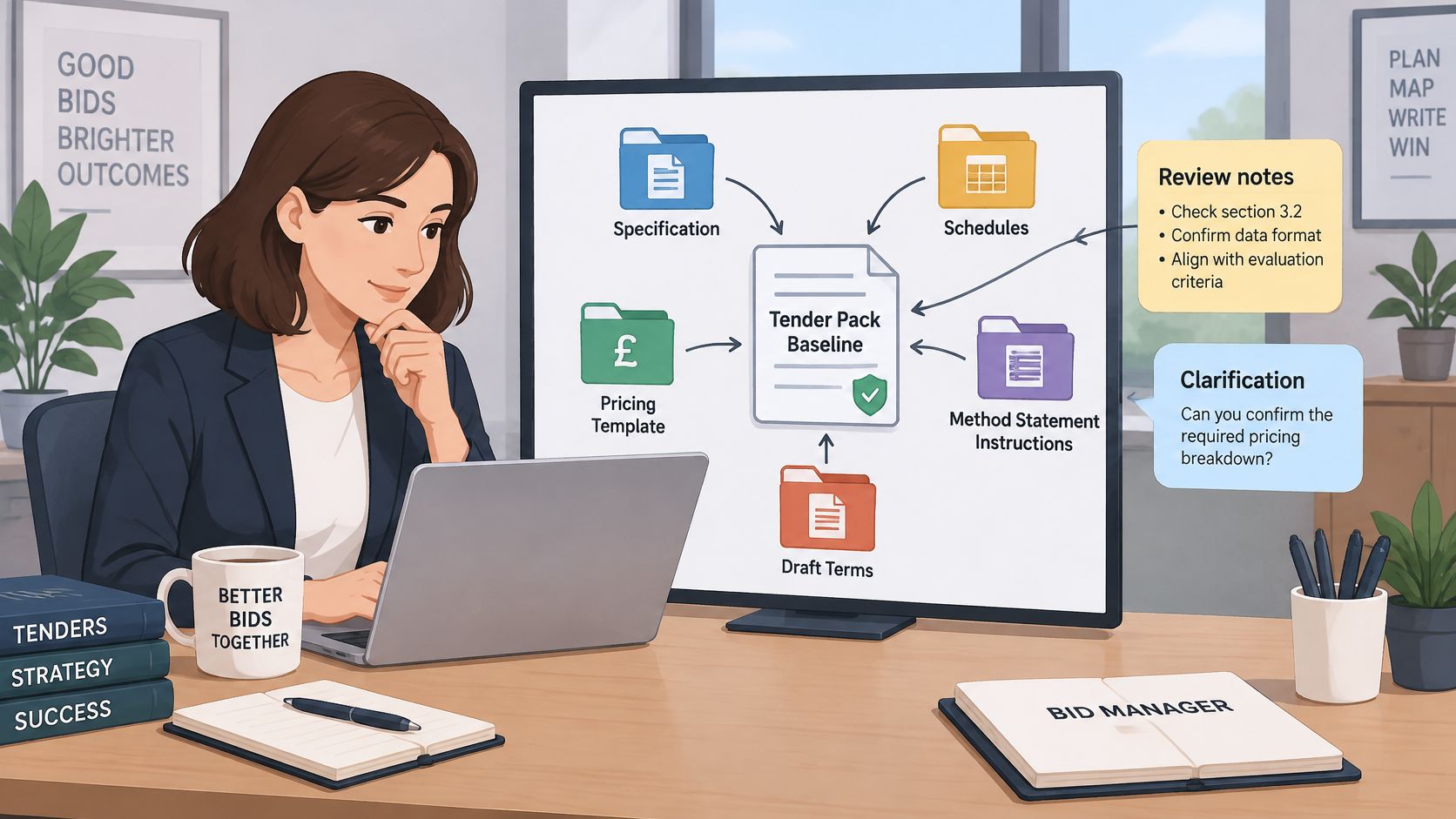
One Row Per Requirement
| Column | What to record | Example entry |
|---|---|---|
| Requirement ID | Clause or question reference and wording | Spec 4.2, respond to urgent calls within agreed service level |
| Source document | File name, section and version | Specification v2, section 4, issued with clarification 3 |
| Response location | Question or section where the answer sits | Method statement, section 3 |
| Evidence | Case study, certificate or policy used | 2024 support contract case study, measured response times |
| Owner and status | Named person and compliance status | J. Patel, draft ready |
Each row creates traceability from requirement, to evidence, to submitted answer. When someone asks whether a clause has been covered, you don't rely on memory. You point at a row, a response section and a named owner.
Version Control When Clarifications Land
Clarifications are where maps earn their keep. A clarification or replacement document can change scope, scoring or a mandatory condition. If your rows cite the version each requirement came from, you can see exactly which answers a change affects.
Work through it methodically when one lands. Update the affected rows, flag the answers that need redrafting, and record any new assumption you've had to make. Teams without a map tend to read the clarification, nod, and carry on writing against the old requirement.
A clarification you haven't mapped is a change you haven't actually absorbed. It sits in an inbox while your draft answers the previous version of the question.
Our Draft stage follows the same logic. A blank tender or PQQ is dropped into Bidwell, every question is extracted and matched to the knowledge base, and answers are drafted in your voice with citations for you to review. The citations give you the same requirement-to-evidence trail the map provides.
The Final Compliance Audit
Before submission, audit against the map line by line. Check every pass/fail condition, every requested attachment, every format rule, word limit and declaration. Confirm each row shows a response location and a compliant status.
I would do this check with the pack open beside the submission portal, not from the draft alone. File names, upload slots and signature fields are part of compliance too. One missing document can end an otherwise strong bid, and it's always the dull item nobody owned.
That final audit is the cheapest insurance in the whole process. It costs an hour of careful checking. Skipping it can cost you the weeks you spent writing.
If you're spending days untangling tender documents before you can even start writing, Bidwell can take the heavy lifting off your desk. We monitor UK tender portals, build a knowledge base from your credentials and past responses, and draft answers against the actual pack with citations you can check. Visit us, drop in a live tender, and see how much of your next audit and first draft we can have ready for your review.


