
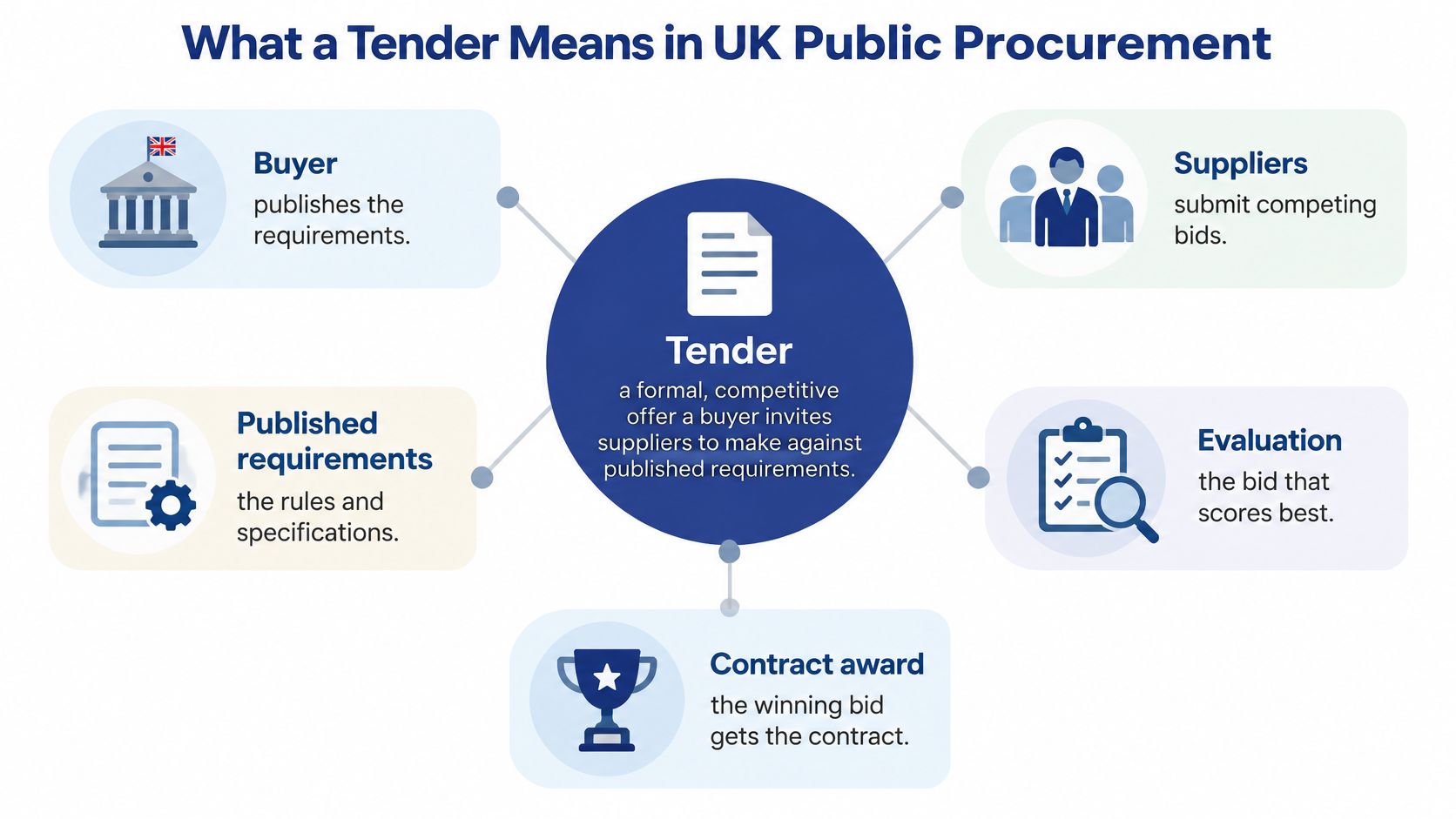
A tender is a formal, competitive offer a buyer invites suppliers to make against published requirements, and the contract usually goes to the most advantageous bid rather than automatically the cheapest.
If your price is competitive and you can deliver the work, what could stop you winning before anyone reads your proposed approach? A missed qualification deadline, an unanswered mandatory question or an unsupported claim can all put you out of contention.
The useful answer to what is a tender isn't just a definition. It's knowing which rules govern the opportunity, what the evaluator can award marks for and whether you should commit your team's time.
What a Tender Means in UK Public Procurement
A public buyer starts with a need. A council might need its offices cleaned, an NHS trust might need equipment maintenance, or a government department might need a software support service.
Say a council wants 500 hours of cleaning a month across six offices. In this hypothetical example, it publishes the cleaning specification, contract terms, submission deadline and scoring method, then receives four written offers.
The council checks whether each supplier meets its requirements, evaluates the eligible submissions and awards the contract to the highest-scoring acceptable offer. It isn't just collecting prices and choosing the smallest total.
The buyer publishes the rules
Under the Procurement Act 2023, a contracting authority must normally conduct a competitive tendering procedure before awarding a public contract, starting with a published tender notice and associated documents. Those documents must give suppliers enough information to prepare their tenders.
The distinction matters. Your offer responds to a requirement the buyer has defined, rather than a sales conversation in which you can freely change the scope.
For the cleaning example, check whether the council specifies working hours, access arrangements, consumables and cover for absent staff. A price based on different assumptions might look attractive but fail to meet the actual requirement.
What to extract from a notice
Before discussing an opportunity with your team, identify:
- Buyer: Who will hold the contract and manage delivery?
- Scope: What exactly must the supplier provide?
- Deadline: When must the required submission arrive?
- Award criteria: What will the evaluator assess?
Treat the notice as your starting point, not the complete instruction pack. Download the attachments and follow the named submission route.
Practical rule: Don't start writing until you can explain what the buyer is buying and how it will judge your offer.
Tender, Quote and Bid Explained Side by Side
| Term | Who uses it | Who sets the rules | How it is judged |
|---|---|---|---|
| Tender | Public buyers under the Procurement Act 2023 | The buyer, through a published notice and documents | Against published award criteria and weightings |
| Quotation | Buyers for defined, usually lower-value purchases | The buyer's written request | Often the lowest price that meets the specification |
| Bid | Everyday term used loosely for a submission | The buyer through the chosen purchasing process | Under that process; in public buying it often means a tender |
| Proposal | Consultancy and private sector clients | The client's brief | The client's judgement of approach, method and team |
The labels overlap, but the response requirements don't disappear because somebody calls the opportunity a quote. Read the instructions before deciding how much work is involved.
A quotation for a defined repair might set out the labour, materials, exclusions and price on a short document. A tender response might require separate technical answers, a pricing schedule, declarations, policies and supporting evidence.
The paperwork changes the decision
The government's competitive tendering procedures guidance explains the structured procedures through which suppliers respond to defined requirements. An attractive price doesn't rescue a submission that fails a mandatory condition.
Suppose the buyer requires evidence of a particular accreditation at submission. Writing that you're working towards it isn't equivalent to holding it, unless the documents expressly allow that alternative.
Equally, don't mistake a persuasive proposal for a complete offer. A clear delivery narrative won't compensate for an omitted pricing workbook or an unsigned declaration.
Read the instruction, not just the label
Use the document pack to establish the work before assigning writers:
- Required files: List every form, attachment and portal response.
- Mandatory conditions: Separate eligibility checks from scored answers.
- Commercial commitment: Confirm what your price includes and what terms you're accepting.
Be careful with old responses too. A previous proposal can supply useful evidence, but its headings, assumptions and promises may not fit this buyer's process.
The practical distinction is simple: a quote mainly states an offer; a formal tender must also demonstrate compliance in the required format. Build your workload around that difference, not the terminology in an email subject line.
Open, Restricted and Competitive Dialogue Routes
| Procedure | Regime | Stages | When buyers use it | What you must do |
|---|---|---|---|---|
| Open procedure | Procurement Act 2023 | One stage, with full tenders invited directly | Straightforward needs with clear specifications | Submit a complete tender by the deadline |
| Competitive flexible procedure | Procurement Act 2023 | Designed by the buyer; can include pre-qualification and dialogue | Procurements needing a tailored process | Follow every stage and date in the notice |
| Restricted procedure | Public Contracts Regulations 2015, the older regime | Pre-qualification shortlist, then invitation to tender | Buyers seeking a shortlist before full tenders | Pass the pre-qualification questionnaire first |
| Competitive dialogue | Public Contracts Regulations 2015, the older regime | Dialogue with shortlisted suppliers, then final tenders | Complex needs where the solution isn't yet clear | Participate in dialogue before submitting a final tender |
Open and competitive flexible are the principal routes under the current Act. Restricted procedure and competitive dialogue are older labels you'll still encounter on legacy procurements.
The important question isn't whether the name sounds familiar. It's whether the buyer is inviting a full tender now or asking suppliers to qualify for a later stage.
Match your effort to the stage
In an open procedure, eligible suppliers can submit their full tenders directly. That makes the initial decision important: you'll need to commit writing, pricing and review resources without knowing how many competitors will respond.
A competitive flexible procedure can involve an initial participation stage, a shortlist and later exchanges with suppliers. Don't assume it follows a standard sequence because you've completed another procurement with the same label.
The statutory provisions on competitive procedures require the procedure to be proportionate to the contract's nature, complexity and cost. A buyer can therefore design a process suited to the purchase rather than use the same workload for every contract.
For suppliers, a staged process has a trade-off. You may avoid writing a full tender until you're shortlisted, but you'll need people available for later submissions, presentations or dialogue.
Check the route before scheduling writers
Use this short check when reviewing the notice:
- Read the procedure name. Establish which regime and route govern the procurement.
- Find the entry requirement. Look for a request to participate, questionnaire or other shortlisting stage.
- Record each closing date. Assign responsibility for participation, clarification and final submission deadlines.
Missing the participation deadline usually means you can't join at the final tender stage. Preparing an excellent technical answer won't reopen the competition.
Framework opportunities need another distinction. The government's frameworks and dynamic markets guidance explains that frameworks provide for later contracts, known as call-offs, whose selection methods must follow the framework documents.
For opportunities listed through frameworks, check both the initial appointment requirements and how buyers will award subsequent work. Getting onto the supplier list isn't the same as receiving a delivery contract.
A place on a framework is a route to future work, not an instruction to start delivering it.
When a Contract Must Be Put to Tender in 2026
| Contract type | Threshold from 1 January 2026 (incl. VAT) | What it means for you |
|---|---|---|
| Goods, services or mixed, central government authority | £135,018 | Full competitive procedure rules normally apply |
| Goods, services or mixed, sub-central authority such as a council | £207,720 | Full competitive procedure rules normally apply |
| Works contracts | £5,193,000 | Construction and building work follows the works threshold |
| Light-touch contracts for specified public services | £663,540 | A lighter regime applies to specified services |
These are the thresholds for procurements commencing from 1 January 2026, including VAT, set out in the government's thresholds guidance. The standard goods, services and mixed-contract thresholds differ according to the type of contracting authority.
They're contract values, not supplier turnover requirements. Don't reject an opportunity because you mistake the threshold for the annual revenue your business must achieve.
Check the value on the right basis
A buyer's headline budget may not be expressed on the same basis as the statutory threshold. Check whether the published estimate includes VAT and what contract period, extensions and options it covers.
Buyers can't divide a requirement into smaller contracts to avoid the applicable rules. A succession of small orders doesn't automatically make a wider requirement a below-threshold purchase.
For your own bid decision, the value is a resource-planning signal. An above-threshold opportunity normally brings a more formal process, but it doesn't tell you how difficult the technical answers will be.
Don't confuse a smaller purchase with an easy win
Below-threshold work can still involve advertising, written requirements and competition. The buyer may also impose practical conditions that make the opportunity unsuitable for your business.
Before allocating bid time, check:
- Contract category: Is this a standard service, works requirement or specified light-touch service?
- Buyer type: Which authority category applies?
- Procedure: What process does the notice require?
- Commercial fit: Can you deliver profitably across the stated scope and term?
A large contract isn't automatically worth chasing, and a smaller contract isn't automatically cheap to bid for. Read the threshold alongside the procedure and workload, then decide how much time the opportunity deserves.
Why Buyers Tender and Why the Cheapest Bid Often Loses
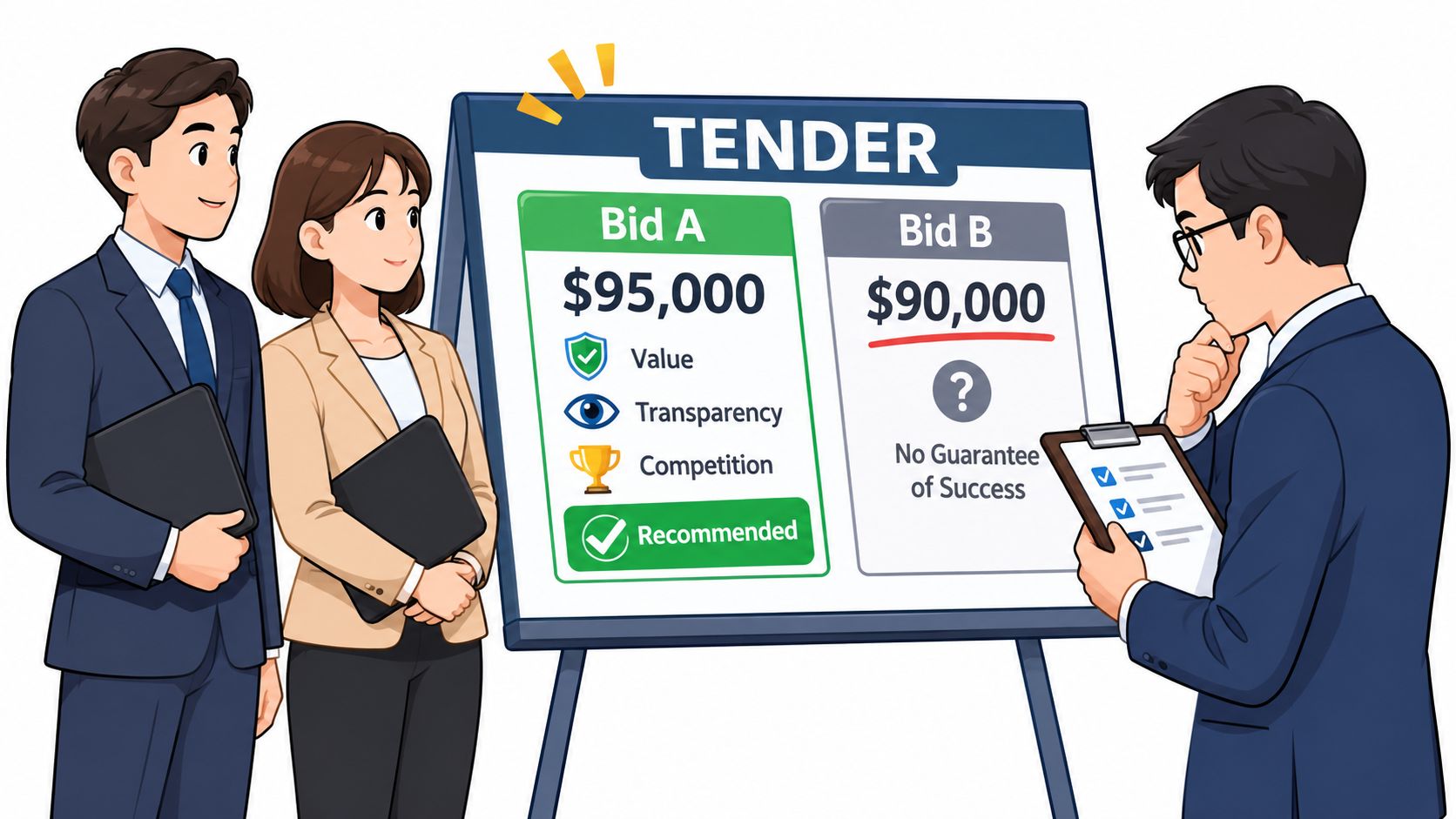
A tender isn't automatically awarded to the cheapest supplier. Buyers use competition to compare offers, explain their decisions and establish value for money, not to collect the lowest available price.
The government's guidance on assessing competitive tenders explains the most advantageous tender approach: award criteria must relate to the contract, be clear, measurable, specific and proportionate, with their relative importance disclosed. Its illustrative split of 60% quality and 40% price shows why a cheaper offer can lose to a better-evidenced response.
Write for the scoring method
Under that illustrative split, a supplier that concentrates on discounting while submitting weak quality answers leaves much of the available score exposed. Price cannot compensate indefinitely for poor answers elsewhere.
Read the scoring descriptors as closely as the questions. If the highest score requires a detailed method supported by relevant evidence, a confident company introduction won't meet that standard.
Depending on the published criteria, buyers may assess delivery, social value, sustainability, implementation and risk. The Home Office's SME action plan places smaller suppliers within this broader value-based procurement context; being an SME doesn't itself earn evaluation marks.
Replace assurances with proof
A cleaning supplier shouldn't stop at saying it provides reliable cover. Explain who receives an absence notification, how replacement staff are allocated and how the supervisor checks that the scheduled work was completed.
Useful evidence includes:
- Measured outcomes: Relevant results with enough context to make them credible.
- Service levels: Clear commitments your delivery team can maintain.
- Implementation milestones: Activities, owners and dependencies.
- Comparable cases: Work that demonstrates the capability being assessed.
For a software procurement, Arch's guide to red flags when hiring product developers offers a useful buyer-side perspective when reviewing your own response. Check whether you've explained delivery responsibility and working arrangements rather than merely listing technical skills.
Before drafting: List the weightings and highlight the heaviest criteria. Give those answers the strongest evidence and the most careful review.
Tools such as bid writing software can help organise a response, but your reviewers still need to test every commitment. Allocate effort broadly in line with scoring importance, while completing every mandatory item regardless of its apparent weight.
A polished answer only helps if it gives the evaluator a defensible reason to award marks.
How a Tender Runs From Notice to Contract
The process works best when you separate opportunity discovery, compliance, drafting and submission. Mixing them together encourages teams to write persuasive answers before checking whether they're eligible.
Follow the published sequence
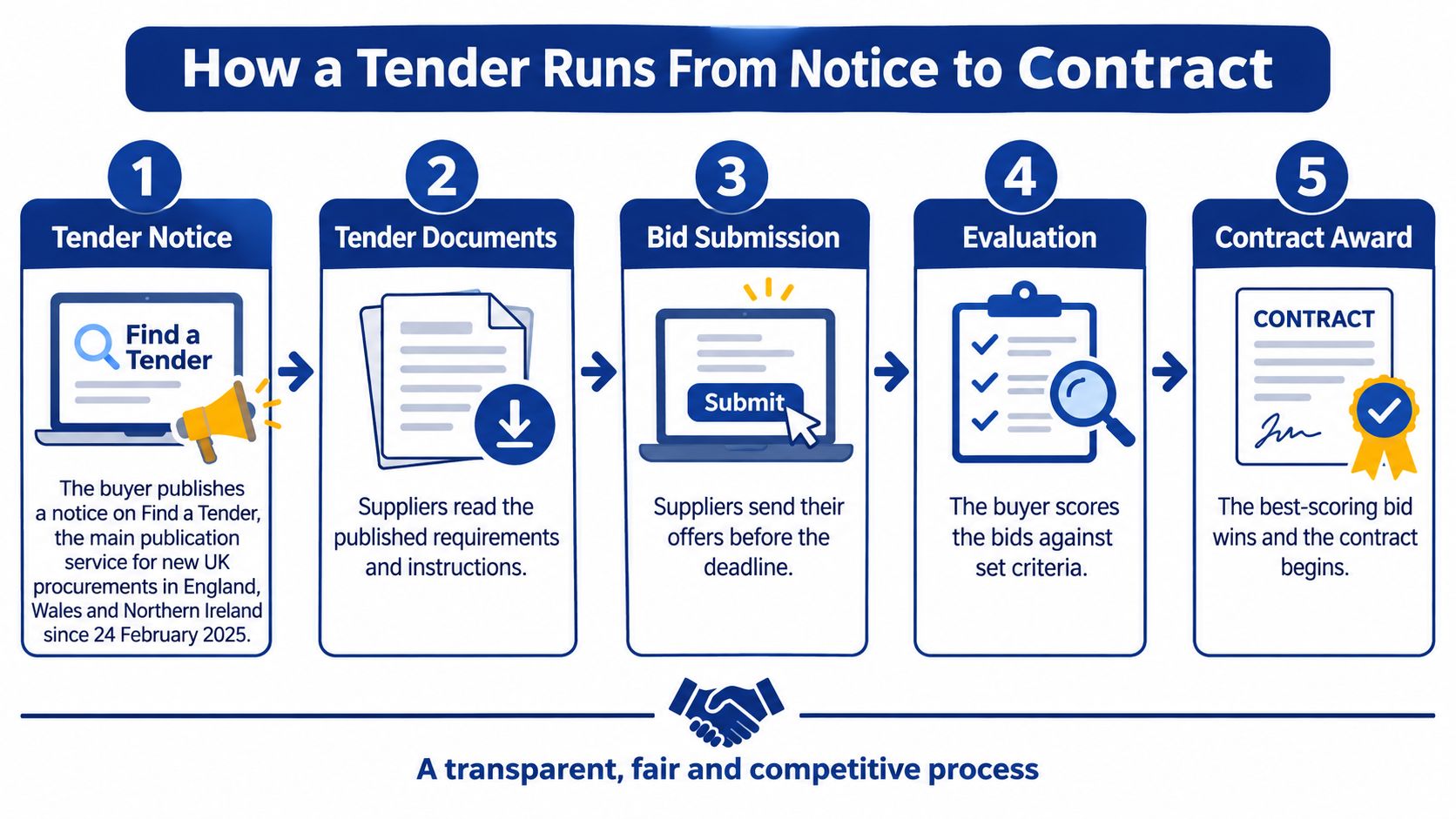
Find the live opportunity. From 24 February 2025, Find a Tender became the main publication service for new procurements in England, Wales and Northern Ireland under the framework described in the Act's procurement provisions, with below-threshold Scottish notices remaining an exception. Follow the portal named in the notice; discovering an opportunity doesn't necessarily mean you've registered on its submission system.
Distinguish early notices from an invitation to bid. A pipeline or preliminary market engagement notice can appear before the formal competition, giving suppliers a chance to understand the requirement and contribute relevant questions. Don't treat it as a live tender or send an unsolicited bid in place of the participation process the buyer specifies.
Read the documents and build a compliance matrix. Map each requirement to a response, evidence source, owner and submission location, then record whether it's mandatory or scored. The common mistake is assigning technical writers immediately while leaving pricing schedules, declarations and contract departures without owners.
Ask clarification questions through the official route. Raise ambiguous requirements before the clarification deadline and monitor the answers shared with bidders. Don't rely on an informal conversation or continue drafting against an assumption after the buyer has corrected it.
Plan backwards and submit early. The statutory time-limit provisions generally provide a 25-day minimum tender period for electronic submissions when all documents are available together, or 30 days when they aren't, subject to the applicable conditions and exceptions. Use the actual notice deadline, allow time for uploading and validation, and retain the submission receipt rather than assuming a saved draft has been submitted.
Allow for evaluation and any permitted follow-up. The buyer assesses submissions using its stated methodology, so keep relevant staff available for clarification requests or other published assessment stages. Don't assume you can use a later clarification to supply material missing from the original tender.
Read the award communication before mobilising. Where applicable, the buyer publishes its award notice and observes a standstill period before entering the contract, allowing the decision to be scrutinised or challenged. Don't confuse notification of an intended award with permission to start work; check the contractual start arrangements.
Keep control of the final submission
For live tender opportunities, keep a submission register alongside the writing plan. Record the latest document version, reviewer approval and upload status for each required file.
Your commercial reviewer should check the pricing against the delivery method. Your delivery lead should verify staffing, mobilisation and service commitments before anyone approves the response.
Finally, compare the completed submission with the compliance matrix, not just the narrative questions. That's how you catch the missing workbook or declaration that a general proofread won't identify.
Find Your First Tender Before the Deadline
Set up searches on Find a Tender and Contracts Finder using your CPV codes, keywords, region and contract value range. Keep the search narrow enough to produce useful matches, then adjust it if suitable notices aren't appearing.
Choose a bid you can deliver and evidence, not one with an appealing contract value. If a mandatory requirement can't be met, resolve that before committing the team.
Prepare reusable material
With Bidwell, tender monitoring covers Find a Tender, Contracts Finder, PCS, Sell2Wales and eTendersNI. Tender discovery is a £10-a-month add-on that watches every UK portal for opportunities matching your sectors, frameworks and CPV codes.
Store credentials, policies, case studies and past responses in the knowledge base so the material is organised before the next deadline. AI response generation then drafts against the actual tender using your material; you review, polish and submit the answers yourself.
With Bidwell, the 20-to-40-hour tender writing task becomes a 2-to-4-hour task. Use that review time to verify evidence, resolve inconsistencies and check that the proposed delivery matches the price.
Make the go or no-go decision
Before opening a blank response document:
- Confirm it's live. Check that the notice invites the submission you're preparing.
- Check the deadline. Include any earlier participation stage.
- Map mandatory requirements. Identify evidence gaps and assign owners.
- Decide go or no-go. Proceed only if you're eligible, capable and commercially comfortable.
Declining an unsuitable tender protects the time you need for a credible one.
Bidwell brings tender monitoring, an organised knowledge base and AI response generation into the same bidding process. Visit Bidwell to find suitable UK opportunities and prepare a custom first draft from your own evidence, ready for your team to review and submit.

