
Home Office direct SME spend rose 5.6% to £267.8 million in 2025/26, yet that was still only 4% of its total procurement spend, below its 8% indicative target, according to Home Office SME procurement spend figures for 2025/26. That gap tells you something useful. SMEs do not lose only because they write weak answers. They also lose time on notices they should have filtered out, or notices they found too late to prepare for properly.
A good Bid No Bid Template fixes that first decision. You run the gates, score what's left, and record one of three answers. Go, no-go, or bid later.
What You Decide Before You Write
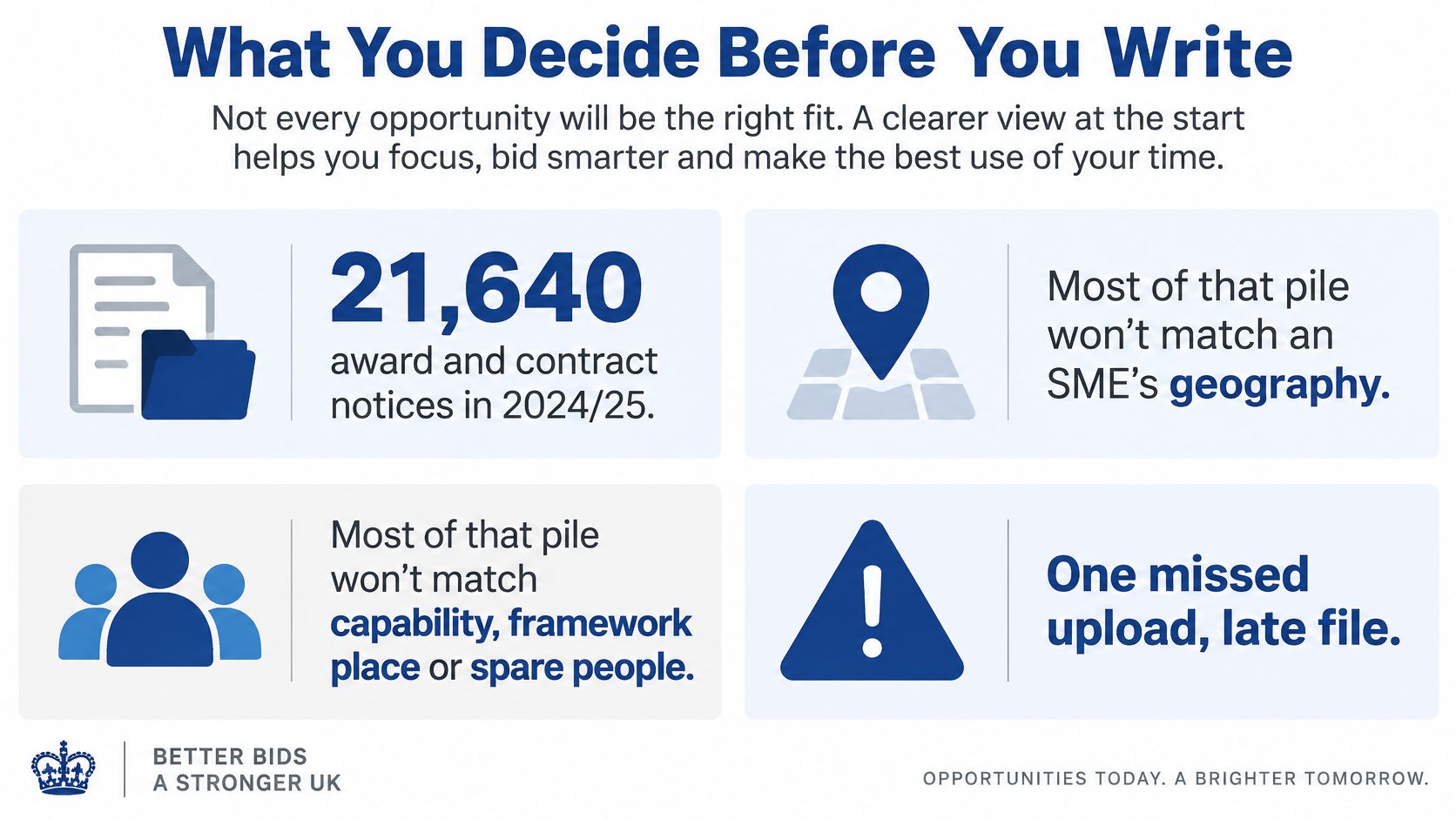
The Public Procurement Review Service progress report for 2024/25 says Find a Tender published 21,640 award and contract notices during 2024/25. Read that as a workload warning, not an invitation. Most of that pile won't suit your geography, capability, framework place, contract size or spare people.
Say a notice lands on Monday morning. It looks close to work you already deliver, the value is tempting, and someone senior says you should have a go. That's exactly when you slow down for 45 to 90 minutes, or half a day on a framework, and finish the template before anyone drafts a sentence.
What the template actually is
It's a short record with two parts. First comes a binary compliance gate, where one fail ends the discussion. Then comes a scored fit check covering service fit, pass and fail requirements, likely competition, staff, accreditations, value and expected margin.
The bid manager usually completes it with the delivery lead and finance. One person can fill in the form, but one person shouldn't supply every answer. Delivery knows if the work is deliverable. Finance knows if the margin survives contact with real labour and material costs, and teams that price physical work sometimes sanity check that side against tools for tracking labor and material costs before they trust a number.
Practical rule: If nobody can name the evidence for a claim, score it as if the evidence does not exist.
Where the notice sits
Write the portal, notice reference and lot in the header before you score anything. From 24 February 2025, Find a Tender became the main publication service for above and below-threshold notices under the Procurement Act 2023, except where Scottish or Northern Irish rules apply. Contracts Finder still covers older below-threshold notices in England and other non-devolved territories, and Public Contracts Scotland covers Scotland.
That split matters because you can't qualify what you never see. Bidwell's tender monitoring watches those routes and filters the feed to your specialism, so you're reviewing relevant notices rather than wading through everything. Our tender tracking for live opportunities page shows how that monitoring fits the wider process.
The knowledge base then tells you whether evidence for each gate already exists, such as insurance certificates, case studies, policies and named staff. AI response generation stays off at this point. Drafting before qualification just makes a bad decision harder to reverse, because people point at the hours already spent.
One missed upload, one late file or one omitted declaration can wipe out the return on all of those hours. That's why the form ends in a verdict, not a vibe. The next part gives you the form itself.
The Bid No Bid Template and Scorecard
Copy this structure into a spreadsheet or document and use it as it stands. Scoring comes last. The header and the gates come first, because a bid that fails a gate never reaches the scorecard.
Header fields to complete first
Record the buyer, notice reference, portal, lot, contract value, closing date and time, submission system and language. Add the bid-validity period and whether bid costs are recoverable. Those two fields look dull. They decide whether you can hold price, people and subcontractors for the full evaluation window without losing money.
Crown Commercial Service guidance on becoming a supplier makes clear that suppliers must respond to the relevant contract notice, and merely expressing interest does not result in appointment. Published UK tender documents also require submission through the named electronic system, before the deadline, and in English. Treat those as basic compliance requirements.
| Row | What to record | Pass rule | Weight |
|---|---|---|---|
| Compliance | Portal, deadline, English, declarations, word limits, submit action | Any miss is no-go | Gate, not weighted |
| Eligibility | Insurance, finances, geography, accreditations, selection tests | Any mandatory fail is no-go | Gate, not weighted |
| SME accessibility | Proportionate tests, cash flow, liability, lots or consortium route | Structurally unsuitable is no-go or bid later | Gate, not weighted |
| Strategic fit | Service, buyer, lot and route to market | Score 1 to 5 | 20% |
| Technical deliverability | Method, sites, subcontractors, dependencies | Score 1 to 5, red if undeliverable | 20% |
| Evidence | Case studies, references, policies, named owner | Score 1 to 5 | 15% |
| Commercial margin | Whole-life price, margin, unrecovered bid cost | Score 1 to 5 | 25% |
| Resource and validity | People held for 90 days, 120 days or six months | Score 1 to 5 | 20% |
The three gates
Compliance covers the named e-sourcing system, the deadline, English, mandatory declarations, page or word limits, pricing format and the correct submit action. A draft left unsubmitted is not a bid. A non-compliant bid can be rejected, and false or misleading information can get a supplier excluded, so treat this as pass or fail.
Eligibility covers insurance, financial standing, geography, accreditations and any pass or fail selection test. If the buyer requires a certificate you don't hold and can't get before the deadline, stop. A strong strategic fit score won't average that failure away.
SME accessibility covers proportionate turnover and experience tests, cash-flow exposure, liability, payment risk, lots, and whether a subcontract or consortium route exists. This gate can return bid later rather than a flat no, because a barrier like an oversized lot or a fixable accreditation can be cleared before the next competition.
Compliance is not a factor to weight. It's a switch. On, you can proceed. Off, you're done.
The weighted rows
Only score opportunities that clear every gate. Score strategic fit, technical deliverability, evidence and past performance, commercial margin, and resource through the validity window from 1 to 5, using weights of 20, 20, 15, 25 and 20. Record the evidence owner and a red, amber or green flag beside each row.
A 1 means you cannot evidence it today. A 5 means you can prove it from a named case study, policy, reference or capacity plan. Anything in between needs a named source in your knowledge base, not a verbal promise in a meeting.
Keep price in its place. Public awards aren't decided on headline price alone, so commercial margin is one input, not the whole decision.
The form ends in one of three verdicts: go, no-go, or bid later where an SME accessibility barrier can be fixed ahead of a future competition. That third verdict is what stops the template forcing a yes you don't believe or a no you'll regret. If you want to see how other suppliers organise these checks and what evidence they keep close to hand, compare tools for government contractors.
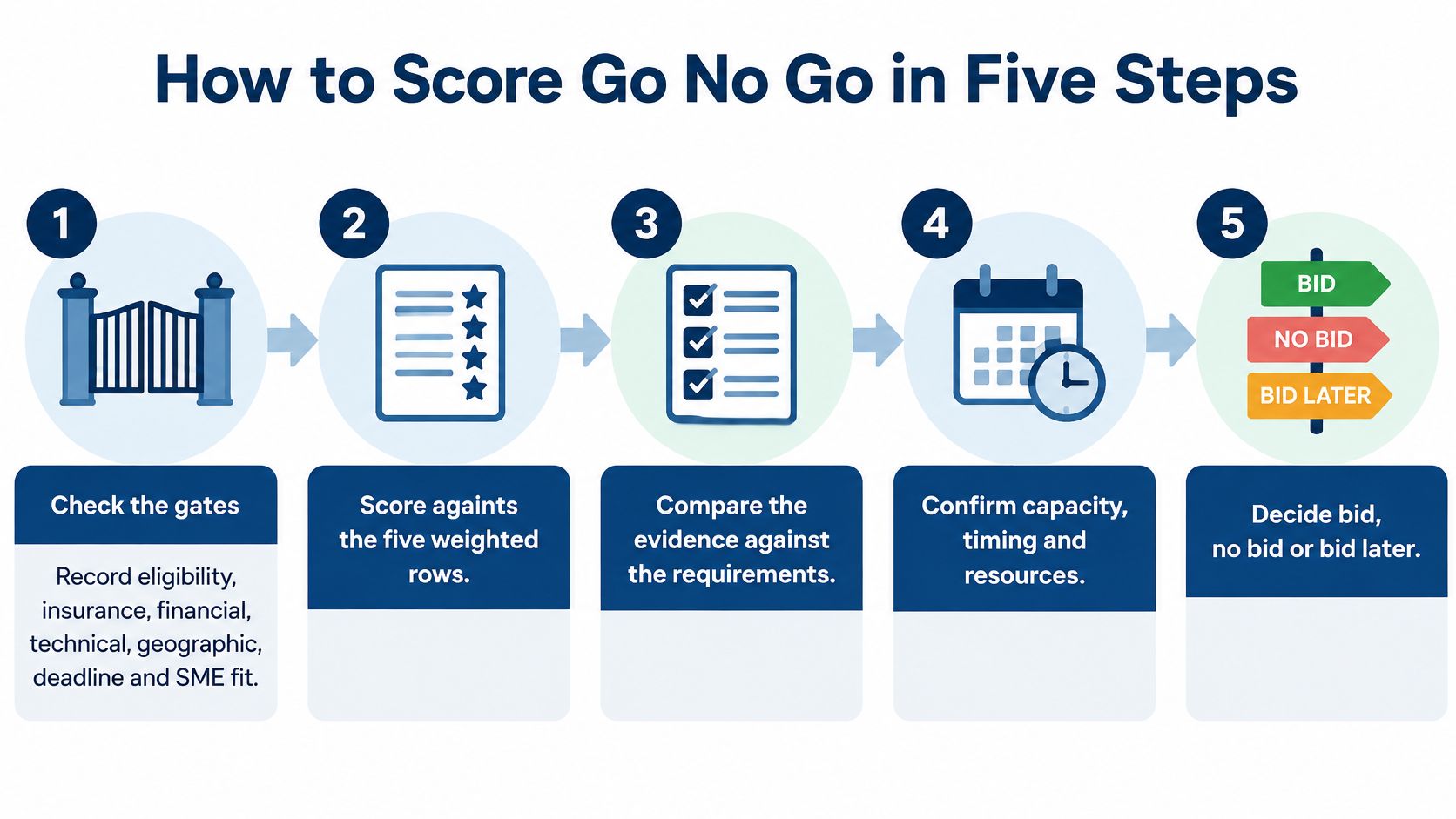
How to Score Go No Go in Five Steps
Run the same order every time. Skipping ahead to the score is how teams talk themselves into bids they've already decided they want.
Steps 1 and 2
Step 1. Check the gates. Record eligibility, insurance, financial, technical, geographic and deadline requirements, plus the SME accessibility items. A compliance or eligibility fail stops the process there. An SME accessibility fail moves to bid later if the fix is achievable, and to no-go if it isn't.
Step 2. Map evidence. Match each remaining requirement to a source in your knowledge base and mark its pass or fail risk. Include word and character limits, mandatory forms, pricing schedules, subcontractor dependencies and social-value promises. If the evidence owner can't produce the document, mark it red.
Steps 3 and 4
Step 3. Extract the published method. Pull out the award criteria, sub-criteria, weightings and scoring bands exactly as published. Ignore any preference that isn't in that methodology. The Procurement Act 2023 guidance on assessing competitive tenders requires award criteria to be relevant, measurable, specific and proportionate, and the assessment methodology to be transparent and published.
Step 4. Score 1 to 5. Score strategic fit, technical deliverability, evidence, commercial margin, and resource and validity. Then estimate win probability from incumbent status, framework position, relevant references, price position and past evaluator feedback. With thin evidence, write a range and use the low end. An unsupported percentage is just optimism with a number attached.
- Incumbent status: Are you, or a rival, already delivering this or a neighbouring lot?
- References: Do you hold two or three cases that match the buyer's setting and scale?
- Price position: Can you price keenly without cutting margin below your floor?
- Feedback: What did evaluators mark down last time, and have you fixed it?
Step 5 and the stop rule
Step 5. Do the sum and apply the bands. Calculate expected bid value as contract gross margin times win probability, minus bid cost, minus a delivery-risk allowance. Then read the weighted score against the table. Negative expected value means no, even if the room likes the buyer.
| Gate result and score | Expected value | Decision |
|---|---|---|
| Compliance or eligibility gate fails | Any | No-go |
| SME accessibility gate fails | Any | Bid later if the fix is achievable, otherwise no-go |
| All gates pass, weighted score below 3.0 | Any | No-go |
| All gates pass, score 3.0 to 3.9 | Positive | Go only with named conditions met |
| All gates pass, score 4.0 or above | Positive | Go |
Before you approve a go, run a ten-minute mock evaluator using only the authority's criteria. Read your likely evidence against each scoring band and ask what mark an evaluator could defend. Then write the approver and date on the form, and only then let AI response generation near it. Bidwell's tender monitoring found the notice and the knowledge base supplied the proof, but the decision is still yours.
When an SME Should Bid Later Instead
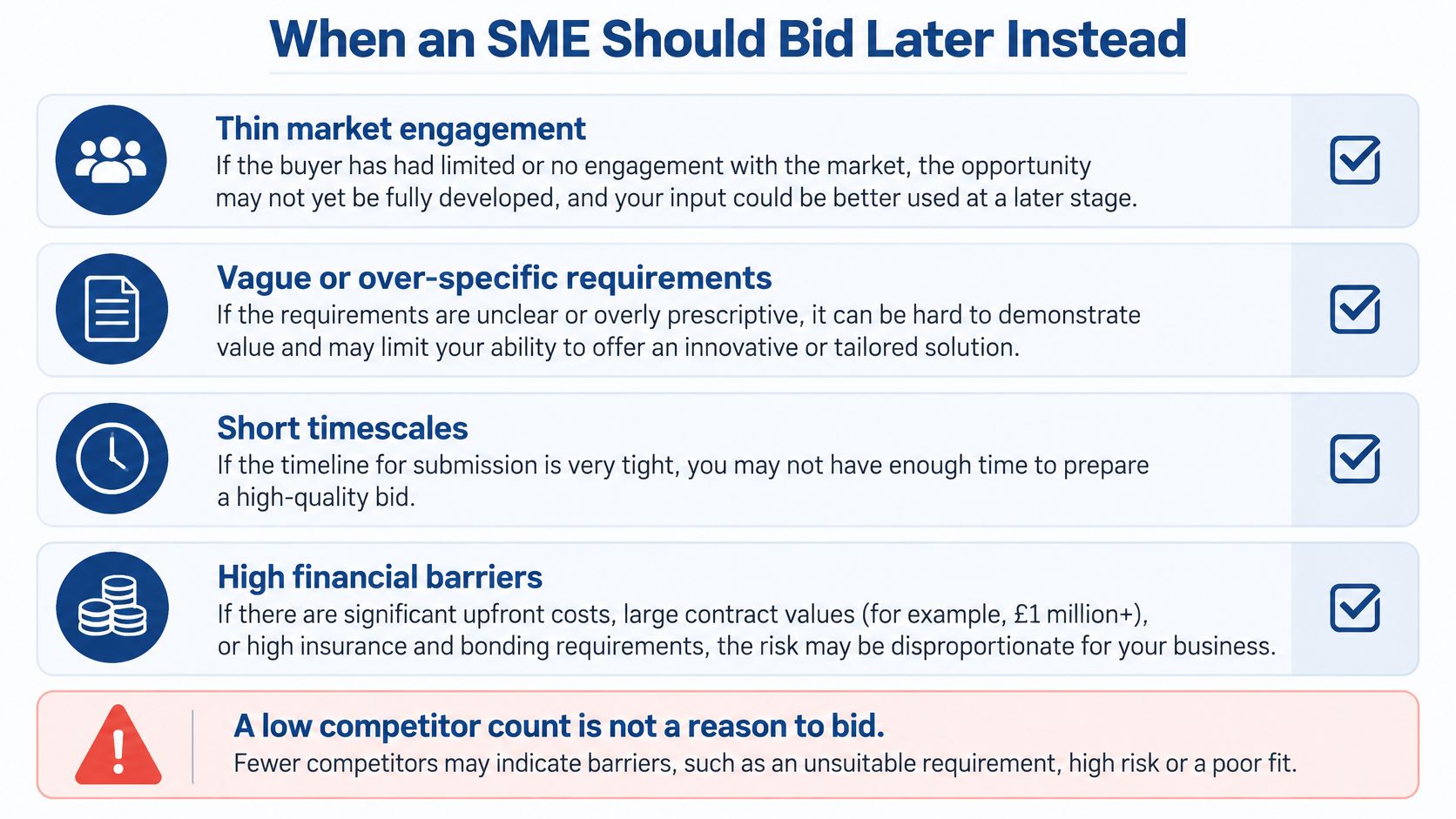
A low competitor count is not a reason to bid. If few suppliers are interested, ask why. Sometimes the answer is that the contract is poorly structured, badly paid or carrying risk nobody sensible wants.
The Department for Business and Trade SME action plan 2025 to 2028 names recurring barriers, including insufficient market engagement, vague or overly specific requirements, short bid timescales, high financial thresholds, unsuitable contract structures, disproportionate risk allocation, lack of feedback and the resource burden of bidding. Standard templates often skip all of that and ask only about fit and value. Don't.
Four stop questions
- Proportionate tests: Are turnover, insurance, technical-capability and experience requirements proportionate to the work?
- Cash flow: Can you deliver without unacceptable cash-flow exposure while you wait to be paid?
- Market engagement: Was meaningful preliminary market engagement conducted, and did the buyer listen?
- Route in: Are lots, subcontracting or consortium routes available, and confirmed in writing?
One no on risk or cash flow outweighs a pretty strategic-fit score. Where capacity is the blocker, be honest about whether you'd need partners or extra hands, and sense check what that involves by evaluating staffing partners with HireArchitects rather than assuming you'll recruit in time. Our page for SME owners bidding for public work covers how smaller firms approach that judgement.
Live tender or early signal
Split live tenders from earlier signals, because the right answer differs. Under the Find a Tender notice types guidance, a pipeline notice must be published by a contracting authority that expects to spend more than £100 million on relevant contracts in a financial year, covering intended requirements above £2 million, generally between 1 April and 26 May for competitions expected during the following 18 months. That gives you months to prepare, if you spot it.
If the notice is still at pipeline or engagement stage, bid later usually means monitor it, join a consortium, agree a subcontractor role, or obtain the missing accreditation. Write the exact change that would flip the decision next time. Public liability at £10 million, two sector references, or a partner for the out-of-area lot are the sort of entries that help. "Get stronger" doesn't.
The market is real, since the British Chambers of Commerce and Tussell SME Procurement Tracker 2025 reports SMEs received 20% of wider UK public-sector procurement spend directly in 2024. Still, a suitable-for-SMEs tick on a notice is not a route to win. Use tender monitoring to catch the pipeline entry, the knowledge base to see which credential is missing, and hold AI response generation until the live competition and the gate both say yes.
Two Worked Go and No Go Decisions
Run each notice through the same form. The examples below use round figures so you can check the arithmetic yourself.
Example 1, a facilities no-go
Say a facilities SME reviews a hypothetical £180,000 local-authority cleaning contract. It has 25 days to submit, a 120-day validity period and insurance already in place. But the selection stage requires an ISO certification the firm doesn't hold, with no time to obtain it.
Eligibility fails, so it's a no-go before any scoring. There's no weighted total to argue about. Hoping for a waiver in the clarification window is wishful thinking, and spending 30 hours drafting won't change the certificate position.
Example 2, a thin IT go
Now say an IT support firm sits on the relevant framework lot and reviews a call-off. Gross margin is £40,000 and evidence-based win probability is 35%, because the firm is incumbent on a neighbouring lot and holds two matching references. Bid cost is £6,000 of staff time and the delivery-risk allowance is £4,000 for a possible night-shift subcontractor.
The sum is £40,000 × 0.35 − £6,000 − £4,000, which equals £4,000. Every gate passes and the weighted score is 4.1, so this is a thin go, not a celebration. A small slip in win probability or bid cost turns it negative, so I'd cap the hours and set a review point.
Contracts Finder procurement documentation describes the award basis as the "most economically advantageous tender", assessing quality and whole-life cost rather than initial price alone, and UK documents include bid validity periods of 90 days, 120 days and six months. The same documentation says the authority will not pay suppliers' bid costs, including where the competition is terminated or amended. So price is one input, your bid cost is sunk, and your price may need to hold for months.
| Scenario | Gate result | Expected value | Decision |
|---|---|---|---|
| Facilities cleaning, missing ISO certification | Eligibility fail | Not calculated | No-go |
| IT support, incumbent on the lot | All gates pass | £4,000 | Go (thin) |
| Consultancy, 10-day window, unlimited liability | SME access fail | Negative | Bid later |
Example 3, a bid later
Say a consultancy scores 3.6 but faces a 10-day window and unlimited liability. The work fits and the team could write a decent answer at speed. The SME accessibility gate still fails, because the risk sits with the supplier and the timescale leaves no room to negotiate or partner.
That lands on bid later, with the flip condition written down. Capped liability, a realistic window, or a consortium partner sharing the risk would reopen it. After a genuine go, the knowledge base supplies the citations and AI response generation turns the approved brief into a first draft for review.
Record the Decision Then Start the Response
Don't leave the call in a meeting note. Write go, no-go or bid later on the scorecard, with the approver, date, weighted score and expected value. If the decision isn't recorded, someone will reopen it next week from memory.
What each outcome needs
For a no-go, one line on the failed gate is enough. Then stop. Don't open a draft just to feel busy, and don't keep the notice on the tracker as a maybe.
For bid later, record the single change that would reopen it, its owner, and the date you'll recheck the pipeline or next competition. Put that date in a diary. Keep tender monitoring switched on for that buyer and service, so the recheck isn't left to chance.
For a go, freeze the brief before anyone writes. Fix the question list, word limits, evidence owner, pricing assumptions for the validity period, and social-value promises you can deliver. Our bid writing software for tender responses page sets out how drafting works once that brief is agreed.
How drafting should run
Write each answer in this order. Requirement, approach, proof, measurable outcome, then the benefit for this contract. That sequence keeps answers tied to the scoring bands instead of drifting into general company history.
Count words against the limit as you go. The SME and VCSE public procurement bid pack warns that text exceeding a word or character limit may be ignored or cut off, while responses that are too short may lack sufficient evidence to score well. Have someone who didn't draft the answer check every claim against a credential, case study, policy or delivery record. The same person shouldn't mark their own work.
We draft each new bid against the actual tender notice rather than a generic template, pulling from your knowledge base so claims carry their sources. Set-up with Bidwell takes 15 minutes, and the first draft comes back in minutes, which leaves your time for checking rather than blank-page writing. You review and approve every word, and a human always signs the bid before it goes out.
That's the whole discipline. Qualify first, record the verdict, then write only where the gates, the score and the sum all agree.
Run your next notice through the gates before you write a word, and let Bidwell handle the monitoring, the knowledge base and the first draft once you've recorded a clear go. You'll spend your hours reviewing evidence and sharpening answers instead of chasing notices that were never winnable. Start today with Bidwell and make bid later a planned move, not a last-minute retreat.

