You've probably got the draft open already. The method statement is half there, pricing is still moving, and someone has asked for “a strong executive summary” by close of play.
That's usually where bids go wrong. The summary gets treated like a glossy opener written in a rush. In UK public sector tenders, it's usually more useful as a compliance bridge. It should help an evaluator read the rest of your bid through the right lens, and it should hold up when the authority later explains scores against each criterion.
What a Tender Executive Summary Really Does for Evaluators
Evaluators rarely read your tender in the order you wrote it. They open the file, scan the front, look for orientation, then start hunting for evidence. If your tender executive summary is vague, salesy, or detached from the scored response, you've made their job harder in the first minute.
That matters in a market this large. UK public procurement accounts for around £400 billion a year, and government material also says bid rigging can increase prices by 20% or more, with an estimated impact of £1 billion to over £3 billion on the UK economy, which tells you how seriously value, fairness and scrutiny are taken in this space (UK public procurement analysis).
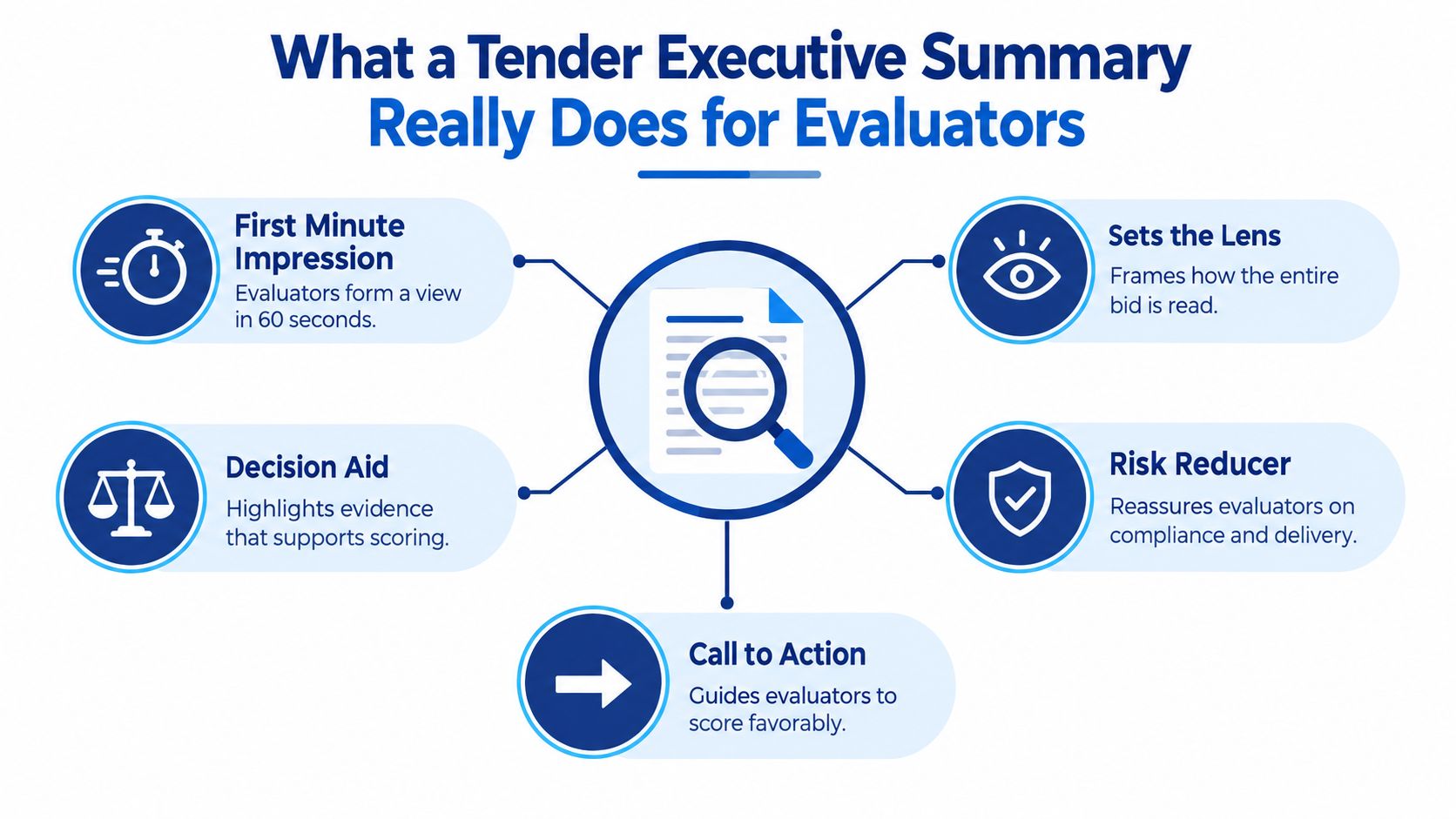
It is not a brochure intro
A tender executive summary is not the place for “we are delighted to submit our proposal” or three paragraphs about your history. Evaluators don't need a welcome note. They need a fast, buyer-led précis of four things:
- What the buyer needs
- What you're proposing
- Why it meets the criteria
- Why it feels low risk
The strongest summaries feel organised around the authority's problem, not your company profile.
It sets the reading frame
A good summary tells the evaluator what to expect from the rest of the response. If your main themes are service continuity, mobilisation control and social value delivery, the summary should surface those themes early and point cleanly into the evidence already sitting in the bid.
That's why I usually write it last. By then, the themes are real, not aspirational.
Practical rule: If a sentence in the summary can't be traced to evidence elsewhere in the tender, it probably doesn't belong there.
There's also a simple procurement reason for this. UK guidance says evaluators must assess bids against the published award criteria and methodology, using only the information contained in the tender return, not against competing bids (competitive tendering guidance).
If you want extra help with summary craft itself, these executive summary expert tips are useful. The difference in tenders is that style only helps if it serves scoring and compliance.
For teams building bids across multiple opportunities, tender response workflows matter. You need the opportunity context early, then a reliable way to pull in approved evidence rather than rewriting from memory.
The Anatomy of a High Scoring Tender Executive Summary
The easiest way to write a stronger summary is to mirror how buyers score. Don't think “intro page”. Think “compressed evaluation map”.
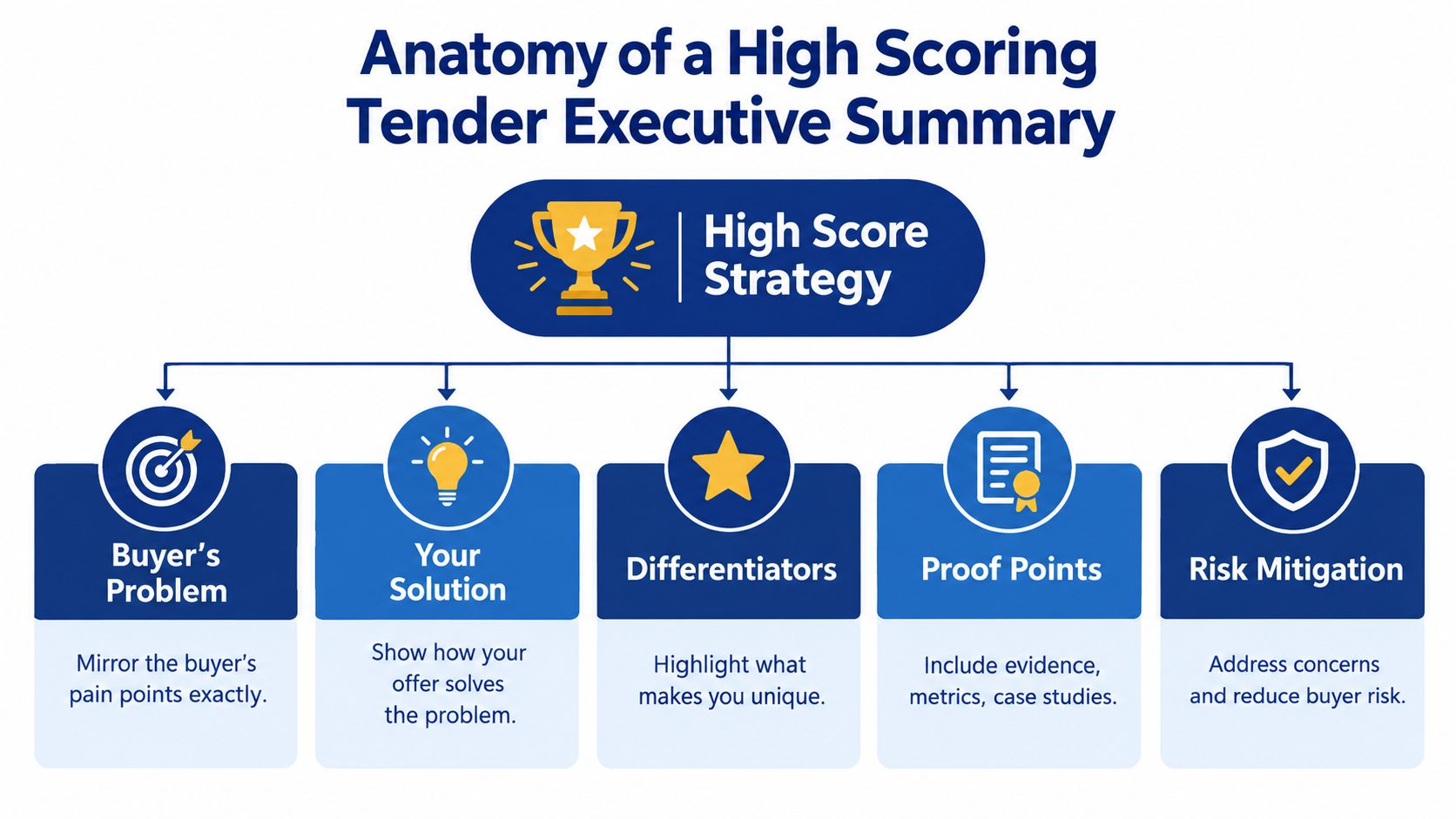
Start with the buyer's problem
Open with the authority's requirement in their language. Name the contract aim, the operating pressures, and the outcomes they're trying to buy.
A weak opening says you understand their needs. A strong opening proves it by being specific.
Example: “You need a provider that can mobilise safely, maintain service continuity across the contract term, and give contract managers clear performance visibility from day one.”
Keep this short. Usually one compact paragraph is enough.
Then state your solution
Now tell them what you are offering. Not every feature. The shape of the solution.
This paragraph should answer: what will we deliver, how will it work, and how does it fit this contract?
Example: “Our delivery model combines a named contract lead, site-level operational control, and a reporting structure aligned to your contract management timetable, so transition, delivery and review all sit within one accountable framework.”
Add credibility, not biography
Evaluators don't score your pride in the business. They score relevant confidence. So skip the long origin story and use this space for fit.
A good credibility paragraph usually includes relevant experience, operational capability, accreditations if asked for, and team suitability. Keep it tied to the requirement.
- Use relevance first: Mention experience that looks like this contract.
- Use named proof: Refer to evidence already included elsewhere in the submission.
- Use restraint: Don't dump everything you've ever done into four lines.
Cover value and risk together
Many summaries become fluffy. “Value” is not a slogan. In a public contract, value usually means a combination of service quality, cost control, delivery confidence and practical risk management.
The strongest paragraph in many summaries is the one that shows you understand what could go wrong and how you'll control it.
Example: “We've structured mobilisation, governance and performance reporting to reduce delivery risk, maintain continuity and give your team a clear line of sight on corrective action throughout the contract.”
Write for the criterion, not for the competitor. Evaluators are usually comparing your answer to the published scoring rules before they compare it to anybody else's style.
Close with a concise recommendation
End cleanly. No grandstanding. No repeated claims. Just a short close that reinforces fit.
You can restate the contract outcome, your suitability, and readiness to deliver. That's enough.
A simple five-part flow works well:
| Block | Purpose | What good looks like |
|---|---|---|
| Buyer understanding | Show you grasp the contract | Mirrors buyer language and priorities |
| Solution | Explain your delivery model | Tailored to this requirement |
| Credibility | Build confidence | Relevant, evidenced, restrained |
| Value and risk | Reassure on outcomes | Specific, practical, low-fluff |
| Close | Reinforce fit | Short and controlled |
How to Write Your Tender Executive Summary Without Starting From Scratch
Drafting the summary first feels efficient, but it usually creates rework.
Write it last instead. Once the scored answers, method statements and pricing narrative are stable, you can pull the win themes out of the bid and compress them properly.

Use the full tender as your source material
Start by reading your own response like an evaluator. Mark the phrases that carry weight. Usually these sit in answers on mobilisation, contract management, staffing, risk, quality and social value.
Then pull out three things:
Your core themes
The repeated messages that matter to this buyer. Not generic claims. Contract-specific themes.Your strongest proof points
The evidence already present in the bid that supports those themes.Your risk controls
The parts that reduce evaluator anxiety. Mobilisation discipline, governance, escalation, continuity, reporting.
If you can't find enough substance to build a one-page summary, the problem usually isn't the summary. It's the underlying bid.
Draft from approved content, not a blank page
A knowledge base saves time. Instead of hunting through old folders, CVs and past submissions, pull approved case studies, credentials and standard proof points from one place and adapt them to the contract.
AI response generation can help here too, if it's drawing from your own approved material rather than inventing copy. In practice, that's how teams turn a 20 to 40 hour writing task into 2 to 4 hours of review and refinement. The gain isn't magic. It comes from reducing first-draft effort and focusing people on checking relevance, tone and traceability.
Bidwell is one example of that approach. It combines tender monitoring, a knowledge base and AI response generation so teams can spot opportunities, assemble evidence and draft responses from existing material rather than starting over each time.
Tighten it until every line earns its place
The first draft is usually too long and too abstract. Cut hard.
Try this edit pattern:
- Replace puff with specifics: Swap “high-quality service” for the actual mechanism that produces quality.
- Shorten openings: “We understand the authority requires” can often become “You need”.
- Remove repetition: If the same theme appears three times, keep the clearest version.
- Check every claim: If it isn't supported in the tender return, delete it or rewrite it.
A quick before-and-after shows the difference.
Weak: “We are a trusted supplier with extensive experience and a strong commitment to delivering an excellent service.”
Stronger: “Our proposed contract structure gives you named accountability, defined reporting lines and a delivery model designed to maintain service continuity from mobilisation onwards.”
The best tender executive summary usually reads like the final answer to the evaluation, not the opening to a brochure.
Finish with a traceability check
Before sign-off, test the summary line by line against the tender. Can you point to where each claim is evidenced? If not, fix it.
That matters even more under the Procurement Act 2023. Authorities must issue an assessment summary to every supplier that submitted an assessed tender before publishing the contract award notice, and that summary must explain the score for each criterion and, for unsuccessful bidders, why the tender was unsuccessful (assessment summary guidance).
That's why traceable writing beats clever writing.
Tailoring Your Summary for UK Portals and Page Limits
The right summary on one portal can be the wrong summary on another. Same contract type, different buyer behaviour, different portal limits, different attachment rules.
At a minimum, UK suppliers should keep track of Find a Tender, Contracts Finder, Public Contracts Scotland and Sell2Wales, which government guidance and independent procurement commentary both identify as the main routes across the UK public market (UK contracts portals guidance, public sector tender portals overview).
Where Your Summary Lives Across UK Portals
| Portal | Typical Use | Summary Implication |
|---|---|---|
| Find a Tender | Higher-value public contracts | Expect formal documentation and tighter alignment to criteria |
| Contracts Finder | England and non-devolved bodies | Watch for local authority formatting quirks and attachment rules |
| Public Contracts Scotland | Scottish public sector opportunities | Check whether summary format is structured, uploaded, or embedded |
| Sell2Wales | Welsh public sector opportunities | Keep wording tight in case portal fields or buyer templates constrain space |
The portal itself doesn't score your response. The buyer's documents do. But the portal affects how easy your summary is to submit, read and cross-check.
Scored, unscored and consistency-checked
This is the part many guides miss. Some buyers ask for an executive summary and don't score it formally. Some effectively use it as a consistency check. Some don't ask for one at all. Some ask for a summary only in a box with hard character limits.
There isn't one universal rule, so check the tender pack before you write a single line.
A practical decision matrix helps:
If it is scored
Align headings closely to award criteria language. Keep proof dense. Don't waste space on pleasantries.If it is unscored but required
Treat it as a navigation aid and risk control document. It still shapes first impressions.If it is consistency-checked
Make it fully reconcilable with the main response. No fresh promises. No extra scope. No accidental contradictions.
Length is a tactical choice
In live UK tenders, summary expectations vary. Some buyers want one page. Some allow more. Some use a few thousand characters. Some say almost nothing at all about format. A lot of public examples still impose hard caps, which is why brevity matters in practice (UK tender executive summary guidance).
The safest rule is simple. Write short enough to survive portal limits and evaluator time pressure, but detailed enough to show buyer understanding, relevant experience and delivery confidence.
If you're managing multiple opportunities across formats, bid writing software for public sector tenders helps mainly because it keeps source content organised. That makes it easier to produce one-page, two-page or character-limited versions without drifting into inconsistency.
Common Pitfalls That Cost Marks and How to Avoid Them
Most weak summaries fail for predictable reasons. Not because the writer can't write, but because the summary stops being a summary and starts becoming a sales page.
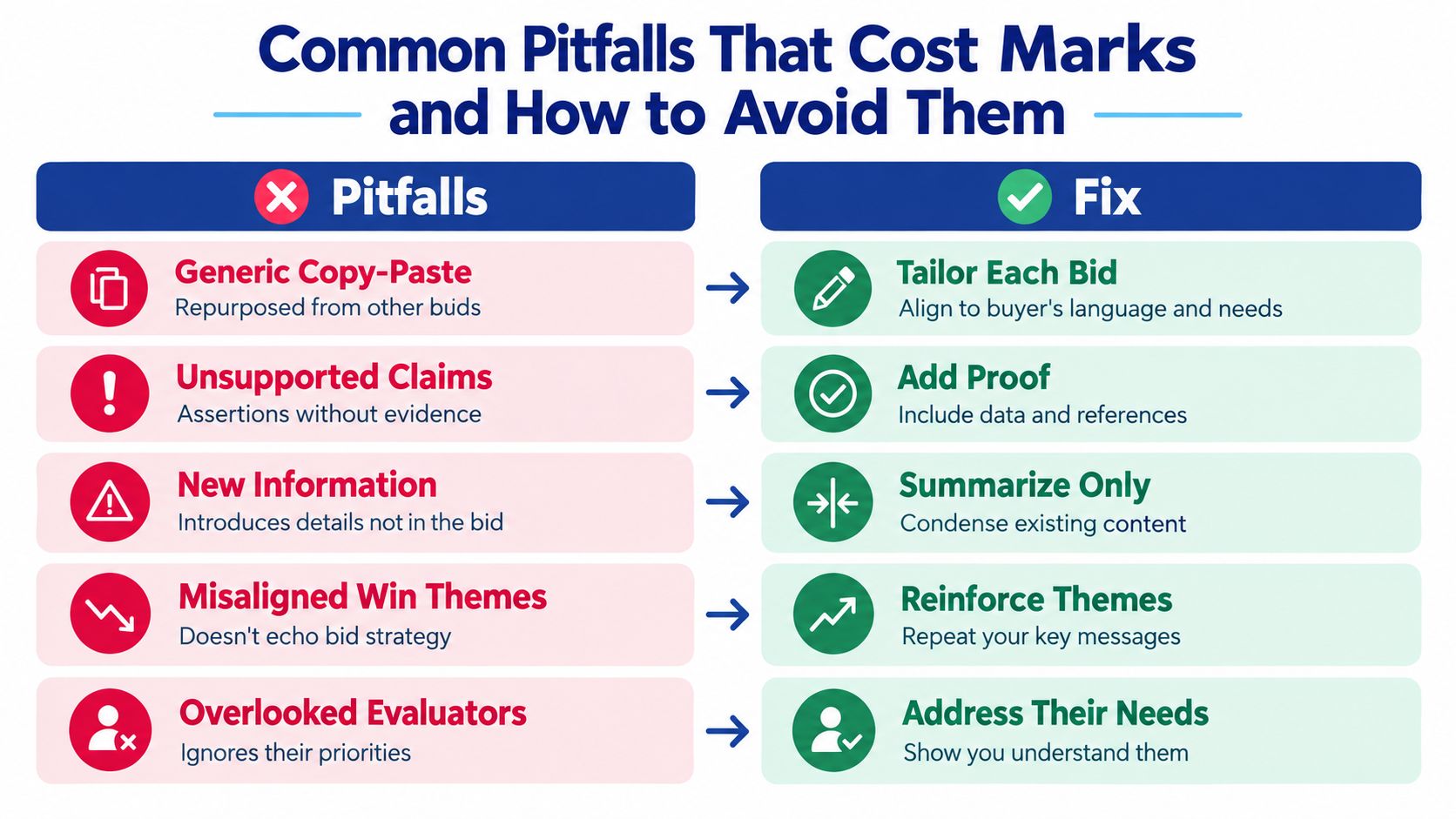
Five mistakes that show up again and again
Generic copy-paste
Weak: “We provide client-focused services to every customer.”
Strong: “Your contract requires controlled mobilisation, clear reporting and continuity of frontline delivery. Our proposal is structured around those three needs.”
Why it loses marks: it sounds reusable because it is reusable. Evaluators spot that quickly.
Unsupported claims
Weak: “We are uniquely positioned to deliver this contract.”
Strong: “Our proposed team structure, governance route and named contract lead are set out in the service delivery and mobilisation responses.”
Why it loses marks: unsupported assertions don't help scoring.
New information
Weak: using the summary to introduce extra commitments not explained elsewhere.
Strong: summarising commitments that are already evidenced in the tender.
Why it loses marks: evaluators are instructed to use the tender return. If the summary says more than the bid supports, you create doubt.
If the summary is stronger than the rest of the response, the summary is the problem.
Misaligned win themes
Weak: leading on brand prestige when the buyer cares about operational delivery.
Strong: leading on the actual contract outcomes and controls.
Why it loses marks: the evaluator is not looking for your preferred story. They're looking for their requirement answered well.
Fluffy language
Weak: “excellent”, “world-class”, “market-leading”.
Strong: plain statements about how you will deliver, measure and govern the contract.
Why it loses marks: fluff takes space away from evidence.
A fast self-edit before submission
Run this ten-minute check:
- Traceability: Can every sentence be backed up elsewhere in the bid?
- Criteria fit: Does the wording reflect the buyer's published scoring logic?
- Buyer focus: Is most of the space about their need, not your profile?
- Consistency: Do pricing, staffing and mobilisation references match the main response?
- Language control: Have you removed empty adjectives and repeated claims?
The UK market is crowded and fragmented. In 2025, 75,992 contract award records were published, cleaned down to 51,608 distinct procurements worth about £185 billion, awarded to 28,622 suppliers by 3,658 buying organisations. Open tenders also made up about 41% of procedures in February 2026, while direct procedures fell from 53% in March 2025 to 34% in February 2026, which means many buyers are comparing a high volume of bids in a more openly competed setting (UK procurement overview).
In that environment, vague opening pages don't help.
Your Ready to Use Template and Final Checklist
You don't need a dramatic format. You need a usable one. Keep it short, buyer-led and easy to verify.
A practical template
Use this as a starting point, then tailor it to the tender pack.
Paragraph 1
“You need a supplier that can [buyer outcome], while managing [key risk or operational pressure]. This tender response is built around [two or three contract priorities stated in buyer language].”
Paragraph 2
“Our proposed solution provides [short description of service or delivery model]. We will deliver this through [team, method or structure], aligned to your requirements for [criterion-related need].”
Paragraph 3
“We offer relevant experience in [comparable work or capability], supported by the evidence set out in [relevant tender sections or attachments if cross-reference is permitted]. Our approach is designed to give you confidence in [delivery, governance, continuity, reporting or quality].”
Paragraph 4
“Our proposal offers value through [service, efficiency, control, social value or quality], while reducing risk through [specific mechanism]. This gives your team [practical buyer benefit].”
Paragraph 5
“For these reasons, we believe our proposal is well placed to deliver [contract outcome] in line with your evaluation priorities.”
Final checklist before upload
A good final review often looks more like an editor's check than a writer's check.
- Criteria mirrored: Does the summary reflect the published evaluation language?
- Evidence aligned: Is every claim supported in the tender return?
- No fresh promises: Have you avoided adding commitments that appear nowhere else?
- Portal ready: Does it fit the page or character limit?
- British English tidy-up: Spelling, punctuation and tone all consistent?
If your team needs a standard review routine, even something outside bidding like a structured meeting notes template can help you formalise who checks what and when. The principle is the same. Keep approvals clear and version control tight.
For repeatable bidding, the practical next step is to build your evidence library properly and keep your process centralised. A working set of bid playbooks and review prompts in Bidwell guides for tender teams makes it much easier to produce a first draft from approved material, then spend your time refining instead of rebuilding.
Bidwell helps UK teams monitor tender portals, build a reusable knowledge base and generate draft responses from approved bid content. If your tender executive summary keeps getting written at the last minute, it gives you a cleaner way to pull together buyer context, evidence and a traceable first draft. Visit Bidwell to see how it fits your bidding process.