
The usual advice about contract award notices is to find out who won and add them to your competitor list. That's useful, but it misses the decisions that matter most: can you still act on the outcome, has the contract been signed, and could your business access similar work next time?
A winner's name alone won't answer those questions. Read the notice as a timing and access signal, then use it to decide whether to seek clarification, investigate a framework or prepare for an accessible tender.
What a Contract Award Notice Actually Says
A contract award notice is the public record a contracting authority publishes to say who it intends to appoint and for what. Say a council selects a supplier for building maintenance across several lots. The notice records the intended appointment, rather than providing the full evaluation history.
Under section 50 of the Procurement Act 2023, the authority must generally publish the notice before entering into the contract, according to the government's contract award notices and standstill guidance. For competitive tendering, it must also provide an assessment summary to each supplier that submitted an assessed tender before publishing the notice.
Read the fields together
Start with the contract subject matter, successful supplier, awarded lots, contract value and tender information. Check whether the supplier won the whole requirement or only the lot that interests you.
The guidance sets out different competition disclosures:
- Contracts valued at £5 million or less: the notice includes total tenders submitted, the number assessed and the number submitted by small and medium-sized enterprises (SMEs) or voluntary, community and social enterprises (VCSEs).
- Contracts valued at £5 million or more: it identifies each unsuccessful supplier and indicates whether they're an SME or VCSE.
For the maintenance example, the lot structure may be more useful than the headline value. A supplier appointed to a specialist lot isn't necessarily capable of delivering the entire contract, and a large combined value doesn't tell you the value available within your niche.
Practical rule: Treat the notice as a structured outcome record, not an explanation of the winning bid.
You can establish who was selected, the stated scale of the work and how crowded the competition was. You can't establish why the winner scored better by reading their name.
Where to Find Award Notices on UK Portals
Award notices are spread across UK procurement portals. Start with the service that matches the buyer and procurement route, then search elsewhere if the result is missing.
| Portal | Covers | Use it for |
|---|---|---|
| Find a Tender | Above-threshold UK public procurements under the Procurement Act 2023 | High-value awards and framework awards after 24 February 2025 |
| Contracts Finder | Lower-value contracts and notices for procurements under previous legislation | Smaller awards and older framework call-offs |
| Public Contracts Scotland | Scottish public bodies | Awards by Scottish buyers |
| Sell2Wales | Welsh public sector bodies | Awards by Welsh buyers |
| eTendersNI | Northern Ireland public bodies | Awards by Northern Ireland buyers |
Find a Tender is the starting point for above-threshold awards under the newer regime. The Government Commercial Agency's guide to Procurement Act 2023 notices explains the UK6 award notice used for procurements under the regime introduced on 24 February 2025, including framework awards and direct awards.
Contracts Finder remains useful for smaller contracts and older procurement routes. A buyer's notices may be split across services, particularly for framework call-offs. Contracts Finder publishes a large volume of award notices each year, so manual browsing quickly becomes inefficient.
Build searches around the buying decision
Use several search methods together rather than relying on a broad keyword alert:
- Search the buyer's name. This shows the authority's award pattern across related requirements. Check naming variants, departments and shared procurement arrangements before treating results as a complete history.
- Filter by CPV code. Common Procurement Vocabulary codes help identify notices when buyers describe similar work differently. Combine them with service keywords so an unsuitable classification does not hide useful results.
- Save alerts. Use the portal's available notification settings and check publication dates when results arrive. A weekly review may miss a time-sensitive update.
A Buckinghamshire Council e-tendering system page can help you investigate an authority. Keep the underlying notice reference alongside anything you add to your tracker.
If an expected award is missing, search the other relevant portals before concluding it was not published. Try the original tender title, buyer name and procurement reference separately. Buyers may use different wording across notices.
Award, Standstill and Challenge Decisions
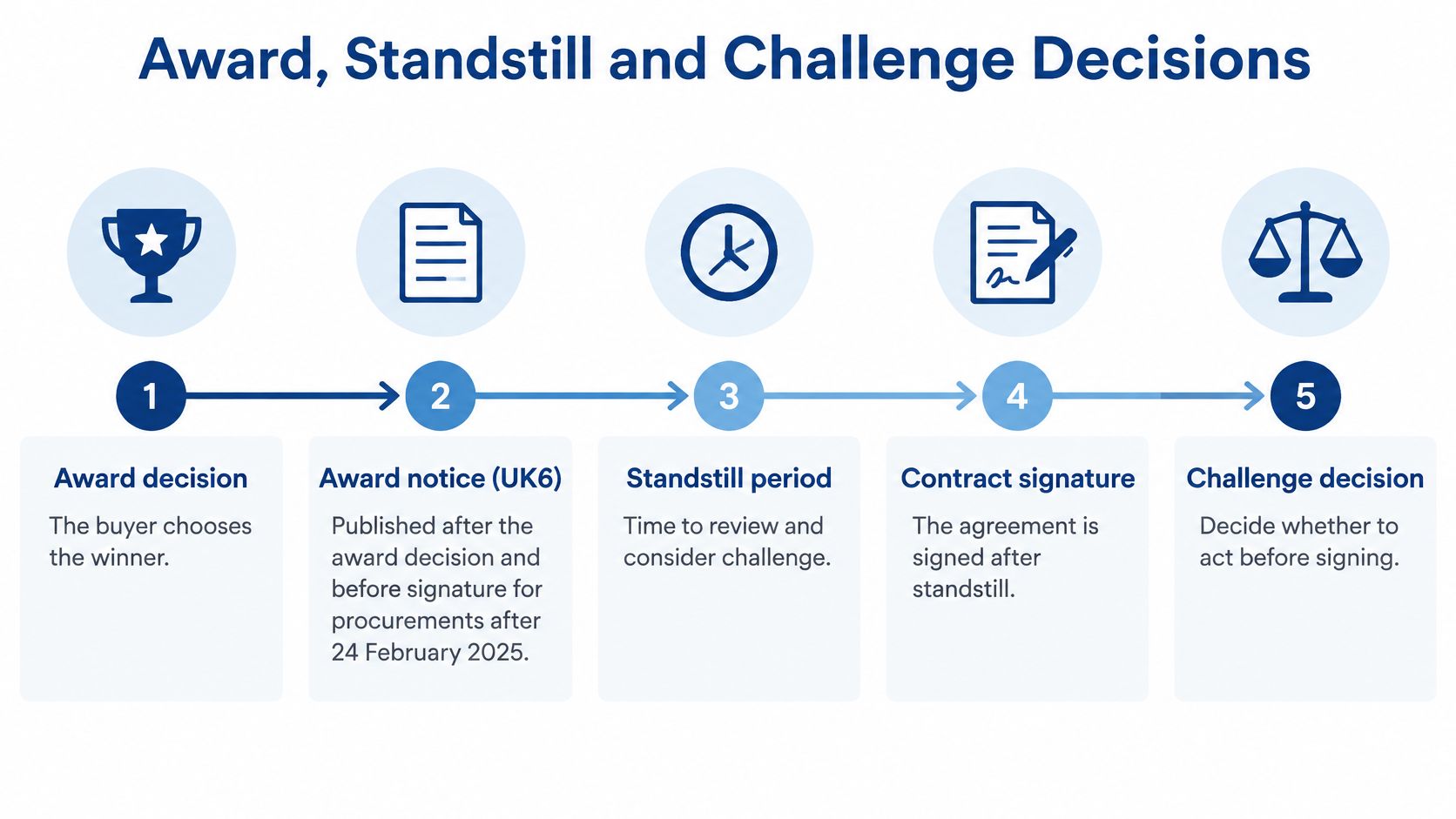
The sequence matters: the buyer makes its award decision, publishes the award notice and then, where required, observes standstill before signing. An unsuccessful bidder who waits for confirmation of signature may lose the most useful opportunity to act.
The official assessment and award training explains that publication normally starts a mandatory standstill of at least eight working days, during which the authority must not enter into the contract. Exceptions include certain direct awards, framework awards, dynamic markets and light-touch contracts, so establish whether mandatory or voluntary standstill applies.
The timeline below shows the milestones. Make your challenge decision during standstill, before signature, not after the final milestone shown.
Establish the contractual position
The later notice has a different purpose. The Procurement Act's contract publication provisions require a contract details notice within 30 days of contract entry, or 120 days for light-touch contracts.
Notice stages, timings and what each confirms
| Stage | When it happens | What it confirms |
|---|---|---|
| Award notice (UK6 under the newer regime) | After the award decision, before contract signature | The intended supplier and awarded lots |
| Standstill period | From publication, for the applicable standstill window | The authority cannot sign during that window; unsuccessful bidders can seek clarification or challenge |
| Contract details notice | After contract entry, within the applicable publication deadline | The contract has actually been entered into |
A notice published on a Monday requires immediate attention that day. Record the publication timestamp, but don't calculate the earliest signature date by merely adding calendar days. Check the stated standstill end date, applicable working-day rules and bank holidays.
Make a documented decision
Record the publication date and deadline. Assign a named owner to check the standstill calculation. Don't substitute the date of an informal email for the notice's publication date.
Look for a contract details notice. Its presence establishes that the contract has been entered into. If you're considering procurement remedies at that point, obtain legal advice; its absence alone doesn't prove the contract remains unsigned.
Analyse your assessment summary. It should already have been supplied where required. If it's missing, request it immediately and identify the scoring explanations you need clarified.
Compare the records. Check supplier identity, awarded lots, value and bidder information against the tender documents and feedback. A mismatch warrants a question, but it isn't automatically evidence of an unlawful evaluation.
Choose clarification, legal review or closure. Clarify an unclear fact. Seek urgent procurement-law advice where the documents suggest an evaluation error or procedural breach. Move on when the evidence supports the outcome and there's no credible basis for action.
Asking the buyer a question isn't a substitute for protecting a legal deadline.
Store the notice, assessment summary, correspondence and decision together in your knowledge base. Record who reviewed the outcome and why you acted or closed it. AI response generation can help organise a clarification draft, but a responsible person must check every allegation and deadline.
Reading Award Notices Without Being Misled
An award notice can show that work went to a supplier without showing whether your business could have competed. Classify the procurement route before treating an award as evidence of future opportunity.
Award routes and who can bid next time
| Route | What it means | Can a new bidder get in? |
|---|---|---|
| Open competition | The buyer publishes a tender that eligible suppliers can bid for | Yes, if you meet the criteria |
| Framework call-off | The buyer selects a supplier through an existing framework | Only suppliers on that framework |
| Mini-competition | Suppliers on a framework compete for a call-off | Only framework members |
| Direct award | The buyer appoints a supplier without a competition | Usually only through a later opportunity |
The government's central digital platform guide explains how procurement information is published and searched. A framework call-off awarded to one supplier and marked as suitable for SMEs shows why commercial interpretation matters: suitability does not mean unrestricted access.
Check the framework, relevant lot and call-off procedure. Those determine who could compete. An incumbent may also have a commercial advantage, even when the route allows other eligible suppliers to bid.
Separate accessibility from attractiveness
Before adding an award to your prospective pipeline, ask:
- Was there a competition? Distinguish an openly advertised tender from a competition restricted to framework suppliers.
- Who could participate? Identify the framework and lot, then check whether your business has access.
- When might access change? Check for framework replacement, future procurement plans and stated contract options. Don't assume the current arrangement will repeat.
The government's direct award guidance helps distinguish the notice sequence under the newer regime from procurement conducted under previous legislation. Check the notice type and governing rules; publication date alone does not establish the regime.
A list of large SME-suitable awards isn't an addressable pipeline.
Label each award open, framework-locked or direct, and record the specific route beneath that label. If access is unclear, mark it for investigation rather than counting it as open.
Save the access decision with your bid notes. Use tender monitoring to identify accessible follow-on opportunities, and start drafting only when you have established a viable route to compete.
Tracking Award Notices for Competitor Insight
A winner's name is a weak signal on its own. Track each award against its buyer, scope and procurement route, then use those records to assess timing and access, not just to rank suppliers.
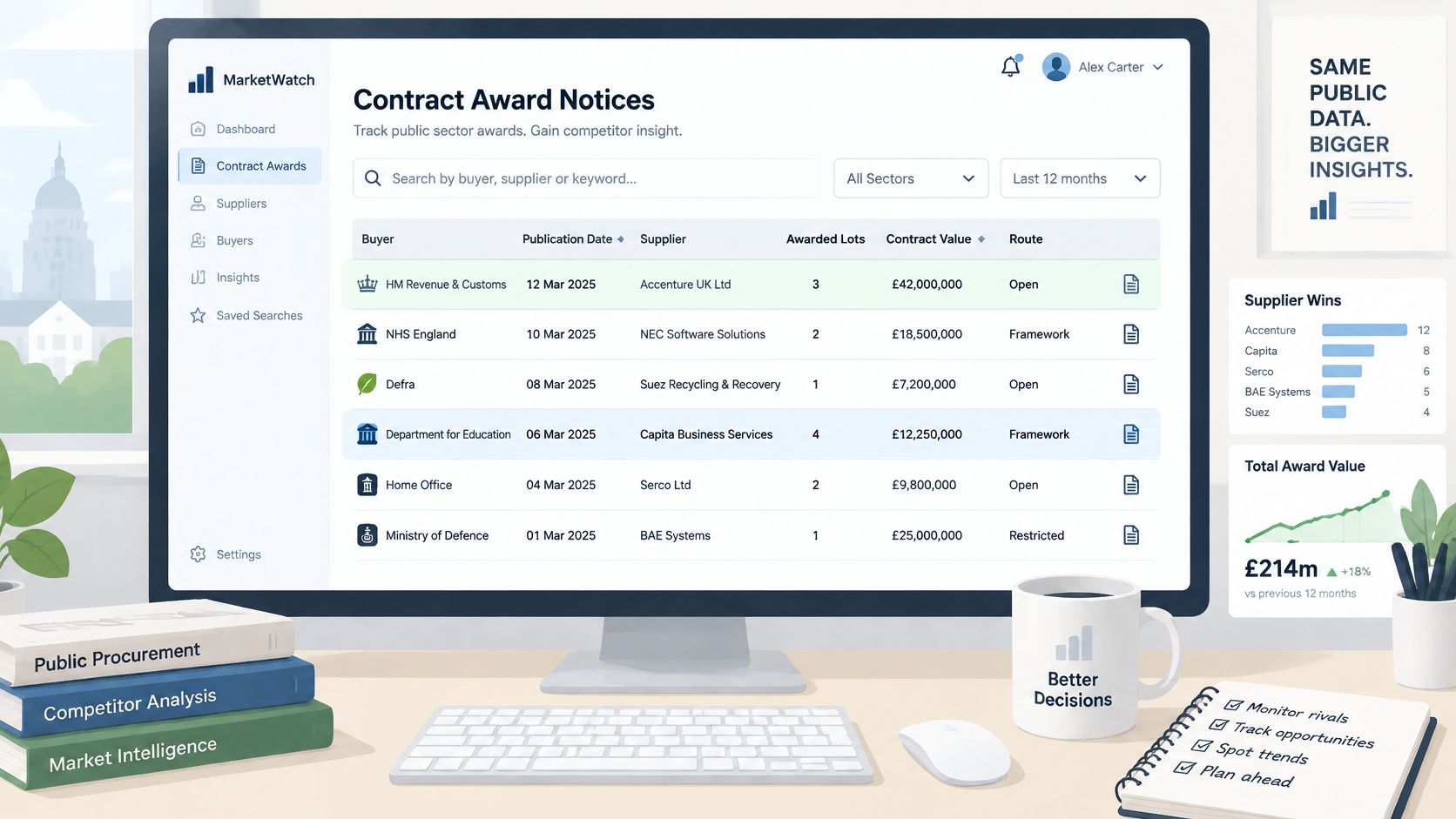
Build a record you can verify
A UK research services contract published in February 2024, worth £49,830, was awarded to one supplier, according to a Contracts Finder notice. The notice establishes that award, but not the size or competitiveness of the wider research services market.
Tracker template for award notices
| Field | Why it matters | Example or entry rule |
|---|---|---|
| Buyer | Shows which authorities repeat the same suppliers | Record the contracting authority named in the notice |
| Publication date | Establishes chronology and may identify a standstill trigger | Copy the exact notice date, not the date you found it |
| Supplier and awarded lots | Shows who won and where a niche sits | Record the named supplier and verify lot information separately |
| Contract value | Indicates the stated scale of the work | Copy the published value and retain its stated basis |
| Tenders submitted, assessed and SME count | Shows competition where the notice discloses it | Record each count separately; mark missing fields as not published |
| Route | Indicates whether a new bidder may be able to compete next time | Record the stated route, such as open competition, framework call-off or direct award |
Don't turn missing information into zero. One named winner doesn't establish that only one bidder entered, and an aggregate contract value doesn't establish annual spend.
For Contracts Finder awards, Bidwell ingests the published award notice automatically and prompts the user to confirm it. That confirmation gives the user a chance to check the buyer, route and whether the record duplicates an existing award in Bidwell's tender response workflow.
Look for patterns, then test them
Group notices by buyer, supplier and service category. A recurring winner is a reason to investigate the buyer's procurement pattern, not proof that newcomers are excluded. Compare notice dates and routes to see whether the awards point to a recurring cycle or a limited-access route.
For a broader framework for collecting and assessing competitor information, see Scrappey's competitive intelligence best practices. Keep procurement decisions anchored to the original notices; extracted summaries can omit details that affect interpretation.
End each buyer review with a short judgement: likely access route, recurring suppliers, relevant lots and the next action. That gives the team a usable view of timing and access, rather than an unexplained league table of winners.
Turning Award Data Into Bid Strategy
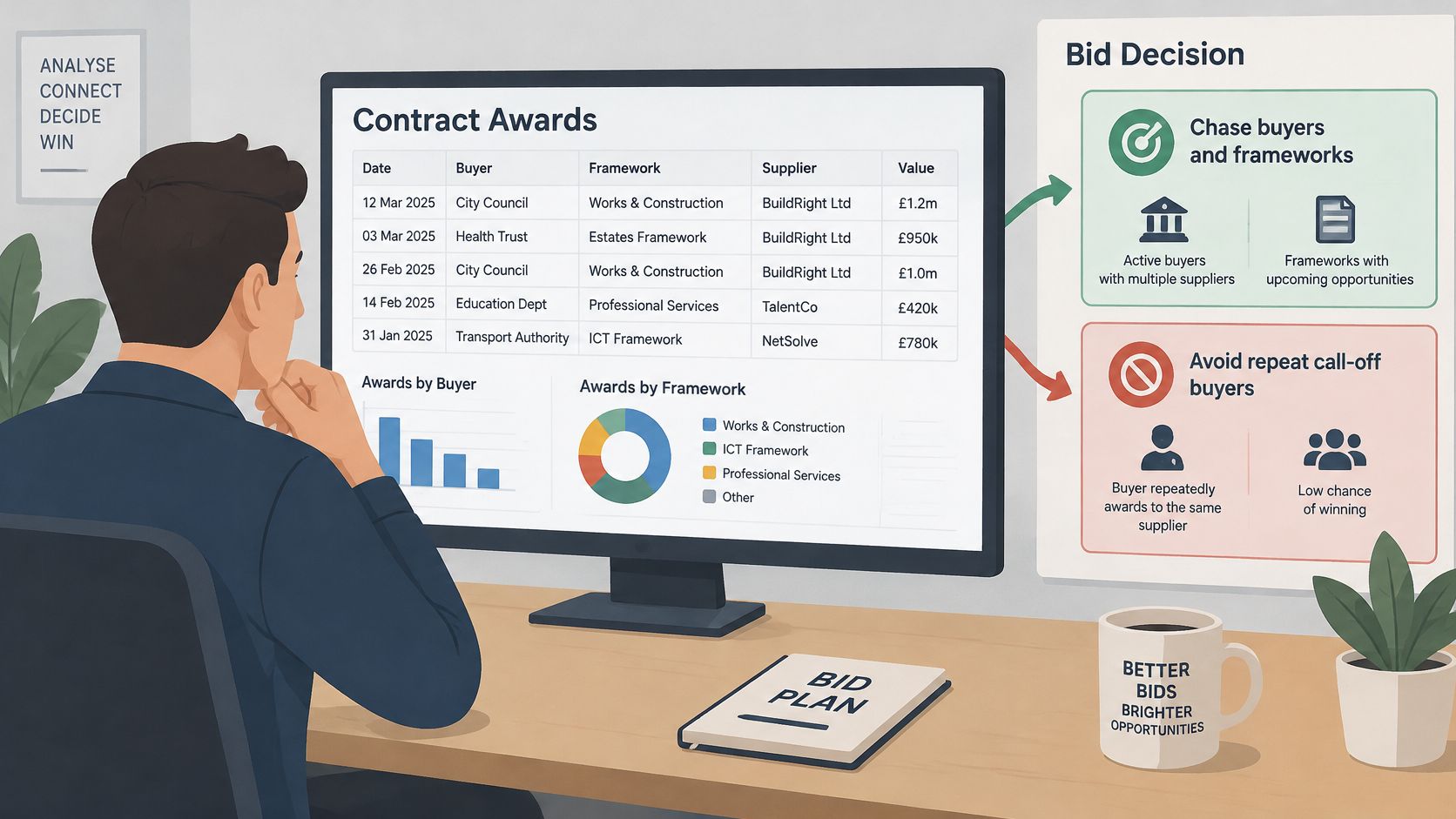
Choose buyers and frameworks before choosing bids. A buyer repeatedly using framework call-offs may be a poor immediate target if you're outside the framework, while a buyer dividing requirements into specialist lots may offer a realistic opening.
Neither pattern guarantees the next outcome. Use it to decide what to investigate: framework access, delivery capacity, relevant references or a specialist partner.
Turn a target into an evidence-led response
Recurring winners tell you who succeeds, but award notices don't disclose the evidence evaluators accepted. Use your own assessment summaries, successful submissions and published tender criteria to identify what your response needs to prove.
Store case studies, certifications, references and past responses in the knowledge base, tagged by sector and buyer type. Distinguish current evidence from expired credentials or claims that applied only to a previous contract.
Bidwell drafts each new bid against the actual tender notice, rather than a generic template. Its AI response generation draws on saved knowledge base entries; the bid-writing workflow still needs your review against the buyer's questions and scoring criteria.
- Select the tender. Confirm access, scope, delivery requirements and commercial fit before committing writing time.
- Pull matching evidence. Choose examples that demonstrate the requested outcome, not merely a familiar sector.
- Review the draft. Check that each answer addresses the question, supports its claims and respects response limits.
- Fill genuine gaps. Obtain fresh delivery details, references or commitments rather than asking AI to make weak evidence sound stronger.
Keep the decision proportionate. A potentially attractive contract can still be the wrong bid if you lack access, capacity or credible evidence.
Before authorising the response, answer this: does the award pattern suggest we can realistically win this? If the answer depends on an untested assumption, investigate that assumption before drafting.
Bidwell brings tender monitoring, a knowledge base and AI response generation into the same bidding process. Visit Bidwell to track relevant notices, preserve what you learn from award outcomes and prepare responses against the actual tender requirements.


