A useful tender bid example often has less to do with elegant writing than people think. The stronger response usually wins because it answers the exact scored question, mirrors the buyer's wording, and backs each claim with evidence that can be checked. That matters even more now because the UK notice environment is broader and more data-led. From 24 February 2025, both above and below threshold notices are published on Find a Tender, except below-threshold notices in Scotland, and above-threshold notices cover the contract lifecycle from pipeline to termination, according to the Find a Tender service guidance.
That change shifts how good bid teams work. They don't just polish prose. They read the notice trail, spot what evidence is likely to be tested, and shape the response around measurable award criteria.
The seven anonymised formats below show what that looks like in practice. Each one is judged through an evaluator's lens. Structure, evidence, wording, compliance, and pricing all affect the score together.
Bidwell fits that workflow neatly. Tender monitoring helps you spot the right opportunity early. The knowledge base keeps approved evidence, policies, CVs, and case studies in one place. AI response generation then gives you a first draft that is appropriate enough to review, challenge, and improve, rather than a blank page to wrestle with.
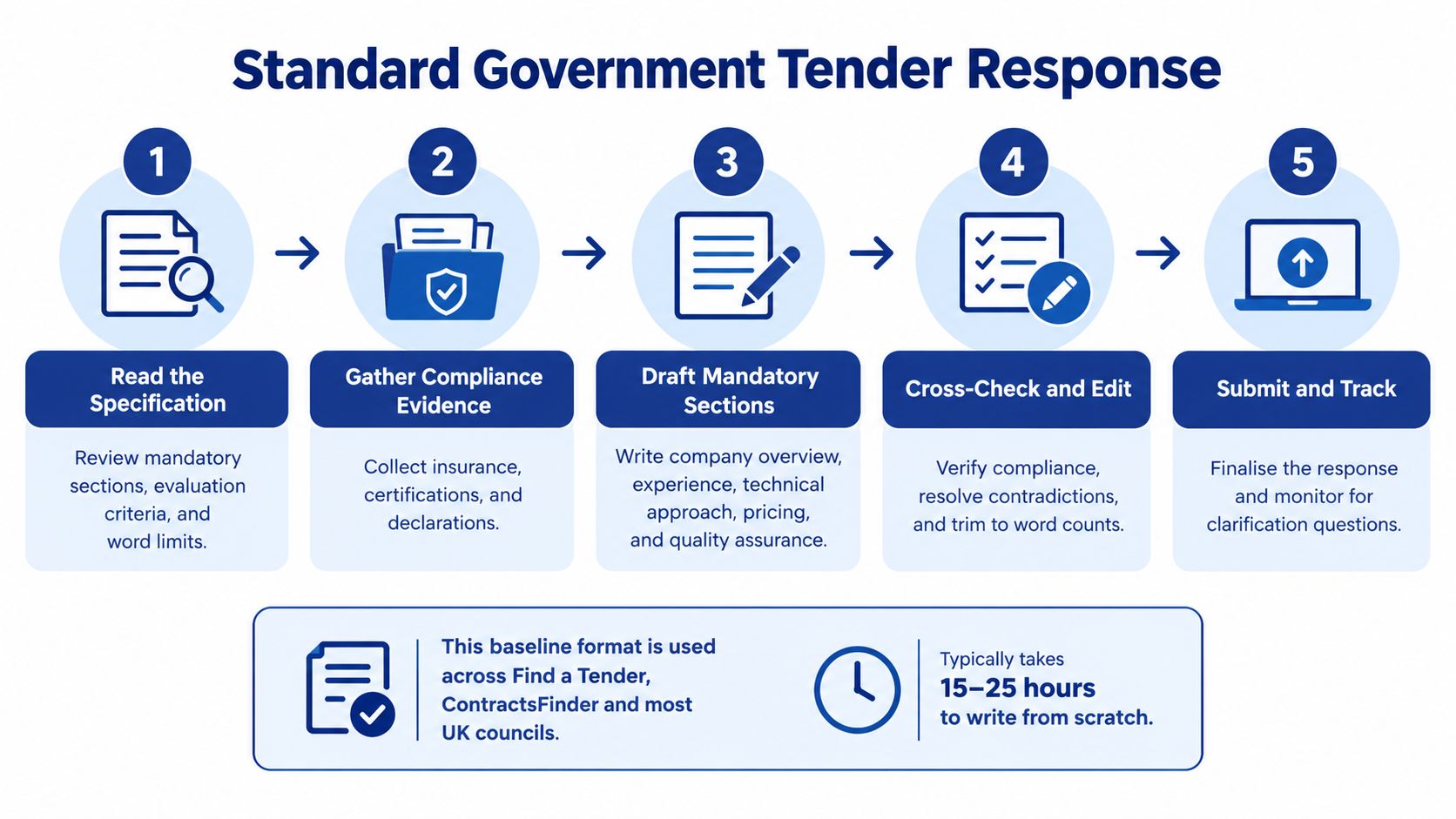
1. Standard Government Tender Response (Find a Tender Format)
This is the format most bid teams see again and again. It usually follows a strict pack: company overview, relevant experience, technical method, pricing, declarations, and quality controls. If your tender bid example doesn't work here, it probably won't work anywhere.
The reason this format matters is scale. Open Contracting's registry records 206,280 notices and 262,386 awards in the Find a Tender dataset, with 66,935 award items recorded, making it one of the core public tender channels for higher-value UK procurement after Brexit according to the Open Contracting Find a Tender dataset profile.
What evaluators reward
Evaluators usually score this format harshly because it looks familiar. They can see instantly when a supplier has pasted in boilerplate. Generic capability statements tend to fail because they don't connect the supplier's experience to the contract's subject matter.
The better response mirrors the structure of the specification. If the buyer asks about mobilisation, service continuity, and complaint handling, those exact phrases should appear in your headings and opening lines.
Practical rule: Write to the score, not to your brand deck.
A local council IT support bid might ask for transition arrangements, call handling, asset tracking, and escalation. A strong answer names the systems, the handover steps, the named roles, and the reporting outputs. A weak one says the supplier is committed to excellent service.
What to copy from this format
Three habits make this format easier to repeat:
- Build by section: Keep a knowledge base entry for each common heading, such as mobilisation, contract management, safeguarding, or business continuity.
- Track patterns: Use Bidwell tender use cases to monitor the kinds of opportunities and recurring evaluation themes appearing in your sector.
- Check compliance first: Drafting before checking declarations, insurance, and file requirements is how good bids become non-compliant bids.
I'd also mirror the buyer's wording back into the first sentence of each answer. Not because it sounds pretty. Because it reassures the evaluator that you've answered the actual question.
2. Quality and Method Statement (QAMS) Tender Document
A high-scoring QAMS answer lets an evaluator see the contract running before it starts. They should be able to trace the job from day one mobilisation through daily delivery, exception handling, and management oversight. If they cannot see that chain clearly, they usually mark the answer down for uncertainty, even if the supplier is capable.
The strongest anonymised QAMS formats I review tend to do seven things in one place: define the sequence of work, assign named roles, set control points, show records, explain escalation, deal with failure, and tie the method back to the contract requirement. That combination scores because it answers the evaluator's real question. Can this supplier deliver consistently, under pressure, without creating management effort for the client?
Take two common examples.
An NHS community service method statement that scores well usually maps the patient journey, shows who picks up referrals, states response times, explains clinical supervision, and sets out what happens when staffing drops below safe cover. A weaker version talks about patient-centred care and experienced staff, but leaves the evaluator to guess how rotas, incidents, and continuity work.
In a waste services bid, the same scoring logic applies differently. Evaluators look for route planning, pre-start vehicle checks, missed collection recovery, contamination reporting, and resident updates. The format changes by sector. The scoring lens does not.
One simple test helps. Remove the company name from the page. If the answer could belong to any supplier, the marks will cap out quickly.
Good QAMS writing also has a clear internal shape, but it does not need to follow the same template every time. A process-heavy service often scores better with a staged workflow, short control notes, and a risk table. A people-led service may need a responsibility matrix, supervision cycle, and communication path instead. The point is fit. Evaluators reward answers that make the method easy to assess.
Here is what usually earns marks inside the answer itself:
- A start-to-finish service path, in the order the work happens
- Role ownership at each step
- Specific controls such as inspections, approvals, checklists, or call reviews
- Trigger points for escalation
- Evidence of records the buyer will receive
- A credible fallback plan for absence, failure, or surge demand
The trade-off is real. Add too much process detail and the answer becomes hard to score. Keep it too high level and it reads like bid prose rather than operating practice. The best responses choose the points that show control and leave out background noise.
I usually tell teams to draft QAMS answers from live operations material first, then edit for scoring. Pull from SOPs, inspection sheets, onboarding plans, supervision records, and service dashboards. That is how you get wording an evaluator trusts. It also stops the common problem where the bid promises a method the contract team never uses.
Using approved source material matters even more when several contributors are involved. A shared knowledge base keeps role descriptions, procedures, and evidence consistent across answers, and Bidwell's bid writing software can turn those approved inputs into a first draft that sounds like your delivery model rather than generic AI copy.
The practical tactic to reuse is this: write each QAMS subsection so an evaluator can answer four scoring questions without searching. What will happen? Who does it? How is it checked? What happens if it goes wrong? If each paragraph answers at least one of those, the section starts to work much harder.
3. Innovation and Added Value Tender Section
This section catches suppliers out because they treat “added value” like a brainstorming exercise. Evaluators usually treat it as a credibility test. They want something useful, relevant, and deliverable.
The strongest examples start with a live contract problem from the brief. In an IT support bid, that might be user adoption. In a care setting, it might be reporting visibility for family members and commissioners. In recruitment, it might be retention after placement.
What a good answer looks like
A convincing answer doesn't pile in ideas. It picks a small number of additions that support the specification and can be evidenced. Free training sessions, enhanced reporting, earlier warning triggers, or a better handover model can all work if they fit the buyer's problem.
What doesn't work is innovation theatre. A flashy idea that isn't tied to the service often reads like filler.
Under the Procurement Act approach, award criteria need to be clear, measurable, specific, proportionate, and linked to the contract's subject matter, as set out in the official Procurement Act 2023 e-learning on assessment and award. That's why your added value section should read like a contract-enhancing commitment, not a list of slogans.
The reusable tactic
Store past examples of added value in your knowledge base, but tag them by sector, problem, and delivery model. Then AI response generation can suggest ideas that fit the brief.
A care provider might propose extra staff training linked to fall prevention. An IT supplier might include onboarding workshops. A recruiter might offer expanded post-placement reporting. The point isn't novelty alone. The point is relevance plus proof.
4. Social Value and Corporate Responsibility Tender Response
Social value responses are often the first place where bidders overpromise. That's a mistake. Buyers can usually tell when commitments have been copied from a corporate brochure and not built around the contract.
A better tender bid example keeps social value close to delivery. If the contract is local, talk about local recruitment routes, local spend, and community activity linked to that area. If the contract has environmental pressure points, focus on those instead of trying to cover every ESG topic at once.
What evaluators actually score
The strongest social value answer is specific enough to monitor after award. Buyers increasingly work with contract-level performance expectations, and procurement analysis now tracks things such as the share of contracts carrying agreed performance metrics, as highlighted in Open Contracting's analysis of the UK Procurement Act one year on.
That changes the scoring lens. Broad statements about supporting communities sound pleasant, but they don't give the evaluator much to mark. A commitment tied to delivery activity, reporting cadence, and accountable roles gives them more confidence.
The safest social value promise is one your operations team can report on without inventing a new system.
A stronger way to write it
A facilities contractor bidding for a council estate contract might focus on resident engagement, apprenticeships already supported by its current model, and local supplier use where practical. A care provider might focus on local recruitment, staff development, and community partnerships linked to wellbeing.
The practical move is to keep evidence ready in the knowledge base. Policies matter, but proof matters more. Existing programmes, referral routes, supplier engagement records, and prior delivery evidence are what stop the section sounding aspirational.
Tender monitoring helps here too. If you track recent opportunities in your sector, you'll start to see how often social value appears and what kinds of commitments buyers keep asking suppliers to explain.
5. Price Submission and Cost Justification Tender Document
Price is where a convincing bid often falls apart.
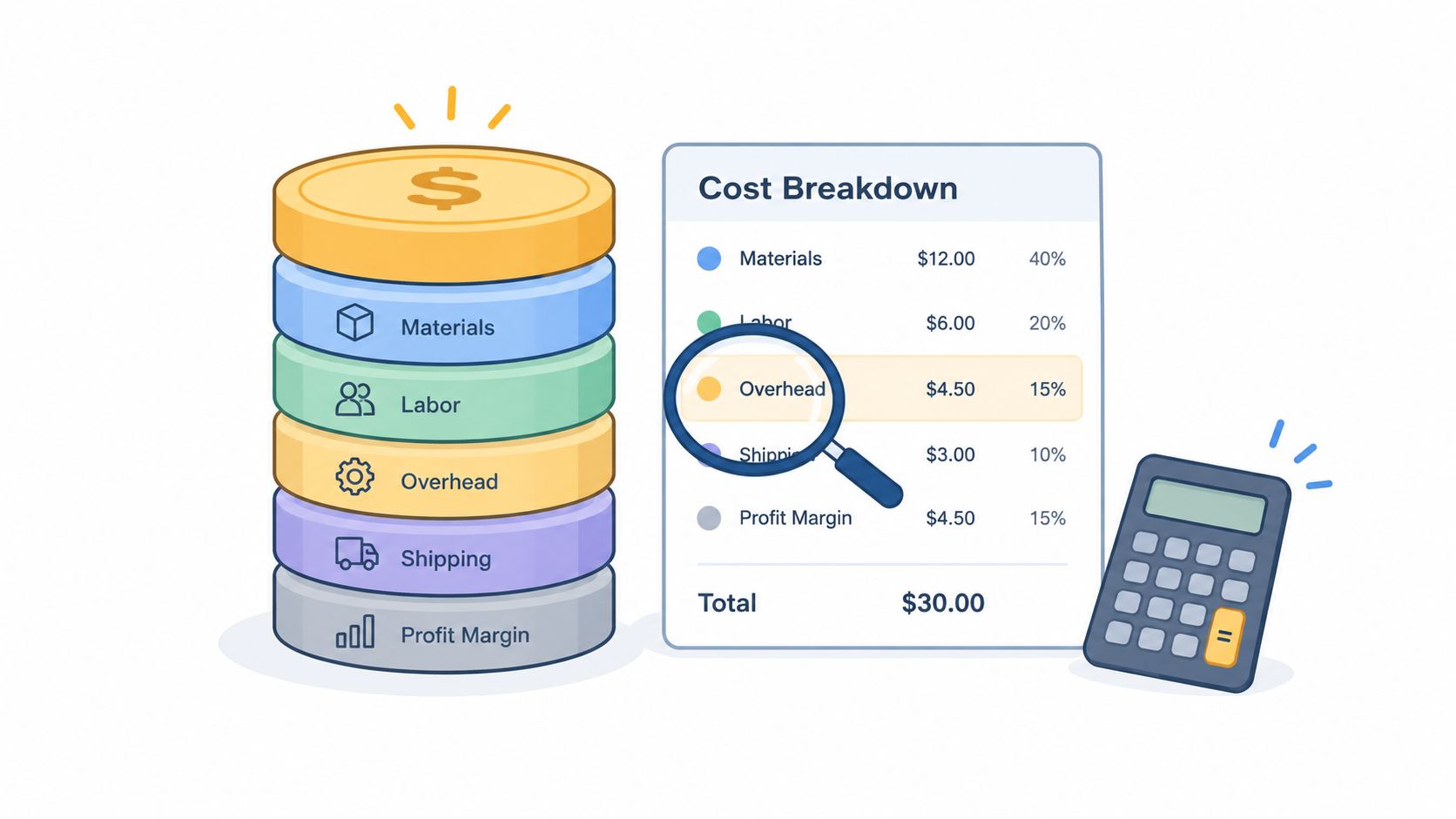
Evaluators do not score the commercial schedule in isolation. They test whether the numbers support the operating model described elsewhere. If a response promises seven-day cover, senior oversight, tight SLAs, and regular reporting, the price needs to show how that service can be delivered. If it does not, the buyer starts looking for risk. They may question mobilisation, staffing levels, service continuity, or whether the bidder will try to recover margin through change control later.
UK bid evaluation guidance supports that approach. The Cabinet Office bid evaluation guidance note states that award decisions should use objective, proportionate, and unambiguous criteria linked to the contract, and that MEAT does not mean the lowest-price offer.
One format scores well with evaluators. It gives them a traceable line from service design to cost.
Anonymised example. A maintenance bidder split its submission into three layers. The pricing schedule gave the totals the authority required. A short cost note explained labour mix, shift coverage, management time, vehicles, and call-out assumptions. A final table listed exclusions, buyer dependencies, and rate triggers for out-of-scope work. That response tends to score better than a bare spreadsheet because it reduces guesswork without exposing every internal margin decision.
The practical lesson is simple. Explain enough for the evaluator to see that the price is deliberate.
Different contracts need different cost logic. A care bid usually needs staffing ratios, supervision time, training provision, travel assumptions, and contingency cover to line up with the method statement. An IT support bid often needs to separate service desk resource, on-site engineering, licence assumptions, and project exclusions. Consultancy bids usually benefit from clear day-rate roles, capped volumes, and scenario pricing, because buyers want to see what changes if demand rises or scope narrows.
Poor marks usually come from one of three faults.
First, the maths and the narrative describe different services. Second, assumptions are buried in footnotes or left out entirely. Third, the bidder prices too aggressively, then tries to look high quality in the written response. Evaluators see that tension quickly.
I have seen capable suppliers lose ground here because they treated pricing as a finance exercise done at the end. The stronger bids build the cost model from the delivery model, then check every promise in the quality response against it.
A useful review method is to read the bid backwards from the price sheet. Check each cost driver against a corresponding delivery commitment. Check each named process, role, and reporting obligation against the commercial model. Then check whether any qualification in the pricing notes weakens a statement made elsewhere.
Bidwell's knowledge base helps teams keep approved rate cards, assumptions, and commercial wording consistent across bids. Tender monitoring also shows how buyers in your sector structure price questions, which helps you prepare the right breakdowns before the deadline. AI response generation can then draft the cost narrative around the model you have already agreed, which is usually the part teams rush and where inconsistencies creep in.
6. Case Study and Relevant Experience Tender Evidence
Case studies often decide whether a buyer trusts the rest of your bid.
Evaluators are not looking for your biggest logo. They are checking whether you have handled the same delivery conditions they are worried about here. In this format, evidence earns marks when it lines up with the scoring lens used across the tender. Structure, proof, wording, compliance, and price all need to support each other.
What evaluators score in a strong case study
A high-scoring example usually does four jobs at once. It shows similar scope. It proves you managed the main risk. It gives measurable results you can stand behind. It makes the link to this contract explicit, so the evaluator does not have to work it out.
That last point matters more than many teams expect. Buyers read fast, and they score against set criteria. If relevance is implied rather than stated, good evidence can still lose marks.
A practical structure is:
Client type, starting position, your role, delivery method, outcome, and direct relevance to this tender.
Use plain wording. Name the contract conditions that match this bid, such as multi-site rollout, safeguarding, tight mobilisation, regulated reporting, incumbent handover, or volume spikes. Then show the result. If the same people proposed for this contract delivered that work, say so clearly.
A case study scores well when it answers the buyer's risk question before they ask it.
How to choose the right example
Close fit beats prestige.
If the tender is for a service with operational pressure, use the example that proves control under pressure. A smaller contract with a difficult mobilisation can outscore a larger contract with little scrutiny, because the evaluator is marking relevance, not fame.
This is the same judgement I apply in bid reviews. Teams often reach for the contract they are proudest of. The stronger move is to pick the one that mirrors the buyer's concerns and then write the relevance line plainly.
A useful reference point is outside procurement. Good evidence works the same way in other fields. These YouTube channel growth examples show why outcomes land better when the starting point, method, and result are tied together instead of listed as isolated claims.
What to do if you do not have a perfect match
Use adjacent evidence, but make the transfer credible.
A supplier new to NHS work can still score if it proves disciplined delivery in another regulated setting. A business entering local government can use a private‑sector example if the operating model, reporting cadence, service levels, and risk controls are comparable. The burden is on the bidder to explain the match.
Avoid inflated numbers or vague claims. If an outcome cannot be evidenced, describe the operational result in concrete terms instead. Explain what changed, how performance was monitored, and what the client relied on you to manage.
Bidwell's knowledge base helps teams store case studies in reusable parts, tagged by sector, service line, delivery risk, systems, outcomes, and named staff. That makes it easier to select the right evidence for each opportunity rather than forcing the same reference into every answer. AI response generation can then draft a case study around the scoring points and the actual buyer risk, which usually produces a tighter answer than copying a generic credential sheet.
7. Compliance and Regulatory Tender Certification
Compliance documents decide whether your quality answer gets read at all.
Evaluators usually score this material in two stages. First, they check pass or fail requirements such as declarations, policies, insurance levels, financial standing, accreditations, and conflict disclosures. Then they look for consistency across the whole submission. A bid can look strong in the method statement and still fail because the policy dates, named entities, or subcontractor details do not match the forms.
The scoring lens here is simple. Low risk, easy verification, no contradictions.
Thresholds and publication rules matter because they shape what the authority must ask for and disclose. The Procurement Act 2023 short guide on new legislative requirements sets out the newer transparency duties, including payment publication requirements and below-threshold notice rules. The Crown Commercial Service guidance on the Procurement Act 2023 is also useful for checking how authorities are applying the regime in practice.
One anonymised response format I reviewed handled this well without saying much. It opened with a one-page compliance matrix listing every required certificate, policy, declaration, issuing body, renewal date, and attachment reference. That format scored well because the evaluator did not need to hunt for evidence or guess whether the bidder had missed anything. The lesson is practical. Make verification faster than doubt.
A weaker format buried key files in a generic appendix called “Company Documents” and used different legal entity names across the form, insurance certificate, and pricing schedule. That does not just irritate evaluators. It creates a clarifications trail, and on a tight process it can push a compliant bid into the discard pile.
Use a controlled pack, not a folder of loose PDFs.
A workable setup includes a master compliance register, named file conventions, and an owner for each document. Insurance, modern slavery statements, GDPR material, health and safety policies, equality policies, cyber certifications, and subcontractor evidence should be checked before drafting starts. If a requirement is likely to trigger clarification, fix it early or explain it directly in the schedule.
For teams that deal with repeated selection questionnaires, Bidwell's PQQ and compliance workflow helps keep approved evidence in one place, track expiry dates, and pull the right document set into each bid. That matters because tender monitoring finds opportunities long before the deadline, the knowledge base keeps current certifications reusable, and AI response generation can reference the right policy set without lifting outdated wording from an old submission.
The tactic to reuse is straightforward. Build the compliance pack around evaluator effort. Give each requirement a document, a date, an owner, and a clear cross-reference. If the buyer can confirm compliance in minutes, you remove an avoidable reason to lose.
7-Point Tender Bid Comparison
| Item | 🔄 Complexity | ⚡ Effort & Resources | ⭐ Likely Effectiveness | 📊 Typical Outcomes | 💡 Practical Tips |
|---|---|---|---|---|---|
| Standard Government Tender Response (Find a Tender Format) | Moderate, structured template with cross-references | Medium, 15–25 hrs manual; AI draft ~90 mins | High when customised; average if generic | Compliant, shortlist-able for routine public-sector contracts | Mirror evaluator language; build reusable KB modules; use a compliance checklist |
| Quality and Method Statement (QAMS) Tender Document | High, detailed methodology, risk registers, named staff | High, 30–40 hrs manual; AI + KB reduces to 4–6 hrs review | Very high for operationally complex contracts if accurate | Strong differentiation on delivery approach; lowers perceived risk | Use real operational procedures, diagrams/Gantt, link CVs; maintain QAMS templates |
| Innovation and Added Value Tender Section | Low–Moderate, conceptual but must be evidence-based | Low, 1–2 hrs refining with KB; >5 hrs if inventing ideas | High when genuine and demonstrable; subjective scoring | Can swing evaluations (often 10–20%); highlights competitive advantage | Quantify benefits, use proven examples, avoid over‑promising; store case evidence |
| Social Value and Corporate Responsibility Response | Moderate, measurable commitments and reporting required | Medium, collect policies, metrics, and reporting frameworks | High if backed by verifiable commitments and data | Differentiator where social value is scored (10–20%); builds community confidence | Anchor to specific numbers/timelines; keep evidence current; use KB for policies |
| Price Submission and Cost Justification | Moderate, technical but formulaic; must be defensible | Medium–High, detailed cost models, spreadsheets, justifications | Critical, often decisive (can be 40–50% weighting) | Determines value-for-money outcome; can win or lose on price | Build from actual delivery costs, flag small contingencies, keep pricing consistent |
| Case Study and Relevant Experience Evidence | Low–Moderate, needs permissions and measurable outcomes | Low–Medium, 2–5 tailored studies; client approvals may be needed | High when matched, quantified, and recent | Provides concrete proof of capability; increases evaluator confidence | Select closely matching examples, include at least one metric, update annually, secure permissions |
| Compliance and Regulatory Tender Certification | Low to compile but zero-tolerance for gaps | Low–Medium, maintain certificates, chase subcontractors | Essential, pass/fail gate; enables further evaluation | Eligibility gate; missing docs often cause rejection | Maintain a compliance tracker, store certs in KB, verify subcontractor evidence early |
Turn These Examples Into Your Next Bid
Across all seven formats, the pattern is consistent. Strong responses answer the scored question directly. They use evidence that matches the buyer's need. They make credible claims in plain language. And they treat compliance, pricing, and delivery method as connected parts of one submission.
That matters in a market this large. The UK's Contracts Finder regime was established under the Public Contracts Regulations 2015, with publication rules at £10,000 for central government and £25,000 for the wider public sector and the NHS, and Open Contracting's registry records 594,095 tenders and 439,536 awards in the UK Contracts Finder dataset according to the Open Contracting profile of the UK Contracts Finder dataset. There is a lot to watch, and too many teams still approach bidding as a writing exercise instead of an evidence exercise.
The better workflow is repeatable. Use tender monitoring to find opportunities early and spot patterns in your sector. Read the notice carefully, then read the scoring criteria again. Pull only relevant evidence into the knowledge base, with clear version control and tags that make retrieval easy.
Then use AI response generation for the first draft, not the final answer. Let it assemble structure, past evidence, and buyer-specific language. After that, a human still needs to test the logic, tighten the wording, challenge weak claims, and check every file, declaration, and price line.
That approach is especially useful now because public procurement is becoming more open in practice. Analysis of recent UK procurement activity indicates that direct procedures fell from 53% in March 2025 to 34% in February 2026 while open tenders increased from 27% to 41%, as reported by the same Awarded Tenders UK analysis. More open competition means more chances for prepared suppliers, but it also means more need for disciplined, evidence-led responses.
If you want one working rule to keep, keep this one. Don't start by asking how to sound better. Start by asking what the evaluator needs in order to score you confidently.
Bidwell helps teams do the practical parts of this properly. It monitors UK tender portals, stores approved bid evidence in a knowledge base, and generates first drafts for tender responses and questionnaires. If you want to see how that fits the examples above, visit Bidwell.