You've found a public-sector opportunity that looks perfect for your business. Then the tender pack arrives. There are unfamiliar terms, several attachments, strict response rules and a deadline that leaves little room for mistakes. Many UK SMEs don't lose because they lack the right service. They lose because they see the opportunity too late, store evidence in scattered folders or answer the questions without matching the buyer's scoring method.
Small business procurement becomes more manageable when you treat it as a repeatable process. Tender monitoring helps you find relevant work, a structured knowledge base keeps your evidence ready, and AI response generation reduces repetitive drafting so your team can spend more time checking quality and fit.
Introduction to Small Business Procurement in the UK
A regional facilities company may already deliver excellent work for commercial clients. Its directors know they could support councils, universities or NHS organisations, yet public-sector tendering can feel like a separate profession. They check a portal occasionally, see opportunities too late and assume larger suppliers already hold the market.
Small business procurement is the process public bodies use to buy goods, services and works from smaller suppliers. It covers finding opportunities, passing supplier checks, preparing responses, evaluation, contract award and delivery. A large bid department is not required. An organised method is.
The market is substantial. UK public-sector procurement with SMEs reached £45.2 billion in 2025, representing 21% of all direct procurement spend, the highest share in six years, according to the SME Procurement Tracker from Tussell. This does not make every large contract suitable for an SME. It does show that public bodies already buy from smaller businesses at scale.
The opportunity has also grown over time. Direct SME procurement rose from £12.1 billion in 2014–15 to £39.7 billion in 2023, despite ambitious access goals, as reported by the British Chambers of Commerce. Access still depends on choosing a suitable route and presenting clear evidence.
Guidance for SME owners entering public-sector procurement can help your team set up the basics. Bidwell combines tender monitoring, a knowledge base and AI response generation, so staff can review focused opportunities, check stored credentials and refine drafts instead of starting each bid from scattered files.
Understanding Procurement Basics
A council needs a cleaning service. A university needs equipment. A public body needs construction work. In each case, procurement turns that need into a defined requirement, a supplier competition and, eventually, a contract. The buyer sets the required outcome, invites responses and scores them against published criteria.
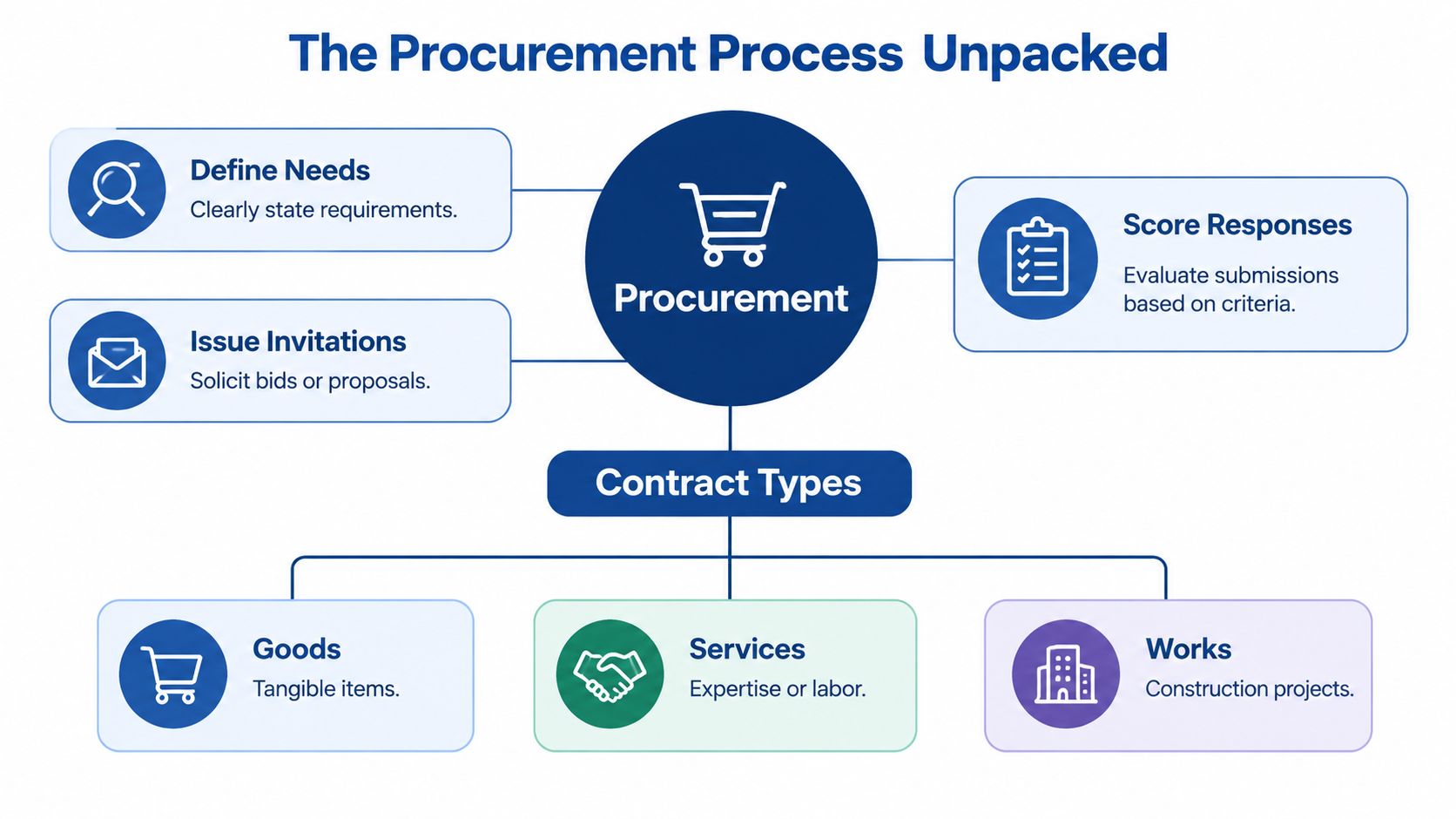
The process has three stages to watch:
- Define needs: The buyer describes the output, standards, timetable and contract conditions. Treat this as the specification for the finished result.
- Issue invitations: The buyer asks suppliers for a tender, quotation or proposal. The notice explains what to provide and how to submit it.
- Score responses: Evaluators compare answers with the published criteria. A polished sales pitch cannot replace a response that misses the scoring points.
The contract type affects the evidence you should prepare. Goods are physical items, such as office supplies or specialist equipment. Services involve expertise or labour, including maintenance, consultancy and training. Works usually cover construction, installation or repair. An equipment supplier may need product specifications and delivery arrangements. A service provider may need staff qualifications, operating procedures and evidence of performance.
The documents buyers expect
Tender packs usually contain several connected documents. The specification explains the requirement. The pricing schedule sets out how to present costs. Quality questions test your proposed method. Pre-qualification or supplier questionnaires may ask about financial standing, insurance, policies, accreditations and previous work.
Read the instructions before drafting. Check the required file format, naming convention, response limit and declarations. One missing attachment can make a strong technical answer unusable. Create a checklist from the pack, then mark each requirement as you complete it.
Where the three Bidwell features fit
Tender monitoring supports discovery. It helps your team identify notices that match your sector, region and capability, rather than reviewing every opportunity. The knowledge base supports compliance and drafting. Store approved company details, policies, certifications, team biographies and case studies in one controlled place.
AI response generation can use that approved material to create a first draft aligned with the buyer's question. It does not take responsibility for the submission. Subject experts must check accuracy, remove irrelevant wording and confirm that every promise can be delivered.
The next practical task is to map each tender question to the evidence it requires. Bidwell's monitoring, knowledge base and AI drafting features can keep that chain together, from finding a suitable notice to producing a checked response.
Navigating UK Public Sector Tendering
The first question isn't “How do we write this bid?” It's “Where should this opportunity appear, and what route does the buyer use?” UK public-sector notices can appear through national systems, devolved portals, procurement platforms and buyer-specific arrangements.
For above-threshold procurement, publication on Find a Tender is mandatory once the relevant regulated threshold is passed. As of January 2026, the thresholds are £135,018 for central-government goods and services, £215,720 for goods and services bought by sub-central authorities, and £5,193,000 for works contracts, according to this Find a Tender threshold reference.
Match the portal to the buyer
Central-government departments may publish through Find a Tender and use Crown Commercial Service arrangements. You can review the Crown Commercial Service buyer information to understand how frameworks and central purchasing routes affect supplier access.
Councils, NHS trusts and universities fall within the sub-central group for the stated goods and services threshold. Their notices may be visible through national publication routes, but some buyers also use e-tendering systems for documents, clarification questions and submissions.
Scotland and Wales have their own procurement environments. Public Contracts Scotland is important for Scottish opportunities, while Sell2Wales serves the Welsh market. A supplier working across borders should not rely on one portal or assume that a search on a national system captures every practical step.
Read the route before preparing the response
A notice can lead to different stages. The buyer may request a short expression of interest, a supplier questionnaire, a full invitation to tender or a response through an existing framework. Each route changes the amount of evidence and the submission method.
For example, a local authority buying grounds maintenance may focus on mobilisation, staffing, safeguarding, environmental controls and service continuity. A central department buying specialist consultancy may place more weight on methodology, expertise, information assurance and commercial structure. The same company should adapt its evidence rather than send one universal answer.
Practical rule: Treat the portal, notice, specification and response instructions as one set of requirements. A good answer submitted through the wrong route is still a failed submission.
Set up tender monitoring around the portals your buyers use. Store portal instructions, standard declarations and account ownership details in your knowledge base. When AI response generation prepares draft answers, tell it which buyer, route and evaluation criteria apply. That context prevents generic responses and gives your reviewer a clear checklist.
Finding and Assessing Tender Opportunities
Manual searching creates two problems. You spend time reading irrelevant notices, and you may miss a suitable tender because the buyer uses different wording from your website. A better approach starts with a defined opportunity profile.
Write down what your business can deliver, where you can work, which buyers you understand and which contract types you can resource. Include alternative terms. A cyber-security firm might search for information assurance, security testing and penetration testing. A training provider might include workforce development, professional learning and skills delivery.
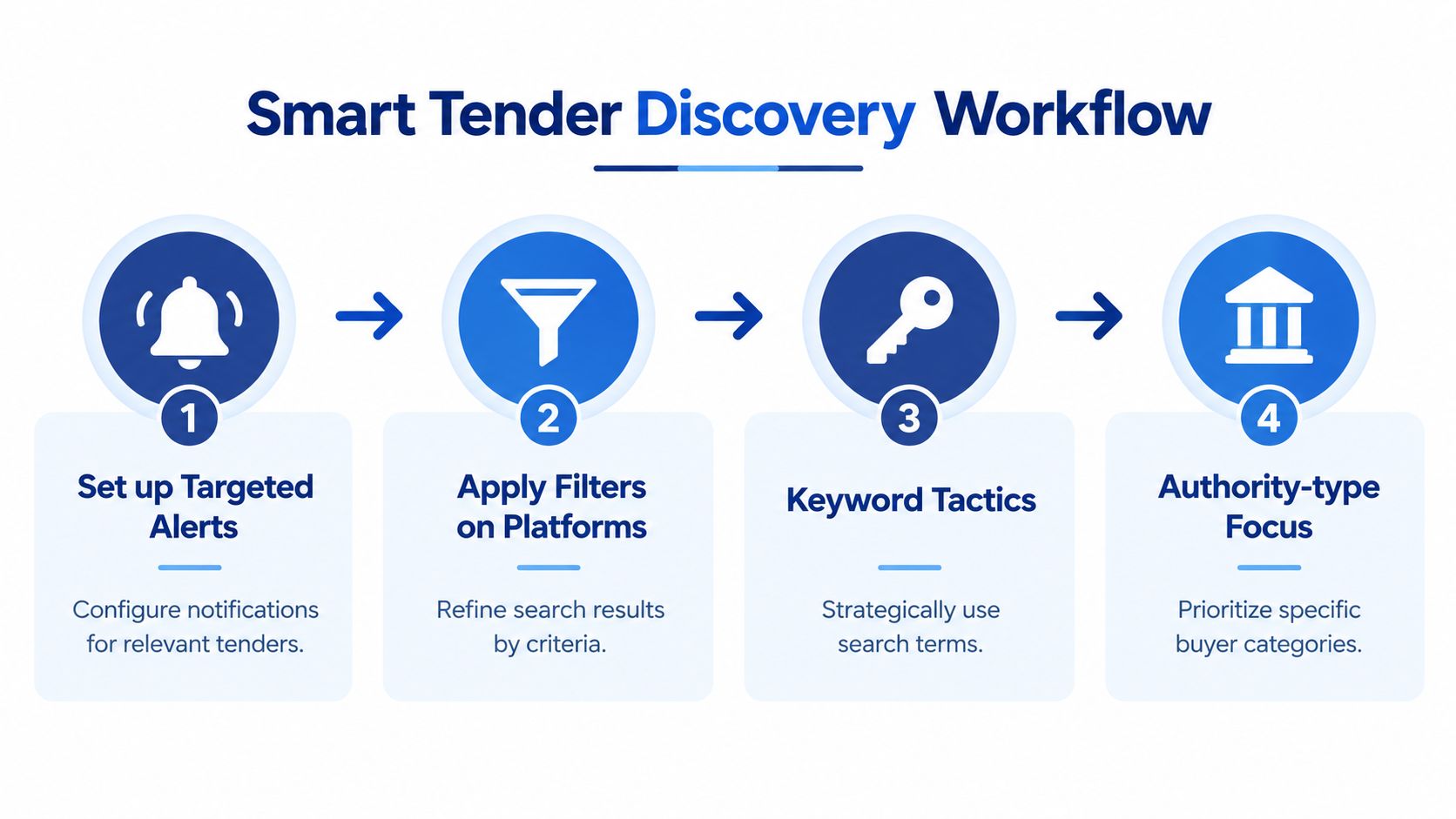
Build better filters
Use four filters together rather than relying on one keyword.
- Service terms: Add the words buyers use in specifications, not only your preferred marketing phrase.
- Authority type: Separate councils, NHS bodies, universities and central departments. Their buying patterns and evidence needs differ.
- Geography: Remove locations your team can't serve profitably or safely.
- Contract fit: Check scope, delivery model, required capacity and commercial terms before assigning bid resource.
Authority type deserves serious attention. In 2023, local government spent 34% of its procurement budget with SMEs, NHS bodies in England spent 22%, and central government spent 11%, according to ICAEW's analysis of SME public-sector procurement. These figures don't guarantee a win, but they show why a council-focused supplier shouldn't treat every public buyer as equally accessible.
Score the opportunity before you bid
Create a short bid-fit check. Can you meet every mandatory requirement? Do you have relevant evidence? Can you deliver within the required location and timetable? Does the likely work justify the internal effort and risk?
Your tender monitoring system should surface the notice, deadline, buyer and key requirements together. Bidwell can monitor major UK portals, including Find a Tender, Contracts Finder, Public Contracts Scotland and Sell2Wales, then provide alerts and summaries for relevant opportunities. Use that output as a shortlist, not as an automatic bid decision.
A wider sales process also benefits from clear follow-up routines. If you're connecting tender discovery with broader business development, these effective workflows for converting prospects can help your team manage contacts that aren't ready to enter a formal procurement process.
Selection test: Don't ask only whether you can perform the contract. Ask whether you can prove it in the buyer's required format before the deadline.
Keep rejected opportunities in a simple record. Note the reason, such as missing certification, location mismatch or insufficient capacity. That history improves future filters and stops your team reconsidering the same poor-fit work.
Preparing Your Bid and Building Your Knowledge Base
A bid should read like a direct answer to the buyer's evaluation criteria. Start by copying each question into a working document. Under it, list the points the evaluator needs to see, the evidence you'll use and the person responsible for checking the answer.
Eligibility and compliance come before polished prose. Depending on the tender, the buyer may request financial statements, insurance details, ISO certificates, safeguarding policies, equality policies, environmental information, health and safety records or data-protection procedures. Don't assume that a document's existence is enough. Check its expiry date, approval status and relevance to the specific requirement.
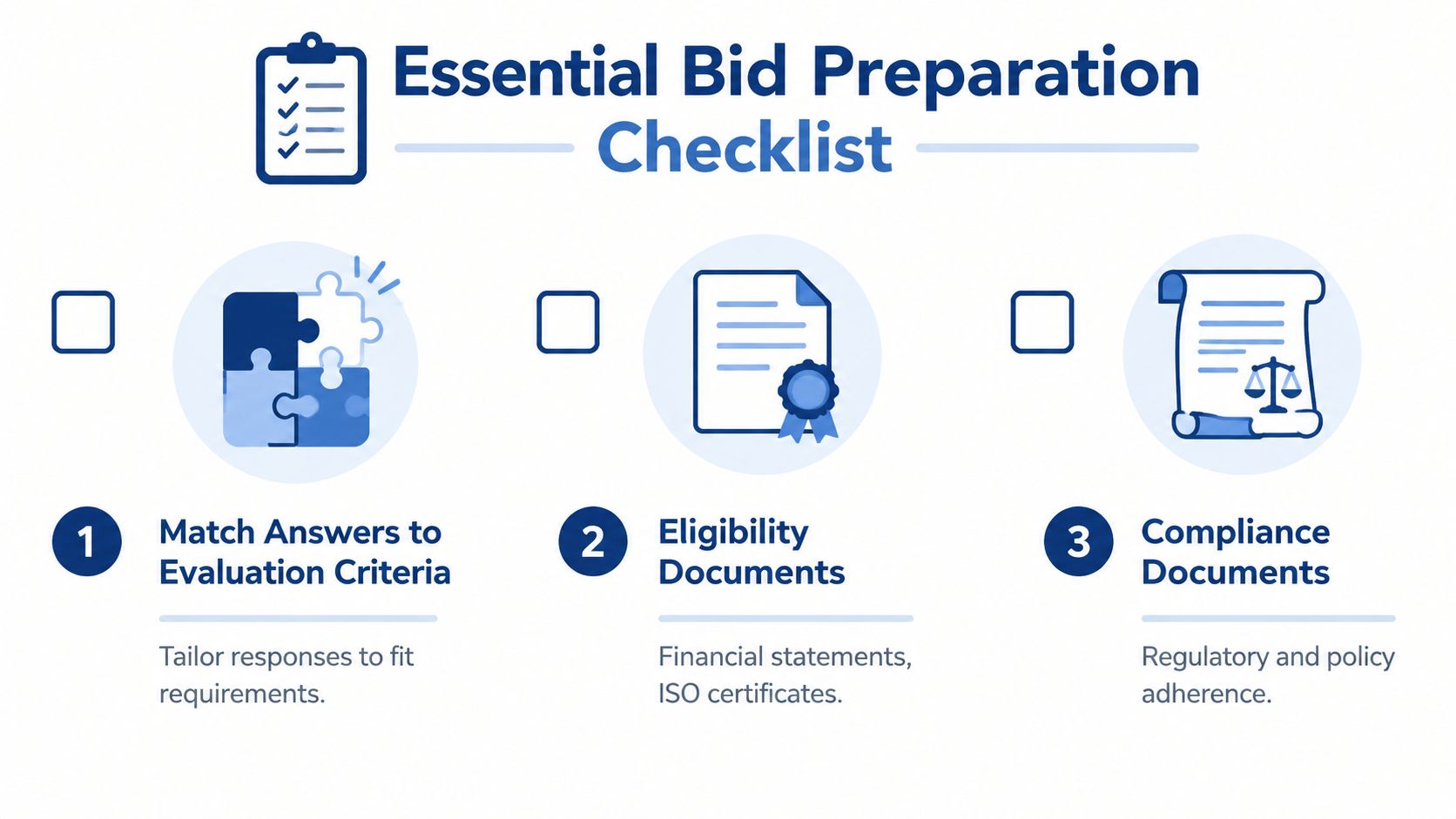
Turn past work into reusable evidence
Your knowledge base should hold more than old bids. Organise it around evidence that can be checked and adapted.
- Company credentials: Legal details, insurance, accreditations, policies and service descriptions.
- People: Current CVs, qualifications, roles and availability assumptions.
- Delivery evidence: Case studies, outcomes, client references and lessons learned.
- Operating methods: Mobilisation plans, quality controls, risk registers, reporting processes and escalation routes.
- Commercial content: Approved pricing explanations, exclusions and assumptions.
Label each item with an owner and review date. Remove claims that no longer apply. A draft generated from outdated information creates risk rather than saving effort.
Government priorities can also guide emphasis. The Cabinet Office aims for 30% of procurement expenditure to go to SMEs by the end of the 2027/28 financial year, while HM Treasury's target is 22% for the same deadline, according to the Cabinet Office and HM Treasury SME action plan. Don't claim alignment without evidence. If your proposal offers local employment, specialist innovation or a practical supply-chain contribution, explain it clearly and support it with facts.
Draft, check and package
Bidwell's bid writing software can use your stored credentials, policies and case studies to create customized draft responses. Your team should then compare each draft with the question, confirm every factual statement and ensure the proposed method matches the pricing schedule.
Finish with document control. Convert the final approved file using easy steps for Word to PDF conversion, if the tender requires PDF, then open the exported file and check tables, page breaks, signatures and attachments. The final package should be treated as a compliance deliverable, not an administrative afterthought.
Avoiding Pitfalls and Planning Resources
Many SMEs assume the hard part is writing persuasive content. In practice, preventable errors often happen around the writing. A team can produce a strong methodology and still fail because it missed an annex, exceeded a response limit or uploaded an earlier version.
Start with the deadline and work backwards. Record clarification dates, internal review points, approval time, final packaging and the actual upload window. Don't plan to submit at the last minute. Portals can require account access, file checks or declarations that only a named authorised person can complete.
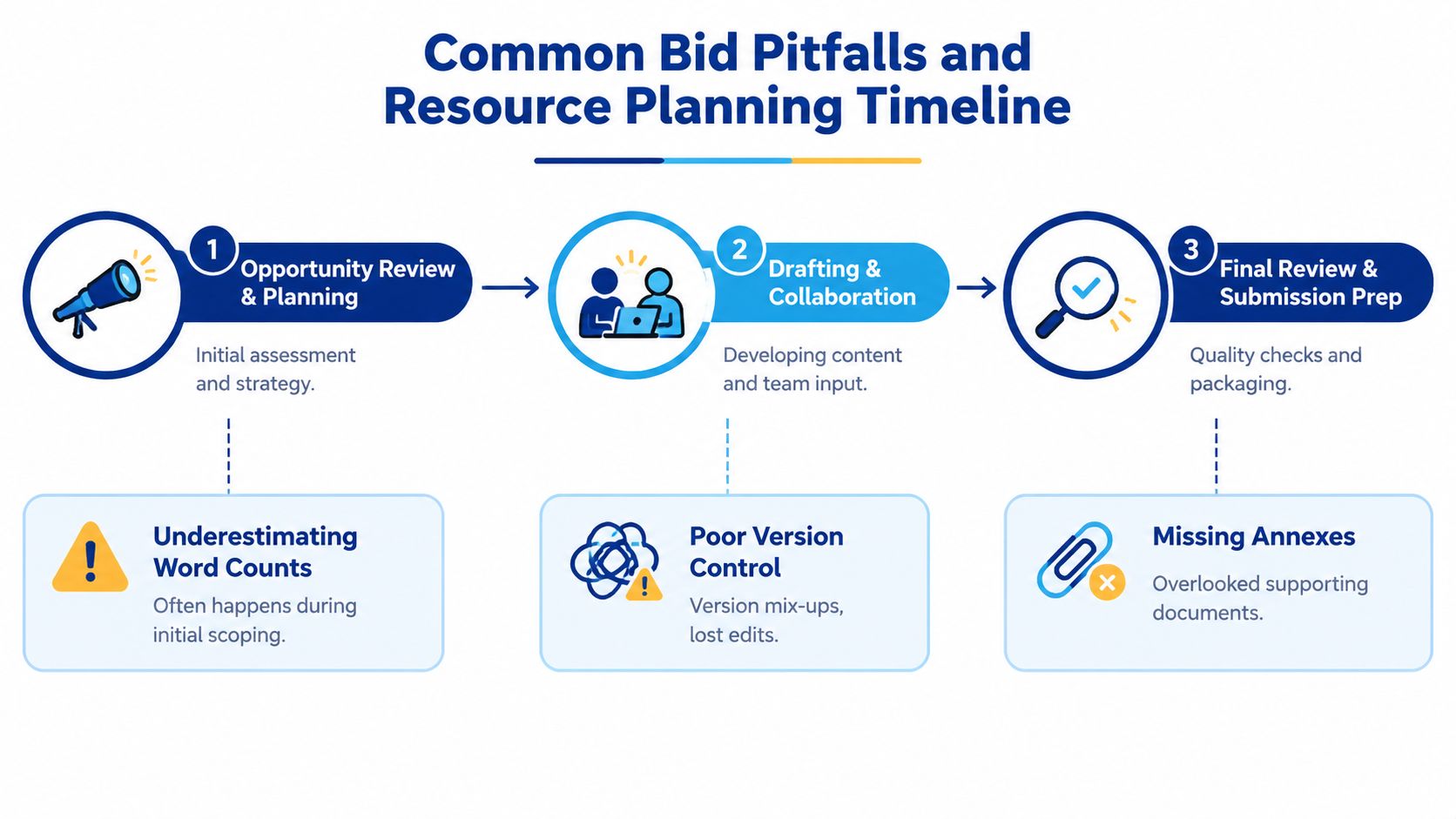
Give each stage a named owner
Use a simple responsibility map.
- Opportunity review and planning: A bid lead checks scope, eligibility, conflicts, capacity and commercial risk.
- Drafting and collaboration: Subject experts provide accurate content while one editor controls the master response.
- Final review and submission preparation: A senior approver checks compliance, quality, pricing alignment and attachments.
Keep one approved master file. Use a clear naming convention and restrict editing after sign-off. For wider operational guidance, this resource on data governance and retention can help you define how long bid records remain available and who should access them.
Design review gates
A useful review asks different questions at different points. Early review tests whether the opportunity is worth pursuing. The middle review checks whether the draft answers the scoring criteria. The final review checks facts, formatting, signatures, annexes and upload status.
AI can reduce repetitive drafting, but it doesn't remove the need for review. Treat generated text as a working draft. A technical lead must verify delivery claims, a commercial lead must check assumptions, and an authorised person must approve the final submission.
Final check: Compare the uploaded files with the approved bid after submission. Save the confirmation and the exact final documents in your controlled record.
Bidwell's tender monitoring can track deadlines and relevant notices, while its knowledge base supports controlled reuse. AI response generation then gives your team a starting draft, leaving people to resolve judgement calls, evidence gaps and contract risks.
Conclusion and Next Steps
Small business procurement is less mysterious when you separate it into connected tasks. Find the right opportunity. Test whether your business can meet the mandatory requirements. Build answers around the evaluation criteria. Submit complete, accurate documents through the correct route.
The strongest operating model links three capabilities. Tender monitoring reduces the chance that a relevant notice passes unnoticed. A knowledge base turns scattered credentials, policies, CVs and case studies into approved evidence. AI response generation uses that evidence to prepare relevant drafts, while your team remains responsible for accuracy, commercial judgement and final approval.
Use a practical first-quarter roadmap.
- Start with discovery: Define your sectors, regions, buyer types, service terms and exclusions. Configure tender alerts around that profile.
- Create your evidence base: Gather current policies, certificates, financial information, case studies and team details. Assign owners to each item.
- Set a bid-fit process: Use a short go or no-go check before committing specialist time.
- Draft from approved material: Generate a first response from the knowledge base, then edit it against every evaluation criterion.
- Protect the submission: Add review gates for compliance, word limits, annexes, signatures, file formats and portal confirmation.
Public-sector buyers still differ in how they purchase and evaluate. A council opportunity may require a different delivery story from a central-government framework. Your system should preserve that context instead of forcing every tender into one template.
A repeatable process beats a heroic last-minute bid.
Review your last few opportunities and identify the first failure point. Was the notice missed, the qualification evidence unavailable, the response too generic or the final upload poorly controlled? Fix that point first, then build the next improvement into your monitoring, knowledge base or response workflow.
Bidwell combines UK tender monitoring, a reusable knowledge base and AI-generated response drafts to help SMEs manage public-sector opportunities from discovery to submission. Visit Bidwell to set up a more organised procurement process and turn suitable tenders into focused, reviewable bids.