Most RFP automation advice starts and ends with speed. That's the wrong priority for UK public sector bidding. A fast draft that misses a mandatory requirement, cites the wrong policy, or makes an unsupported promise can waste the opportunity faster than a careful manual response.
The useful question is different: which parts of the response should software handle, and where must a bid professional take control? UK teams face compressed tender windows, large document sets, strict evaluation criteria, and evidence requirements that generic AI can't safely manage alone.
The Procurement Act 2023 sets minimum periods of 25 days for electronically submitted tenders where all tender documents are issued together, 30 days where documents aren't all issued at the same time, and as little as 10 days in several special cases, as set out in the UK government guidance on procurement time periods. That changes the economics of automation. The constraint isn't the software licence. It's whether your team can find, verify, and approve the right answer before the deadline.
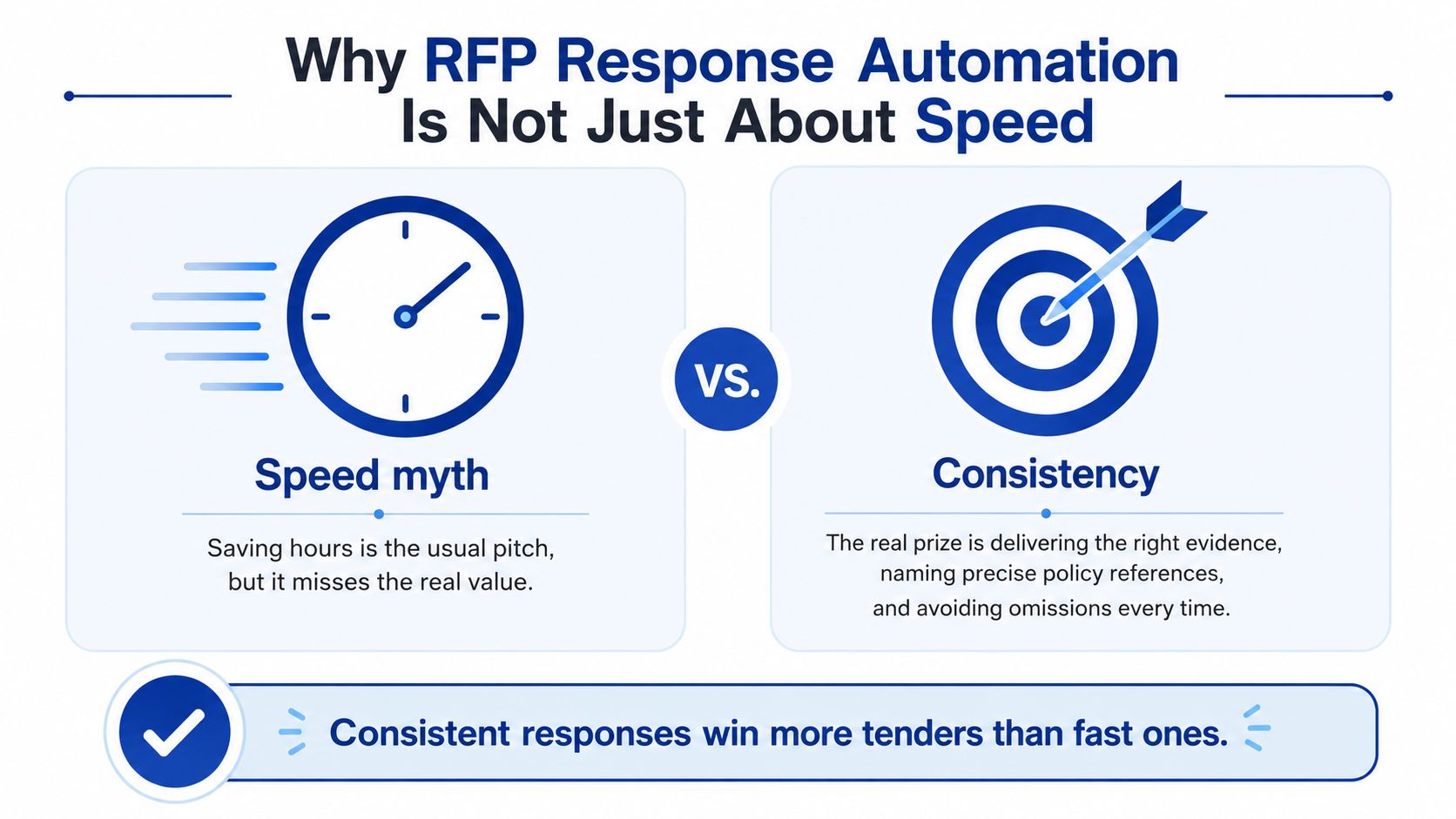
Why RFP Response Automation Is Not Just About Speed
The popular pitch says automation saves writing hours. It does, but that's only the visible benefit. In a public sector tender, the core value lies in consistent evidence retrieval, controlled wording, and fewer compliance omissions.
A moderator doesn't award marks because your response was produced quickly. They score it against published criteria. Generic paragraphs, unsupported claims, and answers that fail to address the exact question won't become competitive just because an AI tool generated them in seconds.
The real operational problem
A bid desk needs to assemble compliant answers, evidence, and pricing narratives within a compressed cycle. Tussell's analysis of Contracts Finder and TED data found that UK central government buyers gave suppliers an average of 26 days to respond in 2018, with no department meeting the 35-day guideline, and some giving less than 20 days. That finding is documented in Tussell's analysis of supplier tender windows.
That pressure makes manual searching expensive. One person looks for a relevant case study, another copies an old policy answer, and a subject matter expert rewrites both because the source material is out of date. The team may submit on time, but nobody can clearly explain which approved document supports each important statement.
Practical rule: automate retrieval and drafting, never automate accountability.
A well-designed workflow turns a substantial writing task into a shorter review and refinement cycle. The writer still owns the narrative, the bid manager still checks compliance, and the subject matter expert still validates technical claims. Software removes the searching and repetitive assembly, not the professional judgement.
Why traceability matters more than fluent prose
The strongest platforms connect every draft to a controlled knowledge base. That lets a reviewer ask, “Where did this claim come from?” and get a useful answer rather than a plausible sentence.
This is also part of broader enterprise AI procurement readiness. Before an organisation deploys AI in procurement, it needs clear ownership, approved information, and review controls. Those same controls determine whether RFP response automation improves a bid or introduces hidden risk.
How RFP Response Automation Actually Works
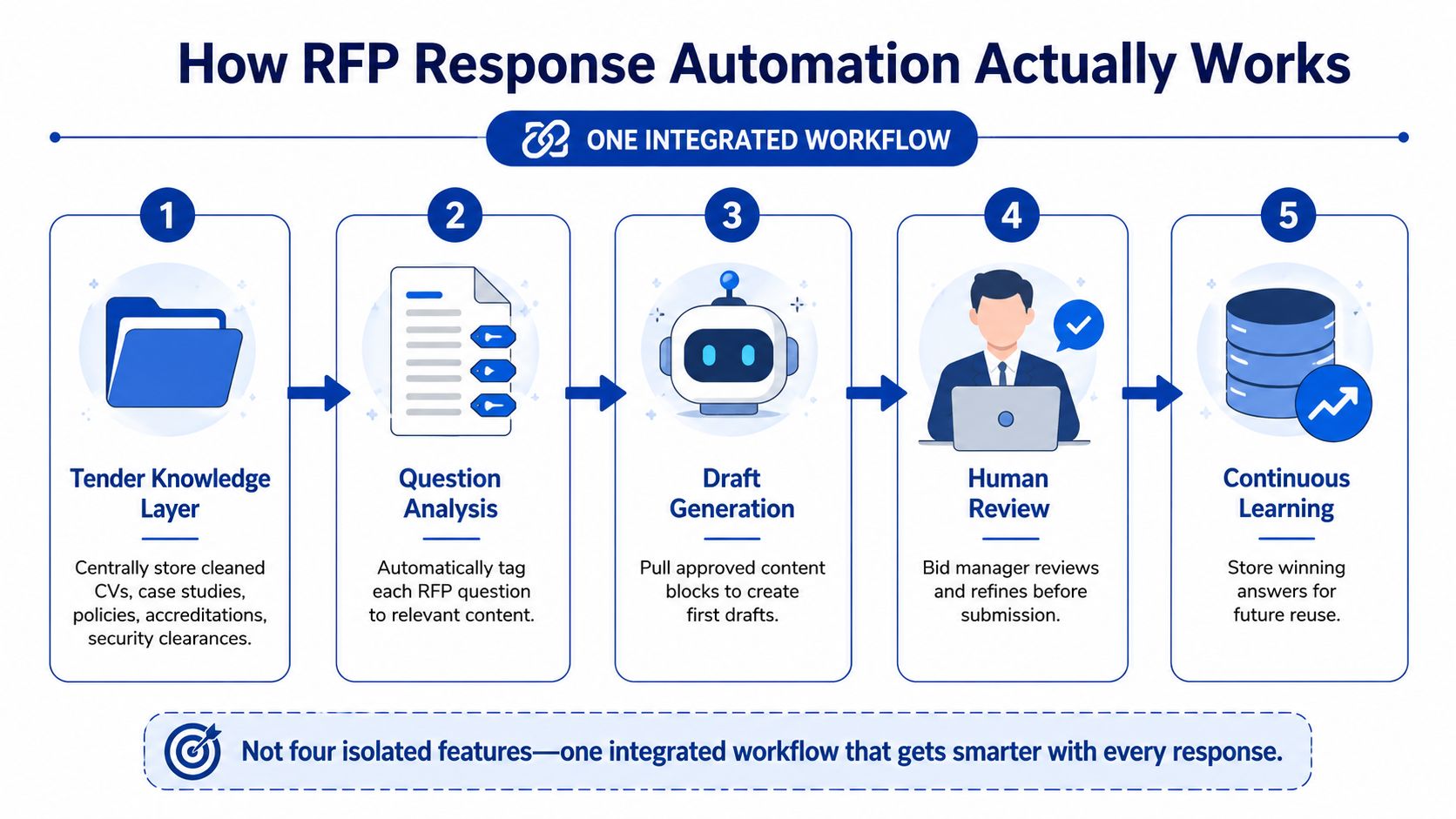
RFP response automation works as one connected workflow. Tender monitoring identifies an opportunity, the knowledge base supplies approved evidence, question analysis maps requirements to content, AI response generation creates a draft, and people review the result before submission.
Treating these as separate features creates gaps. Monitoring without content preparation gives you alerts but no capacity to respond. Draft generation without review produces polished uncertainty.
Start with controlled tender knowledge
Your knowledge base should contain more than old bids. It needs cleaned CVs, case studies, policies, accreditations, security clearance evidence, service descriptions, social value material, and approved commercial language.
Each asset should have an owner, a review status, and useful tags. A case study might be tagged by sector, service, contract type, geography, and outcome. A policy answer needs its current version and approval status. Without this structure, AI can only search a messy archive and repeat its weaknesses.
Let the system analyse the buyer's question
Natural language processing helps the software interpret the question, not just match isolated keywords. It can identify whether the buyer is asking for technical capability, mobilisation method, social value commitments, information assurance, or evidence of previous delivery.
The system then retrieves relevant approved content. A question about NHS mobilisation shouldn't receive a generic IT implementation paragraph because both documents contain the word “implementation”.
Generate within the buyer's constraints
AI response generation should pull from approved content blocks and draft in the organisation's established voice. Templates should enforce word limits, mandatory headings, response fields, and buyer-specific instructions.
That matters for areas such as Social Value and Net Zero. The answer needs to reflect the published requirement and evaluation method, not a reusable promise that sounds attractive but lacks delivery detail.
Bidwell's tender response use case illustrates the practical shape of this workflow. The platform reads tender questions and sub-questions, matches them to stored credentials and previous responses, and prepares material for review.
Connect the workflow to daily work
Monitoring should cover the portals where your target opportunities appear. Find a Tender became the main UK portal for above-threshold and below-threshold notices from 24 February 2025, except below-threshold notices in Scotland, according to the Find a Tender service. It replaced TED in the UK on 31 December 2020.
Scotland requires separate attention. Public Contracts Scotland is the official Scottish procurement portal, where suppliers can find contract opportunities and awards. A UK-wide monitoring process that ignores Scotland is incomplete.
The final workflow should support single sign-on, Microsoft 365 or Google Workspace connections, and export into the buyer's Word, Excel, or portal format. The outcome is practical: less rewriting, fewer missed fields, and quicker sign-off. Teams considering broader task-based AI deployment may also find it useful to review how organisations deploy AI employees in minutes, while keeping bid approval with named humans.
Realistic ROI for UK Public Sector Bid Teams
ROI depends on what your team does with recovered capacity. If automation merely creates more drafts that still need the same searching and rewriting, the investment hasn't solved the operational problem.
For a UK SME bid desk handling roughly two tenders a month, the baseline is usually a writing task that takes 20 to 40 hours per PQQ or RFP, followed by review from two people and an elapsed process lasting four to six weeks. Those figures describe the working model for this guide, not a universal industry benchmark.
The gain is a 30% to 50% time reduction, focused mainly on question analysis, evidence matching, first-draft production, and mechanical compliance checks. The team still needs time for win themes, technical validation, pricing, and final approval.
| Metric | Before Automation | After Automation |
|---|---|---|
| Core writing effort | 20 to 40 hours per response | Less manual drafting, with time redirected to review |
| Reviewer involvement | Two reviewers search, edit, and challenge answers | Two reviewers focus on evidence, compliance, narrative, and pricing |
| Knowledge retrieval | Manual searches across old bids and folders | Tagged retrieval from an approved knowledge base |
| Tender discovery | Reactive checking across portals | Monitored opportunities and structured alerts |
| Drafting risk | Copy and paste can leave inconsistent or outdated wording | Drafts can be tied to source documents, subject to validation |
| Capacity | Existing team spends heavily on repetitive assembly | Bid managers can assess more opportunities without treating AI as a substitute for expertise |
Where the reclaimed hours go
A bid manager might use the recovered time to qualify opportunities more rigorously, improve a case study, involve a technical expert earlier, or test the response against the scoring matrix. That's more valuable than producing more low-quality submissions.
The strongest business case therefore combines three measures:
- Cycle time: How quickly can the team move from tender intake to a review-ready draft?
- Reviewer hours: How much time goes into checking and improving, rather than hunting and rewriting?
- Pass-through quality: Are responses meeting mandatory requirements and reaching quality evaluation stages?
Treat win-rate assumptions carefully
A stronger evidence chain and fewer disqualifications can support a 5% to 15% win-rate uplift in the planning model, but automation alone doesn't create that result. The range is a sensitivity assumption for evaluating potential value, not a guaranteed outcome.
Sector knowledge, delivery credibility, pricing strategy, relationship context, and the actual competition still matter. If your evidence is weak, automation will expose that weakness more efficiently. Your knowledge base and tender monitoring feature create capacity, while AI response generation creates a starting point. Your people still decide whether the bid deserves to proceed.
Implementation Checklist You Can Run This Quarter
You don't need to rebuild the bid desk around software. Run a controlled rollout alongside live work, beginning with content and review discipline rather than AI configuration.
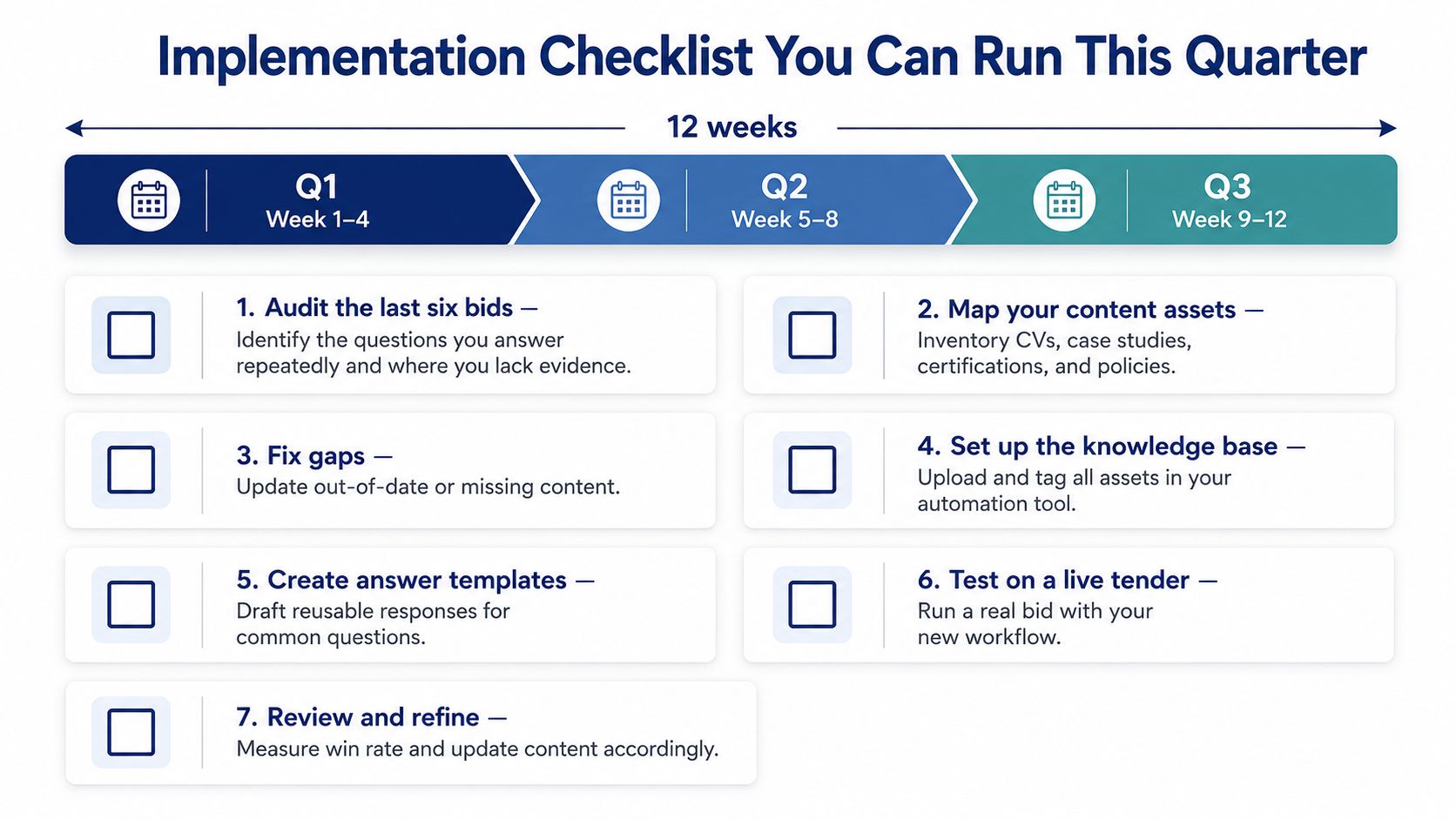
Use a seven-step rollout
Audit the last six bids. Mark repeated questions, late evidence requests, missed instructions, and sections that required the most rewriting. This shows where automation can help without guessing.
Map your content assets. List approved CVs, case studies, certifications, policies, social value evidence, security material, and standard commercial responses. Record the owner and review status for each item.
Fix the gaps first. Remove obsolete claims, replace missing documents, and resolve conflicting versions. An AI system can't make an unapproved policy reliable.
Set up portal monitoring. Configure searches for Find a Tender and Contracts Finder, then add Public Contracts Scotland and any relevant regional sources. Find a Tender currently shows 306,471 notices in its live results set, as shown on the Find a Tender search results page. Your filters must be narrow enough to keep the pipeline usable.
Create modular answer templates. Tag response blocks by question family, including technical, methodology, social value, commercial, and compliance. Keep the buyer's instructions beside the template, not in a separate document nobody checks.
Test one live tender. Let the system parse the tender, extract questions and word limits, retrieve evidence, and generate first drafts. Name a reviewer for every section before generation starts.
Measure and refine. At the 30-day gate, compare cycle time, reviewer hours, evidence corrections, mandatory-item misses, and pass-through quality with the manual baseline. Feed reviewer comments back into the knowledge base.
Put review gates in writing
Every compliance, social value, and pricing answer should require named human sign-off. Use a two-pass approval before submission, with one pass checking factual and documentary support, and another checking scoring alignment, formatting, and completeness.
The Bidwell guides provide a useful starting point for organising this operating model. The important point is ownership. Someone must be responsible for the knowledge base, someone must approve the generated response, and someone must confirm the final submission.
Don't roll out across every tender type at once. Start with recurring question families where evidence is stable, then expand after the 30-day measurement gate shows that review quality is holding up.
Where Automation Breaks Down on UK Tenders
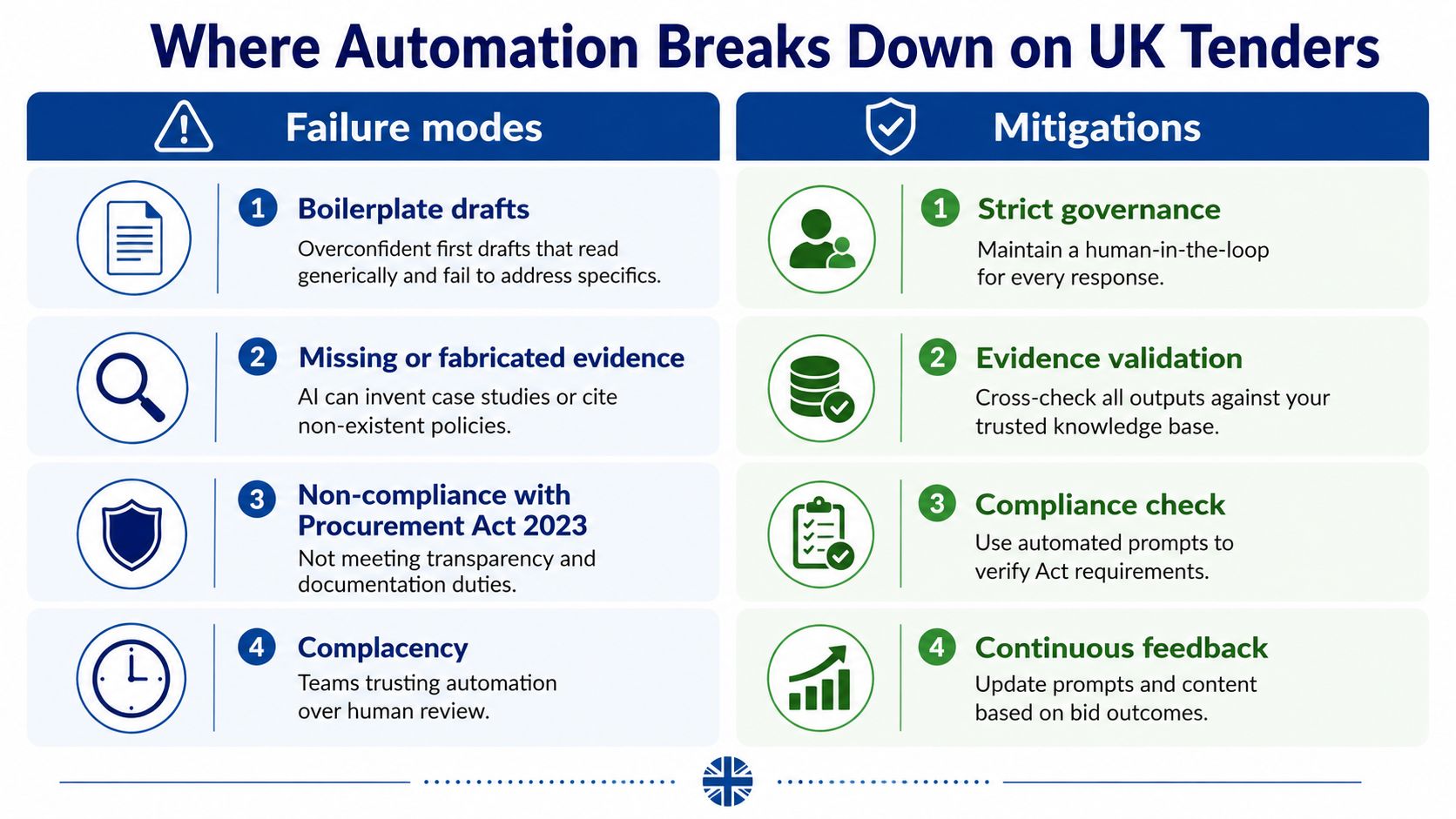
AI fails most dangerously when the draft sounds certain. A vague answer is easy to challenge. A confident answer built on the wrong case study can survive internal review if nobody checks the source.
Independent UK commentary on whether AI bid writers work for public sector bidding reaches the practical conclusion bid teams need: AI bid writers work mainly as human-led productivity tools, and on their own they rarely produce competitive, compliant responses for complex government tenders. The same commentary notes that UK bid writing doesn't prohibit AI and that Cabinet Office PPN 02/24 recognises suppliers will increasingly use AI in submissions.
Four failure modes to expect
Boilerplate drafts: The answer repeats your capability statement but doesn't address the buyer's operating context, risk, timetable, or requested evidence.
Missing or fabricated evidence: The draft cites a case study that doesn't meet the requirement, refers to a policy that has changed, or invents support that isn't in the source material. Treat unsupported output as a defect, not a minor edit.
Procurement policy blind spots: Language and instructions vary between Crown Commercial Service, NHS, and local authority templates. A model that has learned one pattern can lose marks when the evaluation structure changes.
Complacency: The team assumes a fluent draft is a safe draft. That's how mandatory declarations, pricing instructions, word limits, and submission conditions get missed.
Social value and carbon reduction answers need particular care. Buyers may require commitments mapped to specific evaluation criteria, delivery measures, and reporting arrangements. A generic statement about community benefit or emissions reduction won't answer a weighted criterion properly.
What a proper human review looks like
A reviewer shouldn't only proofread the AI output. They should perform a structured validation pass:
- Check every material claim against the source document.
- Confirm that each named case study meets the question's sector, service, and outcome requirements.
- Map Social Value answers to the published evaluation criteria.
- Check every mandatory heading, sub-question, word limit, and attachment instruction.
- Validate pricing schedules against the ITT instructions.
- Confirm whether the contracting authority requires disclosure of AI use.
- Preserve an audit trail showing the source, reviewer, change, and approval.
The audit trail is where many tools remain weak. If a reviewer can't see why a sentence appeared, which version supported it, and who approved the final wording, the system isn't ready for high-stakes tenders.
Vendor Selection Criteria for UK Bid Teams
A polished demonstration proves very little. Ask the vendor to process one of your difficult tenders, including its tables, sub-questions, evidence requirements, and awkward formatting.
Portal coverage comes first. Your monitoring layer should support Find a Tender, Contracts Finder, Public Contracts Scotland, Sell2Wales, and the portals your buyers use, including Jaggaer, ProActis, Due North, and Bravo. Missed notices damage the pipeline before response automation has any chance to help.
Score the platform against working reality
| Criterion | Weight | What to Verify | Red Flag |
|---|---|---|---|
| Portal coverage and monitoring | High | Relevant UK portals, alert timing, filtering, summaries, and duplicate handling | Only one generic feed or broad keyword alerts |
| Evidence traceability | High | Each generated claim points to an approved, version-controlled source | No citations or opaque source selection |
| Security and residency | High | UK or EU hosting, ISO 27001, Cyber Essentials Plus, and contractual data-use terms | Bid content may train shared models |
| Knowledge-base flexibility | High | Tags, owners, expiry dates, approval states, and document-level permissions | One flat library with no governance |
| Review workflow | High | Named reviewers, comments, two-pass approval, and debrief capture | One-click generation with no approval gate |
| Template control | Medium | Word, Excel, portal exports, headings, fields, and word limits | Export requires extensive manual repair |
| Integration | Medium | API, SSO, Microsoft 365, and Google Workspace support | Teams must copy content between systems |
| Contract terms | Medium | Contract length, price per seat, onboarding time, and exit clause | Long commitment before a real-tender trial |
Security questions deserve contractual answers, not verbal reassurance. Ask where data is hosted, whether your content is used to train shared models, how access is controlled, and how you retrieve your data if you leave.
Your reviewers also need a usable comment history. A platform that drafts well but loses the rationale behind edits will make future audits and debriefs harder. For guidance on the writing fundamentals that still matter after automation, use this resource on how to write proposals that close deals.
Before committing, test the workflow against one live or recently completed tender. Compare the generated output with the original response, count unsupported claims, inspect citations, and ask reviewers whether the system reduced work or merely moved it elsewhere. See how Bidwell's bid writing software fits your process only after you've defined those tests.
Best Practice Examples and What to Do Next
The best UK bid teams don't hand the whole response to AI. They use automation for discovery, retrieval, assembly, and first drafts, then reserve human time for judgement.
The rapid framework call-off
An SME IT services supplier receives a 14-day framework call-off. The bid lead's monitoring workflow flags the opportunity within an hour, the knowledge base retrieves tagged IT case studies, and the team protects the final two days for compliance review and pricing sign-off.
That allocation matters. The team doesn't spend the deadline day discovering that a case study lacks the required public sector context or that a pricing schedule has been completed in the wrong format.
The Social Value lot
A facilities management bidder faces a lot with substantial Social Value content. The team doesn't paste its standard community benefits paragraph into every answer.
Instead, it adapts approved response blocks to the published evaluation weightings, names the delivery activity, identifies the responsible team, and links the commitment to the buyer's scoring matrix. The AI can assemble the first version, but a bid manager checks that the response answers the criterion rather than merely mentioning Social Value.
The consultancy with clear boundaries
A bid consultancy uses automation to prepare first drafts while keeping narrative review, win-theme stress testing, and sign-off in-house. Reviewers challenge whether the response is differentiated, commercially sensible, and supported by evidence.
That's the cleanest human-in-the-loop model. The system handles repeatable assembly. Experienced bid professionals decide what the buyer should believe and whether the evidence proves it.
Your next move this week
Pick one upcoming tender. Build a starter knowledge base with five documents, such as a current company profile, one approved CV, one relevant case study, a key policy, and a social value or delivery example.
Run one response through automation and compare it with a manual baseline. Review both against the published evaluation weightings, record every correction, and use those comments to improve the knowledge base before expanding the workflow.
Don't buy a platform because its demo produced fluent prose. Choose one that helps your team find the right notices, retrieve approved evidence, show its sources, and stop for human approval when the question is too important to automate.
Bidwell monitors Find a Tender, Contracts Finder, Public Contracts Scotland, and other UK tender sources, then connects relevant opportunities to a governed knowledge base and AI-generated first drafts. Visit Bidwell to see how your team can test that workflow on a real tender while keeping compliance, evidence, pricing, and final sign-off with your people.