
A tender has landed, the deadline is already in your diary, and the evidence is scattered across folders and colleagues' inboxes. You can find a previous answer quickly enough. Working out whether it's current, relevant and safe to reuse takes longer.
RFP automation should take the repetitive work out of that process without taking judgement away from the bid team. The useful starting point isn't faster writing. It's a controlled route from the buyer's requirements to evidence, review and a submission someone is prepared to sign.
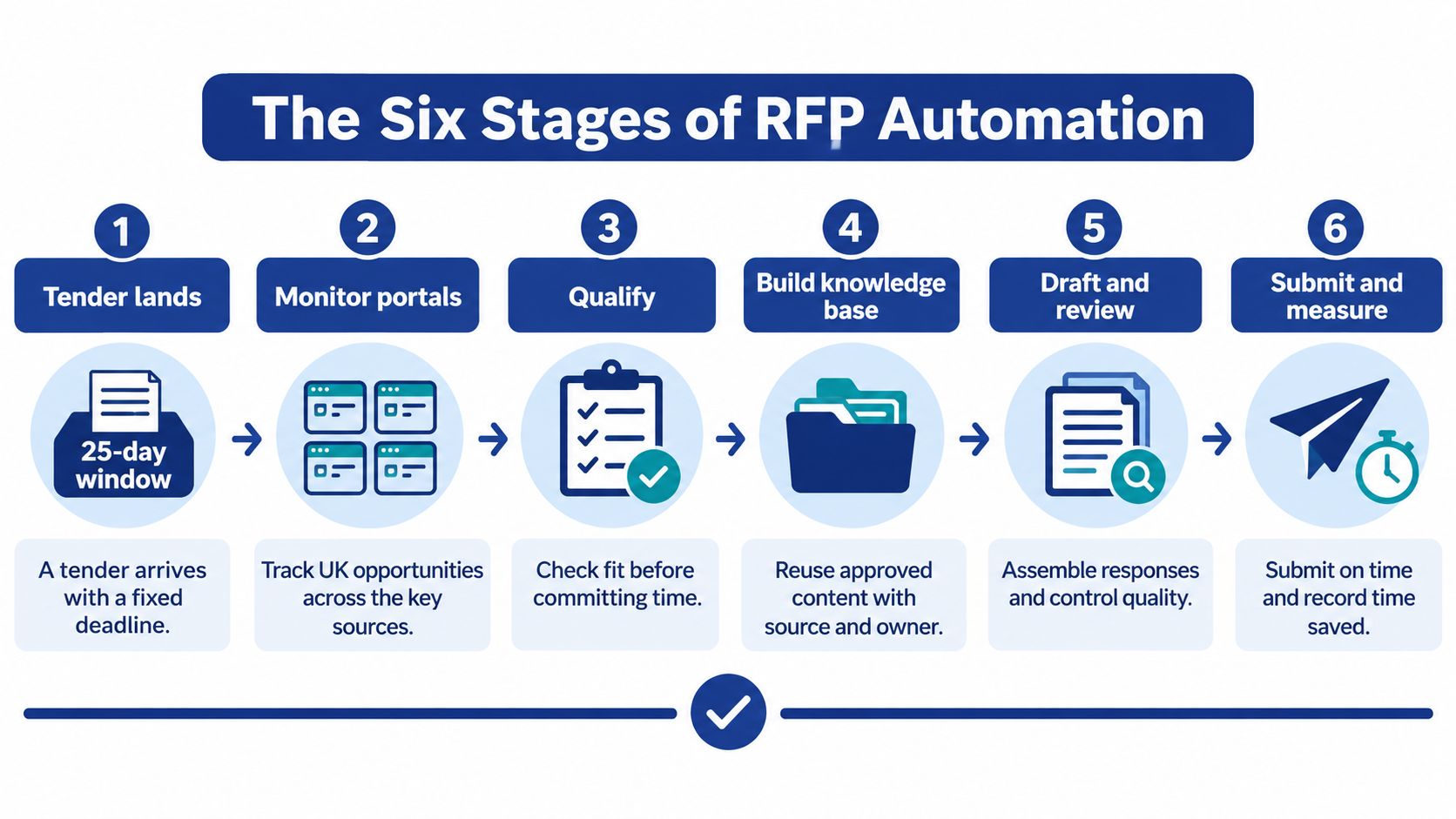
The Six Stages of RFP Automation
Say your next tender arrives with a short response window. Your operations lead has the delivery methodology, finance holds the insurance documents, and the strongest case study sits inside an old submission.
A drafting tool can assemble convincing prose from that material. It can't decide whether the case study proves the requirement, whether the proposed team is available or whether you can honour a contractual commitment.
The government's SME/VCSE Bid Pack recommends clear responsibilities, early collection of supporting documents and two review rounds, even for smaller bids. Build those controls into the workflow rather than adding them after drafting.
Separate processing from judgement
Start by turning the notice and its documents into a requirements register. Keep the original question beside the extracted requirement so reviewers can spot missing conditions, not just missing words.
Then connect each requirement to approved evidence. Where nothing suitable exists, assign the gap to a named person instead of allowing the drafting tool to fill it with plausible language.
Six-stage RFP automation workflow
| Stage | What happens | Software can handle | A person must decide |
|---|---|---|---|
| 1. Requirement extraction | Pulls every pass/fail requirement, question, weighting, page limit, deadline and evidence need | Extracting questions and building the checklist | Confirming scope and spotting gaps in the notice |
| 2. Source mapping | Links each requirement to an approved knowledge base entry | Retrieval of matching evidence with document citations | Choosing the right evidence for the buyer |
| 3. Drafting | Writes answers in the buyer's terms and scoring logic | First draft against the specific notice | Tone, commitments, pricing and delivery promises |
| 4. Evidence check | Confirms every claim is backed by a source document | Flagging claims with no source | Judging whether the evidence is strong enough |
| 5. Two independent reviews | First for completeness against the question, then for clarity and structure | Reviewer checklists and version tracking | Scoring each answer against the published criteria |
| 6. Final compliance check | Confirms mandatory attachments, word limits and portal rules | Mandatory field validation before upload | Final sign-off before submission |
Our workflow connects tender monitoring, a knowledge base and AI response generation. Monitoring feeds the pipeline, approved evidence supplies the substance, and drafting starts from the actual notice.
Use Bidwell's tender workflow as a reference when assigning those responsibilities. The table is your working map, not permission to automate the decisions in its final column.
Choosing RFP Automation Tools Before You Set Anything Up
Choose tools against the workflow, not the quality of a demonstration answer. A polished paragraph tells you little about missed attachments, unsupported claims or awkward spreadsheet exports.
The redesigned Find a Tender service launched in February 2025, bringing procurement opportunities together with machine-readable information, according to the Competition and Markets Authority's procurement reflections. That makes notice-level filtering a sensible starting requirement, rather than accepting keyword matching alone.
Questions worth putting in the demonstration
| Ask the vendor | A useful demonstration | A warning sign |
|---|---|---|
| Can it read the actual notice? | Filters for CPV code, keywords, region, value and notice stage | A generic text search |
| Can reviewers inspect supporting evidence? | Claim-level references, document dates and owners | A bibliography detached from the answer |
| What happens when evidence is missing? | A visible gap assigned for resolution | Confident invented detail |
| Can we reconstruct approval? | Version history and named approval records | An editable final document with no history |
| What happens to confidential information? | Clear storage, access, retention and model-use terms | Vague assurances about security |
| Can we export into the required format? | A completed buyer template that still works | Copying everything manually after drafting |
For a broader view of agent-based software, compare agents with AI Tool Seekers, then test the shortlist against your own tender documents. General agent capabilities aren't a substitute for procurement-specific controls.
Price the whole process
Compare the subscription, setup, content maintenance and review effort against your realistic bid volume. A flat fee can suit frequent bidding, but may be poor value for an occasional bidder.
Our bid-writing workflow gives you another process to assess against that checklist. Run a live-opportunity test before committing, and measure the checking and formatting work as carefully as the drafting.
How to Set Up Tender Monitoring and Qualification
A Monday-morning alert is useful only if it helps the team decide what to do. Start with the main UK portals: Find a Tender, Contracts Finder, Public Contracts Scotland and Sell2Wales. Then separate pipeline notices, which may support early engagement, from live tenders that need prompt qualification.
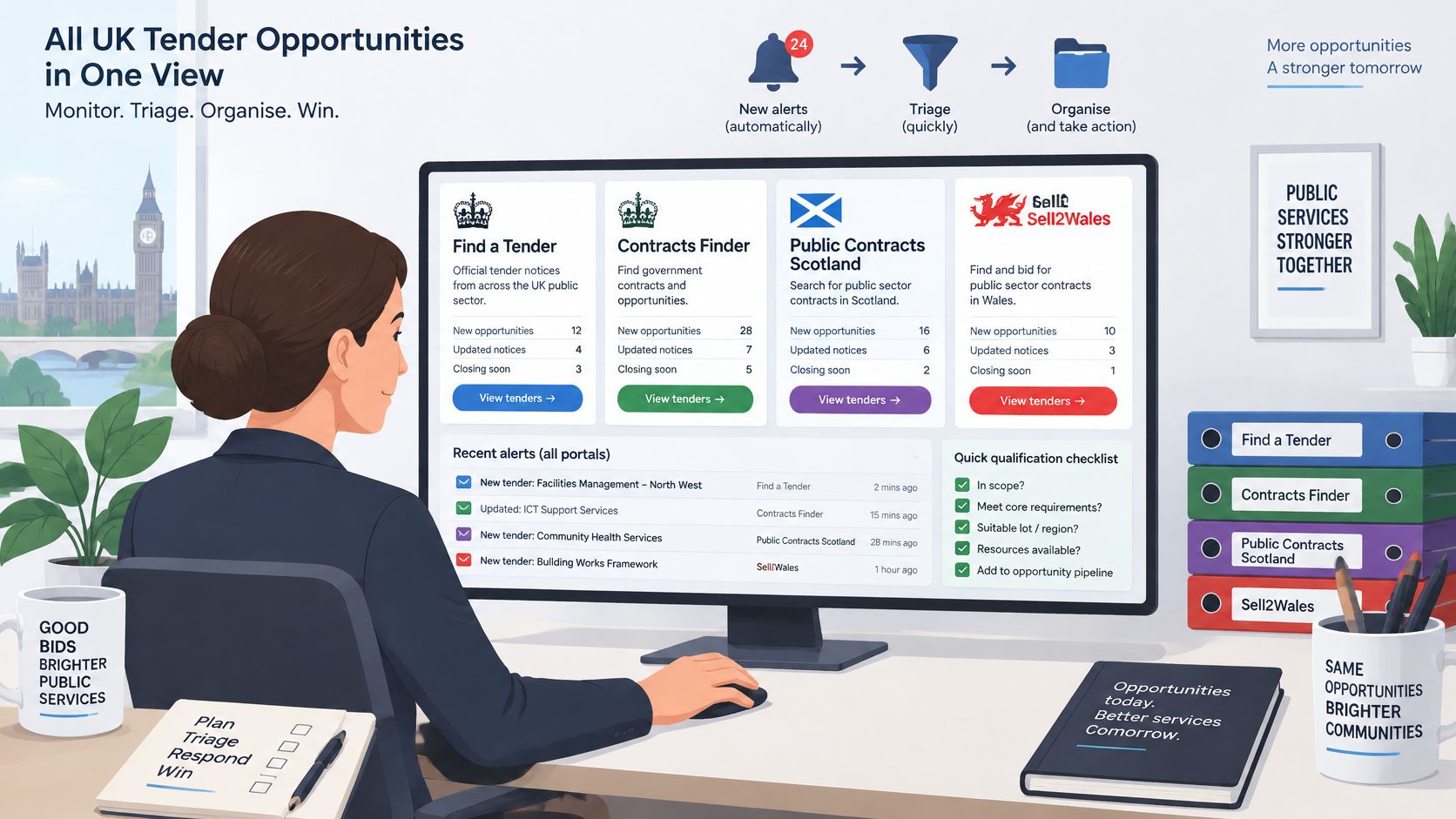
Configure the alerts around work you can deliver
List your delivery CPV codes. Choose categories that describe services you can provide now. Keep adjacent markets separate so speculative opportunities do not crowd out relevant work.
Add buyer-language keywords. Use terms from previous tenders, including lost bids. Include common abbreviations and alternative descriptions, then exclude obvious sources of irrelevant matches.
Set region and value bands. Account for mobilisation costs, travel and delivery capacity when choosing your geography. The Procurement Act's below-threshold provisions require publication before advertising a notifiable below-threshold contract. Check the applicable rules rather than assuming one value threshold applies to every authority.
Check the stage and legal regime. Find a Tender's notice-type guidance explains that the new notice sequence applies to procurements starting on or after 24 February 2025. Procurements begun under earlier legislation continue under that legislation. Scottish, Northern Irish, framework, dynamic purchasing system and qualification-system opportunities may follow different rules, so a keyword match alone does not establish the route.
Score the opportunity before drafting. Assess eligibility, evidence coverage, deadline feasibility, delivery capacity, expected bid effort and incumbent advantage. A failed mandatory eligibility condition is a stop, not a weakness a strong narrative can repair.
Record the decision and reason. Give the bid lead ownership of the bid/no-bid call. A recorded rejection, such as insufficient mobilisation capacity, is more useful than letting the tender disappear into an inbox.
Make rejection a useful result
Limited resources for customer intelligence and market engagement can make procurement harder for SMEs, as noted in government commercial commentary on SME procurement barriers. Faster writing does not remove those constraints.
Qualification rule: Reject an unsuitable tender before asking colleagues to produce evidence for it.
Bidwell's Discover process matches opportunities by CPV code, keyword, region and value, then emails tenders that fit. Check the notice stage and applicable regime alongside that match so the team can choose the right action.
After a working week, count the alerts, qualified opportunities and rejection reasons. If nearly every alert is irrelevant, narrow the filters. If none reaches review, check whether exclusions are too aggressive before concluding there is no suitable work.
Redesigning Roles and Timetables for Automated Bids
Automation changes who prepares the first draft. It doesn't remove the need for an accountable bid lead, available subject-matter experts or protected review time.
Assign people before loading documents. Otherwise, the software will produce answers faster than the organisation can approve them.
Give each decision an owner
- Bid lead: Owns qualification, the timetable, unresolved risks and final sign-off.
- Content owners: Maintain credentials, case studies, methodologies and team biographies.
- Completeness reviewer: Checks that each answer addresses every part of its question.
- Clarity reviewer: Tests structure, relevance and evidential strength against the scoring criteria.
- Compliance checker: Verifies attachments, declarations, limits and portal requirements.
A small team may combine roles, but it should still keep review decisions distinct. The person who wrote an answer shouldn't be its only reviewer, especially where it contains delivery or contractual commitments.
Work backwards from the submission deadline
The normal minimum periods in section 54 of the Procurement Act provide the planning reference below. These are minimum tendering periods, not a promise that every procurement follows the same timetable; check the procedure and any applicable exceptions.
Minimum tendering periods to plan around
| Situation | Minimum tendering period |
|---|---|
| Electronic submission, notice and all documents supplied at the same time | 25 days |
| Electronic submission, documents not all supplied together | 30 days |
| Electronic submission not allowed | 30 or 35 days, depending on document availability |
For a worked example using the shortest window shown, I'd target a complete draft by about day nine. That's a scheduling recommendation, not a statutory milestone, and it only works if evidence collection starts immediately.
Book reviewers when you make the bid decision. Put clarification deadlines, specialist approvals and portal preparation in the same calendar, with internal cut-offs ahead of the buyer's deadline.
Time saved on drafting belongs first to review, not to another unqualified bid.
Our knowledge-base process keeps pre-approved case studies and credentials ready for drafting. The operational benefit is earlier exposure of difficult questions, leaving specialists time to resolve them rather than receiving an urgent request just before submission.
For colleagues allocating responsibilities, Bidwell's bid-manager workflow provides a useful reference. Keep the timetable visible, and escalate missing evidence while there's still time to change the proposed response.
Building a Knowledge Base That Survives Evaluation
A folder of old tenders isn't a knowledge base. It contains useful material, but it also contains promises made for particular buyers, expired credentials and descriptions of teams that may no longer exist.
Create entries that a reviewer can verify independently. Each needs a source document, date, owner, approval status and permitted use.
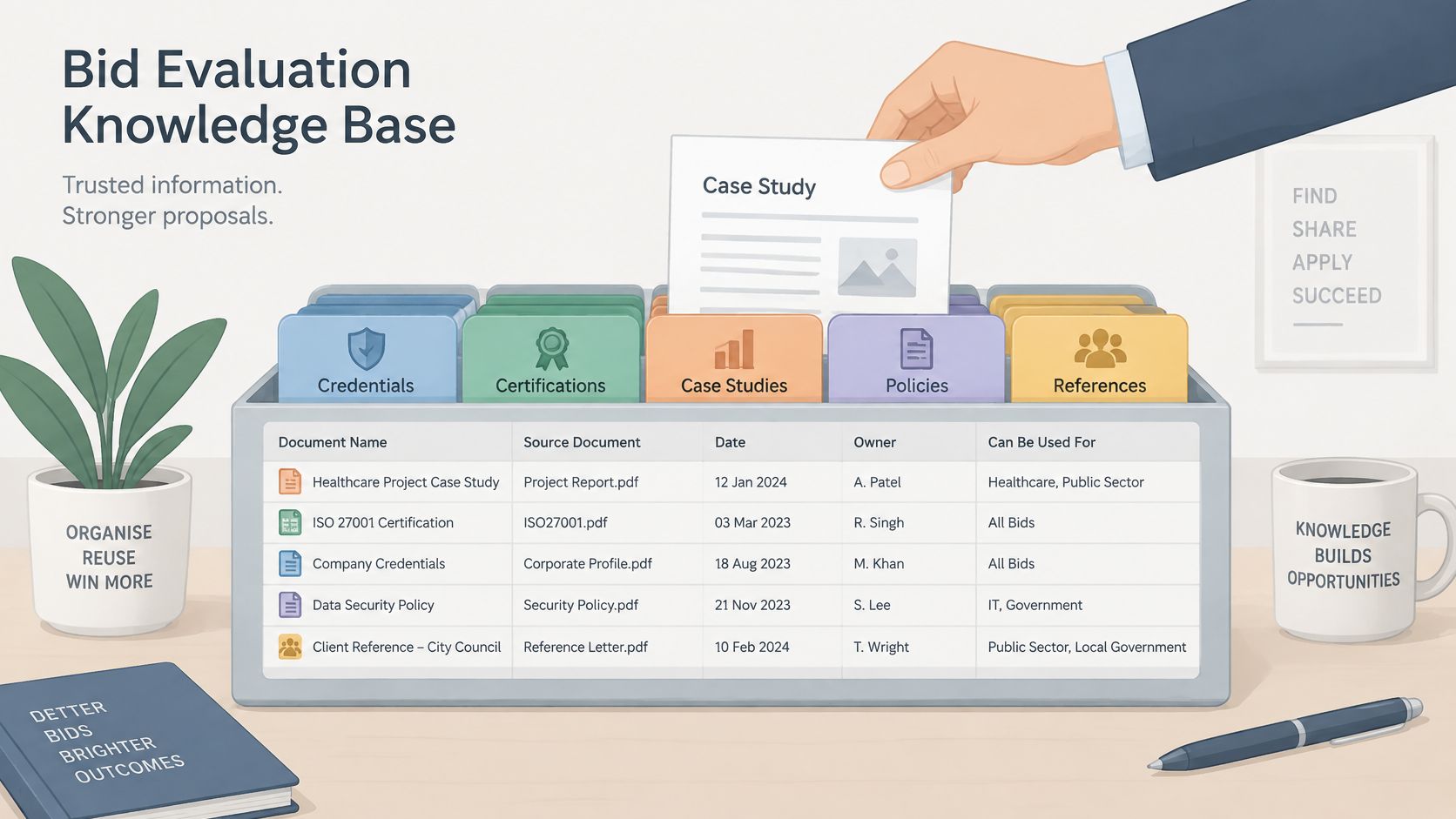
Store evidence, not just reusable wording
| Content category | Keep with the entry | Watch for |
|---|---|---|
| Credentials and certifications | Certificate, scope and expiry date | Claiming coverage beyond the certified activity |
| Case studies | Approved outcomes, context and client permissions | Reusing confidential details |
| Methodologies | Current process and delivery owner | Describing an approach the team no longer follows |
| Team biographies | Role, experience and availability checks | Promising unavailable staff |
| Policies | Approved document and version number | Conflicting policy versions |
| Insurance and financial details | Current documents and authorised figures | Outdated cover or unapproved disclosure |
Say a case study documents onboarding falling from six weeks to three. That hypothetical entry is reusable if the underlying record establishes the starting point, outcome, scope and your contribution.
A statement that your team provides world-class service offers no equivalent evidence. Replace it with a specific action, documented result and explanation of relevance to the buyer.
Build from submissions, then curate
Start with recent won and lost submissions. Extract supported passages, remove buyer-specific commitments and tag them against the questions they address, not just the sector they came from.
Keep evaluator feedback separate from the approved answer. A lost bid doesn't make every passage weak, and a winning bid doesn't prove that every sentence earned marks.
Our drafting process uses existing case studies, methodologies and team biographies to produce a first draft in minutes. When a tender is won, the response goes back into the customer's knowledge base, but content owners should still check its suitability for future use.
Maintain approval boundaries
Set a quarterly review schedule as an internal working practice, with immediate updates when a policy, credential or delivery capability changes. Retire expired entries from active retrieval rather than leaving a warning buried in the text.
Flag content used in unsuccessful bids for review against feedback, not automatic deletion. Keep draft material outside the approved collection until its owner signs it off.
Finish with a practical acceptance test: choose five answers at random and try to trace every claim to a document in under two minutes per answer. That's a suggested quality check, not an industry benchmark; if you can't complete it, the entry isn't ready for a buyer.
Using AI Drafts Without Losing Control of the Bid
A fluent answer can still fail. It might describe your general approach beautifully while missing the buyer's requested escalation process, evidence requirement or contract-specific outcome.
Human review isn't enough unless the reviewer can inspect the basis of the answer. Reading for plausibility is different from verifying that a statement is true and authorised.
Start with the question, not a generic prompt
Our Draft process takes a blank tender or PQQ, extracts every question, matches it to the knowledge base and drafts in the customer's voice. Each new bid is drafted against the actual tender notice rather than a generic template.
The reviewer's job is to test responsiveness. If the buyer asks how you'll manage service failure, an answer about your commitment to quality isn't a substitute for triggers, responsibilities, escalation and corrective action.
Keep internal evidence references attached during review. Remove or adapt them for submission only where the buyer's required format calls for it, without losing the internal record.
Keep an AI-use record from the start
Under PPN 017 on transparency of AI use in procurement, contracting authorities can include questions asking whether suppliers used AI to develop responses or will use it to deliver the service. That isn't a universal ban on AI assistance, but it does make an accurate disclosure record important.
Maintain a bid log containing:
- AI-assisted sections: Record where the tool extracted, assembled or drafted content, and distinguish response preparation from proposed service delivery.
- Approval history: Name the reviewer, record approval time and retain the approved version.
- Claim provenance: Identify supporting documents, especially for statistics, performance results and compliance assertions.
- Confidentiality controls: Record what information was uploaded and how access and permitted use were checked.
- Disclosure wording: Prepare a concise explanation that can be adapted to the buyer's exact question.
Don't describe the process as wholly manual because someone edited the output. Equally, don't imply AI will deliver the service merely because it helped prepare the bid.
Approval boundary: Software can propose wording. Only authorised people can commit the business.
Make high-risk approval explicit
Legal wording, pricing, safeguarding, data protection and delivery commitments need approval from the responsible person. A bid lead can coordinate those decisions without being qualified to make all of them.
For example, a case study showing successful mobilisation doesn't authorise a shorter mobilisation promise for a different contract. The delivery owner must confirm resources, dependencies and feasibility.
Our process leaves that boundary intact: we draft the bid, the customer reviews and approves every word, and a human always signs before it goes out. Keep a single disclosure log with the final response so a buyer's follow-up question doesn't trigger a search through emails.
Training, Piloting One Bid and Measuring Time to Bid
Start with a pilot, not a company-wide rollout. Choose a well-qualified open tender with at least 25 days remaining as a deliberate pilot condition, rather than testing the process on an urgent or strategically critical bid.
Before starting, log the effort on two or three comparable recent bids. Those are suggested sample sizes for your internal exercise, not external benchmarks; use records where available rather than reconstructing everyone's time from memory.
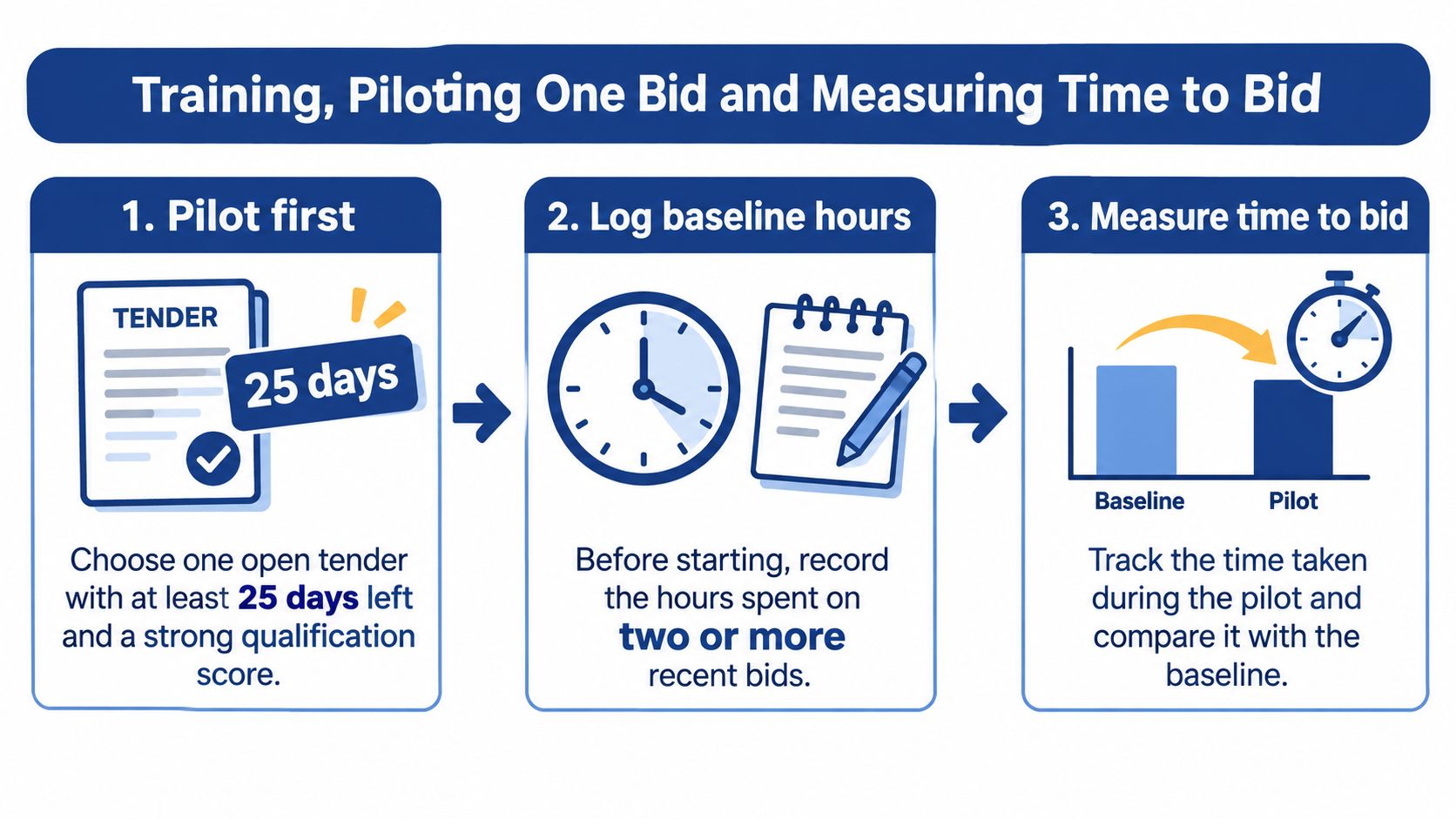
Practise verification before the live deadline
Run a closed tender through the process first. Ask reviewers to inspect citations, challenge unsupported claims and check the exported buyer template.
Then assign a named owner to each live-pilot stage and log active hours separately from elapsed waiting time. Otherwise, you won't know whether you saved drafting effort or just moved the bottleneck to approvals.
Time-to-bid and outcome metrics to track
| Metric | How to calculate | Why it matters |
|---|---|---|
| Qualified opportunities per month | Alerts that pass your bid or no-bid score | Shows whether monitoring finds the right work |
| Submission rate | Submitted bids divided by qualified opportunities | Shows whether you are chasing too few or too many |
| Compliant-submission rate | Submissions passing the final compliance check divided by total submissions | Catches automation errors before the buyer does |
| Hours per response | Total hours logged from requirement extraction to submission | Tracks the time-to-bid gain against your baseline |
| Win rate by procedure and sector | Wins divided by submissions, split by procedure type and sector | Shows where the process works and where it does not |
| Contract value won per bid hour | Contract value won divided by total bid hours | Shows the return on the team's time |
Read outcomes alongside competition
Open Contracting Partnership's analysis of the Procurement Act's first year reported that single-bid lots fell from approximately 21% to 16%, while single-bid tenders were approximately 7% more expensive than tenders attracting multiple bids. Competition conditions therefore matter when interpreting your results; don't attribute every change in win rate to automation.
Track clarification counts and evaluator feedback themes alongside the table. Separate clarification requests about weak answers from routine buyer questions, and distinguish confirmed losses from awards still pending.
For Contracts Finder awards, we automatically ingest the published award notice and prompt the user to confirm it. That confirmation keeps the outcome record tied to the procurement result rather than an assumption.
Decide what earns wider use
Compare preparation and review effort with the baseline, then inspect the compliance result. Extend the workflow if it helped, narrow it to suitable opportunities if performance was mixed, or repair the weakest stage before expanding.
Keep the team's pilot summary to a sentence, for example: the pilot reduced preparation effort against the baseline, passed the final compliance check, and will be extended to similarly qualified tenders.
Bidwell connects tender monitoring, a knowledge base and AI response generation so your team can find suitable opportunities and prepare evidence-led responses with human sign-off. Visit Bidwell and use the free Tender readiness checker, Framework eligibility tool or Cost-to-respond estimator to choose a sensible starting point for your pilot.


