UK public sector procurement is not a niche market. The public sector spent an estimated £393 billion on goods and services in 2022-23, equal to around one-third of total public spending, according to the National Audit Office analysis of government procurement. For a bidder, that figure represents more than market size. It represents a large stream of notices, evidence requirements, evaluation rules and post-award duties that public sector procurement policy controls.
The practical question isn't, “What does the law say?” It's, “What must we do differently on the next tender?” This guide follows that question through the legal framework, thresholds, procedures, social value, transparency and a council tender example. It also shows where tender monitoring, a structured knowledge base and AI response generation fit into the work.
Why Public Sector Procurement Policy Matters to UK Bidders
Public sector procurement policy sets the operating conditions for every bid. It influences which opportunities buyers must advertise, how suppliers are assessed, and what evidence and performance commitments continue after award.
That makes policy a commercial issue, not just a legal one. A supplier can have a strong service and still lose because it missed a publication route, misunderstood the applicable procedure, or supplied an attractive claim without enough supporting evidence.
The three effects a bidder feels first
Start with opportunity visibility. Above-threshold opportunities are generally advertised through Find a Tender before appearing on Contracts Finder or elsewhere, while below-threshold publication duties apply at different points for central and sub-central authorities. The Contracts Finder transparency guidance explains those routes and the relevant publication duties.
Your monitoring process must therefore distinguish the portal, authority type and likely procurement regime. A daily alert without classification still leaves the bid team to work out whether a notice is a genuine competition, an early market signal or a lower-value opportunity with a shorter response.
Next comes evaluation. The tender documents determine the questions, scoring method, quality requirements, price model and any social value or environmental evidence. Your response must mirror that structure. A general corporate brochure won't answer a method statement question that asks who will perform the work, how risks will be controlled and how outcomes will be measured.
Post-award obligations are the third effect. The contract may include reporting, key performance indicators, payment information, security controls and commitments made in the tender. The Procurement Act 2023 requires at least three key performance indicators before a contracting authority enters into a public contract worth more than £5 million. That creates a direct bid-writing task: identify the proposed measures, then make sure your operational team can deliver the promises being drafted.
Practical rule: Treat every policy requirement as a workflow instruction. Record it, assign an owner, attach evidence and place the deadline in the bid calendar.
A monitoring platform can surface notices from the relevant UK portals. A knowledge base can hold approved policies, accreditations, case studies and delivery evidence. AI response generation can then draft against the actual question set, but a bid owner still needs to verify accuracy, approval and delivery feasibility. You can see how this workflow fits procurement teams in Bidwell's procurement manager resource.
The Legal Framework from 2015 to the Procurement Act 2023
A new bid writer needs a simple legal timeline. The key is to identify which regime governs the opportunity, rather than assuming that every public tender follows the newest rules.
The first layer is the Public Contracts Regulations 2015. They remain important for procurements started under the former regime and for understanding notices, thresholds and procedural concepts that still appear in tender documentation. A legacy opportunity can sit beside a newer one, so the publication date and governing documents matter.
The second layer is the Procurement Act 2023. Parliament records that the Act received Royal Assent on 26 October 2023. Although parliamentary material referred to an October 2024 commencement date, the government's open-contracting update confirms that the Act, the associated Procurement Regulations 2024, the Central Digital Platform and the enhanced Find a Tender service came into force on 24 February 2025. The Parliamentary briefing on the Procurement Act 2023 provides the legislative background.
The third layer is the Procurement Regulations 2024. These regulations provide the operational detail that buyers and suppliers need, including provisions connected with thresholds, exclusions and award processes.
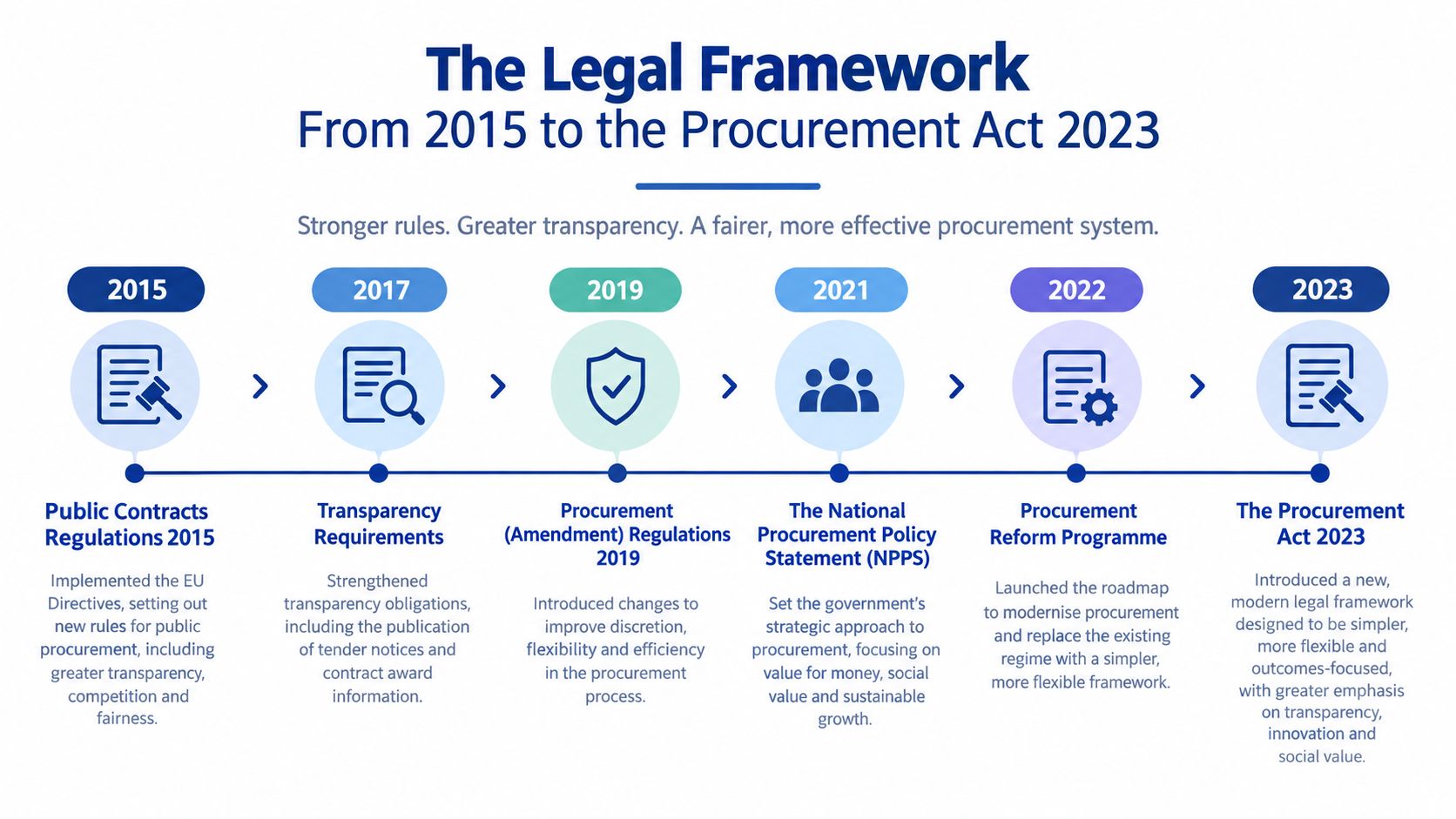
What the legal ladder means for a bid writer
You don't need to memorise every regulation. You do need to capture the governing regime early and use it to shape the response plan.
- Check the notice date: Older procurements may still use PCR 2015 terminology and documents.
- Read the procurement documents together: The contract notice, instructions, specification, selection questions and draft contract may divide requirements across several files.
- Record exclusions and evidence: The newer framework increases the importance of accurate supplier information and timely disclosure.
- Track buyer guidance: The Procurement Policy Unit and Procurement Review Unit form part of the wider policy and oversight environment, so published guidance can affect how authorities operate the rules.
Teams carrying out legal checks can also consult top legal research tools from LegesGPT, an AI Legal Assistant. Use those tools to locate and compare source material, but keep the tender documents and official legislation as the controlling references for a live bid.
Your internal knowledge base should store the regime, source documents, clarification answers and approved interpretations for each opportunity. That record helps AI drafting use the right terminology instead of combining content from tenders governed by different rules.
How Procurement Thresholds Shape Policy in Practice
Thresholds are financial gateways. They help determine whether a buyer must follow formal advertising and competition duties or can use a simpler process.
Under the Public Contracts Regulations 2015 threshold provisions, the main thresholds include £5,336,937 for works, £138,760 for central-government supplies and services, £213,477 for sub-central supplies and services, and £663,540 for Schedule 3 social and other specific services. Values are assessed over the contract and include VAT for the relevant scope test.
The policy effect is straightforward. Below the applicable threshold, buyers have more procedural flexibility. Once the value reaches the relevant threshold, the bid team should expect more formal notice publication, structured evaluation, stricter timelines and heavier evidence requirements.
A threshold check belongs at qualification
Don't let a sales lead decide whether an opportunity is attractive before someone checks its value, authority type, service category, duration, extensions and VAT treatment. A small change in the estimated lifetime value can move the opportunity into a different compliance environment.
The following table uses the verified threshold classes to show the operational consequence.
| Contract type | Threshold in GBP | Procedural regime | Bidder implication |
|---|---|---|---|
| Works | £5,336,937 | Above-threshold duties under the applicable regime | Prepare for formal notices, detailed evidence and structured evaluation |
| Central-government supplies and services | £138,760 | Above-threshold procurement requirements | Monitor Find a Tender, check selection requirements and build a controlled response |
| Sub-central supplies and services | £213,477 | Above-threshold procurement requirements | Confirm the authority classification and adapt the evidence pack |
| Schedule 3 social and other specific services | £663,540 | Light-touch threshold category | Check the service classification and read the authority's stated procedure carefully |
The 2023 threshold policy note also records thresholds that applied from 1 January 2024, including £139,688 for central-government bodies, £214,904 for other authorities, £5,372,609 for works and £663,540 for light-touch services. Those figures relate to that policy update, so don't mix them with the later threshold figures without checking which procurement regime applies.
The value is not a label to add at the end of qualification. It is an early routing decision for the entire bid.
A tender monitoring workflow should classify notices by authority, category and threshold band. The knowledge base should retain the applicable threshold source and procedure notes. AI response generation should only draft after those controls are set. For buyers and suppliers working with central frameworks, the Crown Commercial Service procurement information is a useful reference point for understanding the market context and published opportunities.
Main Procurement Procedures and What They Mean for Bidders
The Procurement Act 2023 gives contracting authorities several ways to run a competition. The procedure affects how early you need to engage, how much selection work comes before the tender and where the buyer creates competitive pressure.
An open procedure generally gives suppliers one opportunity to submit the required response. Your team must have the policies, evidence, pricing assumptions and delivery method ready when the tender opens.
A restricted-style process places more weight on selection before the full tender. The Selection Questionnaire becomes a gate. Weak answers on financial standing, experience, exclusions or technical capacity can prevent the buyer from assessing the main bid.
A competitive flexible procedure allows the authority to design stages around its requirement. That might mean qualification, written responses, presentations, dialogue or revised offers. The flexibility helps the buyer test complex solutions, but it makes the bidder's planning harder because the eventual response path may not look like a standard open tender.
An innovation partnership is designed for requirements where the authority needs development as well as purchase. Suppliers must show not only that they can deliver an existing service, but also that they can work through development, risk and eventual implementation.
A light-touch route for certain services can use a different level of formality. Never assume that “light-touch” means “easy”. The specification, social value requirements, safeguarding provisions and evidence demands can still be substantial.
Match the procedure to the work
| Procedure | Who can use it | Stages for bidder | Competitive pressure |
|---|---|---|---|
| Open | Authorities running a single-stage competition | One complete response, including selection and tender information where required | Strong emphasis on completeness, clarity and price or quality scoring |
| Restricted-style process | Authorities that want to filter suppliers before detailed tendering | Selection Questionnaire, then invitation to tender for shortlisted suppliers | Early pressure sits in eligibility and evidence |
| Competitive flexible | Authorities designing stages for a complex requirement | Stages set by the tender documents, potentially including dialogue or presentations | Strategy must adapt as the process develops |
| Innovation partnership | Authorities seeking development and later delivery | Capability, development approach, testing and delivery stages | Pressure sits in technical credibility and development risk |
| Light-touch route | Authorities procuring qualifying social or other specific services | Follow the procedure stated by the authority | Supplier must understand the buyer's chosen balance of flexibility and control |
Before publication, use market engagement to test whether the requirement is understandable and whether your evidence is relevant. During the competition, store every clarification and version in the knowledge base. AI drafting is most useful when it can work from the exact stage, question and approved evidence, rather than from a generic answer library.
Social Value, Green Rules and New Transparency Duties
Social value and environmental requirements turn broad policy goals into bid evidence. A response that says your organisation “supports communities” won't carry much weight unless it explains the activity, beneficiary, owner, timing and measurement.
Central-government requirements may use a Social Value Model, and tender documents can specify themes, outcomes and reporting expectations. The safe response method is to map each commitment to the buyer's requested framework, then link it to a delivery plan. Keep examples proportionate. Don't promise apprenticeships, community events or local spending that your contract team can't resource.
Environmental questions require the same discipline. Where a tender asks for carbon information or a Carbon Reduction Plan, give the document requested, identify the relevant boundary and explain how data is governed. Avoid inserting unsupported emissions figures into a response. A knowledge base can hold the current approved policy, methodology and supporting records, with an owner responsible for updates.
Transparency changes the evidence burden
The newer framework increases the importance of information published across the tender lifecycle. The government describes the reform as intended to improve transparency and reduce costs, while its open-contracting status update records that contracting authorities in England must publish payment information for payments over £30,000 from 1 April 2026.
For suppliers, this means internal records need to withstand later scrutiny. Keep delivery reports, KPI evidence, subcontractor information and contract changes organised. Future procurement teams may examine published performance information when assessing supplier credibility.
National-security controls and debarment checks add another screening layer. Assign a named owner to confirm ownership information, relevant relationships, exclusion grounds and any available self-cleaning evidence. A drafting tool can assemble the response, but a responsible person must approve every declaration.
For sector-specific practical context, the Reworx Recycling 2026 guide can sit alongside the official policy material when a tender involves recycling or environmental services. Use it as background, not as a substitute for the authority's procurement documents.
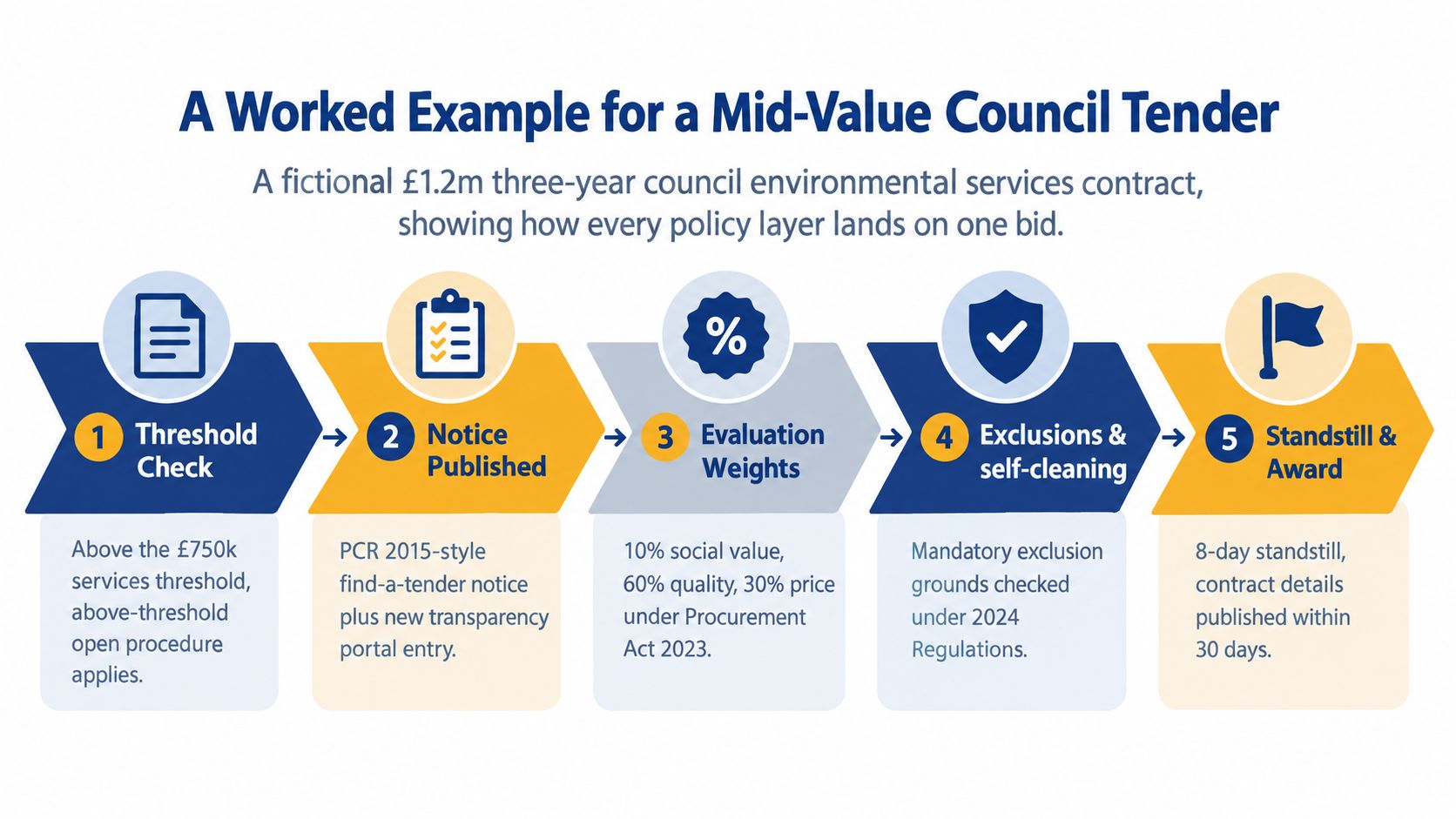
A Worked Example for a Mid-Value Council Tender
Consider a fictional £1.2 million, three-year council environmental services contract. The example is illustrative, so the tender documents would remain the final authority. The point is to show how a bid writer turns policy into a controlled response.
The first action is a value and scope check. The team confirms the contract value, extensions, service classification, authority type and governing regime. It then records the result in the opportunity file, so the response team doesn't use a threshold assumption copied from another tender.
The buyer chooses an open competition. The bid manager creates a compliance matrix with one row for every instruction, pass or fail requirement, question, attachment and declaration.
Assemble the response in the scoring order
The method statement comes first because it explains how the service will work. It should cover mobilisation, staffing, health and safety, service continuity, reporting, escalation and improvement. Each answer should identify an activity, an accountable role, a control and an outcome.
The priced schedule comes next, with assumptions checked against the specification. Don't let the commercial response contradict the method statement. If the method promises additional site visits or reporting, the price and resource plan must reflect that commitment.
Social value needs its own evidence map. Connect proposed outcomes to the council's requested themes and measures. Name delivery owners, explain when activities will occur and state how the council will receive progress information. Avoid repeating general corporate commitments that aren't specific to this contract.
Environmental evidence should include the requested Carbon Reduction Plan or equivalent documentation where the tender requires it. The bid team should use an approved version from its knowledge base, check its date and confirm that the operational model supports the commitments.
Protect the bid from avoidable failure
Common failures include missing an attachment, answering a previous version of a question, using an unapproved case study or promising a social value outcome without an owner. A response generator can reduce drafting effort, but it can't decide whether a proposed commitment is commercially or operationally safe.
Use tender monitoring to capture the notice and amendments. Use the knowledge base for policies, accreditations, staff profiles, case studies and approved environmental evidence. Use AI response generation to produce a first draft aligned to the council's questions, then run human checks for relevance, accuracy, scoring and delivery.
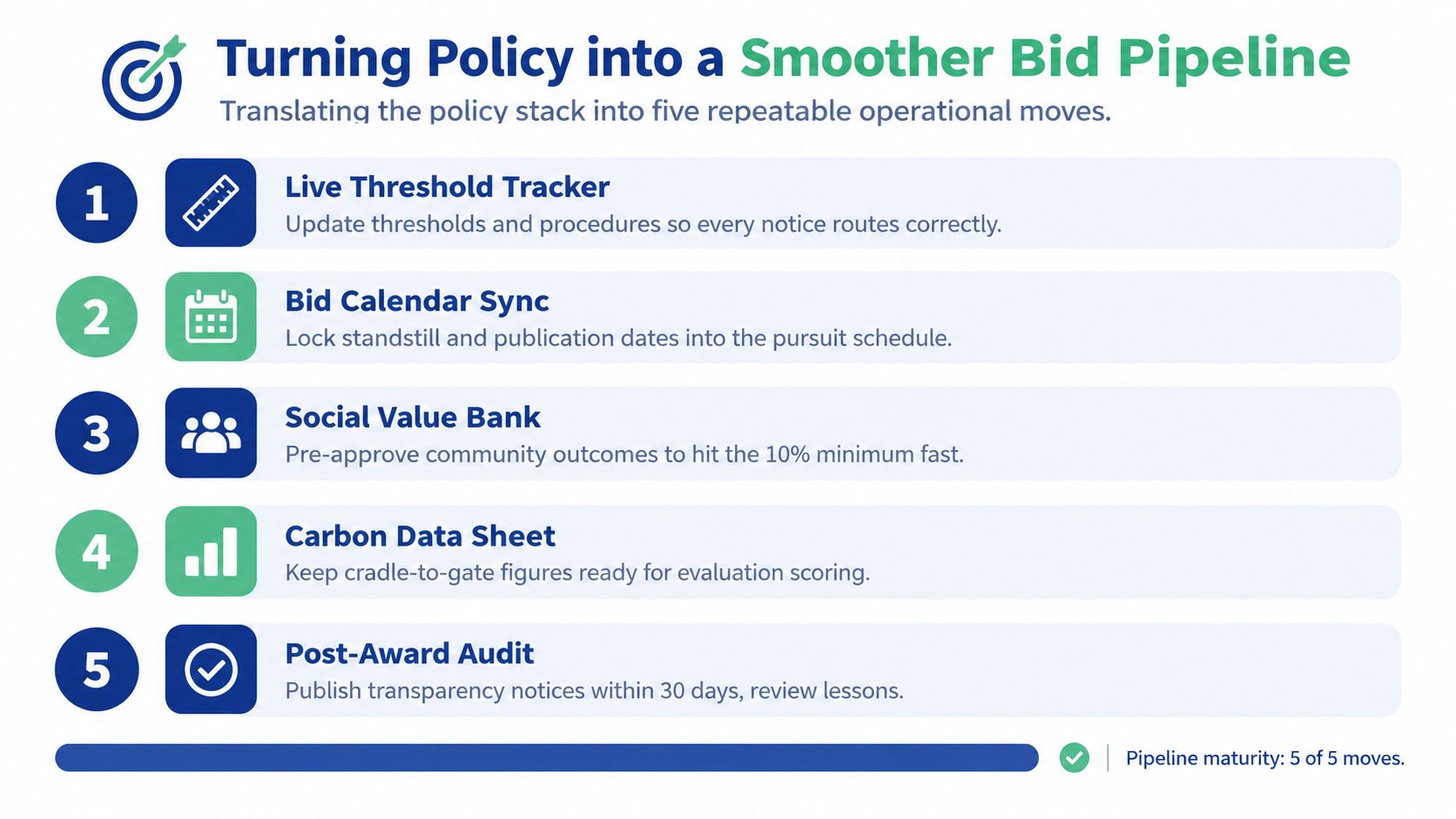
Turning Policy into a Smoother Bid Pipeline
A good pipeline makes policy visible before the deadline. It doesn't rely on one bid writer remembering every threshold, declaration, publication duty and performance commitment.
Five controls for a bid team
Keep a live threshold tracker. Record the current threshold source, authority type, service category and likely procedure for every opportunity. If the notice changes, update the classification and tell the bid owner.
Build an evidence library. Organise social value commitments, environmental policies, accreditations, case studies, CVs and delivery records by subject and approval status. Retire outdated content rather than allowing old answers to remain available without warning.
Assign screening responsibility. A named person should own exclusion, debarment, ownership and national-security checks. A separate owner should confirm that transparency and performance information can be supplied if the contract requires it.
Put policy dates in the pursuit plan. Add clarification deadlines, submission dates, interview stages, standstill information, contract publication requirements and internal approvals. The plan should show who acts and what evidence they need.
Close the loop after submission. Store clarification questions, buyer feedback, score breakdowns, lessons and contract commitments. A debrief log turns one tender into reusable knowledge, but only after someone checks that the lesson is accurate and suitable for future use.
The trade-off is real. Chasing every notice can leave a team with shallow responses and weak operational checks. Qualification should protect time for opportunities where your evidence, capacity and delivery model genuinely fit.
A monitoring workflow can sort notices by category and procedure before they reach the bid calendar. A knowledge base can keep the approved source material in one controlled place. AI response generation can then prepare structured drafts from the relevant documents, leaving experienced staff to test the argument, evidence and commitments.
The Bidwell bid writing software page describes a workflow built around those three activities. The important principle is broader than any one tool: policy should be connected to the daily work of finding, qualifying, writing and learning from public sector bids.
Use Bidwell to monitor UK tender portals, organise approved bid evidence and generate custom response drafts from your knowledge base. Set up a policy-led workflow so your team can identify the right opportunities, meet the relevant compliance duties and spend review time improving the bid rather than searching for basic information.