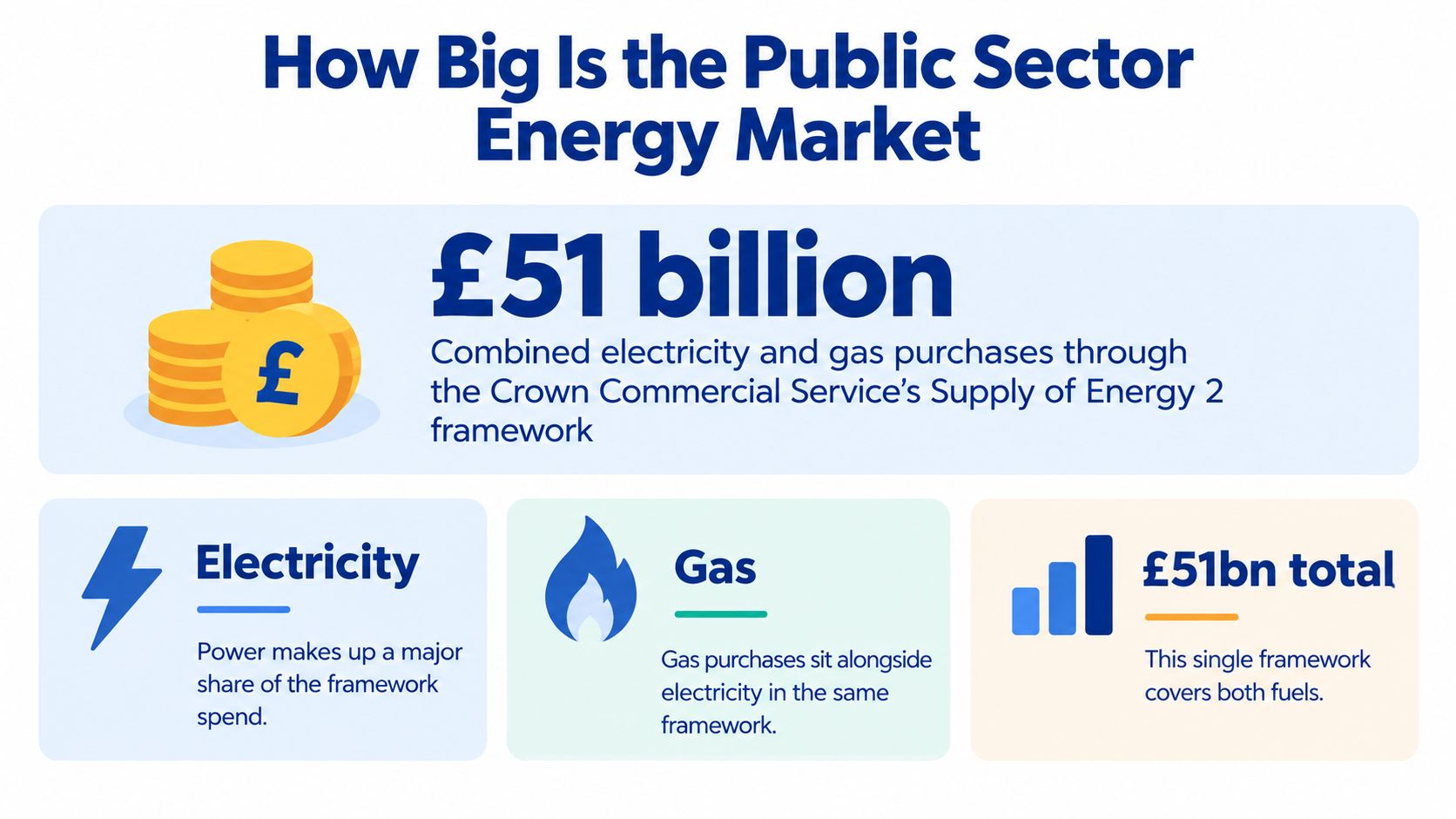
£51 billion is the combined value of electricity and gas purchases covered by the Crown Commercial Service's Supply of Energy 2 framework. For suppliers, that figure shows that public sector energy procurement is a serious, structured market, not a collection of small local utility deals.
The opportunity is substantial, but it isn't easy money. Public buyers expect suppliers to understand risk-managed purchasing, sustainability, contract performance and public procurement rules. A strong bid needs to do more than offer a competitive tariff. It needs to show that your business can deliver reliably, explain its assumptions clearly and fit the buyer's procurement route.
For SMEs, the main challenge is usually not technical capability. It's finding the right opportunity early enough, understanding what the buyer will score and producing a response that proves your claims. That's where disciplined tender monitoring, a usable knowledge base and careful AI-assisted drafting can make a practical difference.
How Big Is the Public Sector Energy Market
The Crown Commercial Service's Supply of Energy 2 framework represents approximately £43 billion for electricity and £8 billion for gas, giving it a combined value of about £51 billion. The framework began on 27 February 2023, runs for four years until 27 February 2027, covers two lots and is available to central government and wider public sector organisations through a risk-managed purchasing model. The UK Government guidance on buying energy sets out the framework and its intended use.
That scale changes the supplier's question. You aren't asking whether a council or government department needs electricity. You're asking which aggregated route it uses, whether your organisation can access that route and what capability the buyer expects at framework and call-off stage.
Aggregation changes the sales process
Centralised procurement gives buyers purchasing strength and a more consistent contracting process. It also means suppliers face a more organised competitive field. A place on a framework may provide access, but it doesn't guarantee a call-off win. You still need to compete on commercial terms, operational delivery, reporting and sustainability.
For a smaller supplier, this can feel intimidating. The answer isn't to chase every large framework. It's to identify where your delivery model fits. A specialist in renewable supply, energy data, flexible purchasing or energy efficiency may be more credible in a focused opportunity than in a broad commodity competition.
Practical rule: Treat a framework place as market access, not revenue. The real sale happens when you answer the specific call-off.
The market also includes opportunities beyond direct energy supply. Public bodies buy metering support, consumption analysis, energy management, retrofit design, installation and compliance services. Suppliers that understand the wider public sector energy opportunity can find routes that suit their expertise without competing only on unit price.
Resource your pursuit properly
A tender of this type can involve legal review, pricing input, technical evidence, environmental documentation and senior approval. Before bidding, check whether you can support the contract's reporting requirements, service levels and payment profile. A bid that wins work your operations team can't deliver is a costly success.
Use tender monitoring to identify opportunities while there's still time to assemble the right team. Your knowledge base should hold current policies, accreditations, service descriptions and evidence from previous work, with owners responsible for keeping each item accurate.
Main Procurement Routes and Frameworks
Public bodies buy energy through several routes, and the route determines how a supplier gets access. The central framework model is only one part of the market. Councils, combined authorities, NHS organisations and other public bodies may use an existing framework, participate in an aggregation exercise or run their own procurement.
The Local Government Association's national energy category strategy states that councils collectively spend over £773 million each year on gas and electricity. It also describes a market where energy costs continue to rise and encourages flexible, aggregated and risk-managed approaches. The national energy category strategy explains why local authority buying requires more than a basic commodity quotation.
Framework call-offs
A framework can shorten the buyer's route to contract because core terms, supplier eligibility and procedural rules have already been established. For a supplier, the trade-off is clear. Framework access can reduce the need to qualify from scratch for every opportunity, but call-offs still require detailed responses and competitive pricing.
Read the framework rules before investing in a bid. Check which buyers can use it, whether there are limits on the services covered and how mini-competitions will be evaluated. Suppliers often waste time by assuming that being appointed removes the need for opportunity-specific preparation.
Aggregated and collaborative purchasing
Public buyers may combine demand to obtain more favourable commercial terms and reduce internal procurement work. Aggregation can create a larger opportunity, but it can also produce demanding requirements around forecasting, billing, data quality, customer service and contract governance.
A supplier should model the whole delivery burden, not just the expected energy volume. Ask whether your systems can handle multiple sites, different operating patterns and regular management information. If the buyer wants a single accountable supplier, subcontracting arrangements and escalation routes need to be clear before submission.
Standalone tenders and lower-value work
Some organisations run individual competitions, particularly where their requirements don't fit an existing framework. Smaller opportunities can be attractive to SMEs because they may be closer to the supplier's operational capacity. They still require careful compliance, including correct pricing, signed declarations and responses that follow the tender structure.
Maintain profiles on relevant public sector frameworks, but don't rely on one route. Monitor live notices, framework announcements and buyer pipelines. A balanced pursuit strategy includes large framework access, targeted call-offs and smaller contracts that build relevant public sector experience.
Sustainability and Net Zero Requirements
Sustainability now affects how public energy tenders are written, evaluated and managed. A supplier may need to explain renewable sourcing, carbon reporting, environmental controls, energy efficiency support and how its service contributes to the buyer's wider decarbonisation plans.
That doesn't mean every tender asks for the same evidence. Read the specification carefully. Some buyers may focus on the source of supplied energy, while others may assess fleet emissions, waste controls, social value, supply-chain practices or support for building improvements.

Build evidence before the tender arrives
A policy statement alone won't carry much weight. Buyers want evidence that your organisation manages environmental commitments in day-to-day operations. Useful material can include environmental objectives, responsibilities, monitoring arrangements, improvement records and supplier controls.
If your documentation needs strengthening, a guide to a practical environmental management system can help you structure the evidence without turning the response into vague sustainability language. Keep the final tender answer specific to the question and supported by documents you can provide.
The strongest responses connect an environmental commitment to a delivery action. For example, explain who collects consumption data, how exceptions are escalated and how the buyer receives performance information. Don't promise an outcome you haven't defined or measured.
Understand the PPA opportunity
The Crown Commercial Service's Provision of Power Purchase Agreement agreement went live on 15 April 2025. It is designed to give central government and the wider public sector access to UK-based renewable energy, fixed-term pricing options and simplified call-off terms aligned to the PPA market, as described in the green energy agreement announcement.
For suppliers, this points to a practical issue. Renewable energy expertise must be matched with a clear explanation of pricing, term, volume, forecasting and risk allocation. Buyers need to understand how a PPA compares with standard utility purchasing, and suppliers need to make that comparison intelligible.
Energy efficiency providers should also watch adjacent opportunities, including energy efficiency consultancy services. A credible bid explains how proposed measures will be delivered, monitored and maintained, rather than treating net zero as a slogan added to the final page.
Contract Types and Pricing Models
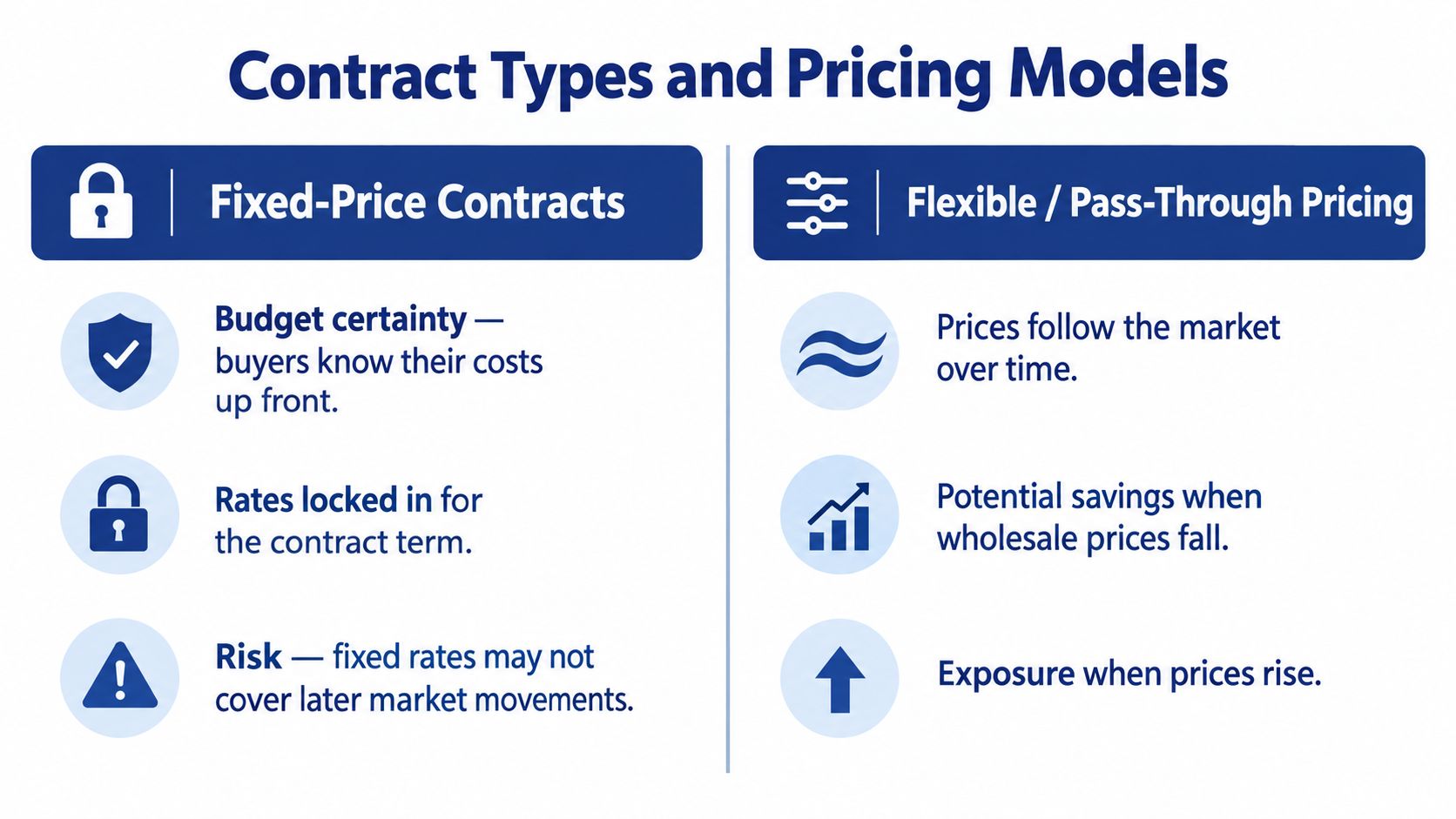
Contract structure affects both the buyer's budget and the supplier's exposure. The right model depends on how much price certainty the public body needs, how actively it wants to manage market movements and what services sit alongside energy supply.
| Model | What the buyer gains | What the supplier must manage |
|---|---|---|
| Fixed price | Greater budget certainty and a known rate for the agreed term | Wholesale movement, forecasting risk and margin protection |
| Flexible or pass-through pricing | The ability to follow market conditions and potentially benefit when prices fall | Greater budget exposure and more complex purchasing decisions |
| Power purchase agreement | Access to renewable energy through a defined, longer-term structure | Generation, volume, settlement and contractual performance obligations |
| Bundled efficiency delivery | Supply or services combined with improvement work | Delivery coordination, measurement and whole-life performance |
Fixed pricing is not automatically safer
A fixed price gives the buyer a straightforward budget assumption. For the supplier, it can create exposure if input costs change after the bid is submitted. Your pricing model therefore needs clear assumptions, valid quotation periods and a realistic view of what the contract permits you to pass through.
Flexible pricing moves more risk to the buyer, but it can support a more responsive purchasing strategy. That makes communication important. A supplier should explain governance, approval points and reporting, not just state that prices will follow the market.
PPAs and outcome-based work
A PPA can support renewable sourcing and longer-term price planning, but it isn't a standard supply contract with a green label. The parties need to understand volume obligations, balancing arrangements, certificates, termination terms and the consequences of underperformance.
The same principle applies to retrofit and efficiency work. In February 2025, Plymouth City Council launched an Energy Efficiency Dynamic Purchasing System with a stated value of up to £425 million, open to public sector bodies and covering energy efficiency measures, retrofit installations and related works across social housing and domestic properties, according to the Contracts Finder notice.
That model changes the commercial proposition. Buyers are purchasing delivery capability and measurable improvement, not merely a single installation. Suppliers should show how surveys, design, installation, resident communication, quality assurance and aftercare fit together.
Evaluation Criteria and What Buyers Actually Score
Many suppliers read an energy tender as a pricing exercise. That's usually a mistake. The evaluation may examine commercial value, technical approach, environmental performance, social value, risk controls, data management and contract mobilisation.
A low price can't rescue a response that fails a mandatory requirement or creates doubt about delivery. A well-priced offer can also lose if it doesn't answer the question asked. Buyers score the evidence in the submission, not the capability the supplier hoped they would infer.
Start with the scoring structure
Find the evaluation methodology before drafting. Identify pass or fail requirements, weighted questions, minimum thresholds and evidence rules. Then create a response matrix that links every requirement to an answer owner and supporting document.
Your response should make scoring easy. Use the buyer's terminology, follow the question order and put the evidence near the claim. If the question asks how you'll manage billing exceptions, don't spend most of the answer describing your company history.
A useful response usually contains four elements:
- Method: What will you do, and in what sequence?
- Ownership: Which role is accountable for delivery?
- Evidence: Where have you done something comparable?
- Control: How will you detect and correct failure?
Track the right notices
From 24 February 2025, the new Find a Tender central digital platform publishes above-threshold and below-threshold notices for new UK procurements, except below-threshold notices in Scotland. For procurements started before that date, it continues to show only above-threshold notices, usually above £139,688 including VAT, while lower-value opportunities are split between Contracts Finder, Public Contracts Scotland and Sell2Wales, as set out on the Find a Tender search platform.
A supplier monitoring one portal can miss relevant work. Your opportunity process should record the buyer, route, deadline, estimated scope, mandatory requirements and likely competitors. That information helps you decide quickly whether the opportunity deserves pursuit.
Scoring insight: Write for the evaluator's marking scheme, not for your own sales presentation.
A strong bid also separates proof from promise. If you claim that mobilisation will be controlled, show the plan, roles, milestones and escalation process. If you claim environmental competence, identify the system, owner and records that support it.
Practical Bidding Tips for Energy Suppliers
Winning suppliers tend to be organised before the notice appears. They know which buyers matter, keep their evidence current and don't treat every tender as a blank page.
Start with monitoring. Find a Tender, Contracts Finder, Public Contracts Scotland and Sell2Wales cover different parts of the UK market, so set up a process that checks each relevant source. Daily alerts with concise summaries are more useful than a long list of unfiltered notices, because the bid team can focus on fit, deadline and likely effort.
Build a working bid system
Your knowledge base should be more than a folder of old submissions. Organise it around reusable evidence:
- Company information: Legal details, policies, insurances and financial documents.
- Delivery method: Mobilisation plans, account management, billing, data and escalation processes.
- Technical capability: Supply arrangements, energy management, retrofit or reporting expertise.
- Proof: Relevant contracts, outcomes, references and named personnel.
- Compliance: Accreditations, declarations, environmental controls and subcontractor information.
Assign an owner and review date to each important item. Outdated evidence can create a compliance problem even when the underlying business is capable.
Don't copy old answers blindly. A previous response can provide structure and language, but every statement needs to match the new buyer, contract and evaluation method. Generic text is easy for evaluators to spot, especially where it uses the wrong service scope or refers to a different customer type.
Use AI for speed, then apply judgement
AI response generation can reduce the time spent producing a first draft, but it shouldn't decide what your business can promise. Give the system approved source material, the tender questions and the evaluation criteria. Then have a subject-matter owner check every operational, commercial and environmental claim.
Bidwell combines tender monitoring, a searchable knowledge base and AI response generation for UK public sector opportunities. It can monitor major portals, provide summaries, store company evidence and produce draft responses for review. That makes it useful for an SME that needs a repeatable process, provided a human still checks accuracy, tone, pricing assumptions and contractual commitments.
A practical workflow looks like this:
- Qualify early: Check route, scope, eligibility, deadline and delivery fit.
- Map requirements: Turn the specification into a response matrix with owners.
- Retrieve evidence: Pull only current, relevant policies, examples and credentials.
- Draft against scoring: Answer each question directly and attach proof.
- Review commercially: Test pricing, risk, capacity, subcontracting and cash flow.
- Red-team the submission: Check every instruction, attachment, declaration and deadline.
The final review is where many bids are won or lost. Ask someone unfamiliar with the draft to find unsupported claims, missing evidence, and answers that fail to address the question. Confirm that the proposed service matches the contract type and that your delivery team accepts the commitments made in the response.
For larger buying activity, suppliers should also pay attention to procurement signals before the tender is live. Under the Procurement Act 2023 regime, a pipeline notice is required where a contracting authority expects to pay more than £100 million in the coming financial year for relevant contracts, with payments under existing and future contracts included in the calculation, according to the government guidance on framework notices. That kind of early visibility can help a supplier decide whether to build a consortium, strengthen delivery capacity or prepare evidence for a likely competition.
Public sector energy procurement rewards preparation more than last-minute enthusiasm. Monitor consistently, keep your evidence usable, understand the buyer's risk, and write to the scoring method. Price matters, but a credible route to delivery is what makes the price believable.
Bidwell helps energy suppliers monitor UK tender portals, organise bid evidence in a knowledge base and generate customised response drafts for public sector competitions. Visit Bidwell to see how you can build a more consistent process for finding and responding to energy opportunities.