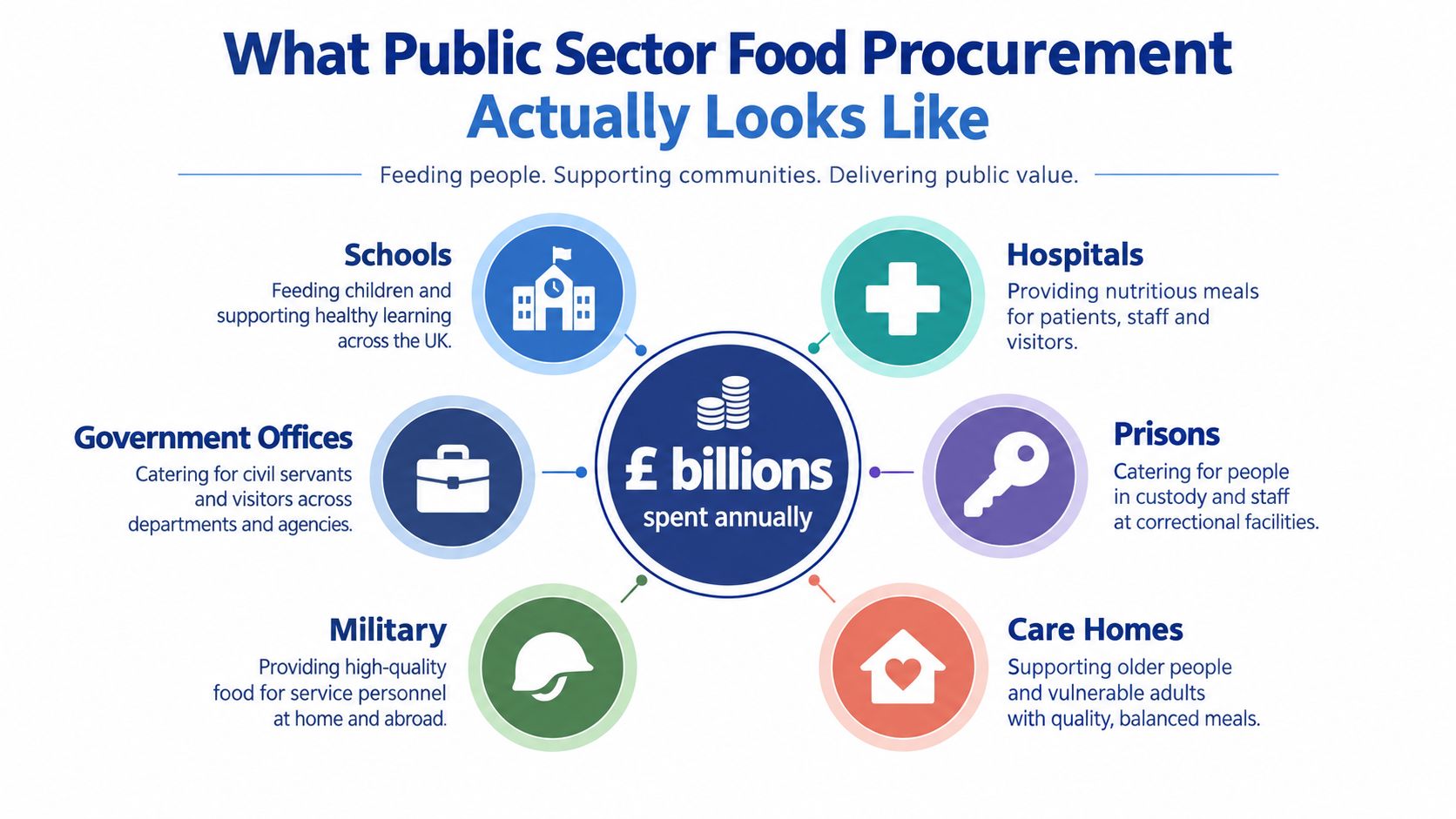
The UK public sector spends around £5 billion a year on food and catering, covering schools, hospitals, prisons, care homes, the military and government offices, according to recent UK policy estimates. That makes public sector food procurement far more than a catering exercise. It's a route through which buyers pursue nutrition, sustainability, domestic supply, animal welfare and social value.
For suppliers, the important change is how contracts are judged. Price still matters, but standards, evidence and traceability increasingly shape selection too. A strong bid must show what you sell, where it comes from, how it reaches the buyer and how it supports the contract's wider objectives.
What Public Sector Food Procurement Actually Looks Like
A school catering manager ordering ingredients, an NHS trust buying meals and a prison commissioning a catering service all work within public procurement, but they don't buy in the same way. Their menus, operational risks, contract models and evaluation criteria differ.
The scale is easy to underestimate. The National Audit Office report on public sector food procurement recorded around £2 billion a year in English public-sector food and catering spend in 2006. At that time, this represented about 7% of the £26 billion UK food and catering market. The report identified schools, hospitals, prisons and the armed forces as the four largest public-sector food-buying segments.
More recent estimates put public-sector food procurement at around £5 billion annually, with food buying alone cited at about £2.4 billion across settings such as schools, hospitals, prisons, care homes, the military and government offices. These figures show why buyers and policymakers treat procurement as a practical policy lever, not merely a back-office function.
A contract has several jobs to do
Suppose you supply fresh produce to a group of public kitchens. The buyer may need reliable deliveries, documented origin, suitable nutritional profiles, evidence of responsible production and a plan for handling disruption. The tender may also ask how your business contributes to local economies or wider environmental goals.
That creates a different bidding task than offering a low unit price. Your response needs to connect product information to the specification. A product catalogue on its own won't explain whether your supply chain meets the buyer's requirements.
The NAO estimated that smarter procurement could save more than £220 million annually by 2010 to 2011, equal to 11% of 2004 to 2005 baseline expenditure, as recorded in its report. The lesson remains relevant. Public buyers need value, but value includes operational reliability, compliance and the outcomes written into the tender.
Practical rule: Treat every requirement as an evidence request. If the tender asks about origin, provide origin records. If it asks about sustainability, provide a defined measure and supporting documents.
Foodservice operations also affect what buyers expect from suppliers. Equipment, storage and preparation processes can influence food safety and service reliability, so suppliers and catering contractors may find durable school kitchen equipment advice useful when considering the wider operating environment.
Why standards change the competition
Public sector food procurement now sits at the intersection of several objectives. A buyer might need to balance affordability with nutrition, environmental performance, traceability and supply resilience. A bid that addresses only the commercial offer leaves unanswered questions about risk.
That's why preparation matters before a tender appears. Store product specifications, allergen information, origin records, certifications, delivery details and social-value evidence in an organised knowledge base. Bidwell's knowledge base can support that preparation, while its tender monitoring helps suppliers identify relevant opportunities before response deadlines become difficult to manage.
Who Buys Public Food in the UK
There isn't one public-sector food buyer. The market is divided among organisations with different responsibilities, contract structures and risk profiles.
Schools are the dominant spend category. Around 60% of UK public food procurement is linked to education settings, and English schools spend about £2.1 billion annually from the wider government food and catering budget, according to research on school food procurement and sustainability. That concentration affects the whole supply chain. Suppliers targeting education need to understand school meal operations, predictable delivery, menu planning and the practical pressures facing catering teams.
Hospitals create a different environment. NHS buyers must account for clinical nutrition, patient needs, food safety and service continuity. Suppliers bidding for NHS work should review opportunities from NHS England buyers alongside the relevant NHS food requirements, because a product suitable for a school contract may need different evidence for a clinical setting.
The main buyer groups
| Buyer type | What tends to shape the requirement | What suppliers should prepare |
|---|---|---|
| Schools and education bodies | Nutrition, affordability, dependable service and local priorities | Menu information, product specifications, delivery plans and value evidence |
| NHS organisations | NHS Food Standards, patient nutrition and continuity | Nutrition data, allergen controls, carbon evidence and service procedures |
| Local authorities | Community services, care settings and local economic aims | Local sourcing information, social-value commitments and flexible logistics |
| Prisons | Security, controlled delivery and consistent catering | Delivery controls, resilience plans and compliance records |
| Armed forces | Scale, availability and dependable supply | Capacity evidence, contingency arrangements and traceable sourcing |
| Government offices | Catering service quality and responsible purchasing | Product data, service methods and sustainability records |
Local authorities may buy food directly for workplace catering, meetings and community services, or commission services for schools and care settings. Their specifications can place particular emphasis on local supply, community benefit and environmental outcomes.
Prisons and the armed forces often require suppliers to demonstrate that they can operate reliably within controlled environments. Government offices may involve smaller or more service-led contracts, but the same principle applies. The buyer wants evidence that your organisation can meet the specification consistently.
Before responding, identify the actual contracting authority, end users, delivery model and route to market. Bidwell's tender monitoring can help suppliers separate school, NHS, local-authority and wider public-sector opportunities, rather than treating every food notice as interchangeable.
Nutrition Standards and Mandatory Buying Rules
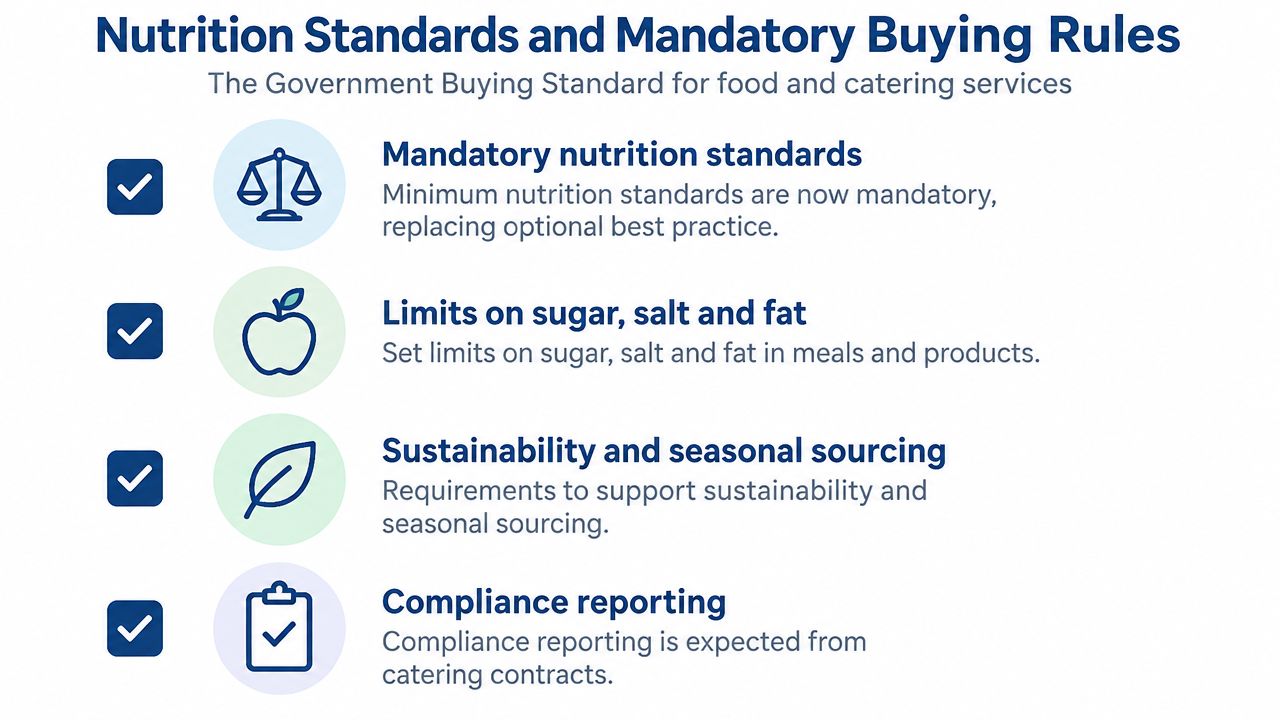
The Government Buying Standard for food and catering services changes the starting point for many public contracts. In England, central government procurers and their catering contractors must apply the standard. The wider public sector is encouraged to use its minimum mandatory standards in tenders, according to the Government Buying Standard guidance.
The standard is designed to put nutritional health, UK production or equivalent standards, animal welfare, traceability and sustainability into procurement specifications. These points aren't decorative policy language. Once they appear in the specification, they become conditions that suppliers must address.
Read the specification as an evaluation map
Start by separating mandatory requirements from scored criteria. A mandatory requirement may determine whether your bid remains compliant. A scored criterion may affect your position against competing suppliers.
For each requirement, record four things:
- The buyer's wording, copied accurately from the tender.
- The evidence required, such as a certificate, policy, product sheet or audit record.
- The owner inside your business, who can verify the answer.
- The response location, so the final bid remains easy to assess.
This approach prevents a common mistake. Suppliers often make broad claims about responsible sourcing but fail to connect those claims to the products and services being offered.
For NHS procurement, the standard contract requires providers to comply with NHS Food Standards. NHS organisations must also include at least a 10% net zero and social value weighting in procurements, as set out in the government's guidance. A bidder therefore needs more than a product list. You should be ready to map menu design, sourcing and logistics to nutrition, carbon and social-value evidence.
What your evidence pack should show
A useful evidence pack might include:
- Nutrition: product specifications, allergen information and relevant menu data.
- Sourcing: supplier names, country or region of origin and chain-of-custody records.
- Animal welfare: applicable standards, certifications and audit information.
- Environment: packaging details, logistics information and documented environmental measures.
- Social value: commitments linked to the buyer's stated objectives, with a method for reporting delivery.
The Food Standards Agency buyer information can also help suppliers identify food-related public opportunities and consider which regulatory evidence may be relevant.
The English consultation proposed that at least 50% of food spend should go on food produced locally or certified to higher environmental production standards. It also proposed a 10% social-value minimum and a 40% cost, 50% quality weighting, as described in the proposed public-sector food and catering policy for England. These are consultation proposals, so suppliers should check the wording of each live tender rather than assume that every buyer uses the same model.
Bid advice: Don't attach evidence without explaining what it proves. Name the requirement, identify the document and show how the evidence applies to the products or services in the bid.
Framework Agreements and Lotting Structures
A framework agreement gives public buyers an established route to purchase goods or services. Instead of running a completely new tender for every repeated category, the buyer can use the framework's agreed structure, supplier list and purchasing process.
The Crown Commercial Service's Buying Better Food and Drink agreement, RM6279, is open to all public-sector customers. The Crown Commercial Service announcement describes a single online access point, shorter supply chains and collective purchasing, while retaining food safety and quality requirements through Defra's Government Buying Standards for Food and Catering Services.
That design matters to suppliers because it changes the route to market. A supplier may be competing for a place on a framework, then for a later call-off or purchasing opportunity. Missing the framework tender can therefore mean missing access to several future buying routes.
Frameworks compared with direct tenders
| Route | How it works | Best suited to |
|---|---|---|
| Direct contract tender | One buyer seeks a defined supply or catering service | Suppliers with a strong fit for a specific requirement |
| Multi-supplier framework | Several suppliers gain access to an agreed purchasing route | Businesses that can meet repeat category requirements |
| Lot-based framework | The opportunity is divided by product, region, service or customer type | SMEs with specialist products or limited geographic capacity |
| Call-off competition | Framework suppliers compete for a particular requirement | Suppliers with clear pricing, capacity and delivery evidence |
Lotting can make a large opportunity more accessible. A buyer might separate products by category, geography or service model, allowing a specialist supplier to bid for a realistic part of the requirement rather than the whole contract.
That doesn't mean every lot is suitable. Check minimum turnover requirements, delivery coverage, insurance, certification, ordering systems, response times and the length of the commitment. A small supplier may have an excellent product but lack the capacity to serve every site listed in a national lot.
The public-sector agreement was expected to attract £100 million of spend over four years, while the announcement described this as only a small proportion of the annual £2.1 billion public-sector food spend. Those figures illustrate the difference between a single framework and the wider market.
Suppliers can use Bidwell's framework opportunities area to track relevant routes to market. The practical task remains the same: decide which lots match your capacity, then prepare evidence that can survive both initial evaluation and later purchasing stages.
Supplier Accreditation and Provenance Requirements
A certificate can help establish that your business follows a recognised process. It doesn't, by itself, answer every provenance question in a public food procurement tender.
Buyers increasingly need to know where food comes from, which standards apply and whether the information can be checked. That's especially important because the UK system still has a transparency gap. A recent policy note on sustainable and healthy public food procurement says public food spending is about £5 billion annually, but there's limited transparency about where the money goes and which standards are being met.
Parliamentary evidence states that, as of March 2025, the government didn't hold information on where publicly procured food was sourced from. A separate 2025 CCRI and Defra survey was launched to improve data collection, management and sharing across England. For suppliers, the message is clear. Buyers can't report what suppliers don't record.
Build a provenance file before the tender
Keep a product-level record rather than a general sustainability brochure. For each relevant product or product family, record:
- Origin: country, region or producer information, with changes logged.
- Certification: certificate name, scope, expiry date and issuing body.
- Traceability: supplier and batch records that show how information can be verified.
- Logistics: delivery locations, lead times and contingency arrangements.
- Resilience: alternative supply arrangements and procedures for disruption.
- Reporting: the format in which you can provide updates to the buyer.
This data helps with more than compliance. It lets you answer follow-up questions without asking several teams to recreate the same information under deadline pressure.
Buyers increasingly need an audit trail, not a promise. If you can't show where a product came from and which standard applies, your response leaves a material risk unresolved.
Accreditation also needs to match the tender. A food safety credential may be essential, but the buyer may separately ask about animal welfare, environmental production, labour practices, packaging or local sourcing. Read the scope carefully. A certificate covering one facility or product range may not cover everything you're offering.
Operational evidence matters too. If your business carries out testing, quality checks or product development, suitable beverage quality lab workstations can support an organised quality environment, but the tender response still needs the underlying records and procedures.
The supplier advantage comes from consistency. When origin, certification and resilience data are ready before publication, your bid team can focus on the buyer's question instead of chasing basic facts.
How Bidwell Helps Suppliers Win Food Procurement Tenders
The difficult part of public sector food procurement isn't only finding an opportunity. It's turning a large set of requirements into a precise, evidenced answer before the deadline.
Bidwell combines tender monitoring, a knowledge base and AI response generation in one workflow. Its monitoring covers major UK portals, including Find a Tender, Contracts Finder, Public Contracts Scotland and Sell2Wales, with alerts and summaries for relevant opportunities. Suppliers can use those alerts to identify food, beverage and related contracts that match their categories and delivery capacity.
Monitoring finds the right tender
Food notices can sit inside wider catering, facilities or local-authority procurements. A useful monitoring process should therefore look beyond a single product keyword. Review the buyer, location, lot structure, contract scope, estimated value where provided, deadline and required accreditations.
Bidwell's tender monitoring helps bring relevant notices into one working view. Your team still decides whether the opportunity is commercially suitable, but you spend less time checking multiple portals manually.
The knowledge base turns evidence into reusable material
Your knowledge base should hold the information buyers repeatedly request:
- Product specifications and allergen details.
- Origin and traceability records.
- Accreditation documents and expiry dates.
- Delivery coverage, lead times and resilience plans.
- Environmental and social-value evidence.
- Previous tender answers and approved case studies.
Preparation pays off. When a tender asks about local sourcing or environmental standards, the response team can work from approved evidence rather than draft a general statement from memory.
AI response generation drafts against the question
AI response generation can use the stored material to produce a customized draft for the opportunity. The draft should reflect the buyer's wording, lot, evaluation criteria and evidence requirements. A bid manager must still check accuracy, remove unsupported claims, confirm current certificates and approve the final answer.
That review is essential for food contracts. The response must distinguish between what your organisation already delivers, what it will deliver under the contract and what depends on a subcontractor or producer. It should also make clear how evidence maps to nutrition, traceability, carbon and social value.
Bidwell is one option for combining these activities. Used properly, it helps suppliers maintain a repeatable process: find the notice, qualify the opportunity, retrieve the evidence and review a structured draft. The technology doesn't replace procurement judgement. It gives the bid team a more organised starting point.
Bidwell monitors UK public-sector food tenders, stores your provenance and accreditation evidence in a reusable knowledge base, and generates custom response drafts for review. Visit Bidwell to see how the platform can support your next public sector food procurement bid.