
You've got the pricing schedule open in one window and the method statement in the other, and the deadline is Thursday. The labour rate was easy. Everything after it is guesswork: the mobilisation nobody costed, the subcontractor the specification mentions twice, the inflation clause you haven't read properly, and whatever margin happens to be left at the bottom of the spreadsheet.
That guesswork is where bids fall apart. Not in the headline price, but in the gap between what you promised in the quality response and what the money funds.
Tender pricing is a cost build, not a percentage. Get the components right, map them to the scoring model, and you can defend a higher number without flinching. Get them wrong and the cheapest bid in the room is also the one that loses money for three years.
What Goes Into a Tender Price
A price built on a percentage unravels at the first clarification. A bid manager prices a three-year cleaning contract by adding 8% to the labour rate, checks the total against a similar win from last year, and submits. Then the questions land: does that figure cover TUPE transfer, two on-site supervisors and the first month of mobilisation? None of them are in there.
The failure happens at component level, long before it shows in the total. The market is big enough that the detail matters: gross public-sector procurement spending reached £461 billion in 2025–26 across the United Kingdom, spread across contracts of every size and every level of scrutiny. Bigger contracts invite more questions, and each question probes a line you either costed or guessed.
A complete price has eight moving parts.
| Cost component | What it covers | Where it must reconcile |
|---|---|---|
| Direct labour | Salaries, statutory employment costs, time on contract | Staffing levels in the method statement |
| Materials and fixed costs | Consumables, equipment, licences, premises | Pricing schedule and delivery plan |
| Specialist subcontractors | Third-party services and their margin | Subcontractor section and assumptions |
| Mobilisation and implementation | Set-up, training, transition in the first months | Implementation plan and dependencies |
| Overhead recovery | Management, systems, insurance, compliance | Overhead line in the cost model |
| Inflation exposure | Cost elements not covered by indexation | Indexation clause or priced risk allowance |
| Bid preparation cost | Staff time spent writing and reviewing the response | Internal cost record, not the contract price |
| Margin | Return for risk and sustainability | Final price after all costs are priced |
Two rows trip up most first drafts. Software charges sit inside overhead until the licence model shifts the maths: if your delivery model includes software, understand how the charges are structured before you bury them. Per-user and module-based pricing behaves very differently from a flat licence, and a per-user charge that grows with headcount is a cost you cannot index away.
The bid you write is a cost line too
Preparation time is real money, and it comes out of your margin whether you win or lose. Price the bid effort into your bid/no-bid decision, not into the contract price. A cost column the buyer never sees still decides whether the contract was worth chasing at all.
Reconciliation is the discipline that holds the whole thing together. Every line ties back to something you have promised elsewhere in the response: labour hours against the staffing chart, mobilisation against the implementation plan, subcontractor assumptions against the section where you name them. Bidwell's tender tracking for bid teams watches every UK tender portal and emails only the tenders that match your sectors, CPV codes, regions and contract values, so you are pricing the schedules the buyer published rather than last year's template.
Before you open the schedule, list every component on a single sheet. One page, eight lines. If a line cannot be traced to a sentence in your response, either the line or the sentence is wrong.
Practical rule: price the contract you have described in writing, not the one you would like to deliver.
How Evaluation Weighting Shapes Your Price
Read the weighting before you read the price schedule. In one published Contracts Finder price-evaluation model, quality accounts for 75% of the score and price for 25%, with each bidder's pricing score converted into a percentage and applied to the maximum available price score (Contracts Finder).
A 10% price cut in that model buys you a fraction of a point. One thin quality answer costs you several. That is the whole game in a single ratio.
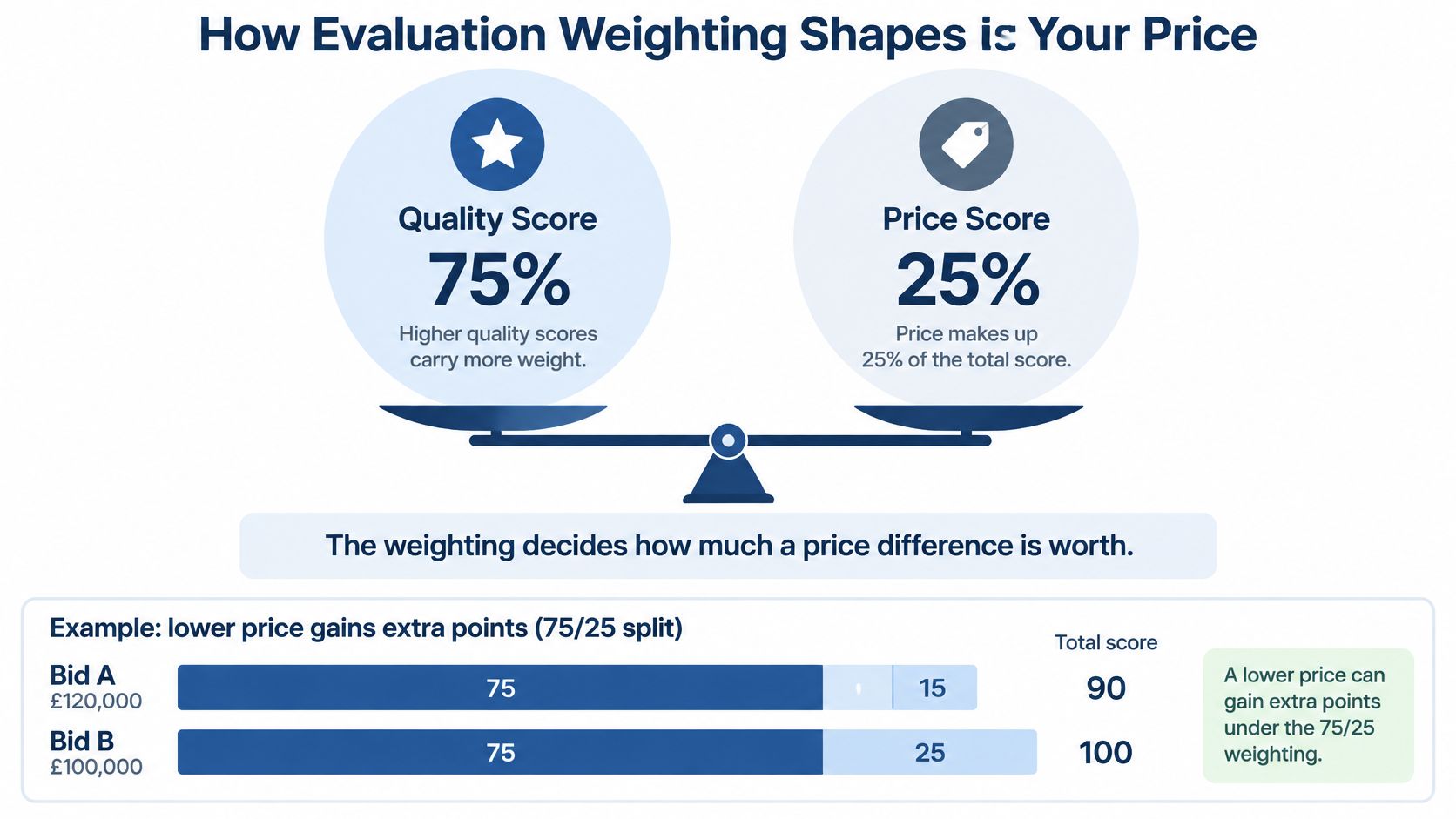
Four ways a price gets scored
The method matters as much as the weighting. UK government bid-evaluation guidance identifies several valid price methods, including relative price scoring and price-per-quality-point, and warns that relative scoring can produce unstable outcomes because your price score depends on the prices other bidders submit (Bid evaluation guidance note).
| Evaluation method | How the price score works | Pricing risk |
|---|---|---|
| Relative price scoring | Score depends on the prices other bidders submit | Results can be unstable and hard to predict |
| Price-per-quality-point | Cost measured against the quality achieved | Weaker delivery value can be exposed even when cheaper |
| Fixed price weighting (example 25% price, 75% quality) | Each bidder's price converted to a percentage of the maximum price score | A small price edge rarely offsets weak quality evidence |
| Maximum payable exposure check | Cost modelled under the highest expected volumes | Unexpected volume growth can erode margin |
Price-per-quality-point gives you an absolute benchmark rather than a moving one. You are measured on cost against achieved quality, which is why a marginally cheaper bid with materially weaker delivery value stops dominating the field.
Model each scored lot or service component separately. Then calculate your maximum payable exposure under the highest volumes the specification allows, and test the whole bid against the authority's stated quality threshold. The guidance is direct about what a costing model must do: contingent pricing has to be clearly identified and linked to the proposed quality solution, so labour assumptions, mobilisation, service levels, subcontractor costs, overhead recovery and implementation dependencies all reconcile to the method statement. A price that cannot evidence delivery at the promised quality may be challenged even when it looks commercially attractive.
Bidwell's Discover stage watches every UK tender portal and emails only the tenders matching your CPV codes, keywords, region and contract value, so you can pull the weighting from the notice early and price against it while there is still time to reshape the offer.
Find the weighting in the notice, write your target price beside it, and treat that number as a constraint you design around before you draft a single answer.
When a Higher Price Still Wins
UK public buyers don't have to pick the cheapest bid. Under the Procurement Act 2023, contracting authorities can assess tenders using several award criteria, provided they publish the relative importance of each one through percentage weightings, a ranking or another clear method. They must then assess bids against that published methodology rather than changing the rules during evaluation (Procurement Act 2023 guidance on assessing competitive tenders).
Government guidance also says price doesn't have to take precedence over non-price factors, because value for money can include wider public benefit rather than cost alone. That is a legal opening for a supplier whose real advantage is delivery quality, not cost.
The test: can you show, line by line, that the cheaper alternative leaves a scored gap the weighting won't forgive?
Four checks decide whether you keep the higher number.
- Link every priced resource to the scored specification. If the rate funds three supervisors and the quality answer promises three, that's evidence. If the answer promises a named contract manager the price doesn't cover, you've just written your own downfall.
- Test whether the price funds KPI delivery, dependencies and whole-life cost. Not year-one labour.
- State potential price increases, including inflation you can't recover. Buyers accept an honest risk position far more readily than a surprise in year two.
- Keep outcome evidence next to the assumption that drives the rate. The assumption is the weakest link in every challenge you'll face.
Thresholds set the frame for which opportunities you even look at. Current government guidance lists £139,688 for goods and services bought by central government authorities, £214,904 for goods and services bought by sub-central authorities such as councils, and £5,372,609 for works, and notes that dynamic markets can't be used to award below-threshold goods, services or certain works contracts because membership has already involved supplier suitability assessment (Procurement Act 2023 e-learning, module 1).
Use those numbers as a filter on what reaches your desk. Buyer type, estimated value and procurement route tell you more about the likely competition than the contract title does, and they're the first fields to record in a knowledge base of bid/no-bid decisions.
That commercial work takes time, and time is the thing bid teams never have. With Bidwell, the 20-to-40-hour tender writing task becomes a 2-to-4-hour task, which leaves the modelling somewhere to happen.
Pricing Strategies That Survive Scrutiny
Fixed price or rate card? The answer comes from who carries the risk, not from what feels safer to submit.
Fixed price works when the scope is stable, well defined and short, and the buyer wants cost certainty. You carry both the cost risk and the volume risk. Bid it only on scope you control.
A rate card suits uncertain volumes. The rates are fixed and the total moves with demand, so the buyer carries volume risk while you carry rate risk. It's the honest structure for call-off work where nobody knows how many call-offs there will be.
Cost-plus arrangements apply where the buyer wants open-book costs and accepts more cost movement. They carry more of the risk and expect full transparency in return. Don't offer cost-plus to a buyer who wants a number on a page.
| Structure | When it fits | Who carries the risk |
|---|---|---|
| Fixed price | Stable, well-defined scope and a short duration, where the buyer wants cost certainty | Supplier carries cost and volume risk |
| Rate card | Uncertain volumes, with rates fixed and the total moving with demand | Buyer carries volume risk; supplier carries rate risk |
| Mixed | Facilities example: a fixed monthly fee for core cleaning plus a set hourly rate for call-outs | Core scope is fixed; extra demand is variable |
| Cost-plus | Buyer wants open-book costs and accepts more cost movement | Buyer carries more of the cost risk |
The mixed structure is the one most contracts need. A facilities contract with a fixed monthly fee for core cleaning and a set hourly rate for additional call-outs gives the buyer certainty on the predictable part and flexibility on the rest.
Fixed price buys certainty for the buyer and sells risk to you. Only take it when you control the scope.
Set each rate from the cost components you already built, then check the total lands on the margin you need rather than the one you'd like. Buyers test whether each rate ties back to the delivery model, and an unexplained rate is the easiest thing in your bid to challenge.
The same logic runs through other supplier markets. When fixed-price software development works comes down to scope certainty, which is exactly the test for a fixed-price tender. Our guide on tender pricing schedules covers when to use fixed pricing versus variable rate cards, and the bid manager workflows we build around them keep the rate card and the cost model in step.
One closing check before you submit: does the structure match the risk the buyer is carrying?
Managing Inflation and Indexation Risk
A three-year price with no adjustment mechanism is a three-year bet on inflation. Most suppliers lose that bet at least once, and the loss lands in year two when the contract is already running.
UK government sourcing guidance identifies three principal approaches: escalation factors, indexation, and cost-plus payment mechanisms or variants. Where inflation risk isn't wholly transferred to the supplier, the contract can link specified price elements to an independently compiled Office for National Statistics index, using published index data rather than forecasts (Risk allocation and pricing approaches).
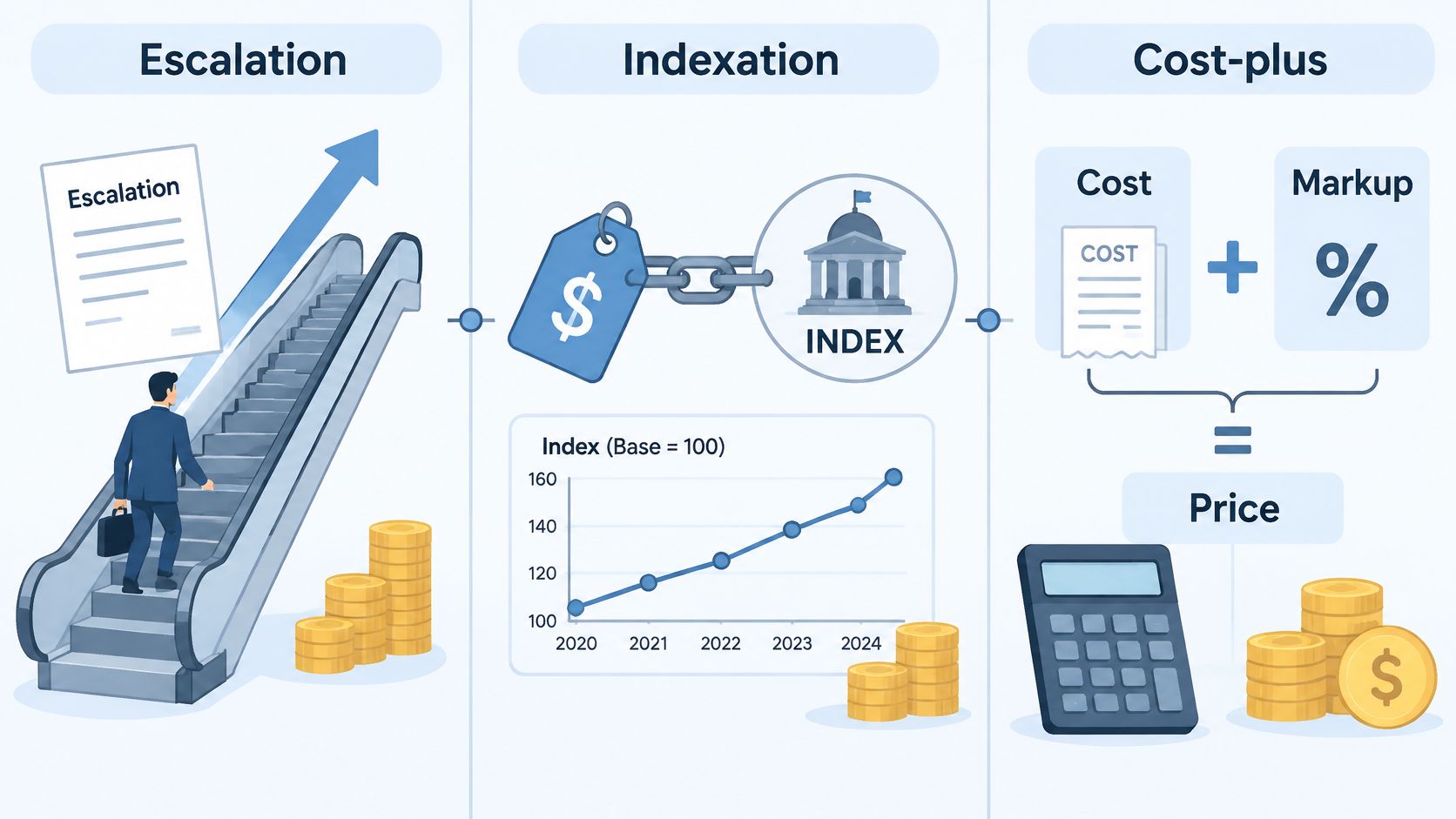
The clause has to name four things. The applicable index, the affected cost base, the calculation method, and the price-uplift date. Annual updates are the typical operating cadence.
Then do the separation work inside your own schedule. Split base labour from statutory employment costs, fuel, materials and specialist subcontracting, because those lines move at different speeds and some don't move at all. Quantify the exposure under low, central and high inflation scenarios and you'll know within an hour whether the contract is viable.
Practical rule: if the contract offers no indexation, the inflation you can't recover belongs in the price or in a clarification. Never in hope.
Absorbing it is how a competitive bid becomes a loss-making contract. The price looks sharp at submission, but the margin is gone by month eighteen, and at that point you're funding the buyer's service out of your own cash flow.
If the authority offers nothing, raise a transparent clarification. Ask whether the pricing schedule permits an inflation allowance, or whether the contract value has been set against a stated assumption about cost movement. An honest question before submission costs you nothing. A loss-making contract costs you three years.
Proposing indexation tied to official UK data does something else useful. It gives you an auditable basis for sustainable pricing and reduces the arguments about later increases, because neither side is guessing.
Write the clause and the date of the first uplift into the pricing schedule before submission. Not into the covering letter, not into a footnote, and not into an assumption the evaluator has to hunt for.
What to do when the buyer offers nothing
Price it. A visible allowance in the cost model is more defensible than a number that assumes flat costs for three years. Evaluators understand inflation. They don't understand how your rate stayed flat through it.
Common Pricing Mistakes and How to Avoid Them
Pricing mistakes cost you twice. Once when you lose the award, and again when you win it.
Treat these four as a pre-submission test rather than a post-mortem.
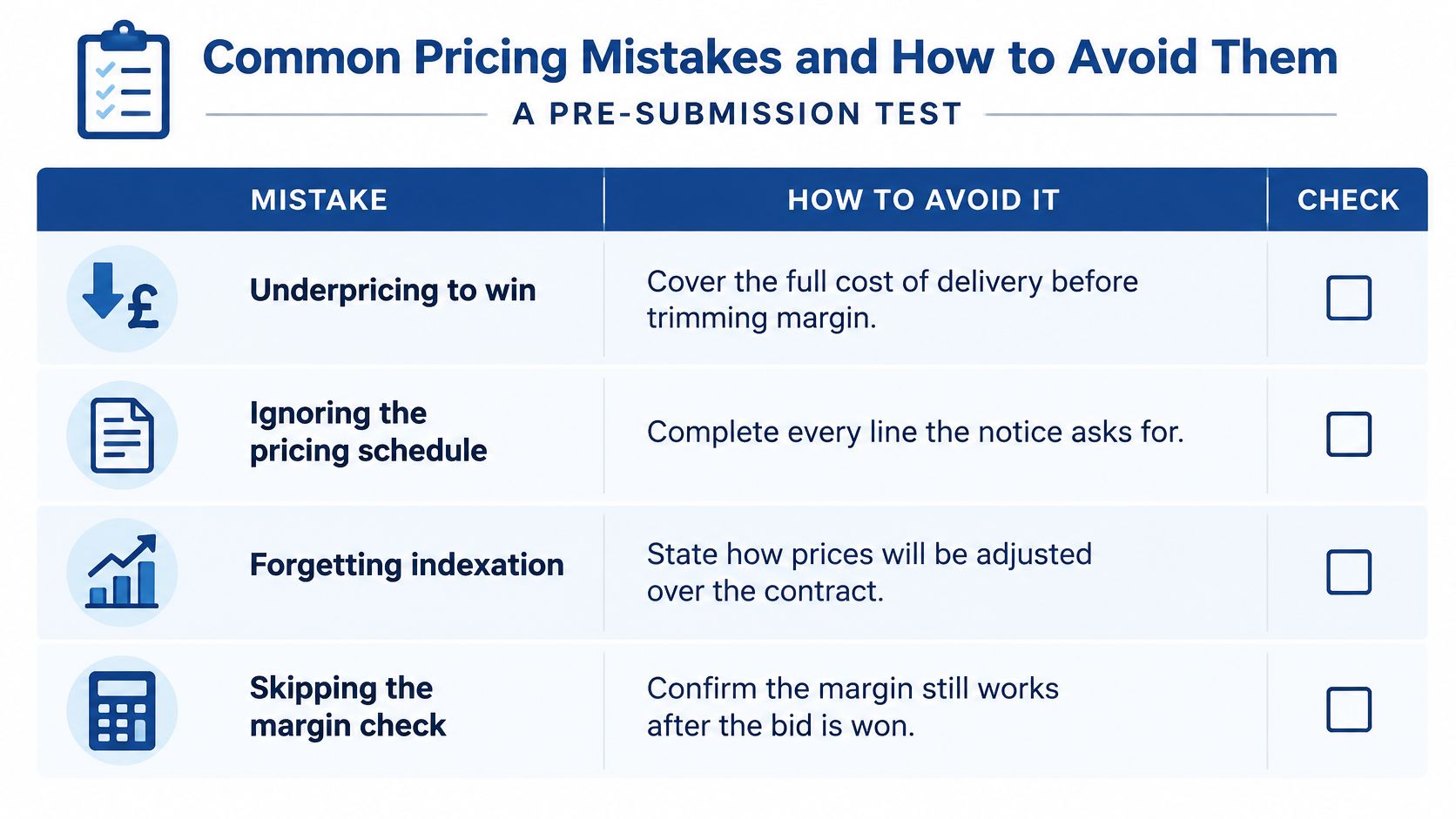
Underpricing to win. Cover the full cost of delivery and a sustainable margin, because a price that looks keen can signal you haven't understood the service. It can fail both evaluation and delivery, and the second failure is the expensive one.
A figure the buyer can't test. If your price sits far below the range implied by the specification, expect a challenge against the cost model even when competition is thin. Thin competition doesn't make a weak cost model safe.
Assuming a crowded field. Of more than £100 billion in contract value awarded by major government departments during 2021–22, approximately two-thirds was subject to competition in some form, and analysis of 235 large contracts recorded on Find a Tender between January 2021 and January 2023 found that 20% of open-competition procurements received only one bid (Competition and Markets Authority). A single-bid outcome doesn't prove weak pricing, but it removes the comparison, which means your cost model has to show credibility entirely on its own.
Treating a weak field as room to pad. The same CMA guidance cites OECD research indicating that bid rigging can increase public-procurement prices by 20% or more, transferring the extra cost to taxpayers. Buyers know that figure. So do their auditors.
A cheap bid that can't be delivered is a delay, a dispute and a reference you'll never use again.
The pattern behind all four is the same. Each one treats price as a number to be optimised in isolation, when it is in fact the financial statement of everything you've promised elsewhere in the bid.
Build Your Pricing Workflow Before the Next Deadline
Most pricing problems are workflow problems. A figure that cannot be reconciled to a cost component, a schedule nobody opened, an indexation clause skimmed on deadline day: each one is a skipped check, and each one is avoidable. Run these seven, in order, once you have the notice, the schedules and the evaluation method in front of you.
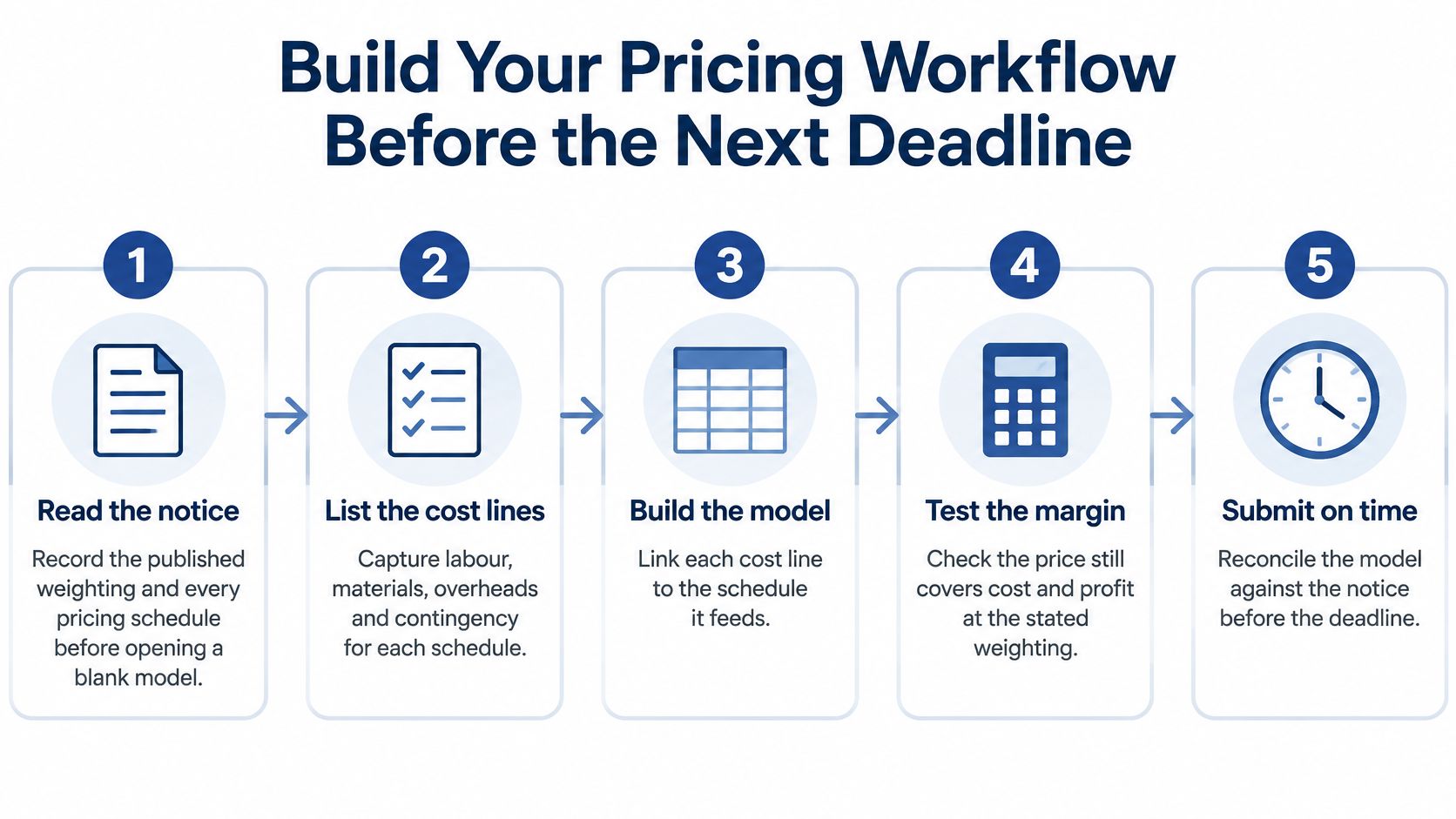
- Record the published weighting and every pricing schedule from the notice before you open a blank model. The schedule you miss is the one that gets scored.
- List each cost component and tick it against the method statement: labour, subcontractors, mobilisation, overhead, risk, margin.
- Choose the structure (fixed, rate card, mixed or cost-plus) so it matches the risk the buyer is carrying, then set each rate from those components.
- Separate the inflation-sensitive lines. Apply the stated index, uplift date and calculation, or price an explicit allowance and raise a clarification.
- Test the total under low, central and high volumes against the quality threshold, and note your maximum payable exposure.
- Write the price narrative so each figure ties to a delivery commitment, a KPI and an assumption.
- In the 48 hours before the deadline, re-run the same checks. Stop if a line doesn't reconcile. A week of writing is cheaper than three years of a contract that doesn't fund itself.
Step 7 is the one that pays for the other six.
Bidwell's tender monitoring watches Find a Tender, Contracts Finder, Public Contracts Scotland, Sell2Wales and eTendersNI, and matches each notice by sector, CPV code, region and contract value, so the tenders that reach you are already narrowed to work you can price. Its bid writing software drafts a first-pass response against the actual tender notice rather than a generic template, using a knowledge base built from your credentials, past responses and case studies. Every figure in the pricing schedule still gets your own check against the commercial commitments, because you review, polish and submit the response yourself. When a tender is won, the response goes back into the knowledge base, so the next bid starts from your own evidence.
If you want to gauge the cost before committing a bid window to the wrong opportunity, the free tender readiness checker and cost-to-respond estimator are at Bidwell.

