AI bid platforms reduced a 47-hour manual baseline to 11 hours of human review and refinement, a 76.5% reduction, in a 2026 UK SME audit. That result shows what proposal automation software can do well, but it doesn't mean a complex public-sector tender can be generated, approved and submitted without expert judgement.
The useful question isn't whether software can write. It can. The useful question is whether it can help your team find the right opportunities, organise defensible evidence, draft against the scoring criteria and leave a clear record of who checked what.
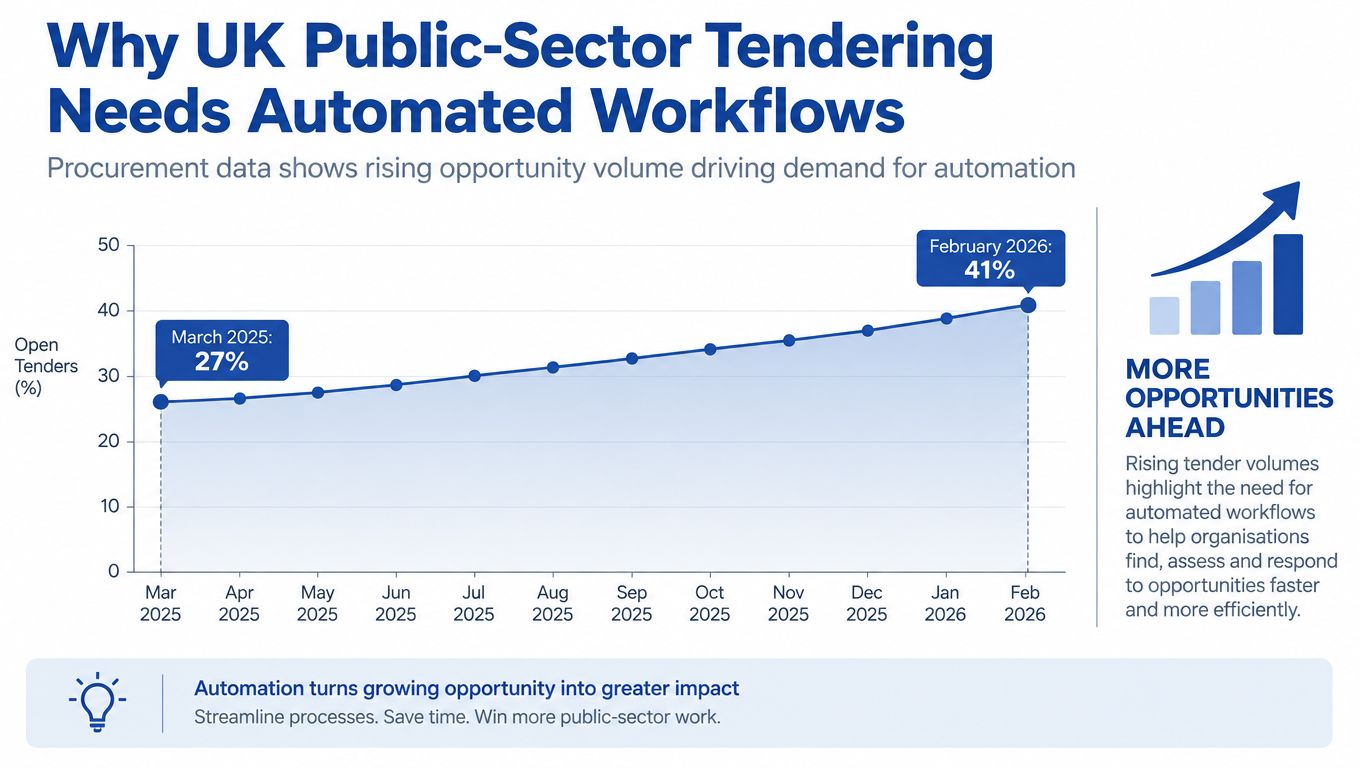
UK procurement is creating more need for that discipline. Open tenders rose from 27% in March 2025 to 41% in February 2026, while direct procedures fell from 53% to 34% over the same period, according to analysis of UK Procurement Act data. More structured competition means more requirements, more deadlines and more opportunities for a small bid team to miss something.
What Proposal Automation Does
Proposal automation software can monitor tender portals, extract requirements, locate relevant evidence in an approved knowledge base and produce a first draft mapped to the buyer's questions. The practical benefit is coordination: fewer manual searches, clearer ownership and more time for review.
The output remains a starting point. Drafting assistance gives the bid manager structured material to test and improve. Autonomous response generation would create a complete, reliable submission without meaningful human intervention. Complex UK public-sector bids still require the first approach because compliance, evidence and approval cannot be delegated to a text generator.
A 2026 UK audit of 1,140 live public-sector bids by SME contractors in soft FM categories found that complete first drafts could be produced in under 30 minutes (UK AI bid-writing market analysis). That changes the bid manager's working day. Time previously spent assembling a rough response can move to checking mandatory requirements, testing evidence against the evaluation criteria, resolving gaps with subject-matter experts and recording approvals. Faster drafting only creates value when the recovered time is used for those controls.

Automation is not a replacement for bid judgement
The software handles volume and structure well. It can break a question into requirements, constraints, evidence requests and response instructions, then suggest approved content instead of leaving a writer to search old folders and emails.
Judgement remains with the team. Software cannot decide whether a mobilisation plan is credible for a particular authority, whether a case study proves the buyer's priority or whether a commercial position is sensible. Those decisions depend on context, risk and knowledge of the opportunity.
Practical rule: Use AI to reduce drafting effort, not to outsource accountability.
A governed bid-writing software workflow should therefore support opportunity identification, evidence selection, drafting, review and approval. Each stage needs a visible owner and a record of the changes made. That audit trail matters in public-sector work, where a persuasive answer still fails if it ignores an instruction or relies on unsupported evidence.
The output depends on the inputs
A generic model can produce fluent prose. Fluent prose is not a compliant answer. Outdated policies, vague credentials or unverified claims in the knowledge base give the system weak material to reproduce.
Good automation creates time for quality control. The team can test each answer against the marking scheme, strengthen the evidence, remove unsupported promises and document human review. The role changes from writing every sentence to directing, checking and improving the submission.
Core Features of Effective Proposal Automation Platforms
For UK public-sector bidders, three features need to work as one workflow: tender monitoring, a governed knowledge base and AI response generation. A platform that only drafts text leaves opportunity discovery and evidence control to separate manual processes.
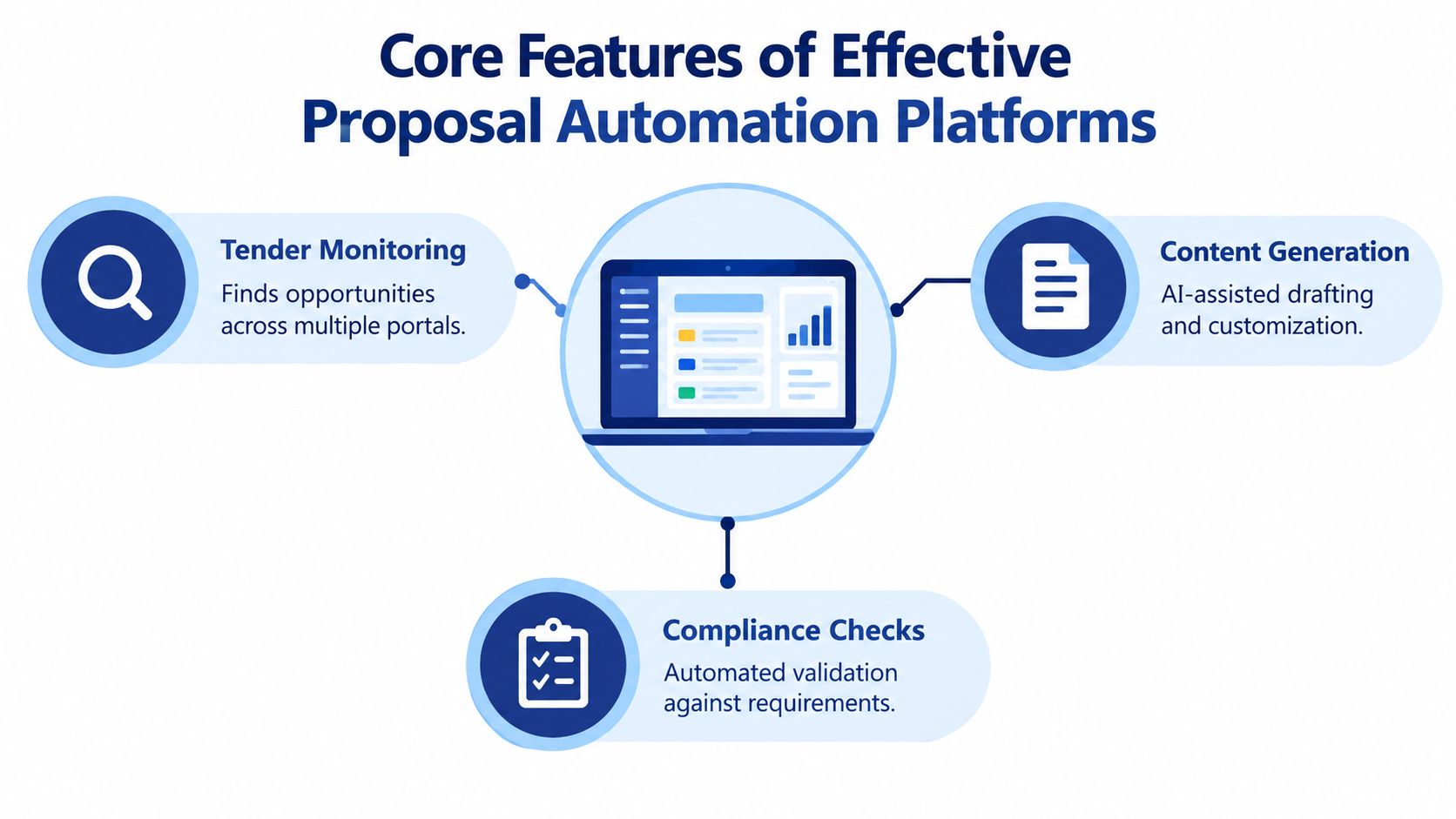
Tender monitoring
A useful monitoring function needs to cover the places where relevant notices appear. That includes Find a Tender, Contracts Finder, Public Contracts Scotland and Sell2Wales, rather than relying on a single feed.
The reason is structural. Contracts Finder covers UK contracts worth over £12,000 including VAT, while opportunities usually above £139,688 including VAT move to Find a Tender (Contracts Finder guidance). Scotland, Wales and Northern Ireland also use dedicated procurement websites.
Monitoring should do more than send a large stream of alerts. It should filter by service category, geography, contract value, buyer and deadlines, then provide a short summary that lets the team make a bid or no-bid decision quickly.
Knowledge base management
The knowledge base is where the organisation stores the material that makes a response specific. Useful records include accreditations, policies, mobilisation plans, staff qualifications, case studies, quality procedures and approved answers from earlier bids.
The important control is ownership. Each item needs a responsible person, a review status and enough context for a writer to understand where it can be used. A case study about cleaning services shouldn't automatically answer a question about security guarding just because both use the word “service”.
AI response generation
AI response generation should use the tender's requirements and the organisation's own evidence. The result should be a first draft that follows the question structure, reflects the evaluation criteria and points to supporting material.
A platform that monitors but doesn't connect opportunities to evidence still leaves the writer with a blank document. A platform that generates text without monitoring or a governed knowledge base creates a different risk, polished answers that may not fit the tender or may rely on information nobody has checked.
The sequence matters:
- Find the opportunity: Apply filters to official portal data.
- Qualify the bid: Check scope, deadlines, eligibility and likely fit.
- Map the requirements: Turn instructions and scoring criteria into a compliance matrix.
- Retrieve evidence: Match approved knowledge-base records to each requirement.
- Generate and review: Produce a draft, then have named reviewers validate it.
That sequence is more useful than a product demo built around a single impressive paragraph.
Why UK Public-Sector Tendering Needs Automated Workflows
Excluding cross-government frameworks, 52% of awarded value was tendered openly, compared with about 35% by value through direct awards, according to UK procurement data analysis. For bid teams, that means document-heavy competition remains a major route to public-sector revenue. The operational need is clear: find relevant notices early, qualify them consistently and preserve evidence of each decision.
Portal coverage is now a workflow issue
Find a Tender began publishing both above-threshold and below-threshold notices for new UK procurements from 24 February 2025, except below-threshold notices in Scotland (Find a Tender search guidance). Teams still need to check Contracts Finder, Public Contracts Scotland and Sell2Wales for other notices.
That creates a governance problem as well as a monitoring problem. A bid manager checking one portal can miss an opportunity or find it too late to assess properly. Automated monitoring should record the source, apply source-aware filters and retain the original notice alongside the qualification decision.
Bidwell's tender use case shows how tender monitoring can connect with summaries and response preparation. The useful control is the handoff from alert to decision. If the team proceeds, the workflow should preserve who approved the bid, which requirements were identified and what evidence supports the response.
More competition increases the cost of weak process
Open competition does not mean an SME should bid more often. It requires a repeatable method for comparing scope, eligibility, deadlines, evaluation criteria and delivery fit before writing begins.
As the Open Contracting Partnership analysis of Procurement Act data cited earlier showed, direct awards moved from 15% of published procedures in March to 24% by May. Bid teams therefore need workflows that handle both open and direct routes, with an audit trail that explains why an opportunity was pursued, rejected or escalated.
Human review remains necessary. Automation can collect notices, classify requirements and route work, but it cannot own the bid or no-bid judgement, confirm that an interpretation is correct or approve a claim for submission.
For an SME with one senior writer and several operational contributors, that separation matters. Automation increases discovery and preparation capacity, while named people retain responsibility for compliance, evidence and the final response.
How Proposal Automation Works in Practice
Take a regional cleaning contractor considering a local authority facilities management tender. The team has relevant accreditations, mobilisation documents and previous answers, but those materials sit across a shared drive, old submissions and email attachments.
The process starts with a monitored alert. The tender matches the contractor's service category and operating area, so the bid manager checks the contract scope, submission deadline, minimum requirements and evaluation method. The team then records a bid or no-bid decision before anyone begins drafting.
From tender notice to evidence map
The system imports the tender documents and breaks the response into individual questions. It can identify instructions such as required policies, staffing information, service levels, reporting arrangements and social value commitments.
The bid manager verifies the extracted requirements and builds a compliance matrix. Each row should show the question, word limit, evidence needed, owner, reviewer, submission location and status. The machine does the extraction. The bid manager confirms that nothing important has been misunderstood.
The knowledge base then suggests relevant content. A previous mobilisation plan might support the implementation answer. A quality policy may support the inspection regime. A case study may provide evidence of handling a large, multi-site cleaning operation.
Drafting against the marking scheme
AI response generation can assemble a first draft around the authority's evaluation criteria. It may place the mobilisation sequence in the order requested, identify the proposed roles and connect each commitment to stored evidence.
That draft still needs work. The operations lead checks whether staffing assumptions are realistic. The commercial lead checks the cost implications. The bid manager tests whether each paragraph answers the question directly and whether the response makes the evidence easy for an evaluator to find.
The system can organise a response around the marking scheme. It can't decide whether your pricing strategy is competitive.
Review, approval and submission
The final stage should preserve the human checks. Reviewers confirm factual accuracy, policy references, dates, named responsibilities and any claims that could create a contractual commitment.
The platform's role is to show what was generated, which knowledge-base records informed the answer, who edited it and who approved it. The team then completes the buyer's submission process. Automation reduces the writing burden, but the contractor remains responsible for the response.
That division of labour is the sensible model. Machines handle extraction, retrieval and first-pass composition. People handle interpretation, risk, commercial judgement and final accountability.
Choosing the Right Proposal Automation Approach
The right approach depends on where your current process breaks. A modular tool may suit a team that already has reliable portal monitoring and document control. An integrated platform is more useful when alerts, evidence and drafting are spread across disconnected systems.
| Evaluation area | What to test | Typical trade-off |
|---|---|---|
| Portal coverage | Does it monitor Find a Tender, Contracts Finder, Public Contracts Scotland and Sell2Wales? | Wider coverage may require more careful filtering |
| Knowledge base | Can you tag policies, credentials, case studies and previous answers by use and owner? | Flexibility needs governance to prevent clutter |
| Compliance support | Can it create a requirement list, compliance matrix and approval record? | More controls may add review steps, but reduce hidden omissions |
| Human review | Can named users edit, approve and trace generated content? | Stronger controls limit unattended generation, appropriately for public bids |
A single-portal monitor may be simple to operate, but it won't provide dependable coverage for a UK-wide bidder. A template library can improve consistency, but it won't tailor evidence to a new evaluation criterion. AI drafting can save time, but it needs source material and review controls.
Questions to ask during a trial
- Source coverage: Which official portals are monitored, and how are duplicates handled?
- Evidence control: Can an administrator mark content as approved, restricted or due for review?
- Requirement mapping: Does the system separate mandatory instructions from desirable content?
- Disclosure support: Can the workflow record AI use in a way that supports PPN 017 disclosure expectations?
- Auditability: Can you see the source records, edits, reviewers and approvals behind a final answer?
- Export and submission: Does the final document preserve the buyer's structure, formatting and response limits?
Bidwell's alternatives overview is useful as a comparison starting point, but no feature list can replace a controlled trial with one of your own tenders. Test a difficult opportunity, not a clean sample document. Check whether the system handles ambiguous wording, conflicting requirements and evidence that needs careful qualification.
The most important trade-off is speed against control. A tool that generates quickly but cannot show why an answer was produced may create more work at final review. A tool with requirement mapping, governed content and clear approvals may feel slower at first, but it supports a defensible process.
Common Misconceptions About Tender Automation
Misconception one, automation means full autonomy. UK government guidance permits AI in tendering, while relevant procurement notice guidance may require suppliers to disclose its use in ITT responses (PPN 017 guidance).
The workflow therefore needs a usable audit trail and human approval. Bid teams should be able to identify where AI assisted, which evidence informed the answer and who approved the final wording. Without those records, a fast draft can create questions during assurance or clarification.
Misconception two, AI bid writers replace bid expertise. Tussell's analysis of AI bid writers in public-sector bidding presents them as useful for first drafts, clearer wording, summaries and repetitive administration. They do not independently produce competitive, compliant answers for complex UK government tenders.
The bid manager still has to interpret the buyer's priorities, evaluation method, service model and the risks attached to each promise. Software can find and shape approved material faster, but it cannot supply organisational knowledge absent from the source content.
Misconception three, speed is the only benefit. Consider a team triaging five tenders in one week. Automation can reduce time spent searching, comparing requirements and rewriting standard material, leaving more capacity for qualification, tailoring and review. That capacity matters only if governance keeps pace with output.
The audit cited earlier reported a change in soft FM SME win rate from 8.4% in 2024 to 14.1% in 2026 among contractors using AI-assisted preparation. The finding does not show that software alone wins bids. Preparation quality, opportunity selection and commercial fit remain decisive, while documented human review makes the process defensible.
Strategic Adoption Tips for Bid Teams
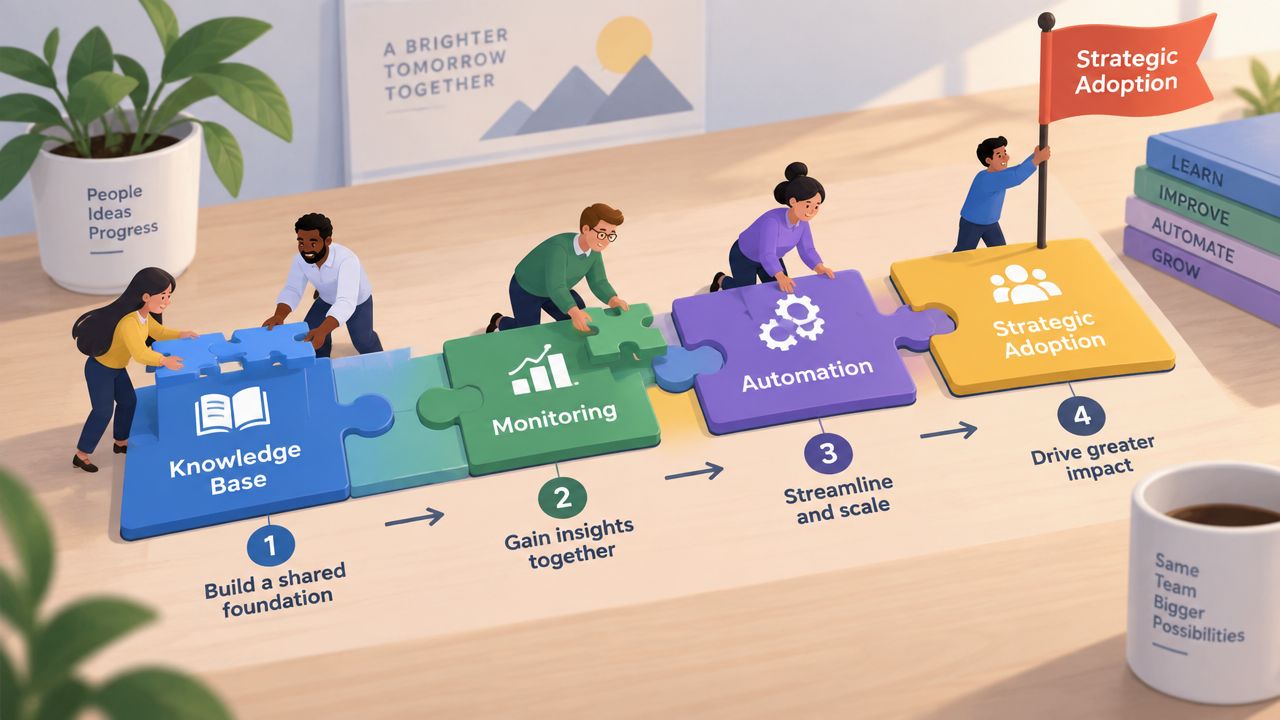
Start with the foundations. Configure tender monitoring first, then build the knowledge base, then introduce AI response generation once the source material is organised and owned.
Assign clear roles from the outset:
- Bid manager: owns qualification, requirement mapping and final response quality.
- Subject matter expert: checks operational claims and service feasibility.
- Content owner: reviews policies, credentials and case studies.
- Approver: confirms the response is accurate, compliant and commercially acceptable.
Build governance into the workflow
Record which content is approved, who last reviewed it and when it needs checking again. Keep a clear distinction between source evidence, generated wording and human edits.
Create a simple AI disclosure process that your team can apply when a tender asks about AI use. PPN 017 makes transparency relevant, so the platform should support an audit trail rather than treating generation as an invisible background task.
Measure outcomes that reflect bid quality and capacity. Time per bid, review effort, qualified opportunities pursued and the quality of compliance checks are more useful than the number of alerts or drafts produced.
The purpose of automation is not to remove the bid team. It's to give the bid team enough capacity to apply judgement where it has the greatest effect.
Start with one service line and a manageable set of tender filters. Review the first completed responses with the people who wrote and approved them. Remove weak knowledge-base records, refine the filters and only then increase the scope.
Proposal automation software works when tender monitoring, knowledge management and AI response generation reinforce one another. The technology handles repeatable work. Your team remains responsible for selecting the right bid, proving the claims and signing off the answer.
Bidwell combines UK tender monitoring, a searchable knowledge base and AI response generation for teams preparing public-sector bids. Visit Bidwell to see how the workflow can support opportunity discovery, evidence-led drafting and human review.