
An estimated 7 million people in the UK had used generative AI at work by 2024, according to Deloitte's findings described in the Office for National Statistics' account of AI in the UK economy. That makes this a management question, not just a software question: what are people putting into these tools, and who checks what comes out?
For a business bidding on public-sector contracts, faster writing is only useful if the submitted answer remains accurate, credible and compliant. The practical case for generative AI for business starts with that distinction, not with how quickly a tool fills a blank page.
What Generative AI Means for Your Business
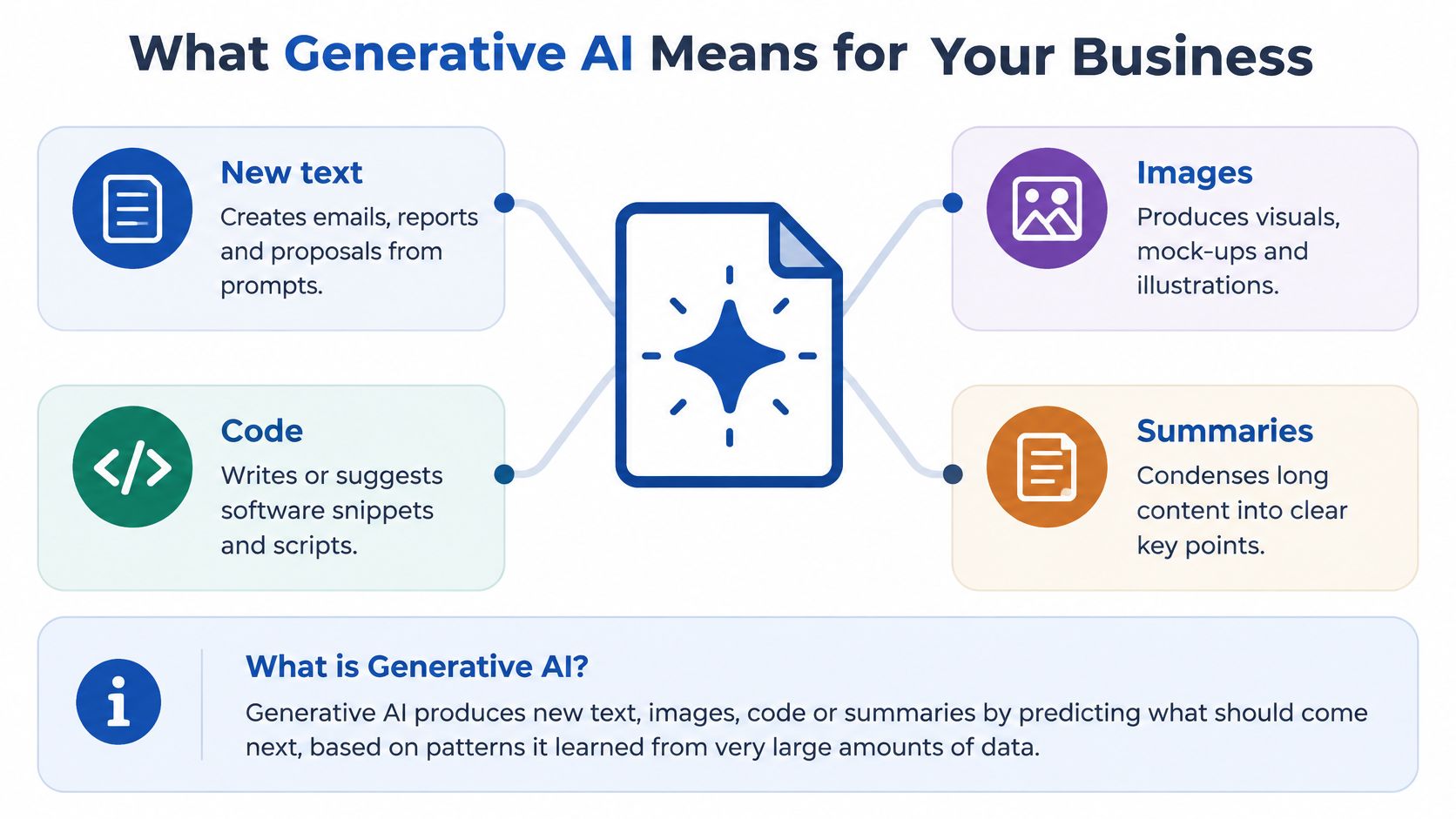
Generative AI produces new text, images, code or summaries by predicting what should come next, based on patterns it learned from very large amounts of data. For a bid manager, it's like a fast junior writer who has read a huge library but has never seen your company's files.
Say you ask it to describe your mobilisation approach. Without your implementation plan, staffing assumptions and customer evidence, it can produce something convincing that your business has never agreed to deliver.
Older rules-based automation follows steps you've written in advance. An unexpected input may stop the process or trigger an error. Generative AI can keep writing, which makes an unsupported answer harder to spot.
Start with the work, not the technology
The UK Government's 2025 AI Adoption Survey found that 16% of businesses used at least one AI technology, while 85% of existing AI users used natural-language processing or text-generation tools. Those are figures for AI adoption generally, not a measure of tender-writing software.
You don't need to build a machine-learning department to try a commercially available language tool. You do need to give it a bounded job:
- Draft new text, such as an initial method statement.
- Reshape existing material, such as shortening a case study without changing its evidence.
- Answer from supplied documents, such as finding the policy that supports a security answer.
For broader organisational planning, Freeform Company's enterprise AI guide is a useful companion to a workflow-level assessment. Keep your first implementation smaller than your eventual ambition.
Practical test: Does the task involve reading, writing or reshaping text, and can someone check the result in a few minutes?
Tender monitoring helps you identify work worth considering. A knowledge base supplies business evidence. Response generation should operate inside those boundaries, rather than invent the missing parts.
Where Generative AI Earns Its Place
The benefits worth testing are faster first drafts, capacity for more suitable bids, and consistent reuse of approved answers. Treat each as a pilot objective, not a promised result.
Business functions, typical tasks and review effort
| Function | Typical task | Review effort | Main risk |
|---|---|---|---|
| Bid and tender writing | First drafts of method statements and case study answers | High: every claim, price and scored answer checked by a named expert | Unsupported claims that fail scoring checks |
| Marketing | Blog drafts, email sequences and social posts | Low to medium: a read-through and brand check | Generic tone that dilutes your brand voice |
| Customer support | Reply drafts pulled from an approved knowledge base | Medium: check each reply against the source | Confident answers to questions the knowledge base doesn't cover |
| Operations | Meeting summaries and standard operating procedure drafts | Low to medium: check decisions and owners | Missed actions or decisions in the summary |
| Finance | Commentary on monthly variance reports | High: every figure must be checked | Plausible explanations for numbers the model hasn't seen |
| HR | Job adverts and draft policies | High: legal and tone review | Discriminatory wording or outdated legal references |
Match review effort to the consequence
A meeting summary might need a quick check of decisions, actions and owners. A tender answer committing your business to a service level needs a delivery owner who can approve that commitment.
Finance is another useful boundary. Give the tool verified figures and ask it to organise commentary, but don't accept its explanation for a variance unless someone has established the cause. A well-written guess remains a guess.
For a hypothetical large tender response, you might budget 20 to 80 hours of manual work, with a smaller submission nearer the lower end. That's a planning scenario, not an industry benchmark. Your own timesheets should determine whether drafting is the expensive part.
Sometimes the bottleneck is finding suitable opportunities. Sometimes it's waiting for a technical director to approve evidence. Faster prose won't fix either problem by itself.
Choose a task you can verify
Use these questions before approving a use case:
- Is the source material available? A missing policy can't be replaced by a confident paragraph.
- Can someone check the output against that source? Review needs evidence, not a second opinion from another model.
- Does a mistake cost little? Start with internal drafts before externally binding statements.
Structured work such as security questionnaire responses provides a useful assessment case because reviewers can compare answers with approved controls. However, a response about encryption or incident handling still needs a qualified owner.
Pick one function for the pilot. Introducing drafting across marketing, HR, finance and tendering together makes it difficult to identify what helped and what created rework.
Controls to Set Before You Bid
Start with the failures you need to prevent:
- Confidentiality breaches, including restricted buyer information entering an unsuitable tool.
- Invented evidence, such as unsupported accreditations or customer outcomes.
- Scoring errors, where a polished answer misses the actual question.
- Unapproved commitments, caused by submitting without human sign-off.
- Weak security or biased wording, including inappropriate access and discriminatory language.
A small firm doesn't need enterprise bureaucracy to address these risks. It needs controls that people can follow under a submission deadline.
The UK Government's AI adoption report records accuracy and bias concerns among 60% of businesses, with adoption around 24% for micro-businesses, compared with 44% for businesses with 250 or more employees. The practical answer is a short operating procedure, not a policy nobody opens.
The minimum control set
Keep the rules alongside the bid checklist:
- Approved tools and inputs. Name the permitted tools and distinguish public, internal and restricted material. Redact personal or customer details that aren't needed.
- Supplier terms. Check training reuse, subprocessors, deletion and access arrangements. At Bidwell, customers' knowledge base, past wins and policies aren't used to train shared models; our privacy information supports your wider assessment.
- Traceable evidence. Require a document reference for substantive claims, with an owner and current approval status.
- Review and version control. Assign reviewers, retain the approved submission and distinguish it from working drafts.
- Retention and incidents. Set a retention period suited to your obligations. Name who handles accidental disclosure, stops further processing and arranges investigation.
Don't set a retention period merely because the software offers it. Check what your contracts, procurement process and data-protection obligations require.
Make the controls visible in the workflow
For tender-generation systems, separate public tender inputs from the private knowledge base. Restrict access by role, isolate customers' information, encrypt stored and transmitted data, and retain tamper-resistant prompt and output logs.
Only approved documents should be available for answer generation. Otherwise, an obsolete response may become the source for a new commitment.
Say a draft cites an ISO certificate that expired last year. A reviewer can catch that quickly if the answer opens the certificate and shows its validity dates. Without traceability, they have to reconstruct the claim from scratch.
A citation makes a claim checkable. It doesn't make the claim correct.
The reviewer signs off what the business submits. The tool doesn't accept responsibility for delivery.
How Generative AI Fits Into Bidding and Tendering
The Cabinet Office's procurement notice on AI transparency permits suppliers to use AI when preparing bids, while identifying confidentiality, hallucination, transparency and over-reliance as risks. Its important distinction is decisions supported by AI, rather than reliance on AI.
Build the workflow around named human decisions. Generating an answer and authorising a submission are different jobs.
Give each stage a human owner
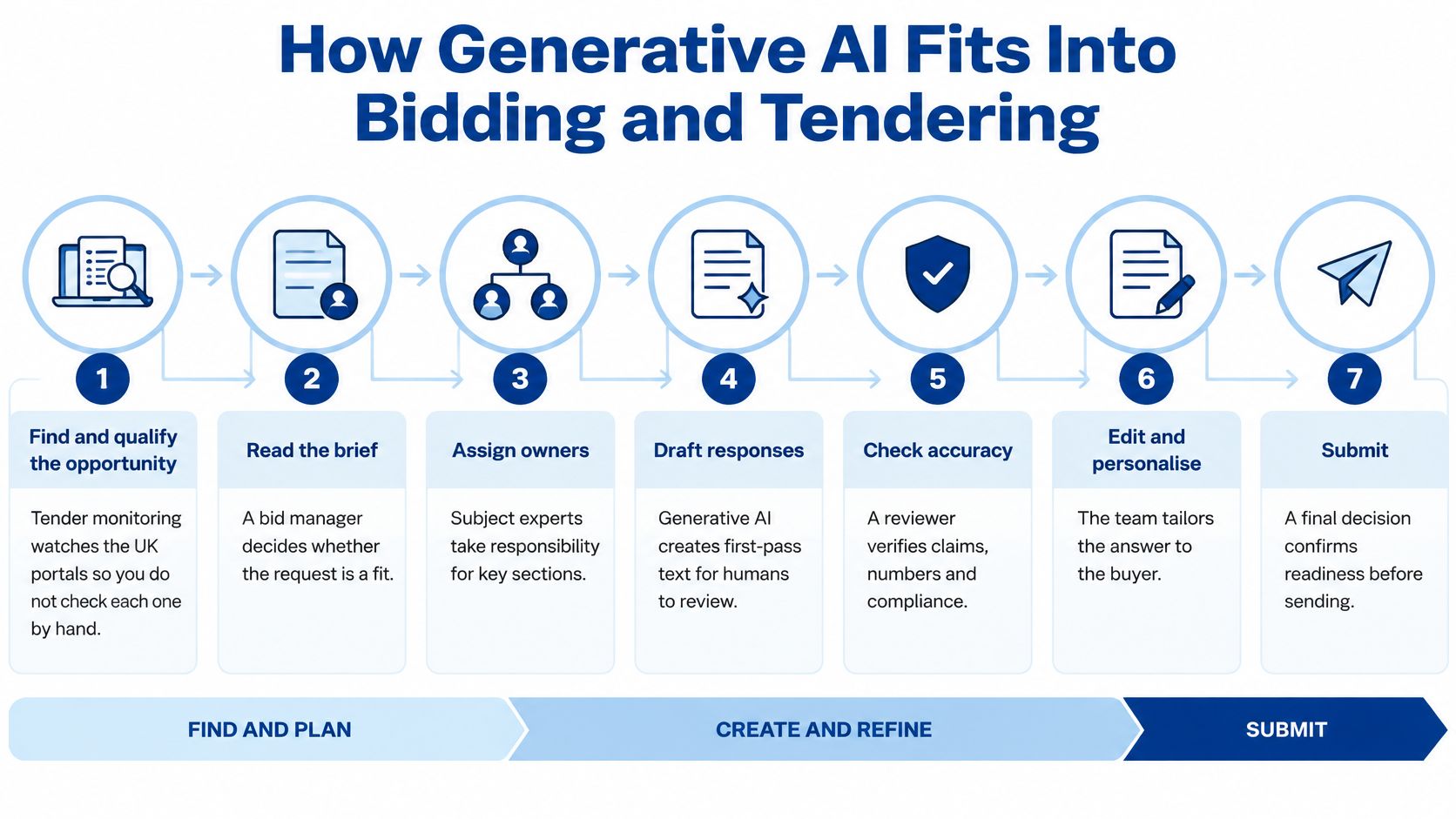
Find and qualify the opportunity. Tender monitoring watches UK portals so staff don't have to check each one manually. A commercial owner decides whether the scope, eligibility, likely margin and available capacity justify bidding.
Read the requirements and scoring criteria. Extract the questions, mandatory attachments, word limits and evaluation criteria into a working checklist. The bid manager compares that checklist with the original documents, including schedules and clarification notices.
Build the knowledge base. Gather past responses, accreditations, case studies, policies and team CVs so the business isn't described from scratch each time. Evidence owners decide which documents are current, relevant and authorised for reuse.
Draft answers against the evidence. Match each question with appropriate case studies and credentials, retaining citations to source documents. The section owner decides whether the selected evidence proves the buyer's requested outcome, rather than merely mentioning a similar subject.
Review every commitment. Allocate pricing to the commercial owner, contractual wording to the appropriate adviser, and delivery promises to the operational lead. Review social-value assertions, staffing availability and scored requirements before polishing the language.
Handle disclosure and submission approval. Follow the tender's questions about AI use and protect confidential authority information from training reuse. The authorised signatory decides whether the response is accurate, complete and ready to submit.
Record the outcome and improve the evidence. Capture scores, clarification requests and loss feedback in the knowledge base. The bid lead decides which lessons require stronger evidence, a different approach or a more selective bid decision next time.
Protect the time that determines quality
Bidwell learns a business once from its past responses and credentials, then drafts complete tender responses in hours instead of weeks. That changes where the team spends its effort; it doesn't remove the need to understand the procurement.
Review should focus on proof and fit. If the buyer asks how you'll maintain service during mobilisation, a history of successful projects isn't enough. The response needs a practical continuity plan, responsibilities and evidence that the proposed approach is deliverable.
Don't spend all the saved drafting time making the prose sound smoother. Use it to resolve weak evidence, challenge assumptions and check whether the answer deserves the score you're targeting.
A short, specific answer backed by a relevant case study is preferable to a longer response full of unverified assurances.
Choosing a Vendor and Starting Small
Generative AI vendor categories compared
| Category | Examples | Best for | Watch-out |
|---|---|---|---|
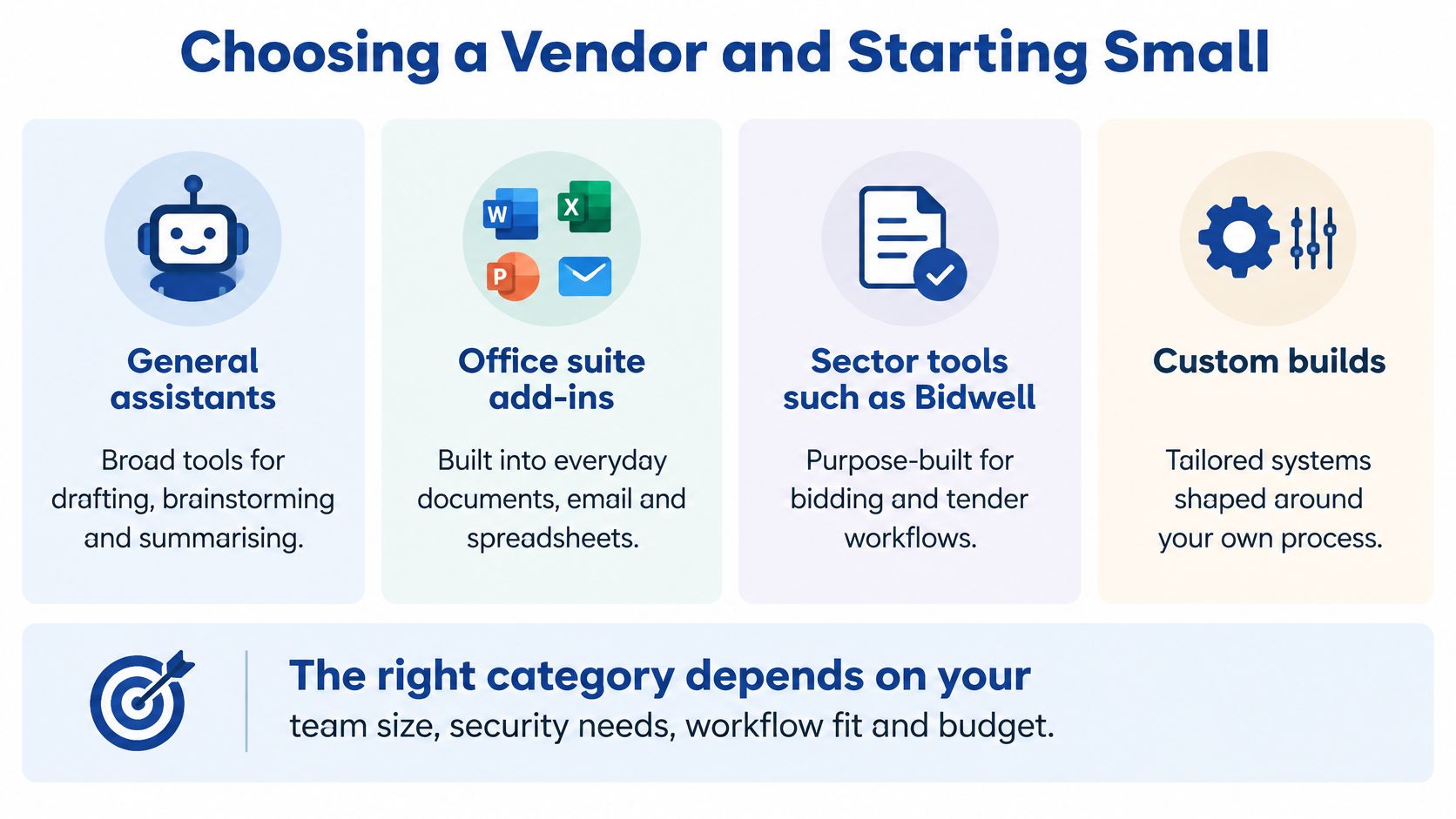
| General assistants | Microsoft Copilot, Google Gemini | Drafting, summarising and research across many tasks | Check for tender monitoring and source-linked answers rather than assuming they're included |
| Office suite add-ins | Copilot in Word and Excel, Gemini in Google Workspace | Teams already working in those suites | Output quality depends on the documents you feed it |
| Sector tools | Bidwell | Tender monitoring, knowledge base and response generation for UK public-sector bids | Narrower scope; you still review every answer |
| Custom builds | Models accessed through cloud platforms | Firms with in-house data science staff | Budget for development and ongoing upkeep |
Test the buying criteria
The right category follows your bottleneck. If staff can't find suitable tenders, a writing assistant alone won't solve the problem. If evidence is scattered across personal folders, connecting a model to those folders won't make the evidence trustworthy.
Compare vendors on practical questions:
- Data handling. What happens to uploaded files, prompts and outputs, and can they train shared models?
- Source citations. Can reviewers open the exact document supporting an answer?
- Auditability. Can you establish who generated, changed and approved the response?
- Pricing. Are charges tied to users, usage, documents or optional functions?
- Workflow fit. Can staff move from opportunity assessment to evidence selection and approval without duplicating work?
Ask for a demonstration using an awkward question, not just a clean sample. Include an expired document, contradictory evidence or a question your material cannot answer. The useful behaviour is to expose the gap, not conceal it.
Fit matters more than breadth
Bidwell is built for UK SMBs who already know how to deliver. Its sector focus brings together tender monitoring, a knowledge base built from business evidence, and AI response generation for review.
That focus is a trade-off. A general assistant covers more types of work, but you may need to assemble the tender process, document permissions and checking arrangements yourself. A custom build gives you more design control, alongside responsibility for maintenance and testing.
Use the bid-writing software overview to check the current workflow and features before committing. Don't assume that a demonstration includes every capability in the quoted package.
Test your preferred option on one live tender with a manageable deadline. Keep submission authority with the existing bid owner, and retain a manual fallback if the trial creates more work than it removes.
Measuring Payoff and Running a Two-Week Pilot
Only 50% of AI-adopting businesses reported increased overall employee productivity, while 42% reported no change and 4% reported a decrease, according to the UK Government's AI Adoption Survey executive summary. That publication also reports adoption doubling from 16% of businesses in 2025 to 32% in 2026, so most businesses still hadn't adopted AI.
Adoption isn't proof of value. A faster first draft that needs extensive correction, weakens the submission or distracts reviewers from pricing can be a poor operational result.
Measure the whole response
Track drafting, checking and outcomes separately. The values below form a hypothetical worked example, not a forecast or customer result.
Metrics for measuring generative AI in tender work
| Measure | How to calculate | Example |
|---|---|---|
| Drafting time | Logged working hours from tender receipt to first full draft, excluding waiting time | 30 hours before, 12 hours after |
| Review time | Hours of expert checking per response | 3 hours in the worked example |
| Unsupported claims | Count of claims with no source found in review | Target zero |
| Win rate | Wins divided by bids submitted | 2 wins from 10 bids = 20% |
| Bids per quarter | Bids submitted by the same team in a quarter | 3 before, 5 after |
| Cost per bid | Total loaded staff cost plus allocated tool cost, divided by bids | Use actual staff rates and allocated subscription cost |
Say a two-person team normally submits about ten bids a year. Drafting falls from thirty hours to twelve, with three hours of review added. On that simplified comparison, the task takes fifteen hours rather than thirty.
Don't call that an end-to-end saving until you've included evidence preparation, corrections, approval and submission administration. If the old process already included review, record its duration too; otherwise, you're comparing different tasks.
The team might then move from three bids in a quarter to five. That's useful only if the additional opportunities pass qualification and the delivery team could fulfil them.
Decision rule: Count a saved hour only when the work is finished to an acceptable standard.
For a broader measurement framework, Kagool's practical ROI metrics for AI pilots can help organise the financial assessment. Keep tender quality and compliance beside the cost calculation, rather than treating them as optional commentary.
Run a bounded pilot
Use this two-week schedule as a practical experiment, not a statistical test.
Choose two live tenders. Pick one straightforward response and one containing a scored method statement. Don't use an unusually complex strategic opportunity as your first test.
Establish a comparable baseline. Record the hours spent on the last similar bid, separating drafting, review and administration. Note differences in scope so you don't attribute an easier tender to better software.
Prepare a small evidence library. Start with five to ten useful past responses, alongside current accreditations, case studies and CVs. Remove obsolete or unauthorised material before drafting begins.
Generate and log the work. Record drafting and review time separately, including time spent finding sources and repairing answers. Log interruptions and technical problems rather than excluding inconvenient work.
Use an independent checker. Have a second person verify every substantive claim against its source and count unsupported claims. Correct every unsupported statement before submission, even if the overall draft looks strong.
Make a continuation decision. Compare total effort, evidence quality and reviewer capacity with the baseline. Continue only if drafting time falls, unsupported claims remain at or near zero during review, and staff can sustain the workload.
Separate early signals from outcomes
Two wins from ten submissions gives a hypothetical 20% win rate, but that sample is too small to establish whether AI improved performance. Track outcomes for at least six months as a practical observation period, and longer if your bid volume is low.
Record evaluation scores and buyer feedback as well as wins. A loss caused by price says something different from a loss caused by an incomplete delivery methodology.
For the cost calculation, drafting tenders from our knowledge base costs £20 a month, and customers only pay for it if they want it. Add the staff time required to prepare evidence and approve answers; a low subscription cost doesn't make expert attention free.
If reviewers spend the saved drafting time correcting invented claims, narrow the task. If qualification remains weak, improve tender monitoring and bid decisions before increasing output. If the evidence library is unreliable, stop generating answers until its owners repair it.
Bidwell brings together tender monitoring, a knowledge base built from your business evidence, and AI response generation for human review. Visit Bidwell to assess the workflow against a live opportunity, then use a bounded pilot to check whether it improves total effort without weakening your submission.


