A UK-wide evidence base from the Federation of Small Businesses shows how unforgiving public procurement can be. Only 1 in 5 SMEs bid for a public sector contract in the last 3 years, and 49% of SMEs new to public sector opportunities failed to secure a single contract. Even among experienced SMEs that made more than 9 bids, 11% still won none. The FSB's procurement research points to a practical conclusion: bids and proposals need disciplined targeting, clear evidence and repeatable production, not just good writing.
Why Bids and Proposals Matter in UK Public Sector
The 2025 opportunity pipeline is large and split across several registers. Find a Tender recorded 8,639 procurements with £64 billion in advertised value, while Contracts Finder recorded 41,219 procurements with £117 billion. Public Contracts Scotland added 1,469 procurements worth £3.2 billion, and Sell2Wales recorded 281 worth £0.7 billion. These figures come from consolidated data covering the main UK portals, as reported in UK bid and win-rate benchmark data.
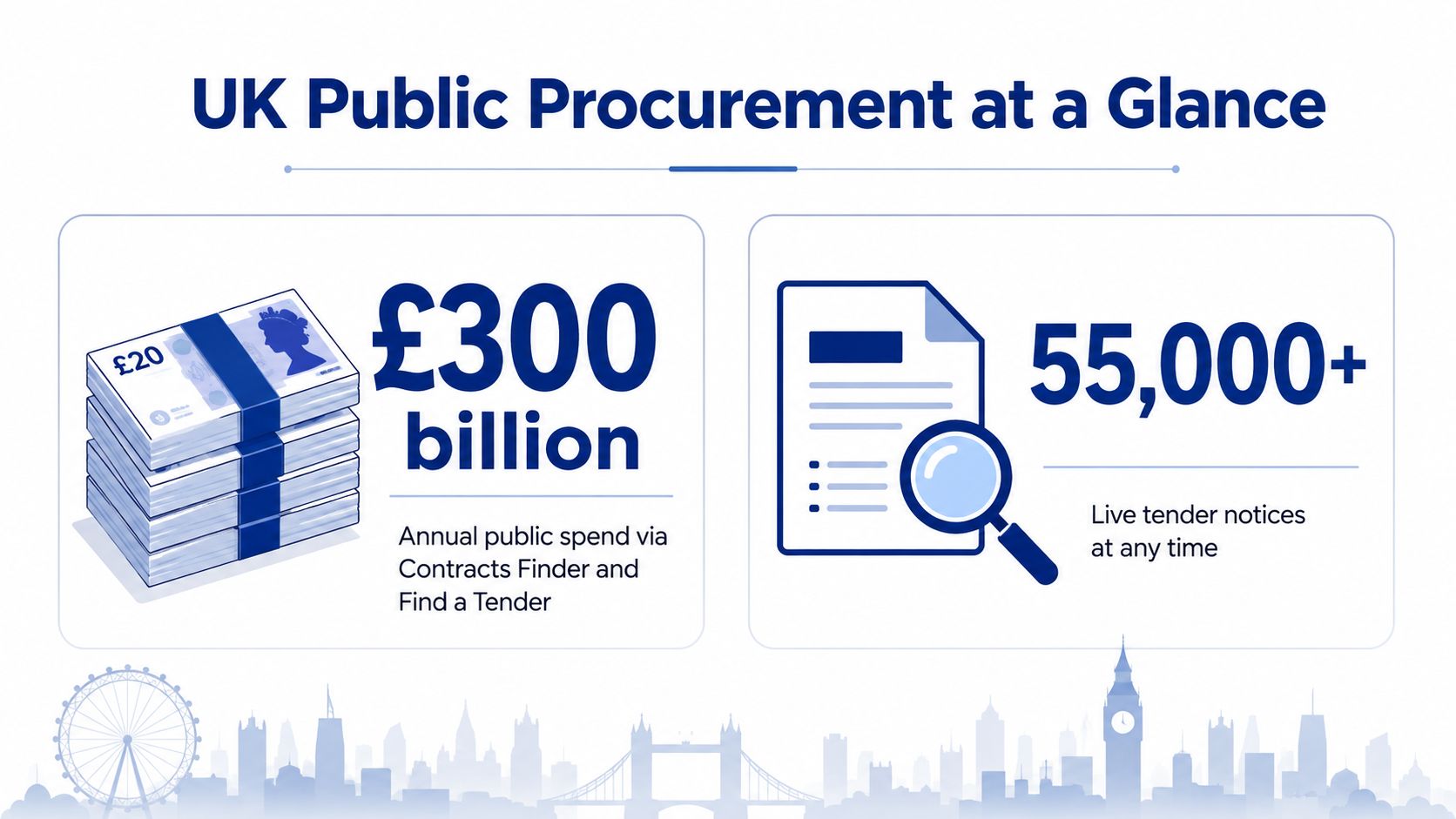
That scale changes how teams need to work. Occasional searches and forwarded notices miss opportunities and waste review time. A workable process identifies relevant tenders, checks mandatory requirements, and turns usable evidence into a response before the deadline.
Formal scoring makes discipline essential
UK public procurement evaluates the most economically advantageous tender, or MEAT. The lowest price is not automatically the winner. The UK Government's bid evaluation guidance states that evaluators score against the published criteria and the information included in the tender return.
The practical test is simple: answer the scored question with evidence that matches its wording. If the criterion asks how you will manage mobilisation, a broad account of past experience leaves marks available. A specific plan, named responsibilities, identified risks, controls and evidence from a comparable engagement gives the evaluator material to score. The same government evaluation guidance means information held elsewhere in the company cannot earn marks unless it appears in the response.
Three commercial benefits follow:
- Revenue stability: A suitable public contract or framework can provide a steadier sales base than unrelated one-off projects.
- Credibility: Public sector references can support consortium bids and larger supply-chain opportunities.
- Auditability: A structured response records the offer against the buyer's criteria, pricing schedule and contractual requirements.
Teams that separate monitoring, evidence management and drafting usually struggle. Monitoring without a knowledge base produces alerts nobody can act on. A knowledge base without drafting support leaves relevant evidence unused under deadline pressure. Bidwell brings tender monitoring, a knowledge base and AI response generation into one workflow, so teams can identify a fit, retrieve supporting material and shape it around the scored question.
The opportunity also needs commercial discipline. SMEs usually pursue smaller contracts: 89% of contracts applied for were valued below £100,000, and 48% were below £25,000, according to the same FSB evidence base. Choose work the delivery team can support, then produce a response that earns marks under the published MEAT criteria. That is more useful than chasing every large notice.
Bid Versus Proposal: Where the Documents Diverge
Bid and proposal are often treated as interchangeable, but the distinction affects how a team prepares, checks and submits its response. A formal bid answers a defined procurement process. A proposal makes the persuasive case within that response, or supports a broader commercial discussion before a formal tender exists.
A bid normally contains the commercial offer, declarations, pricing schedules and compliance documents. It must reach the named portal or submission route by the stated deadline. The buyer evaluates it against published criteria, and acceptance can create defined commercial commitments.
A proposal allows more room to frame the problem and explain value. It may support a private sector pitch, early market engagement, consortium discussions or a buyer conversation before an RFP is issued. Pricing can remain indicative, and the document may suggest an approach without carrying the same submission mechanics.
| Dimension | Formal Bid | Proposal |
|---|---|---|
| Purpose | Respond to a published tender and make a formal offer | Present a solution, commercial idea or persuasive case |
| Legal weight | Usually carries defined commercial and compliance commitments | May be exploratory, depending on the context |
| Evaluation | Scored against disclosed criteria and instructions | Often judged through buyer preference, fit and value |
| Pricing | Usually required in a specified schedule or format | May be optional, indicative or negotiated |
| Submission channel | Procurement portal or named formal route | Email, presentation, document exchange or buyer platform |
| Core discipline | Compliance, accuracy and evidence | Persuasion, relevance and value framing |
The useful grey area
A proposal-style executive summary can work well at the front of a formal bid. It gives evaluators a quick view of your understanding, approach and differentiators before they assess the detailed answers against the published MEAT criteria.
The risk is allowing that style to control the whole submission. A polished narrative cannot make up for a missing declaration, an incorrect pricing template or an answer that fails to address the scoring criterion. The summary helps the evaluator understand the case. The bid mechanics determine whether the response is compliant and scoreable.
A bid lead should therefore separate persuasion from proof. Use the proposal element to frame the answer, then connect each claim to the requirement, evidence, deliverable and commercial commitment the tender documents require. Bidwell can support the drafting process, but every generated commitment still needs checking against the tender documents, pricing and delivery model.
The Tender Lifecycle From Notice to Award
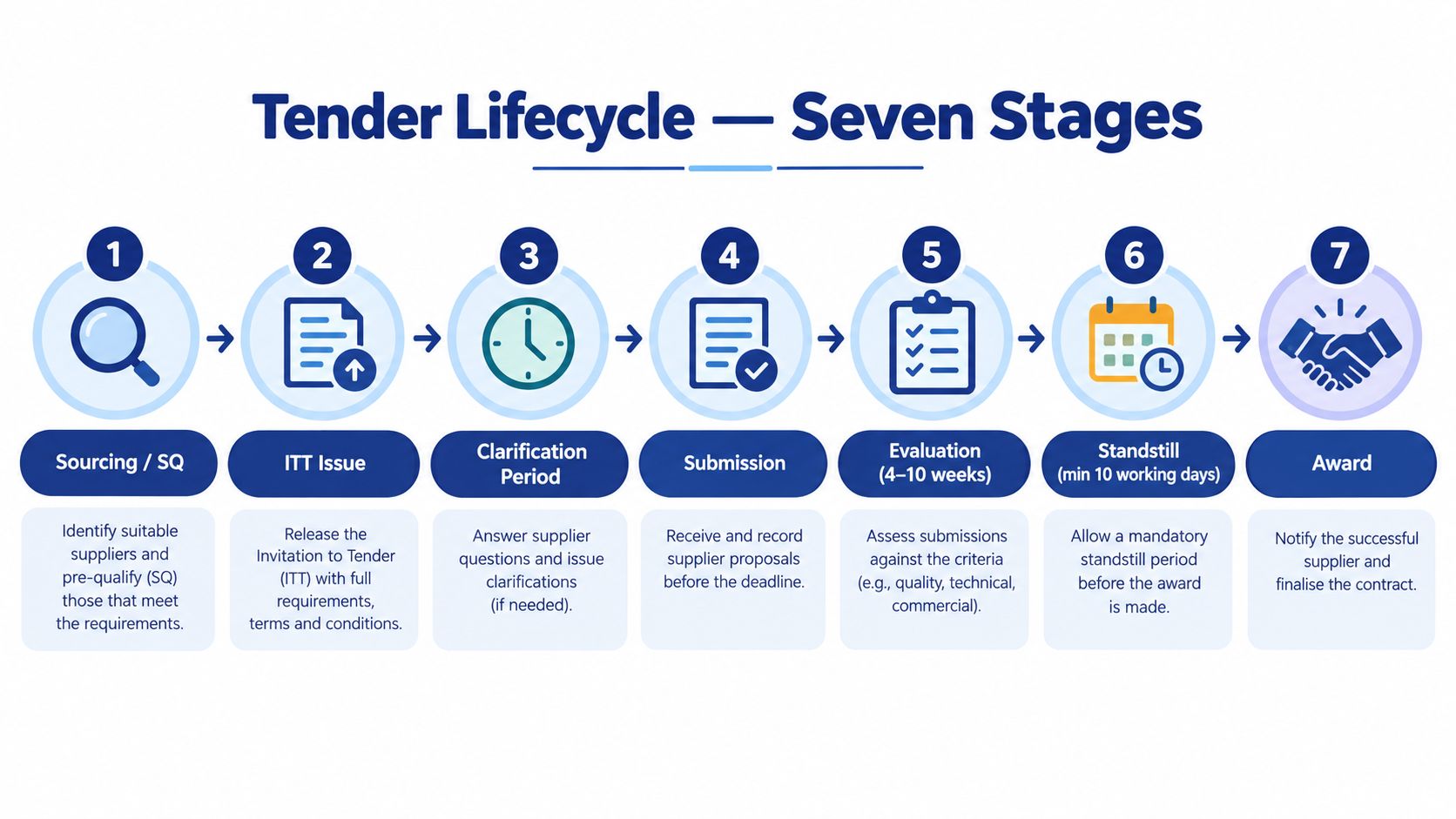
A UK public tender runs through controlled events, and a short response window can leave little room for recovery. Suppliers typically progress through sourcing or selection, ITT issue, clarifications, submission, evaluation, standstill and award. Each stage creates a separate scoring or compliance risk.
Seven stages to manage
Sourcing or SQ: The buyer publishes an opportunity or selection questionnaire. Check scope, eligibility, financial standing, experience and mandatory requirements. The output is a completed SQ and a clear bid or no-bid decision. Portal monitoring gives the team earlier visibility of relevant notices, rather than starting when a colleague forwards a deadline.
ITT issue: The buyer releases the invitation to tender, specification, evaluation criteria, pricing schedule and contract terms. Build a compliance matrix immediately. Map every requirement to an owner, evidence source and response location before drafting begins.
Clarification period: Suppliers ask questions through the formal channel. Answers are normally shared with all participants, so a poorly framed question can expose an interpretation or create confusion. Submit questions before the stated cut-off and record the buyer's answers in the working bid file.
Submission: Upload the complete response in the required format. The bid lead checks filenames, signatures, declarations, word limits, attachments, pricing arithmetic and portal confirmation. A strong answer that misses a mandatory field may never reach quality scoring.
Evaluation: The buyer scores against the published model, including the Most Economically Advantageous Tender (MEAT) balance of quality and price where specified. Evaluators assess the information in the tender return, so unsupported claims remain unsupported even when the supplier could have explained them later. Drafting must therefore follow each criterion, not a general company narrative.
Standstill: For relevant above-threshold awards, the buyer observes a standstill period before completing the contract award. The minimum is 10 working days under the Public Contracts Regulations 2015, while light-touch regimes can specify a 35 calendar day period. Check the procurement documents and applicable rules rather than relying on a generic timetable.
Award: The buyer completes the award and issues notices or debrief information. An unsuccessful supplier should request feedback promptly and record scoring gaps in its knowledge base. That record improves future evidence selection and exposes recurring weaknesses.
Bidwell's tender workflow connects the stages as one pipeline. Monitoring identifies the notice, the knowledge base supplies checked evidence, and AI response generation shapes that evidence around the actual questions and MEAT criteria. Human review still confirms commitments, pricing and compliance.
Plan backwards from the deadline
Supplier response windows can be compressed. One UK analysis found that Central Government departments gave suppliers an average of 26 days, or 15 working days, to respond in 2018, and no department met the 35-day benchmark in that analysis. The procurement response-time analysis also reports that some departments averaged under 20 days.
Use the deadline as the final gate. Set internal dates for evidence collection, first drafting, red-team review, commercial approval and upload. A supplier finding a tender 10 days before close is often facing a capacity problem that earlier monitoring would have exposed.
Anatomy of a Winning Tender Response
A strong response is assembled around the buyer's scoring model. It isn't a collection of standard documents placed beside a price. The structure below is common, but the tender instructions always take priority.
| Component | Typical Length | Weight |
|---|---|---|
| Selection Questionnaire | As prescribed | Pass or selection stage |
| Method statements | Often 500 to 1,000 words each | Frequently the main quality score |
| Pricing schedule | Buyer's template | Commercial score |
| Social value commitments | As prescribed | May form part of quality or value |
| Mobilisation plan | Short plan or method statement | Quality and delivery confidence |
| Risk register | Table with controls and owners | Quality and assurance |
| Executive summary | About one page | Reader orientation, not a substitute for evidence |
The method statements usually carry the writing burden. A practical response pattern has four parts:
- Restate the requirement: Use the buyer's language so the evaluator can see the connection.
- Explain the approach: Describe the activities, sequence, roles, tools and controls.
- Prove the claim: Use a case study with a comparable sector, service, delivery environment and outcome.
- Connect to the result: Explain how the approach protects quality, timing, cost, users or compliance.
Evidence should be selected, not collected
A large knowledge base isn't automatically useful. A bid lead needs to know which case study supports which criterion, whether the reference is current, who owns approval and what commitments the evidence allows the business to make.
That's where the three-part pipeline matters. Tender monitoring identifies opportunities worth qualifying. The knowledge base links past responses, case studies, CVs, policies and accreditations to the questions they can answer. AI response generation creates a starting draft that the writer then tests for accuracy, buyer relevance and commercial fit.
Social value also needs deliberate treatment. The tender may specify a social value model, reporting requirement or weighting. Don't add a generic paragraph at the end. Assign ownership, define the deliverable and show how you'll evidence delivery during the contract.
For practical bid templates and response guidance, teams can use Bidwell's bid-writing guides. The point isn't to make every response sound identical. It's to give writers a dependable structure, so the quality of the argument doesn't depend on who happens to be available during a compressed tender window.
Why Most Submissions Lose Marks
The common belief is that submissions lose because the competitor was cheaper. That's often too simple. Under MEAT scoring, evaluators consider the published criteria and the evidence in the tender return, so a supplier can lose marks without being the lowest-priced bidder.
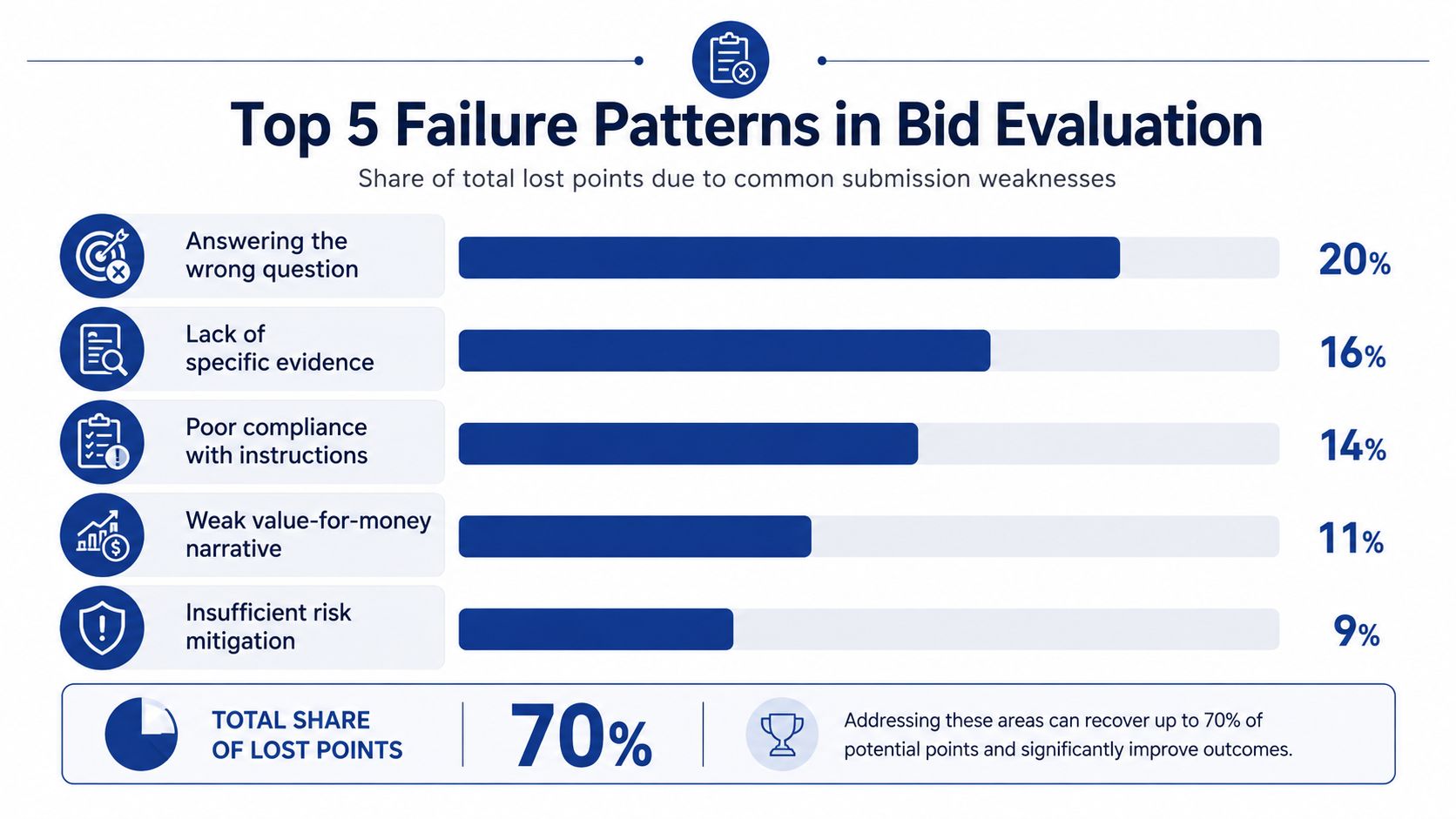
Five failure patterns recur in bid reviews:
- Answering the wrong question: The response paraphrases the specification but doesn't explain how the supplier will meet the exact criterion.
- Lack of specific evidence: The writer claims an “experienced team” or “proven methodology” without a relevant example, named role, measurable outcome or clear connection to the buyer's environment.
- Poor compliance with instructions: The response misses a word limit, uses the wrong template, omits an attachment or places evidence in a section the evaluator isn't scoring.
- Weak value-for-money narrative: The pricing is presented as a number rather than connected to outcomes, risk controls, service quality and total value.
- Insufficient risk mitigation: The answer describes normal delivery but avoids what could go wrong, who owns the risk and what happens when the control fails.
Fix the mapping before polishing the prose
A fluent answer can still score poorly if the evaluator has to hunt for the evidence. Put the criterion in the response plan. Break it into its component requirements. Then assign an evidence source, an owner and a review check to each part.
Practical rule: If a reviewer can't highlight the sentence that answers the criterion, the answer isn't finished.
Pricing needs its own control process. Have a separate person check formulas, assumptions, tax treatment, optional items and consistency between the pricing schedule and written response. Keep commercial caveats visible. A beautiful method statement won't rescue a bid that fails a mandatory pricing instruction.
The knowledge base should record both successful evidence and weak areas from debriefs. AI response generation can flag missing evidence or repeated generic language, but a human must decide whether the claim is defensible. Tender monitoring helps prevent rushed bids, which is often the first condition behind the later writing errors.
How AI Changes the Bid Workflow
AI earns its place in a bid workflow when it removes repetitive handling while keeping every claim traceable. It creates risk when confident prose is not checked against the tender, evidence or delivery model.
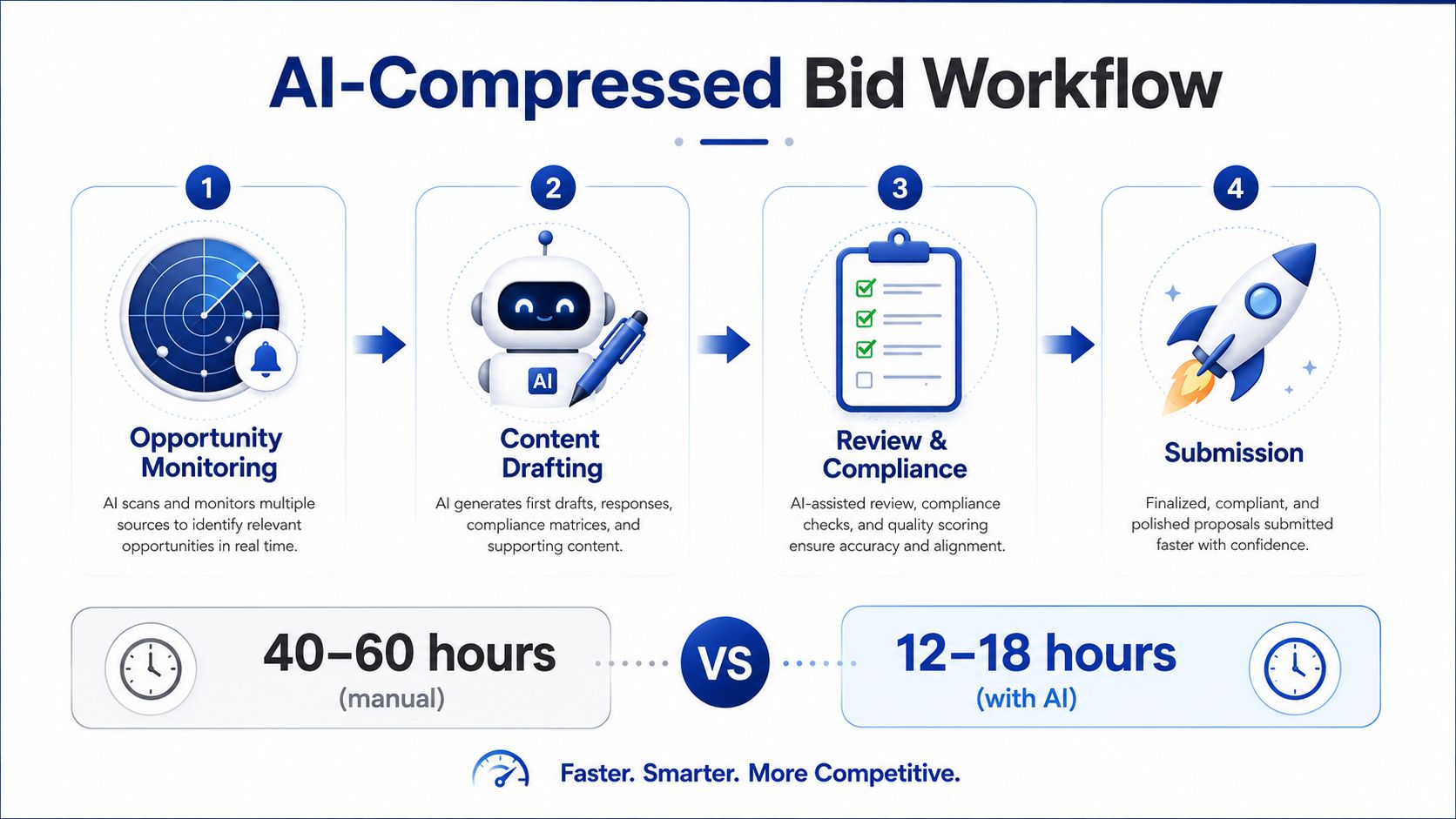
A practical workflow has four connected stages.
Start with opportunity monitoring
A bid team may need to watch Find a Tender, Contracts Finder, Public Contracts Scotland and Sell2Wales. The UK Government confirms that Find a Tender operates alongside Contracts Finder and the devolved portals, while Contracts Finder guidance explains that Scotland and Wales use their own services.
Summing the four portals gives roughly 51,608 distinct procurements worth about £185 billion in 2025, based on the consolidated portal data. BidStats' portal analysis reports that only 38% of Find a Tender records showed an end date, compared with 0% on Contracts Finder. AI can filter notices, but a bid lead must still verify deadlines, route, scope and eligibility.
Build evidence once
The knowledge base should store approved case studies, policies, accreditations, CVs, insurance details, delivery plans and past responses, with an owner and review date for each item. Without that control, AI may reuse stale evidence or apply a case study to a buyer environment it does not match.
Draft against the criterion
AI response generation should receive the question, scoring guidance, word limit and relevant evidence. It can create a structured starting point, while the bid writer tests the argument, removes unsupported claims and checks that each promise can be delivered.
Bidwell's bid-writing software connects tender monitoring, a company knowledge base and AI response generation in one workflow. Treating drafting as an isolated task produces the 20 to 40 hour writing sprint before submission, because evidence gathering and question mapping were never connected to the draft.
Check before submission
Automated checks can find missed questions, overlong answers, inconsistent names, unsupported claims, missing attachments and conflicts between narrative and pricing. A human reviewer must then test the response against the published MEAT scoring model, confirming that evidence is relevant, measurable and easy to score.
AI should reduce the hidden cost of finding and reusing evidence, not merely produce a fast first draft. A sourced draft gives the writer time to test buyer relevance, delivery risk and scoring alignment. That is where the operational value sits.
Building a Repeatable Bid Pipeline
Winning more public contracts depends on disciplined selection and repeatable execution. A working pipeline connects monitoring, qualification, evidence and drafting, then uses the result of each submission to improve the next.
Triage the market every week
Start with the channels buyers use. UK public sector opportunities can appear across Find a Tender, Contracts Finder, Public Contracts Scotland and Sell2Wales. The public sector procurement guidance explains why suppliers may need to monitor several sources.
Use keywords, CPV codes, geography, contract route and buyer type to build a shortlist. Check every notice manually before committing resource. Portal records can omit or misstate dates and other fields that affect capacity planning. Bidwell's tender monitoring helps surface relevant notices, but the bid lead still confirms scope, deadlines and eligibility.
Make go or no-go explicit
Score each opportunity against mandatory requirements, delivery capability, evidence strength, commercial viability, incumbent position and available resource. A contract should not enter drafting because the buyer is familiar or the value looks attractive. Failure against one mandatory requirement is enough to stop the bid.
Run a controlled kickoff
The kickoff should assign:
- Win themes: The few reasons the buyer should trust your approach.
- Evidence owners: People responsible for approving case studies, CVs and policies.
- Review gates: A 25% structure check, a 50% evidence check and a 100% compliance and commercial review.
- Decision rights: One person who resolves conflicting advice and protects the timetable.
A controlled knowledge base gives contributors approved evidence rather than scattered files. It should retain ownership, dates, service scope and the criteria each example supports. AI response generation can then create question-level drafts from the approved material, while the bid lead remains accountable for accuracy and delivery promises.
Review against the weighting
Use independent red, amber and green reviews before final sign-off. Reviewers should score each answer as an evaluator would under the published MEAT model, then record the reason for every amber or red rating. This exposes a common failure: a polished answer that contains evidence but does not make the scoring requirement easy to award.
In my experience running bid teams, two bids a month per bid lead, with five working days for a standard PQQ and ten for a full ITT, is a sustainable ceiling. These are internal planning rules, not procurement standards. Complexity, evidence readiness and the buyer's deadline may require a lower cadence. Bidwell's monitoring, knowledge base and AI drafting support the workflow, but review capacity still sets the limit.
Close the loop after award
Request feedback after a loss and record the evaluator's comments against the relevant question. Update the knowledge base, retire unsupported claims, improve weak case study tags and link each approved example to the criterion it answered. Record where the response failed to score, not only where the team believes the evaluator was wrong.
The pipeline only compounds if this debrief loop runs. Teams that skip it rebuild the same evidence for every tender, so a later bid costs almost as much effort as an earlier one.
Bidwell combines tender monitoring, a controlled knowledge base and AI response generation for UK businesses preparing bids and proposals. To find relevant notices earlier and turn approved evidence into reviewable tender responses, visit Bidwell.