UK direct public-sector procurement spending with SMEs reached £39.7 billion in 2023, yet SMEs still captured only about 20% of that spend. That gap makes bidding efficiency a strategic necessity, not a neat convenience.
Bidding management software matters because the work is messy before it's persuasive. Tender alerts arrive from different portals, qualification is half commercial judgement and half admin, and the response still needs proper evidence behind it. If you're running bids in the UK public sector, the job is deciding what's worth chasing, keeping the paperwork under control, and only then drafting a response that stands up to scrutiny.
What Bidding Management Software Actually Solves

A senior bid manager doesn't lose tenders because the team lacks effort. The loss usually comes from scattered information, late decisions, and too much time spent rebuilding the same evidence from scratch. That's where bidding management software earns its keep, it gives the team one place to monitor opportunities, one place to store credentials, and one place to turn the right inputs into a usable draft.
UK direct public-sector procurement spending with SMEs increased from £22.4 billion in 2018 to £39.7 billion in 2023, yet SMEs received only 20% of overall direct procurement spending (British Chambers of Commerce and Tussell). That matters because the market is there, but the bandwidth often isn't. Small teams are trying to juggle delivery, sales, finance, and bid writing at the same time, so the bottleneck becomes capacity, not intent.
The grind it removes
A typical week can look like this. Someone spots a tender in one portal, another appears in a different system, a buyer sends a clarification update by email, and the bid lead spends half a day hunting for the last version of a case study. None of that is strategic work. It's just friction.
Practical rule: if your process depends on someone remembering where the latest certificate lives, you've already made the bid more expensive than it should be.
The right software cuts out that waste by centralising the workflow. For Bidwell users, that usually means tender monitoring for discovery, a knowledge base for approved credentials, and AI response generation for first drafts based on those approved assets. If you want to see how that maps to live opportunities, the tenders use case shows the kind of workflow teams build around it.
The point isn't to write faster for the sake of it. The point is to stop treating each bid like a fresh emergency. When the evidence is already organised, the drafting stage becomes review work instead of reconstruction.
How Bidding Management Software Works
Good systems do three things in order: they find the right tenders, keep approved evidence in one place, and turn that material into a draft the bid team can review. That workflow matters because the actual problem is usually not writing speed; it is wasting time on bids that were never worth the effort.
Tender monitoring first
The first task is opportunity discovery. Bidwell monitors Find a Tender, Contracts Finder, Public Contracts Scotland, and Sell2Wales, so the team is not relying on a single portal or a manual checklist. That matters in the UK because notices are split across different systems and they do not always present the same way.
A good monitoring setup filters by geography, sector and value before the alert ever reaches a human. The result should be a short list that is worth reading, not a flood that buries the team in noise.
Knowledge base second
The next task is evidence control. A decent knowledge base stores case studies, policies, accreditations, team CVs, and standard answers in a format the team can reuse. That stops people hunting through old folders for the same insurance certificate or pulling the wrong company overview into a live submission.
The best bid systems reduce search time before they reduce writing time.
That is where the practical gain shows up. The team answers from approved material instead of memory, which cuts inconsistency and keeps the same evidence clean across bids. It also makes it easier to spot gaps early, before a deadline turns them into a scramble.
AI response generation last
The final task is drafting. Used properly, AI turns approved content into a first draft that a bid writer can shape, not a text generator fed with raw tender PDFs. With Bidwell, the aim is to draft from your own knowledge base, then check fit, tone, and compliance before anything goes out.
A simple rule applies. If the software cannot show where the answer came from, it should not be the answer. That keeps response generation useful without letting it drift into risk.
The value is not speed for its own sake. It is turning each bid from a fresh scramble into a controlled workflow, so the team spends more time deciding whether to bid and less time rebuilding the same material again.
UK Tender Portals and What Bidding Software Needs to Cover
If monitoring only checks one portal, coverage is incomplete. UK procurement is spread across different platforms, and publication rules vary by value and by nation. A bid team that ignores that will miss opportunities, then waste time trying to work out why the pipeline feels thin.
Find a Tender search guidance shows the current split clearly. From 24 February 2025, Find a Tender publishes both above- and below-threshold notices for new UK procurements, except below-threshold notices in Scotland, while Contracts Finder continues to handle existing regimes. That makes multi-source monitoring a baseline requirement for any credible coverage claim. If a tool only watches one feed, it is doing partial work and calling it coverage.
What the system has to do
The software needs to normalise notices into a common format, because the same opportunity can look different across portals. It should capture the buyer, category, geography, deadline, framework status, eligibility, and source URL, then remove duplicates so the team does not see the same opportunity three times under slightly different wording.
Practical rule: the goal is fewer alerts that are easier to act on.
A solid system also separates a live competition from an award notice. That sounds basic, but it is exactly the kind of mistake that wastes time in a busy SME. When a bid manager is trying to protect capacity, that distinction matters more than a flashy dashboard.
Change detection also matters when notices are amended after publication. Tools such as Website change detection can help if you are watching a buyer page or supporting evidence source that changes often.
Why the workflow has to stay auditable
Traceability is the reason. If your monitoring pipeline cannot show where an alert came from, or when a notice changed, you are left with uncertainty when someone asks why the team pursued one tender and not another. Bidwell's monitoring approach should sit alongside a clear daily view, not replace judgement.
For teams already using In-Tend e-tendering, the practical point is the same. The software should help you watch the right sources, not force you into one portal's way of organising the market.
Bid Decisions Before Bid Writing
The biggest mistake in bid software is assuming every alert deserves a response. It doesn't. Some opportunities are badly sized for the business, some carry too much risk, and some are poor commercial choices no matter how tidy the paperwork looks.
Direct public-sector spending with SMEs reached £45.2 billion in 2025, representing 21% of direct procurement spend, with central government direct SME spend at only 10% compared with 34% for local government (DBT SME Action Plan 2025 to 2028). That split tells you something useful. Not every part of the public sector is equally accessible, and chasing the wrong work can drain time from the places where you have a chance.

What good qualification looks like
A proper bid/no-bid decision starts with fit. Does the contract size suit your delivery model? Are the insurance, mobilisation, and compliance asks realistic? Can your team prepare a credible response without blowing a hole in the week?
Those questions sound obvious, but they're often skipped when the alert count is high. Software helps when it forces the team to score opportunities against the same criteria every time. That makes the decision less emotional and more commercial.
Why speed alone can backfire
There's a temptation to think faster drafting means more wins. In practice, it can just mean more bad bids. If the system encourages the team to pursue tender after tender without checking margin, capacity, and risk, you end up paying for productivity with a weaker pipeline.
Practical rule: the cheapest bid is the one you never wrote for the wrong contract.
That's why the smartest use of software is to protect time, not to fill it. A strong monitoring and qualification process lets the team decline work earlier, which is often more valuable than shaving another hour off the writing stage. Bidwell fits that model because the monitoring and knowledge base do part of the filtering before AI ever drafts a response.
Implementation and Compliance Realities
Getting the software into daily use is the hard part. Teams don't fail because the platform is weak. They fail because the evidence isn't structured, the review process isn't clear, or the team keeps using old habits alongside the new tool.
Cabinet Office guidance under PPN 02/24 allows procurement documents to include disclosure questions about AI use and recommends controls that stop bidders from using confidential authority information as training data (PPN 02/24). That means your process has to separate approved company content from buyer material. If you blur those two things, you create avoidable compliance risk.
Set up the knowledge base properly
Start with the content you already trust. Approved case studies, policies, certificates, method statements, and CVs should be cleaned up, tagged, and versioned before they're used in drafting. If the knowledge base is full of stale material, the AI will only help you produce stale responses faster.
The review step matters just as much. A human still needs to check the draft against the tender, because the software can't take responsibility for legal wording, buyer-specific instructions, or scope nuances. It can help prepare the answer, but it can't own the submission.
Keep buyer material separate
That separation is not just good practice, it's common sense. Buyer documents, clarification notes, and tender packs should stay distinct from your own approved content. The draft should be built from your knowledge base, then checked against the live notice and attachments before it goes out.
If you're assessing vendors, ask about version control, audit trails, and how they prevent cross-contamination between sources. That question is more useful than asking whether the tool can “write faster”. For compliance leads, Bidwell's compliance and infosec information is the kind of place where those controls should be spelled out clearly.
A tidy workflow beats a clever one when the submission deadline is close.
Building a Repeatable Tender Workflow
When the pieces are connected, bid work stops feeling improvised. The team knows what gets checked first, what gets rejected early, what gets drafted automatically, and what always needs human review. That sort of rhythm is what keeps bids from becoming a weekly fire drill.
The practical flow is straightforward. Tender monitoring filters the market. Qualification decides whether the opportunity is worth the effort. The knowledge base gives the AI approved material to draft from. The bid lead reviews the output, checks compliance, and submits.
That's also where the return shows up for SMEs. Less time spent re-keying the same information means more time available for the bids that fit. You're not just writing faster, you're creating a repeatable system that keeps the team from wasting energy on unworkable tenders.
For a useful comparison on document-heavy workflow automation, the AgentStack automation overview is worth a look because it shows how structured content handling changes the amount of manual effort a team carries. The principle is the same here. Good software doesn't replace judgement, it removes the low-value repetition that gets in the way of it.
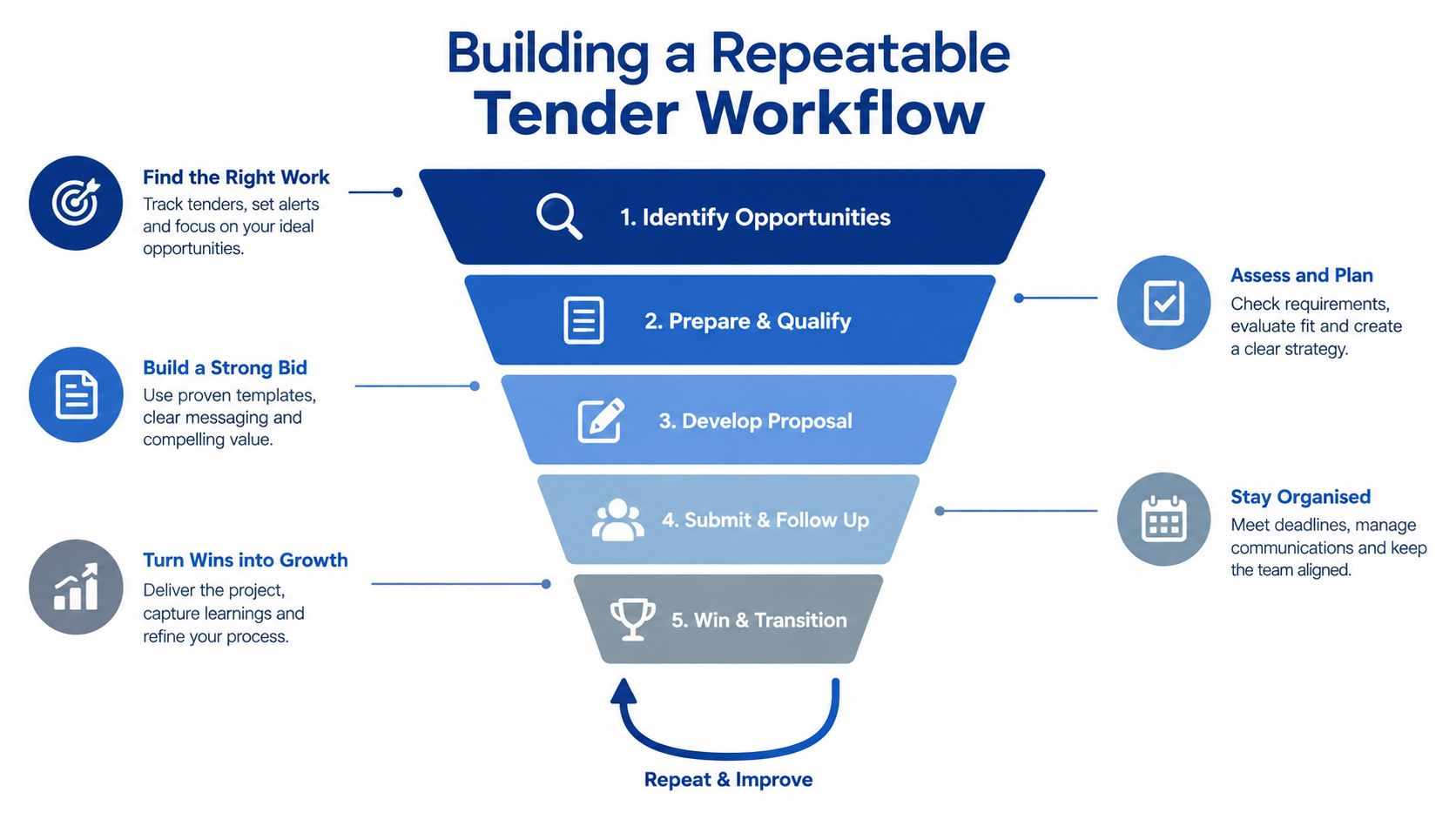
A repeatable process also makes handovers cleaner. If one person is away, the next person can see the same qualification notes, the same approved evidence, and the same response history. That's what turns bid management from heroics into a working system.
If you're trying to stop tender chaos from eating your week, Bidwell gives you the three things that matter most, monitoring, a structured knowledge base, and AI response generation built on your own approved content. Visit Bidwell and see how that fits your team's bid process.