
Most advice on bidding for contract work starts with the answer: improve the writing, add stronger evidence, polish the final draft. That's too late if the opportunity is the wrong route, too large to deliver, or uneconomic to pursue. I'd qualify the route and margin first. Only then would I ask the team to draft.
Public procurement is a real route to market for smaller suppliers, but award counts and contract value tell different stories. The opportunity is there; your job is to identify the competitions where your size, evidence and delivery capacity give you a credible shot.
Why Bidding for Contract Work Starts Earlier
Treating every notice as a writing job wastes effort. The route determines who can compete, what the buyer expects, and whether the opportunity suits your business. A polished response can't fix a poor fit or an unrealistic mobilisation plan.
The shift towards open competitions is worth watching. In the first year of the Procurement Act 2023, open tenders rose from 27% of procedures in March 2025 to 41% in February 2026, while direct procedures fell from 53% to 34%. By February 2026, SMEs and voluntary, community and social-enterprise organisations represented 67% of bidders. Below-threshold open competitions were awarded to at least one SME in 73% of cases, compared with 61% for ordinary open tenders, according to analysis of the Procurement Act's first year.
Route choice comes before response writing
Those figures don't mean every open tender is a good bet. They do show why you should check the procedure, contract size and possible route into the work before drafting. Depending on the opportunity, the right move may be to bid as prime, pursue a suitable lot, join a partner's supply chain or focus on a below-threshold competition.
That distinction matters because public-sector access isn't limited to winning a prime contract. Historical central-government figures show that direct awards and indirect SME participation through larger contractors can present very different pictures of the market. A smaller supplier might have the capability to deliver a defined part of a contract without being ready to take on the full commercial and mobilisation risk.
My rule: If you can't explain why this route suits your business, don't open a blank response document yet.
For a live opportunity, start by asking what the buyer is inviting suppliers to do. Check the procedure, any lots, the expected delivery footprint and the evidence the evaluation will reward. Then compare those demands with your resources and track record.
Pick the competition you can deliver
A good opportunity is one where the contract's shape matches your business, not just its service description. A large contract can be a poor fit if you'd need to stretch your team, find mobilisation cash you don't have or take on risks you can't control. A smaller competition or subcontracting role may be the more practical route to a first public-sector award.
This is the discipline that makes bidding work sustainable. Qualify the route first, then decide whether a persuasive answer can realistically turn capability into a deliverable offer.
Finding Notices and Choosing a Route
A good qualification decision depends on seeing the relevant notices in the first place. Don't rely on a single portal feed and assume you've covered the market. UK notice publication is split across services, with an important exception for Scottish below-threshold notices.
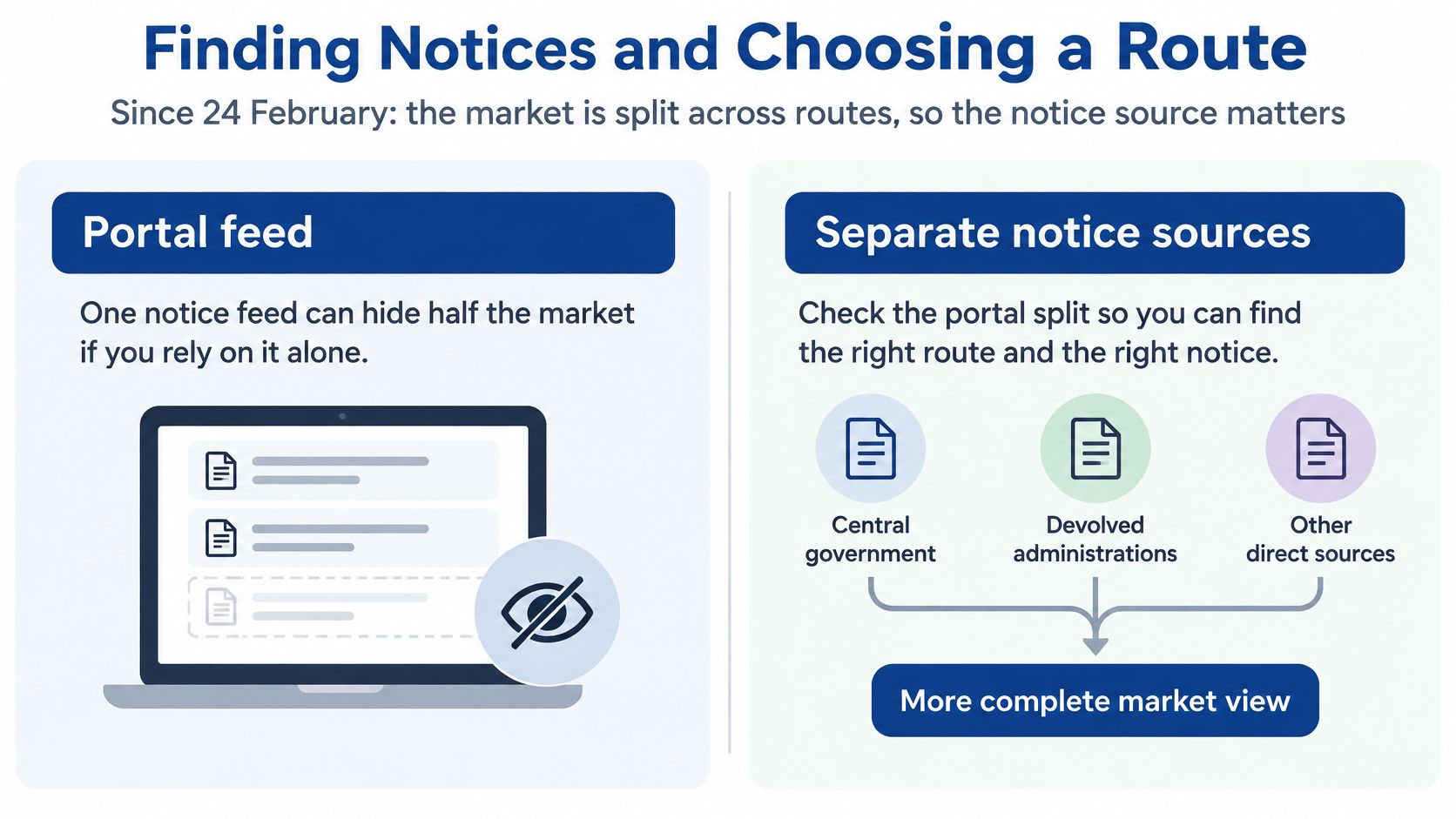
Since 24 February 2025, Find a Tender has published above- and below-threshold notices for new UK procurements, except below-threshold notices in Scotland. For England and other non-devolved territories, below-threshold contracts over £12,000 including VAT, or over £30,000 for central government, are available through Contracts Finder, as set out on the Find a Tender service.
Cover the portals that match your market
Build monitoring around the places your buyers publish. Check Find a Tender and Contracts Finder, and include Public Contracts Scotland and Sell2Wales when your service area warrants it. If you sell into Northern Ireland, include eTendersNI in your discovery routine too.
The point isn't to collect every notice. It's to make sure the right opportunity doesn't pass unnoticed because you watched the wrong feed. Set filters around the sectors, locations and contract types you can serve, then review the notice summary before spending time on the full procurement pack.
Bidwell is one option for this monitoring task. It tracks major UK public-sector portals and provides daily alerts with AI-generated summaries, so a bid manager can review likely matches and decide which ones deserve a closer look. If you're considering public-sector frameworks as a route to market, review Bidwell's frameworks information alongside the notice and buyer requirements.
Decide whether to bid, partner or target a lot
Under the Procurement Act 2023, competitive tendering uses the open procedure or the competitive flexible procedure. Both begin with a tender notice, but a competitive flexible procedure can include multiple stages. That can affect how you plan internal reviews, manage versions and reserve staff time.
Use the route details to make a practical choice:
- Bid as prime when you can meet the full requirement, manage delivery and support your offer with evidence.
- Partner or subcontract when you can deliver a credible part of the work but shouldn't carry the whole contract.
- Pursue a lot when the buyer has divided the requirement into manageable areas that fit your capability.
- Target below-threshold work when the contract scope and value are a better match for your current capacity.
Keep the decision grounded in size, mobilisation risk and the proof you already hold. If the procedure has stages, keep document control tight from the outset. A clear notice-monitoring routine gives you more time to make that decision before the response deadline starts driving the work.
Checking Whether the Bid Is Worth It
A contract's value doesn't tell you whether it's worth bidding for. Decide first whether the route, likely margin and cost of preparing a bid make commercial sense. Writing quality matters only after the opportunity clears that test.
Bid effort varies with the tender. Use the estimates below as illustrative planning guidance, not published averages. Adjust them to the scope, procedure and evidence the buyer requires. For UK procurement policy context, consult the Department for Business and Trade SME action plan. It doesn't substantiate these effort estimates, so don't present them as figures from that document.
Put effort beside contract value
Treat the ranges as a starting point, then review the actual tender pack. A multi-stage procedure, detailed service specification or heavy evidence burden can add work. Allow for reviews and approvals as well as drafting.
| Contract value | Illustrative bid effort | Commercial check |
|---|---|---|
| Up to £50,000 | Around 4–5 full-time-equivalent days | Can the margin cover delivery, start-up costs and bid effort? |
| £50,000–£250,000 | Around 7–12 full-time-equivalent days | Do cash flow and payment terms support mobilisation? |
| £250,000–£1 million | Around 15–25 full-time-equivalent days | Can you carry the delivery risk, or should you partner? |
A smaller lot may reduce delivery exposure, but it still needs to justify the time required to bid. A larger contract can offer more revenue and still leave too little margin after mobilisation, staffing and financing costs. Model the likely delivery cost before committing people to a response.
Test the downside, not just the prize
Estimate bid effort, your realistic chance of award, gross margin and start-up spend. Then test cash flow, payment terms and contractual liabilities. If a subcontractor could reduce the risk, include that option in the calculation. Decline when the buyer's requirements are unclear, the timetable leaves too little time, or a critical delivery risk has no workable mitigation.
| Decision | Choose it when | What to write down |
|---|---|---|
| Bid | The scope fits and the margin supports delivery | Assumptions, resourcing and funding needs |
| Partner | You can deliver part of the work, but shouldn't own all of it | Your proposed role and the partner capability you need |
| Decline | The commercial case or delivery plan doesn't hold | The reason, so the team can screen similar opportunities faster |
Commercial test: A contract's headline value is not your return. Calculate what you'll spend to bid, what delivery will cost and what margin remains.
Make the decision before drafting starts. Record the assumptions and the call, so the team can stop early when the numbers don't work and reserve effort for a better-fit opportunity.
Running a Bid That Survives Compliance
Once you've agreed to bid, treat the tender as a gated compliance-and-evidence process. A strong narrative won't rescue missing forms, an ineligible supplier or a submission that doesn't follow the buyer's instructions.
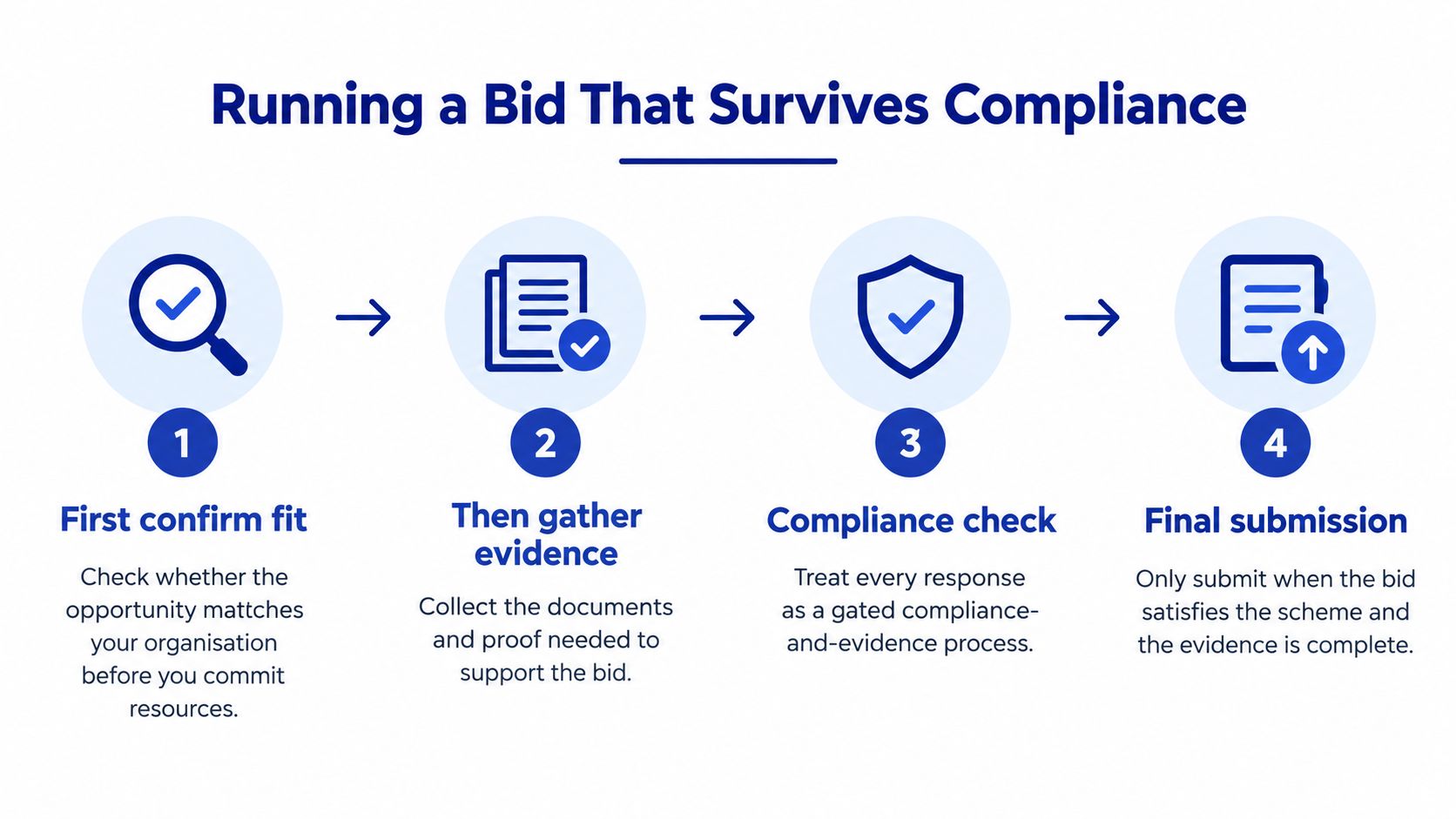
Gate one, confirm you can take part
Check eligibility, exclusion-status declarations, insurance, financial standing and required accreditations. Confirm that your organisation can meet the delivery requirement, manage the risks and make the economics work. Don't assume that a familiar buyer or a similar past contract makes you eligible for this one.
Gate two, turn the pack into a control sheet
Create a compliance matrix that lists each mandatory requirement, question, supporting document, word limit and deadline. Assign an owner and reviewer to every item. Include submission instructions and any clarifications or amendments, then make one person responsible for checking updates and the final portal version.
This catches avoidable administrative problems while there's still time to fix them. Use a structured process for PQQs and supplier questionnaires too. Bidwell's PQQ use case is one place to review how that part of the process can be organised.
Gate three, plan answers against the scoring
Build an answer plan from the published evaluation criteria and weightings. Each response should address the buyer's question directly and identify the evidence that will support the claim. Use relevant contracts delivered, performance measures, customer references, qualifications, policies, mobilisation plans and risk controls.
Draft around the buyer's need, your method, implementation detail, measurable outcomes, risks and relevant case studies. Keep each claim traceable to proof. A knowledge base of credentials, previous answers and case studies can help the team reuse material, but someone still has to check that it applies to this contract.
Gate four, run an independent final review
Ask a reviewer who didn't write the response to check compliance, scoring potential, pricing and evidence. They should look for missing attachments, word-count breaches, inconsistent pricing, unsupported statements and version errors in the portal. Ask clarification questions when the tender documents leave a material point unclear.
Government guidance identifies recurring failure points including poor-fit bids, missed deadlines, ignored word limits, unsupported claims, generic copy-and-paste responses, late compliance checks and unanswered questions. Under the UK's Most Advantageous Tender model, the winning offer best meets the requirements and award criteria. It isn't automatically the cheapest, so don't apply an across-the-board discount instead of building a persuasive quality, social-value, risk and price proposition. The public procurement bid guide sets out those practical pitfalls.
Your finish line is clear: zero avoidable administrative defects, with every scored claim supported by evidence. Submit only when the compliance matrix is complete and the independent reviewer has checked the final version.
Writing Answers Evaluators Can Score
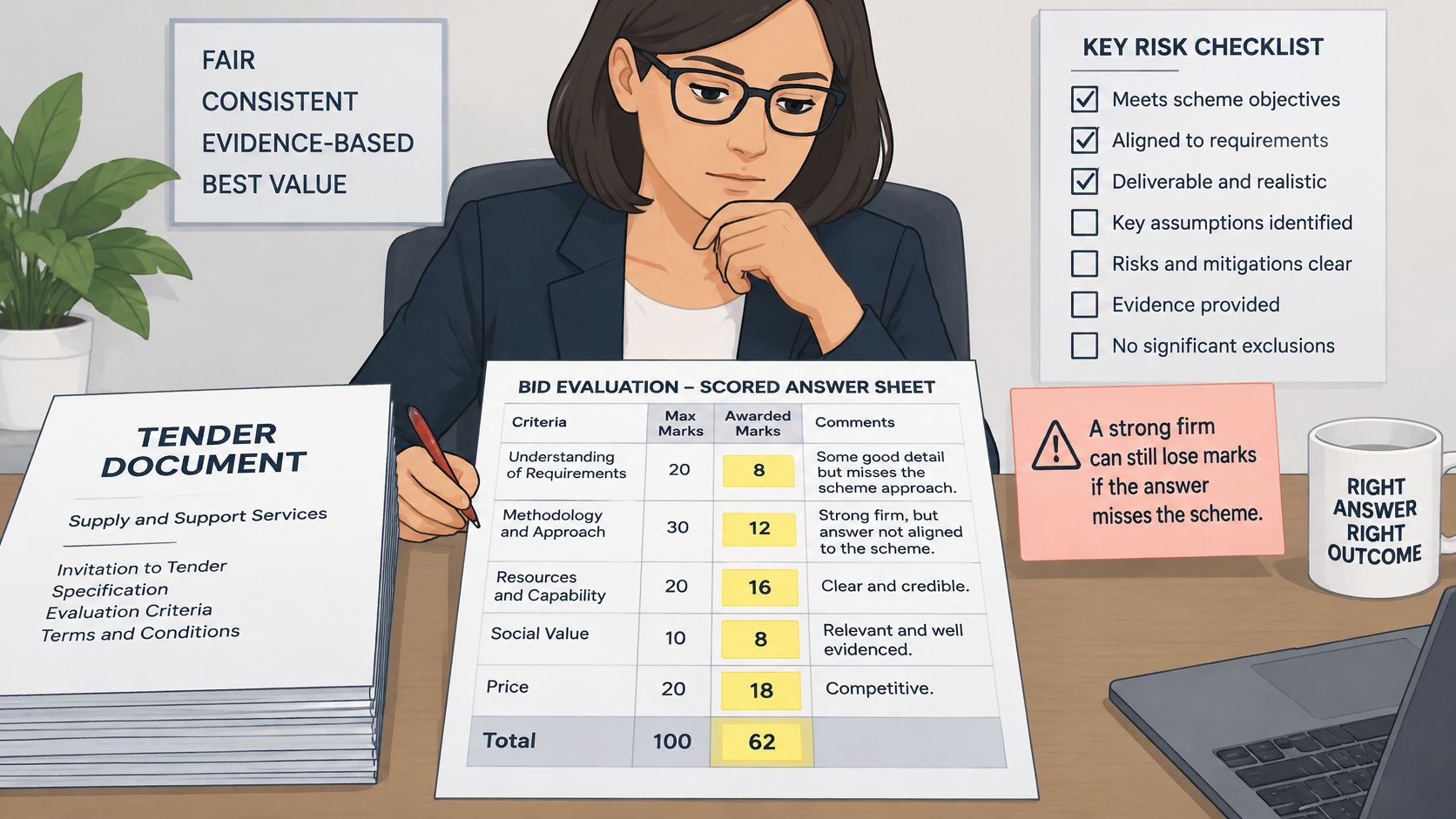
The evaluator can only award marks for what your answer demonstrates against the published question and criteria. A list of company history and accreditations may be true, but it won't answer a question about how you'll manage delivery risk.
Start with the buyer's question
Read the question closely, then check the evaluation criteria for clues about what the buyer will score. Put your direct answer in the opening sentence. If the question asks how you'll manage service quality, don't begin with a general introduction to your business.
A useful response makes the delivery clear. Name the method, who will carry it out, how you'll measure performance and what you'll do if something goes wrong. Add a relevant case study only when it proves the point you're making.
For example, if the buyer asks about continuity during mobilisation, explain how you'll transfer work, assign responsibility and manage risks. Then show the evidence that makes the plan credible, such as a comparable delivery record or a documented mobilisation process. Don't claim a result you can't verify.
Use proof, not a collection of claims
Stored credentials and past answers save time only when they fit the current requirement. A policy from another contract may need updating; a case study may describe a different service or scale. Keep the evidence, but tailor what you use to the buyer's question and the delivery model in the tender.
The tender management insights for PreSales teams from PreSales Unleashed GmbH offer a useful perspective on coordinating tender work with sales activity. That coordination matters when the bid team needs timely input from operations, finance and subject-matter colleagues. Set clear owners for each answer, and give reviewers enough time to check the supporting evidence.
Keep the offer aligned to the weighting
Don't discount every line to compensate for a weak answer. Align the price, delivery plan, capacity and social-value commitments with the criteria the buyer has published. If a section carries meaningful weight, give it enough space to explain the method and evidence, while staying inside the word limit.
A response reviewer should be able to score each answer without searching through unrelated background. Cut claims that don't answer the question. Replace vague assurances with a specific process, a named responsibility and evidence the buyer can verify.
Bidwell's bid-writing software can draw on a business's stored material to help prepare relevant responses. Treat any generated draft as a starting point, not an approved submission. Your team must verify every claim, confirm that the evidence fits the contract and make sure the answer follows the buyer's instructions.
Using the Window You Actually Have
The tender timetable tells you how much time you have to qualify, gather evidence, write and review. Don't assume that the full period is available for drafting. You'll need time for clarification, internal approval, pricing and portal checks.
For an electronically submitted tender, the usual minimum is 25 days when the tender notice and all associated documents are provided together, or 30 days when some documents are supplied later. For non-electronic submissions, the minimum is 30 days if all documents are available with the notice, or 35 days if they aren't. A qualifying planned procurement notice or genuine urgency can reduce the period to 10 days, under the Procurement Act guidance on time periods.
Use the time before the notice
Set up monitoring across Find a Tender, Contracts Finder, Public Contracts Scotland and Sell2Wales so your team can spot suitable notices early. Short summaries help you screen the opportunity before committing to a full review. Add eTendersNI if your market includes Northern Ireland.
Build your evidence store before the next invitation to tender arrives. Keep credentials, relevant policies, past responses and case studies organised so owners can find and validate them quickly. A knowledge base won't remove the need for review, but it stops the team having to assemble every piece of evidence from scratch.
When a notice appears, run the route and margin test first. If it's a yes, assign owners, map compliance requirements and use AI response generation to prepare a draft from approved business evidence. Spend the remaining review time on the things a draft can't decide for you: whether the claims are accurate, the delivery plan is credible, the price works and the portal contains the final files.
The practical next step is simple. Pick one live notice, decide whether you should bid, partner or decline, and record the commercial reason. Open the response only after that decision is made.
Bidwell monitors UK tender portals, sends alerts with AI-generated opportunity summaries, stores your credentials and past evidence in a knowledge base, and helps draft tender responses. Visit Bidwell to see how it can support your next qualified bid.


