
In 2025/26, Contracts Finder recorded 34,968 awarded contracts, and SMEs took 12,533 of them, about 35.8% of the total. A tender is the buyer's formal invitation with its rules and scoring, a bid is your priced response to that tender, and a proposal is the document setting out how you'll deliver, often answering a request for proposal or sent unprompted to a private buyer.
Those award totals are published in the Contracts Finder collection on data.gov.uk. Public buying is not reserved for giant firms. It is still a crowded market, and the words people use for the paperwork don't line up neatly.
You've got a pack open and a deadline that won't shift. A colleague calls the file a proposal. The portal calls it a tender response. You're about to write your first UK tender, and you need to know what the evaluator will mark, and how the quality of that answer changes the price.
How Bids and Proposals Differ in Practice
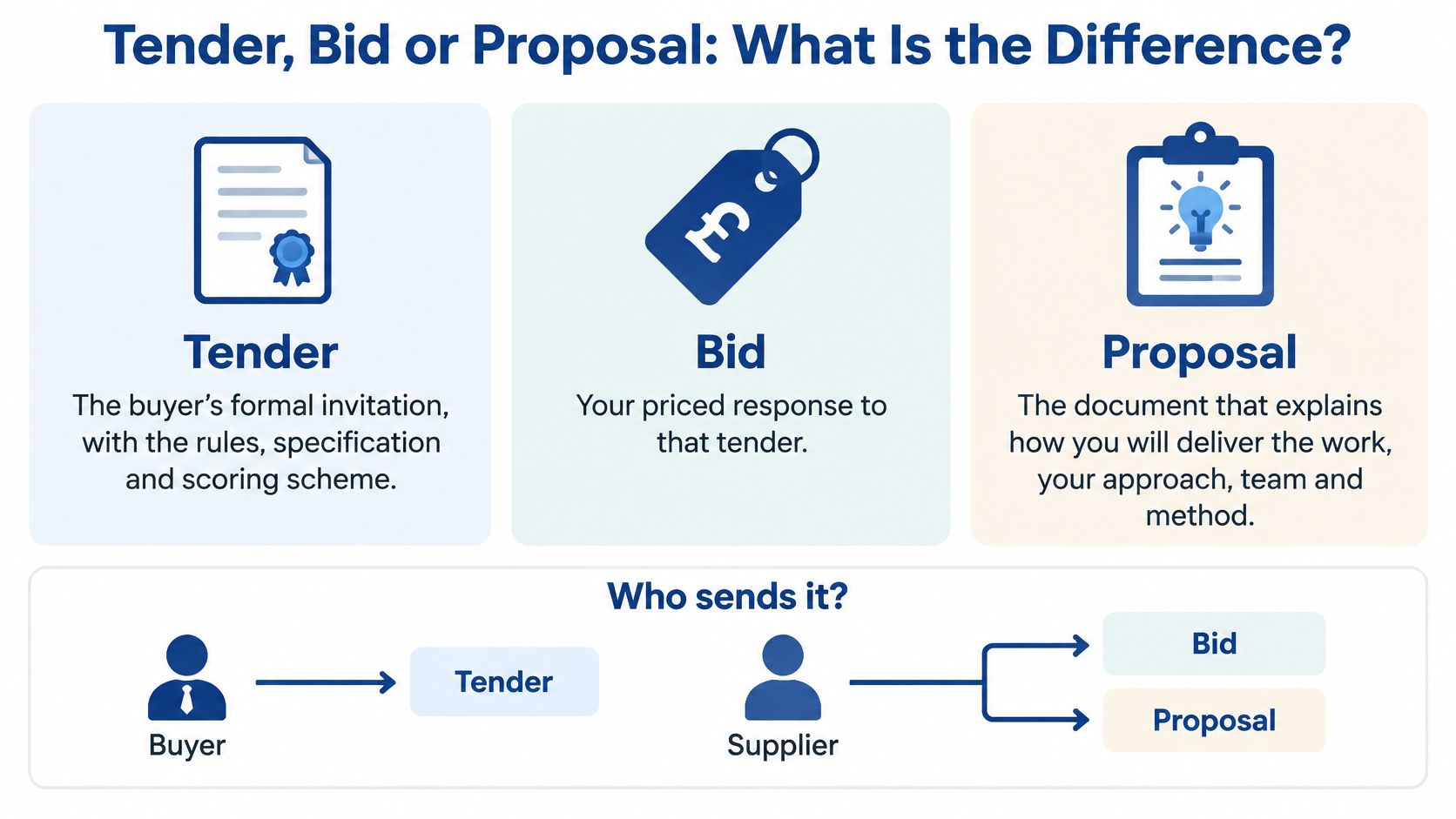
A tender is the buyer's document. A bid is your priced answer to it. A proposal is how you explain delivery, usually after a request for proposal, or as an unprompted pitch to a private buyer.
| Term | Who issues or submits it | What it contains | Typical effort |
|---|---|---|---|
| Tender | Buyer issues it | Rules, specification and evaluation criteria; 20-30 pages for a simple contract | 2-6 hours to read and understand |
| Bid | You submit it | Your priced response answering every requirement and scored criterion | 20-80 hours for a full response |
| Proposal | You submit it, often after an RFP or unprompted | Method, team, timeline and commercial terms | Varies by buyer and sector |
Where the words overlap
In UK public procurement, people say bid and tender response for the same file. The buyer's documents decide the label, not a dictionary. An invitation to tender, a request for proposal and a competitive flexible procedure can all ask for method, team, price and evidence. What changes is how fixed the questions are, and whether price is scored against quality.
A simple tender can already run to 20-30 pages before you type a word. Reading it properly takes a few hours. Writing the response is the long part. Skip the read and you'll answer a question the buyer didn't ask.
Practical rule: If the buyer has issued a formal document with a scoring scheme, you're writing a bid. If you're proposing a solution with no fixed structure, you're writing a proposal.
Check three things first. Who issued the document. Whether price is scored. Whether the questions are fixed. Tender monitoring should pull the notice and the supporting documents, not just the title, so that check starts from the actual pack.
What Goes Into a Bid and Proposal Pack
Evaluators don't award marks for promises. Each part of the pack has to prove something specific. Fail the front of the pack and the rest may never be read.
What has to be true before the story starts
Compliance and selection questions come first. Eligibility, insurance and financial standing are pass or fail territory. Keep certificates, accounts, policies and signed declarations in one folder before anyone drafts a method statement. Rebuilding that folder on every opportunity is how teams miss a declaration and get set aside.
A private-sector proposal may drop that compliance block. It still needs a method and a price. The scored public pack rarely lets you choose.
| Component | What the evaluator checks | Evidence to include |
|---|---|---|
| Executive summary | Whether you understand the requirement | One page mapped to the top-scoring criteria |
| Compliance and selection questions | Eligibility, insurance and financial standing | Certificates, accounts, policies and declarations |
| Method statement | How you'll deliver each requirement | Steps, roles, timelines and quality checks |
| Pricing schedule | Cost, assumptions and value for money | Rate card, cost breakdown and stated assumptions |
| Social value response | Measurable local commitments | Beneficiary numbers, apprenticeships, local spend and dates |
| Case studies | Proof you've delivered similar work | Client, scope, contract value and measured results |
| Team and CVs | Named people with relevant skills | Roles, time allocation and qualifications |
| Risk register | Whether you've spotted delivery risk | Risk, owner, mitigation and trigger |
Where the marks actually sit
The method statement carries most of the quality marks. Name the roles, the sequence and the quality checks. "We will work closely with stakeholders" doesn't tell an evaluator what happens in week two.
Put the pricing schedule beside the method, not in a separate universe. A cost breakdown and stated assumptions show what drives the number. Hidden assumptions get challenged in clarification, or worse, in delivery.
Case studies need a client, a scope, a contract value and a measured result. A paragraph that says you have experience doesn't. CVs should show time on this contract, not a career history. The risk register needs an owner and a trigger, not a generic list of things that could go wrong.
Write the one-page executive summary last, and map it to the criteria with the heaviest weight. If selection questionnaires are eating your week, a current evidence folder is the fix, including the material you reuse on PQQ responses. A knowledge base keeps certificates, case studies and CVs current so you aren't rebuilding that folder for each bid.
How Evaluators Score Price Against Quality
The lowest price does not automatically win a UK public tender. Award criteria have to be objective, proportionate, clear, relevant and able to separate bids, and evaluators score quality on a defined scale with weightings that match importance. That model is set out in the Cabinet Office bid evaluation guidance note.
Price per quality point
Where a buyer uses Price Per Quality Point, the total bid price is divided by the quality score. The lowest result wins. A stronger answer can beat a cheaper one. A thin answer can make an attractive price lose.
| Bidder | Total price | Quality score | Price per quality point |
|---|---|---|---|
| Bidder A | £500,000 | 70 | £7,143 |
| Bidder B | £480,000 | 55 | £8,727 |
Bidder A is £20,000 dearer and still wins, because £500,000 divided by 70 is about £7,143 per point, against about £8,727 for Bidder B. The quality gap more than pays for the price gap. This is an illustration of the arithmetic, not a live tender. Your buyer may use a different formula, so read the evaluation section before you assume PQP applies.
What is scored and what is only a gate
Conditions of participation are assessed separately from award criteria and from the tender response. Pass them and you enter the scoring. Fail them and the quality narrative doesn't get a chance.
Map every paragraph to a published criterion before you write it. Words that don't sit on a scored line don't help the price per point.
Run an independent score challenge before you submit. Someone who didn't draft the answer should try to mark it from the buyer's scale. If they can't find the evidence, the evaluator won't either. AI response generation can draft against the tender documents, but you still have to check that each paragraph lands on a criterion that earns marks.
Decide Which Tenders Are Worth Writing
A slow draft wastes days. A weak fit wastes the bid. Most of the damage happens before anyone opens a blank page.
Research cited in the UK's Open Government Partnership results report found that 62% of SMEs considered finding relevant public-sector contracts difficult, and 27% blamed inconsistent portals, forms and rules. Lots tagged suitable for SMEs rose from 15.4% in March 2025 to 32% in May 2025. Lots marked suitable for VCSEs rose from 6.8% to 13.7%. A suitability label is not a win. Contract size, geography, incumbent signals, insurance and financial thresholds still decide whether you should spend the hours.

A five-point go or no-go
Use the same test on every notice.
- Scored fit: You can answer the criteria with evidence you already hold, not with a story you'll invent.
- Time: The window is long enough against the statutory minimums below, including clarification and review.
- Mandatory conditions: You meet them now, not after a policy rewrite.
- Insurance and finance: Thresholds are covered without a special exception.
- Lot and place: The lot size and geography are work you can deliver.
Under the Procurement Act 2023, a qualifying planned procurement notice must be published at least 40 days and no more than 12 months before the tender notice. If the authority runs preliminary market engagement, it must publish a notice first or explain in the tender notice why it didn't. Those rules sit in the Procurement Act 2023, Part 3. They are early signals, not live bids.
| Situation | Minimum tender period |
|---|---|
| Electronic tenders, notice and all documents supplied together | 25 days |
| Documents not all supplied at the same time | 30 days |
| Tenders cannot be submitted electronically, all documents supplied together | 30 days |
| Least favourable listed situation | 35 days |
| Exceptions: pre-selected suppliers, qualifying planned notice, urgency, dynamic market | 10 days |
Those minimums are in Chapter 6 of Part 3. A 10-day exception is not a comfortable writing window.
Set saved searches on Find a Tender, Contracts Finder, Public Contracts Scotland and Sell2Wales, then run the five-point rule on the next five notices you open. Tender monitoring should flag planned and preliminary-engagement notices as well as live bids, which is what a dedicated tender search is for. Once you decide to bid, the knowledge base and AI response generation take over the drafting.
How to Build a Bid Step by Step
Set the working calendar before you plan the writing. Work backwards from the deadline using the minimum periods in the table above. If the notice and documents didn't arrive together, don't pretend you have the shorter window.
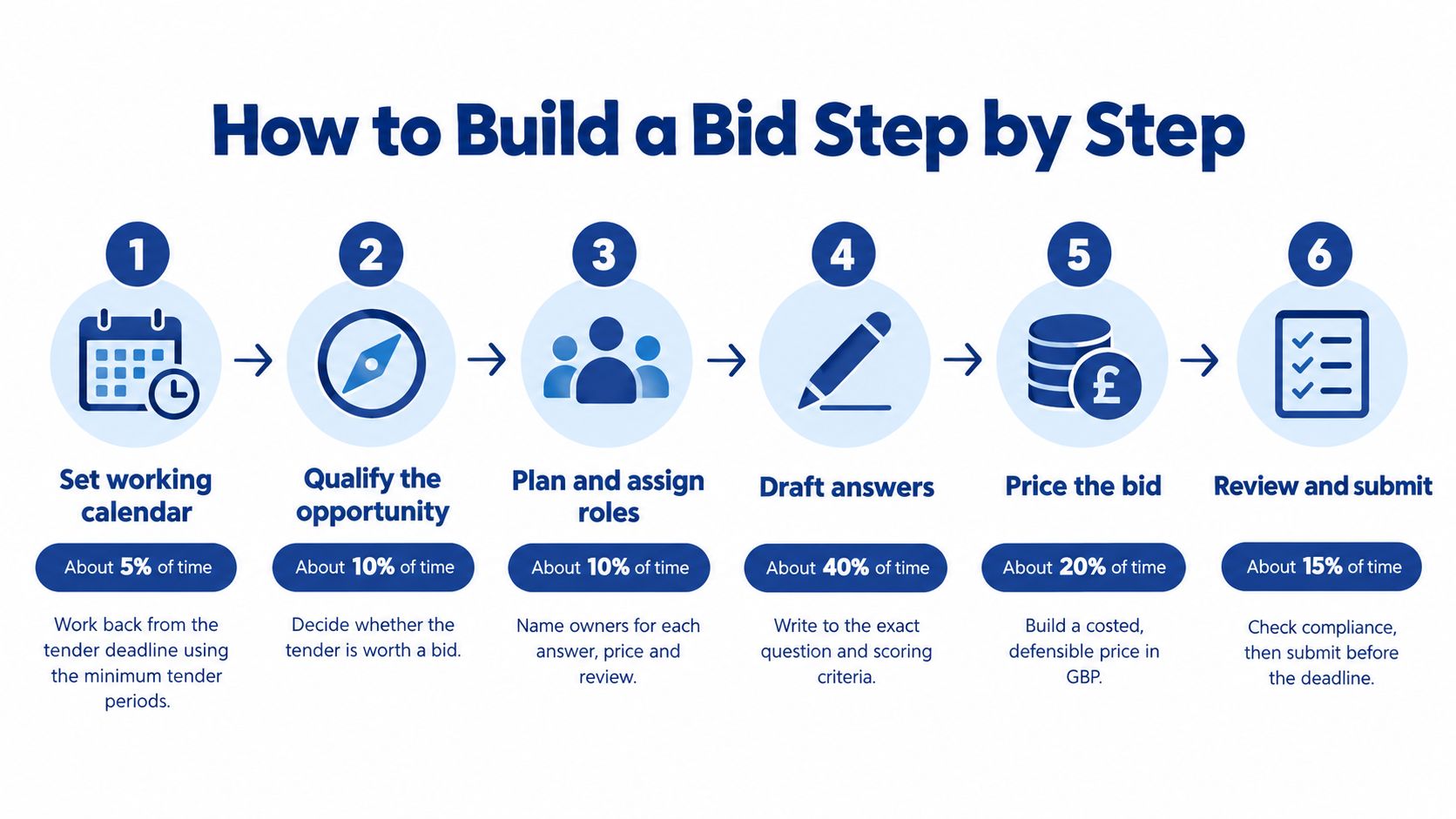
Reading is usually a few hours. Drafting is the largest block. Review is the part teams cut, and the part evaluators notice.
The order that keeps you compliant
- Confirm the gates. Check mandatory conditions before anyone drafts. If you can't pass them, stop.
- Log the pack. Record every mandatory requirement, deadline and clarification route. Don't rely on memory after page 40.
- Build a compliance matrix. Map each question to its criterion and weighting so orphan paragraphs show up early.
- Pull evidence. Take credentials, case studies and policies from the knowledge base. Don't rewrite a policy inside the answer.
- Draft to the question. Open with the buyer's wording, then the method, then the proof.
- Price with assumptions. Build the number and write down what sits behind every line.
- Independent review. Someone who didn't write the answer marks it cold.
- Submit a day early. Do a final compliance check, then send. Portals fail on deadline day.
Where the hours should move
Typing is the expensive habit. Checking is the useful one. AI response generation can draft from your knowledge base and the tender documents, so the hours shift from blank-page writing to testing each answer against its criterion. Keep the review even when the draft looks clean. A fluent paragraph that misses a sub-criterion still scores nothing.
Tools that hold approved content and generate a first draft, including bid writing software, don't remove the bid manager's judgement. They shorten the gap between "we decided to bid" and "someone who didn't write this has marked it".
Best Practices That Lift Your Scores
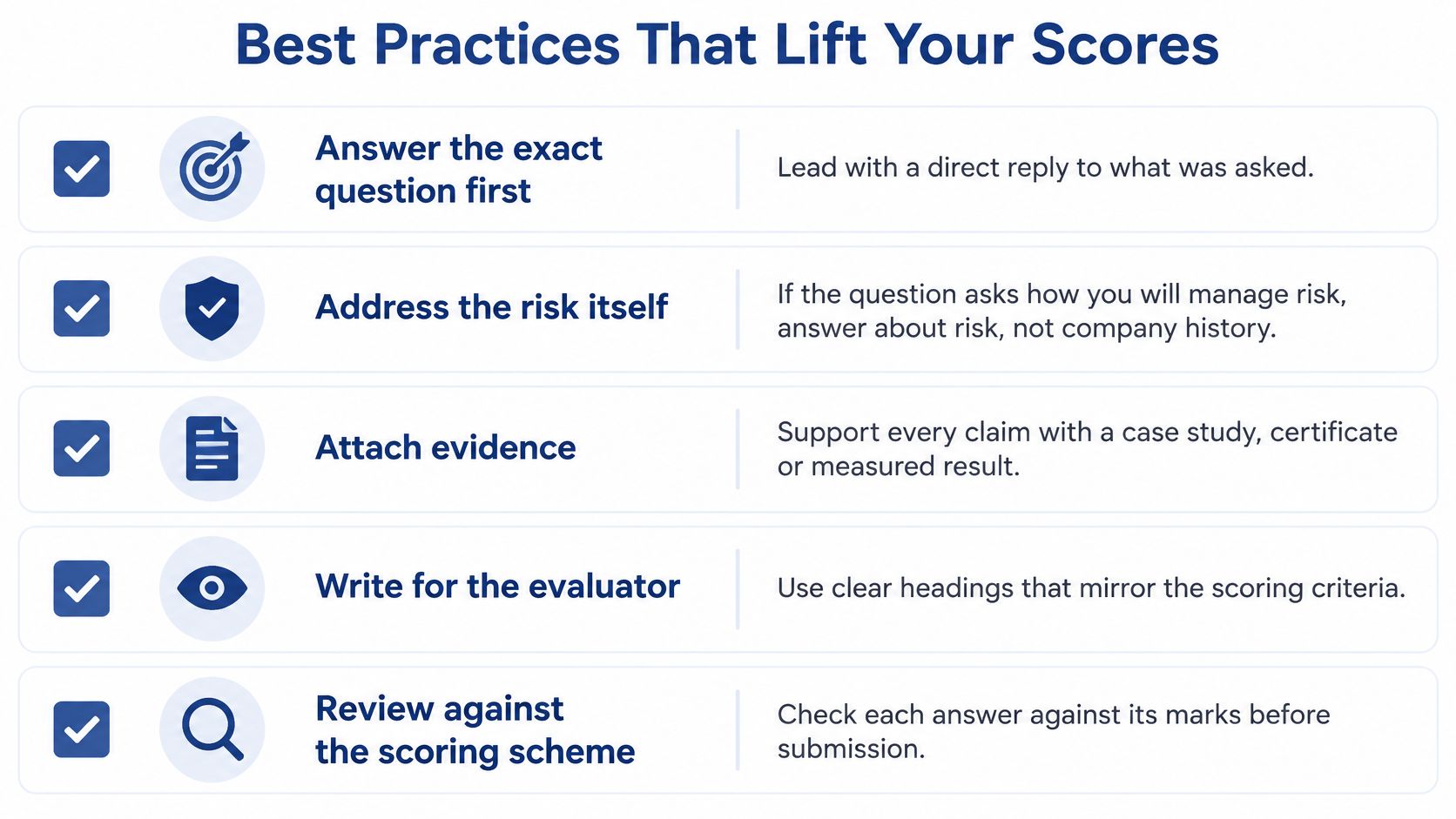
A buyer asks how you will manage risk. If your answer opens with company history, the evaluator has to search for the relevant evidence. A strong response makes the scoreable point easy to find and verify.
Answer the question you were asked
Use the evaluation criterion as a heading, then answer it directly. Keep background on your organisation only when it helps prove the point. Evaluators compare responses against the buyer's published criteria, so make the link between each claim and the question explicit.
Support claims with relevant evidence: a named project, a measured result or a certificate. “We have extensive experience” gives the evaluator little to score. A specific result from a named client is more useful. Keep the wording plain and sentences readable; clarity helps the evaluator find the evidence without inferring what you meant.
Social value needs an operating spec
Social value needs a deliverable the buyer can assess, not just a broad promise. The buyer's published evaluation criteria set how it is assessed. The PPN 002 guidance covers the Social Value Model for relevant public contracts. Check the tender documents for the measures and weightings that apply to the opportunity.
“We'll support local communities” leaves the evaluator guessing about the outcome. Make the commitment specific to the contract: state what you will deliver, where, when, who owns it and how you will provide evidence. For example, an apprenticeship commitment could name the number of places, the location and the delivery period, then set out how progress will be reported. Choose commitments your team can resource and substantiate. A larger promise may look attractive, but an unsupported one can weaken confidence in the whole response.
Before you submit, ask whether an evaluator could name the result, the owner, the timing, the metric and the proof without guessing.
Apply the same test to method, risk and resourcing answers. Reuse is useful only when evidence is current and relevant. Keep approved credentials and case studies in a knowledge base, then check each draft against the tender's question and requirements. The system can speed up drafting; the bid team remains responsible for accuracy and fit.
Learning From a Lost Bid
A lost tender can leave you with little more than an award notice. Ask the buyer for a written debrief, then record what they share. The Federation of Small Businesses has described bids from small firms disappearing without explanation, but a thin response can still help you separate a weak answer from a poor opportunity.
Sort the loss before you rewrite anything
Map each comment to the relevant criterion and score. Classify the findings before changing your next draft:
- Compliance failure: A missing certificate, a late upload or an unsigned declaration.
- Quality weakness: The method did not explain roles, timing or evidence.
- Price gap: Your quality score was competitive, but your commercial offer was not.
- Wrong opportunity: The lot, threshold or geography did not fit your business.
Keep a loss log with the date, buyer, score, price and any information shared about the winning bid. Patterns can point to the cause. Repeated weaknesses in method statements suggest a template or evidence problem. Repeated price gaps call for a review of costing, not just sharper wording.
What better writing won't fix
Turn each finding into a specific action. Update a case study, correct the template or add a check to your go or no-go process. Better sentences will not solve an eligibility gap or make an unsuitable lot worth pursuing. The log helps distinguish those issues from weaknesses in the response itself.
Store the log in your knowledge base alongside updated case studies and corrected policies. Before the next submission, check that the changes have reached the draft. Otherwise, the same problems can return in the next bid.
Bidwell monitors UK tender notices, stores evidence in a knowledge base and drafts responses for review against the scoring scheme. For a live public tender, start with the notice, evaluation criteria and evidence you already hold. Visit Bidwell to see how those inputs fit a deadline.


