You've found a promising public-sector opportunity, but the tender pack asks for security policies, supplier details, subcontractor controls and evidence of data protection. Your documents exist, somewhere. The problem is finding the current version, checking whether it covers the exact question, and producing a defensible answer before the deadline.
That's where the phrase auto trust centre creates confusion. It can refer to a local automotive business, or to an automated digital hub that organises supplier assurance evidence. For UK SMEs bidding for public contracts, the second meaning is the one that matters. A trust centre only helps you win if it turns compliance claims into current, reviewable evidence.
Decoding the Auto Trust Centre Search Intent
Search for “Trust Auto Centre” and you may land on a very different type of business. The available UK results identify Trust Auto Centre, not a clearly documented organisation called “Auto Trust Centre”, as a DVSA-approved MOT testing station in Blackpool, Lancashire. A garage directory lists its postcode as FY2 0QX, while its own local-service pages identify Layton and Poulton and provide the number 01253 508999. The available evidence supports a profile of a local independent garage, not a national automotive chain. The garage directory listing is the sensible starting point for verifying that distinction.
That matters because similarly named organisations can lead to poor due diligence. The available search results don't reliably establish the garage's founding date, turnover, employee count, MOT volume, pass rate or years in operation. A procurement team should verify the current legal entity, Companies House record and DVSA station listing before treating the business as a supplier benchmark.
The B2B meaning
For an SME preparing a public-sector bid, an automated trust centre is a digital assurance hub. It brings together policies, certifications, access controls, vulnerability records, privacy information, subcontractor details and approved answers to recurring buyer questions.
The buyer isn't interested in a polished page full of logos. They want to know who owns each control, when the evidence was issued, whether it remains current and what happens when a supplier or hosting provider changes. A static PDF folder rarely answers those questions quickly.
Practical rule: If a claim can't be tied to an owner, document version, issue date and review date, it isn't ready for a high-scrutiny tender response.
The same principle should shape your bid-writing software workflow. Your tender monitoring identifies opportunities, your knowledge base stores approved evidence, and AI response generation uses that evidence to draft an answer against the buyer's wording. Without the evidence layer, automation only produces faster unsupported claims.
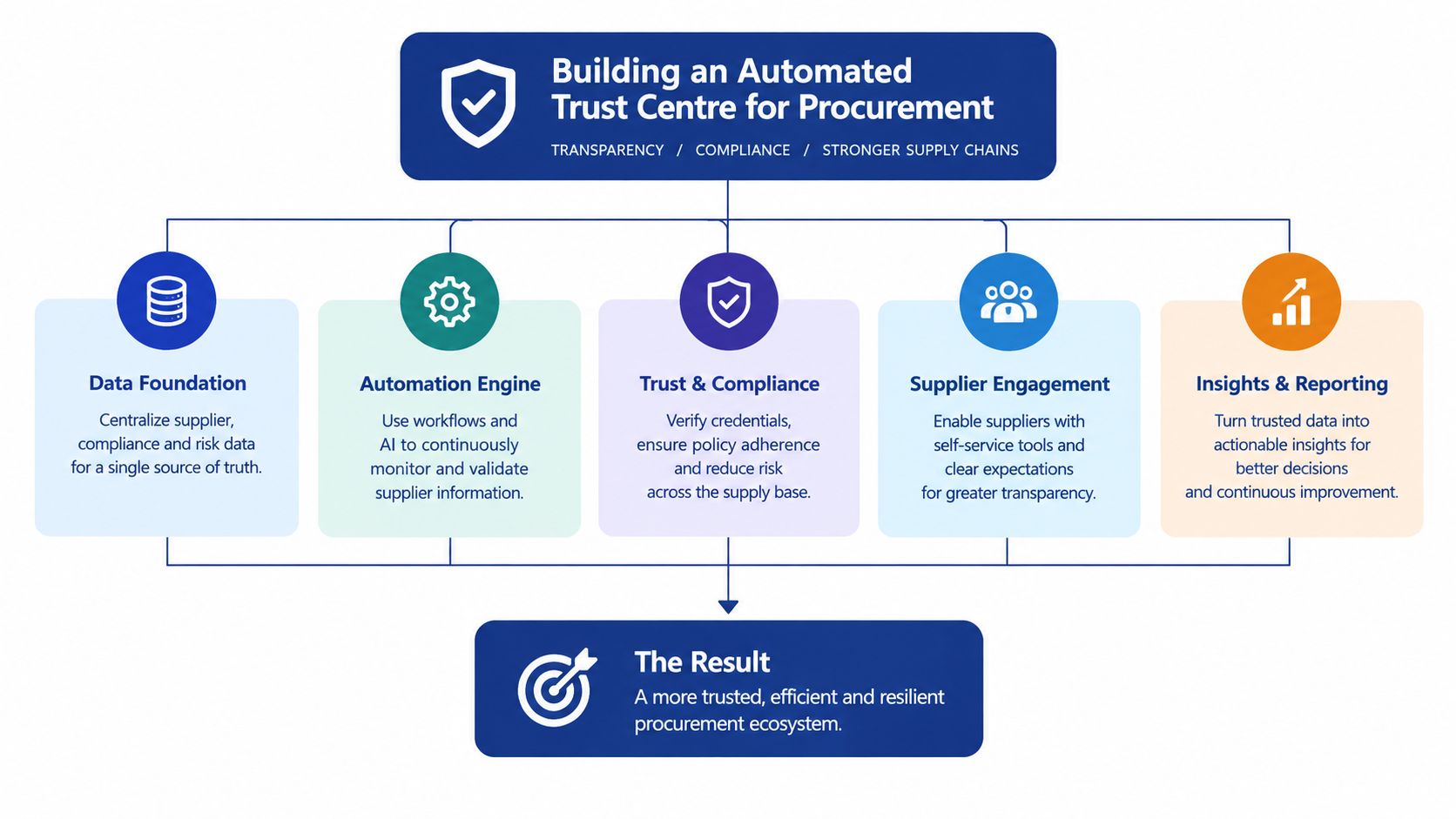
Building an Automated Trust Centre for Procurement
An effective automated trust centre operationalises security requirements. It doesn't just display a certification logo and assume the procurement team will fill in the gaps.
The ICO's security outcomes guidance expects organisations to authenticate and authorise human users and automated functions that access personal data. It also covers strong authentication for privileged access, encryption in transit and at rest, vulnerability management, protection against common web weaknesses such as SQL injection, and regular vulnerability scanning and penetration testing.
Turn controls into evidence
Map each control to an artefact that a bid manager can retrieve without asking an engineer to recreate the answer. Useful evidence may include:
- Access control: The policy, privileged-access process, approval record and review owner.
- Encryption: The architecture summary, encryption policy and scope of protected systems.
- Vulnerability management: Patch records, scanning results, penetration-test summary and open remediation actions.
- Web application security: Relevant testing scope, issue status and the date of the latest review.
- Data protection: Processing details, retention rules, subprocessors and incident-response arrangements.
The ICO also expects testing outcomes and remediation action plans to be recorded. Your trust centre should therefore show the document version, issue date, scope, next review date and remediation status. A buyer can then distinguish an active control from a historic assurance statement.
Supplier identity creates another practical control point. Before you associate a tax record, legal entity or payment profile with a supplier, use a specialist resource such as TaxID supplier validation to support consistent verification. That doesn't replace legal or procurement checks, but it helps prevent mismatched supplier records from entering the evidence chain.
The trade-off is transparency versus exposure. Public summaries can explain your security posture, while restricted documents may need controlled access and an approval process. Publishing everything creates unnecessary information risk. Publishing too little forces buyers into repeated clarification rounds.
Centralising Evidence in Your Knowledge Base
A shared drive isn't a trust centre. It's a storage location, and storage alone doesn't tell an AI system which document is approved, which version applies to the tender or whether a policy has expired.
Start with a control register. Give each control a plain-language name, an owner, a scope, a review date and links to the supporting artefacts. Then separate evidence by use, not just by department. A folder called “IT policies” may make sense internally, but “Encryption of customer data at rest” is much easier to retrieve when answering a scored procurement question.
A practical repository structure
Use Bidwell's knowledge base to create a controlled evidence set with clear metadata:
- Credentials and certifications: Store the certificate, scope, issuing body, validity details and approved description. Don't rely on a logo without the supporting record.
- Policies and procedures: Keep the current policy beside a short buyer-facing explanation. Mark superseded versions clearly so AI response generation can exclude them.
- Technical evidence: Add architecture diagrams, test summaries, access-control procedures and remediation records with an identified owner.
- Supplier and subprocessor records: Record the service provided, data accessed, location, contract status and control responsibilities.
- Past answers: Save successful responses with the original question, evaluation criterion, date, approval status and evidence used.
This structure helps AI response generation retrieve a specific answer rather than assemble a plausible paragraph from unrelated files. It also makes review easier. A bid manager can check whether the draft cites the current policy and whether the response addresses the buyer's wording.
A knowledge base should support judgment, not replace it. AI may spot a relevant certificate, but a human still needs to confirm that its scope covers the proposed service. The same applies to case studies. A past answer can provide useful language, but it shouldn't be reused if the delivery model, subcontractors or data flows have changed.
For teams formalising this work, the practical guidance on unlock revenue with Contesimal offers useful context on knowledge-base design. The important procurement test is simple: can a reviewer trace every material claim back to an approved source?
A focused PQQ workflow should use the same evidence rules. Pre-qualification questions often establish whether you can proceed to the tender stage, so an unverified security statement can remove an opportunity before your technical proposal is assessed.
Managing Supply Chain and Dispute Risks
Your trust centre must cover more than your own organisation. If a cloud provider hosts the service, a specialist subcontractor delivers part of it, or a logistics partner handles physical assets, the buyer needs to understand the full delivery chain.
The UK Government Supplier Assurance Framework places emphasis on early identification of high-risk projects and contract risk management. It also says that a Statement of Applicability assessment covers the prime supplier and subcontractors delivering the service. The government's procurement essentials guidance also identifies cyber security, suitable insurance, financial stability and policy compliance as core assurance areas.
Digital and physical risks are different
A software supplier may need to prove that a hosting provider encrypts data, that a subcontractor follows access controls and that responsibility for incident response is documented. A physical asset supplier may need to verify identity, ownership, condition, mileage, modification history and the accuracy of supporting documents.
The consequences differ, but the weakness is similar. A prime contractor accepts a downstream claim without checking the evidence.
UK-focused automotive reporting cites analysis of 2.5 million cars, in which 16.25% showed a discrepancy in mileage or VIN data, and estimates that roughly 160,000 vehicles are sold with fraudulent mileage annually. Those figures appear in this analysis of clocked cars in the UK, but they shouldn't be treated as evidence about any particular garage or supplier.
| Assurance Area | Digital Service Requirement | Physical Asset Requirement |
|---|---|---|
| Identity | Verify the legal entity, account owners and access approvers | Check VIN, ownership documents, supplier identity and vehicle records |
| History | Retain policy versions, test results and remediation actions | Compare MOT history, V5C details, invoices and inspection findings |
| Third parties | Map hosting providers, subprocessors and subcontractors to controls | Record dealers, repairers, transport providers and inspection parties |
| Disputes | Define escalation, incident ownership and contractual remedies | Pause approval, preserve photographs and documents, request a written explanation |
| Evidence | Store current artefacts with scope, dates and owners | Keep inspection reports, mileage records, correspondence and purchase documents |
An official MOT history can reveal inconsistent recorded mileages, but it cannot by itself establish ownership, finance status, accident history or liability. Commercial checks also depend on the completeness and accuracy of their contributing databases. If a mileage reading drops, pause the transaction or repair approval, photograph the VIN and odometer, compare the GOV.UK record with the V5C and invoices, request a written explanation, and arrange an independent inspection. Unresolved consumer disputes may need advice from Citizens Advice or an appropriate motor-trade dispute channel.
The same discipline applies to a digital subcontractor. Don't ask only whether the provider is “compliant”. Ask which control it owns, what evidence supports the answer, when the evidence was reviewed and what happens if the provider changes.
A specialist guide to due diligence evidence collection can help teams formalise that record. In a tender, the strongest response is rarely the one with the most documents. It's the one that shows clear responsibility across the delivery chain.
Aligning with the Procurement Act 2023
Tender monitoring needs a date-aware view of the UK procurement system. Since 24 February 2025, new UK procurements under the Procurement Act 2023 use the enhanced Find a Tender service for above- and below-threshold notices, with some Scottish and Northern Irish exceptions. The official Find a Tender notice guidance explains that the service now covers pipeline, tender, award and contract information, with related notices connected by a procurement identifier.
That changes how an SME should interpret an alert. A tender notice may be the start of a chain, not the complete opportunity. Monitoring needs to connect the pipeline notice, tender, award and contract updates, then distinguish a live opportunity from a later announcement.
Keep legacy and new-regime searches separate
Contracts Finder still matters for procurements started under earlier rules. Government guidance says it is no longer used to publish notices under the new regime, while devolved systems continue to have their own arrangements. The Find a Tender search service should therefore sit within a dated search routine, not replace every other source.
A practical monitoring workflow should record:
- Procurement start date: This determines which rules and portal treatment apply.
- Notice type: Pipeline, tender, award or contract information may require different action.
- Procurement identifier: Use it to connect related notices and avoid treating an award update as a new bid.
- Geography: Check whether the opportunity belongs in Find a Tender, Contracts Finder, Public Contracts Scotland or Sell2Wales.
- Action status: Separate research, qualification, live bid, clarification and post-award monitoring.
The official service states that below-threshold information above £12,000 including VAT is available through relevant national systems, including Public Contracts Scotland and Sell2Wales. That threshold should be treated as a portal and search-rule detail, not as a guarantee that every suitable SME opportunity will appear in one place.
AI use creates a second workflow requirement. UK government SME guidance says answers should follow the published structure, address each question directly, align evidence with the criteria and weightings, and avoid irrelevant material. It also calls for strong evidence behind claims, a final check against the criteria and transparency about AI use where policy requires it. The government SME bid pack provides the relevant guidance.
Configure AI response generation so it can identify the source evidence used, map the draft to the question and weighting, and flag where disclosure is required. Never submit authority-provided non-public information to a generative AI tool without permission. Store approved credentials and case studies in the knowledge base, and keep confidential tender material separate from reusable company evidence.
Turning Compliance into Winning Bids
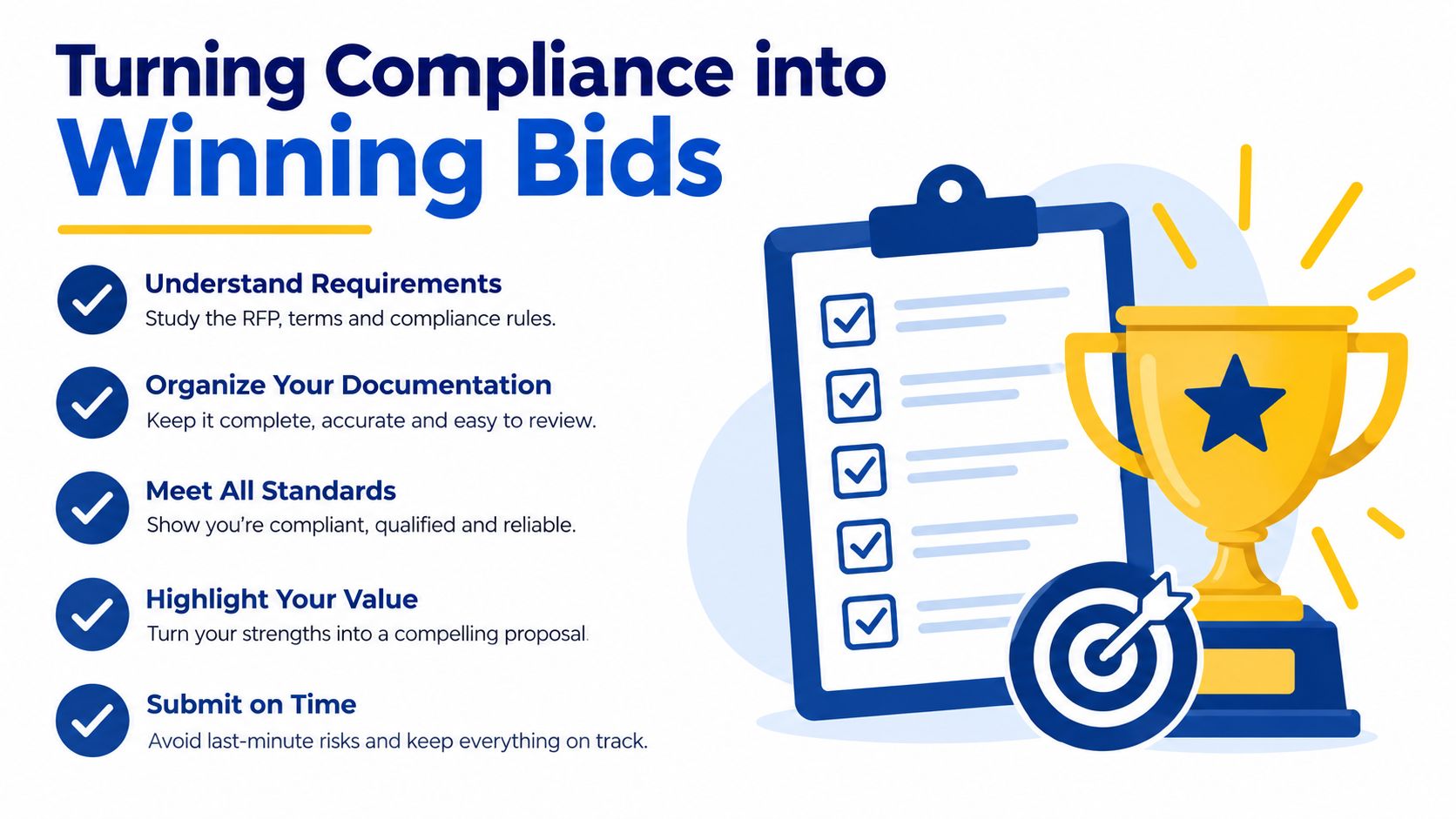
An auto trust centre earns its place when it improves the quality of a scored answer. A collection of certificates won't compensate for a response that ignores the evaluation weighting, fails to answer the question or makes a claim that the evidence doesn't support.
Use tender monitoring to identify the right opportunities and related notices. Use the knowledge base as the controlled source of truth. Use AI response generation to produce a structured first draft, then have a knowledgeable reviewer test every material statement against the tender and its evidence.
A bid-ready evidence check
Before submission, confirm that:
- The source is current: Remove or quarantine expired certificates, superseded policies and outdated supplier lists.
- The scope matches: Check that the evidence covers the service, data, geography and delivery parties in the tender.
- The answer follows the question: Mirror the published structure and respond to each requested point.
- The weighting is visible: Give more space and stronger evidence to higher-weighted criteria.
- The supply chain is covered: Include hosting providers, subprocessors and subcontractors where they affect delivery.
- AI use is controlled: Disclose it when required and exclude confidential authority information unless permission exists.
- The reviewer can trace claims: Link each important statement to an approved artefact, owner and review date.
A tender response workflow works best when these checks happen before drafting, not after a polished answer has already circulated. Automation can find the evidence and expose gaps early, but it can't approve a claim on behalf of your security owner or subcontractor.
The practical position is straightforward. Build the trust centre around evidence, not presentation. Keep it current, assign ownership, include the delivery chain, and make every AI-generated answer answerable to the tender's scoring method.
Bidwell brings tender monitoring, a controlled knowledge base and AI response generation into one workflow for UK businesses pursuing public-sector contracts. Use it to track relevant opportunities, organise approved trust evidence and prepare responses for review, then visit Bidwell to see how the platform fits your next bid.