
It's Friday afternoon and a 180-page invitation to tender has just landed. The deadline is next week. You've still got delivery work, a thin bid team, and a shared drive full of case studies nobody has dated. An AI proposal generator can take the blank page away. It cannot take the responsibility away.
What an AI Proposal Generator Actually Does
The software reads the tender, pulls out the questions and the mandatory requirements, and drafts answers from material you have already approved. A person then checks every line. It does not know your company until you feed it your evidence, and it does not win bids by itself.
Where the hours go
On a manual bid, reading the pack takes 2 to 6 hours. A standard tender sits nearer 2 to 4. A framework with lots of lots and annexes sits nearer 4 to 6. After that you hunt for evidence, draft, chase sign-off and fight the formatting. A standard response often eats 20 to 40 hours. Complex frameworks can run to about 80 hours.
| Task | Typical manual effort | With an AI proposal generator |
|---|---|---|
| Reading and understanding requirements | 2-6 hours (2-4 standard, 4-6 complex) | Requirements pulled into a checklist; you still check the source |
| Whole response, standard tender | 20-40 hours | 2-4 hours of review and refinement (Bidwell's stated range) |
| Whole response, complex framework | Up to about 80 hours | A long review, often a working day, because every annex still needs a human check |
| Finding evidence for each question | Several hours in shared drives and old Word files | Retrieved from the knowledge base against each requirement |
The Office for National Statistics reports that the share of UK businesses with 10 or more employees using at least one AI technology rose from about 12% in September 2023 to around 35% by June 2026. Adoption still splits by size. 28% of businesses with 0 to 9 employees reported AI use, against 49% of firms with 250 or more people. That gap is why the hour count hits SME bid teams hardest. You don't have a bench of writers waiting for Friday's pack.
Three jobs have to sit together. Tender monitoring finds the notice. The knowledge base holds the evidence. AI response generation drafts the answer for a named person to approve.
Which UK Portals Your Tender Alerts Must Cover
No single site carries every UK tender. If you only refresh one bookmark, you will miss work that was advertised somewhere else.
From 24 February 2025, Find a Tender became the publication service for above-threshold notices and for below-threshold notices under the Procurement Act 2023, except below-threshold procurements in Scotland. The official service points suppliers to Contracts Finder for England and other non-devolved territories, Public Contracts Scotland, Sell2Wales, and eSourcing NI or eTendersNI for Northern Ireland.
| Source | What it covers | Value to know |
|---|---|---|
| Find a Tender | Above-threshold notices, and below-threshold notices outside Scotland | Pipeline notices for intended requirements above £2 million |
| Contracts Finder | England and other non-devolved territories, as directed by the official service | £12,000 central government; £30,000 sub-central authorities and NHS trusts |
| Public Contracts Scotland | Scottish public sector below-threshold procurements | Confirm the notice route on the official service |
| Sell2Wales | Welsh public sector procurements | Confirm the notice route on the official service |
| eSourcing NI or eTendersNI | Northern Ireland public sector procurements | Confirm coverage directly before relying on alerts |
Thresholds that move a smaller contract
For below-threshold notices, the values that matter are £12,000 including VAT for central government and £30,000 for sub-central authorities, NHS trusts and NHS foundation trusts. Those are the notices SMEs miss when they only watch high-value procurements. A facilities firm that ignores anything under six figures will never see a local authority job that matches its actual capacity.
Pipeline notices as early warning
UK1 pipeline notices on Find a Tender cover intended requirements above £2 million, which gives you a view of planned buying before the invitation arrives. The Foreign, Commonwealth & Development Office describes its own pipeline as an 18-month forward look, reviewed and updated annually or when needed, in the Home Office SME action plan. Use that window to file experience against the likely requirement, not to start writing on the day the ITT drops.
Bidwell's tender monitoring is built around daily coverage of these separate sources, with AI summaries so you can judge fit against credentials and capacity in minutes. Treat Northern Ireland as a manual check. Confirm that eSourcing NI or eTendersNI is in the alert set before you rely on it.
How the Draft Gets Built From Your Own Evidence
Think of a bid writer who has read every approved file before they start, and who will not write a sentence unless they can point at the file behind it. That is the behaviour you want from the tool.
Retrieval-augmented generation means the model writes from documents you retrieve, not from a general memory of the internet. UK Government guidance on AI procurement expects data governance from the start, a check on data quality and bias, and human oversight of accuracy.
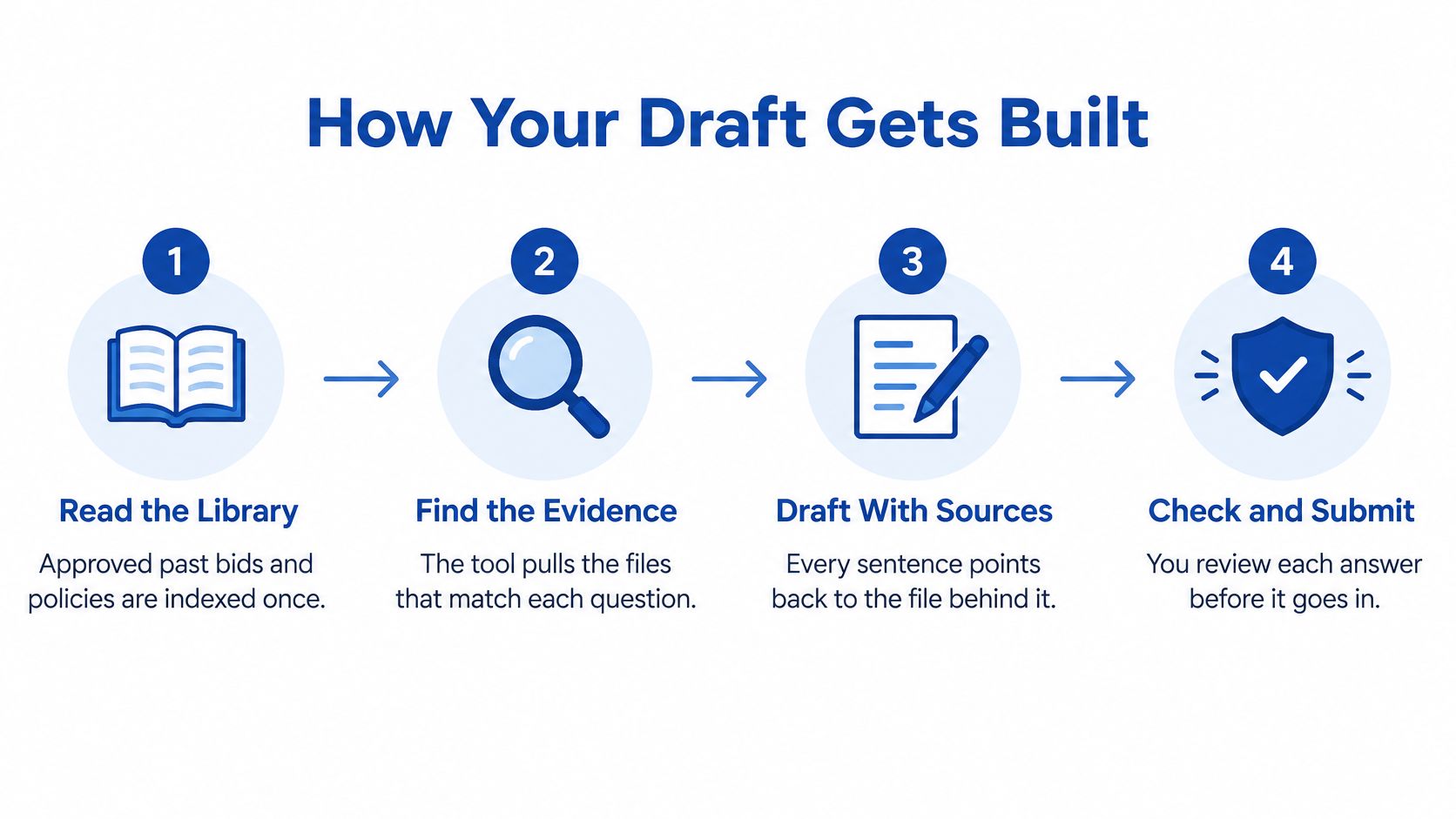
Six stages, and why each one exists
- Load approved credentials, case studies, policies and past answers into the knowledge base. Give each item an owner and an expiry date, or last year's policy will keep coming back.
- Split the tender into requirements. Note word limits, mandatory items and scoring themes. Buyers who write a clear specification make this easier. The AI-completable spec guide for procurement teams shows how a spec can be structured so an assistant can complete it, which is also how hidden mandatory items get missed when the spec is a mess.
- Retrieve the best evidence item for each requirement. If nothing matches, stop. Do not improvise.
- Generate a draft where each paragraph links to its source. That link is the audit trail.
- Flag any claim with no evidence. Plausible wording is the failure mode, not a helpful fill.
- The bid manager validates and edits. Those edits go back into the library so the next draft starts from the corrected version.
Stages 1 to 3 sit in the knowledge base. Stages 4 and 5 are AI response generation. Tender monitoring only helps if the evidence is already there when the alert arrives.
A quality question and a gap
Say the question is about quality management. The tool retrieves an ISO certificate and two case studies, and the draft cites them. A later question asks for healthcare delivery. You have no healthcare case study. The draft should flag the gap, not invent a ward-based contract.
Practical rule: An unsupported certification or outcome is a blocking error, not a drafting style issue.
The same guidance covers storage limitation, security and personal data under UK GDPR and the Data Protection Act 2018. Use retention rules, role-based access, encryption, and a hard split between client-confidential files and reusable company content. That matters once CVs, references, pricing or special-category data are in the library. Before you load anything, audit for expired certificates and superseded case studies.
Where a Generator Helps and Where People Still Must Step In
A good first draft helps on repetitive method questions. Wording stays consistent from bid to bid. You don't stare at a blank page. You can answer several tenders in one month without rebuilding the evidence pack each time.

| Task | Generator handles well | Person must own |
|---|---|---|
| Turning the ITT into a requirements checklist | Extracts questions, word limits and mandatory items | Checks the source for anything the model missed |
| First draft of a method statement | Reuses approved case studies and policies | Confirms the method is what the team actually does |
| Staff CVs and named references | Pulls the latest approved versions | Checks consent, currency and UK GDPR handling |
| Pricing and commercial terms | Formats tables from supplied rates | Owns every number and assumption |
| Quantified outcomes, such as on-time delivery rates | Flags when no evidence item exists | Verifies the source, date and definition |
| Tone and scoring themes | Mirrors the buyer's language from the ITT | Judges whether the answer is specific and persuasive |
A risk question, worked through
The buyer asks how you will manage project risk, with a 250-word limit. The tool pulls three risk-register extracts and a delivery case study, then drafts about 300 words and cites them. It also flags the word limit. You cut the draft. You check the case study is still current. You confirm the method is what the delivery lead actually runs, not what a previous bid wished you ran. The tender use cases are a useful place to see how those question types show up on real public-sector work.
What still fails
Invented capabilities are the obvious failure. So are quantified outcomes with no source, stale case studies, and a mandatory requirement buried in an appendix that never made the checklist. Generic answers that match no scoring theme score poorly even when every sentence is true.
The generator owns the first draft. People own every fact, every number and every judgement about whether the answer persuades.
The knowledge base is what supplies the case studies and policies the draft cites. Tender monitoring only earns its place if it flags the requirement early enough for someone to check each of those person-owned items before the deadline.
Disclosing AI Use Without Losing Buyer Trust
The fastest draft can be the riskiest one. If a claim has no source, or nobody can say who approved it, speed has made the bid worse.
Procurement Policy Note 017, published in February 2025, accepts that suppliers may use AI to develop bids. It also warns that a contracting authority may ask whether AI was used, may restrict confidential tender information being used as training data, and may test you with a site visit, clarification questions or a supplier presentation.
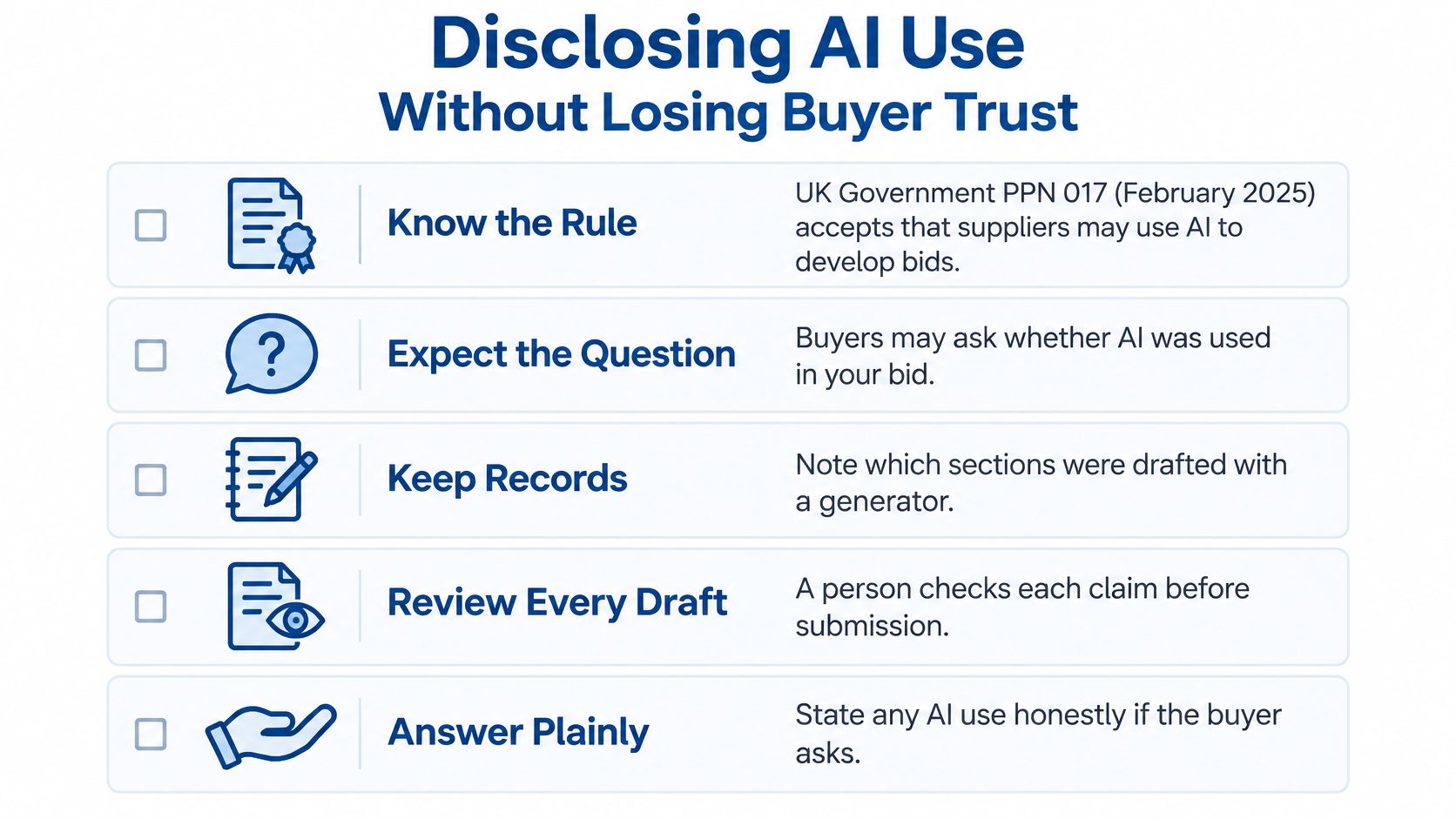
What you should be able to show
Keep these ready before anyone asks.
- Audit trail: Each claim links to the evidence item behind it.
- Data record: You can say what went into the system, and what did not.
- Named approval: A person signs off every answer, not a shared inbox.
- Confidentiality split: Client material stays out of the reusable library.
- AI-use statement: A short standard paragraph lives in the knowledge base and gets reviewed for each bid.
- Delivery proof: You could walk a buyer through staffing and method on a site visit and match what the response says.
Say the response claims eight qualified engineers available from week one. On the visit the buyer asks to meet them. You have three, and two are booked elsewhere. The draft was fast. The bid is now a credibility problem.
The disclosure statement should be honest and short. It is not a defence. Store the standard wording in the knowledge base next to the source link for each claim. AI response generation should leave unsupported claims flagged for that named approver, so the statement and the draft tell the same story.
Testing and Governance Checks Before You Commit
Build a holdout set of about 20 past tender questions from your last two years. Annotate each one with mandatory requirements, the evidence that should support it, prohibited claims, word limits and scoring themes. Run the generator without showing it the old answers.
Crown Commercial Service AI buyers' guidance expects proper evaluation criteria, technical expertise, security testing, governance, and a way to avoid vendor lock-in. Fluency is not one of the measures that matter.
| Measure | What it tells you | How to run it |
|---|---|---|
| Requirement recall | Share of mandatory requirements the draft answers | Count answered mandatory items against the annotated list |
| Evidence-grounding precision | Share of claims linked to a correct evidence item | Check each linked item supports its claim |
| Unsupported-claim rate | How often the draft states something with no evidence | Count ungrounded claims per answer; any quantitative one is blocking |
| Citation completeness | Whether every paragraph points to a source | Count paragraphs without a source link |
| Human correction time | Minutes a bid manager spends fixing the draft | Time reviewers on the holdout set and compare with your manual baseline |
Any ungrounded quantitative claim is a failure. A percentage, a headcount or a contract value with no source is not a style note. It blocks the draft.
Questions to put to a vendor
Ask where the data is stored, who can open the knowledge base, how client-confidential files are separated from reusable content, and what the retention rules are. Ask whether the vendor trains models on your bids. A published usage policy, such as the 1chat guidelines for teams, is the sort of plain document you should be able to read before you upload a single CV. Check you can export the library and the prompts. Require versioning of prompts, models, retrieved documents and reviewer edits, so you can reproduce a submitted answer if a buyer asks after award.
Demos prove little. The holdout test proves more.
Run that test on the knowledge base and on AI response generation. Build the question set from recent tenders you found through monitoring, so you are testing the work you bid, not a sample pack. Compare the privacy terms, including how personal data is handled, with your own retention rules before you commit.
Deciding Whether to Start With a Generator Like Bidwell
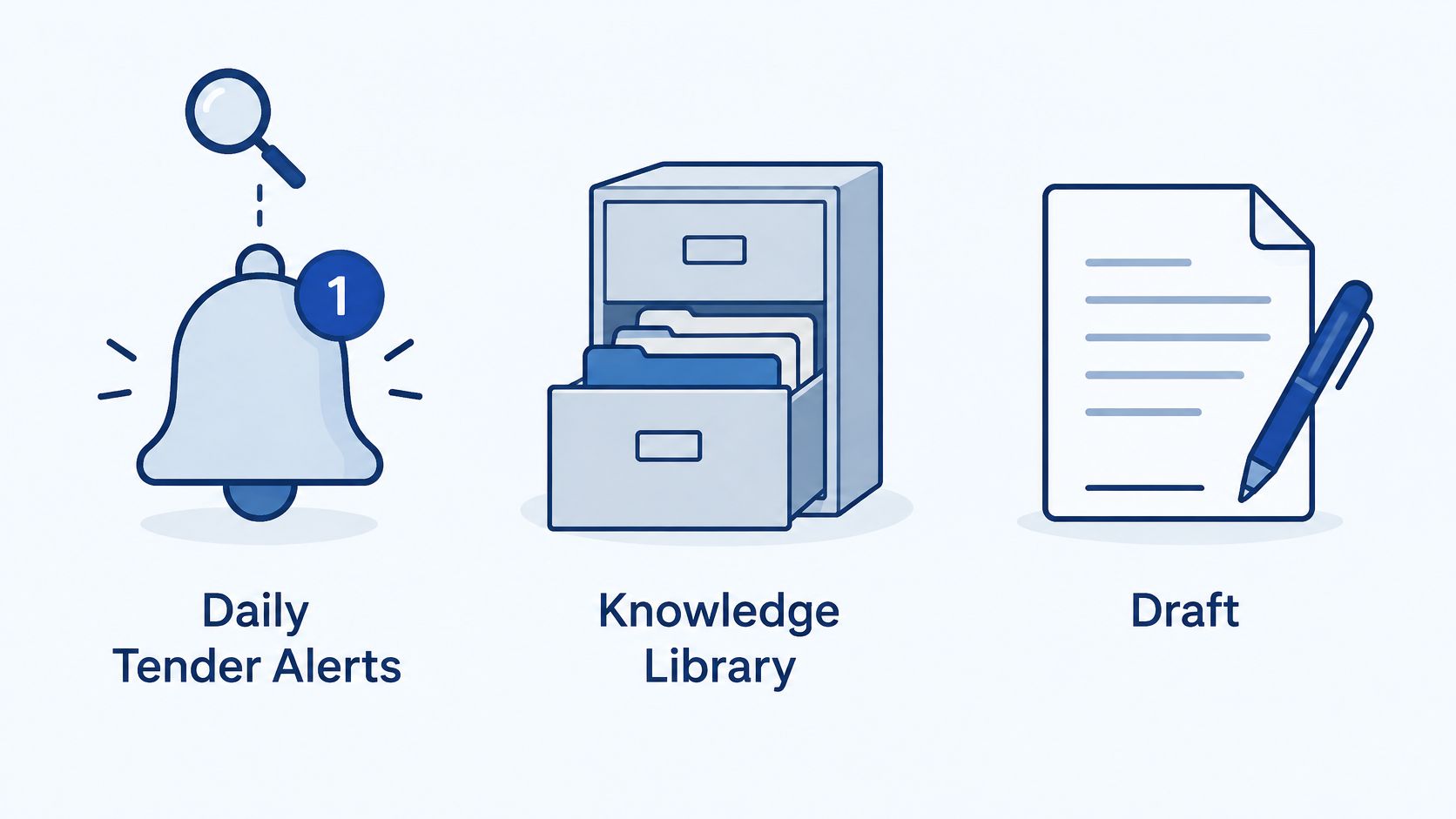
Match the three features to the actual work, not to a feature list.
Tender monitoring sends daily alerts across the portals, with AI summaries. You spend minutes sorting matches instead of hours searching. The knowledge base holds credentials, past responses and case studies in one governed place. That is where evidence-grounded drafting starts. AI response generation produces a draft fitted to each bid, which Bidwell states takes a 20 to 40 hour writing task down to 2 to 4 hours of review. You still own the facts.
A 2025 SME procurement tracker reported that 130,000 SMEs supplied government directly in 2024, while SMEs received only 20% of overall procurement spending. The market is there. The capacity often is not. That is a preparation problem as much as an opportunity problem.
When it adds less
It suits SME owners and bid teams who respond to several tenders a month and keep losing days to search and rewrite. It adds less if you bid once a year and the library is already stable, current and easy to find. In that case the tool will not repay the setup.
Pick one live tender. Load your last ten answers. Run the holdout test. Record correction time against your usual baseline. Then decide. Check current pricing and trial terms on the bid writing software pages before you load client files.
Bidwell monitors UK tender portals, keeps your evidence in a knowledge base, and drafts responses you still have to check line by line. If you want that workflow on a real bid rather than a demo, start with one live tender and visit Bidwell.


