Wednesday afternoon. Three writers are working through a 60-page ITT, the deadline is 48 hours away, and the compliance matrix is still half-finished. One person is searching old bids for a relevant case study. Another is drafting the methodology response. The bid lead is trying to answer clarification questions while checking that every scored requirement has an owner.
The problem isn't a lack of strategy. It's the volume of structured writing required under pressure. Tender responses need a consistent voice, evidence-backed claims, precise answers to evaluation criteria, and enough tailoring to show the buyer you understand the requirement.
AI document generation can take on the first-draft work, but only when it's connected to approved source material and a controlled review process. It should give experienced writers more time for win themes, differentiation, commercial judgement, and quality assurance. It shouldn't decide what your organisation can promise.
The Real Problem Bid Teams Are Trying to Solve
Most bid teams still begin with a blank document, even when the business has answered similar questions before. The relevant material may be spread across Word files, PDFs, spreadsheets, SharePoint folders, old submissions, and individual writers' memories.
That creates avoidable work. A bid writer spends time finding evidence, copying standard language, checking whether it's still current, and reshaping it around the new question. Only then can they start doing the valuable work, such as deciding what the answer should make the evaluator believe.
Volume creates the bottleneck
The pressure is worse when several sections are being written in parallel. Different authors use different terminology, repeat the same claim in slightly different ways, or miss a requirement because the compliance matrix changed after drafting began.
A controlled generation tool can handle the mechanical layer:
- Structure: It turns the question, instructions, word limit, and evaluation criteria into a usable response shape.
- Source retrieval: It finds relevant material from an approved library instead of relying on a writer's memory.
- First drafting: It assembles a starting answer that the writer can challenge, edit, and strengthen.
- Consistency checks: It helps identify missing evidence, repeated claims, and conflicting statements across documents.
The bid writer still owns the answer. They decide whether a case study proves the point, whether a proposed service model is deliverable, and whether the wording reflects the buyer's priorities.
Practical rule: Use AI to reduce the time between a tender question and a credible first draft. Never use it to remove accountability from the person signing off the response.
This distinction matters in UK procurement. Government guidance has moved from defining generative AI and setting expectations for responsible use to treating AI-assisted tender responses as a transparency issue. The technology belongs inside the bid process, not outside governance.
What AI Document Generation Actually Is
In bid-team language, AI document generation is software that creates a structured draft from an instruction and a curated knowledge base. The knowledge base might contain approved past responses, CVs, policies, certifications, case studies, service descriptions, and evidence records.
It isn't the same as opening a general chatbot and asking it to “write a tender response”. A bid tool should retrieve relevant material from your own library, use that material to draft the answer, and show enough traceability for a reviewer to verify the claims.
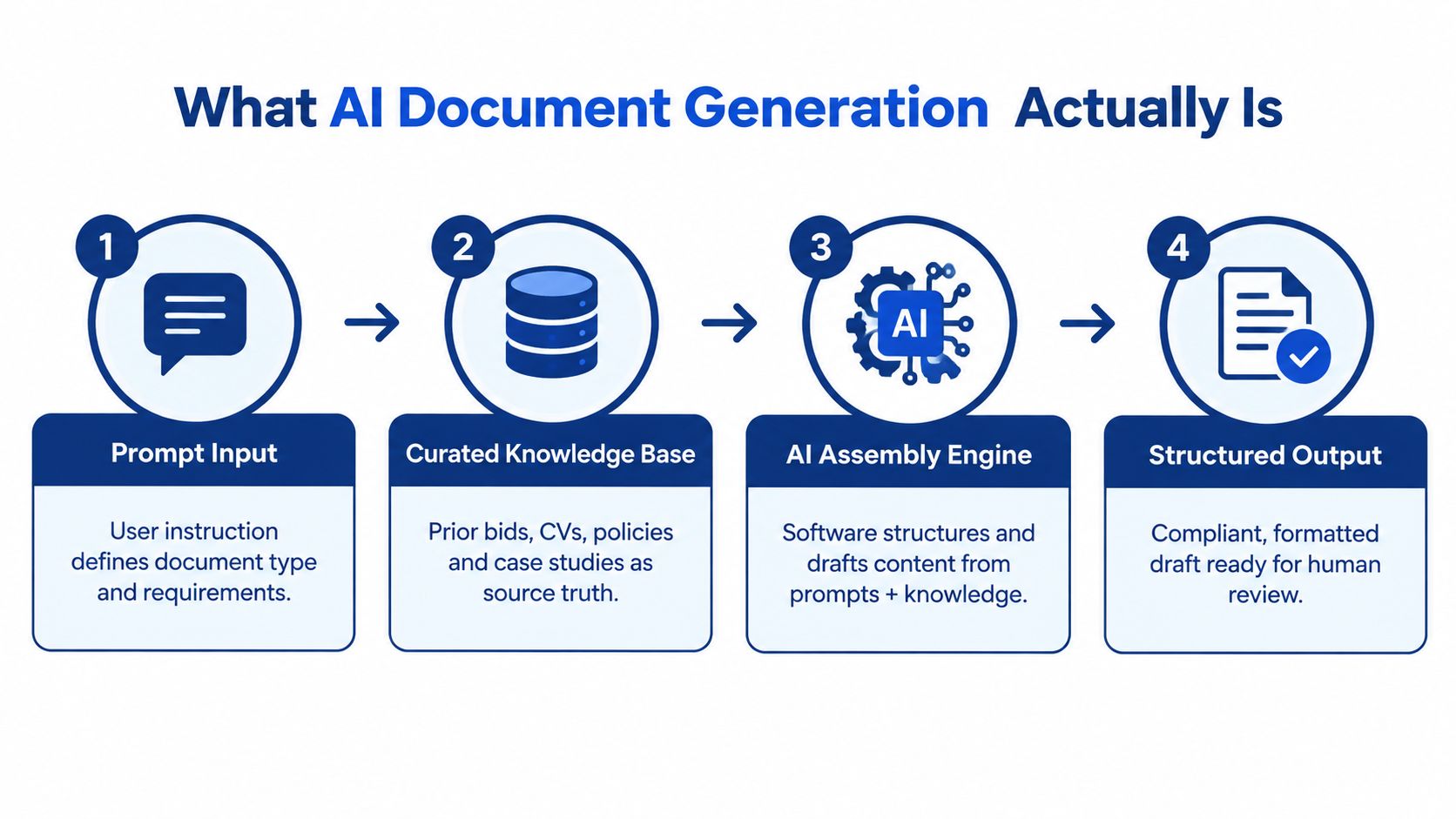
The four-part pipeline
First, the prompt defines the job. It might include the buyer's question, response instructions, evaluation weighting, word limit, required format, and the tone the team wants to use.
Next, retrieval searches the knowledge base. The system looks for material relevant to the question. This is often called retrieval-augmented generation, or RAG. In practical terms, RAG means the model is given selected source content before it drafts.
Then, the language model assembles the answer. It organises the retrieved evidence into a response rather than copying a previous bid. The model can propose headings, connect evidence to the requirement, and identify areas where the source library is thin.
Finally, guardrails shape the output. These can enforce response length, structure, terminology, source restrictions, and review status. The result should be a formatted draft, not an unverified final submission.
The vocabulary that matters
- Grounding means tying the draft to approved source material. A grounded answer can still be poorly written, but it has a defensible basis.
- Hallucination means the model produces a plausible statement that isn't supported by the available evidence. It may invent a capability, outcome, certification, or project detail.
- Embeddings are numerical representations that help software find content with a similar meaning, even when the wording in the source and the tender question differs.
- RAG is the retrieval and drafting pattern that gives the model relevant evidence before generation.
Teams assessing the category can also create smarter documents using AI to understand how structured generation works outside tendering. For a bid-specific workflow, bid writing software should connect source retrieval to response drafting, rather than treating document creation as a separate writing exercise.
The useful mental model is simple. The model supplies language and structure. The knowledge base supplies organisational truth. The reviewer supplies judgement.
How the Workflow Fits Together
AI adds value across the bid cycle, but it doesn't contribute equally at every stage. The strongest workflow uses it to organise information, propose structure, draft from evidence, and test coverage. People remain responsible for opportunity selection, win strategy, pricing, commitments, and final approval.
Where the time goes
At tender selection, the system can compare a new notice with go or no-go criteria. It can surface contract scope, buyer type, deadlines, required certifications, geographic constraints, and obvious conflicts. That gives the bid lead a faster starting point for a decision, but it won't understand strategic fit unless the team has defined those criteria properly.
During go or no-go, AI can summarise the ITT and flag risks for review. At storyboarding, it can suggest a response structure mapped to the evaluation criteria. The writer then decides which themes deserve prominence and which claims the organisation can prove.
Drafting is where document generation earns its place. A source-grounded first draft can turn a blank page into a reviewable answer. The writer should still challenge every claim and tailor the language to the buyer.
| Bid stage | AI role | Realistic time saved | Human oversight required |
|---|---|---|---|
| Tender selection | Match notice details to go or no-go criteria | Less manual scanning | Commercial fit and strategic judgement |
| Go or no-go | Summarise requirements and surface risks | Faster initial review | Capacity, bid cost, delivery risk, and conflicts |
| Storyboarding | Suggest headings and evidence against scoring criteria | Less outline preparation | Win themes, scoring logic, and answer strategy |
| Drafting | Produce a source-grounded first response | Less blank-page writing | Accuracy, tailoring, commitments, and tone |
| Review | Check requirement coverage and identify unsupported claims | Fewer manual checks | Compliance sign-off and subject-matter validation |
| Submission | Prepare summaries and cross-document consistency checks | Less final formatting work | Final approval, declarations, and portal submission |
A government-led generative AI trial involving more than 20,000 civil servants found that users saved an average of 26 minutes per day on tasks including drafting documents, summarising long emails, updating records, and preparing reports. The official trial findings describe that as nearly two working weeks per person per year.
That result points to an important design choice. The gain comes from embedding AI in repeated workflow steps, not from asking a model to write a complete bid in isolation.
The right target isn't “AI writes the tender”. It's “the team reaches a defensible draft sooner, then spends its time improving the answer”.
Procurement teams report a similar pattern. A 2024 survey of 300 UK supply-chain and procurement decision-makers found a 44% reduction in manual processes among organisations adopting generative AI, with use concentrated in task automation, internet research, document analysis, and content creation. The Ivalua survey release supports a combined workflow of retrieval, summarisation, analysis, and drafting rather than a standalone writer.
For broader workflow design, the discussion of Prometheus Agency workflow automation is useful context. Bid teams should borrow the principle of connecting stages, while keeping procurement-specific controls around evidence and confidentiality.
Benefits and Risks in Plain English
The case for AI document generation is strong when a team has a usable content library and a disciplined review process. The case against it is equally strong when people treat fluent prose as proof of accuracy.
| Benefit | Failure mode that cancels it out | Control |
|---|---|---|
| Faster first drafts | The team accepts a plausible but unsupported answer | Require source references and named review |
| Consistent tone | Every section sounds generic and detached from the buyer | Add buyer-specific instructions and writer editing |
| Fewer missed requirements | The model overlooks an instruction hidden in an attachment | Use a compliance matrix owned by a human |
| Reusable evidence | Old or restricted content gets reused incorrectly | Tag ownership, status, date, and permissions |
| More time for strategy | Writers spend longer correcting weak AI output | Pilot on controlled response types first |
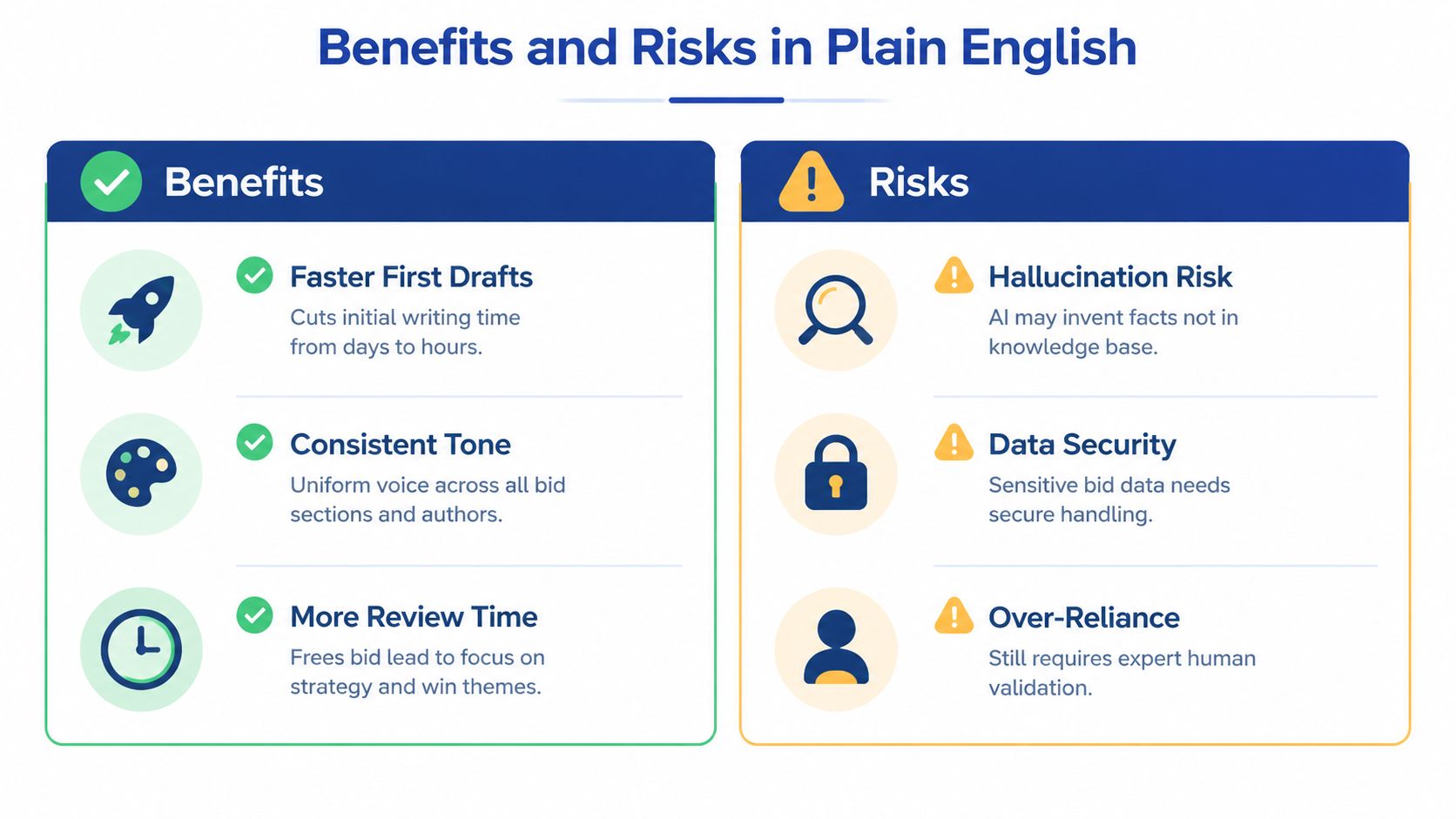
The benefits are practical
A good system removes repetitive searching and formatting. It can help several authors use the same approved terminology, find the right case study, and start from a response structure that reflects the question.
It also makes knowledge more reusable. A strong answer shouldn't disappear into a closed submission folder where nobody can find it later. Proper tagging allows the team to distinguish approved credentials from draft material, expired policies, confidential client information, and content that needs a subject-matter owner.
The risks are procurement-grade
A model can write confidently and still be wrong. It may combine two projects, overstate an outcome, confuse a certification with an intention, or create a delivery promise that nobody approved.
Confidentiality needs equal attention. Tender responses can contain pricing, personal data, client names, security information, and commercially sensitive operating details. Putting that material into an uncontrolled public model can create a contractual and reputational problem, even if the generated prose looks harmless.
Buyer perception matters too. A contracting authority may not object to assisted drafting, but a generic response with thin evidence will still score badly. AI doesn't excuse a team from understanding the requirement or tailoring the answer.
UK government guidance requires officials to signpost when generative AI has been used to create content or interact with the public, and it stresses justification, minimum necessary use, and privacy-enhancing techniques for personal data. The Government AI Playbook provides the relevant public-sector context.
Adoption is a trade-off, not a verdict. Approve AI for controlled drafting where source evidence is strong. Keep people in charge of claims, commitments, confidential data, and sign-off.
Using It on a Live Tender
Take a public-sector ITT from a local authority or a Crown Commercial Service route. The work starts before anyone asks the model to write. The team first needs to find the opportunity, decide whether it fits, and prepare a trusted source set.
For monitoring, remember that UK procurement is spread across official channels. Contracts Finder lets suppliers search for contracts worth over £12,000 including VAT, while high-value opportunities are directed to Find a Tender. Scotland and Wales use Public Contracts Scotland and Sell2Wales, and GOV.UK public-sector procurement guidance shows how these portals work alongside one another.
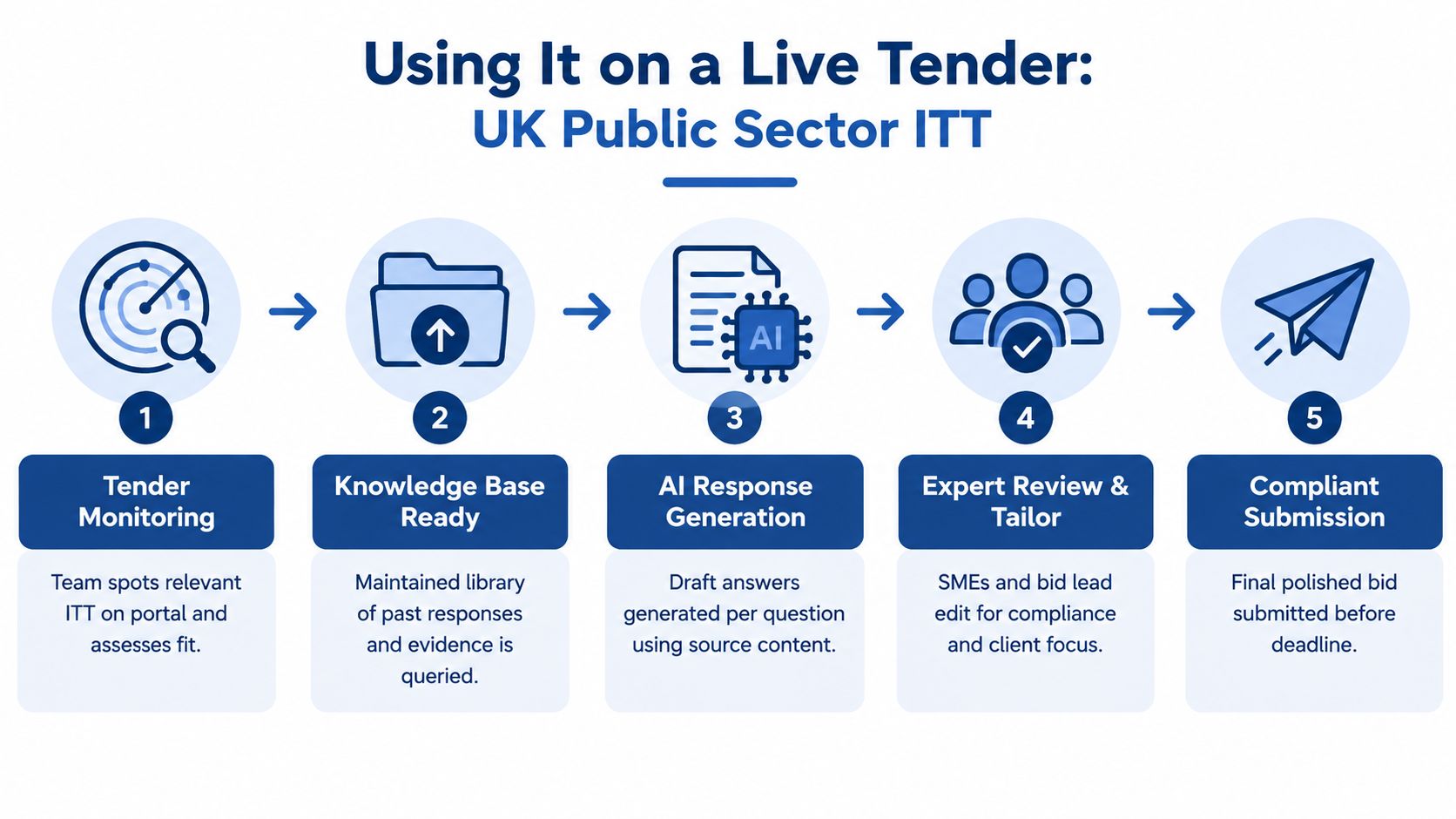
The working example
The alert lands in the team's tender monitoring queue. The bid lead checks the buyer, scope, deadline, framework route, and mandatory requirements. Once the opportunity passes the initial fit check, the team creates a controlled workspace for the ITT.
The knowledge base is then queried for relevant evidence. That might include a social value response, a cyber security policy, a Cyber Essentials Plus certificate, implementation plans, service descriptions, and CVs for proposed roles. The system should return the source passages and their status, not just a paragraph with no provenance.
Consider three questions:
- Social value: AI drafts a response linking the organisation's approved employment, training, or community commitments to the buyer's stated outcomes. The bid writer removes generic promises, adds the correct delivery owner, and checks that every commitment can be measured and delivered.
- Cyber Essentials Plus: AI finds the relevant certification and security policy language. The security lead confirms the certificate applies to the bidding entity, checks its validity, and removes any wording that implies controls beyond the evidence.
- How will you deliver: AI proposes a structure covering mobilisation, governance, resourcing, reporting, and risk management. The delivery SME replaces generic process language with the actual operating model, dependencies, and escalation route.
The hand-off is deliberate. AI response generation creates a draft. The bid writer aligns it to the scoring logic, the subject-matter expert validates the detail, and the bid lead signs off the final answer.
Teams that want to map this operating model to a tender-focused product can review Bidwell's tender use cases. The principle remains the same regardless of software: tender monitoring identifies the work, the knowledge base supplies evidence, and AI response generation creates a reviewable starting point.
Tricky Questions Bid Teams Ask First
Can the model be trusted?
Not on its own. Models hallucinate, and fluent wording doesn't make a claim true.
The practical defence is source-grounded retrieval plus a named human reviewer for each answer. Require the reviewer to check the draft against the underlying source, the ITT question, and the compliance matrix. If the evidence isn't available, the system should flag a gap or ask for input instead of filling it with plausible language.
A useful rule is to treat every generated claim as unverified until a person accepts it. This applies to dates, contract values, certifications, staffing, outcomes, service levels, and references to named clients.
What can go into a third-party tool?
Start with the NDA, client contracts, internal information-security policy, and the tool provider's data-handling terms. If a document contains personal data, confidential pricing, security architecture, or client-restricted information, don't upload it until your organisation has approved the processing route.
A private or on-premise deployment may change the risk assessment, but it doesn't remove governance. You still need access controls, retention rules, audit records, model-provider checks, and a clear decision about whether submitted content can be used for training.
The Government's framework tells officials to justify personal-data use, use the minimum necessary data, and apply privacy-enhancing techniques. Those principles translate directly into bid operations. Redact information where the answer doesn't require it, restrict the source library by role, and don't give every contributor access to every client file.
Do you have to disclose AI use?
The answer depends on the procurement documents and the contracting authority's requirements. PPN 017, published in February 2025, says suppliers may be asked to disclose whether AI was used to develop tender responses and allows proportionate controls to protect confidential tender information from being used to train AI systems. The PPN 017 guidance is the document your bid governance process should address.
Don't wait for a buyer to ask before deciding what you'll say. Record the tool, the type of assistance it provided, the human checks completed, and whether any confidential data was processed. Use the contracting authority's requested format where one exists.
When should a person overrule the AI?
Whenever the draft conflicts with evidence, weakens a scored answer, introduces a commitment, exposes restricted information, or fails to reflect the buyer's question. Record the reason for a significant override in the review trail. That record helps explain why the submitted answer differs from the generated draft if the bid is later challenged.
Rolling It Out Without Burning the Team
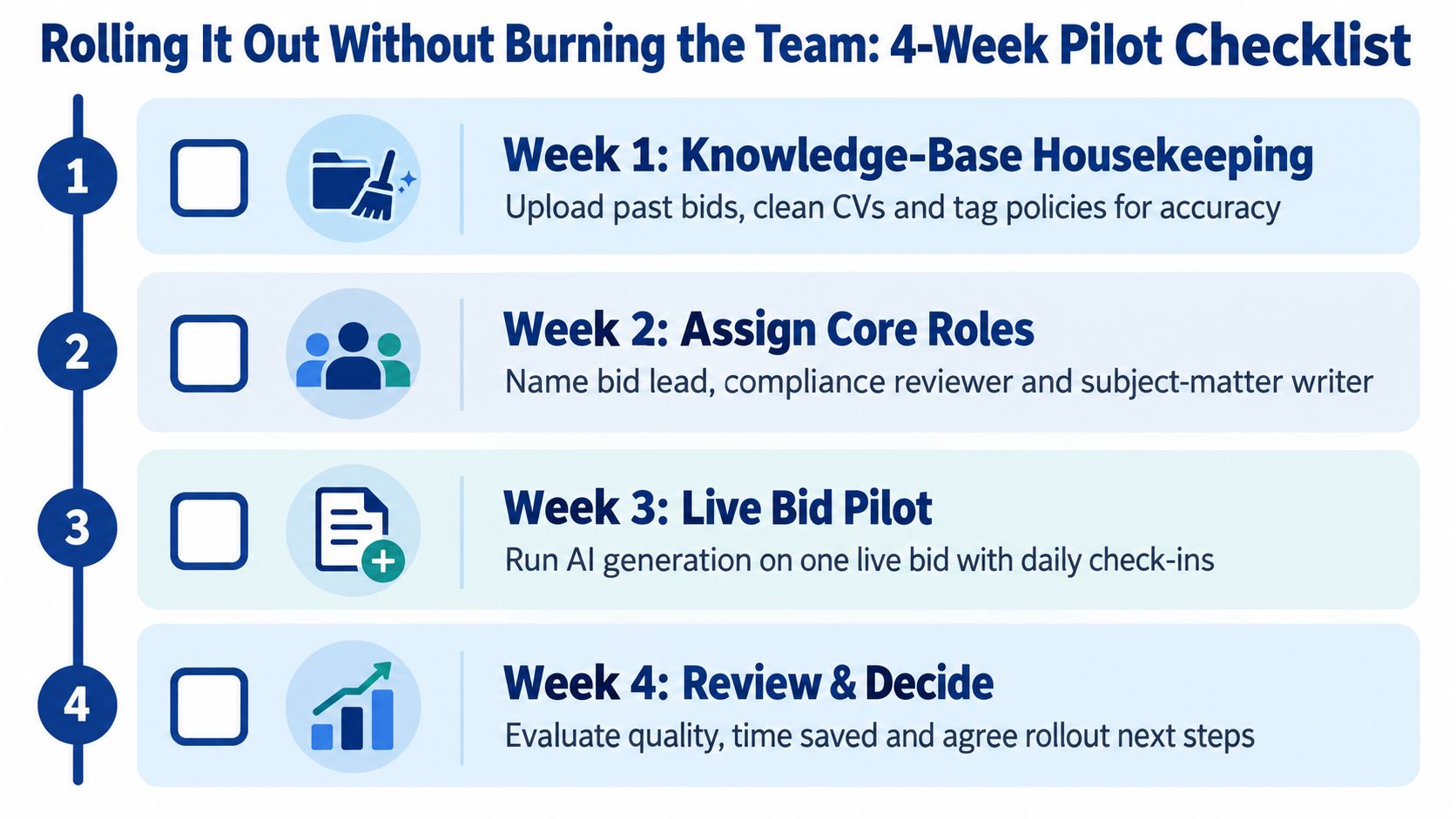
Don't begin with every tender, every document type, and every department. Run a four-week pilot on one live bid with a named bid lead, a compliance reviewer, and one subject-matter writer.
A controlled pilot
Week one is knowledge-base housekeeping. Upload past winning answers, clean CVs, case studies, certifications, and pricing guardrails. Tag each item by topic, owner, approval status, permissions, and review date.
Week two tests drafting on three non-critical responses. Compare the AI output with the team's usual first draft. Check time taken, word-count drift, factual accuracy, and how much rewriting the writer needs.
Week three adds reviewer scoring. Use a simple rubric covering compliance pass, tone match, evidence quality, and flagged hallucinations. Keep the scoring visible so sceptical writers can see where the tool helps and where it creates work.
Week four decides whether to proceed. Set access rules, define approved use cases, confirm disclosure wording, and attach a one-page AI usage note to the bid process.
Track three measures from the first day:
- Hours saved per response: Measure actual elapsed work, not the model's generation time.
- Win rate on AI-assisted bids versus historical baseline: Use this as a directional management measure, not proof that AI caused an outcome.
- Reviewer override rate: If it stays above 40% after a month, improve the knowledge base before scaling.
Keep the pilot small, visible, and reversible. The team needs to see credible drafts and clear controls, not promises about replacing bid writers. Practical implementation material and governance ideas are available in Bidwell's guides, but your own review trail and source ownership matter more than any template.
The right rollout leaves writers with less mechanical work and more time for judgement. If the pilot produces faster drafts but increases factual corrections, stop and fix retrieval, tagging, permissions, or prompts before adding more bids.
Bidwell combines tender monitoring across key UK portals, a permissioned knowledge base for credentials and past responses, and AI response generation for tender drafts. Visit Bidwell to see how the workflow can help your team find relevant public-sector opportunities and review evidence-backed responses without handing final accountability to the model.