A call-off contract is the specific contract or order placed under a framework agreement, and the legal foundation for that setup in UK public procurement comes from the Public Contracts Regulations 2015. A framework sets the terms for future buying during a given period, but the actual work and revenue only happen when a buyer makes a call-off.
A call-off contract is like ordering a specific meal from a restaurant's set menu. The menu is already agreed. You still need someone to place the order.
That's the part many suppliers miss. You win a place on a framework, the team celebrates, and then nothing happens for months. People start asking whether the work is coming, whether the buyer has to use you, and what you're supposed to do next.
In practice, the call-off process reveals whether bid teams are organised or caught flat-footed. Call-offs transform framework membership into live opportunities, short deadlines and, if you respond well, signed contracts.
You Won the Framework What Now
Winning a framework place is good news. It means you've cleared the first gate. It does not mean work is on the way automatically.
That catches out a lot of new suppliers. They treat the framework award as the finish line when it's really the start of a different kind of sales process.
If you need a grounding in how frameworks fit together, Bidwell's guide to public sector procurement frameworks is a useful starting point.
The framework is the menu. The call-off is the order.
That analogy works because it keeps the roles clear. The framework sets out the basic terms, approved suppliers, rules, pricing approach and buying method. The call-off is the buyer saying, “We need this specific piece of work now, on these terms, by this date.”
What happens after appointment
Once you're on a framework, your job changes.
You're no longer fighting to get onto the supplier list. You're fighting to be selected from that list when real work appears. That means keeping an eye on buyer activity, understanding the rules for each lot, and having reusable bid content ready before the next mini-competition lands in your inbox.
A practical way to think about it is operational readiness. Teams that can improve order efficiency with automation usually apply the same mindset well to call-offs. They reduce admin friction, keep documents current, and avoid rebuilding every response from scratch.
What works and what doesn't
A few patterns come up again and again:
- What works: Treat the framework award as pipeline access, not booked revenue.
- What works: Map each lot, buyer group and likely service line internally.
- What works: Prepare your pricing notes, case studies, CVs and method statements early.
- What doesn't: Waiting for the first call-off before deciding who owns the response.
- What doesn't: Assuming every buyer will run the same process.
- What doesn't: Forecasting framework value as if it's guaranteed income.
If you're training a new bid writer, that's the core message. Framework award gets you into the room. Call-offs are how you get paid.
The Framework and the Call-Off Explained
The cleanest way to answer “what is a call off contract” is to separate the umbrella from the order underneath it.
A framework agreement is the umbrella. A call-off contract is the individual contract awarded under that umbrella when the buyer has an actual requirement.
The legal foundation comes from the Public Contracts Regulations 2015, which define a framework agreement as an arrangement whose purpose is to establish the terms governing contracts to be awarded during a given period, as explained in Flint Bishop's note on framework and call-off contracts.
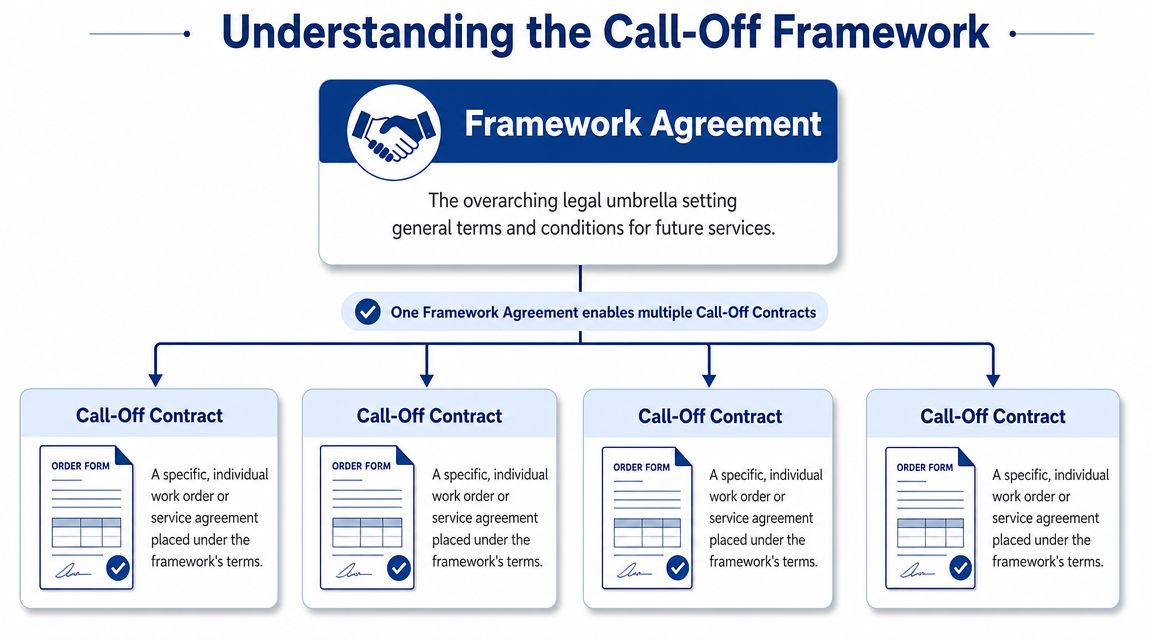
The simple split
Think of the framework as the rules of the game.
It usually sets the supplier pool, the lot structure, broad scope, pricing method, award process and core terms. It creates the route to buy. It does not by itself define every future job in full detail.
The call-off is the actual piece of work. It nails down the exact requirement, delivery terms and the order being placed under the framework.
Working definition: The framework sets the rules for future contracts. The call-off is the legally operative contract that applies those rules to a specific requirement.
If you want a broader explanation of the umbrella agreement itself, see Bidwell's guide on what a framework agreement is.
Why bidders need to care
This distinction isn't just legal housekeeping. It affects how you plan resources and how you write bids.
If you misunderstand the framework as the contract, you can end up overestimating revenue, underpreparing for mini-competitions, or missing the fact that each buyer may still ask for customized responses. The framework gets you pre-approved. The call-off is where you still need to prove fit.
A useful test is this. If the buyer has not issued an order or awarded a specific package of work, you do not yet have a call-off.
A practical example
Say a council has a framework for building maintenance. Your firm is appointed to the electrical services lot. That does not mean the council has bought anything from you yet.
When a school needs rewiring, the council can use the framework rules to award that specific job. That award is the call-off contract. It's the point where scope, timing and delivery become real.
How Call-Off Contracts Actually Work
Once a buyer has a requirement, the framework rules decide how the call-off can be awarded. In practice, that usually means one of two routes.
The first is direct award. The second is a mini-competition.
Where the framework terms are fully fixed, a buyer can direct-award the call-off to a pre-approved supplier. Where requirements need refinement, or the framework rules require it, the buyer must run a mini-competition among eligible suppliers, as outlined in Oboloo's explanation of call-off contract definition and award routes.
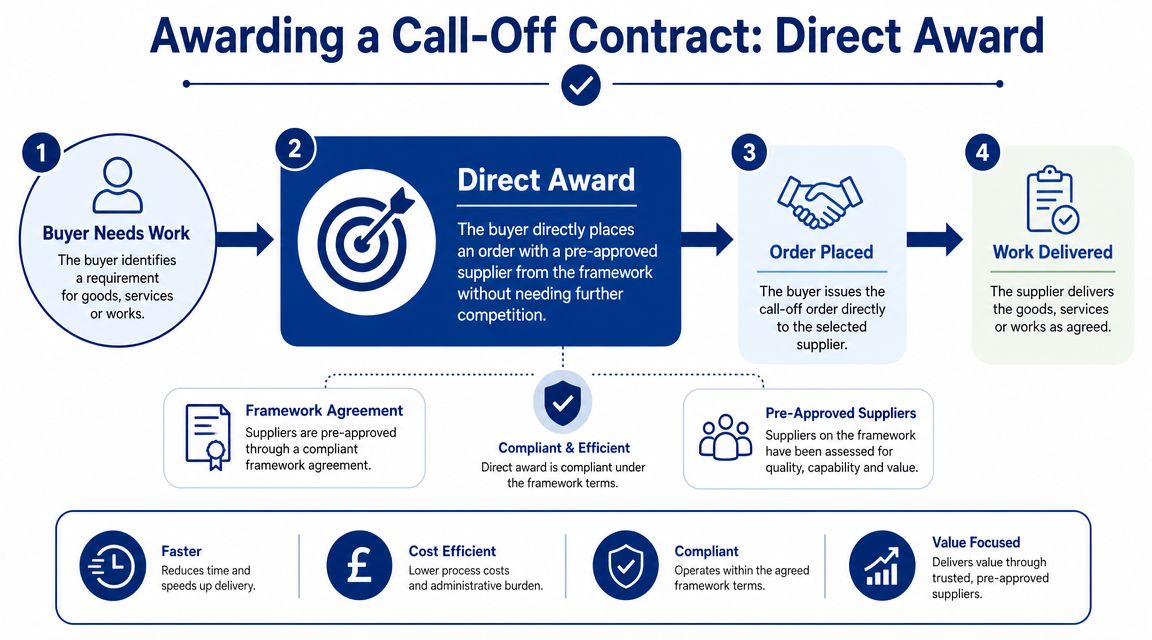
Direct award
Direct award is the quicker path.
The buyer already has enough information in the framework to choose a supplier without reopening competition. That only works if the framework terms are fixed enough to justify it. The scope, pricing structure and selection logic need to be clear upfront.
For suppliers, direct award can feel quiet. There may be limited back-and-forth before the order arrives. That means account management matters. So does keeping your buyer-facing information current.
Mini-competition
Mini-competitions are where most bid teams feel the pressure.
The buyer sends a specific requirement to eligible suppliers on the framework lot and asks for a response. Deadlines are often tight. Questions can be highly practical. Buyers assume you already know the base framework rules, so they don't always repeat them in detail.
Mini-competitions reward teams that are prepared before the notice arrives.
What usually works is a disciplined response process:
- Check the lot and eligibility first. Don't waste half a day answering a call-off you can't bid for.
- Read the call-off terms against the framework terms. Spot what's fixed and what's being assessed now.
- Reuse approved content carefully. Past material helps, but only if it matches the current requirement.
- Price with discipline. Framework pricing logic often limits how far you can improvise.
- Get sign-off early. Legal, operations and finance delays kill short-turnaround bids.
The operational bottleneck
Teams don't lose mini-competitions because they lack expertise. They lose because they burn time hunting for the latest policy, the right CV, the approved answer on social value, or the final pricing assumptions.
That's where a proper knowledge base earns its keep. When your bid library is organised by service line, framework, buyer theme and approved evidence, you can turn around a response much faster and with fewer compliance errors. AI drafting can help too, but only when it's built on content your team has already validated.
If the buyer moves quickly to contract issue, signing processes matter as well. It helps to have a clear internal path for approvals and a workable digital signature process for agreements, so the award stage doesn't stall after you've done the hard part.
Call-Off vs Other Contract Types
A call-off contract sits in its own lane. It isn't the same as a standalone public contract, and it doesn't behave like a Dynamic Purchasing System.
One point matters most. In UK procurement, a call-off contract is not the framework itself but the legally operative purchase made under it, with the framework setting the commercial and procedural rules and the call-off specifying the exact requirement, as explained in Stotles' glossary entry on the call-off contract.
Contract type comparison
| Feature | Call-Off (from Framework) | Standalone Contract | DPS (Dynamic Purchasing System) |
|---|---|---|---|
| How work is awarded | Through a framework route already set up | Through a fresh procurement for that contract | Through a DPS process for suppliers admitted to the system |
| Supplier entry point | You must already be on the framework | Any eligible supplier can bid when the tender is published | New suppliers can apply to join during the life of the DPS |
| Speed for buyers | Usually faster because core terms are already set | Usually slower because the full tender is run for that requirement | Can be faster than a standalone route, but still needs the DPS process |
| Competition style | Direct award or mini-competition, depending on the rules | Full competition for the specific contract | Competition among admitted DPS suppliers |
| Commercial setup | Base terms pre-set at framework stage | Terms built around the single procurement | Terms governed by the DPS and the specific competition |
| What bidders need to win revenue | Secure framework place first, then win call-offs | Win the tender itself | Join the DPS, then win competitions under it |
Why this matters in practice
For a supplier, the key trade-off is access versus timing.
A standalone contract gives any eligible supplier a shot when the tender goes live. A framework call-off can move faster, but only if you're already inside the supplier group. A DPS is different again because suppliers can usually join later, which changes your market-entry options.
If you miss a framework, you may be locked out until the next refresh or replacement agreement. If you miss a standalone tender, you've only missed that one contract.
That's why bid planning matters. Framework strategy is about getting onto the right routes early. Call-off strategy is about being ready to convert those routes into actual orders.
A bidder's rule of thumb
Use this quick test:
- Framework call-off: You're already approved. Now compete for the live work.
- Standalone contract: This tender is the main event.
- DPS: Entry stays more open, but you still need systems to track notices and respond quickly.
If your team confuses those routes, your pipeline forecasts and bid effort will drift fast.
Finding and Winning Call-Off Opportunities
Call-offs don't always behave like open-market tenders. Some are sent directly to framework suppliers. Some sit in portal messages that busy teams miss. Some arrive with very short windows and minimal room for clarification.
That's why monitoring matters. If your process relies on someone casually checking inboxes and portals, you'll lose chances you were already eligible to pursue.
If you need to tighten that part of your process, this guide on how to find tender opportunities is a good place to start.
Where call-offs usually appear
The practical sources are narrower than people expect:
- Framework portal notifications: Buyers often issue mini-competitions inside the framework system.
- Direct email invitations: Common where the framework manager contacts eligible suppliers directly.
- Procurement team follow-ups: Clarifications, timetable changes and document replacements can arrive separately.
- Internal account signals: Your delivery or sales team may hear about an upcoming requirement before the formal issue lands.
That means your tender monitoring process needs to do more than scrape public notices. It needs to bring buyer messages, portal alerts and framework-specific activity into one view.
What wins the work
UK procurement guidance consistently treats the call-off as the mechanism that turns a framework into actual spend. The framework sets the terms, and the call-off is the purchase or awarded contract made under those terms, as set out by Thornton & Lowe in its guide to call-off contracts in government contracts.
For suppliers, that changes the focus. Getting onto the framework is only access. Winning call-offs is where the revenue sits.
The teams that do this well usually keep three things tight:
- Tender monitoring: They know when an opportunity lands and who owns the response within minutes, not days.
- Knowledge base: They store approved answers, evidence, policies, CVs and case studies in a way that can be effectively searched and reused.
- AI response generation: They use drafting tools to build a strong first version from existing content, then review for buyer fit, compliance and tone.
One option in that category is Bidwell, which monitors major UK tender portals, stores bid content in a knowledge base, and generates draft tender responses from that approved material. For call-offs, that setup is useful because mini-competitions often reward the team that can produce a compliant draft fast and then spend its time improving the answer instead of assembling it.
A practical workflow
A simple operating rhythm works well:
- Triage immediately. Confirm lot fit, deadline, pricing inputs and internal owner.
- Pull precedent content. Use the nearest approved answers first.
- Draft against the buyer's wording. Don't submit a generic framework answer to a specific operational problem.
- Review for delivery reality. Operations should recognise the plan you've written.
- Submit cleanly. Naming, attachments and portal steps matter more than people like to admit.
Teams often overfocus on writing and underfocus on retrieval. On call-offs, retrieval speed is half the battle.
Key Considerations for Bidders and Buyers
The hardest truth for suppliers is simple. A framework place is not a promise of income.
The Government Commercial Function states that a framework agreement creates the route to buy, but it does not itself guarantee any volume of work, and call-offs are only made if and when the buyer chooses to use the framework, as explained in its note on what a call-off is under CCS arrangements.

For bidders
Forecast cautiously. Treat framework admission as qualified pipeline, not contracted turnover.
Resource planning matters too. If you're on several frameworks in the same sector, mini-competitions can bunch together. Teams that don't pre-assign authors, reviewers and pricing owners end up rushing all of them.
Commercial rule: Don't staff up on the assumption that framework value will automatically flow to you.
For buyers
Clear call-off documents get better responses.
If the scope is fuzzy, the timetable unrealistic, or the pricing instructions inconsistent with the framework, suppliers will either ask avoidable questions or price in risk. Buyers get stronger submissions when they state the requirement plainly, confirm the award route, and show exactly what they want evaluated.
This is one area where both sides benefit from discipline. Buyers get cleaner procurement files. Suppliers get a fairer shot at answering the right question.
Call-Off Contract FAQs
Can the terms of a call-off contract be different from the framework?
They need to stay within the framework rules. A buyer can specify the exact requirement for the order, but they can't treat the call-off as a chance to rewrite the basic framework arrangement from scratch.
How long does a call-off contract last?
That depends on the framework rules and the specific order. The framework sets the route and boundaries. The call-off sets the actual scope, timescales and delivery terms for that piece of work.
What does a simple call-off clause look like?
In plain terms, it says the buyer may place an order under the framework and that the resulting order forms a separate contract for the defined goods, services or works. In practice, the wording varies by framework, so always check the call-off terms, order form and schedules together.
If your team is winning framework places but struggling to turn them into live contracts, Bidwell helps you run the practical side properly. You can monitor tender and call-off opportunities, build a reusable knowledge base from approved bid content, and generate draft responses faster when mini-competitions arrive.