The popular advice is to start writing as soon as the tender pack lands. That's backwards. Tender document preparation starts with compliance mapping and evidence collection, not polished prose. A beautifully written response still fails if a mandatory declaration is missing, a certificate is out of date, or an answer ignores the published scoring method.
Treat the work as a controlled bid process. Monitoring finds the right opportunity, compliance mapping defines what must be submitted, your knowledge base supplies proof, and AI response generation turns that proof into readable answers. Writing comes last because it's the easiest layer to change.
Why Tender Document Preparation Is Mostly a Compliance Job
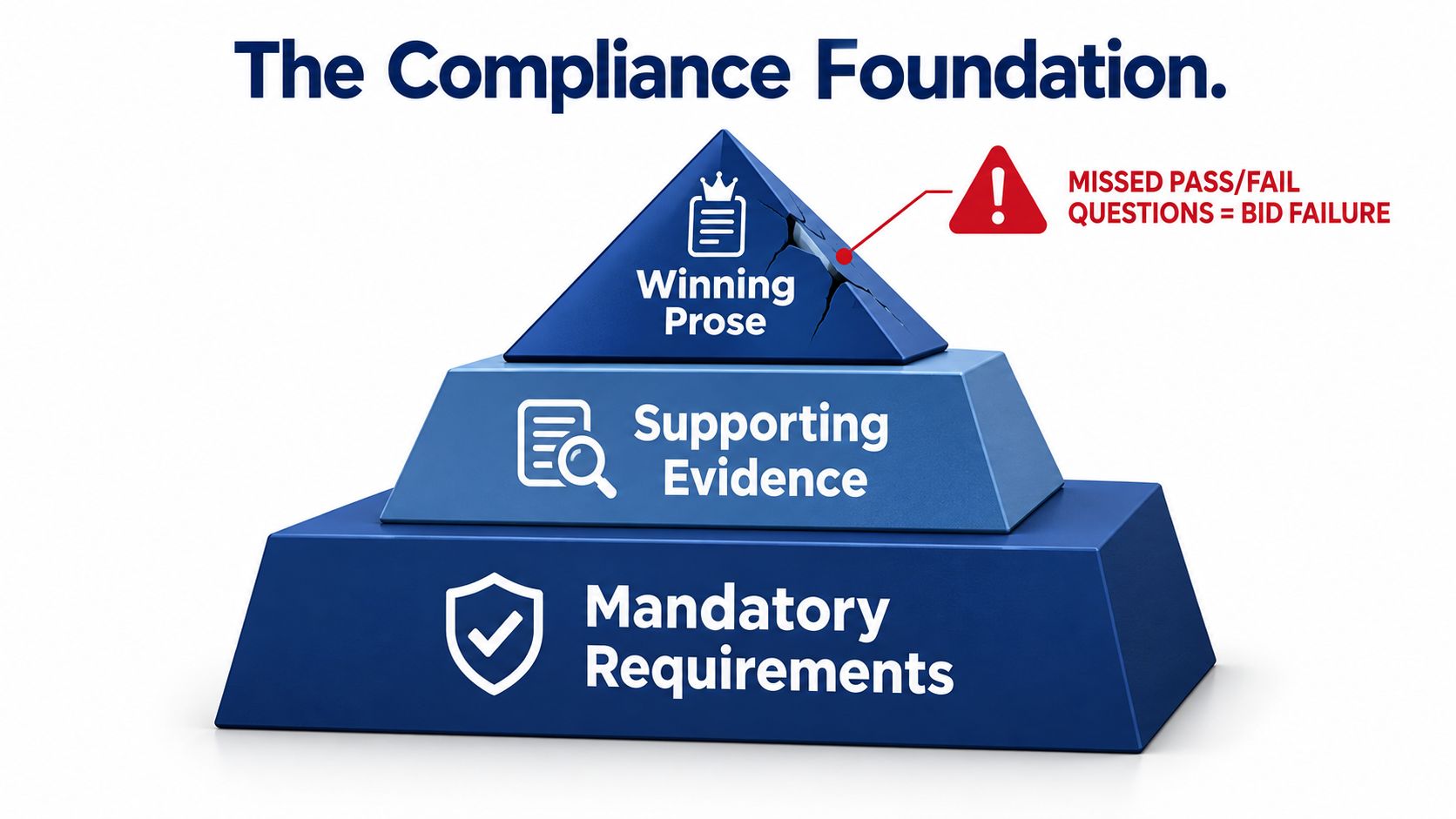
Most bid failures aren't caused by weak grammar. They come from missed pass/fail requirements, incomplete attachments, answers that don't follow the specification, or evidence that doesn't support the claim being made.
There are three layers to a reliable submission:
- Mandatory requirements, which determine whether the buyer can assess your bid.
- Supporting evidence, which proves your organisation can deliver.
- Winning prose, which presents the first two layers clearly.
The order matters. If the foundation is missing, better writing won't rescue the submission.
The evaluator follows the published method
Under the Procurement Act 2023, award criteria must relate to the contract, be clear, measurable and specific, be proportionate, and include an assessment methodology. Where there's more than one criterion, the buyer must disclose the relative importance through weighting, ranking or another stated method, as set out in the government's guidance on assessment and award.
That limits how much elegant wording can achieve. Evaluators must apply the declared criteria consistently. They shouldn't award marks for a point that isn't tied to the scoring model, and they shouldn't infer evidence you haven't provided.
Practical rule: If a sentence doesn't answer a requirement, support a scored claim or clarify delivery, remove it.
Your process should therefore begin before drafting. Use tender monitoring to find suitable opportunities early, then review the pack against a compliance structure. Bidwell's bid writer workflow fits this model because the knowledge base can hold policies, accreditations, case studies, CVs and previous responses before a new question arrives.
The knowledge base is where the core preparation happens. Store evidence with clear labels, owners, dates and usage notes. Then your writer, reviewer or AI tool can retrieve the right proof instead of rebuilding the answer from memory.
Planning Your Bid Before You Open the Tender Pack
Treat bid planning as a controlled decision process, not a rush to produce a response document. The first job is to decide whether the opportunity fits your capability, capacity and commercial position.
Register and monitor the right portals
For lower-value public sector opportunities, Contracts Finder lets suppliers search for contracts worth over £12,000 including VAT. Find a Tender is the central digital platform for UK public procurement under the Procurement Act 2023. Its notices are separated into Planning, Tender, Award, Contract and Termination stages.
Monitor planning notices as well as live tenders. Early visibility gives you time to assess the buyer, line up partners, check delivery capacity and prepare evidence before the formal deadline appears.
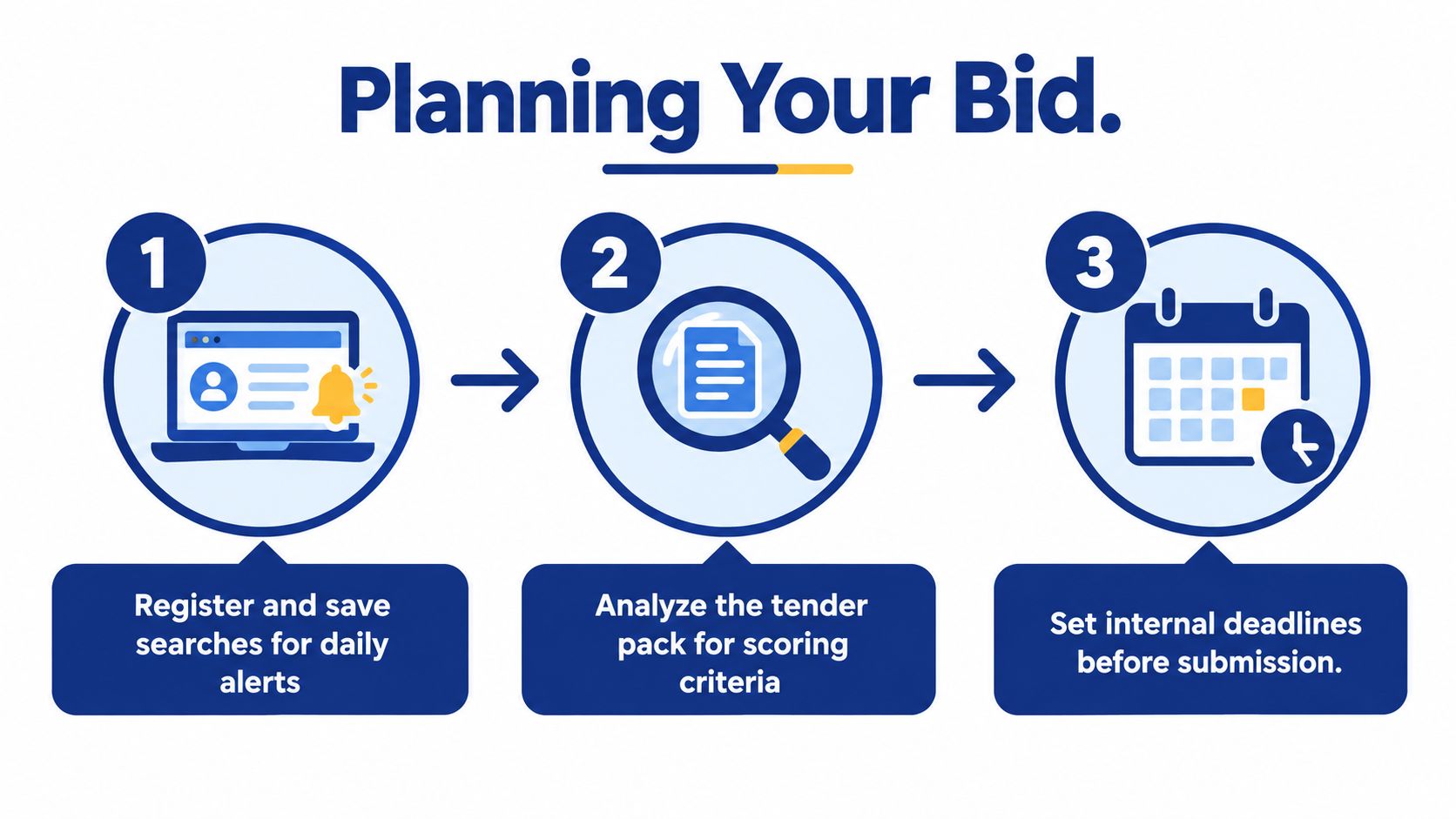
Bidwell's daily alerts and AI summaries can support this first filter. Set saved searches by sector, buyer, geography, contract type and threshold. The objective is a short list of opportunities your delivery team can realistically support, not a large collection of notices no one can qualify.
Read the pack before making promises
Start with five checks:
- The buyer and requirement: Confirm who is buying, what they need and whether the service matches your capability.
- The deadline and method: Record the final submission time, portal, file rules and clarification process.
- The evaluation model: Capture criteria, weightings, sub-criteria and every pass or fail gate.
- The commercial shape: Note lots, pricing schedules, contract length, options and unusual terms.
- The evidence burden: List certificates, financial information, policies, references and named personnel.
Then document a go or no-go decision. Weigh win probability, strategic value, delivery capacity and margin. Give one person authority to decide. A committee that never formally decides produces a half-funded bid, drains the team and leaves the submission below standard.
Assign ownership and work backwards
Name the bid lead, proposal writer, technical lead, pricing owner and final reviewer. Confirm who can approve exceptions, pricing and contractual qualifications.
Plan backwards from submission. Set internal checkpoints when 75%, 50% and 25% of the available time remains. These markers expose slippage while recovery is still possible, rather than during the final upload.
The UK government's guidance for SMEs bidding for contracts recommends registering early, reading the full pack, confirming requirements, answering in the buyer's order and submitting before the deadline. Bidwell's tender workflow supports monitoring and pack analysis, while the bid lead remains accountable for the decision, evidence plan and timetable.
Building Your Compliance and Evaluation Checklist
A useful checklist separates mandatory compliance from scored quality. Don't mix them into one long list. The first category determines whether your submission can proceed. The second determines how well it performs after acceptance.
Separate gates from marks
Mandatory items commonly include insurance levels, financial thresholds, certifications, modern slavery statements, conflict declarations and cybersecurity requirements. A missing item may prevent meaningful evaluation, regardless of the strength of your methodology.
Desirable items carry marks rather than acting as an entry gate. They can include relevant experience, service improvements, social value, sustainability or additional delivery options. Their priority depends on the published criteria, not on what your sales team thinks sounds persuasive.
Procurement Act 2023 guidance requires buyers to disclose award criteria, relative importance and assessment methods. Your checklist should copy that structure exactly. For each question, record the requirement, response location, evidence source, owner and reviewer.
That is also where tools such as find buying signals in RFPs can help during early analysis. Signals are useful only when they're tied back to the buyer's stated requirements and evaluation method.
Use a line-by-line evidence map
Map every selection questionnaire question and scored question to a specific item in your knowledge base. If the evidence doesn't exist, label the gap clearly. Don't let a missing case study or outdated policy remain hidden inside a draft.
The current UK regime also changes how teams should think about timing and transparency. Under the Procurement Act 2023, the contracting authority must publish the criteria and methodology it intends to use, then apply them consistently and proportionately. Your response should mirror that disclosed structure instead of relying on evaluator interpretation.
| Item Type | Examples | Consequence If Missing | Where It Lives In The Pack |
|---|---|---|---|
| Mandatory | Insurance, certifications, declarations, financial thresholds | The bid may fail a pass or fail check | Selection questionnaire, instructions and schedules |
| Desirable | Experience, innovation, social value, service enhancements | Lost evaluation marks | Award questions and quality schedules |
| Commercial | Pricing template, assumptions, rates and discounts | Commercial non-compliance or clarification risk | Pricing schedule and contract documents |
| Contractual | Method statements, KPIs and delivery commitments | Promises may become binding obligations | Specification, response schedules and contract |
The bid lead needs a checklist that works on review day, not a spreadsheet designed only to look complete. Put the question reference in the first column, then show whether the requirement is mandatory or scored, where the evidence sits, who owns it and whether a reviewer has signed it off.
Writing Responses That Hit Every Scoring Point
A high-scoring tender response is mapped before it is written. Treat the question as a compliance and evidence exercise first, then use clear prose to present the result.
Break the question into parts
Start with the instruction verb. Describe, explain and demonstrate require different answers. Identify the service requirement, scoring criteria, word or page limit, and any standard, policy or outcome the evaluator is testing.
Build a response matrix before drafting:
| Question Ref | Evidence Source | Owner | Reviewer | Score Focus |
|---|---|---|---|---|
| Q1 | Relevant case study and delivery plan | Technical lead | Bid lead | Understanding and methodology |
| Q2 | Policy, process and audit record | Operations owner | Compliance reviewer | Governance and assurance |
| Q3 | CVs and mobilisation plan | Resource lead | Contract director | Capability and resourcing |
| Q4 | KPI framework and reporting example | Service manager | Quality reviewer | Measurement and continuous improvement |
Assign every answer an evidence owner and a reviewer. This exposes gaps early, such as an unverified claim, missing case study or outdated policy. It also gives Bidwell's knowledge base a useful structure, because approved documents can be linked to the criteria they support rather than stored as unlabelled past bids.
Lead with the answer, then prove it
Open with a direct statement that addresses the requirement. Follow it with the method, responsible person, evidence and expected output. Remove the company introduction unless it directly answers the criterion.
“We pride ourselves”, “we're committed to excellence” and “we provide a high-quality service” add no scoring value. State the action, owner, timing, control and evidence instead.
Use the buyer's headings and terminology when they improve navigation. Answer every part of the question, covering both what you will deliver and how you will deliver it. Respect the stated word count, because content above the limit may be disregarded.
Keep sentences roughly 15 to 20 words and paragraphs around 6 to 7 lines. Use headings, numbering and bullets so an evaluator can find each response element without searching. These controls improve readability, but they do not replace evidence.
Don't ask the evaluator to connect your evidence to the criterion. Make the connection explicit in the answer.
Store each source policy, case study, CV or certificate with notes explaining what it proves and which criteria it supports. That evidence map should drive the draft. Bidwell's AI response generation can turn approved, mapped evidence into a structured first draft, while a human reviewer checks accuracy, relevance, contractual implications and tone.
The AI should draft from approved evidence. It must not invent delivery details to make a paragraph sound complete. A concise, fully supported answer will score better than polished wording built on assumptions.
Pricing Schedules, Social Value and Contract-Binding Promises
Pricing is a separate workstream. Don't leave it until the quality response is finished, and don't let a writer improvise commercial content inside a methodology answer.
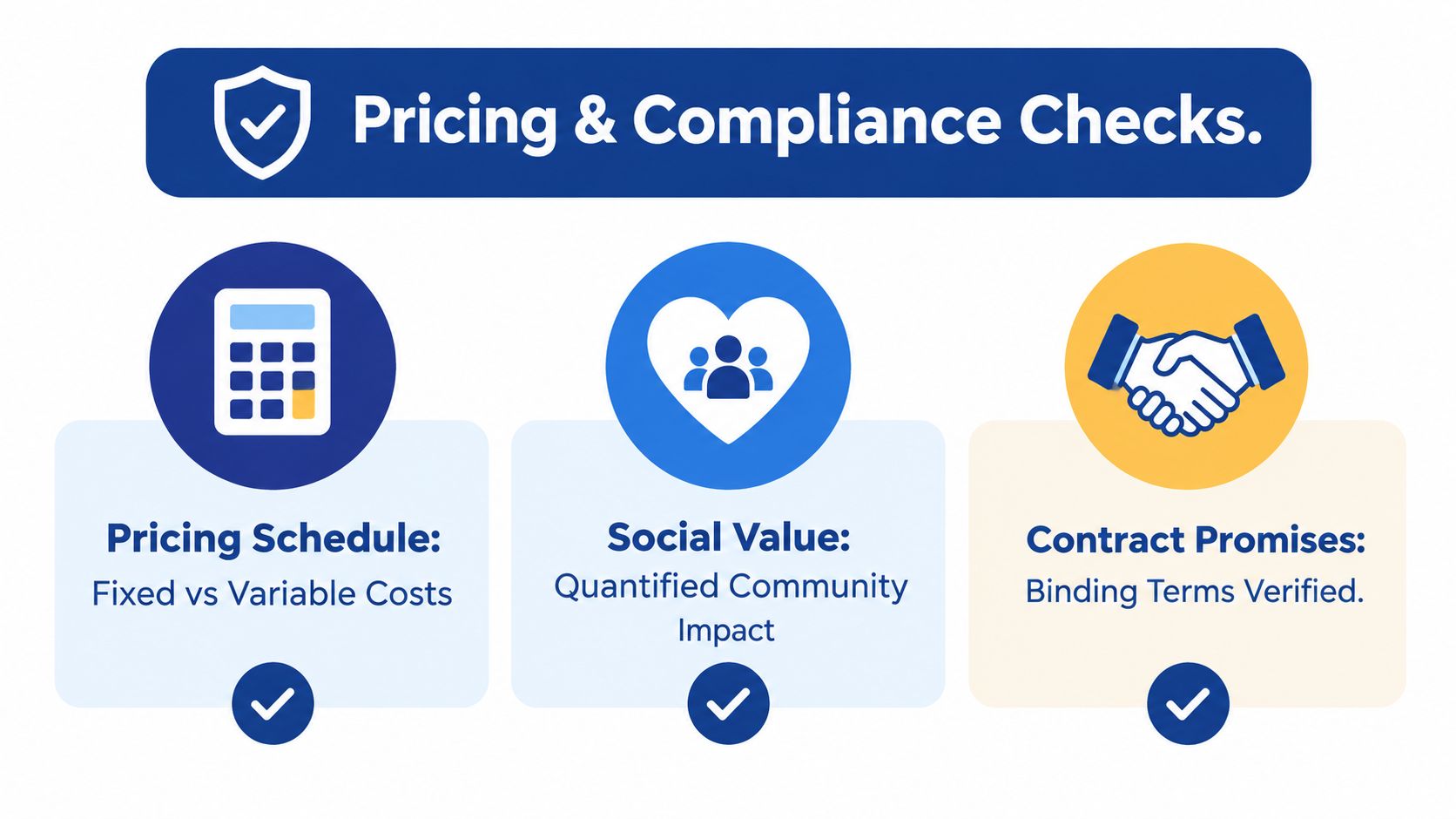
Start with the published pricing schedule. Identify fixed costs, variable costs, pass-through items, rate cards, optional lots and required assumptions. Build the price from the delivery model, then check the arithmetic and confirm that every figure appears in the correct field.
The UK government warns tenderers not to include prices, day rates or overheads in sections where they aren't requested. An accidental reference to a discount, margin or rough figure can create an evaluation and compliance problem. Keep commercial information in the commercial response unless the buyer explicitly asks for it elsewhere.
For teams reviewing internal cost structures or professional support, it can be useful to see our pricing as a comparison point for how external finance services present their commercial information. Your tender still needs to follow the buyer's schedule, not a supplier's preferred format.
Treat social value as delivery
Social value shouldn't be a decorative paragraph at the end of the bid. Government competitive tendering guidance allows associated tender documents to include the specification, award criteria, assessment methodology and contract terms, usually provided electronically and free of charge. Construction procurement guidance also says minimum social-value requirements should be stated in the tender documents, with successful price and quality responses incorporated into the contract documents. See the competitive tendering guidance for the framework.
That means a promise in your response can become a contractual commitment. Write only what your delivery team can fulfil, then define:
- The deliverable: What will you provide?
- The measure: How will the buyer verify it?
- The owner: Who is accountable?
- The reporting route: When and where will performance be reported?
- The remedy: What happens if delivery falls short?
Government, NHS and local authority buyers may structure social value differently. Don't assume one template applies across all three. Read the minimum requirements, scoring method and contract terms together, then make sure the knowledge base stores the approved commitments so AI-generated drafts don't introduce unsupported promises.
Attachments, Formatting and the Final Submission Run-Through
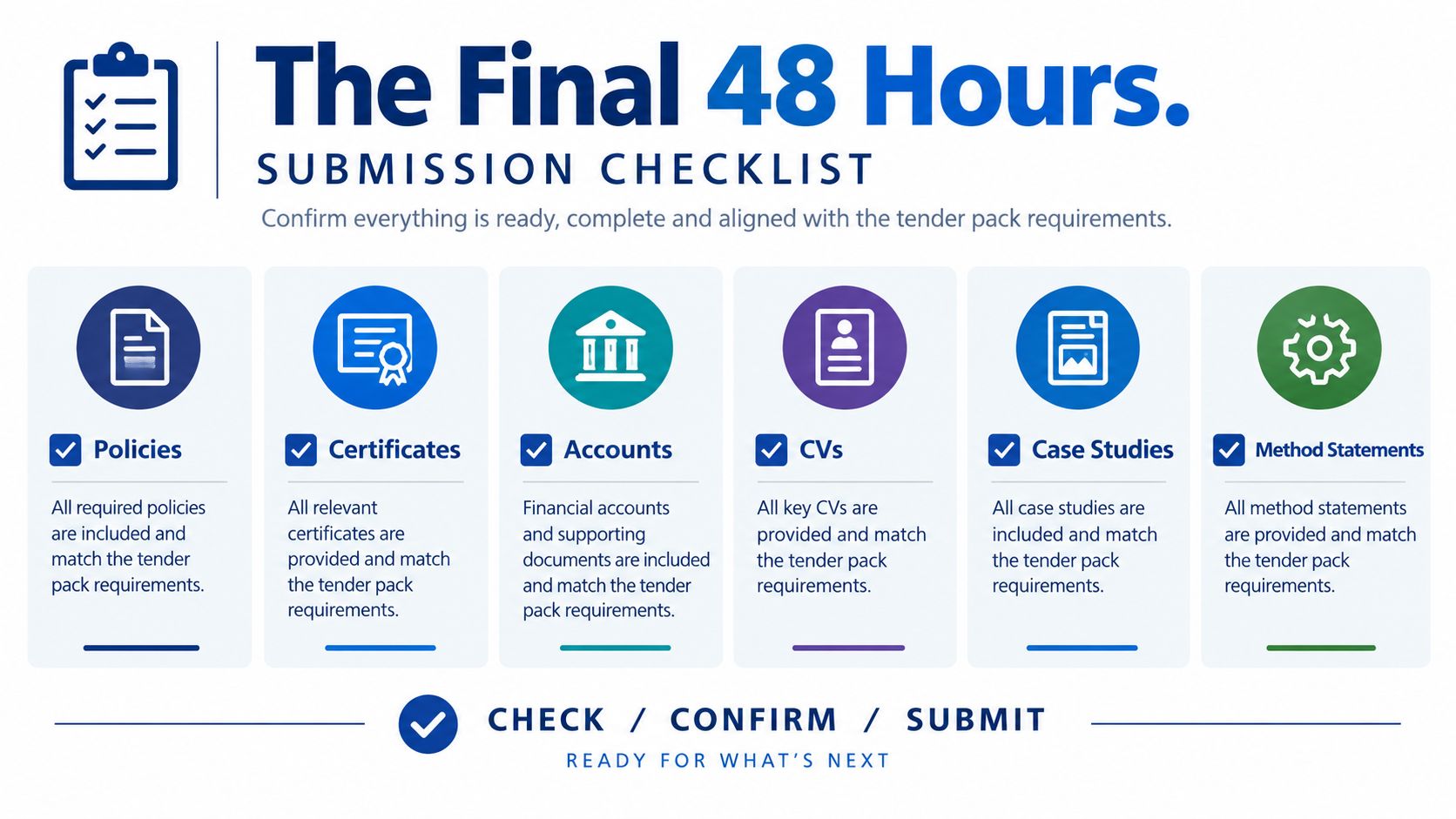
The final 48 hours are where disciplined preparation either pays off or unravels. At that point, you shouldn't still be deciding what the bid means. You should be checking that the approved response and every required attachment are present, current and uploadable.
Run one controlled attachment check
Create one master list from the tender pack. Check policies, certificates, accounts, CVs, case studies, method statements, pricing spreadsheets and buyer-supplied forms against the exact document names and schedules.
A final reviewer should sign off each item, not just the main narrative. Common failures include unsigned forms, expired insurance certificates, outdated policies, prices entered in the wrong field and attachments saved in an unacceptable format.
Check the portal rules separately:
- File formats: Confirm whether PDF-only attachments apply and whether spreadsheets must remain editable.
- File names: Follow the buyer's naming convention and remove confusing duplicate versions.
- File limits: Check maximum file size, page limits and any restrictions on zip files.
- Signatures: Confirm whether a wet signature, digital signature or named declaration is required.
- Portal workflow: Verify where each file belongs and whether the system accepts replacements.
Government guidance emphasises plain English, organised structure and compliance with portal constraints. Box-level word limits, formatting restrictions and attachment rules need to shape the response from the beginning, not be patched in during final quality assurance.
Final check: Open every PDF, inspect every attachment, confirm the pricing fields and record the submission receipt.
Where the portal permits it, run a dry upload. Confirm how corrections work before you need one. Many systems lock the submission immediately, so don't assume a second upload will replace the first.
Teams using document-heavy design or construction workflows may also find this Exayard vs Bluebeam comparison useful when assessing document review tools. Whatever software you use, retain the final files, submission timestamp and confirmation email for the bid record.
Turning Tender Document Preparation Into a Repeatable System
Tender document preparation works best as a loop, not a heroic sprint.
Tender monitoring feeds the pipeline with relevant planning and live notices. The compliance checklist turns each pack into requirements, deadlines and owners. The knowledge base accumulates approved evidence after every bid, including reviewer corrections and buyer feedback. AI response generation then converts that evidence into structured drafts for human review.
Track the points where the process breaks:
- Bid or no-bid ratio: Shows whether qualification is disciplined.
- Win rate by buyer: Reveals where your proposition and evidence fit best.
- Time from alert to first draft: Shows whether monitoring and preparation are connected.
- Compliance pass rate at first review: Exposes recurring document and requirement failures.
Review these measures quarterly. If first-review compliance remains weak, improve the checklist and document library before asking writers to work faster. If drafting takes too long, improve evidence tagging and question mapping rather than adding more templates.
A maintained knowledge base often matters more than seniority. A junior writer working from approved, well-labelled evidence can produce a more consistent response than an experienced writer relying on memory. Procurement Act 2023 evaluation standards reward traceable answers and consistent application of criteria, not individual flair.
Bidwell's bid writing software brings monitoring, a reusable knowledge base and AI-assisted response drafting into one workflow. Use it as part of a controlled process, with named owners and human approval at each important stage.
Bidwell monitors UK tender portals, summarises relevant opportunities, stores your approved evidence and generates response drafts mapped to tender questions. Visit Bidwell to see how your team can replace reactive tender writing with a repeatable compliance and evidence workflow.