Friday at 4:37 pm is when this usually lands. A site manager calls. A specialist trade has missed a key date, paperwork is incomplete, and the client is already asking who's in control.
That's subcontractor management in real life. It isn't admin. It's the difference between a tidy delivery and a weekend spent containing damage.
In UK public sector work, buyers don't just want a contractor with technical capability. They want a contractor who can prove the supply chain is selected properly, contracted properly, monitored properly, and paid properly. If you can't show that in a bid, your answer looks thin. If you can't do it on the job, the margin disappears fast.
Your Playbook for Subcontractor Management
At bid stage, subcontractor management looks tidy on paper. Then the job starts, one package slips, a variation turns into an argument, and nobody can produce the latest insurance, programme commitment, or agreed scope. That is usually the point at which evaluators, clients, and your own delivery team work out whether your process is real or just well-worded.
For public sector work, the standard is higher than “we know our supply chain.” Buyers want evidence that selection, controls, performance reviews, and issue management are documented and repeatable. If that evidence is easy to retrieve, the tender answer scores better. If it is scattered across inboxes, old spreadsheets, and site folders, the answer becomes vague very quickly.
Practical rule: If a process is not written down, reviewed, and evidenced, do not expect it to score well in a public sector tender.
A working playbook usually includes six parts:
- Prequalify before live procurement starts. Good teams build a bench of vetted trades before the programme is under pressure.
- Set contract terms that reflect actual delivery risk. Scope boundaries, payment triggers, design responsibility, warranties, and change control need to be clear.
- Onboard with structure. The subcontractor should know reporting lines, site rules, document requirements, meeting cadence, and escalation routes from day one.
- Measure performance consistently. Weekly records beat memory every time, especially when quality, delay, or disruption is challenged later.
- Control change early. Small informal instructions often become the most expensive disputes because nobody fixed price, time, or responsibility at the point of change.
- Reuse delivery evidence in bids. Strong subcontractor management is not just operational protection. It gives bid teams credible material for method statements, case studies, risk responses, and social value commitments.
The firms that do this well are rarely flashy. They keep approved supplier lists current. They use standard forms, expiry tracking, close-out reviews, and named owners for each package. They also carry out due diligence background checks where the trade, package value, or project sensitivity justifies it. That work is not box-ticking. It prevents avoidable surprises and gives you something solid to point to in a tender response.
Failure usually comes from gaps between teams. Estimating appoints on one basis. Commercial agrees something slightly different. Site runs the subcontractor on verbal instructions because the programme is tight. Months later, the bid team is asked to explain supply chain control in a PQQ or quality response and finds there is no clean audit trail.
Disciplined systems become critical in that context. A platform such as Bidwell helps turn delivery process into bid evidence by keeping subcontractor records, review notes, compliance documents, and performance history in one place. That matters because AI drafting only helps when the source material is current, specific, and believable. If the underlying process is weak, the tender answer will read that way too.
Finding and Vetting Subcontractors You Can Trust
A lot of firms still confuse price competition with proper vetting. They're not the same thing. Cheap on day one can be very expensive by month three.
The starting point is a structured prequalification process. The UK Department for Business and Trade has reported that a step-by-step subcontractor risk allocation methodology using past performance of at least 5 similar projects, financial stability with a current ratio above 1.2, and safety history with LTIF below 0.5 reduces subcontractor default rates by 42% compared to informal selection (Department for Business and Trade).
What to check before anyone gets near a project
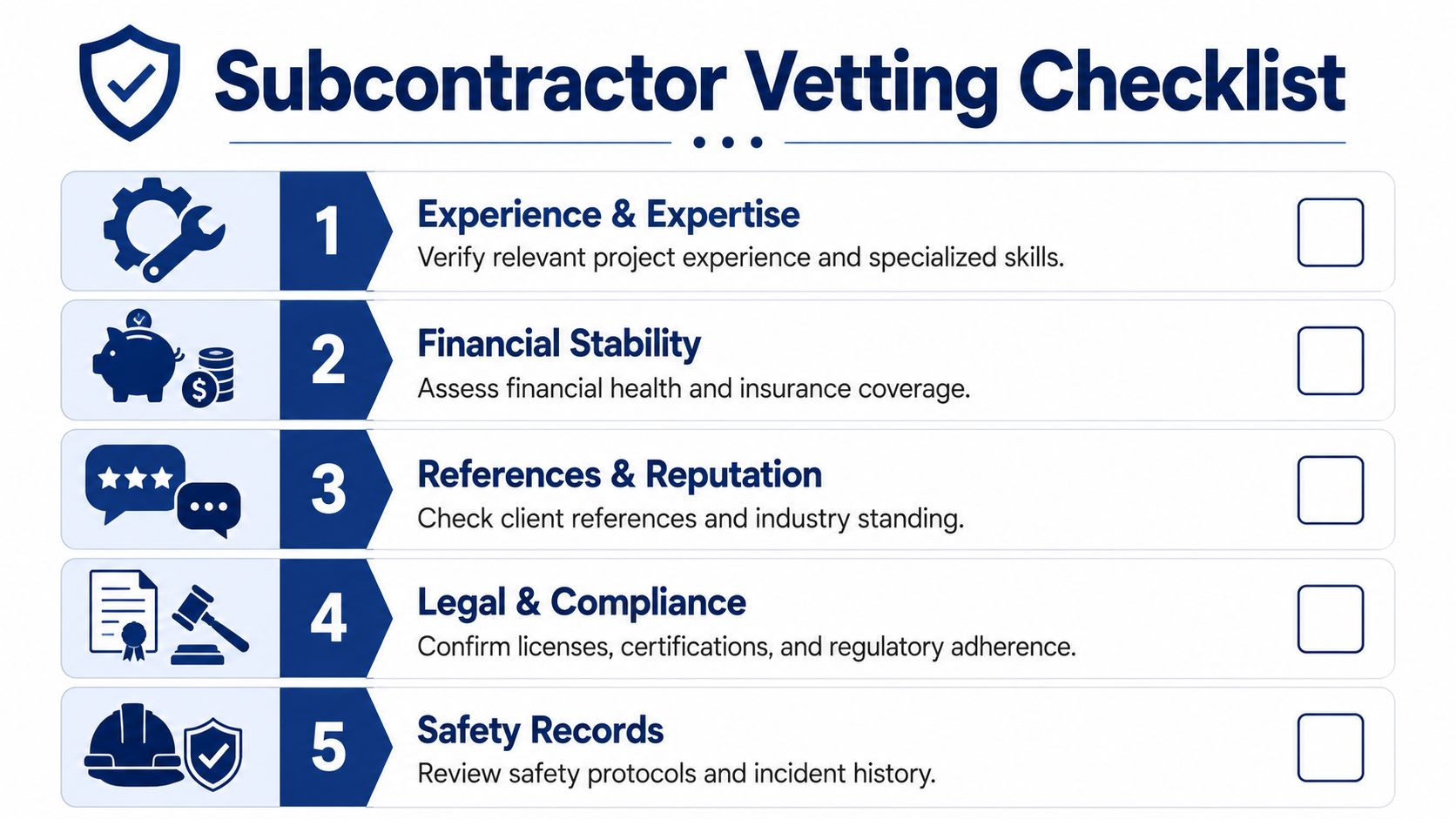
I'd split vetting into five practical checks.
- Track record on similar work. Ask for evidence of at least five comparable projects if you're following the DBT-style methodology. Similar means similar in complexity, not just trade label.
- Financial health. Review accounts, payment behaviour, and whether the business looks stretched. If a subcontractor is relying on your mobilisation payment to survive, that's a warning sign.
- Safety and compliance. Insurance, training records, accreditations, and incident history should all be current and easy to verify.
- Operational capacity. Can they resource the package when you need them to, or are they overcommitted?
- Reputation. Speak to recent clients and site teams, not just the polished references they've prepared.
For higher-risk packages, extra due diligence background checks can help fill gaps that standard paperwork misses. That's particularly useful when a subcontractor looks fine on paper but the trading history or ownership picture feels unclear.
Build a preferred list before the tender lands
The firms that look calm during mobilisation usually did the hard work months earlier. They maintain a preferred subcontractor list with verified documents, review dates, and notes from previous jobs.
A simple internal table is often enough if it's kept current:
| Area | What good looks like | What causes trouble |
|---|---|---|
| Experience | Evidence tied to similar public sector or regulated projects | Generic project lists with no detail |
| Commercial | Clear pricing basis and exclusions | Low headline price with hidden assumptions |
| Compliance | Current insurance and policy documents | Expired certificates found after appointment |
| Delivery | Named supervisors and realistic availability | Promises with no confirmed resource |
| Behaviour | Responsive, organised, transparent | Slow replies, vague answers, missing attachments |
Buyers can tell when your supply chain answer is built on real records and when it's stitched together the night before submission.
A knowledge base proves useful. If your team stores subcontractor profiles, certificates, references, meeting notes, and close-out reviews centrally, you're not reinventing the answer every time. You're pulling from live evidence.
That matters in bids because evaluators want more than a statement that you “work with trusted subcontractors”. They want to see the process, the controls, and the proof that you apply them consistently.
Building Contracts That Prevent Future Problems
A weak contract leaves the project team to negotiate under pressure later. That usually happens on site, in email chains, with imperfect records and bad timing. It's a poor way to manage risk.
The contract should do three jobs. It should define the package clearly, pass down the right obligations from your client contract, and create a workable commercial process when reality changes.
Don't stop at scope and price
Scope matters, but it's rarely the only reason relationships fail. Payment terms, notices, design responsibility, confidentiality, programme obligations, and document control are often where arguments start.
In public sector work, flow-down clauses need real attention. If your main contract requires reporting, social value commitments, data handling standards, or specific health and safety obligations, your subcontract needs to reflect that. Otherwise you carry the liability while the specialist carries only part of the duty.
For teams trying to understand the practical logic of back-to-back contracts, the key point is simple. Risk should sit with the party controlling it, and the subcontract should mirror the obligations that need to pass down.
Payment clarity is not optional
The UK's Construction Act regime is one of the reasons payment wording can't be treated casually. It created statutory payment notices and adjudication rights to improve cash flow and reduce disputes, and public buyers expect tenderers to show they can comply with those legally enforceable timelines and processes (UK legislation on the Construction Act framework).
That has a few practical consequences.
- State due dates and final dates clearly. If the timetable is fuzzy, the argument is already baked in.
- Define notice responsibilities. Teams need to know who issues payment notices and pay less notices, and when.
- Align payment with evidence. Applications, valuations, and sign-off points should match how work is measured.
- Set a dispute route. Don't wait until tempers rise to decide who escalates what.
Clauses that save pain later
A decent subcontract for public work usually needs more than commercial boilerplate. It should spell out:
- Change control rules so no one proceeds on verbal instructions alone
- Information security and confidentiality where project data or resident information is involved
- Compliance obligations linked to Modern Slavery Act requirements, site rules, and any buyer-specific policies
- Mobilisation and access conditions so delays at the front end aren't turned into retrospective claims
- Records and reporting duties so the evidence trail exists if the client asks for it
A clear contract doesn't signal mistrust. It stops both sides relying on memory when the job gets busy.
The best contracts are readable, not theatrical. If your site manager, commercial lead, and subcontractor supervisor can't all explain how change, payment, and programme obligations work, the drafting probably isn't doing its job.
Onboarding Subcontractors and Setting Clear KPIs
The difference between a subcontractor who settles in quickly and one who causes friction often shows up in the first two weeks. Not because of technical ability, but because nobody aligned expectations properly.
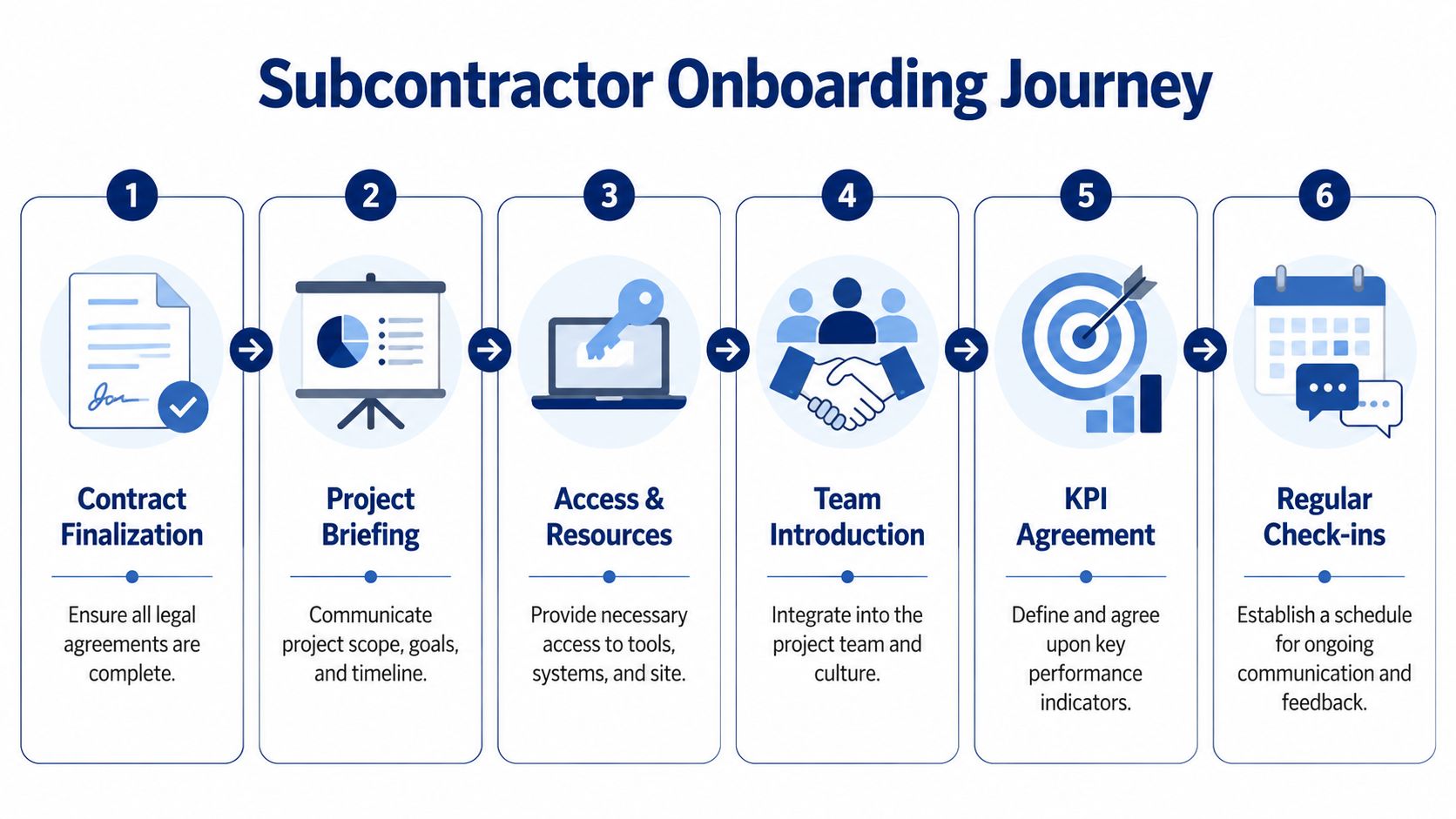
The strongest starts usually look unremarkable. There's a kickoff meeting. Scope gets walked through line by line. Key contacts are named. Site rules are explained. Information routes are agreed. Nobody leaves guessing who approves what.
Integration beats arm's-length management
The Construction Industry Council reported in 2025 that a formalised subcontractor integration protocol, including joint team briefings and bi-weekly check-ins, increases project success rates by 31% and reduces rework by 29% (Construction Industry Council).
That finding matches what experienced delivery teams already know. When specialist trades are treated as an afterthought, they behave like outsiders. When they're briefed properly and brought into the working rhythm of the job, coordination improves.
A useful onboarding agenda usually includes:
- Scope confirmation. Review drawings, interfaces, exclusions, and assumptions.
- Programme alignment. Check dates, dependencies, and lead times.
- Quality expectations. Agree inspection points, sign-off stages, and document standards.
- Site conduct. Cover access, inductions, permits, and escalation routes.
- Commercial process. Explain applications, valuations, variations, and notice requirements.
Choose KPIs that are actually manageable
Bad KPIs are vague and decorative. Good KPIs tell both sides what success looks like and what will trigger intervention.
Try a small set that people can track without turning the job into an admin exercise:
- Programme reliability. Milestones met when promised.
- RFI turnaround. Responses issued within the agreed timescale.
- Quality at first inspection. Fewer repeat visits and fewer snagging loops.
- Safety compliance. Site rules followed, documentation current, issues closed promptly.
- Communication discipline. Attendance at meetings and timely reporting.
You don't need dozens. You need a handful that site teams, project managers, and bid teams can all understand.
For teams building repeatable bid content, the useful habit is to capture onboarding records and KPI templates in one place. A central library of forms, meeting agendas, and past examples makes it much easier to produce consistent answers later. If you need a reference point for building that sort of bid-supporting process, Bidwell's guides for tender teams are a sensible place to start.
Monitoring Performance and Ensuring Compliance
A subcontractor can look fine at order stage and still become a delivery risk six weeks later. The warning signs are usually ordinary. Missed actions. Old insurance certificates. Quality defects that keep reappearing. A supervisor who stops turning up to coordination meetings because they are stretched across too many jobs.
That is why monitoring needs a set routine, not a vague promise that someone is keeping an eye on things. Public sector buyers look for evidence that supply-chain risk is being checked, recorded, and acted on. If you can show a documented process on live projects, you are in a much stronger position when the tender asks how you control subcontractor performance.

What good monitoring looks like on a real project
Good monitoring is regular, documented, and tied to action. It is not a monthly spreadsheet produced after the damage is done.
The jobs that stay under control usually have the same habits in place. Site teams check progress against what was promised. Quality issues are logged with clear owners and dates for reinspection. Compliance records are reviewed before they expire, not after. Commercial teams compare what is being claimed with what is built.
A practical review cycle usually includes:
- Weekly progress reviews. Confirm completed work, upcoming activities, hold-ups, and actions due before the next meeting.
- Targeted quality inspections. Record defects, root causes, rectification dates, and repeat issues by trade.
- Compliance reviews. Check insurances, RAMS, training records, permits, and any policy documents the contract requires.
- Commercial cross-checks. Match site progress against applications, notices, and approved changes.
- Periodic performance scoring. Rate each subcontractor against the KPIs already agreed and record any intervention.
The point is not admin for its own sake. The point is to spot drift early enough to correct it while the project can still recover.
Evidence wins arguments and scores marks
Buyers do not give many marks for saying you monitor subcontractors closely. They give marks for showing how you do it.
A simple reporting structure is usually enough if it is kept current:
| Review point | What to capture | Why it matters |
|---|---|---|
| Weekly meeting | Progress, constraints, actions, dates | Keeps responsibilities visible and the programme credible |
| Inspection record | Defects, photos, rectification owner, close-out date | Stops recurring quality problems becoming accepted practice |
| Compliance log | Expiry dates, missing documents, status of follow-up | Reduces avoidable legal and site risk |
| Performance review | KPI trend, concerns, agreed corrective action | Creates a record for intervention, replacement, or future selection |
This record matters twice. First, it helps the project team control live delivery. Second, it gives bid teams usable proof. Tender responses are stronger when they refer to scorecards, meeting records, close-out logs, and escalation history rather than broad statements about supplier oversight.
That is also where systems matter. If those records sit in inboxes and site folders, they are hard to use when a framework response asks for your subcontractor assurance process. Teams that centralise evidence through procurement management workflows for subcontractor oversight have a much easier time turning day-to-day discipline into credible tender answers.
Compliance needs active checking
Compliance failures rarely arrive as one dramatic event. They build through small gaps that nobody chased. Expired cover. Missing training records. A permit process skipped because the programme is tight.
For teams reviewing insurance and worker risk, even a non-UK guide for contractors on liability is useful as a prompt for the kinds of exposure that get missed when subcontractor records are allowed to drift.
Write concerns down while the job is live. If a subcontractor needs improvement, record the issue, the instruction given, who owns the fix, and when it will be checked again. If that trail does not exist, it is much harder to defend a payment position, justify escalation, or explain to a buyer how your management process works in practice.
Handling Project Changes and Resolving Disputes
Changes are normal. Undocumented changes are dangerous. Most subcontractor disputes don't start with a dramatic breakdown. They start with a small instruction, a rushed conversation, or an assumption that everyone “understood” the same thing.
The cleanest way to manage this is a formal variation process. One person raises the change. Scope and impact are described. Cost and programme effect are reviewed. Approval is given before work proceeds, unless there's a genuine emergency and the exception is recorded.
Keep payment and change tied together
A frequently missed point in subcontractor management is cash flow. Many disputes aren't really about workmanship. They're about payment, and poor milestone structures can leave the main contractor exposed if a subcontractor runs into trouble (legal guide on subcontractor payment risk).
That's why milestone design matters. Milestones should reflect verifiable progress, not hopeful assumptions. Retentions, vesting where relevant, and evidence of completed work all need thought before the order is signed.
A sensible escalation path
When a disagreement does arise, jumping straight to legal posturing usually makes it worse. A tiered approach is better.
- Project-level discussion. Let the project managers compare records and try to resolve facts first.
- Commercial review. If the issue is valuation, programme effect, or entitlement, bring in the QSs and contract managers.
- Senior escalation. Use this when the issue affects relationship, continuity, or major cost.
- Adjudication if needed. The statutory right exists for a reason. It can resolve payment and contract disputes far faster than court.
The trick is to stay procedural. Keep the tone calm. Keep the evidence clean. Keep the relationship workable where you can.
A lot of disputes can be prevented with one simple habit. Don't let anybody start extra work on a nod and a wink.
How to Showcase Your Subcontractor Strategy in a Tender
This is the part many good contractors undersell. They may run a decent subcontractor management process on live jobs, but when the tender asks about supply chain control, they reply with bland policy language.
That leaves marks on the table.
Buyers want to see how you select subcontractors, how you allocate risk, how you onboard them, how you monitor them, and how you intervene when performance slips. They also want evidence that this isn't just a promise for the bid.
Turn operations into scored answer content
A strong answer usually includes a clear operating model, supported by records.
For example, instead of writing:
“We work closely with our subcontractors to ensure high standards.”
Write something closer to this in substance:
- Selection method. Explain that subcontractors are prequalified against defined capability, financial, safety, and compliance criteria.
- Contract controls. State that package orders include clear scope, flow-down obligations, payment procedures, and change control requirements.
- Integration process. Describe kickoff meetings, role allocation, and agreed KPI tracking.
- Monitoring routine. Refer to meeting schedules, inspections, compliance checks, and documented reviews.
- Corrective action. Show how issues are escalated, recorded, and closed.
That structure scores better because it reads like a system, not an aspiration.
Use evidence from your knowledge base
The quality of the answer depends on the quality of the evidence behind it. Bid teams should be able to pull in:
| Evidence type | Useful proof point in a tender |
|---|---|
| Approved supplier records | Shows selection discipline |
| Certificates and policies | Supports compliance claims |
| Meeting notes and scorecards | Proves active performance management |
| Lessons learned and close-out reviews | Shows continuous improvement |
| Past subcontractor examples | Demonstrates the process works in practice |
This is exactly why a maintained knowledge base matters. If your subcontractor information lives in inboxes, local folders, and half-finished spreadsheets, you'll struggle to produce a convincing response under deadline.
Where tender monitoring and AI actually help
Tender monitoring is valuable because it tells you early which opportunities place weight on supply chain resilience, contract management, social value delivery, or specialist trade mobilisation. That gives bid and operational teams time to prepare evidence instead of scrambling after the tender drops.
AI response generation becomes useful when the source material is already organised. If the platform can access current subcontractor policies, process notes, past responses, and delivery evidence, it can draft a first version that sounds specific and credible rather than generic. Bid teams then review, sharpen, and align it to the buyer's scoring language.
If you want to see how that kind of workflow fits into public procurement, Bidwell's tender use case page shows the practical connection between organised knowledge and faster response drafting.
The unwritten rule is simple. Public sector buyers don't award marks for saying you manage subcontractors well. They award marks when you prove you've built a repeatable system, you use it consistently, and you can explain it in plain English.
Good subcontractor management wins work twice. First in the evaluation, when buyers see a controlled supply chain and a credible delivery model. Then on site, when the process holds up under pressure. If your team wants a better way to find relevant tenders, organise bid evidence, and draft stronger responses from a real knowledge base, take a look at Bidwell.