You've got the tender pack open, the clock's already ticking, and the first thing you see is a rulebook that feels bigger than the opportunity itself. That's the moment most SMEs realise the public sector procurement directive isn't abstract policy, it's the set of rules that decides whether your bid is even welcome, how it will be judged, and what happens if the buyer gets it wrong.
For a first-time or occasional bidder, that can feel like a lot. In practice, it's a commercial filter. It tells you when the buyer must compete the contract, when they can award directly, what they must publish, and how much room you have to challenge a flawed process.
UK public procurement sits on a huge flow of public money, around a third of government expenditure and about £300 billion a year according to the Procurement Act 2023 notes, so the rules matter because the market is big enough to shape entire supplier pipelines UK legislation notes on procurement scale. If you understand the framework, you can stop treating every tender as a guess. You can use Bidwell's tender monitoring, knowledge base, and AI response generation to focus on the right opportunities, store the right evidence, and answer faster with less rework.
Why the Procurement Directive Matters to You
A lot of SME owners meet procurement law for the first time on a Tuesday afternoon, after downloading a 90-page tender pack and realising the documents aren't just asking for a price. They're asking whether you meet the right threshold, whether you've read the procedure correctly, and whether you'll accept a process that can disqualify you for a simple compliance miss.
That's why the public sector procurement directive matters. It isn't a policy debate in the background. It's the framework that shapes your commercial odds before you've written a single response.
What it gives bidders
At its best, the regime gives bidders a few real protections. Transparency means the buyer must publish opportunities and explain how they'll run the process. Equal treatment means they can't favour one supplier over another. Challenge rights matter too, because if the authority breaks the rules, bidders can seek remedies.
Practical rule: if the buyer's process looks inconsistent, don't assume it's just “how procurement works”. The rules exist precisely so bidders can question unfair treatment.
That matters for smaller firms because you're often bidding against bigger suppliers with more in-house bid resource. The rules are one of the few things that stop procurement turning into a closed shop.
What happens if you ignore it
Ignore the framework and the risks go from annoying to expensive very quickly. You can spend days or weeks preparing a bid for a route that wasn't open to you, or miss a mandatory requirement and get knocked out before scoring begins. In some cases, the buyer's breach can also create grounds for challenge, but only if you've tracked the process properly.
This guide is for the owner who occasionally bids, the bid manager who needs the legal envelope in plain English, and the sales director who wants to know where the commercial opportunities sit. The important thing is not to memorise every clause. It's to understand the journey from the directive's origins, through thresholds and procedures, into the 2025 changeover and the practical gaps still left for SMEs.
How the UK Procurement Framework Got Here
You spot a promising public contract, then notice the documents refer to both PCR 2015 and the Procurement Act 2023. That is not a drafting quirk. The date and legal route can determine which rules govern your bid, what notices to monitor, and how a challenge would work.
From EU rules to a UK framework
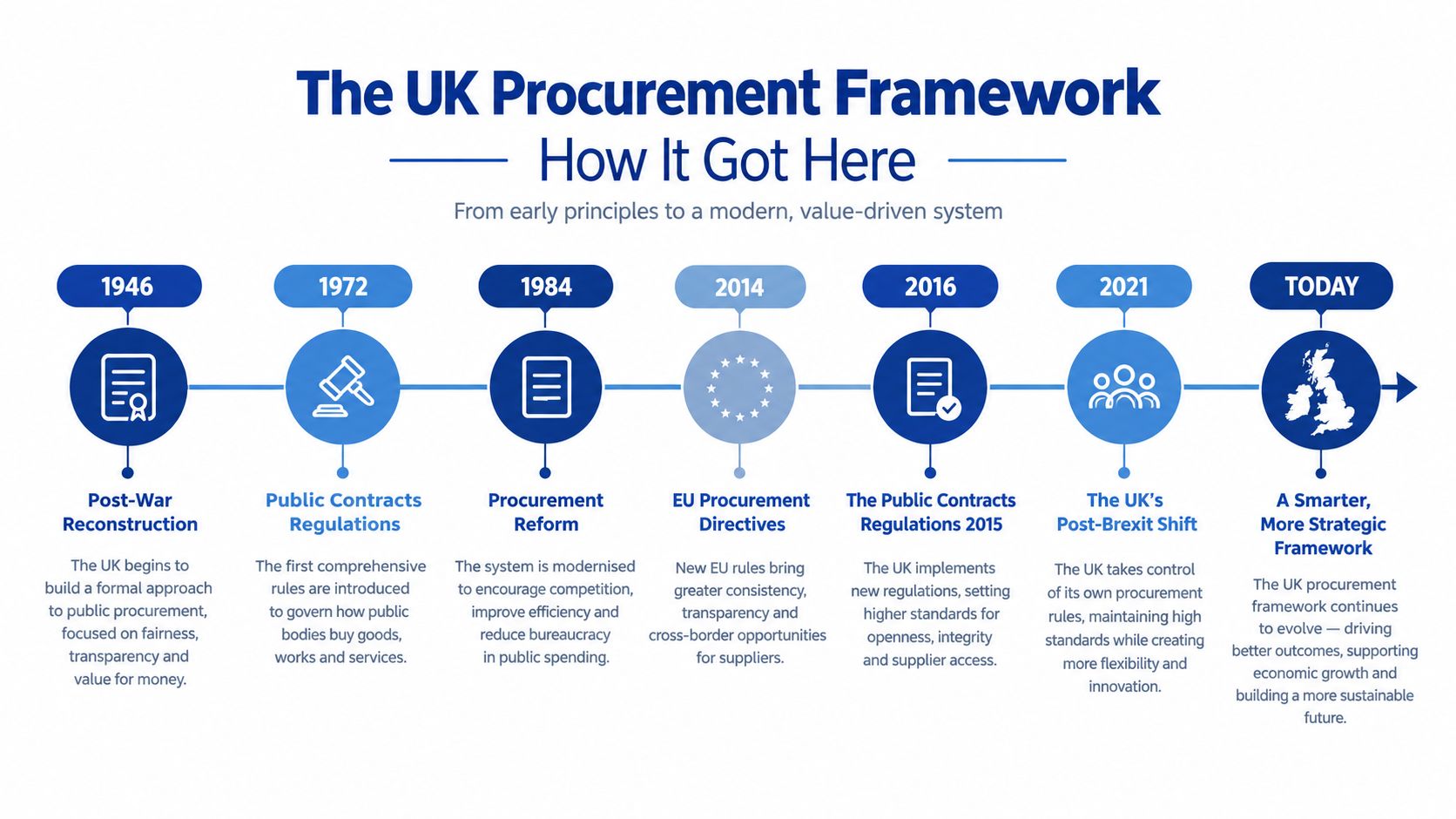
The modern framework developed in stages. Directive 2014/24/EU came into force on 17 April 2014 and had to be transposed into national law by 18 April 2016. In England and Wales, the Public Contracts Regulations 2015 provided that route EU directive and UK transposition summary. The directive established a common structure for regulated public competition, including familiar features such as notices, procedures, and equal access for suppliers.
Over time, early frameworks were consolidated through bodies like Crown Commercial Service, which still anchors much of central government buying today. The UK later created the Procurement Act 2023, bringing the main public procurement rules into a more consolidated domestic framework. The Act replaced more than 350 individual regulations derived from EU directives, according to the accompanying legislative notes Procurement Act notes.
Why the transition matters in practice
PCR 2015 and the Procurement Act are related, but they are not interchangeable. A procurement released before the cutover can remain governed by the older rules throughout its lifecycle. A procurement issued after the cutover follows the new framework.
When monitoring opportunities, check the release date before you assess the bid route.
That check changes your preparation. Under PCR 2015, you may need to interpret the older terminology and procedure. Under the Act, the notices, stages, and duties may use different language. The contract title alone will not settle the question.
Bidwell's knowledge base should therefore store both rule sets rather than one generic explanation of UK procurement. Your team can identify the legal regime first, then check the relevant notices, deadlines, and requirements before investing hours in a response. The practical discipline is simple: confirm the framework, match your bid process to it, and only then shape your offer.
Thresholds That Decide Which Rules Apply
The threshold is the point where a contract changes from ordinary buying into a regulated process. For an SME, that matters because it tells you how much formality to expect, how much evidence the buyer will ask for, and whether the competition is likely to be open, structured, or relatively light-touch.
All PCR 2015 figures below are from the 2015 Regulations, while the newer Procurement Act thresholds come from the government's threshold guidance.
| Contract Type | Central Government Authorities | Sub-Central Authorities | Compliance Regime Triggered |
|---|---|---|---|
| Goods and services under the Procurement Act 2023, for procurements started on or after 1 January 2026 | £135,018 inclusive of VAT | £207,720 inclusive of VAT | Regulated procurement route, formal notice and competition framework |
| Public Contracts Regulations 2015, central government supply and service contracts | £138,760 net of VAT | £213,477 net of VAT | Full regulated procedure under PCR 2015 |
| Works contracts under PCR 2015 | £5,336,937 net of VAT | £5,336,937 net of VAT | Full regulated procedure under PCR 2015 |
| Social and other specific services under PCR 2015 | £663,540 net of VAT | £663,540 net of VAT | Light-touch regime |
| Lower-value advertising thresholds | £10,000 for central government bodies policy guidance | £25,000 for wider public sector bodies policy guidance | More likely to appear in portals, or be handled more informally |
The practical takeaway is straightforward. Below threshold, buyers can use lighter processes. At or above threshold, they must follow a regulated framework with standard notices, set procedures, and clearer remedies for suppliers. Social and other specific services sit in a lighter regime, but they are still regulated, so the buyer cannot treat them as fully informal.
For bidders, the threshold also signals how competitive the opportunity may be. The older directive-era limits were lower, which shows how far the rules have moved over time. That comparison matters because a contract that once sat outside the formal regime may now fall within it, or the reverse may apply depending on which framework governs the procurement.
Thresholds also move on a review cycle. Under the 2015 Regulations, the Minister for the Cabinet Office must review the main thresholds every two years against the GPA benchmark threshold review rule. So a bid library should treat them as current inputs, not fixed background law.
If your figures are out of date, your pipeline will be too.
Bidwell's tender monitoring should use the threshold data to separate serious targets from background noise. That helps your team focus on notices that fit your market, rather than spending time on opportunities that are too small, too informal, or governed by a different route.
Core Rules Every Bidder Should Know
A procurement procedure can look technical from the outside, but the bidder's job is practical. You need to know how much room the buyer has, how much evidence you must provide, and whether the route fits the way your business sells.
The procedure tells you the shape of the bid
Under PCR 2015, buyers can use several familiar routes. The open procedure suits straightforward contracts, because any supplier that responds can be considered. The restricted procedure adds a first stage of selection, so you show you are suitable before you submit a full bid.
More complex contracts may use competitive procedure with negotiation, competitive dialogue, or innovation partnerships. Those routes usually appear when the buyer needs a developed solution, a phased design, or a working relationship that changes as the project moves on.
What you have to submit
The procedure changes the amount of work in your bid. An open procedure may ask for a clean tender response, financial information, and compliance declarations. A negotiated route can involve clarification, back-and-forth questions, and revised proposals. An innovation partnership can mean the solution develops during the process instead of being fully fixed at the start.
Award criteria matter just as much. Buyers normally assess value, not just price, and the rules push them towards the most economically advantageous tender rather than the cheapest offer alone. For an SME, that means your bid needs to show more than a low number. It should make clear how you reduce risk, support delivery, or improve the outcome the buyer wants.
Practical rule: when a buyer asks for the “best” bid, they usually mean the bid that proves value in their terms, not the one with the lowest figure on the page.
The special case of below-threshold work
Below threshold, the full procedure burden usually does not apply, but the buyer still cannot act casually. Fairness and transparency still matter, and that is where many SME opportunities appear through lighter advertising routes, supplier lists, or less formal market engagement.
That broader shift also matters for monitoring. As noted earlier, procurement reporting moved further into digital systems, so portals now carry more of the market visibility suppliers rely on. If the notice does not reach the system, your team may never see it.
What Changed When the Procurement Act 2023 Went Live
A supplier tracking a familiar tender in February 2025 could face a different process only days later. The change affected how public procurement is published, structured, and monitored. For an SME, the practical lesson is simple: the tender's release date now helps determine which rules and procedures you need to prepare for.
A single regime replaces a scattered one
The Procurement Act 2023 went live on 24 February 2025, and Government Commercial Agency guidance says ITTs released on or after that date fall under the new regime. Earlier ITTs remain under PCR 2015 throughout their lifecycle Government Commercial Agency guidance. Treat the release date as a checkpoint before you reuse an old bid response or assume that a buyer will follow a familiar route.
The new regime also introduced a more unified competitive flexible procedure, replacing the older group of named procedures. Buyers have more freedom to design a process around the requirement, but they still need to publish the approach and explain how it will operate. For bidders, each notice deserves a closer read. The procedure may resemble a previous tender without matching it.
Transparency became more central
The new digital platform brings planning, tendering, award, and contract information together in machine-readable form. It has added 143 new fields, taking the total to 551 fields, and the platform contains over 4,000 pipeline notices, according to Open Contracting UK implementation analysis. That gives suppliers more information to examine before a formal tender appears. Pipeline notices can show where a buyer may be heading, although they are not invitations to bid.
The UK's 2026 threshold reset also made direct-award activity more visible. Official guidance requires a transparency notice before a contracting authority makes a direct award. Analysis of 2026 direct-award notices found that 37% concerned contracts below the lowest threshold of £139,688 official module and notice analysis. For a bidder, those notices can reveal demand and incumbent arrangements, even where a formal competition is not required.
| Area | PCR 2015 (Pre-Feb 2025) | Procurement Act 2023 |
|---|---|---|
| Procedure design | Multiple named procedures | Single competitive flexible procedure |
| Data visibility | Publication split across multiple portals and notices | Single digital platform with machine-readable planning, tender, award, and contract data |
| Below-threshold awareness | More limited market visibility | More structured pipeline and transparency notices |
| Direct awards | Less central in buyer signalling | Transparency notice required before direct award |
| Practical bidder impact | Procedure familiar, but uneven across buyers | More timing-sensitive, more data-led, more notice-driven |
Where the Regime Still Has Gaps for SMEs
The new regime improves visibility, but it doesn't solve every problem for smaller bidders. The biggest gap is still practical usability. Data may be available, but turning that into a smart bid decision still takes time, structure, and a clear view of buyer behaviour.
Visibility is better, but not yet simple
Open-contracting commentary on the UK's first months under the Act says the platform is designed for scrutiny and contains pipeline notices, but there still isn't a widely used public dashboard for non-specialists Open Contracting UK implementation analysis. That gap matters because many SMEs don't need more raw notices. They need answers to practical questions, like which buyers repeat the same pattern, which notices tend to lead to award, and which categories are worth a serious bid.
The same analysis points to the problem clearly. Transparency is improving faster than usability. That's useful for analysts, but it still leaves a lot of SMEs relying on manual sorting.
SME duties are real, but not guarantees
Recent 2026 developments also show the regime keeps evolving. Section 70 payment-information duties came into force in April 2026, below-threshold notices now require a unique supplier identifier from 1 April 2026, and Cabinet Office PPN 024 introduced a mandatory Public Interest Test for central government service contracts worth more than £1 million, plus five-year insourcing strategies for departments spending £100 million or more annually Trowers 2026 procurement update. None of that creates a quota for SMEs, though. It changes process discipline, not the outcome.
That's why the duty to consider SMEs is helpful but limited. It creates pressure on buyers to think about access, but it doesn't guarantee ring-fencing, lotting, or a fair evaluation outcome. If your business sells specialist professional services, social care, or low-value ICT, that can still leave you having to work harder than larger incumbents to get through the door.
Bid writing software for procurement teams can help here, but only if it's fed with the right knowledge. A good knowledge base should hold your compliance proof, past answers, and buyer-specific patterns, so your team isn't rebuilding the same evidence every time.
Turning Directive Knowledge Into Bid Strategy
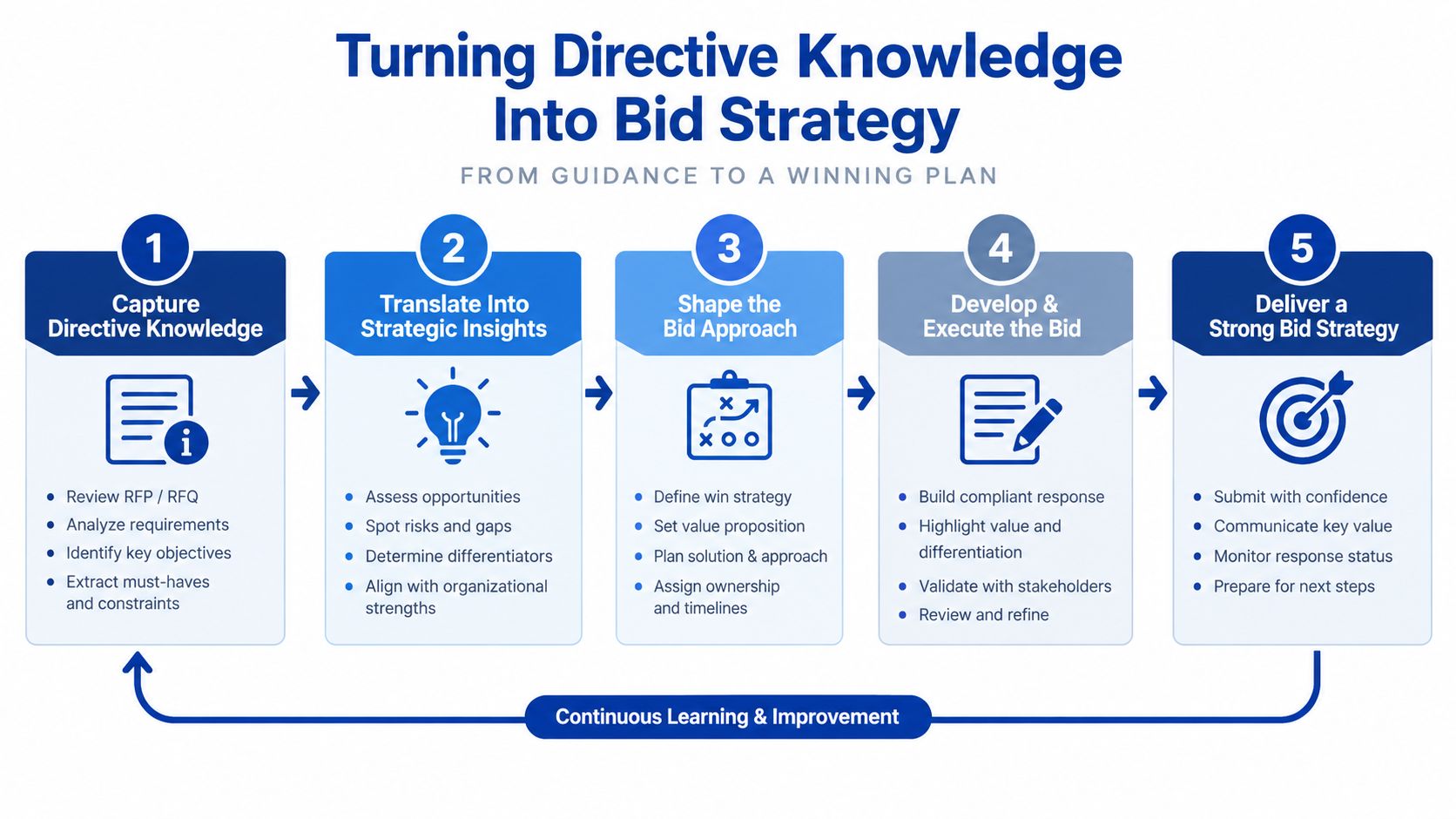
Knowing the rules changes how you target. It tells you where the market is likely to open up, what kind of process you're walking into, and which opportunities are worth the cost of a serious response. That's a commercial advantage, not an admin exercise.
Use the rules to filter, not just to comply
Below-threshold notices and pipeline signals are useful precisely because they arrive before the tender is fully formed. If you track them properly, you can spot buyers that repeatedly purchase in your space and prepare before the pack drops. That's especially useful where the transparency regime makes buyer behaviour easier to map than it used to be.
The right targeting shortlist usually combines three things, authority-level spend patterns, CPV-coded award history, and notice timing. Put those together and you can stop chasing every opportunity with the same effort. You'll know which buyers are recurring, which categories are steady, and which ones are noise.
Commercial rule: the best bid pipeline is rarely the longest one. It's the one you can defend with evidence.
Make the rules part of the response engine
Bidwell's tender monitoring and AI response generation fit naturally. Monitoring surfaces the right notices. The knowledge base stores your proof points, policies, and case studies. The response engine then helps assemble answers faster, so your bid team spends more time tailoring and less time rewriting.
If you work in procurement consultancy, that same discipline helps you advise clients on when to bid, when to walk away, and when the notice trail suggests a stronger opportunity is coming soon procurement consultancy services. The directive stops being a legal backdrop and becomes a targeting filter.
Your Next Steps This Week
Start with your current pipeline. Check Find a Tender and Contracts Finder against the authorities you care about, then remove categories that never fit your offer. That links directly to the directive's publication rules, because if an opportunity isn't visible in the right place, your monitoring process needs fixing.
Next, benchmark at least three target authorities against their historic award behaviour. Look at CPV codes, buyer repetition, and whether they prefer open, restricted, or more flexible routes. That tells you where the process is likely to be worth the effort.
Then clean up your supplier record. Make sure your Companies House details, trading names, and contact information are procurement-ready. It sounds basic, but errors there can slow onboarding and create avoidable friction.
After that, register for the Procurement Policy Notice alerts and the new single digital platform updates. The Act's transparency model only helps if you're seeing the notices as they land. Finally, set a weekly review of awards by relevant CPV code so your team builds a living picture of who's buying, what they're buying, and how often.
If you do those five things consistently, you'll make better bid calls within a quarter. Small improvements in targeting compound quickly when the rules are moving and the data is getting richer.
Bidwell helps UK suppliers turn procurement rules into a practical bidding system, with tender monitoring, a structured knowledge base, and AI response generation for public sector bids. If you want to use the current UK procurement framework to target better opportunities and respond faster, take a look at Bidwell.