If you search for the difference between procurement and tendering, most explanations stop at definitions. That's where people get stuck. The useful question is simpler: when you spot a notice on a UK portal, are you looking at the whole buying process, or just the bidding stage inside it?
That distinction matters in practice. It affects when you start qualifying an opportunity, who you speak to, how much effort you commit, and whether your team should monitor, prepare, or write.
Why People Mix Up Procurement and Tendering
Many industry professionals use procurement and tendering as if they mean the same thing.
That's understandable. In everyday language, both words point to buying. In bid work, though, they describe different parts of the same journey.
The everyday mix-up
You'll hear it all the time in sales calls and bid meetings.
A colleague says, “That tender hasn't gone live yet,” when they really mean the buyer is still shaping the procurement. A buyer says, “We're going out to procurement,” when they mean the tender pack is nearly ready. LinkedIn posts blur the two constantly. After a while, the language becomes sloppy, and teams start making poor decisions from it.
The cleanest working definition is this:
Procurement is the full lifecycle. Tendering is one stage inside that lifecycle.
Once you use that sentence properly, a lot of the confusion disappears.
Why the distinction matters to suppliers
If you treat every procurement signal as a live tender, you waste time. You start drafting responses before the buyer has even published the competition. You also miss earlier stages where suppliers can position themselves through market engagement, pipeline tracking, or careful notice monitoring.
If you treat tendering as the whole story, you miss what happens before and after it:
- Before tendering: buyers define need, test the market, choose their route, and write the documents.
- During tendering: suppliers receive the notice, read the pack, ask clarifications, and submit bids.
- After tendering: the authority awards, mobilises, manages delivery, and reviews the contract.
That's why the difference between procurement and tendering isn't just semantics. It's a way to read the buyer's timeline properly.
A better frame
In UK public contracting, buyers don't just run one big “tender process” from start to finish. They run a governed commercial process with planning, notices, competition, award, and contract management. Tendering sits in the middle.
Once you look at it that way, the legal definitions start making more sense, and the portal notices become easier to read.
What Procurement and Tendering Actually Mean
What are you looking at when a buyer says, “the procurement has started”? In UK public contracting, that phrase often covers far more than the point where suppliers submit bids.
A house-build comparison helps here. Procurement covers the whole job of getting the house built properly. You work out what needs to be built, approve the budget, choose the route to market, ask builders for offers, select one, sign the contract, and manage the work after the decision. Tendering is the stage where those builders are invited to compete and their offers are assessed.
That is the clean distinction.
The plain-English meaning
If you want one line to keep in your head, use this:
- Procurement is the full process of buying works, services, or supplies.
- Tendering is the formal competition stage within that process.
Suppliers mix these up because tendering is the part they can see most clearly. It is public, time-bound, and document-heavy. Procurement often starts earlier, inside the authority, with planning, approvals, market testing, and route selection. It also continues after bid submission into award, contract set-up, and contract management.
So the relationship is simple. Procurement is the lifecycle. Tendering is one stage inside it.
What the legal language is getting at
The legal wording points in the same direction, even if it is less plain than day-to-day bid language.
Under UK public procurement terminology, a contracting authority procures a public contract, while a supplier becomes a tenderer when it submits a tender under the UK threshold and terminology guidance. That split matters. One term describes the buyer's acquisition process. The other describes the supplier's role in a competition.
The same logic runs through the Procurement Act 2023 framework. The Act governs procurement as a wider regulated activity, and competitive tendering procedures sit within that wider activity. So if you are reading a notice on Find a Tender or Contracts Finder, ask a blunt question first. Am I seeing evidence of the whole procurement lifecycle, or am I looking at the competition stage itself?
Procurement vs Tendering at a Glance
| Dimension | Procurement | Tendering |
|---|---|---|
| Scope | Full buying lifecycle | Formal competition stage |
| Timing | Begins before any live bid opportunity and continues after award | Begins when suppliers are invited to compete |
| Main purpose | Define need, buy correctly, and manage the contract | Compare bids and choose the winning tender |
| Activities | Need definition, market engagement, approvals, route selection, award, contract management | Notice publication, tender pack review, clarifications, submission, evaluation |
| Main actors | Commissioners, budget holders, procurement staff, legal, contract managers | Procurement officer, evaluators, bidding suppliers |
| Supplier view | Pipeline tracking and positioning | Deciding whether to bid and preparing a response |
Why suppliers get caught out
A supplier sees a notice, labels it “the tender”, and starts writing. That is often too early, or occasionally too late.
For example, a prior information notice, pipeline entry, or preliminary market engagement notice can sit inside procurement without being a live invitation to bid. On the other hand, a tender notice or tender documents usually signal that the competition stage has arrived. If you miss that distinction, your bid pipeline gets messy. You end up mixing market intelligence with live pursuits and treating every signal as if the submission clock is already running.
That is why supplier-side process advice can still be useful alongside the law. The procurement insights from Doczen team give helpful background on how organisations improve procurement operations, which helps make sense of what buyers are doing before a tender appears.
For bid teams, the practical rule is simple. Do not ask only, “is this procurement?” It almost always is. Ask, “which stage of procurement am I looking at?”
The Procurement Lifecycle and Where Tendering Fits
Procurement is the full journey from identifying a need to managing the contract. Tendering is one stage inside that journey.
That distinction sounds obvious on paper, but it causes real confusion in practice. Suppliers often use “procurement” and “tender” as if they mean the same thing, even though they sit at different points in the buyer's process. Under the Procurement Act 2023, that difference matters because not every notice you see on Find a Tender or Contracts Finder is the start of a live competition.
The six-stage view
The easiest way to get clear on it is to picture procurement as a lifecycle. Tendering sits in the middle.
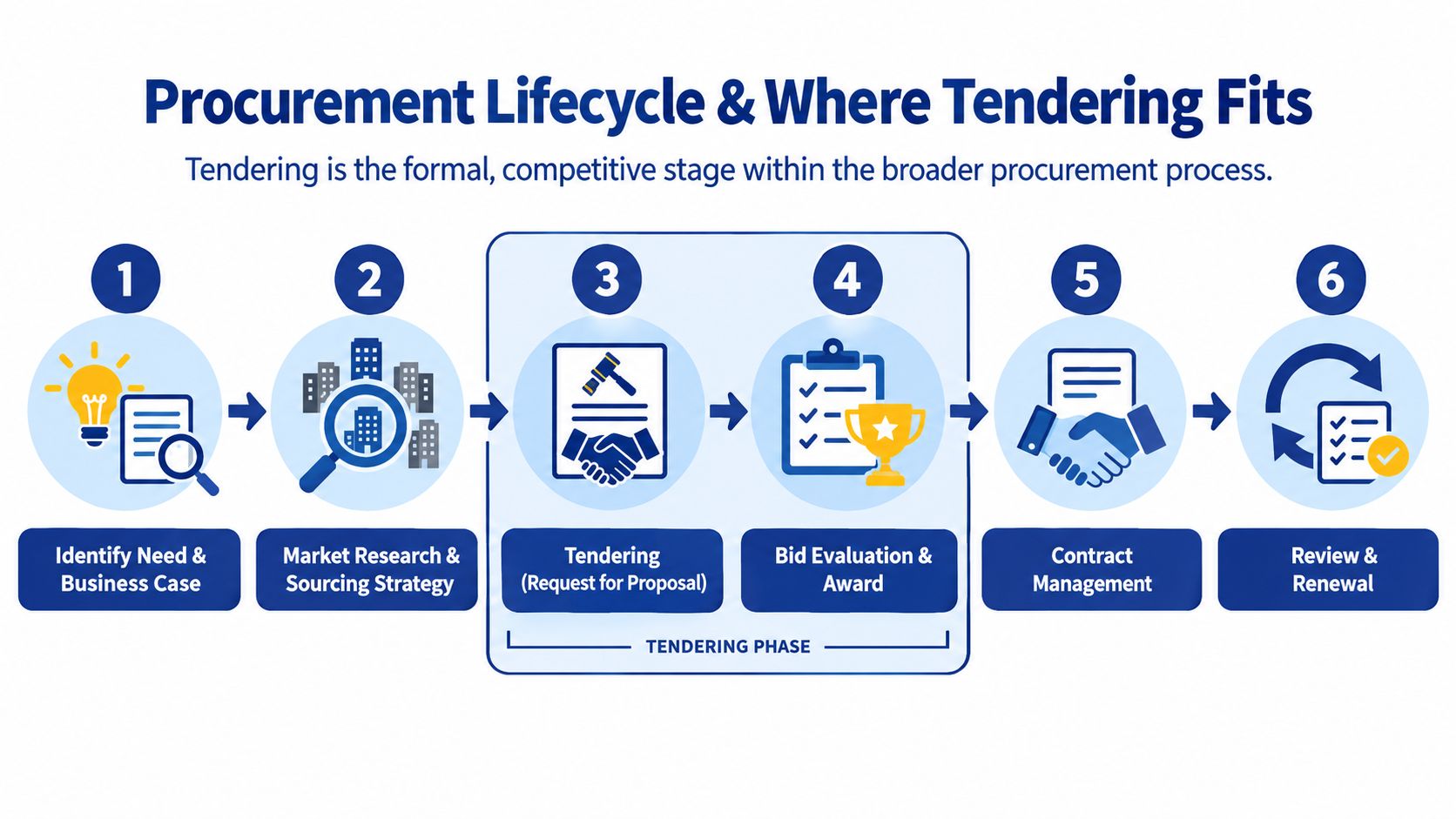
A supplier using tender workflow tools for live opportunities should usually split this lifecycle into three practical buckets. Pre-tender activity, live tendering, and post-award contract activity. If you lump them together, your pipeline becomes noisy and your team starts reacting to every notice as if a submission deadline has already been set.
Before tendering
Start with a simple UK example. A council decides its housing repairs service is underperforming. At that point, there is no tender yet. The buyer still needs to define the problem, confirm budget, decide whether to reprocure the whole service or adjust the current arrangement, and test what the market can offer.
The same pattern shows up in central government, NHS trusts, universities, and housing associations. Before a competition opens, buyers do background work that suppliers may only see in fragments through pipeline notices, planning documents, or preliminary market engagement.
Typical procurement activity before tendering includes:
- defining the requirement
- securing budget and approvals
- assessing risk and route to market
- speaking to the market
- drafting specifications, terms, and evaluation approach
This is still procurement. It is not yet tendering.
A good rule for suppliers is blunt but useful. If the buyer is still deciding what it wants or how it plans to buy it, you are looking at an earlier lifecycle stage, even if a notice has appeared on a portal.
Where tendering actually fits
Tendering begins when the buyer moves from planning to formal competition. In plain English, that is the point where suppliers are invited to submit bids that will be assessed against stated criteria and a deadline.
That is the dividing line.
So if you are checking Find a Tender or Contracts Finder, ask a practical question rather than a legal one. Are you looking at market signalling, or are you looking at a live competition? A planned procurement notice, pipeline entry, or early engagement notice may tell you that something is coming. A tender notice and tender documents usually tell you the competition stage has started.
Once tendering starts, the process becomes more structured:
- the buyer publishes the notice and documents
- suppliers review the requirement and decide whether to bid
- clarification questions are raised and answered
- tenders are submitted by the deadline
- the authority evaluates responses
- the buyer reaches an award decision
That sequence sits inside procurement. It does not replace procurement.
After tendering
Procurement carries on after the competition closes. The buyer still has to award, mobilise, manage delivery, measure performance, deal with problems, and decide what to do when the contract nears expiry.
Many suppliers oversimplify the process. Winning the tender is not the end of procurement. It is the handover point between competition and contract management.
For incumbent suppliers, this matters a lot. Performance during delivery shapes future procurement decisions. Evidence from KPIs, service issues, contract variations, user feedback, and mobilisation all feed into the next lifecycle.
Why this lifecycle view helps suppliers
A lifecycle view helps you label opportunities properly.
If you are looking at early procurement activity, the right move is usually account planning, relationship building, market research, and solution shaping. If you are looking at tendering, the right move is bid qualification, resourcing, clarifications, and response production. If you are looking at post-award activity, the value is in learning from the result and tracking when the next buying cycle may start.
That is the practical difference between procurement and tendering. Procurement is the whole system. Tendering is the competitive stage inside it. If you can tell which stage you are seeing on UK portals, your pipeline decisions get sharper fast.
How Tender Procedures Work Under the Procurement Act 2023
How do you tell whether a notice marks the whole procurement or only the competition stage inside it?
Under the Procurement Act 2023, that question matters because buyers now run competitions through two main procedures: the open procedure and the competitive flexible procedure. For suppliers, the practical job is to recognise which one you are looking at, what stage the buyer has reached, and how much room you have to act once the notice appears on Find a Tender or another portal.
A simple way to read it is this. Procurement is the full buying lifecycle. Tendering is the part where the buyer invites and assesses bids. The procedure tells you how that competition will run, not where procurement begins or ends.
Open procedure
The open procedure is the straightest route. The buyer publishes the notice and any supplier that meets the stated requirements can submit a tender by the deadline.
That sounds familiar because it is. There is usually one clear response window, one set of tender documents, and one main submission point. Suppliers often prefer it because the shape is easier to recognise early.
Timing still needs close attention. The official Procurement Act e-learning explains that minimum tendering periods can change depending on the circumstances, including shorter windows for electronic submissions, planned procurement notices, and urgency in limited cases, as set out in the official Procurement Act e-learning module.
The bidder lesson is blunt. Do not assume you have a long runway just because the route is open.
Competitive flexible procedure
The competitive flexible procedure gives the buyer more control over the design of the competition. That is one of the biggest practical changes under the new regime.
A buyer can build stages into the process, such as initial submissions, dialogue, negotiation, demonstrations, presentations, or a final tender round, provided the approach is set out properly in the procurement documents and run lawfully. For suppliers, this works less like a single sprint and more like a race with checkpoints. If you misread one checkpoint, you can waste bid effort or miss the next action entirely.
A supplier sees a notice on a portal, assumes a standard one-stage tender, and allocates writing resource too early or too late. Confusion starts here. Under a competitive flexible procedure, the notice may signal the start of a competition, but the workload sits in the documents and timetable.
Do not infer the process from the procedure name alone. Read the notice, the documents, the timetable, and the evaluation route together.
Tender Procedures Under the Procurement Act 2023
| Feature | Open Procedure | Competitive Flexible Procedure |
|---|---|---|
| Access | Any supplier can submit | Buyer sets the competition structure |
| Competition shape | Usually one main tender stage | Can include multiple stages |
| Supplier reading task | Check deadline, requirements, and submission documents quickly | Check stage sequence, down-selection points, and instructions carefully |
| Common risk | Missing a shorter-than-expected response window | Treating it like an older restricted or dialogue process without reading the actual rules |
| Portal clue | Often looks like a live bid with an immediate submission ask | May look live, but the documents define how many steps follow |
What changes for bidders
The main shift is practical, not theoretical. Suppliers need to stop reading notices by habit and start reading them by lifecycle stage.
If you are looking at a live open procedure notice on Find a Tender, you are usually in the active tendering stage and need a bid decision fast. If you are looking at a competitive flexible procedure, you still may be in active tendering, but you need to check whether the buyer is asking for a full bid now, an initial participation response, or entry into a staged competition.
That distinction helps on Contracts Finder too. A listing may point you toward a real live competition, or it may only alert you that formal tendering is beginning elsewhere. The procedure label helps, but the notice content tells you what work is in front of you.
Where Each UK Portal Sits in the Process
A portal listing is not automatically a tender. Often it's just a clue about where the buyer is in the procurement cycle.
That's why portal awareness matters. The same supplier can misread an early-stage signal on one portal and miss a live bid on another.
Find a Tender and the central notice system
A major change came with the enhanced Find a Tender service on 24 February 2025, when the UK's central digital platform began supporting notice publishing, sign-in and supplier information under the Procurement Act 2023, replacing the earlier post-Brexit tender notice regime that had started on 1 January 2021 according to the UK procurement data publication.
That same publication records 206,280 tenders and 241,759 tender items across Jan 2021 to Sep 2026, which shows how visible and measurable the tendering stage has become within the wider procurement process.
Contracts Finder and what it often signals
Find a Tender isn't the only place suppliers look. Contracts Finder carries a much larger volume of opportunities and signals, while Find a Tender tends to carry fewer but larger contracts. In 2025, the split was 41,219 procurements and £117.4bn on Contracts Finder versus 8,639 procurements and £64.0bn on Find a Tender, with median contract values of £99k and £320k respectively in the UK procurement data systems guide.
That same dataset shows why suppliers should be careful. End dates were recorded for only 38% of Find a Tender notices and 0% of Contracts Finder notices in the cited dataset. So if a listing looks thin, that may be a portal-data issue rather than a sign that the buyer has published a full live tender pack.
A practical reading rule
Use the portal as a stage clue.
- Find a Tender: often points to a formal, regulated competition or another structured notice in that lifecycle.
- Contracts Finder: may show live opportunities, pipeline signals, or transparency-style notices depending on what's been published.
- Legacy systems: can still matter for historical records, but they aren't where you should centre day-to-day qualification now.
If a notice gives you visibility but not a pack, a deadline, or a response route, treat it as procurement intelligence first, not writing work.
Teams benefit from separating monitoring from response generation. Tender monitoring tells you what's moving. A knowledge base helps decode buyer language. AI response generation should wait until the opportunity is clearly at live tender stage.
Roles on the Buyer Side at Each Stage
One reason suppliers confuse procurement with tendering is that they picture one buyer doing everything. That's rarely true.
Different people show up at different stages. If you don't know who owns what, you'll ask the wrong questions in the wrong place.
Procurement roles versus tendering roles
Procurement, often called commercial or commissioning, usually owns the broad lifecycle. That includes route choice, process control, governance, and the handover into contract management.
Tendering is a narrower slice. The cast is smaller, and their remit is more specific.
| Buyer-side role | Where they sit | What they usually handle |
|---|---|---|
| Procurement or commercial lead | Across procurement | Route to market, compliance, process oversight |
| Service lead or contract manager | Before and during tendering, then after award | Specification, operational need, delivery expectations |
| Procurement officer | During tendering | Notice publication, clarifications, portal administration |
| Evaluation panel | During tendering | Scoring responses against published criteria |
| Award decision maker | End of tendering | Sign-off on award recommendation |
What this means for bidders
If you're asking clarification questions before submission, they should usually go through the formal portal contact. That tends to be a procurement officer or commercial lead, not the service team directly.
If you're trying to understand how a buyer thinks about category strategy or ongoing contract performance, it helps to understand the commercial role more broadly. The category manager view on Bidwell gives a useful supplier-side reference point for that buyer function.
The blunt version
Don't assume the person named on the portal wrote the specification. Don't assume the evaluator controls the route to market. And don't assume the contract manager is the right route for pre-tender commercial conversations.
Those distinctions make your communication cleaner, and they stop you reading tendering as if it covers the whole procurement structure.
When a Notice Is Not Yet a Real Tender
Suppliers lose time by treating every alert as a bid opportunity.
A notice can signal interest from a buyer without creating a live competition. If you don't separate those two things, your pipeline fills up with noise.
Signals that sit before tendering
Some notices belong to procurement activity, not tendering activity.
You might see:
- Prior information style notices: early visibility that something may come later.
- Market engagement notices: the buyer is testing the market or asking for input.
- Expressions of interest: a preliminary filter, not always a full tender submission stage.
- Pipeline notices: useful for planning, but not a live bid in themselves.
The UK system now publishes a broader spread of notice types than older guides tend to explain. From 24 February 2025, Find a Tender began publishing both above- and below-threshold notices for new UK procurements, except below-threshold in Scotland, and the underlying scale is large enough to confuse suppliers. UK public bodies ran more than 51,000 distinct procurements in 2025 across the main registers, with around £185 billion in advertised value according to Find a Tender service context and market data.
Notice Type vs Tendering Status
| Notice Type | Is This Tendering? | What to Do |
|---|---|---|
| Pipeline or forward-look notice | No | Track it and decide whether to position early |
| Market engagement notice | No | Engage carefully if relevant and lawful |
| Notice with documents, deadline, and submission route | Yes | Qualify quickly and decide bid or no-bid |
| Award or transparency notice | No | Use it as market intelligence |
How to check quickly
Read the notice header. Check whether there is a submission deadline. Look for documents, instructions, and an actual response route.
If there is no clear deadline and no obvious way to submit a tender, you're usually looking at procurement activity rather than tendering.
Putting the Distinction to Work in Your Bid Pipeline
This distinction only matters if it changes how you work.
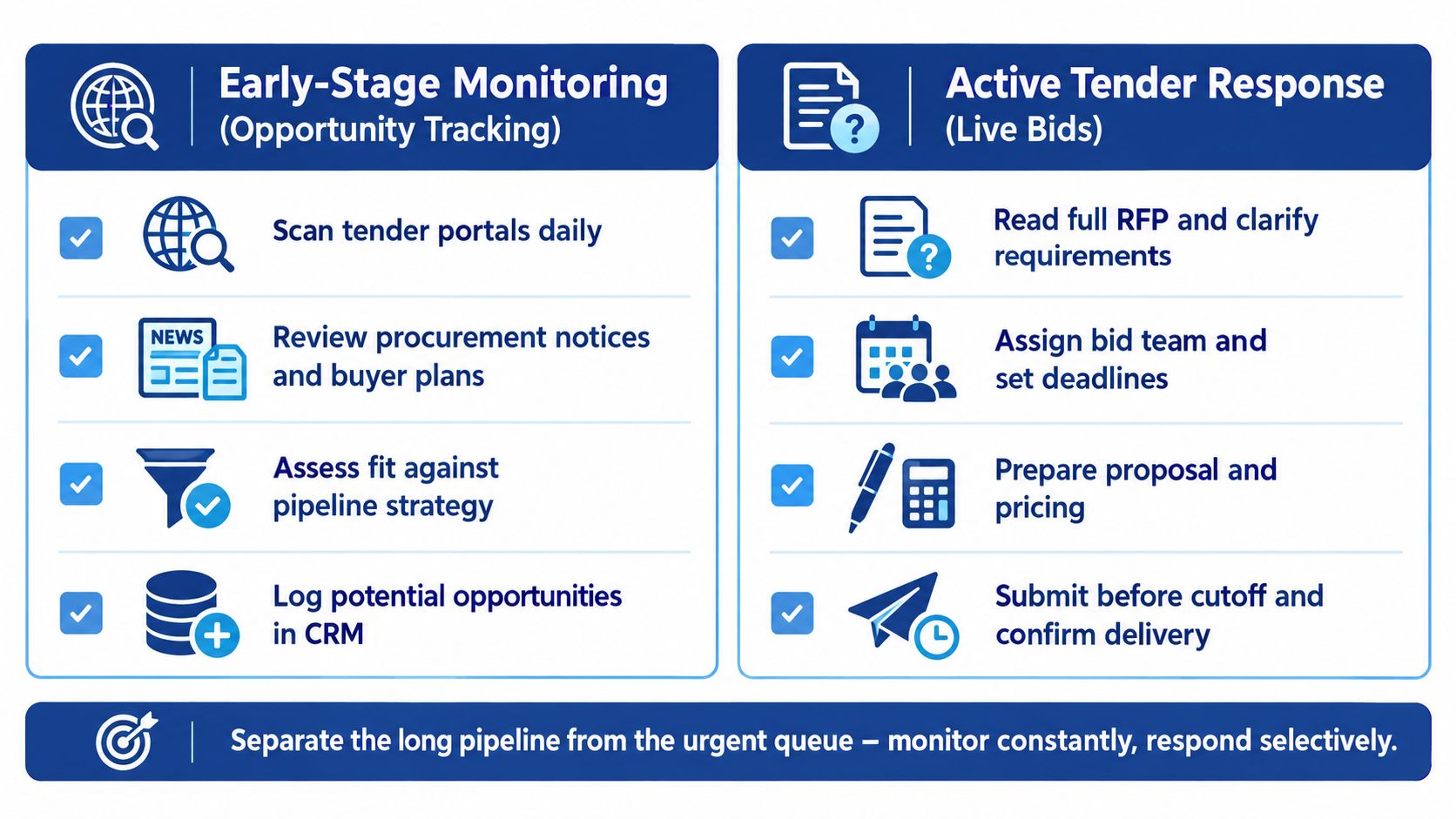
A disciplined bid team doesn't put procurement signals and live tenders in the same queue. They run two tracks. One is for monitoring. The other is for active response.
A practical weekly rhythm
That split usually looks something like this:
- Monday monitoring pass: scan pipeline notices, market engagement signals, and buyer plans. Log anything relevant, but don't start drafting.
- Midweek live review: check Find a Tender and Contracts Finder for notices with documents, deadlines, and active submission requirements.
- End-of-week decisions: run go or no-go on the live shortlist and assign work only where the tender is confirmed.
That sounds basic, but it stops a very common waste pattern. Teams panic on every alert, start writing too early, and then discover the buyer hasn't opened the competition yet.
This kind of separation is exactly where tools can help. Bidwell's bid writing software is one example of a platform that splits the workflow between tender monitoring, a searchable knowledge base, and AI response generation for live opportunities.
Keep the long pipeline away from the urgent queue
This visual captures the operating difference.
What good discipline looks like
The teams that handle the difference between procurement and tendering well usually do three things consistently:
- They monitor separately: tender monitoring is for signals, not just deadlines.
- They organise knowledge centrally: a knowledge base helps map buyer terminology, service evidence, policies, and reusable content to the right stage.
- They reserve AI drafting for real tenders: AI response generation is most useful once the pack, deadline, and evaluation structure are confirmed.
The smartest bid process is not “respond faster to everything”. It's “spot early, qualify properly, and write only when the competition is real”.
That's the practical value of the distinction. Procurement tells you what may be coming. Tendering tells you when it's time to compete.
If your team keeps mixing up early procurement signals with live tenders, Bidwell is built for that exact problem. It helps you monitor UK tender portals, keep a reusable knowledge base of bid content, and generate draft responses when a real tender is live, so you can separate market visibility from actual bid work.