
In 2021/22, UK small and medium-sized enterprises won £21 billion of government work, the highest amount recorded at that point and a fifth consecutive annual increase. That works out at roughly £3,800 of government business for every UK small business, according to the government's own announcement of the figures.
That number matters because it ends the argument about whether public contracts are a closed shop for large incumbents. They aren't. It says nothing, though, about whether your business can win one at a margin you can survive on.
Those are separate questions, and most guides blur them together. Seeing a tender is discoverability. Being able to deliver it profitably is bidability. The second one is what decides whether a bid deserves your next three weeks.
What UK Public Contracts Are and Who Buys Them
Picture the buyer's side first. A local authority needs its civic offices cleaned, its parks maintained and its fleet insured. Each of those needs becomes a public contract: a regulated agreement in which a public body buys works, goods or services from a business, under rules setting out how the opportunity is advertised, evaluated and awarded.
The buyers are familiar once you list them. Central government departments and their executive agencies. Councils. NHS trusts. Schools, colleges and universities. Police forces and fire authorities. Housing associations. The devolved administrations in Scotland, Wales and Northern Ireland, each running its own portal.
What they buy is wider than newcomers expect: cleaning and catering, IT support and hardware, construction and maintenance, consultancy, training, taxi and transport services, agency staff. Public money has to be spent transparently and with demonstrable value for money, so most of this buying is advertised openly and awarded against criteria the buyer publishes before anyone submits.
Scale runs from a single-site cleaning notice worth a few thousand pounds to national frameworks worth nine figures. The machinery is the same at both ends. The rules, the competition and the evidence burden change with the value.
Worth internalising early: a public contract is a buying process, not a grant. The buyer has a budget, a specification and a scoring sheet, and your job is to score on the sheet.
The money is real, the process is open, and the paperwork is survivable. Whether any individual opportunity is worth your time is a separate calculation, and it's the one most overviews skip.
The Procurement Act 2023 in Plain English
The Procurement Act 2023 came into force on 24 February 2025 and replaced the Public Contracts Regulations 2015 as the principal framework for new procurements. Royal Assent came in October 2023. The start date was confirmed on 12 September 2024, after the planned October 2024 start moved back. Suppliers should treat the start date as a change in rulebook, not a clean break. procurements already begun under the 2015 rules continue under them.
Two practical consequences matter. First, the regime that governs a bid depends on when the buyer started the procurement, not when you submit your response. Second, larger central government buyers have a forward-planning duty. They publish pipeline notices covering future planned procurements, giving suppliers a legitimate forward view instead of guesswork. That visibility helps with capacity planning, but it does not make an opportunity bidable. A pipeline entry can still change scope, timing, budget or evaluation approach.
What actually changes for bidders
The 2015 regulations came from EU procurement directives. The 2023 Act is home-grown, and it is built around outcomes the government wanted: less procedural argument, more visibility of upcoming spend, faster payment down the chain.
- One platform. The enhanced Find a Tender service is the central digital platform, with supplier registration, organisational information, declarations and share codes intended to cut out repeated form-filling, per the government's Find a Tender factsheet.
- Fewer procedural cages. Simpler procedures give buyers more discretion to design a competition that fits the market they are buying from. That can reduce bureaucracy, but it also shifts more weight onto the buyer's specification and evaluation criteria. Read both closely before committing bid time.
- Payment pressure. Stronger provisions on paying suppliers and subcontractors matter most to the smallest firm on the chain. For SMEs, late payment risk belongs in the bid decision alongside price and scoring. A win that strains cash flow is not automatically a good win.
- More published data. Notice types for planning, tendering, awarding and contract management mean more of the buyer's thinking is on the record. The useful discipline is to compare what the buyer said it wanted with what it awarded, and then decide whether your evidence is strong enough to compete.
The structure of the new regime is easier to hold in your head as a map.
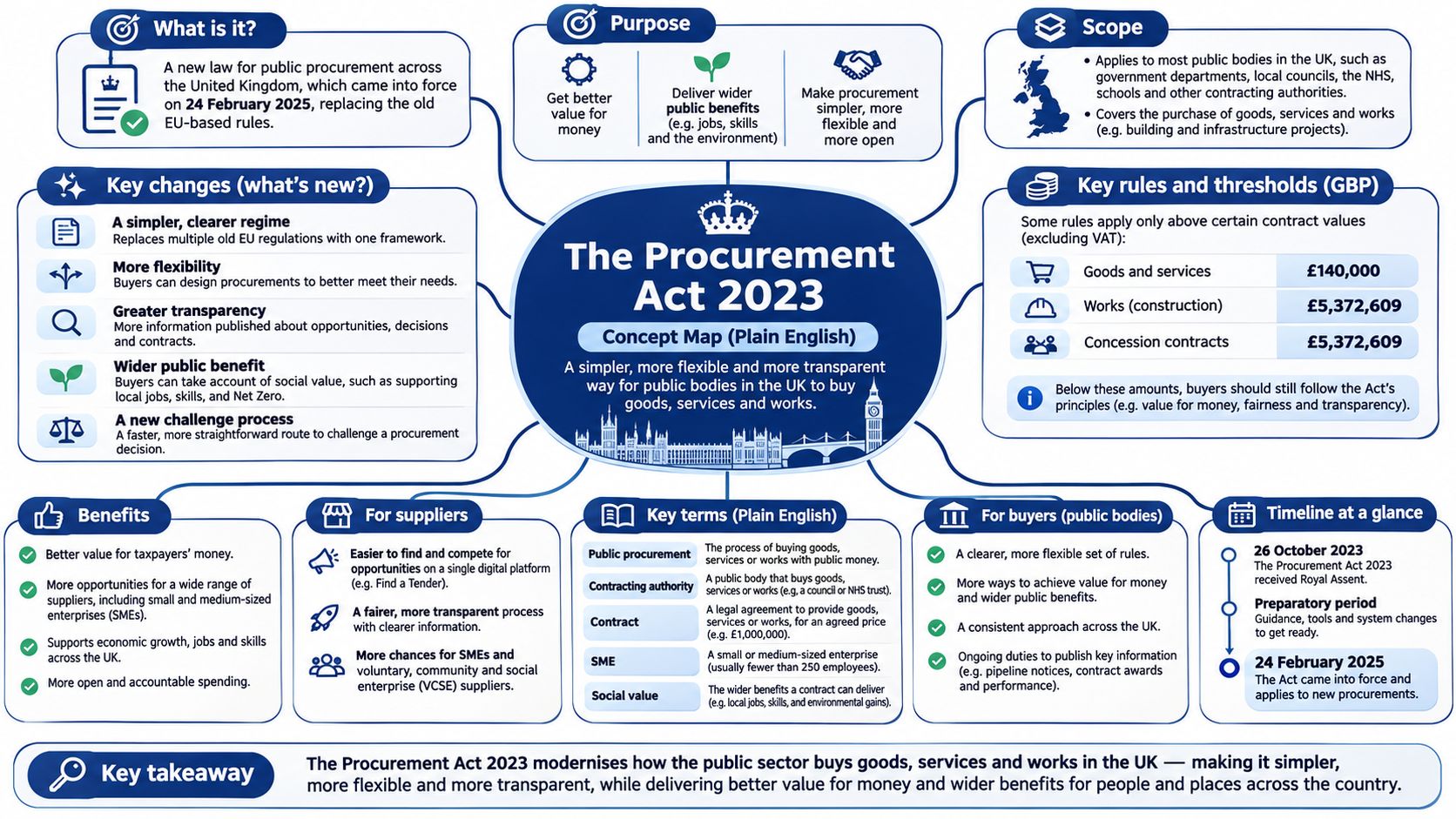
Transition is where bid teams get caught. Two live opportunities in the same week can sit under different rulebooks, with different notice requirements, standstill rules and challenge routes. Check the legal basis on the notice before you plan a response, and brief your approvers on which regime applies.
The practical split is discoverability versus bidability. Public notices can make an opportunity easy to find. Winning it still depends on whether you can meet the specification, prove it with evidence, price it at a margin you can live with, and carry any payment timing risk. Simpler rules change how you bid. They do not do that work for you.
The 2026 Thresholds That Set the Rules
Start with the number that decides how much process attaches to an opportunity. From 1 January 2026, the Cabinet Office threshold guidance sets the regulated contract-value boundaries under the Procurement Act 2023 as follows, all inclusive of VAT.
UK public contract thresholds from 1 January 2026
| Contract type | Central government | Sub-central authorities | Covers |
|---|---|---|---|
| Goods and services | £135,018 | £207,720 | Supplies, services and mixed contracts |
| Works | £5,193,000 | £5,193,000 | Construction, repair and maintenance |
| Light-touch (non-works) | £663,540 | £663,540 | Health, social care and similar services |
Reading the rows
Central government means departments and their executive agencies. Sub-central covers councils, NHS trusts, universities and police forces, which is why the same cleaning contract is regulated at a different value depending on who's buying. Works means construction, repair and maintenance, and the threshold is high enough that most building work below it escapes the full regime. Light-touch covers health, social care and similar services where the buyer gets more discretion over how it runs the competition.
Crossing a threshold is what switches on the heavy obligations: full procedures, notices at set points, published award documentation. Below the ceilings, buying is lighter. It isn't invisible. Buyers still publish below-threshold notices above small value floors, and those notices are where a lot of first wins sit.
A single generic threshold is worse than no threshold. It flags competitions that were never regulated and hides ones that were, and both mistakes cost you weeks.
Classify before you qualify
The routine that works, in order. Identify the contracting authority type, then the contract category, then the VAT-inclusive estimated value, then any light-touch or concession status. Apply the threshold last, not first. Classification also tells you how much effort belongs in monitoring clarifications, exclusion requirements and award documents. A £140,000 central government services contract and a £5.2 million works contract both deserve attention, but not the same kind.
Get this right and any notice takes about thirty seconds to place: which regime governs it, what the buyer is obliged to publish, and how much process to expect.
Where Public Contracts Are Advertised
Public contracts UK buyers award don't sit on one noticeboard. That's the first practical problem, and it catches out firms who assume a single government website lists everything.
Since the Act came into force, Find a Tender has been the main publication service for both above-threshold and below-threshold notices for new UK procurements, except below-threshold procurements in Scotland, per PPN 023 on 2026 threshold amounts. Contracts Finder remains relevant for below-threshold opportunities in England and other non-devolved territories. The same guidance identifies below-threshold contracts over £12,000 including VAT, or over £30,000 outside central government, as published through the relevant service.
Where UK public contracts are advertised
| Portal | Coverage | What appears there | Cost to search |
|---|---|---|---|
| Find a Tender | UK-wide, except below-threshold Scotland | Above-threshold contracts and most new below-threshold notices since February 2025 | Free |
| Contracts Finder | England and non-devolved territories | Below-threshold contracts, see the thresholds section for the floors | Free |
| Public Contracts Scotland | Scotland | Scottish public sector notices, including below-threshold | Free |
| Sell2Wales | Wales | Welsh public sector notices and awards | Free |
| eTendersNI | Northern Ireland | Northern Ireland public sector notices | Free |
Every one of those portals lets you search by keyword, CPV code, location, buyer and value, and most will email you when a saved search turns up something new. Say a facilities firm covers cleaning and grounds maintenance across the West Midlands. It saves two searches on Contracts Finder and two on Find a Tender, filters by region, and switches alerts on for all four. Two portals, four saved searches, one inbox.
The failure mode is the weekly manual sweep. Five tabs, five logins, an hour gone, and a notice missed because it closed in nine days. That's the point where firms stop looking, and it's the reason serious bidders automate their monitoring.
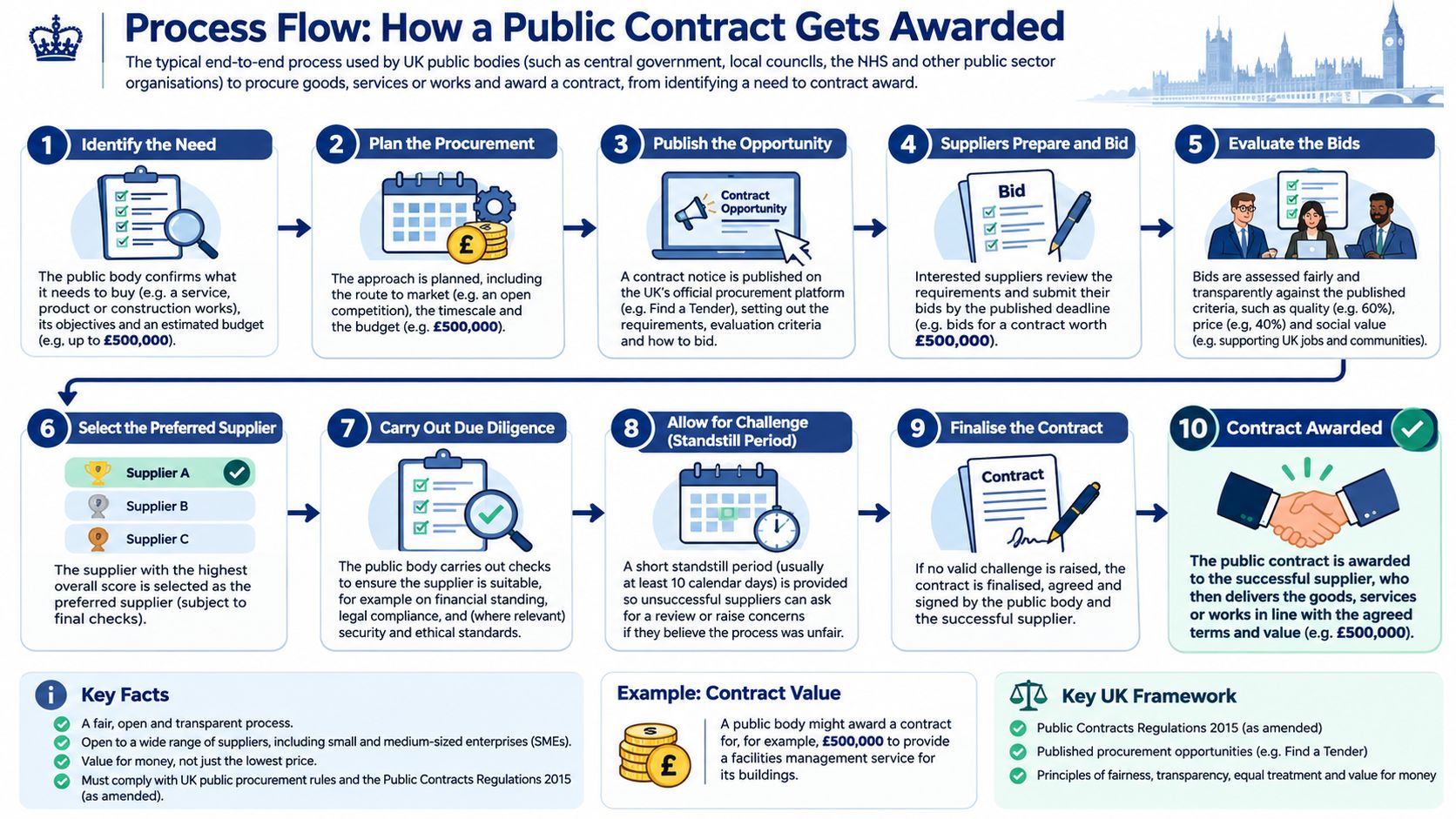
How a Public Contract Gets Awarded
Public contracts UK buyers award follow the same lifecycle whether the value is twelve thousand pounds or five million. Treat it as a sequence, because knowing which stage you're in tells you what to do next and what you've already missed. The practical split is discoverability and bidability. Seeing a notice only gets you into the race. A contract is only worth chasing if you can submit a compliant response, price the delivery risk and still make money after payment terms are applied.
The seven stages
- Pipeline and early engagement. Buyers publish pipeline notices or run preliminary market engagement before a formal competition. Engage here and you can shape a specification, and you'll learn whether the requirement is being written around an incumbent.
- The opportunity notice. Specification, terms, evaluation criteria and timetable go live together. Read the evaluation criteria before the specification. The criteria tell you what wins. The specification tells you what the buyer thinks it wants.
- Selection stage. Registering interest, financial checks, insurance levels, references and exclusion questions. Dull paperwork can do real damage at this stage.
- Invitation to tender. Documents issued, deadline set. Clarification windows are fixed, so missing the deadline for questions means bidding blind on an ambiguity everyone else has resolved.
- Evaluation. Scored against the published criteria, usually split between quality, price and social value, using a stated methodology. Write to the scoring matrix, not to your brochure.
- Award and standstill. The decision is published in a contract award notice, and unsuccessful bidders can request feedback. Ask for it. A debrief is the cheapest intelligence you'll get all year.
- Contract delivery. Performance management, KPIs and payment. A won contract turns into either a reference or a cash-flow problem at this stage.
That last point belongs in the bid decision, not just the delivery file. If the payment structure puts pressure on your working capital, price that risk before you commit. A high score on quality means little if mobilisation, invoicing milestones and late-payment exposure leave you funding the buyer's project.
The framework detour
A large share of public buying runs through a framework, where a group of suppliers has already been appointed and the buyer then runs a mini-competition or makes a direct call-off. G-Cloud and the Digital Outcomes and Services routes are familiar examples in digital work. If your market buys that way, an open tender win is the exception rather than the route, and the work goes into getting onto the framework in the first place. Bidwell's frameworks page lists 18 UK government frameworks it tracks, which is a quicker way to see whether your market is framework-led than reading notices one at a time.
A small below-threshold buy can close in weeks. A regulated procurement runs to fixed minimum periods, and the clock starts when the notice publishes, not when you notice it. That is why the bid/no-bid call has to be early. By the time the specification has been read, the credentials checked and the price built, the timetable may already be dictating the quality of the response.
Where new suppliers fall out
Most first bids fail on administration, not capability. A missing signed form scores zero however good the narrative. A late clarification question leaves you pricing an unknown. An answer that describes your company instead of addressing the scored question earns nothing.
Exclusion ends bids outright. Under the Act, a contracting authority must disregard a tender from an excluded supplier when assessing tenders. That turns declarations, policies and supporting records into bid content rather than back-office admin, and it is worth confirming they are current before a deadline, not after.
The sequence, end to end, looks like this.
How SMEs Win Public Sector Work
£3.913 billion of direct SME spend sat inside £36.190 billion of Crown Commercial Service agreement spend in 2024/25, according to CCS's published procurement figures. That was 10.8%, down from 12.5% in 2023/24. Those numbers matter because they give smaller suppliers a realistic read on the market: public buying includes SMEs, but it does not reserve a fixed share for them.
| Measure | Value | Share | Period |
|---|---|---|---|
| CCS direct SME spend | £3.913bn | 10.8% of £36.190bn agreement spend | 2024/25 |
| CCS direct SME share, prior year | £4.262bn | 12.5% | 2023/24 |
Other published figures can look more generous, often because they cover a different slice of government buying and use a different denominator. What matters for a bidder is the commercial reading: SME participation is significant, but it is won contract by contract. You are competing on specification fit, evidence, price and delivery confidence, often against an incumbent who looks established but may be slow to respond.
That distinction comes before the writing. Discoverability and bidability are separate decisions. A tender alert tells you that a buyer is willing to hear from suppliers. It says nothing about whether the work fits your capacity, accreditations, cash flow or margin. A disciplined SME treats the alert as the start of a screening process, not as permission to bid.
Why the two percentages differ
A direct bidding route is still a competition. It rewards suppliers that can turn ordinary business evidence into scored answers. That means keeping capability statements, case studies, policies, past responses and credential records where they can be reused, then matching them to the question set rather than writing from memory under deadline pressure.
There is a practical trade-off here. A polished narrative can lift a quality score, but it cannot rescue a bid that ignores mobilisation cost, site cover or payment timing. I would rather see a supplier withdraw early from a weak-fit contract than spend three weeks producing a detailed response for work it cannot deliver profitably.
A worked example
Take a 40-person cleaning firm looking at a £180,000 three-year council contract it found on Contracts Finder. The discipline is in what it checks before writing a word.
- Capacity. Can the site be staffed from existing supervisors, or does winning mean hiring one before month one?
- Specification fit. Does the contract demand weekend cover, secure-site vetting or equipment the firm doesn't currently run?
- Mobilisation cost. Recruitment, training, consumables and site set-up all land before the first payment does.
- Social value. Local recruitment or apprenticeship hours the council can verify beat generic pledges.
The firm then prices against the published split, writes quality answers naming the supervisors and citing comparable buildings, and submits. It might also find at pricing stage that mobilisation eats the margin, in which case the right answer is a no-bid. Both outcomes are a good bid decision.
Repeat winners build that screening into their process. They monitor the relevant portals, match notices against sectors, frameworks, CPV codes, keywords, region and value, then keep the evidence needed to answer quickly. AI bid writing software can draft from that knowledge base, but the bid decision still rests on the same questions: can you deliver it, can you evidence it, and will the payment terms leave the contract profitable?
What Catches New Suppliers Out
The late-payment figures are stark: £23.4 billion owed to UK SMEs, an average of £22,000 per SME per year, and an estimated 50,000 business closures annually linked to late payment, as set out in the public procurement reform consultation. New suppliers often treat a public contract as a revenue win before they treat it as a cash-flow commitment. That is where the trouble starts.
Transparency is not access. An SME suitability label on a notice tells you the buyer believes smaller firms could bid. It says nothing about whether the contract fits your capacity, accreditations or margin. Discoverability is the platform's job now. Bidability is yours, and it needs a separate decision with real numbers attached. A tender can be visible on every portal, match your CPV codes and still be a poor bid because the mobilisation cost, specification or payment profile eats the return.
Winning can make you poorer. The Act also tightens supply-chain payment expectations for major-contract suppliers, so check the current payment terms in each tender. Those expectations do not close the gap between contractual entitlement and cash in the bank. You still pay staff, subcontractors and suppliers before the first invoice clears.
A contract that pays in 30 days still costs you 60 if your first invoice goes out at the end of month one.
Model that before you bid: mobilisation spend, the delivery runway to first invoice, the lag to payment, and the margin left after carrying the gap on an overdraft or a director's loan. This is a bid decision, not an accounting detail. If the contract depends on you funding the buyer's operating cycle, the price needs to reflect that or the bid needs to stop. I would rather see a clean no-bid than a first win thatStarves delivery in month three.
Lowest price rarely wins. Evaluation follows the published criteria and the stated scoring method. A bid that undercuts the field by an implausible margin invites questions about viability, and it invites a challenge from the supplier that lost. Price is scored. It is a shortcut past neither the quality questions nor the evidence requirements.
Compliance sits alongside all three. If delivery involves a public-facing website or a citizen-facing service, buyers will ask about availability, security and hosting, and WebinOne's public sector hosting guidance is a decent primer on the sort of questions that land in the security section. Treat those questions as part of bidability. A service you cannot evidence securely is a service the buyer cannot safely score.
The recurring failure points, in one list.
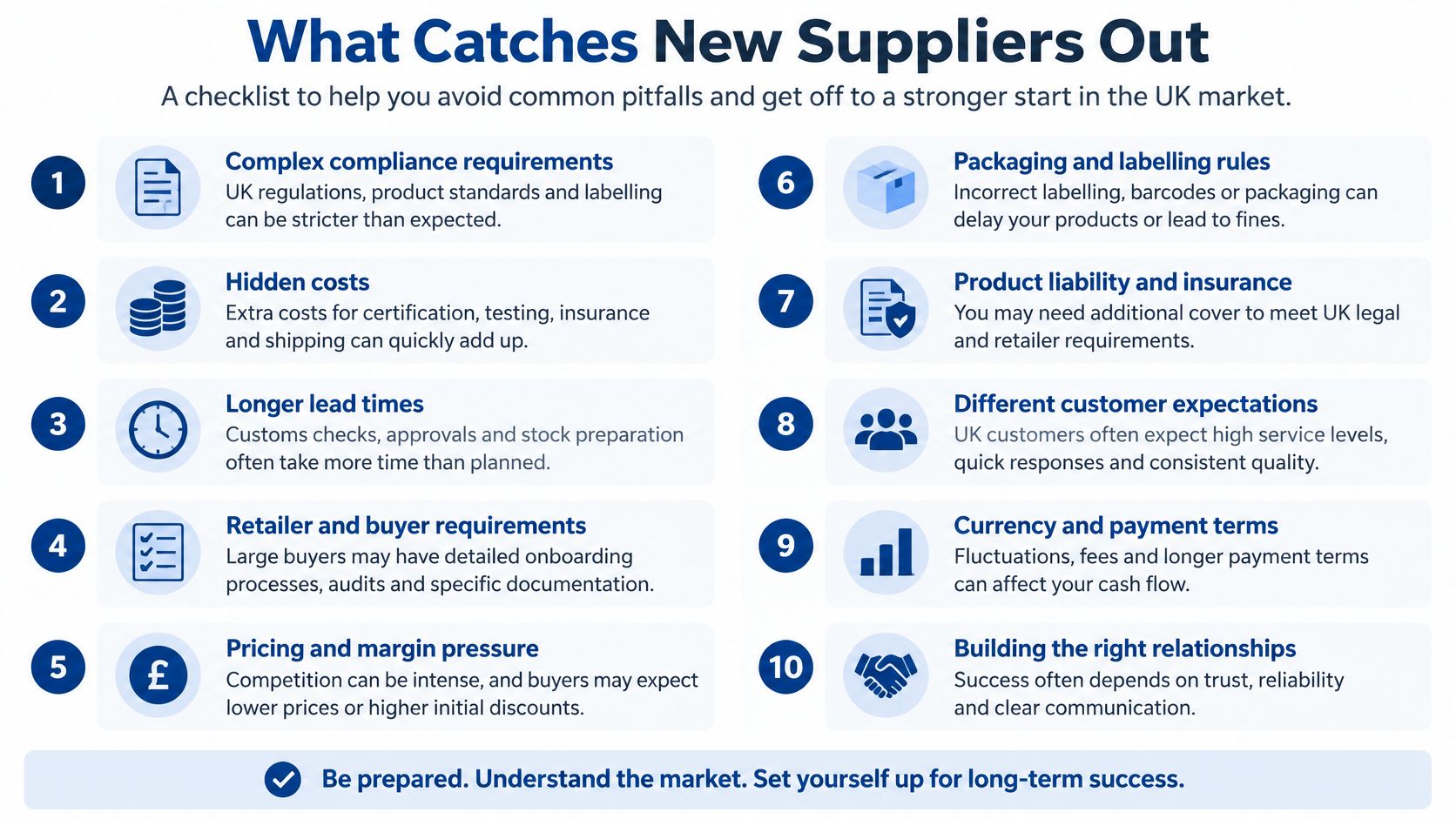
Before you submit, confirm five things. Payment terms and the first-payment date. Margin at 30 to 60 days of unpaid delivery. Capacity to mobilise inside the buyer's timescale. Exclusion records that are current and evidenced. Answers mapped to the scoring criteria, question by question.
Set Up Your Route into Public Contracts
Public contracts are advertised openly, awarded against published criteria, and open to any business that can deliver them. The distance between knowing that and winning comes down to a system you run every week.
- Register where your market buys. Find a Tender first, then the portals that cover your geography and sector: Contracts Finder, Public Contracts Scotland, Sell2Wales, eTendersNI.
- Set monitoring on codes, not habits. CPV codes, keywords, regions and value bands, so the right notices reach you without a manual sweep. How tender monitoring works covers the matching logic if you want to see what good filtering looks like.
- Build the evidence library once. Credentials, policies, accreditations, case studies, team CVs and past responses, all searchable.
- Qualify hard when a tender lands. Classify it against the thresholds, read the payment terms, check exclusion requirements, then draft against the criteria.
Firms don't quit bidding. They quit searching. The weekly sweep of five portals is where the habit dies, usually in week three, and the opportunities that follow go to whoever kept the alerts running.
Bidwell is built for exactly that gap. Its tender monitoring watches every UK tender portal from one set of criteria, so notices arrive instead of being hunted. The knowledge base learns your business from your past responses and credentials once. AI response generation drafts from that material, turning a 20 to 40 hour writing task into a couple of hours of review. Tender discovery is available as an add-on at £10 a month, matching on sector, framework and CPV code.
Pick one live opportunity this week. Classify it, read its payment terms, and decide bid or no-bid before Friday. That single decision, made properly, is worth more than another portal login.
Bidwell watches every UK tender portal, learns your business from your past responses and credentials once, and drafts complete tender responses in hours instead of weeks. If your bottleneck is finding the public contracts UK buyers have already published, or turning a good one round before the deadline, that's the gap it fills. Start at Bidwell and see what's live in your sector right now.


