A good construction firm can lose a tender before anyone reads its method statement. The company has the right experience, competent supervisors and a clean delivery record, but one insurance certificate is out of date, a mandatory field is blank, or a financial question has been answered in the wrong format. The buyer marks the response non-compliant and the opportunity ends there.
That outcome isn't always caused by a weak contractor. Poor pre qualification questionnaire construction creates avoidable work for buyers and avoidable risk for bidders. Long forms repeat information, unclear questions produce inconsistent answers, and broad financial gates can exclude capable SMEs without proving that the supplier can deliver.
The old PQQ is no longer the right mental model for public procurement. The Standard Selection Questionnaire, or SQ, now provides the formal structure for supplier selection, while the construction market has moved from PAS 91 towards the Common Assessment Standard. The practical question is no longer, “What company information can we collect?” It's, “What evidence is necessary to decide whether this supplier should proceed?”
That distinction matters. A construction selection questionnaire should test exclusion grounds, financial standing and technical or professional ability, then stop. Project-specific delivery detail belongs in the tender or a later pre-construction assessment unless the procurement documents properly require it.
A useful way to think about the exercise is through lead scoring best practices, where each question has a clear qualification purpose rather than existing because it appeared in an old template. The same discipline applies here. Every field should help a buyer make a defensible decision, and every answer should give a bidder a fair chance to prove suitability.
Introduction Why Construction PQQs Still Trip Up Good Bidders
A bid manager downloads the questionnaire, sends sections to finance and operations, then starts copying answers from the last portal submission. The team assumes the content is familiar. Nobody spots that the buyer has changed the evidence period, separated mandatory and discretionary exclusions, or requested a named reference for a specific work type.
The problem appears close to the deadline. A strong answer exists somewhere in the company files, but not in the requested format. A policy is attached without its approval date. A reference covers a similar project, but not the required technical activity. A question that does not apply is left blank instead of marked N/A, leaving the response open to challenge or disqualification.
Practical rule: Treat the selection questionnaire as a scored compliance document, not an administrative cover sheet.
The buyer needs to establish whether your organisation can participate legally and financially, and whether it has the technical ability to deliver. The questionnaire should support that decision without becoming a second tender. Selection-stage questions should stay within areas such as exclusion grounds, financial standing and technical capacity, with below-threshold requirements kept relevant and proportionate. The government SQ template and guidance sets out the formal framework.
What a useful construction PQQ actually does
A useful questionnaire creates a clear decision path. It identifies a supplier that must be excluded, one that needs to explain remediation, or one with the financial and technical evidence required to proceed. It does not collect every policy or certificate a buyer has encountered in an older PAS 91 checklist.
Build the response around evidence:
- Legal and organisational facts: Company identity, bidder structure and subcontracting arrangements.
- Exclusion information: Mandatory and discretionary grounds, including relevant self-cleaning evidence.
- Financial evidence: Information needed to assess whether the firm can support the contract.
- Technical evidence: Relevant experience, professional ability and delivery capacity.
This structure also improves internal prioritisation. Use lead scoring best practices as a useful comparison: every question should have a defined qualification purpose, and every answer should help the buyer make a defensible decision. For bidders, that means maintaining approved evidence, checking dates and mapping each project example to the exact activity requested.
Bidwell can support that workflow by connecting opportunities, stored credentials and drafted answers. Its tender monitoring identifies construction opportunities and procurement routes, its knowledge base stores approved policies and evidence, and its AI response generation adapts that material to a questionnaire's wording. The bid team still decides whether evidence is current, relevant and comparable. A tool can organise the material, but it cannot validate the underlying answer.
How the UK PQQ Became the Selection Questionnaire
A contractor can submit the same polished PQQ response it has used for years and still answer the wrong selection test. The term PQQ remains common in construction, but public procurement has shifted towards the Standard Selection Questionnaire and shared assessment standards.
Procurement Policy Note 8/16, published on 26 September 2016 and updated on 8 February 2017, replaced the old pre-qualification questionnaire for supplier selection under the Public Contracts Regulations 2015. It applied to above-threshold procurements in England, Wales and Northern Ireland for reserved functions. The selection stage focused on relevant areas such as exclusions, financial standing and technical capacity, rather than every policy and certificate in a buyer's historic checklist.
Construction had already started standardising its approach. The British Standards Institution introduced PAS 91 in 2010 to reduce the patchwork of buyer-specific PQQs. It gave contractors a more consistent set of early-stage questions across compliance areas and reduced repeated requests for similar information. Buyers still added bespoke sections, so the format never removed the need to review each question.
PAS 91 was later withdrawn following Procurement Policy Note 03/24 in March 2024, which directed contracting authorities towards the Common Assessment Standard. The change matters because a reusable construction questionnaire must remain proportionate, current and defensible. Constructionline's explanation of what PAS 91 was and whether it's still used provides useful context for teams still working from legacy templates.
Why the distinction matters now
The Procurement Act 2023 era has made the label and process harder to ignore. A document called a “PQQ” may contain familiar construction questions, but the buyer should be able to explain what each question tests and why it belongs at selection stage. If that purpose is unclear, the question risks becoming an unnecessary barrier or a challenge point.
Thresholds also need careful handling. Under the former PQQ regime, a contracting authority could not use a pre-qualification stage for below-threshold procurements. The cited guidance gave thresholds of £111,676 for central government and £172,514 outside central government. Buyers could still ask questions relevant and proportionate to the contract, but not create a separate pre-qualification stage in those cases. The SME accessibility reforms guidance explains that distinction.
For construction buyers, a legacy PAS 91 checklist is therefore a poor default. Constructionline identifies the Common Assessment Standard as the preferred route for public sector projects above £5.337 million. Teams should first decide whether a shared assessment meets the procurement need, then add only justified, contract-specific questions. The Common Assessment Standard guidance explains the shift towards shared evidence instead of repeated portal attachments.
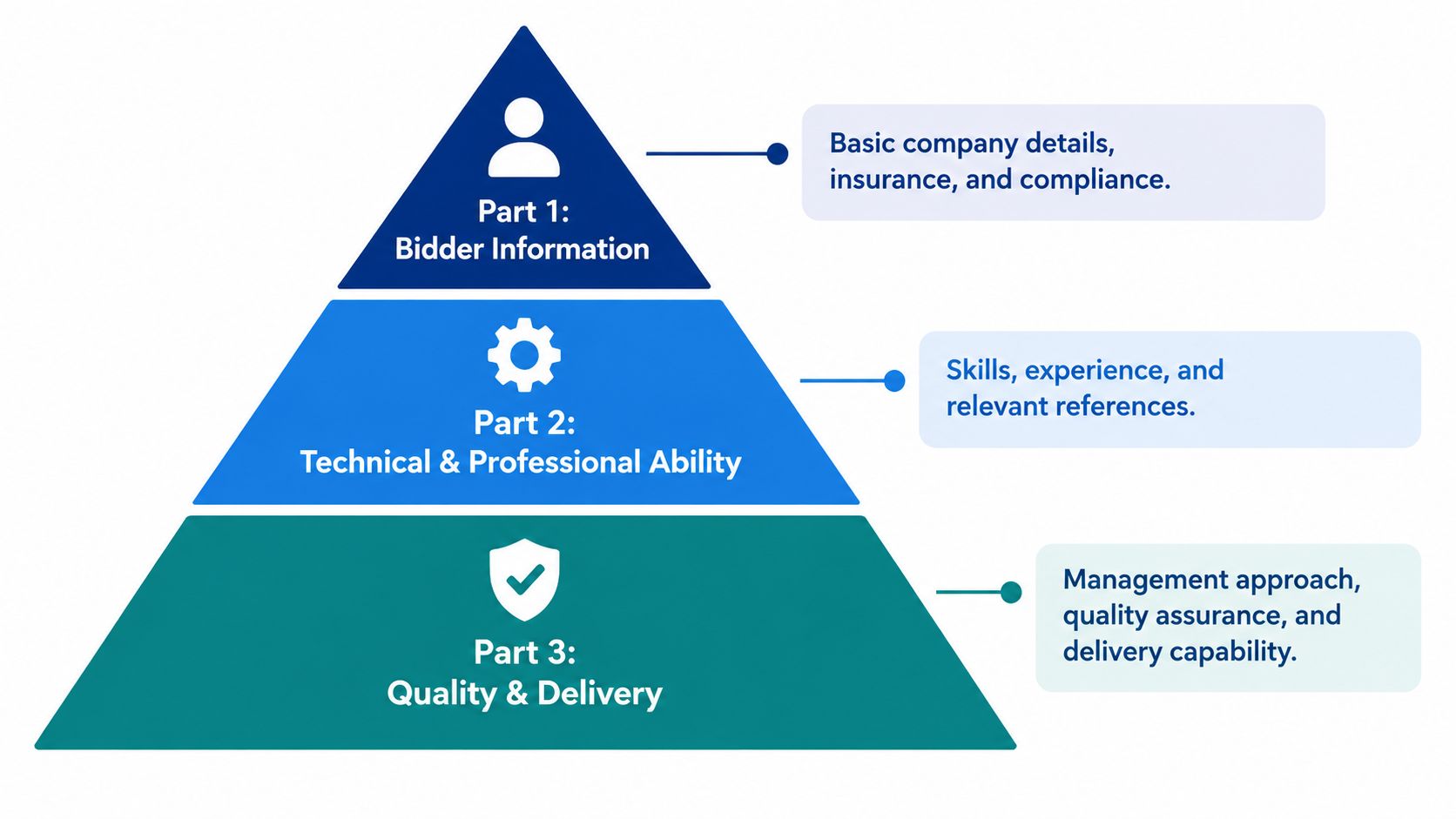
Building Your Questionnaire Around the Three Part Structure
Start with the procurement route, not the old questionnaire in your shared drive. Tender monitoring should flag the opportunity, identify the buyer's stated selection process and show whether the procurement is above or below the relevant threshold. That first check prevents a team from building a formal pre-qualification stage where the route doesn't permit one.
Then create a question map. Every question needs one owner, one evidence type and one decision purpose. If a question can't be assigned to a clear selection gate, remove it or move it to the appropriate tender document.
Part 1 for bidder information and subcontracting
Part 1 establishes who is submitting. Ask for the legal name, registration details, contact information, bidding group information and intended subcontracting arrangements. Keep this factual. Don't mix company identity questions with delivery methodology.
A construction buyer may need to understand whether the bidder is relying on another organisation's capacity or proposing key subcontractors. That belongs here because it affects the identity and structure of the supplier being assessed. The knowledge base should hold the approved company profile, ownership details and standard subcontractor information, with an owner responsible for checking changes.
Part 2 for exclusion grounds
Part 2 covers mandatory and discretionary exclusion grounds, including self-cleaning where relevant. It should be kept separate from technical capability. A contractor may have excellent project experience and still need to address an exclusion issue, while a clean exclusion response doesn't prove that it can deliver a complex build.
Use direct questions and clear response options. If an explanation or supporting document is needed, say so in the question. Avoid burying an exclusion declaration inside a broad “tell us about your business” narrative.
Part 3 for financial and technical ability
Part 3 covers economic and financial standing plus technical and professional ability. Government guidance says Part 3 should collect only evidence vital to delivering the contract. That principle should control the construction of the whole questionnaire.
For example, if the contract requires specialist groundworks, ask for relevant groundworks experience and the financial evidence needed to assess delivery risk. Don't request every historic project, every policy and several years of unrelated accounts because the information is available.
The government Standard Selection Questionnaire structure provides the three-part framework. A knowledge base can organise evidence against each gate, while AI response generation can draft an answer using the exact question wording and attach the correct certificate or policy. The bid manager must still approve the selection, remove irrelevant material and check that the evidence supports the claim.
A simple mapping test
Use this table before releasing the questionnaire:
| Question type | Correct gate | Evidence test |
|---|---|---|
| Company identity and bidding structure | Part 1 | Is the information current and verified? |
| Insolvency, misconduct or exclusion matter | Part 2 | Does the answer address the stated ground and any remediation? |
| Financial capacity | Part 3 | Is the requirement tied to contract delivery risk? |
| Relevant work and technical skill | Part 3 | Does the evidence match the scope, complexity and risk? |
| Project execution detail | Usually tender or later assessment | Is it genuinely needed before shortlisting? |
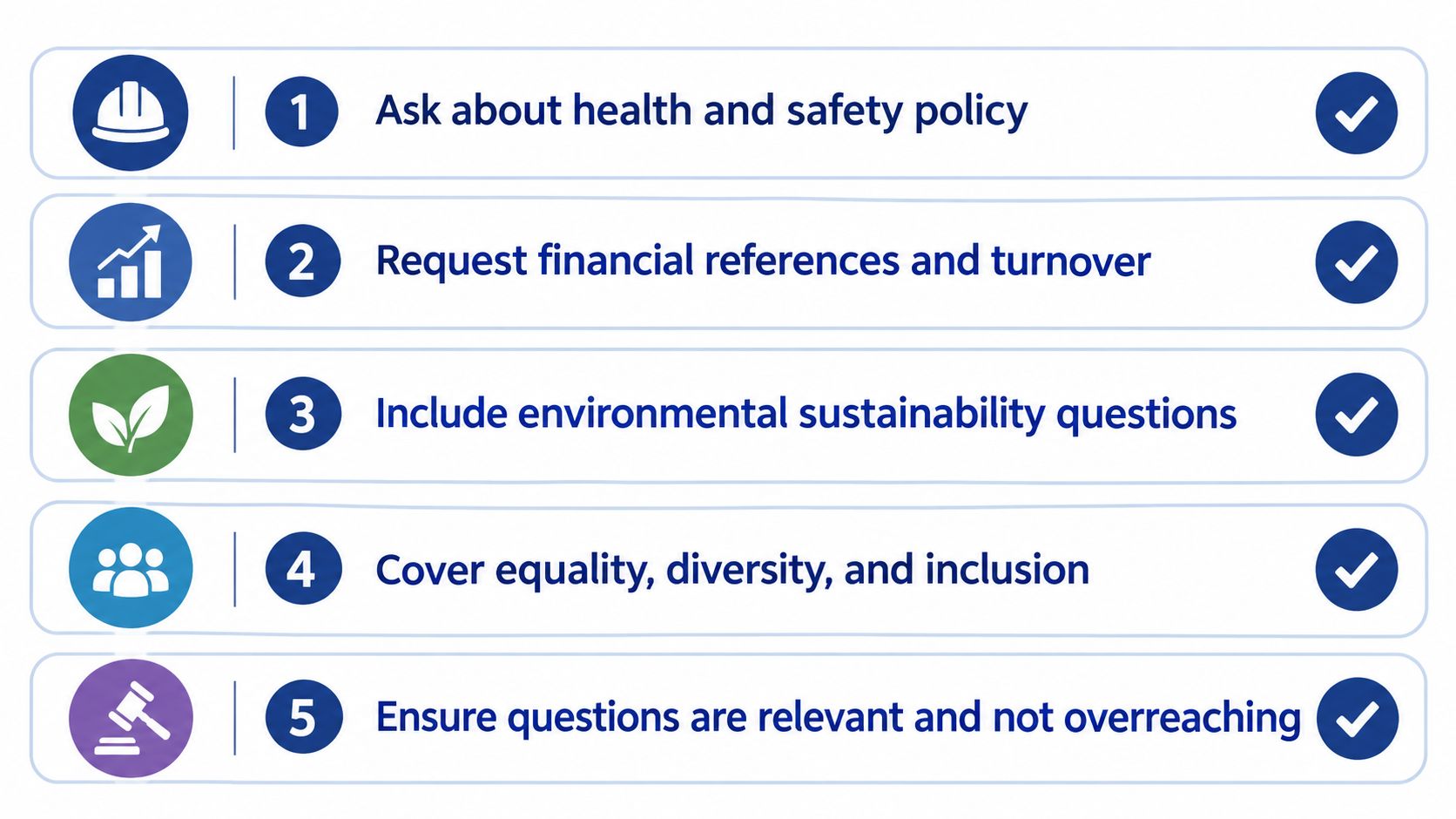
A practical construction form may still ask about health and safety, environmental management, equality and diversity, insurance and quality controls. The issue is not whether those topics matter. It's whether the question tests a permitted and relevant selection criterion, asks only for necessary evidence and gives the bidder a scorable way to respond.
Teams that need a structured way to gather contractor information can also review guidance on how to build a quote form for contractors. The same design discipline applies here, clear fields, defined evidence and no unnecessary narrative.
What to Ask and How to Ask It Without Overreaching
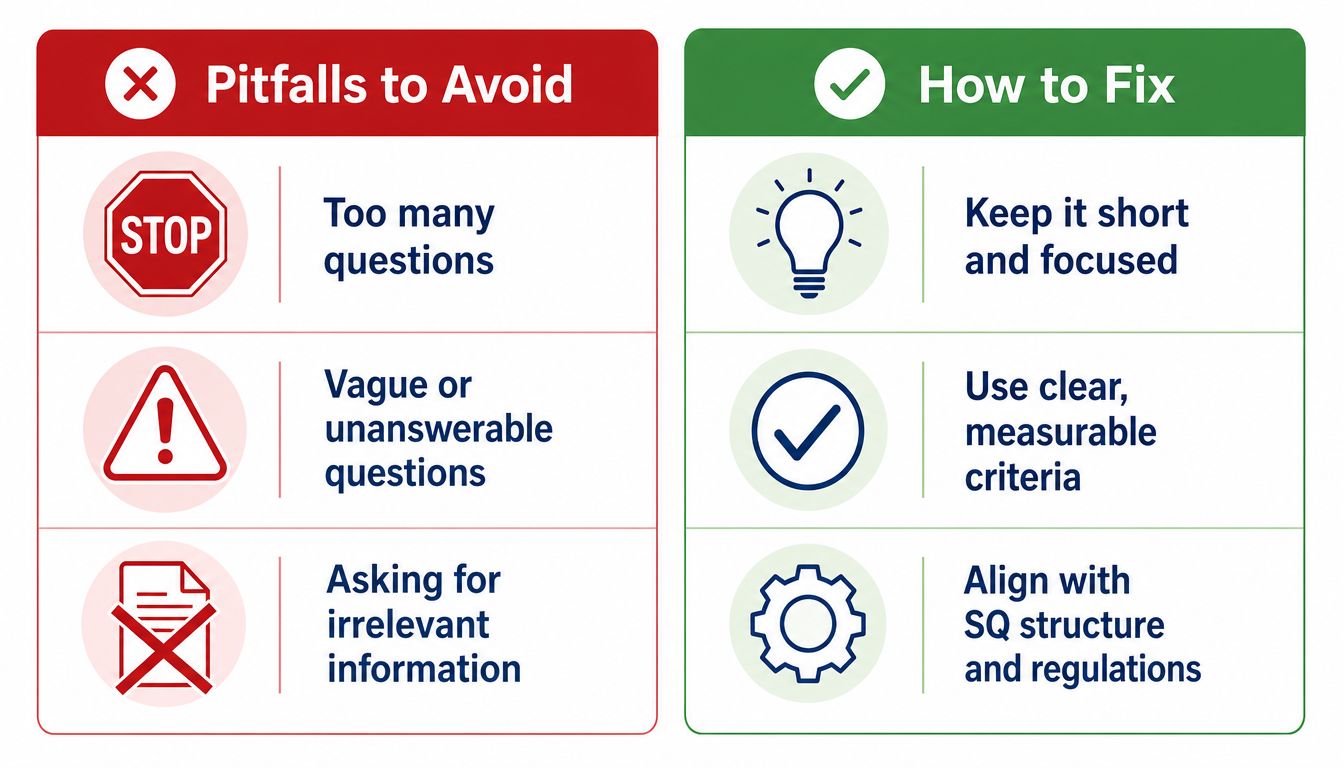
Good questions make the evaluation decision easier. Weak questions create a document that looks thorough but produces answers nobody can compare.
Write the question, the response format and the scoring or pass condition together. If you can't explain how an evaluator will use the answer, the question probably needs rewriting.
Turn broad topics into usable evidence
Health and safety is a common example. “Describe your health and safety arrangements” invites a long policy essay. A better structure separates the evidence:
- Policy control: Provide the current health and safety policy, its approval date and responsible owner.
- Relevant experience: Give an example of managing health and safety on work comparable to this contract.
- Incident management: Explain how incidents, near misses and corrective actions are recorded and reviewed.
- Competence: Identify the roles responsible for supervision, training and site assurance.
The same approach works for insurance. Ask for the type of cover, insurer, policy period and certificate. State whether the cover must be in place at selection stage or before contract award. Don't make a bidder guess which document will satisfy the requirement.
Financial questions need particular care. Ask for information that helps assess the supplier's ability to perform the contract, not information collected because it appears in a standard pack. If alternative evidence is acceptable, state that clearly. A small contractor may be able to demonstrate financial resilience without fitting a buyer's preferred accounts format.
Make technical experience genuinely comparable
A useful experience question names the characteristics that matter. For example:
Provide up to three examples of work involving the relevant building type, technical scope and delivery risk. For each example, state your role, contract value where requested, completion status, client contact and the specific evidence that demonstrates comparable capability.
The buyer should define what “relevant” means. A refurbishment project may not prove competence for a live-site infrastructure scheme. A general reference may not prove experience with the required system. Ask for the connection, then score that connection.
Keep core evidence reusable. The Common Assessment Standard reflects the move towards shared supplier information, and Constructionline identifies it as the preferred route for public sector projects above £5.337 million. That doesn't remove the need for project-specific questions. It means the buyer should distinguish between a core capability check and a question about the named team, site constraints or delivery plan.
Protect completion quality
The old government core PQQ pack used strict completion rules. Every question had to be answered. Where a question didn't apply, bidders were told to write N/A. Where the answer wasn't known, they were told to write N/K. Failure to comply could result in disqualification, as set out in the Annex A core PQQ questions.
That rule remains a practical warning even where the current form uses different wording. Give every question a response instruction, make mandatory fields visible and provide a final completeness check. A knowledge base can store approved company data, while AI response generation can populate a draft against the current form. A reviewer should then verify dates, attachments, names and declarations before submission.
For construction-specific credentials and examples, Bidwell's construction work resources can sit alongside your own evidence library. If the questionnaire is a fillable PDF, teams may also find a practical guide to fill PDF forms with PDFWix useful for handling fields and attachments without losing the original format.
Common Pitfalls That Get Construction PQQs Challenged
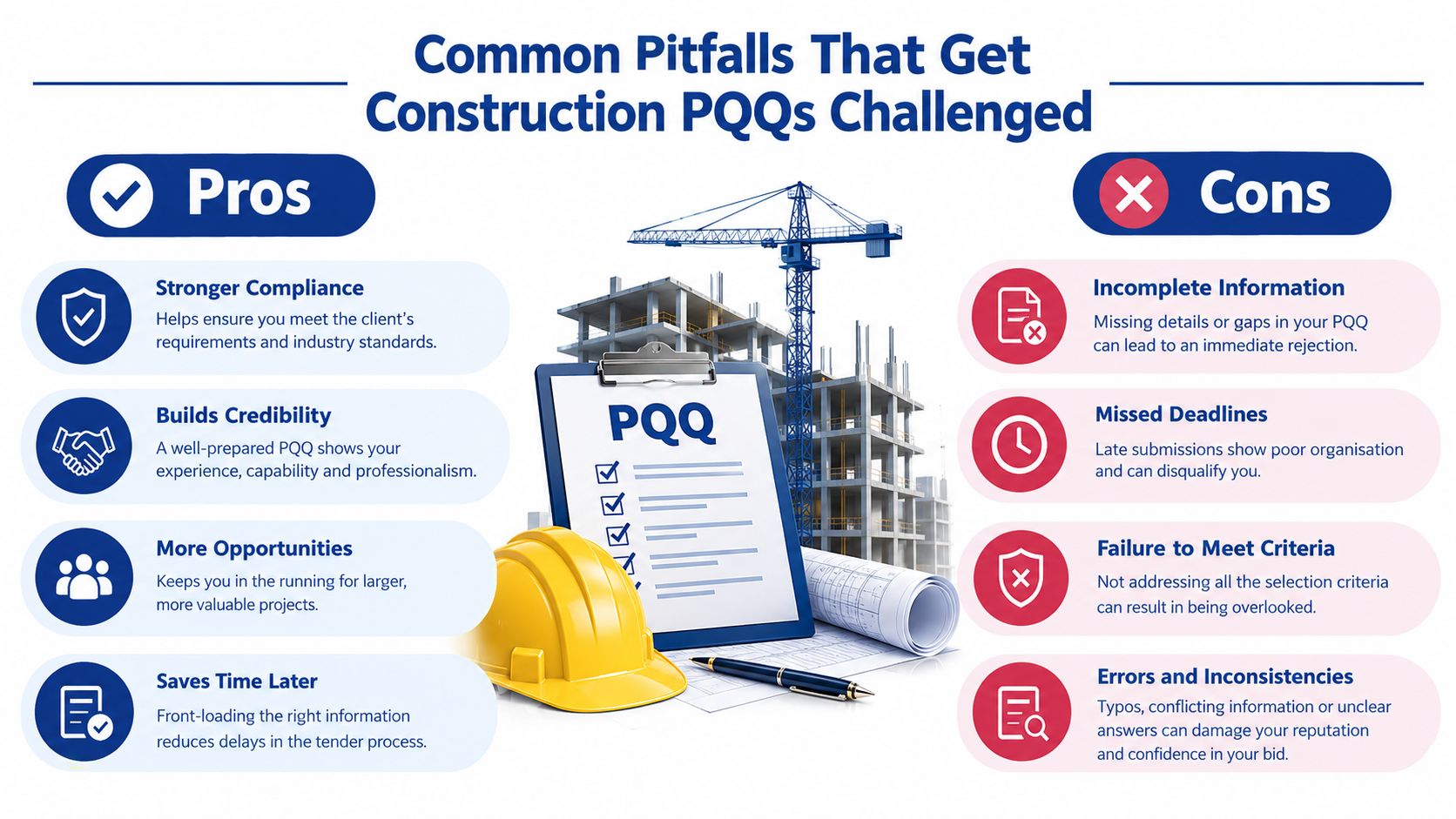
The strongest warning comes from the buyer-side evidence. UK government Mystery Shopper reporting found that PQQ-related issues accounted for 50% of all procurement-process complaints in the reported year, compared with 33% the year before. Financial requirements represented 35% of PQQ issues in that report. These figures are from the Mystery Shopper three-year report, and they show why financial design deserves more scrutiny than a quick template review.
Financial gates that test the wrong thing
The report identified demands for three years of audited accounts, turnover used as a single pass or fail criterion, and financial requirements that could be disproportionate. Those checks may be easy to administer, but they don't automatically prove that a contractor can manage the specific contract.
The better test is risk-based. Ask what financial failure would threaten delivery, then request evidence that addresses that risk. Consider whether a suitable alternative can demonstrate capacity without excluding a firm because its accounts structure differs from the buyer's preferred format.
Forms nobody can score
Long, text-heavy questionnaires create two problems. Bidders struggle to understand what to provide, and evaluators struggle to compare answers. The Mystery Shopper report also identified construction concerns around question length, relevance and experience requirements.
A form can be technically complete and still be badly constructed. Test it with someone who hasn't seen the project. Ask them to identify the required evidence, the response limit and the pass condition without verbal help. If they can't, revise the question.
A pre-release challenge test
Run each question through this short audit:
- Necessity: What delivery or exclusion decision does this question support?
- Proportionality: Is the requested evidence reasonable for the contract and supplier market?
- Comparability: Can evaluators score different answers consistently?
- Currency: Is the evidence period clear, and can the bidder provide current documentation?
- Location: Does the question belong in selection, tender evaluation or mobilisation?
- SME impact: Could the wording exclude capable smaller suppliers without a sound reason?
Standardised questions reduce duplicated work, but copying a standard pack without checking the project is just another form of poor drafting. Use a common core, then add a small number of justified project-specific questions.
A bid manager reviewing an existing questionnaire can use the Bidwell guides as a reference point, but the final audit should follow the procurement documents and applicable guidance. Don't assume a form is defensible because another buyer used it.
Putting It All Together Into a Reusable PQQ System
The practical answer is to stop treating each construction PQQ as a new writing project. Build a controlled evidence system around the three SQ gates, then add only the project questions that a buyer needs.
Start by recording the procurement route and threshold in the opportunity record. Tender monitoring should surface the notice, documents and deadlines, while the bid manager confirms whether the buyer is using an SQ, a Common Assessment Standard route or another permitted process.
Next, organise the knowledge base by evidence type and owner. Store the current insurance certificate, health and safety policy, financial information, technical credentials, case studies and approved company descriptions. Add review dates and clear file names. A document is only reusable if the team knows whether it remains valid.
Finally, use AI response generation to map the uploaded questionnaire to the relevant evidence and draft answers in the organisation's established voice. The workflow should flag missing fields, uncertain evidence and questions that need a human decision. It shouldn't invent project facts or attach an old certificate because it happens to be available.
A repeatable review routine can be simple:
- Before drafting: Confirm the route, thresholds, form version and submission rules.
- During drafting: Map every question to Part 1, Part 2 or Part 3 and identify the evidence owner.
- Before approval: Check every field, attachment, date, declaration and response limit.
- After submission: Save the final answer set and any buyer clarification for future reuse.
Bidwell's PQQ workflow for tender responses follows this operating model by connecting the selection questionnaire with stored credentials and custom drafting. The platform is one option, but the principle applies regardless of software: standardise the evidence, personalise the answer, and retain control of the final submission.
If your construction team is still copying legacy PQQs between portals, review the next live questionnaire against the three SQ gates and mark every unnecessary question for removal. Bidwell can help monitor relevant tenders, organise your approved evidence and generate PQQ drafts for review, so your team spends its time checking accuracy rather than rebuilding the same response.