Most advice about a pre qualification questionnaire starts from the wrong assumption. It treats “PQQ” as though it's still the standard UK form every supplier completes before a tender. It isn't.
The label remains common, especially among SMEs and buyers using older procurement language. The process has moved on, though. For most regulated public procurements, you're more likely to encounter a Selection Questionnaire (SQ), while construction has increasingly moved towards the Common Assessment Standard (CAS). The practical answer isn't to write a fresh response every time. It's to maintain a reusable, controlled evidence pack that can support both legacy terminology and current selection requirements.
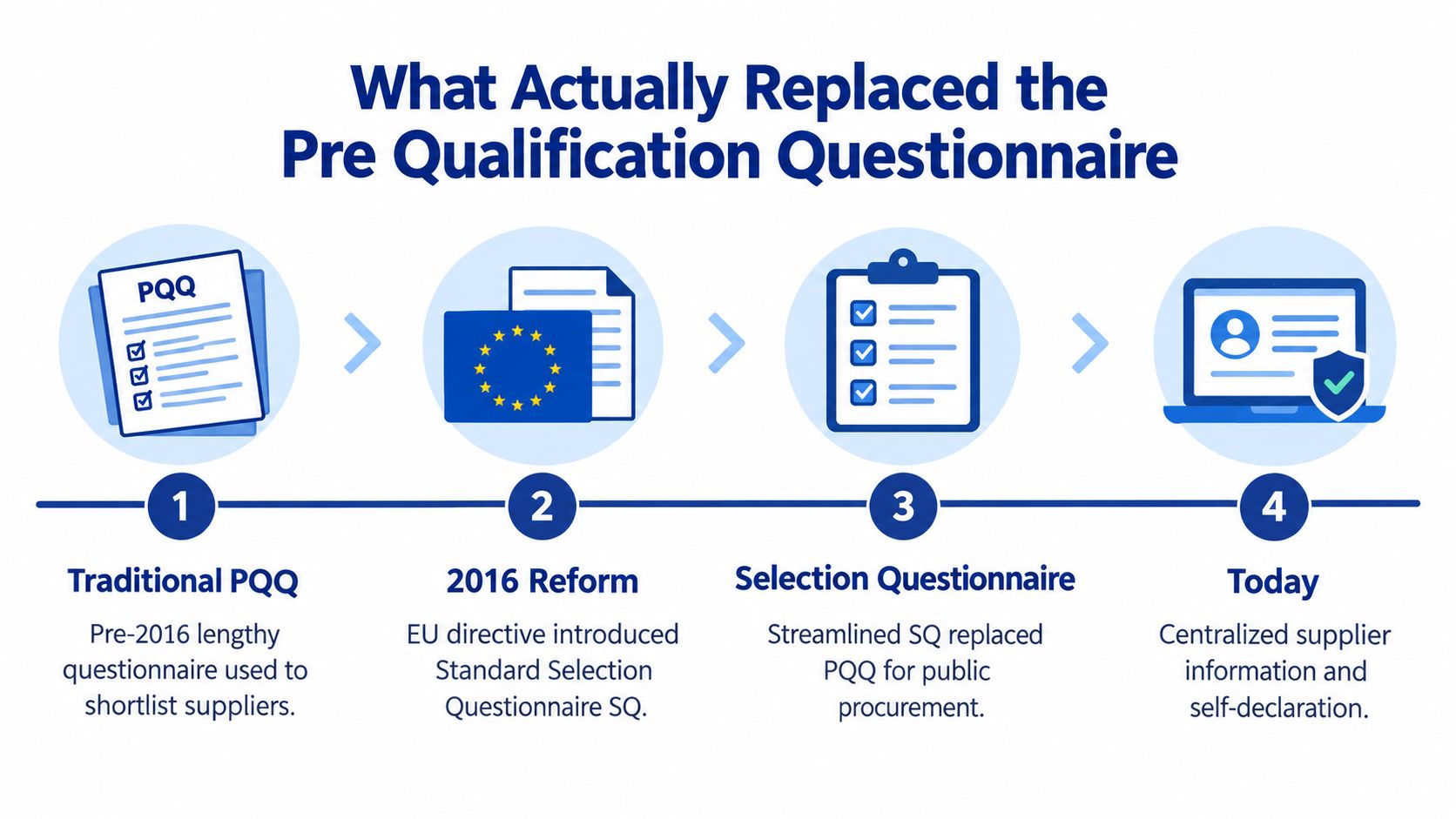
What Actually Replaced the Pre Qualification Questionnaire
The pre qualification questionnaire did not disappear overnight. Its standard public-sector successor is the Standard Selection Questionnaire, introduced through a Crown Commercial Service policy note published on 26 September 2016. The policy applies to contracting authorities in England, and to Wales and Northern Ireland for reserved-function procurements above the relevant Public Contracts Regulations 2015 thresholds. The official Standard Selection Questionnaire policy note confirms that the SQ superseded earlier supplier-selection guidance on PQQs.
For suppliers, the practical change is significant. “PQQ” is now mainly a legacy procurement label, so the term alone does not tell you which form or assessment process applies. The SQ established a shared baseline for exclusion grounds, financial standing and the capacity to participate in a tender. Buyers can still request additional information, but the old buyer-by-buyer approach is less useful as a template for current bids.
Why old PQQ advice causes problems
An earlier PQQ response may contain useful company details, policies and project examples. Its questions, declarations and assumptions may no longer match the procurement route, the buyer's portal or the current legal framework. Copying it without checking each requirement creates avoidable compliance risk.
The Procurement Act 2023 has continued to change the UK public procurement environment. Buyers do not all use identical wording, and suppliers still need to follow the tender documents, supplier instructions and selection criteria. A saved PQQ can provide source material, but it cannot replace a review of the current questionnaire.
The selection stage remains a gateway to the invitation to tender. Contracts Finder bidder guidance explains that the questionnaire gathers the information the contracting authority needs to decide whether a tender should be considered, with only bidders meeting the required pre-qualification scoring criteria invited to the ITT stage. The relevant Contracts Finder bidder guidance sets out that process.
What SMEs should do now
Treat “PQQ” in a notice as a prompt to investigate. Check whether the buyer requires an SQ, a portal-specific selection form, CAS evidence or another qualification system. Then map the request to an evidence pack containing current certificates, policies, financial information and project records.
The same discipline applies to digital questionnaire tools. Teams assessing options to replace Typeform with Kiwiform may improve how they collect structured information, but no tool can correct incomplete evidence or a response that misses the published criteria.
Organise the knowledge base around evidence categories, not one historic PQQ. Bidwell's tender monitoring can identify relevant opportunities, while its knowledge base and AI response generation can draw from controlled information instead of disconnected legacy files. That is the workable replacement for bespoke PQQ writing each time.
Preparing Your Evidence Pack Before You See a Tender
The worst time to discover that an insurance certificate has expired is after a tender alert arrives. A selection-stage response often asks for familiar information, but familiar doesn't mean immediately available, approved or consistent across your business.
Create one controlled evidence pack before you need it. Store the source document, its owner, its issue date, its expiry or review date where relevant, and a short note explaining which selection questions it supports.
Start with the information buyers ask for repeatedly
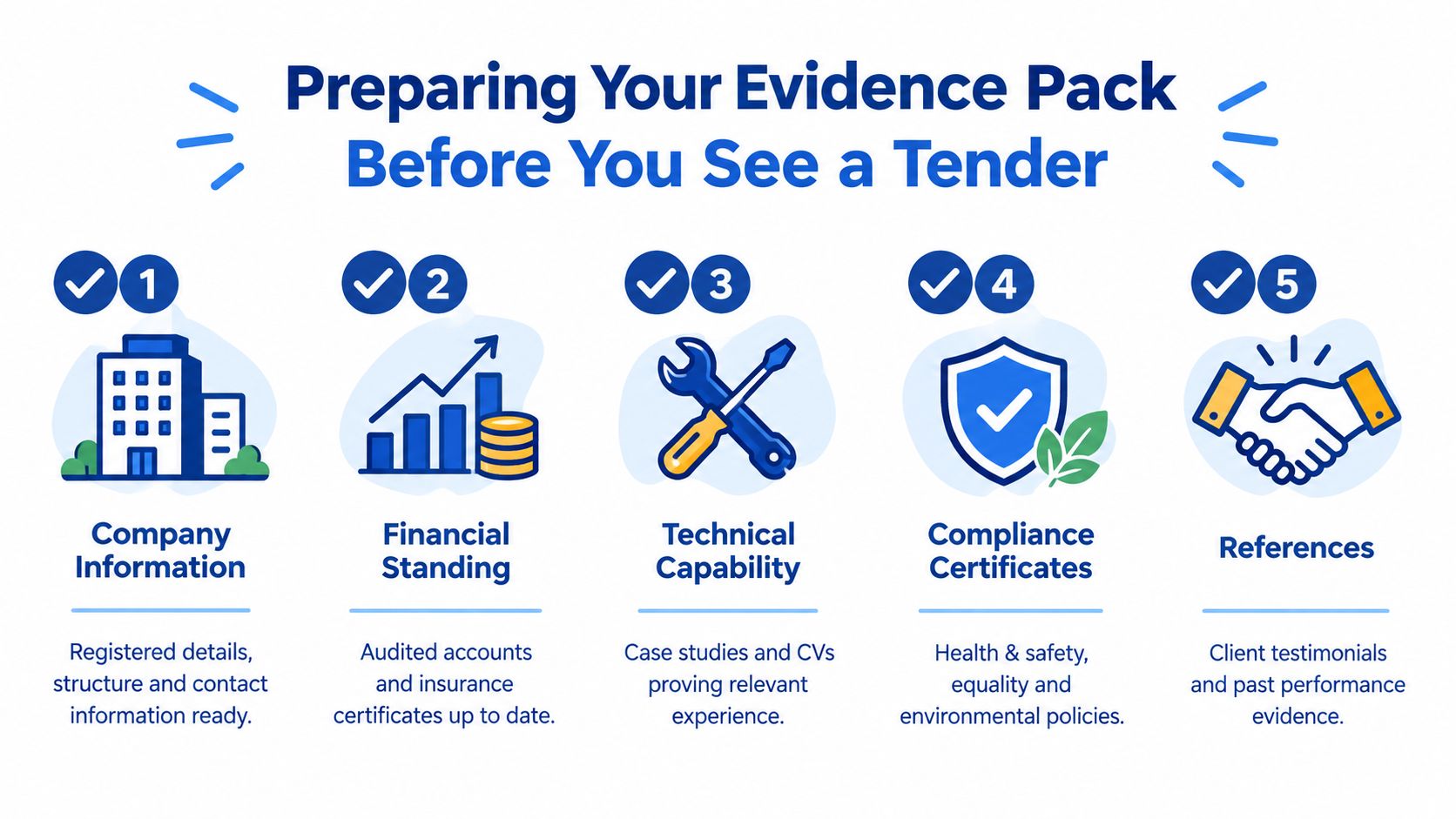
Use five folders or database categories. The exact portal layout may change, but the underlying evidence is broadly familiar.
Company information: Keep registered details, ownership and organisational structure, trading names, contact details and responsible officers together. Record the approved wording for your business description so one bid doesn't call the company a specialist contractor while another calls it a general supplier.
Financial standing: Maintain the relevant accounts, financial declarations, insurance certificates and any buyer-approved explanation of your financial position. Finance should own this section. Bid teams shouldn't guess whether a certificate or account is acceptable.
Technical capability: Store staff CVs, qualifications, technical procedures, equipment information and delivery arrangements. Link each item to the service or work package it proves.
Compliance and exclusions: Keep health and safety, equality, environmental, modern slavery, information governance and related policies with their approval records. Track declarations carefully. A policy title alone rarely demonstrates how your business applies it.
Experience and references: Prepare concise project records covering client type, scope, your role, delivery evidence and outcomes that can be disclosed. If confidentiality limits the client name, agree an acceptable description before the next opportunity.
Control the pack like an operational system
Nominate an owner for every category. Use file names that show the document purpose and status, and archive superseded versions instead of overwriting them. A bid manager should be able to tell which document was approved for submission and who authorised it.
Refresh evidence on a defined cycle suited to the document. Some items need attention when circumstances change, while others have a stated expiry or review date. The important point is not a universal calendar. It's that your team knows what must be checked before submission.
Use the Bidwell PQQ use case to connect this evidence discipline with response drafting. Bidwell's model is built around a shared knowledge base, so approved answers and supporting material can be reused without copying an entire old submission and hoping nothing stale survives.
Practical rule: Never treat a previous bid as the master record. Treat it as a version of your position at that point in time.
Before an SQ reaches the final approver, compare the draft against the pack. Check company names, staff roles, financial wording, certification status and project descriptions. Contradictions create doubt even where the underlying capability is sound.
How Evaluators Score Your Selection Questionnaire
Evaluators do not read a selection questionnaire like a sales brochure. They first check whether the submission is complete, admissible and compliant with the instructions. Only then do they apply the published criteria, thresholds and scoring method.
A Contracts Finder example demonstrates how quickly a submission can leave the process. Bidders had to meet the stated pre-qualification scoring criteria to progress to the ITT stage, while late submissions were not considered. The official questionnaire attachment shows why administration matters. If the response fails at the gateway, technical capability may never be assessed.
Separate gateway checks from scored judgement
Some questions are pass or fail. They can cover exclusion grounds, mandatory certifications, financial requirements, insurance, capacity or the required submission format. A persuasive paragraph cannot compensate for a failed mandatory condition.
Other questions use thresholds or a published scoring method. The buyer may assess relevant experience, delivery capacity or technical competence against defined requirements. Answer the criterion that appears on the questionnaire, not the one you expected to see.
There is no universal weighting model for every UK public contract. Each buyer sets its own criteria, and the tender documents control the assessment. A generic table of “typical” percentages would therefore mislead. Use the published schedule and record the method beside each question:
| Criteria category | Weighting | Assessment method |
|---|---|---|
| Exclusion grounds | As stated in the procurement documents | Mandatory or discretionary declaration checks |
| Financial standing | As stated in the procurement documents | Accounts, ratios, turnover requirements or other stated tests |
| Technical capacity | As stated in the procurement documents | Evidence against the buyer's capability criteria |
| Relevant experience | As stated in the procurement documents | Project examples, references and past performance |
| Compliance information | As stated in the procurement documents | Policy, certification and declaration review |
Read the scoring notes literally
Verbs such as demonstrate, provide, confirm, describe and evidence indicate what the evaluator must find. Treat them as instructions, not stylistic suggestions.
“We have extensive experience” is a claim, not proof. A named project, defined scope, clear responsibility and supporting material give the evaluator something to assess. Keep the response proportionate, but make each sentence serve the criterion.
Timing can affect the process too. Cabinet Office guidance says central government bodies shouldn't use a PQQ or similar pre-tender selection process for goods or services below the relevant EU or UK procurement threshold. The Cabinet Office guidance on PQQ use reinforces the need to check the procurement route and stage before assuming a questionnaire applies.
Writing Responses That Hit the Marking Criteria
Strong selection answers don't sound impressive by accident. They make it easy for an evaluator to locate the required proof.
Start by copying the criterion into your working document. Break it into evidence points, then answer each point in the same order. A useful structure is position, evidence, application. State what you can do, show where you've done it, and explain how that experience applies to this requirement.

Replace claims with proof
Weak wording often sounds like this:
“We're an experienced and reliable provider with a strong team and excellent customer service.”
It contains several claims and no usable evidence. A tighter response would identify the relevant service, your delivery role, the controls you use and the evidence available to support the statement.
“Our delivery team provides planned maintenance services for public buildings. The contract lead manages mobilisation, scheduling and escalation, while qualified engineers complete work under our approved procedures. We can provide the relevant project record, team CVs and service documentation requested by the authority.”
That example is still only a model. Replace every general phrase with your own verified facts. Don't add a client name, outcome or certification unless you can substantiate it.
Match the question, not your company brochure
If the question asks about methodology, don't spend the answer describing your founding story. If it asks about financial standing, don't list awards. If it asks for relevant experience, don't paste a generic capabilities statement.
Use a simple quality check:
- Requirement: What exactly must be demonstrated?
- Evidence: Which approved document, project or person proves it?
- Relevance: Why does that proof fit this opportunity?
- Clarity: Can an evaluator understand it without decoding internal jargon?
Accreditations can support an answer, but they're rarely the answer by themselves. Explain the operational control behind the accreditation and connect it to the contract requirement.
For case studies, protect confidentiality by agreeing a permitted description with the client or your legal lead. You can still explain your role, scope and delivery approach without disclosing restricted commercial information.
Finish with a compliance pass. Check word limits, file formats, mandatory attachments, signatures, portal fields and naming conventions. AI response generation can produce a useful first draft from your knowledge base, but a named reviewer must confirm every factual statement before submission.
Building a Reusable Workflow with Tender Monitoring and AI
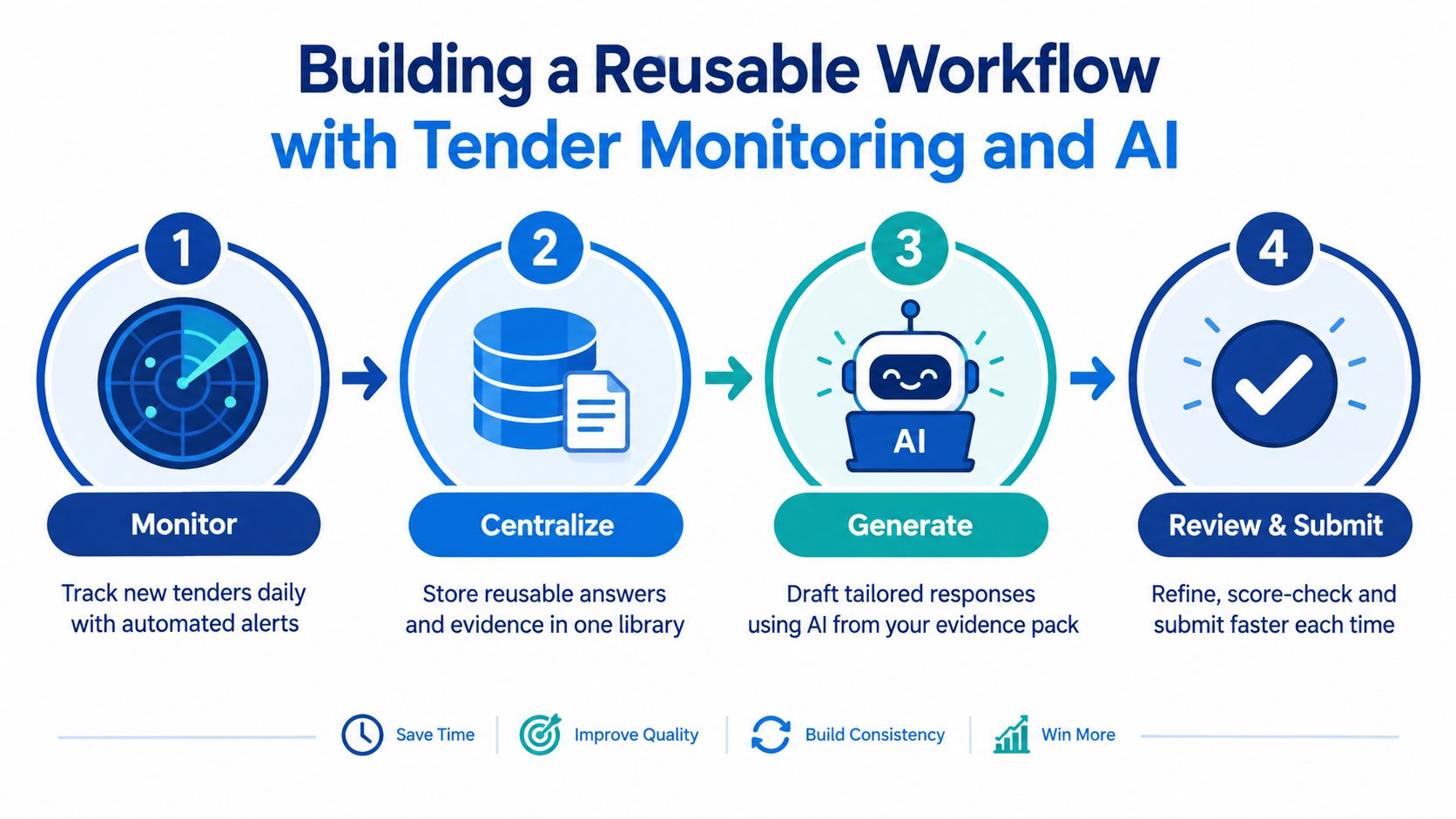
Writing each PQQ or SQ from a blank page is a poor use of an SME's limited bid capacity. The better workflow begins before the notice appears and keeps the evidence, drafting and review stages connected.
Monitor opportunities before the deadline becomes urgent
Set tender monitoring around your actual capability, geography, buyer types and contract categories. Bidwell monitors major UK portals including Find a Tender, Contracts Finder, Public Contracts Scotland and Sell2Wales, delivering daily alerts with AI-generated summaries of relevant opportunities.
The alert should trigger a short qualification decision, not an automatic writing exercise. Confirm the scope, eligibility, likely delivery capacity, key dates and whether the selection requirements are supportable from your evidence pack.
Build a knowledge base that people can trust
Store approved company answers, project records, CVs, policies, certificates, insurance information and previous responses in a structured library. Add tags for service, sector, buyer requirement, evidence owner and review status.
The knowledge base shouldn't become a dumping ground. Separate approved content from draft material, flag confidential content and remove obsolete claims from active retrieval. A response library works only when the team knows which version can be used.
AI response generation is most useful here as a drafting assistant. It can assemble a response from approved evidence, but it can't take responsibility for accuracy, eligibility or a declaration made by a director.
A workflow automation provider such as business workflow automation can help businesses connect alerts, approvals and document tasks, provided the process still includes human ownership and review.
Review the draft against the buyer's rules
Use a two-pass review. The first pass checks factual accuracy and evidence. The second checks the scoring criteria, instructions, limits and submission mechanics.
Bidwell can support this connected process through its tender response guides, alongside the company's own governance. The point isn't to remove bid management judgement. It's to stop skilled people spending their time retyping information the business has already approved.
Review before release: AI can draft from your evidence pack. It can't verify a certificate, approve a declaration or decide whether your business should bid.
Construction Sector Specifics and the Common Assessment Standard
Construction SMEs face an extra layer of terminology. A buyer may still ask for a PQQ, but the recognised route may be the Common Assessment Standard, particularly where the opportunity falls within the construction procurement context.
Constructionline identifies CAS as the preferred method for public-sector pre-qualification on projects exceeding £5.337 million. That threshold is a practical signal for bid teams, but it doesn't remove the need to read the buyer's instructions or check whether a separate SQ or portal declaration is also required. See the Constructionline guidance on the Common Assessment Standard for the stated application.
A practical construction example
A small design-and-build contractor receives a public-sector opportunity described as requiring pre-qualification. The bid manager checks the procurement documents rather than uploading an old generic PQQ. The opportunity calls for CAS evidence, and the contractor reviews its certification, project examples, health and safety information, insurance and building safety material.
The 2025 CAS update made the Building Safety section mandatory for design and build work, while industry guidance says PAS 91 was withdrawn and CAS is the preferred method under PPN 03/24. That makes omissions around building safety more consequential for firms that design, manage or deliver relevant work, including smaller subcontractors whose evidence feeds into the main contractor's submission. The construction guidance on the move from PQQ to CAS provides useful context on the practical shift.
Keep one controlled evidence pack, then map it to CAS, SQ or buyer-specific fields. Don't submit conflicting descriptions of your competence across portals. Bidwell's construction tender opportunities can sit alongside that process, helping your team identify relevant work while the knowledge base keeps supporting evidence organised.
Visit Bidwell to monitor UK tender portals, organise your reusable qualification evidence and generate reviewed first drafts for SQ, PQQ-labelled and tender responses. Set up the evidence pack once, then give your bid team a controlled starting point for each opportunity.