206,280 tenders and 230,645 documents sit in the Find a Tender dataset, while Contracts Finder holds 594,095 tenders and 1,179,441 documents. That's why how to prepare tender documents is usually a 20 to 40 hour job when you do it manually, but only a 2 to 4 hour review cycle when you've got the right workflow in place.
Tender writing isn't slow because people can't write. It's slow because the work is really about collecting evidence, matching the buyer's format, and proving you've read the rules properly. If you treat it like a blank-page writing exercise, you'll keep burning time on rewrites.
Why Tender Preparation Takes So Long (And How to Fix It)
A lot of teams lose time because the work is split across too many files, too many owners, and too many last-minute checks. The 1,179,441 documents behind Contracts Finder's 594,095 tenders are mostly annexes, certificates, and forms, not long narrative answers, which is why evidence assembly eats the hours. Government dataset on tender documents
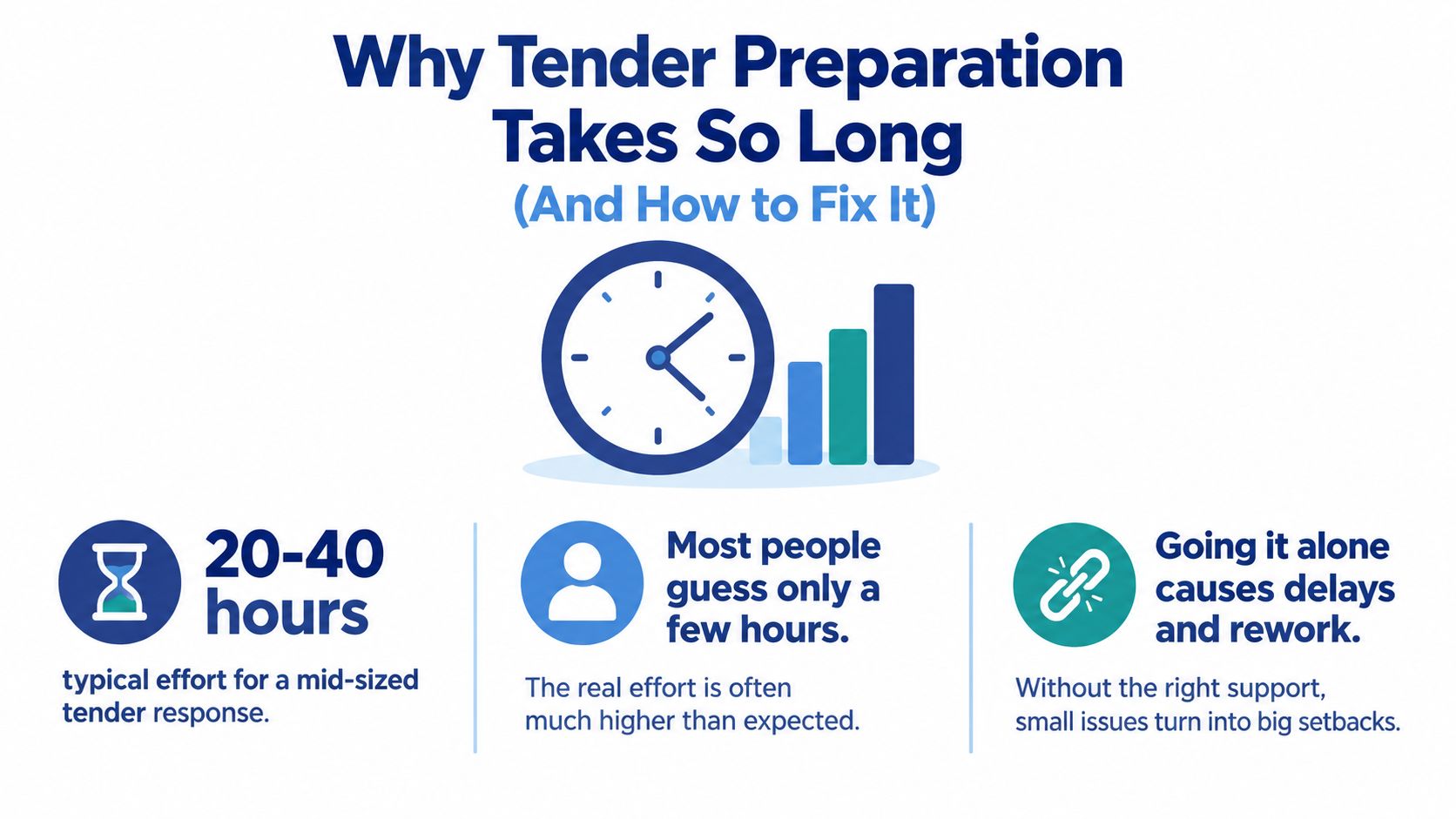
Where the hours are really spent
First, someone reads the ITT, the specification, the pricing schedule, the attachments, and the portal instructions. Then they cross-check the lotting, the pass or fail questions, the method statement format, and the submission rules. Only after that do they find what is missing, and that is where rework starts.
The fix is not faster typing. It is stopping the habit of starting from zero on every bid. A weekly B2B newsletter service for consulting firms works on the same principle as tender preparation, build a reusable content library once, then assemble from it each week instead of drafting from a blank page.
What changed under the new procurement setup
The central digital platform under the Procurement Act 2023 pushes more notice-led compliance. Government guidance says contracting authorities publish procurement information there in a structured, machine-readable way, so the response process has to match a tighter publication model rather than a loose attachment dump. Central digital platform factsheet
Practical rule: treat tender preparation as evidence assembly first, writing second.
That shift changes how Bidwell fits into the process. If you keep the tender monitoring and knowledge base organised, you are not scrambling through old folders on deadline day. You are pulling from a reusable evidence set, then letting AI response generation draft against the buyer's structure.
Starting Your Tender Preparation Process
The first move is not drafting. It's understanding exactly what the buyer is asking for, what they'll score, and what they'll reject without reading further. That sounds obvious, but it's where many bids fail, because teams answer the question they wanted instead of the one that was set.
The Crown Commercial guidance is clear that UK tender documents should be drafted as a tightly structured response pack, with timetables and roles agreed early, technical experts involved early, objectives broken into parts, and the specification arranged in a logical flow with clear headings, sub-headings, and defined terms. Crown Commercial guide
Read before you write
Start with the ITT, the specification, the pricing schedule, and every annex. Build a simple checklist with three columns, what's required, who owns it, and whether it's already in your knowledge base. If a question looks vague, assume it'll be scored against hidden expectations and raise a clarification early.
A good habit is to break the tender into component parts before anyone starts drafting. That means separating technical response, commercial response, policies, certificates, and mandatory forms. It's slower for half an hour, but it saves hours later when people aren't tripping over each other.
Set roles and capture reusable material
Assign a single owner for each section, even if specialists are helping. One person should control the master version, otherwise you'll end up with duplicated answers and conflicting wording. Use your knowledge base to store company credentials, team CVs, accreditations, policies, and older responses so the same proof doesn't need to be rebuilt every time.
If you want a practical reference point for building that process around opportunity tracking and response preparation, Bidwell's tender use cases page is worth a look. The point isn't the tool itself, it's the discipline: monitor opportunities, collect evidence once, and reuse it properly.
Useful habit: create the checklist before the first draft, not after it.
MarTech Do's RFP approach is a decent reminder that proposal work gets cleaner when the team defines ownership, structure, and response logic before writing begins. That's the step many overlook when they're under pressure.
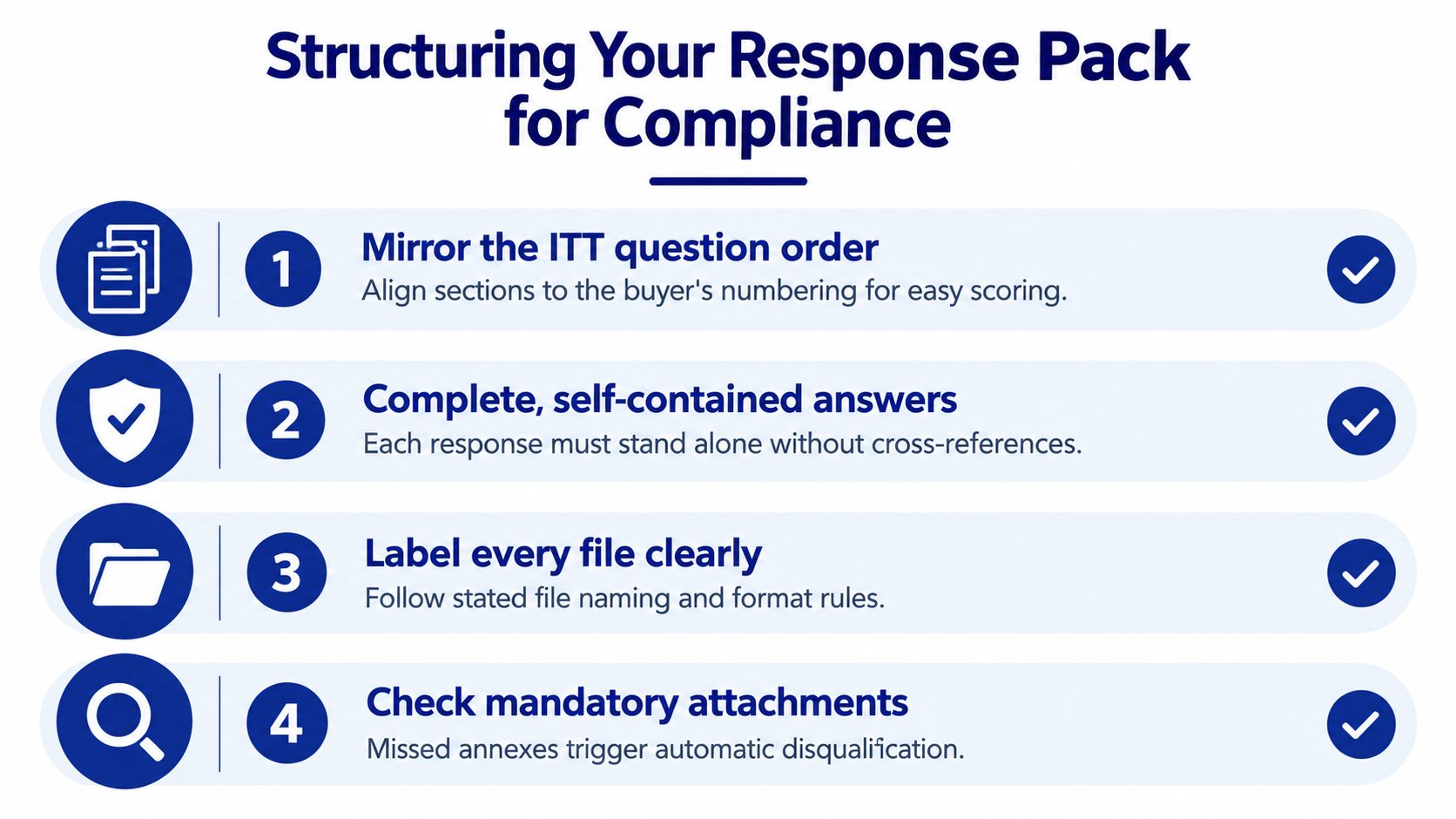
Structuring Your Response Pack for Compliance
A tender can fail on presentation even when the underlying answer is sound. If the buyer expects the response pack to follow a fixed structure, your job is to match that structure exactly and make every answer easy to score.
Many UK tender instructions require complete, self-contained answers in the buyer's template, often in method-statement form. One recent Find a Tender attachment also asked for minimum 11-point font, strict word counts, English language responses, and no reliance on cross-references. Find a Tender attachment guidance
Mirror the buyer's order
Use the buyer's question order unless the instructions say otherwise. Evaluators usually score line by line, so making them hunt for the answer works against you. If question 3 asks about mobilisation, put mobilisation there, not under a generic company overview.
A clean response pack usually follows a simple pattern, one heading per question, a short opening that answers the point, then evidence, then a close that links back to the requirement. A weak pack wanders, repeats the question, and leaves the scorer to do the sorting.
Keep each answer self-contained
Cross-references create friction because they force the evaluator to jump across the document set. “See appendix B” may be allowed in some bids, but it often slows review and can lose marks if the core proof is missing from the main answer. Put the important evidence in the answer itself, then use the appendix as support.
That matters even more if the portal strips formatting or the submission is exported for offline scoring. Each answer should still read clearly on its own.
Make file handling boring
Label documents clearly, follow the file type rules, and do not change the ITT unless the buyer allows it. If the instruction pack asks for signed and dated returns, submit signed and dated returns. If it asks for Excel pricing schedules, do not paste them into a PDF and hope the reviewer accepts it.
For a practical parallel on controlled document handling, Cyndra's compliance automation guide is useful reading. The point is straightforward, compliance errors usually start when teams treat admin as an afterthought.
What works: direct answers, clean headings, and proof inside the section.
What fails: long introductions, buried evidence, and loose file naming.
Manual Preparation Versus AI-Assisted Workflows
Manual tender writing still works, but it wastes time in the wrong places. Every bid starts to feel like a new project, even when the proof should already exist in the business. Teams end up re-searching shared drives, old inboxes, and previous submissions just to rebuild the same evidence pack.
I worked with one team that spent four hours hunting for a signed ISO certificate because nobody owned the evidence library. The document was already in the previous bid, but no one could say which folder held the final version. That is the manual risk, not writing itself, but losing control of the material that supports the answer.
The shift under the Procurement Act 2023 makes this more obvious. Tender preparation is moving toward notice-led compliance, so the job is less about crafting fresh prose and more about assembling the right structure, the right evidence, and the right follow-up updates. A clean response still matters, but the scorer also needs to see that your pack is organised and traceable.
Manual versus AI-assisted tender preparation
| Aspect | Manual Approach | AI-Assisted Approach |
|---|---|---|
| Source material | Searched from old folders and inboxes | Pulled from a knowledge base of credentials, policies, and past answers |
| First draft | Written from scratch each time | Generated from existing approved content |
| Turnaround | Slow and repetitive | Faster drafting, then human review |
| Consistency | Wording drifts between bids | More consistent tone and structure |
| Risk point | Missing evidence and forgotten updates | Over-trusting the draft without checking scoring fit |
Bidwell's bid writing software fits that model because it can pull stored material into draft responses against the tender questions. The gain is not speed on its own. It gives the team a better starting point, provided someone still checks the evidence and updates the content before submission.
Where humans still matter
AI will not rescue a weak answer if the evidence is thin or the response misses the scoring matrix. Someone still has to check whether the draft answers the buyer's question, whether the tone sounds like your organisation, and whether the claims are properly supported. That review step is where the work becomes real.
Let the system handle the first pass, then use a bidder with subject knowledge to tighten the claim and remove anything that cannot be evidenced. The tool should arrange, reuse, and rephrase what you can already prove. It should not invent capability to fill a gap in the pack.
Senior-bidder rule: AI should draft the answer, not decide the claim.
Review, Scoring Alignment, and Final Submission
A tidy draft can still fail if the final pack doesn't line up with the scoring method. The last review is where you make sure every answer maps back to the evaluation criteria, every attachment is present, and every commercial field matches the instructions. That's not glamorous work, but it's the work that protects the bid.
UK public procurement rules say contracts must be awarded on the basis of the most economically advantageous tender, which can be assessed using price or cost, including life-cycle costing, plus the best price-quality ratio with qualitative, environmental or social criteria linked to the contract. Public procurement award rules
Check the scoring path
Go question by question and ask one thing, where will the marks come from? If the answer is experience, put experience first. If the answer is methodology, make the method easy to follow. If the buyer wants social value, don't leave it as a vague promise.
Bidwell for bid managers can help as a workflow layer, because the core problem is rarely drafting alone. It's keeping review, compliance, and version control under control long enough to submit cleanly.
Final submission mistakes to catch
- Wrong file type: if the portal wants Excel, upload Excel.
- Missing signature: check every form that needs signing and dating.
- Pricing mismatch: make sure Sterling pricing and VAT treatment match the instructions.
- Portal rejection: leave time for upload and receipt confirmation, not just for writing.
- Missing annexes: if they're mandatory, a missing attachment can sink the bid.
For a lot of teams, the hardest part is not the writing but the final hygiene. Portals are unforgiving, and a tidy narrative won't fix a late or incomplete upload.
Final check: if the submission rules say no cross-references, no altered templates, and no late files, follow that literally.
Your Tender Preparation Process at a Glance
Tender preparation works best when it's treated as a sequence, not a scramble. You receive the ITT, read it properly, build a compliance matrix, assign owners, draft against the buyer's structure, review against the scoring model, then submit early enough to survive any portal issue. That's the process, and it gets easier when your evidence is already organised.
The new procurement environment makes that discipline even more important. Find a Tender now acts as the central digital platform, and the notice-led model means the buyer's publication route and your document discipline matter more than ever. Find a Tender platform factsheet
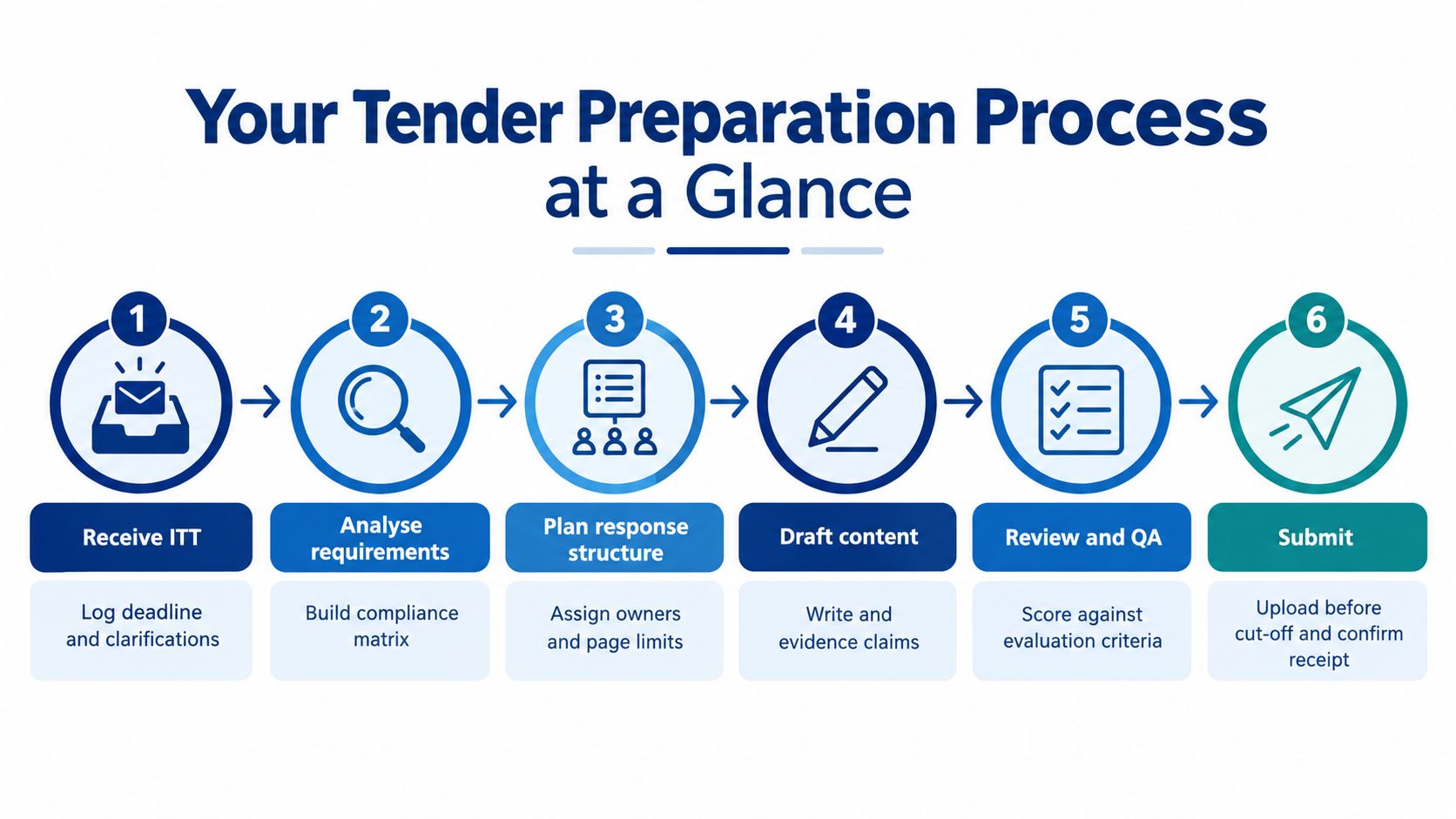
The working sequence
- Receive the ITT. Log the deadline and the clarification window straight away.
- Analyse requirements. Build the checklist and confirm what's mandatory.
- Plan response structure. Assign owners, page limits, and evidence sources.
- Draft content. Write from the knowledge base, not from memory.
- Review and QA. Check scoring alignment, formatting, and attachments.
- Submit. Upload early and confirm receipt.
The main lesson is simple. Better tender writing is less about flair and more about control. If your team can find the right evidence quickly, answer in the buyer's order, and avoid formatting mistakes, you'll spend less time firefighting and more time winning work.
If you want a cleaner way to manage that process, use Bidwell to monitor opportunities, centralise your knowledge base, and draft responses from approved material. It's a practical fit for teams that need to handle tender preparation with less rework and more control.