
In 2023/24, 37% of UK Ministry of Defence Core Department spending went to organisations that followed a competitive bidding process. For suppliers, the decision is not just whether to bid. It is whether the contract, deadlines and likely competition justify the hours required.
Start with the notice and its timetable. Record the clarification deadline, submission deadline and any stated decision or award date. Missing a deadline can rule out an otherwise strong bid, while a low number of bidders or the eventual award notice can help shape your next decision. A bid is only one stage in a longer process.
What Competitive Tendering Means in Practice
Picture a council that needs a roof replaced. It writes down what the roof must do, asks three builders to price it and explain their method, then records why it chose one over the others. Competitive tendering is that exercise with the paperwork published, so anyone can check how the scores were reached.
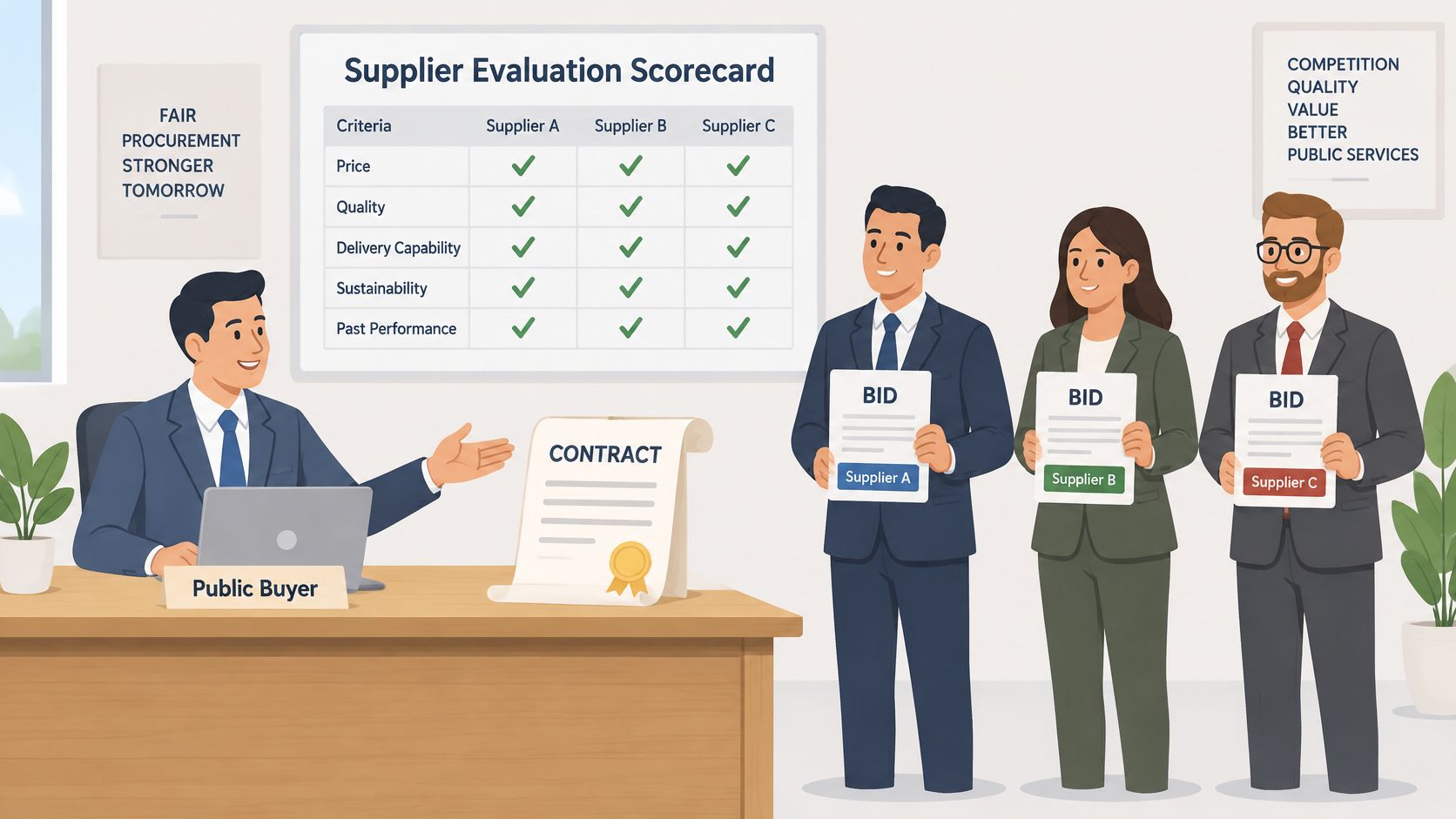
The alternative is a direct award, where the buyer approaches one supplier and no contest happens. Direct awards still exist, but the Procurement Act 2023 came into force on 24 February 2025 and makes open competition the default for most contracts. The Open Contracting Partnership's review of the Act's first year shows behaviour moving with the rules: direct procedures fell from about 53% of procedures in March 2025 to 34% by February 2026, while open tenders rose from 27% to 41% over the same period.
Scale is easy to underestimate. The Ministry of Defence's 2024 trade, industry and contracts statistics record that in 2023/24, 37% of Core Department spending went to organisations following a competitive bidding process. Central government isn't one market either. A Public Accounts Committee report cites a National Audit Office analysis of around 16,000 contracts awarded in 2021-22: 63% were competed to some extent, and those competed contracts carried 61% of recorded value, roughly £61 billion of £100 billion.
That gap between contract count and contract value is the pattern worth holding on to. Competition covers most procurements, but it doesn't cover the biggest ones evenly.
The test I apply to any opportunity is short. Is it openly advertised? Does it name the criteria and the weightings? Does it set a deadline? Three yeses mean it's a competitive tender and the rules apply. Tender monitoring is how those notices reach you on publication day rather than the week before the deadline, and Bidwell watches every UK tender portal to flag the ones matching your sector, CPV codes, region and contract value.
Tender Timeline, Stages and Deadlines
Seven things happen between a notice appearing and a service going live, and most bid losses are set up in the first two. Part 3 of the Procurement Act 2023 requires a contracting authority to run a competitive tendering procedure before awarding a public contract under section 19, and the procedure must follow the published notice and its documents. Treat the notice as the instruction manual, not the covering email.
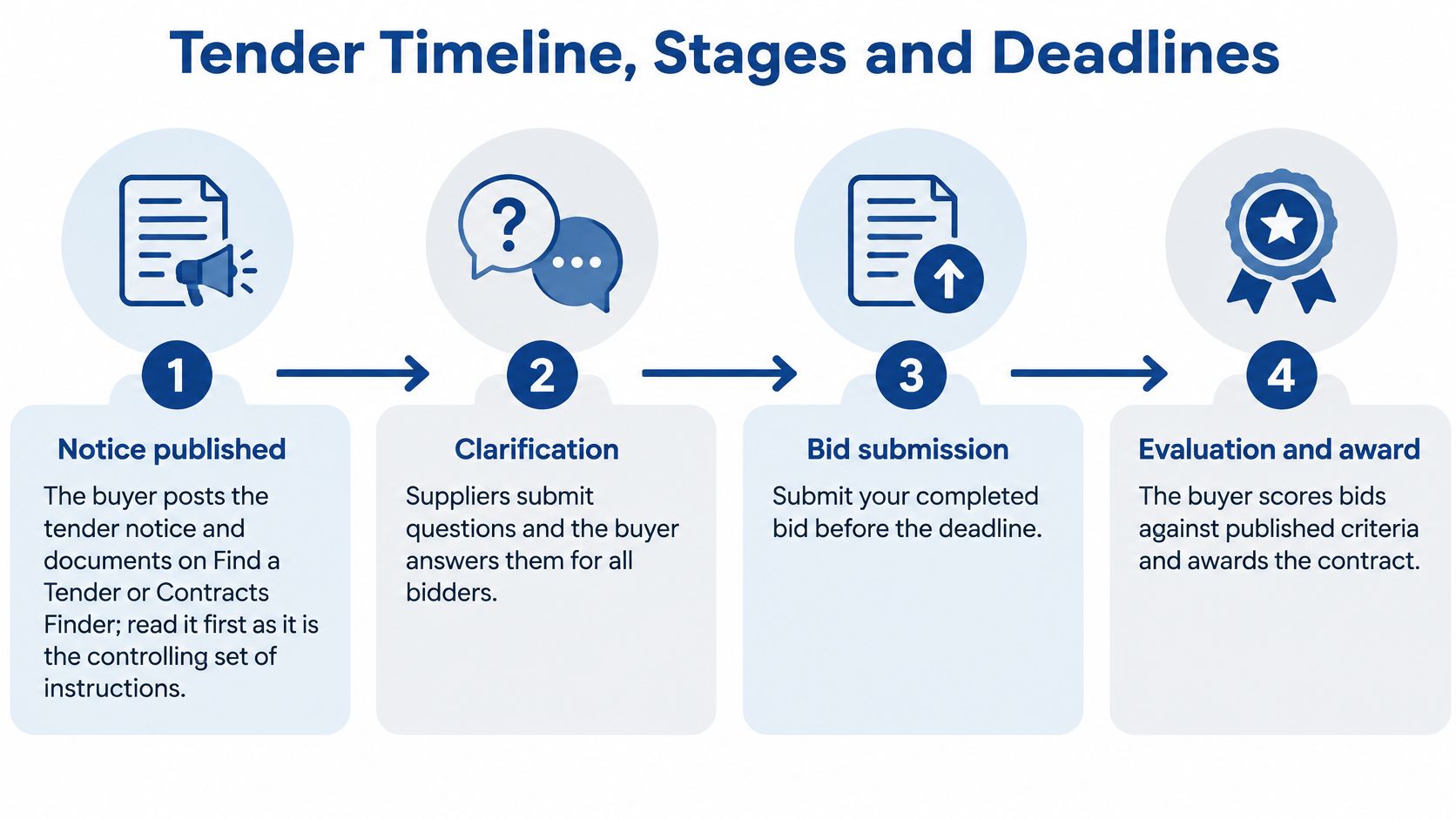
1. Notice published. The buyer posts the tender notice and documents on Find a Tender or Contracts Finder. Read all of it, including the evaluation schedule and the contract terms you'd be signing. The Act also allows a competitive flexible procedure, where the buyer designs stages such as shortlisting, negotiation or dialogue, so the first notice tells you whether you're in for a straight tender or a longer conversation.
2. Clarification. Questions and answers go to every bidder, so one good question can shift the requirement for the whole field. Missing the clarification cut-off is one of the quiet ways suppliers lose. The deadline doesn't move because you were busy.
3. Submission. Late bids are normally rejected, and portals are unreliable at 11:58 on deadline day. Submit a day early with the documents locked and the file formats checked against the notice.
4. Evaluation. Evaluators score independently against the published criteria and weightings, then moderate. A verbal assurance from anyone involved means nothing here. Only what's in your submission counts.
5. Award notice. The buyer publishes the outcome and names the winner. Track it even when you lose, because the notice tells you what the buyer valued and who delivered it.
6. Standstill. The buyer must wait at least eight working days from publication of the contract award notice before entering into the contract, according to the guidance on contract award notices and standstill. That window is when you request feedback or consider a challenge. It applies to all public contracts except those listed in section 51(3).
7. Contract and mobilisation. Signature, then delivery, insurance, reporting and service credits. A rushed mobilisation is where a well-scored bid turns into a loss-making contract.
Practical rule: diary four dates the day you read a notice. Clarification cut-off, submission deadline, expected award, end of standstill. Everything else is writing.
Minimum periods that set your calendar
The Act sets floors, not targets. The guidance on time periods lists the minimum tendering period by route:
| Scenario | Minimum period | Notes |
|---|---|---|
| Electronic tender, all documents issued with the notice | 25 days | Standard minimum for electronic tenders |
| Electronic tender, some documents issued later | 30 days | Applies when associated documents are not supplied with the notice |
| Non-electronic tender, all documents available immediately | 30 days | Less common route |
| Non-electronic tender, documents not all available | 35 days | Longest standard period |
| Qualifying planned procurement notice, urgent, dynamic-market or pre-selected competitions | 10 days | Reduced period in exceptional cases |
| Standstill after contract award notice | 8 working days | Starts on the day the award notice is published, before the contract is entered into |
Four exceptions cut the clock to 10 days: a qualifying planned procurement notice, certain urgent procurements, dynamic-market awards, and competitions limited to pre-selected suppliers. Ten days is not enough time to build a case study library, which is why that work belongs ahead of the notice, not inside it.
Set four reminders the day you read the notice, then decide at stage one whether you're bidding at all. Writing before that decision is how teams spend 30 hours on a tender they were never going to win.
Selection questionnaires run on the same clock. Our PQQ use cases guide covers the evidence to gather before the deadline, and a maintained knowledge base means you're assembling approved answers instead of starting from a blank page.
The Principles Every Competitive Tender Follows
The published award criteria set the rules for scoring. A polished bid can still lose if it does not answer those criteria directly.
The Cabinet Office's SME and VCSE public procurement bid pack says award criteria must relate to the contract and be clear, measurable, specific and proportionate to its nature, complexity and cost. Buyers score against the published criteria, not a general impression of your business. Support claims with evidence that addresses the requirement.
What most advantageous tender means
The Most Advantageous Tender lets a buyer balance price or cost against quality and relevant social, economic or environmental factors. Lowest price alone can still be used, but it may be a poor fit for services where delivery risk matters. A 100% price evaluation should prompt a close look at the contract and its delivery requirements.
How weightings turn into writing decisions
A 60/40 quality-price split gives quality more marks, so allocate more writing and review time to the scored quality answers. A 40% mobilisation question deserves more attention than a 5% narrative section. Equal treatment and transparency mean the buyer must apply the published model consistently.
For each scored question, identify the delivery method, a measurable performance indicator, a risk control and a relevant case study. Answer the question in your first sentence. Then use those details to show how you will deliver.
Bidwell drafts each response against the actual tender notice rather than a generic template, so the questions and published criteria in that notice shape the draft from the start.
If you are evaluating suppliers, the AnyBPO vendor evaluation guide explains how to score them against criteria published in advance. The same discipline applies when you prepare your own bid.
Single-Bid Tenders and Other Real-World Patterns
The National Audit Office's analysis of competition in public procurement found that 23% of 235 large contracts published on Find a Tender between January 2021 and January 2023 received only one bid. Those contracts were worth £4 billion, or 14% of the £29 billion examined.
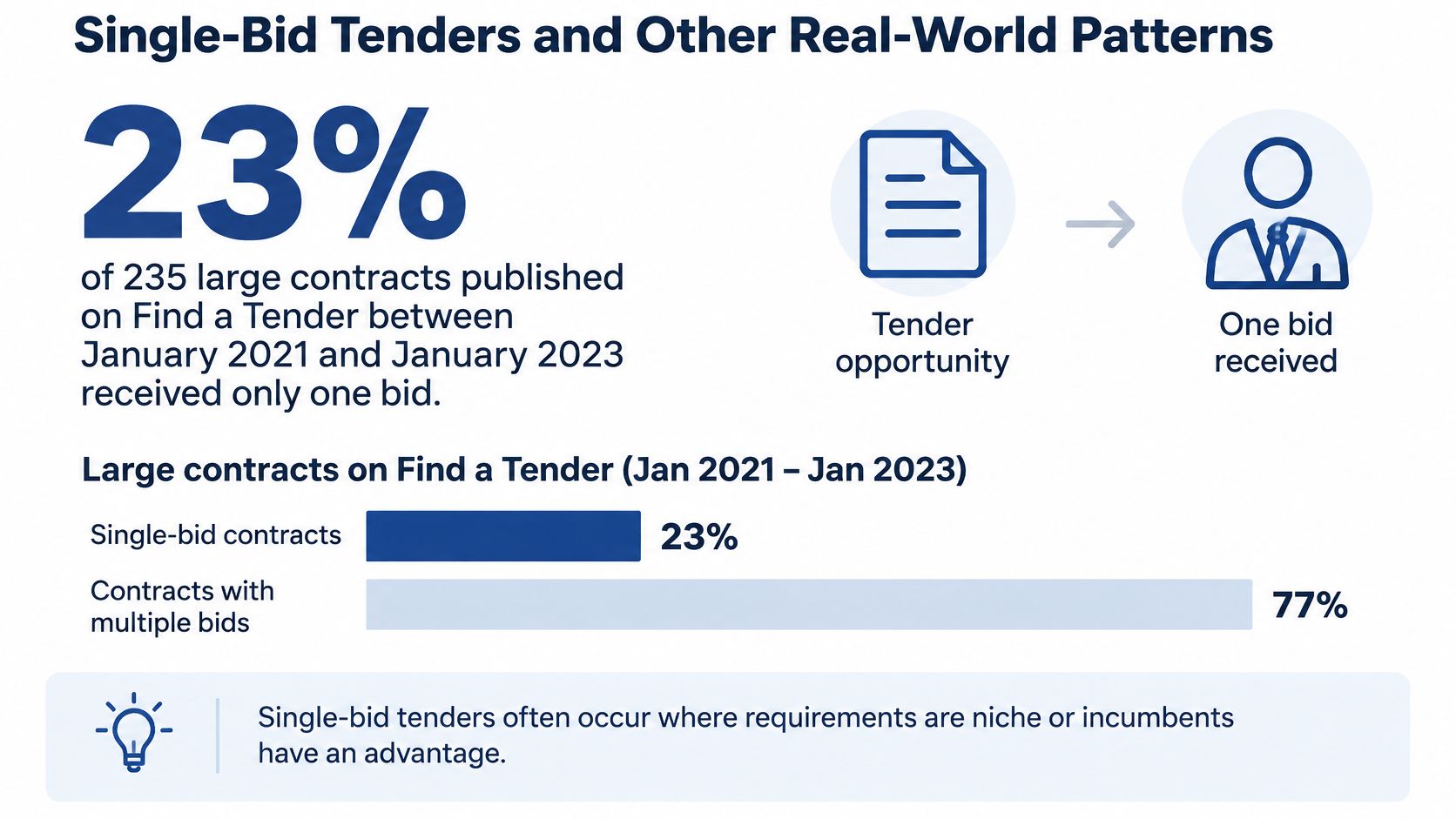
A quiet field can look attractive, but low bidder numbers do not prove that a contract is winnable. Even when buyers used a competitive procedure, 11% of contracts drew one bid. For open competitions specifically, the rate was 20%.
| Measure | Single-bid share | Detail |
|---|---|---|
| All large contracts examined (235 contracts) | 23% | £4 billion of £29 billion total value (14%) |
| Contracts using a competitive procedure | 11% | Single bid even where competition was run |
| Open competitions specifically | 20% | Single-bid rate for open competitions, up from 11% for competitive procedures overall |
Reading a single-bid notice
A single bid may reflect limited rivalry, or a requirement that suits one supplier, an unworkable specification or unattractive contract terms. Check the commercial shape of the opportunity before treating a thin field as an advantage.
- Lots and scope: A national lot requiring local delivery can exclude suppliers without regional coverage.
- Financial standing: Turnover thresholds and insurance requirements can rule out a supplier before its quality response is assessed.
- Contract length and payment terms: Long commitments and slow payment can strain a smaller supplier's cash flow.
- Selection questions and incumbent advantage: Questions that closely match the current provider's operating model can put new bidders at a disadvantage.
The Cabinet Office and HM Treasury SME action plan for 2025 to 2028 identifies recurring barriers for smaller suppliers, including poor opportunity visibility, weak procurement data, limited supplier engagement and sparse feedback on future requirements. Departmental SME targets do not guarantee more small businesses will win prime contracts.
Before you commit: identify evidence that the competition is structurally winnable. If the case rests only on a low bidder count, spend your bid hours elsewhere.
Consider a facilities contract split into three regional lots, with a national helpdesk required for each. That requirement may deter local suppliers. A clarification question can test whether the buyer will accept the helpdesk as a separately priced service. The answer can change your decision to bid. For contracts called off through frameworks, the guide to public sector frameworks explains how awards and call-offs work.
A useful notice alert helps you spot opportunities early enough to assess scope, mandatory requirements and delivery capacity before writing begins. Ruling out a poor fit quickly protects time for bids you can deliver.
How to Prepare a Bid That Scores Well
Weak bids usually fail on structure rather than effort. The content is there, buried in the wrong place, with the answer to the question arriving in paragraph four.

The checklist in working order
1. Map every scored question to its weighting before writing. Ten minutes with a spreadsheet tells you where the marks are. A 30% question earns six times the writing time of a 5% one.
2. Build one knowledge base. Approved credentials, policies, case studies and past answers, written once and reused. This is the single biggest time saver in bid work, and it's what makes a short deadline survivable.
3. Answer the exact question in the first sentence. If the question asks how you'll mobilise in 20 days, say how, then explain. Evaluators score against a marker scheme, not against your narrative flow.
4. Back each claim with something checkable. A named contract, a figure, a certificate, an audited process. General assurance of commitment reads as filler.
5. Check the draft against the notice line by line. Mandatory requirements, page limits, file naming, named personnel, certificates, appendices. A strong answer in a non-compliant submission scores nothing.
6. Review the high-weight answers twice. Then have someone outside the bid team read them cold and tell you what's missing. Fresh eyes find the gaps the author can't see.
Price is part of the same map
After the weighting check, confirm how price is scored against quality. A 40% price weighting carries as many marks as a 40% quality answer, so a cost model built quickly to match the notice's scope can undo a strong technical submission. Build the model from the specification, not from last year's contract, and make sure the number survives scrutiny when the buyer compares it with the rest of the field.
Where drafting tools actually save time
Bidwell drafts each new bid against the actual tender notice rather than a generic template. In the Draft stage, a blank tender or PQQ is dropped in, every question is extracted and matched to the knowledge base, and answers are drafted in your voice with citations you can check. A 20 to 40 hour writing task becomes a 2 to 4 hour review when the knowledge base is well kept.
You still own review, pricing and submission. That's the part that decides the outcome. The bid writing software workflow keeps the notice, the evidence and the draft in one place so nothing gets lost between versions.
If you also commission web or digital work, apply the same scoring discipline when you're comparing web development vendor proposals. Decide the criteria before you read the pitches, and the weaker ones eliminate themselves.
Set Up Tender Monitoring Before Your Next Bid
A tender deadline can arrive before you have time to build a sound response. Set up monitoring before the next opportunity appears, so you can assess notices as they are published rather than relying on forwarded links or a last-minute search.
Track notices across Find a Tender, Contracts Finder, Public Contracts Scotland, Sell2Wales and eTendersNI. Filter by CPV code, region, keyword and contract value. Keep award notices in view too: they can inform a future bid decision, while the standstill period gives unsuccessful bidders a window to raise a challenge.
Three actions for this week: bring your past responses and credentials together, note the weightings in your most recent bid, and check one open notice against its qualification requirements. These steps help you prepare evidence and judge fit before a deadline is close.
Bidwell's Discover stage watches UK tender portals, matches opportunities by CPV code, keyword, region and value, and emails tenders that fit. Bidwell can also track tender notices and score them against your past wins. You review, polish and submit any drafted response yourself.
Before committing time to a bid, assess the fit, the available evidence and the deadline. Bidwell finds notices matching your sector, CPV codes, region and contract value, then drafts responses against the tender documents using your knowledge base. Visit Bidwell to set up tender alerts.


