You arrive at your desk on Monday and find three new portal logins, two clarification deadlines by Wednesday, and a draft response you abandoned on Friday. Before the kettle's boiled, you're searching email alerts, downloading PDFs and trying to remember whether the promising notice came from an English, Scottish, Welsh or UK-wide system.
That's the working reality for many SME bid teams. UK procurement is fragmented, and the shift towards more open competition has made early triage more important. Bid writing software should therefore help you decide which work deserves your limited bid hours, not produce words more quickly.
The Monday Morning Tenders Problem
A small bid team can lose the first part of every week to administration. One person checks Contracts Finder, another searches Find a Tender, and someone else logs into a devolved portal to check whether a local authority has published a new opportunity. Then the team compares notices, removes duplicates, checks deadlines and tries to work out whether any tender fits its capability.
The volume makes this difficult. One independent UK procurement data service reported 267,349 tracked contract notices and 20,198 open tenders at one point in 2026 (UK procurement data systems guide). Those figures describe the size of the search problem, not the number of tenders a particular SME should pursue.
The work before the writing
The decision comes before anyone opens a response template. You need to know whether the buyer's requirements match your services, whether you have the relevant evidence, whether the contract is commercially sensible and whether your team can meet the timetable.
A team that misses this step can spend a week polishing a response for an opportunity it was unlikely to win. A team that handles it well can reject unsuitable notices early and reserve its writers for bids with a credible route to success.
Practical rule: Treat every new notice as a qualification decision first and a writing task second.
This article uses that principle to explain what bid writing software does, how the UK portal environment affects your choice and why three capabilities matter together: tender monitoring, a knowledge base and AI response generation. It also covers governance, cost, implementation and the questions to ask before you sign up.
The useful test is simple. After introducing the software, does your working week contain fewer irrelevant opportunities, less searching for approved evidence and less repetitive drafting? If it only produces a faster first draft, it may be solving the least expensive part of the problem.
What Bid Writing Software Actually Does
Bid writing software sits above the procurement workflow. It helps a team find opportunities, assess them, organise evidence, draft answers and keep the response moving towards submission.
The category is broad. Some products focus mainly on tender monitoring. Others provide bid management, content libraries or AI response generation. The name is used loosely, but the practical purpose is similar: reduce the time between identifying a relevant tender and submitting a compliant response.
Think of it as a working kitchen
Tender monitoring is the grocery delivery. It brings relevant ingredients to the kitchen instead of making you visit every shop. In bid terms, that means collecting notices from relevant portals, filtering them by sector or service and surfacing deadlines that need attention.
The knowledge base is the organised pantry. It holds approved policies, case studies, accreditations, staff profiles, method statements and previous answers. The value comes from finding the right material without opening a chain of old folders and guessing which document is current.
AI response generation is the sous-chef. It can assemble a first response from the opportunity and the approved material in the pantry. It still needs direction, checking and a human sign-off, particularly where the answer includes commitments, evidence or buyer-specific detail.
Why a shared drive isn't enough
Word and shared drives store documents. They don't understand the relationship between a CPV code, a tender deadline, a scored question and the evidence needed to answer it.
A domain-focused platform should connect structured opportunity data with response work. It should help you identify requirements, reuse controlled content and track what happens next. Machine-readable procurement data makes this possible. The official Find a Tender dataset is available as OCDS release packages and can be downloaded in JSON, Excel or CSV through the Open Contracting Partnership's UK dataset.
That distinction matters during a busy week. A shared drive may contain the right case study, but bid writing software should help associate it with the relevant response and preserve the source behind the wording. You can see how one UK-focused platform presents this workflow on Bidwell's bid writing software product page.
The UK Portal Landscape You Need to Cover
UK tender monitoring isn't a single search-box exercise. Public opportunities are published across separate systems, and each system has a different role.
Contracts Finder covers lower-value opportunities above £12,000 including VAT in central government and the wider public sector (GOV.UK Contracts Finder guidance). Find a Tender is the main channel for higher-value UK procurements, usually above £139,688 including VAT (GOV.UK Find a Tender). Find a Tender became the central digital platform for higher-value UK procurements on 1 January 2021, replacing the EU's TED service for high-value notices.
Scotland, Wales and Northern Ireland add their own national systems. Public Contracts Scotland, Sell2Wales and eTendersNI each matter when your target buyers operate in those jurisdictions. The Open Contracting Partnership's UK registry describes publication obligations under the Public Contracts Regulations 2015, which means official notice systems are built into the procurement process rather than being optional advertising channels.
What this means in practice
Local authorities and NHS organisations may also publish through individual e-tendering systems. Common providers include Proactis, Jaggaer and Bravo. A team that monitors only one national portal can still miss a relevant opportunity and end up returning to manual logins.
| Portal | Typical Threshold | What It Covers | Coverage Implication for Software |
|---|---|---|---|
| Contracts Finder | Above £12,000 including VAT | Lower-value government and wider public-sector opportunities | The tool should capture below-threshold notices relevant to your filters |
| Find a Tender | Usually above £139,688 including VAT | Higher-value UK-wide procurements | Monitoring should recognise higher-value notices and their deadlines |
| Public Contracts Scotland | National Scottish procurement | Scottish public-sector opportunities | Scottish coverage should be part of the search if you sell there |
| Sell2Wales | Welsh public procurement | Welsh public-sector opportunities | Welsh buyers need a dedicated feed or alert route |
| eTendersNI | Northern Ireland public procurement | Northern Irish opportunities | Northern Ireland shouldn't be treated as covered by England-only monitoring |
| Buyer-specific portals | Varies by authority and procedure | Local authority, NHS and other contracting-authority tenders | Integration or alert handling matters because many notices sit outside national systems |
The combined territory contains substantial historic data. One independent aggregation reports more than 610,000 notices representing about 444,000 distinct procurements since 2016 (Find a Tender service information). The practical implication is clear: ask vendors which sources they monitor, how they remove duplicates and whether you can see the original notice.
Teams selling into devolved markets should also understand the practical differences in portal access. For example, Bidwell's coverage of In-Tend and e-tendering illustrates why buyer-specific systems need attention alongside the national platforms.
The Three Building Blocks of a Modern Platform
A useful platform doesn't treat monitoring, content and drafting as competing features. They stack together.
Monitoring creates the pipeline. The knowledge base supplies controlled evidence. AI response generation helps assemble an answer after the team has decided to bid.
| Building Block | What It Does | Problem It Solves | How It Connects |
|---|---|---|---|
| Tender monitoring | Finds and filters relevant notices across covered portals | Manual searching and missed deadlines | Feeds qualified opportunities into the bid pipeline |
| Knowledge base | Stores approved answers, policies, case studies and credentials | Repeated searching and inconsistent reuse | Supplies evidence and language for response generation |
| AI response generation | Produces structured first drafts from the tender and approved content | Slow assembly of repetitive or familiar answers | Turns selected evidence into a reviewable response |
Monitoring creates the first advantage
A good monitoring layer should do more than send a daily list. It should help a bid manager distinguish an opportunity that matches the company's service from one that merely shares a keyword.
Useful filters might include buyer, region, contract type, service area and deadline. The exact filters matter less than whether they reduce irrelevant alerts without hiding opportunities that deserve review.
The knowledge base protects institutional memory
Most SMEs already have valuable content. It's just scattered across previous bids, policies, CVs, service descriptions and project folders.
A knowledge base gives that material a controlled home. The team can tag content by buyer, theme, service or evidence type, then review whether it remains current. That reduces the risk of copying an old answer that contains an outdated process or an unsupported promise.
AI should assemble, not invent
AI response generation works best when it draws from approved company material and shows the user where the answer came from. It can organise a response around the buyer's question, identify gaps and suggest a readable first draft.
It shouldn't decide whether a case study proves a requirement. It shouldn't create a certification, contract reference or delivery commitment. A bid manager still owns the final answer.
The strongest workflow is not monitor, click, and submit. It is monitor, qualify, source, draft, verify and approve.
Why Speed Alone Does Not Win Bids
AI can produce words quickly. A bid team still needs to decide whether those words belong in the pipeline.
More open competition under the Procurement Act has changed the triage problem. Direct procedures fell from 53% in March 2025 to 34% in February 2026, according to analysis of UK procurement data by the Open Contracting Partnership. For an SME, the practical implication is clear: assess more structured competitive opportunities before committing limited bid capacity.
Faster drafting can increase waste
A team that uses AI to produce a polished answer for every vaguely relevant notice may finish drafts faster while pursuing more low-fit work.
The better sequence starts with bid/no-bid logic. Check the strength of the service fit, the available evidence, the timetable and whether the likely return justifies the effort. Software can record these judgements, apply a consistent score and show the resulting pipeline to the commercial team. It acts less like a faster typist and more like a gate at the entrance to the writing queue.
That decision changes the working week. Writers spend less time polishing bids that should have been declined, while managers can see why an opportunity entered or left the pipeline.
Speed has value after qualification
Once the team confirms that a tender deserves investment, drafting speed becomes useful. A knowledge base can surface relevant policies and case studies, while AI response generation can arrange them around the buyer's questions. Human reviewers can then test accuracy, differentiation and compliance instead of rebuilding standard paragraphs.
Tender monitoring therefore deserves the same attention as AI drafting. The most valuable hour may be the hour not spent writing an unsuitable bid.
For a small team, the working-week benefit looks like this:
- Fewer false positives: Irrelevant notices leave the pipeline before reaching the writing queue.
- Clearer ownership: Someone records the bid decision, next action and deadline.
- Better use of writers: Experienced staff focus on strategy, evidence and review.
- Controlled acceleration: AI speeds assembly only after the opportunity passes qualification.
A Buyer's Checklist for UK SMEs
Start with governance. Ask how the platform records versions, approvals and source material. If an answer is challenged internally, you should be able to show which evidence informed it, who reviewed it and whether the final wording changed before submission.
Security deserves the same attention as features. For UK public-sector work, ask where data is stored, how it's protected and whether your content is used to train a shared model. Request clear information about retention, deletion and access rather than accepting a general privacy statement.
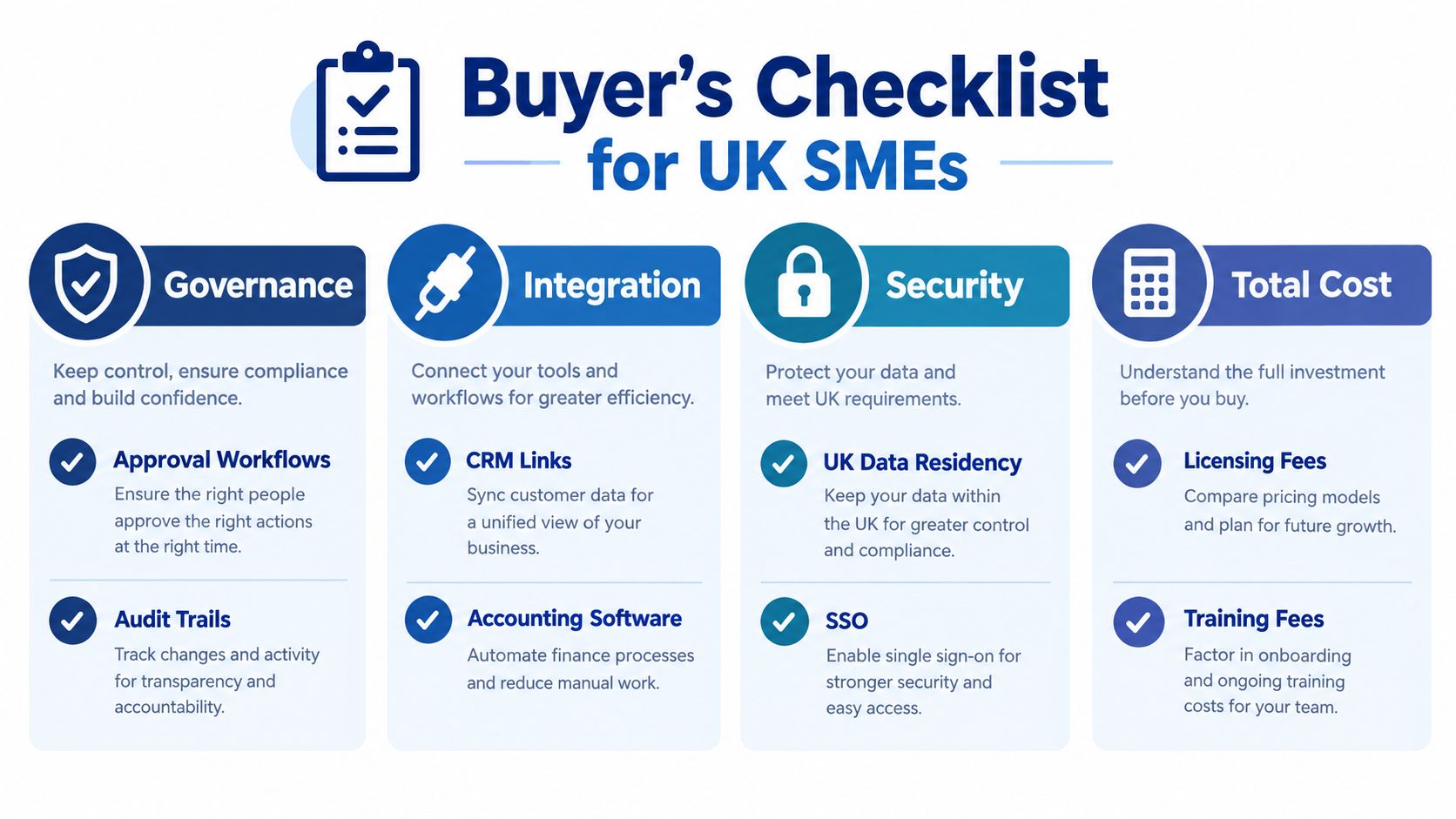
Four areas to test
Governance: Look for approval workflows, audit trails, role permissions and a visible link between drafted text and its source. AI-assisted responses need human control, particularly where they contain contractual commitments.
Integration: Check whether the tool can accept the formats your team already uses and connect with relevant CRM, document or accounting systems. A platform that creates another isolated database may add work rather than remove it.
Security: Confirm data residency, SSO options and user permissions. Small teams still need to control who can view sensitive pricing, customer details and internal policies.
Total cost: Price the subscription alongside implementation, migration and training. A low licence fee can become expensive if someone must spend weeks cleaning shared-drive content and teaching the knowledge base what good evidence looks like.
You should also test portal coverage against the UK. Ask whether the platform monitors Contracts Finder, Find a Tender, Public Contracts Scotland, Sell2Wales, eTendersNI and relevant buyer-specific systems. Confirm whether it exports responses in the formats your clients and internal reviewers expect.
Pricing deserves a fair comparison. A seat-based model may suit a large writing department, while bid-volume pricing may work better for an SME with a small core team and occasional submission peaks. Put every shortlisted tool into the same scoring sheet, including Bidwell's SME bid workflow, so the decision reflects your working pattern rather than the most persuasive product demonstration.
Putting the Three Pillars to Work in Your First Month
A sensible rollout begins with monitoring, not AI drafting. The first month should prove that the platform improves decisions and evidence handling before the team relies on it for live submissions.
Week one
Activate tender monitoring and define filters for Find a Tender, Contracts Finder and any devolved portals relevant to your market. Keep the initial filters narrow enough to be useful, then review the missed and irrelevant notices instead of trying to perfect everything on day one.
Record why each opportunity is accepted, rejected or held for review. That creates the beginning of a qualification process and gives the team something concrete to refine.
Week two
Import previous winning responses, policies, case studies and credentials into the knowledge base. Tag them by buyer, theme and evidence type, then remove material that is obsolete or impossible to verify.
This is the least glamorous part of implementation, but it determines the quality of later drafts. AI can only work safely with content the team has selected and checked.
Week three
Run one live bid through the AI response generation layer. Compare its draft with an existing response, checking tone, factual accuracy, evidence selection and unanswered requirements.
Don't judge the tool by how quickly it produces text. Judge whether a reviewer can identify the source, correct weak sections and improve the answer without starting again.
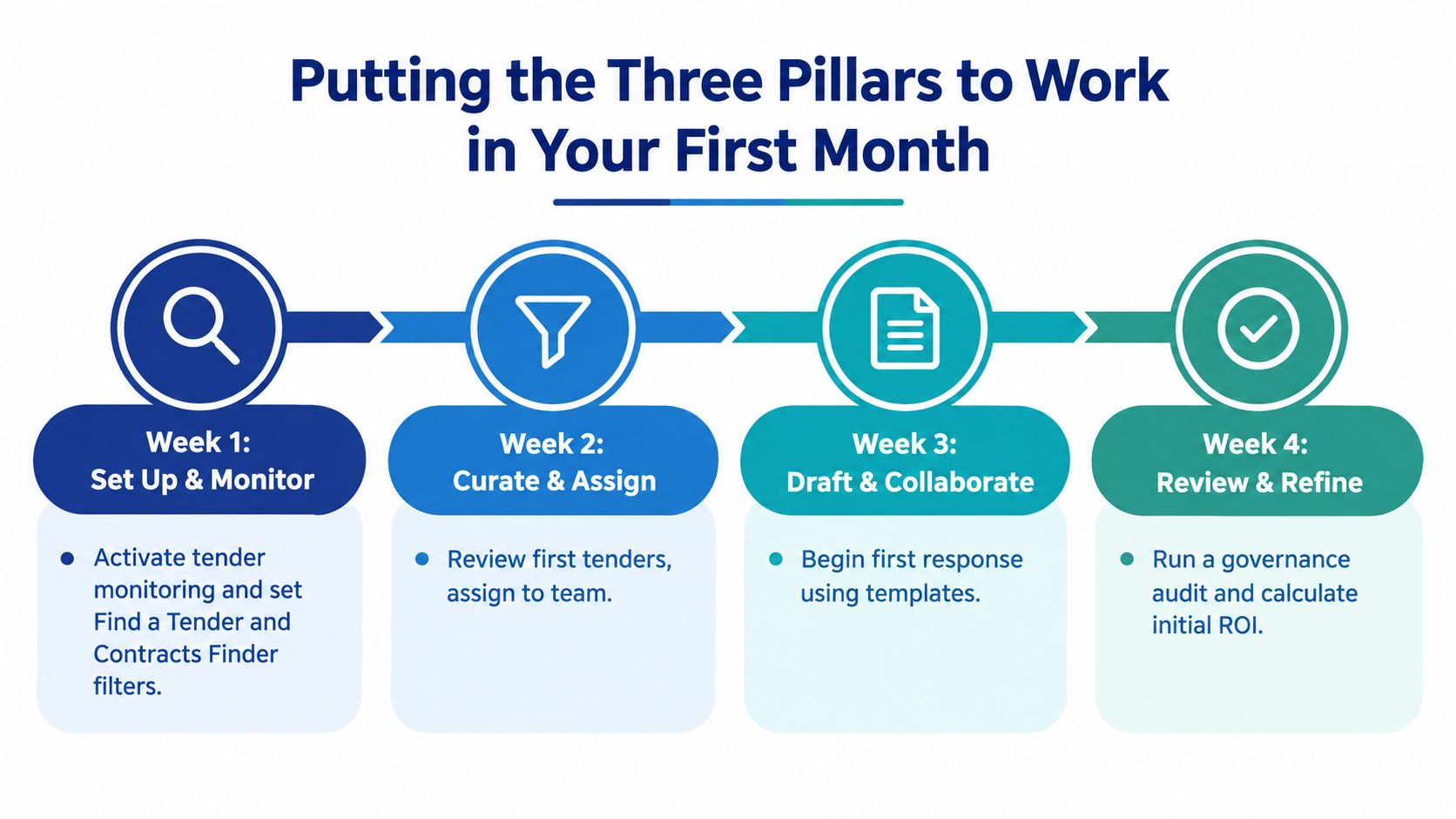
Week four
Review the bid/no-bid decisions made during the month. Compare the time spent searching, qualifying, finding evidence and reviewing drafts with your previous process.
The result you want is not a shorter writing session. You want a cleaner pipeline, fewer unsuitable bids and greater confidence that every submitted answer is supported by approved material.
Before signing, ask a vendor for a sandbox loaded with three of your own previous submissions and a week's worth of live opportunities from your sector. Then assess relevance, evidence traceability, portal coverage and qualification quality. Speed is useful, but relevance tells you whether the software will improve your working week.
Bidwell brings together tender monitoring, a searchable knowledge base and AI-generated tender responses for UK public-sector opportunities. If you want to test whether a decision-first workflow fits your team, visit Bidwell and assess it using your own portals, evidence and bid/no-bid process.