The common starting point is writing. That's the mistake. In UK public procurement, the bigger decision is whether the bid is worth the effort at all, because only one in five SMEs bid for a public-sector contract in the previous three years, and 49% of SMEs with one to nine bids won nothing in that period SME action plan. If you don't qualify the opportunity properly, you end up polishing a response to a contract you were never likely to win.
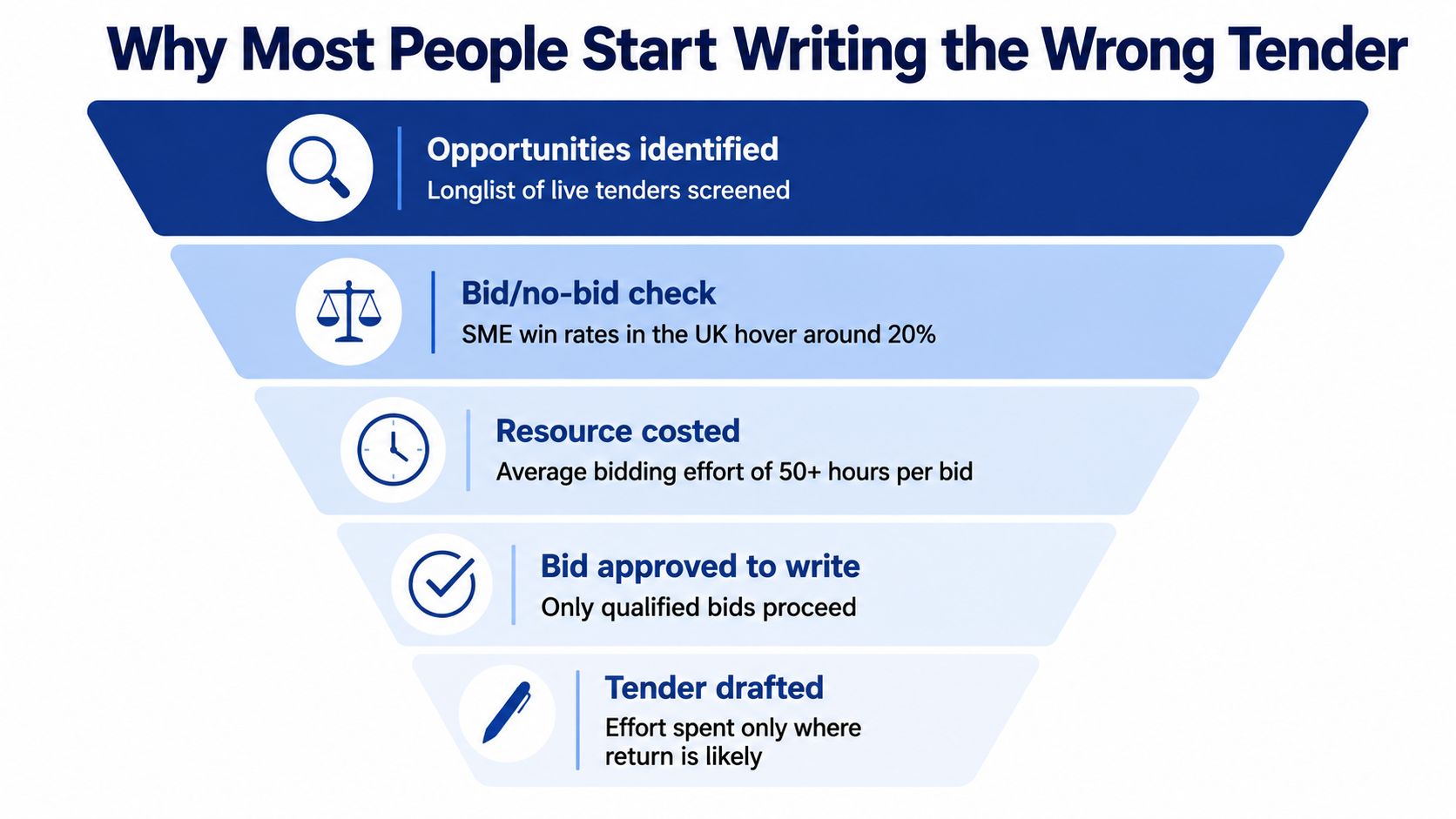
The right place to begin is a live opportunity screen, not a blank document. Bidwell's tender monitoring can help with that first filter, and the same discipline applies whether you're chasing local authority work or a central government contract. For a practical view of how monitored tenders are turned into work, see Bidwell's tender use cases.
Why Bid Teams Start Writing the Wrong Tender
A tender is often treated like a writing test. It isn't. It is an investment decision with a deadline attached.
If the buyer is a poor fit, the route is awkward, or your evidence is thin, walk away. That saves more time than any template ever will. In UK public procurement, SMEs received £45.4 billion in direct spend in 2024, yet they still accounted for only 20% of total reported public-sector procurement spend SME action plan. That gap tells you the competition is real. Bidding on every notice is a weak strategy. Qualifying first is not.
Run the quick bid/no-bid filter
Start with four questions. Can you evidence the core requirement? Can you mobilise on time? Does the opportunity value justify the effort? Can you realistically score against the published criteria?
Practical rule: if you cannot answer those four questions in minutes, not hours, you probably should not bid.
A knowledge base earns its keep here. If your case studies, policies, accreditations, and core company answers already live in one place, Bidwell's tender knowledge base makes qualification faster because you are checking fit against real material instead of memory. AI response generation only comes in after the opportunity has passed the filter.
A lot of teams also waste time on the wrong size of contract. The UK public sector awarded approximately 70,000 contracts in 2023, and the median contract value was £62,672, even though the mean was much higher because a small number of major awards pull the average up public procurement report. Most tenders are focused and specific, so treating each one like a national framework monster is a fast way to waste time.
Reading the ITT Like an Evaluator
Stop scanning the ITT like a supplier. Read it like the person scoring it.
Extract the obligations first
Pull every instruction, requirement, schedule, and scoring note into one working sheet. Separate mandatory items from desirable ones, and mark any pass-fail gates immediately. That sounds admin-heavy, but it prevents the classic failure where someone writes a brilliant answer to the wrong thing.
A sensible reading pass is simple. First, gather the documents. Next, map requirements line by line. Then study the evaluation criteria and note exactly what gets scored. After that, build the compliance matrix so every question has a home, a proof point, and an owner.
The UK Government is explicit about what sinks bids, failure to answer the specific question, incomplete coverage, weak evidence, poor planning, non-compliance, and unattractive pricing government SME bidding guidance. That list is not theoretical. It's a checklist of avoidable mistakes.
Turn the ITT into a response map
Your compliance matrix should show the question, the sub-question, the response section, the evidence source, and the person responsible. If a requirement is unclear or contradictory, flag it before drafting. Don't hope the evaluator will “get what you mean”, they won't.
Raise clarifications early. If a question is ambiguous, you want the buyer's answer before you commit to prose.
Bidwell's AI response generation works best after this stage, not before it. The monitoring function gets the notice in front of you, the knowledge base holds approved evidence, and the response draft can then be built against a map that reflects the published requirements. That keeps the team aligned on the actual scoring structure instead of improvising inside a word processor.
The end result is a single working source of truth. No duplicated effort, no missing declarations, and no guessing which part of the tender matters most.
Building a Storyboard for Every Scored Question
A storyboard is where good intent becomes a usable answer. Without one, writers fill space. With one, they answer the criterion.
What each storyboard needs
Use one storyboard per scored question. Every storyboard should contain the key message, the win theme, the delivery method, the measurable outcome, the supporting evidence, and the exact location of proof. That structure stops people from wandering off into capability statements that sound polished but score badly.
Keep the evidence proportionate. If the buyer wants mobilisation, don't dump in your whole company history. Use the most relevant adjacent-sector example, a pilot, or a named piece of operational experience that shows you can deliver the same outcome. Reusable material from your knowledge base belongs here, but only the parts that directly answer the question.
A useful storyboard is short enough to scan and strict enough to govern the draft. If an answer idea doesn't fit the storyboard, it doesn't belong in the response.
A mobilisation example
For a mobilisation question, your storyboard might say:
- Key message: we can mobilise quickly and control risk.
- Win theme: named owners and a phased start reduce disruption.
- Delivery method: mobilisation plan, handover meetings, training, and weekly checkpoints.
- Evidence: a similar transition, supported by documented milestones.
- Proof location: case study, timetable, and named role profile.
That gives the writer a spine. It also helps the reviewer spot weak claims before they become expensive prose. If the evidence is thin, the storyboard exposes it early.
Bidwell's knowledge base is useful here because it keeps the approved case studies, policies, and credentials in one place. The AI response generation then pulls from that governed material, which is far safer than asking a writer to reconstruct proof from scattered folders.
If the storyboard can't point to proof, the answer is probably bluff.
Drafting Answers an Evaluator Can Actually Score
Good drafting is ruthless. It starts with the answer, not the company brochure.
Before and after
A weak draft sounds like this: “Our experienced team provides a flexible and customer-focused mobilisation service, working closely with stakeholders to ensure a smooth transition and high-quality outcomes.”
That sentence says almost nothing. It's vague, self-congratulatory, and impossible to score cleanly.
A stronger version sounds like this: “We will appoint a mobilisation lead, run the transition plan, and hold weekly checkpoint meetings with the authority. We'll complete handover tasks in line with the agreed timetable, track risks in a live log, and use named service owners to keep responsibility clear.”
The second version scores better because it names responsibility, method, and control. It reads like a response to a question, not a sales pitch.
Make every paragraph earn its place
Lead with the point. Then explain how you'll do it. Then show the evidence. If you can't attach the claim to something real, cut it. Keep your sentences short enough that a tired evaluator can follow them without re-reading.
That matters even more now that the Procurement Act 2023 took effect on 24 February 2025, with public buyers required to consider barriers facing SMEs, and with newer procedures allowing more flexibility through presentations, dialogue, and other interaction beyond a written response Procurement Act guidance. A written answer still needs to stand on its own, but it also needs to survive a live discussion if the route allows one.
If you're working on climate or sustainability answers, use a reference like carbon reduction plan UK guide to understand how evidence is usually structured, then adapt the content to the buyer's wording. Don't copy generic language. Shape it to the question in front of you.
Bidwell's bid writer tools are most useful once the storyboard exists, because then AI response generation can draft in your voice against real evidence instead of spraying generic copy across the page.
Five Failure Points That Kill Tender Scores
Weak bids usually fail in the same five places. That is not a mystery. It is a discipline problem.
The failures and the fixes
| Failure Point | Typical Symptom | Fix at Draft Stage |
|---|---|---|
| Wrong question answered | The response talks about culture when the buyer asked about delivery | Re-read the criterion and rewrite the opening sentence to mirror it |
| Weak evidence | Claims are broad but unsupported | Attach one named example, one document, or one measurable outcome |
| Generic case study | The same example is reused for everything | Match the example to the buyer's sector, risk, or operating model |
| Missing attachments or declarations | The narrative is fine, the bid is rejected anyway | Run a document checklist before edit sign-off |
| Pricing that clashes with the quality story | The response claims premium delivery, then undercuts itself on price | Align pricing with the service model and the promised resource level |
These failures usually travel together. Weak evidence makes the answer sound generic. Generic answers blur your difference. Once that happens, price carries too much of the load, and that is a bad place to be.
In a market where a single contract can matter a lot to a small supplier even if it looks modest on paper, sloppy drafting is expensive. You do not lose because the work was impossible. You lose because the evaluator cannot score what you wrote.
A clean tender also has to reflect the genuine risks the buyer cares about. For cyber-heavy bids, a reference such as assessing your cyber security priorities helps you decide which security points deserve space and which ones should stay out. Leave out the noise. An answer with tight, relevant proof beats a padded one every time.
A quick self-audit before you call it done
Use this cut-down check on every draft:
- Question match: does the first paragraph answer exactly what was asked?
- Proof check: does each claim point to evidence you can upload or name?
- Attachment check: are every mandatory form, policy, and declaration present?
- Price check: does the pricing schedule support the story you told in quality?
- Context check: would this still make sense if the evaluator only skimmed it?
Run that same check before you start writing as well. If a response cannot be supported, scored, and priced in a way that holds together, stop and fix the opportunity fit before you spend more hours on it.
Reviewing and Refining Before Submission
Treat review as three separate passes, not one long edit. Mixing them together is how errors survive.
Pass one, substance
Check each answer against the compliance matrix and storyboard. Confirm every question has been answered, every claim has evidence, and every mandatory requirement is covered. This is the scoring pass, and it should happen before anyone starts obsessing over commas.
Pass two, language and structure
Now tighten the writing. Cut repetition, shorten the bloated paragraphs, and make sure the response still fits the word limits. Fix awkward phrasing, but don't polish away the meaning. If a sentence looks clever and says less, delete it.
Pass three, compliance and submission
Run a final sweep for attachments, pricing schedules, declarations, file names, and portal upload issues. Scottish notices need their own threshold checks, because regulated procurements there begin at £50,000 excluding VAT for goods and services Scottish procurement rules. If you're bidding across regions, that check belongs in the final review, not in someone's memory.
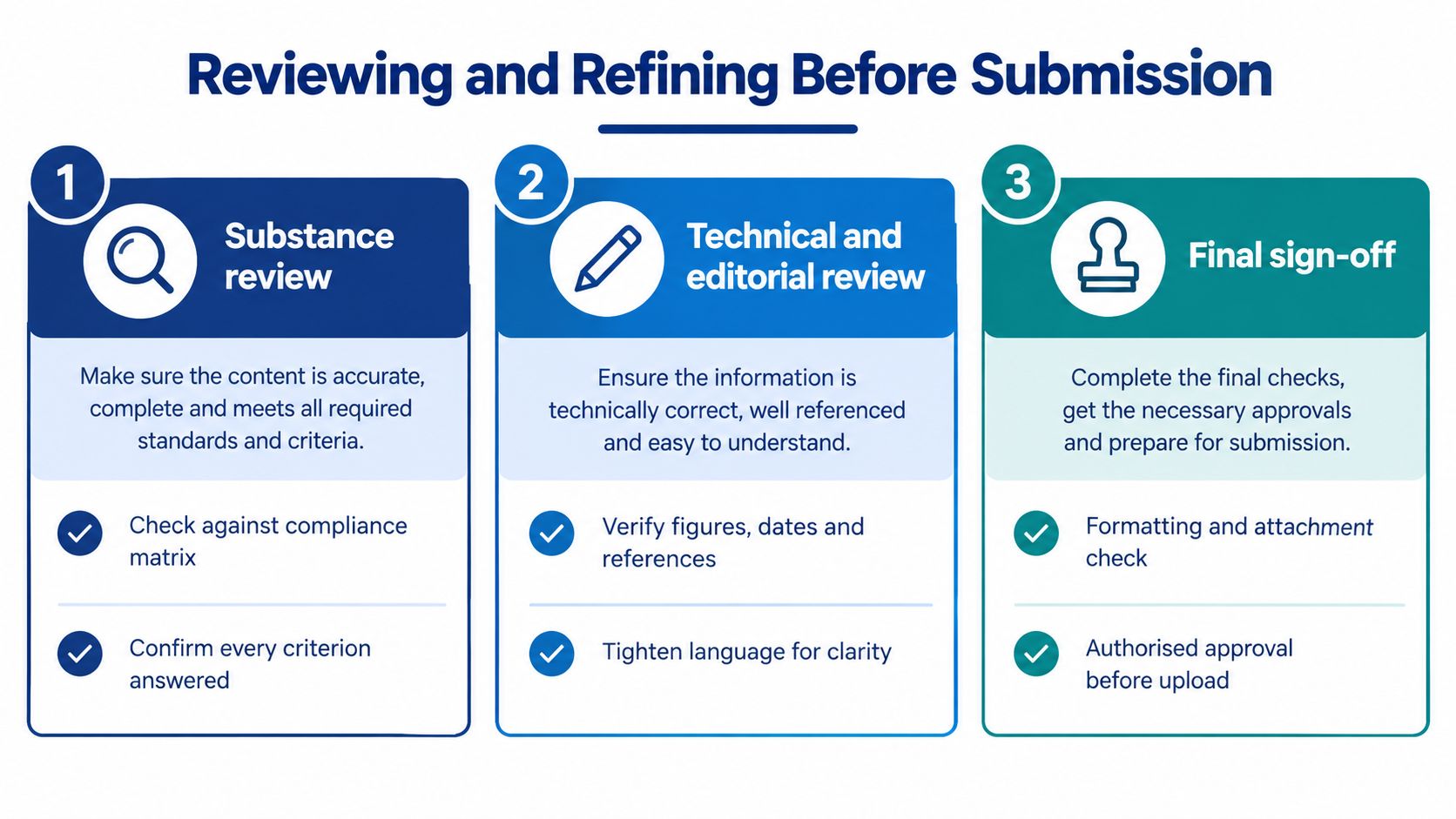
A sensible T-minus-one-day routine is boring, and that's good. Lock the version, test the portal, confirm sign-off, and check the file names against the submission instructions. Bid failures often happen because someone assumed the final upload would take care of itself.
Bidwell's monitoring, knowledge base, and AI response generation all support this stage if they're used properly. Monitoring makes sure the right notice is tracked. The knowledge base gives you approved content. AI response generation turns it into a draft that still needs human checking before upload.
Building a Repeatable Tender Writing Habit
Winning bids don't come from heroic all-nighters. They come from repetition.
Build the 90-day rhythm
For the next quarter, keep a simple cycle. Monitor live opportunities every week, update the knowledge base after each bid, add strong answers to a storyboard library, and review wins and losses after submissions. That's enough to stop every new tender feeling like a fresh start.
The Scottish Government defines an SME supplier as a business with fewer than 250 employees and turnover of no more than £44 million, which is another reason to keep your evidence reusable and your monitoring disciplined Scottish SME definition. If you're smaller, you can't afford to rebuild the same core content every time.
What actually saves time
Tender monitoring saves the most wasted effort. A governed knowledge base saves the most writing time. AI response generation saves the most first-draft time. Everything else is secondary.
If you need help with the opening and summary sections of bids, how to write executive summaries is a useful companion read because the summary is often where the evaluator decides whether your response feels coherent. Keep it sharp, then let the body prove it.
Bidwell's bid writing software fits neatly into that routine because it lets you move from monitored opportunity to controlled draft without rebuilding the same material each time. Use it to store the right evidence, draft against the right question set, and keep the review process tight.
If you're serious about writing tenders that win, stop treating each one like a blank page. Use Bidwell to monitor live opportunities, keep your evidence organised, and draft responses from a governed knowledge base so your team spends time improving bids, not reconstructing them.