You're probably staring at a framework notice, a portal login, and a bid deadline, while wondering if this is a real opportunity or just another box-ticking exercise. That's a fair reaction. A public sector procurement framework can be a smart route into government work, but only if you understand what it is, how the rules work, and where the money moves.
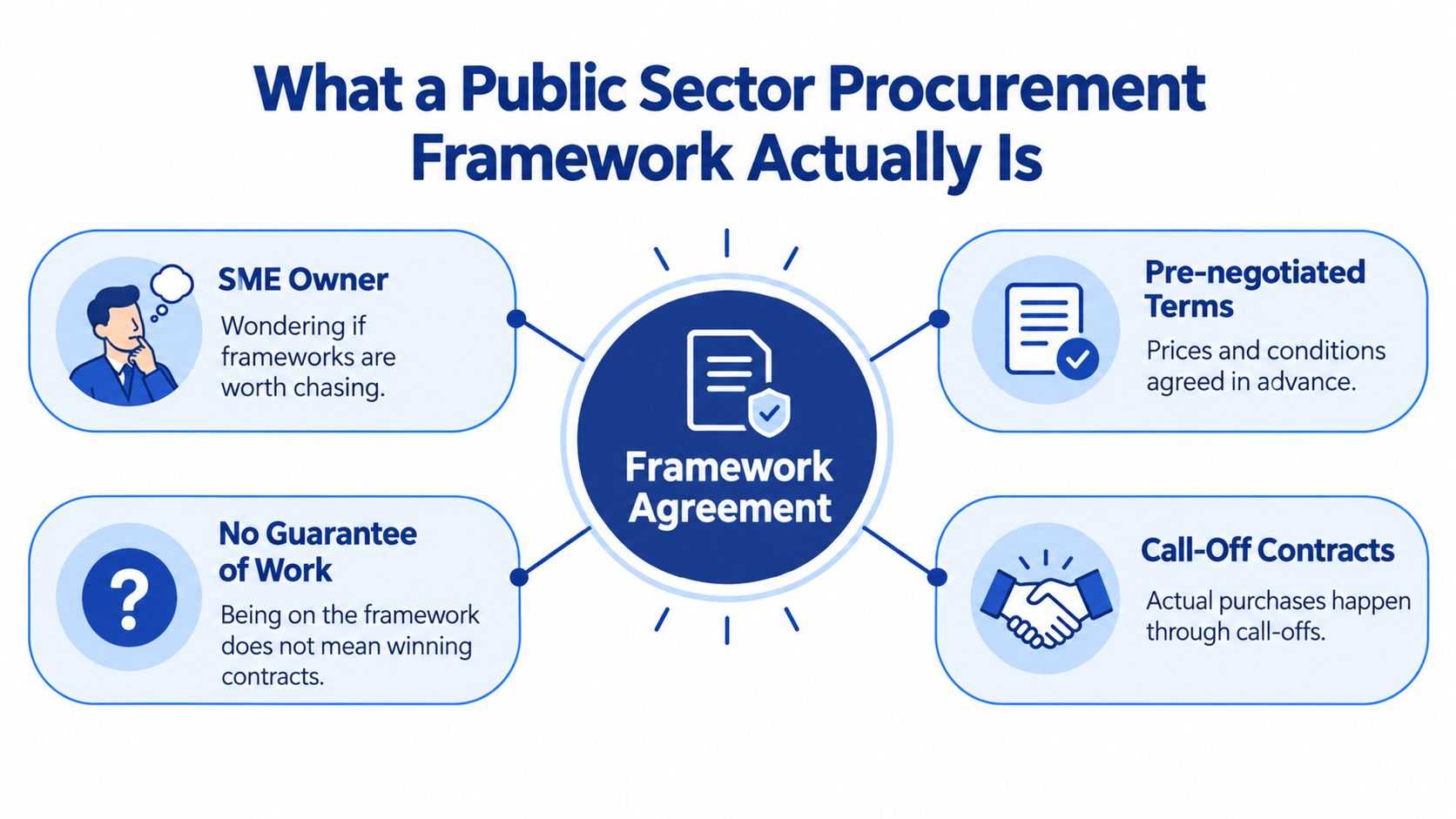
A framework is a contract between a contracting authority and one or more suppliers that sets the terms for later purchases. It's not a purchase order, and it's not a promise of work. Think of it more like being added to a council's shortlist of approved tradespeople. You're in the pool, but you still need the right call-off to land before anyone buys from you.
That distinction matters because the UK public procurement market is huge. UK public procurement reached an estimated £393 billion in 2022-23, and the Crown Commercial Service reported £25 billion through its 238 procurement frameworks in the same year, roughly 20% of the £125 billion common-goods-and-services market (National Audit Office summary). For SMEs, that's a serious route in, but it's also a place where poor qualification wastes time fast. Bidwell's monitoring, knowledge base, and response generation are useful here because the job starts long before the submission.
What a Public Sector Procurement Framework Actually Is
A lot of first-time bidders hear “framework” and assume it means approved supplier, guaranteed work. It doesn't. A framework is a standing agreement that lets public bodies buy later without running a brand-new procurement each time, but only within the rules set in that agreement.
The simple version
The point of a framework is speed and consistency. A buying body can use it to repeat purchases, standardise terms, and avoid starting from scratch for every order. That's why central organisations like the Crown Commercial Service, plus departments, NHS bodies, councils, and devolved administrations, use them so often.
For a supplier, the useful way to think about it is this. You're not winning a contract for work today. You're earning the right to compete, or sometimes to be selected, for future call-offs inside a pre-agreed structure.
Practical rule: if you can't see how a call-off will happen, you don't yet know whether the framework is worth your bid time.
The strategic value is real. The framework route sits inside a procurement market that is big enough to matter for almost any supplier wanting public sector revenue. But the framework itself is just the gateway, not the sale.
Why the language trips people up
The confusion usually comes from the word “approved”. Approved for what, exactly? In framework land, approval means you passed the selection stage and can now be used under the agreement's rules.
That's why the legal detail matters so much. If the framework says work is awarded through mini-competitions, you still need to compete again. If it allows direct award, you still need the authority to follow the exact mechanism set in the framework.
For a quick reference on terminology, Bidwell's guide collection is a useful place to keep your team aligned on definitions, notice types, and what buyers are looking for.
How Frameworks Are Built Under the Procurement Act 2023
A supplier can win a place on a framework and still miss the work. The reason starts with the rules that now sit under the Procurement Act 2023, which received Royal Assent on 26 October 2023 and came into force on 24 February 2025, replacing the Public Contracts Regulations 2015 for new procurements (government guidance). The regime depends on when the procurement started, so the date of the notice matters as much as the date of award.
What must be in the framework
A framework must spell out what it covers. The specification must identify the goods, services, or works in scope, the pricing mechanism, the estimated value, the selection process, the term, the eligible contracting authorities, and whether it is an open framework (framework guidance). That detail is not there for decoration. It tells bidders how the agreement will be used and where the limits sit.
The term limits matter too. Ordinary frameworks can run for up to four years, while defence, security, or utilities frameworks can run for up to eight years (framework guidance). Open frameworks bring extra structural rules, so a supplier should not assume every framework works the same way.
How work comes out of the framework
There are two basic routes. One is competitive call-off, where suppliers compete again under the framework's own rules. The other is direct award, but that only applies where the framework allows it and the statutory conditions are met.
A framework bid is a qualification exercise, not a finished sale. Keep your evidence pack ready to be reused, challenged, and read again, because buyers often return to it when they run the next call-off.
The trap is simple. The Act's ordinary direct-award rules do not let an authority skip the framework's own call-off process. The framework mechanism controls the award route, not a general shortcut around it. Read each notice the way a buyer would read it, not the way an applicant would skim a form.
For suppliers working through central purchasing structures, Bidwell's Crown Commercial Service page is a practical reference point for how those frameworks are organised.
Why Being on a Framework Doesn't Guarantee Revenue
This is the bit many SMEs say and then move past too quickly. Admission does not equal revenue. The numbers show why you should be careful.
Representation and spend are not the same thing
Around 75% of suppliers on Crown Commercial Service commercial agreements were SMEs by April 2025, yet just under 11% of direct spend through those agreements went to SMEs (CCS SME action plan). That gap is the whole story in one line. SMEs are present, but they're not capturing spend in proportion to their representation.
That's why “we're on the framework” is only the first checkpoint. You still need visibility, invitation, and a win. Those are separate stages, and each one can fail for different reasons.
What actually drives the gap
Lot design can make a framework easy or hard to enter. Geographic coverage can help or exclude smaller firms. Minimum capacity requirements can shut out capable SMEs that don't have the scale buyers want on paper. Incumbent advantage also matters, because buyers often fall back on names they already know.
Call-off rules matter too. If the framework leans heavily on mini-competitions, you're competing again and again. If it allows direct award in narrow cases, you need to know exactly when those cases apply.
A framework is an access route, not a revenue guarantee. If you don't understand the call-off mechanics, you're guessing.
The broader point is that frameworks now sit alongside other routes such as Dynamic Markets and related commercial agreements. So the right question isn't, “Should I get on every framework?” It's, “Which agreements create a believable pipeline for my business?”
For many SMEs, that question is where Bidwell's monitoring and AI-assisted drafting help most, because the work starts with reading the route correctly, not writing faster.
The Supplier Journey From Pipeline Notice to Call-Off
A framework bid rarely starts with the tender itself. It usually starts earlier, with a pipeline notice that gives suppliers a chance to decide whether the work is worth pursuing. Under the current rules, a pipeline notice is required for intended procurements valued at £2 million or more, and where an authority expects to spend more than £100 million on contracts in the coming year, it must publish that notice within the first 56 days of that year (government guidance). The notice looks ahead 18 months and is reviewed every six months, or sooner if the buying need changes.
What early monitoring buys you
That early signal matters because it gives you room to decide whether to chase the work at all. You can check fit, line up delivery partners, gather proof, and spot missing accreditations before the tender goes live. If your offer depends on a subcontractor or specialist input, that is the stage for the first conversation.
The central digital platform changes how you watch the market too. Find a Tender now sits inside an enhanced service with one account for organisational information and procurement notices, and the Supplier Information Service sits on the same platform (Procurement Act guidance collection). Saved searches can transfer if the same email address is used, so the admin burden is lower than it used to be, but only if your team keeps the account tidy.
The timing rules that still catch teams out
Once a tender notice is published, suppliers normally have at least 25 days to respond (notices guidance). That can feel comfortable on paper. In practice, it is enough time to read the specification, price the work, gather signatures, and draft scored answers, which is why teams that wait for the tender often feel rushed.
If an authority intends to award directly, it must normally publish a UK5 transparency notice at least 8 days before the award. That gives suppliers a clear window to notice what is happening and decide whether to challenge, seek clarification, or move on.
Bidwell's tender monitoring fits that sequence. It keeps the notices flowing into one queue, so your team reacts at the right stage instead of discovering a deadline after the fact.
Barriers SMEs Still Hit After Policy Reform
The policy language around SME access sounds encouraging, but the practical barriers haven't vanished. Official SME action plans still point to the same friction points, limited awareness of opportunities, vague or overly specific requirements, weak feedback, poor market engagement, disproportionate risk allocation, short bidding timescales, financial thresholds, contract structure, and the time burden of preparing bids.
The numbers show the gap
The Home Office reported £267.8 million of direct SME spend in 2025/26, equal to only 4% of its £6.6 billion procurement spend, against an indicative 8% target for that year and 10% by 2027/28 (DBT SME action plan). That's a clear sign that reform doesn't automatically fix participation.
The useful lesson is to separate the problems you can control from the ones you can't. You can control how well you qualify opportunities, how quickly you reuse evidence, and how disciplined your bid planning is. You can't control a buyer who writes a spec that's too narrow or sets financial tests that don't match the market.
What SMEs can fix themselves
A good knowledge base helps because it stops the same evidence being rebuilt from scratch every time. That's especially useful for policies, certifications, case studies, and standard answers. Bidwell's knowledge base is built for that kind of reuse, which matters when the bottleneck isn't strategy, it's admin.
You can also tighten qualification. If a framework doesn't fit your delivery geography, your team size, or your current capacity, it's probably not a bid, it's a distraction. If the lot structure makes you a stretch candidate, treat that as a warning sign rather than a challenge to “push through”.
What needs buyer-side change
Some barriers only change when buyers write better procurements. Smaller lots help. Clearer specifications help. More realistic risk allocation helps.
Practical rule: if a framework only works when your business overcommits to win it, it probably isn't a healthy fit.
That's the hard truth under the Procurement Act 2023. The rules changed, but the friction is still there.
How to Judge Whether a Framework Is Worth the Bid Cost
A framework bid can absorb a surprising amount of time, so the first job is to stop saying yes too early. If you know your team will spend roughly 20 to 40 hours writing a serious response, each weak fit is expensive even before you factor in lost delivery time.
A quick pre-bid filter
Start with the framework itself. Read the scope, the eligible lots, the permitted contracting authorities, the call-off rules, the pricing mechanism, and whether direct award is allowed. Then check whether the framework is open or restricted, because that changes how easy it is to enter and whether future openings are likely.
After that, test the market reality. Can you name three authorities that buy this kind of thing? Do you have the capacity to serve them without taking on risky stretch work? Does the framework language match evidence you already hold, or would you be inventing an answer under pressure?
If you can't describe the lot clearly, you probably shouldn't bid yet.
The next test is incumbency. If an incumbent is already established, you need a reason the buyer would switch. That reason might be price, coverage, service model, or a narrower lot fit. If none of those are true, the bid cost may be better spent elsewhere.
The decision rule
A framework is worth serious effort when three things line up. You understand the lot, you can see plausible buyers, and your knowledge base already holds most of the proof you'll need. If any one of those is missing, pause before you write.
That's where Bidwell's AI response generation helps, because it turns approved material into a working draft once the opportunity passes your filter. But the filter itself has to come first.
A Weekly Routine for UK Framework Bidding on Bidwell
A decent weekly rhythm beats frantic portal checking every time. Start with tender monitoring across the main UK sources, Find a Tender, Contracts Finder, Public Contracts Scotland, and Sell2Wales, then scan the alerts for pipeline notices, tenders, and award notices. For context on how teams use external monitoring data more broadly, competitive intelligence data sources can be useful reading, especially if you're trying to build a cleaner view of buyer activity.
What the team does each week
The first pass is triage. Sort the alerts by fit, not volume. If the notice doesn't match your sector, geography, or lot profile, leave it alone.
The second pass is evidence management. Keep your policies, accreditations, case studies, CVs, and standard answers in one knowledge base so they're ready when the right framework or call-off appears. Bidwell's bid writing software then uses that approved material to produce a draft in hours rather than weeks.
The third pass is response control. Review the draft, adjust the procurement-specific details, and make sure the call-off route matches the framework rules you've already checked. That keeps the team focused on judgement, not copy-paste work.
A useful reality check sits at the back of all this. Contracts Finder recorded 34,968 awarded contracts in 2025/26, including 12,533 awards to SMEs, a 41.7% increase on 2024/25 (Contracts Finder collection). There's real volume out there, but only if your team is organised enough to see the right opportunities in time.
If you want a cleaner way to track framework opportunities, store your evidence once, and turn approved content into bid drafts faster, visit Bidwell and see how its monitoring, knowledge base, and AI response generation fit around the public sector procurement framework process.